131
International Journal of Pharmaceutical Sciences and Drug Research
2018; 10(3): 131-138
Research Article
CODEN (USA): IJPSPP
ISSN: 0975-248X
The Relationship between Main Polyphenol Components and Free Radical
Scavenging Activity of Selected Medicinal Plants
S. Dagnon
1*, D. Bojilov
1, M. Docheva
2, A. Edreva
31Faculty of Chemistry, Dep. of Organic Chemistry, University of Plovdiv”Paisii Hilendarski”, Plovdiv, Bulgaria 2Tobacco and Tobacco Products Institute, Plovdiv, 4108 Markovo
3Institute of Plant Physiology and Genetics, Bulgarian Academy of Sciences, 1113 Sofia, Bulgaria
Copyright © 2018 S. Dagnon et al. This is an open access article distributed under the terms of the Creative Commons Attribution-NonCommercial-ShareAlike 4.0 International License which allows others to remix, tweak, and build upon the work non-commercially, as long as the author is credited and the new creations are licensed under the identical terms.
ABSTRACT
This study investigates the relationships between the main polyphenols and DPPH radical scavenging activity
(RSA) in extracts from some of the most common wild and cultivated species from the Achillea millefolium group,
Mentha, Chenopodium botrys,Clinopodium vulgare and Artemisia vulgaris. Another aspect of the study is the effects of choosing an extraction solvent, highlighting the importance of selecting an appropriate one for obtaining extracts with maximum manifested bioactivity. Chemical characterization of compounds is performed. It is based on HPLC-PDA fingerprint profiles, obtained from 70% aqueous methanol extracts. Hydroxycinnamic acids, glycosides of luteolin (LG), apigenin (AG), their aglycones and methoxyflavones are found to be the most abundant components, which have the highest impact on radical scavenging activity (RSA) of the extracts. The data allow supposing high correlation relationships between caffeoylquinic acids and RSA of extracts from four
A. millefolium group species and cv. Proa. Cl. vulgare methanol extract, rich in rosmarinic acid, LG and AG,
showed the highest RSA with IC50 10.37μg.mL-1. In contrast, extracts of Ch. botrys which lack phenolic acids,
contain low amount of glycosides and are rich in methoxyflavone aglycones, possess very weak RSA. For multicomponent analysis, our data suggest 70% methanol as the most appropriate solvent for extraction of compounds belonging to the polyphenol complex. Based on the high quantities of rosmarinic acid, luteolin and apigenin glycosides, 66% ethanol solvent is found to be the best choice for medicinal consumption extracts.
Keywords: Polyphenols, HPLC-PDA, extraction, radical scavenging activity.
DOI: 10.25004/IJPSDR.2018.100305 Int. J. Pharm. Sci. Drug Res. 2018; 10(3): 131-138
*Corresponding author: Mr. S. Dagnon
Address: Faculty of Chemistry, Dep. of Organic Chemistry, University of Plovdiv”Paisii Hilendarski”, Plovdiv, Bulgaria E-mail : [email protected]
Relevant conflicts of interest/financial disclosures: The authors declare that the research was conducted in the absence of any commercial or financial relationships that could be construed as a potential conflict of interest.
Received: 02 April, 2018; Revised: 04 May, 2018; Accepted: 10 May, 2018; Published: 25 May, 2018
INTRODUCTION
In the last decade secondary metabolites, occurring in all living organisms while largely distributed in plants
Int. J. Pharm. Sci. Drug Res. May-June, 2018, Vol 10, Issue 3 (131-138) to their indisputable importance in plant stress
physiology. [1] Polyphenols are one of the most widely occurring groups of phytochemicals in plants,
possessing considerable physiological and
morphological importance. As a large group of bioactive chemicals, they have diverse biological functions. The most abundant polyphenols in plants are the phenolic acids and the flavonoids. Their biological, pharmacological, and medicinal properties have already been extensively reviewed. [2] In addition to their free radical scavenging activity, flavonoids and phenolic acids are observed to have multiple biological properties including vasodilatory, anticarcinogenic, anti-inflammatory, antibacterial, immune-stimulating, antiallergic, antiviral, and estrogenic effects, as well as being inhibitors of phospholipase A2, cyclooxygenase, and lipoxygenase. [3-5] Hydroxycinnamic acids are the bioactive compounds in a great number of medicinal plants, coffee and fruits. They are represented mostly by caffeoylquinic and rosmarinic acids, which are ubiquitous, long recognized as powerful antioxidants. The chlorogenic acid family may provide significant health benefits by protecting against the damaging effects of free radicals. Growing evidence indicates that dicaffeoyl derivatives have additive effect to the antioxidant activity of plants from the Asteraceae family. [6-7] Typically, polyphenols help to protect the plant against UV radiation, fungal parasites, herbivores, pathogens and oxidative cell injury. Moreover, the ability of these natural antioxidants to scavenge several oxygen and nitrogen free radicals is another evidence of their health benefits. Polyphenols possess ideal structural chemistry for free radical-scavenging activities, and have been observed to be more effective on a molar basis as in-vitro antioxidants than vitamins E and C. The chemical properties of polyphenols in terms of the availability of phenolic hydrogens as hydrogen donating radical scavengers, suggests their antioxidant activity. [8-9] A number of tests for antioxidant properties are used, with the 2,2-diphenyl-1-picrylhydrazyl (DPPH) and ferric reduction activity potential (FRAP) approaches often being used in parallel. The analysis results demonstrate a high (R ≥ 0.82) and significant (P < 0.0001) correlation with one another. [10] Usually, the relationship between polyphenols and antioxidant activity of extracts is studied on the basis of total polyphenol content and DPPH scavenging activity. [11-12] However, in this case, the exact polyphenol composition responsible for the antioxidant properties of the extracts remains unknown. In the last decade more publications relay on the chromatographic fingerprint profiles of polyphenols, discussing the radical-scavenging activity of medicinal plant extracts. [13-14] The development of fingerprint chromatographic profiles requires additional procedures for optimization of the method conditions, consumables and time. Often, this is overlooked by following a generic method. It is an
absolutely necessity to achieve good separation for obtaining adequate results about the components of the polyphenol complex. This is vital for facilitating the identification and reliable quantification of the components. Recently, the advantages of using the entire chromatographic fingerprint profiles as tools for identification and quality control of herbal extracts and distinction among species has been discussed. [15] For this purpose, in most cases HPLC/PDA method, tailored to the specific plant, has to be developed emphasizing the dissimilarities between the profiles of the different species. [16]
The purpose of the present study is to relate the polyphenol components, their composition and content to the free radical scavenging of extracts. The importance of choosing proper extraction solvent for obtaining extracts with maximum manifested bioactivity is discussed. Chemical characterization of compounds was made on the basis of custom-developed HPLC-PDA fingerprint profiles using 70% aqueous methanol extracts. Furthermore, we aim to stress on the importance of understanding the composition and content of main polyphenols in the plant extracts used for medicinal purposes. This would enable a prediction of their bioactivity to be made and so make their standardization possible.
MATERIALS AND METHODS Plant material
The specimens of Cl. vulgare, A. vulgaris and C. botrys
were collected from natural habitats in the region of Plovdiv, Rodope Mountains between 2011 and 2014 as described by Bojilov et al. [17]
The species belonging to A.millefolium group (A. asplenifolia and A. collina) and the commercially supplied cv. Proa (Pharmasaat, Germany) belonging to the same group were grown and harvested in Sofia region during 2010 as described by Edreva et al. [18] Each species was presented by two populations – A. asplenifolia 9602 and A. asplenifolia 10430, and A. collina
102 and A. collina 3802.
The plants of the three mint species Mentha piperita L., Hayek, Prodr. (Peppery Mint); Mentha citrata Ehrh. (Orange Mint) and Mentha suaveolens Ehrh. (Apple Mint) were cultivated during 2014 in North Bulgaria in the area of Popovo municipality under the observation of Assist. Prof. Koicho Koev from Department of Botany, University of Plovdiv. The seedlings of M. piperita were supplied from the Institute of Roses and Aromatic Plants (IRAP), Kazanlik, Bulgaria. The M. citrata and M. suaveolens seedlings were provided by
Martin Bauer GmbH & Co. KG, 91487
Vestenbergsgreuth, Germany.
The plant material (inflorescences and upper leaves) was dried in a dryer at 40°C. For preparing representative samples the dry material was milled at room temperature and kept in paper bags in the dark. Experimental procedures
Int. J. Pharm. Sci. Drug Res. May-June, 2018, Vol 10, Issue 3 (131-138) Dry powder of the plant samples was weighed (0.2 g).
Five instances of every sample were prepared. The polyphenols were analyzed in their glycoside form (and therefore no hydrolyzed plant extracts were prepared) by extracting the samples with 10 ml 70% (v/v) aqueous methanol in an ultrasound bath for 40 min at room temperature (25°C). The extracts were filtrated under reduced pressure. The volume of the samples was adjusted to 10 ml and passed through a membrane filter 0.45μm prior to HPLC analysis.
HPLC-PDA profiling of polyphenols
The instrumentation used for HPLC analysis consisted of quaternary mixer Smartline Manager 5000, pump Smartline 1000 and PDA 2800 detector (Knauer, Germany). Two columns were used - Kromasil C18, 15 cm × 4.6 mm i.d., 5μm particle size (Supelco, USA) and Purospher C18, 25 cm × 4.6 mm i.d., 5µm particle size (Merck, Darmstadt, Germany). Mobile phase flow rate was set by 1.0 ml min-1; sample volume was 20μl. The polyphenols were monitored at 320 nm, 340 nm, 352 nm and 280 nm.
HPLC conditions for A. millefolium group species and Ch. botrys samples
The chromatographic separation was carried out on Kromasil C18 using 0.1% trifluoroacetic acid (TFA) solution in acetonitrile as solvent B. As solvent A was used а mixture of 90 parts water and 10 parts 0.1% TFA solution in acetonitrile with the following gradient elution program: 0-10 min, 100%-90% A, 10-18 min, 89% A, 18-25 min, 85% A, 25-40 min, 45% A.
HPLC conditions for A. vulgaris sample
The chromatographic separation was carried out on Purospher C18 and the mobile phase composition was A - CH3OH: H2O: CH3COOH=5: 93: 2; B - CH3OH: H2O: CH3COOH= 86: 12:2. The elution followed the gradient profile: 0-15 min, 100% - 80% A; 15-35 min, 45% A; 35-50 min to 0% A.
HPLC conditions for Cl. vulgare and Mentha sp. samples
The chromatographic separation was carried out on Purospher C18 column using 0.1% TFA solution in acetonitrile as solvent B. As solvent A was used a mixture from 90 parts water and 10 parts 0.1% TFA solution in acetonitrile with the following gradient elution program: 0-10 min, 100%-90% A, 10-20 min, 89% A, 20-28 min, 85% A, 28-50 min, 50% A, 50-60 min, 0% A.
Identification and quantification of polyphenols The spectral characteristics of the eluting peaks, scanned with PDA detector (λ=200-400 nm) were compared with those of the authentic standards. The confirmation of the identity of chromatographic peaks was achieved by comparison of retention times and spectra of the peaks in samples with those of standard compounds. Rutin was supplied from Merck, Germany; chlorogenic acid, rosmarinic acid, luteolin, apigenin and hispidulin were purchased from Sigma-Aldrich Chemie GmbH, Buchs, SG, Switzerland.
The identification of compounds was made by summarizing the data for retention times, UV spectra of standards and the peaks in the samples and previously published information.
The calibration curves were prepared from stock solutions of analytical standards (chlorogenic acid, rosmarinic acid, rutin, luteolin, apigenin and hispidulin) at a concentration of 1000 mg.L−1 in methanol by successive dilution until the optimal range of application for each compound. The calibration standards and the samples were injected in duplicate. DPPH analysis
The radical scavenging activity (RSA), expressed as IC50, μg.mL- was determined in methanol extracts by 2,2´-diphenyl- 1-picrylhydrazyl radical (DPPH⋅) as described previously. [19]
Statistical Analysis
Five repetitions of every sample were analyzed. Data are expressed as means ± standard deviation (± SD), n = 5. Microsoft Excel Office Professional Plus 2010 was used to process the statistics.
RESULTS AND DISCUSSION
By studying the pharmacological effects of medicinal plants it is of great importance to obtain extracts containing high amount of bioactive components. In this connection many efforts have been directed to find proper solvent and extraction technique for achieving maximum yields for the main polyphenol components. Recently, it has been shown that the methanol extract and the ethyl acetate fraction from Polygonum minus
had higher antioxidant capacity than aqueous extract. [20] This is due to distinct polyphenol compounds, presented in the different extracts and fractions. It was stated, that the presence and extent of bioactivities of the extracts are influenced greatly by solvents used for extraction.
Extraction of polyphenols
Extraction is the first important step in the process of studying the composition and content of phenolic compounds as well as the radical scavenging activity of plant extracts. The extraction conditions depend on the type of plant and the properties of phenolic compounds - structure, polarity, number of aromatic rings and hydroxyl groups. [21-22] Various solvents are used for extraction of polyphenols from different plant matrices
depending on the type of compounds.
Int. J. Pharm. Sci. Drug Res. May-June, 2018, Vol 10, Issue 3 (131-138) been widely used. [23-24] Even though the new
instrumental techniques increase the extraction efficiency; the data suggests that the major factor, affecting the yield of phenolic compounds is the choice of solvent. For this reason we have undertaken experiments to explore the extraction efficiency of different solvents and their suitability in the HPLC analysis and for obtaining extracts acceptable for medicinal consumption. In Figure 1 are presented the yields of main polyphenols in extracts from Cl. vulgare
obtained using different extraction solvents by application of ultrasound-assisted extraction. The highest yield of polyphenols from Cl. vulgare was achieved by extraction with 70% methanol, 66% ethanol and 80% acetone (Figure 1). The extraction power of 70% methanol is lower than the one of 66% ethanol and 80% acetone, accounting for between 75%-90% from their yields. Despite the lower yield of 70% methanol extract, the data showed higher precision with RSD=4%, compared to RSD=8% and RSD=10% for 66% ethanol and 80% acetone extracts, respectively (Figure 2). This obvious fact makes the extraction with 70% methanol preferable when the solution is used for analytical purposes. Since the detection of polyphenols is in the UV region, the use of acetone for extraction of polyphenols is not a good choice because of its UV absorption up to 300 nm, which influences negatively the chromatographic shape and peak purity. The ability of acetone to extract other compounds from plants than polyphenols, such as pigments, and its UV cutoff are leading to heighten the results. By extraction of polyphenol components, three important factors have to be taken into consideration:
The feature of polyphenol compounds, their structure and trend for inducing molecular dipoles The feature of solvent, its polarity, it is or not
hydrogen donating
The composition of matrix, other components. The goal of multicomponent analysis is striving to obtain data on all components of the polyphenol complex. This can be achieved only by using solvents which extract efficiently all compounds belonging to the three groups of polyphenols: phenolic acids, glycosides and flavonoid aglycones. Obtaining high precision of data is compulsory, thus our results allow us to recommend 70% methanol as the most selective and appropriate solvent for extraction of wide spectrum of compounds belonging to the polyphenol complex (Figure 2). For medicinal consumption 66% ethanol extracts are the best choice, according to the high yield of rosmarinic acid, luteolin and apigenin glycosides. Noteworthy is the safety of the extraction solvent. By UAE extraction with water from Cl. vulgare
at 25°C low yields for the most polar compounds (phenolic acids and glycosides) are observed, as well an absence of the main compound- rosmarinic acid (Figure 1). These results are in accordance with the data obtained previously for the yield of phenolic
compounds using water as extraction solvent. [25] This fact makes water unsuitable solvent for adequate UAE extraction of most polyphenol compounds. The yields of polyphenols strongly depend on the composition of the polar solvent (% organic solvent in the mixture). By increasing the percentage of the organic solvent up to 100%, reduction of yields was observed (Figure 1). Fingerprint chromatographic profiles of polyphenols Developing HPLC-PDA fingerprint chromatographic profiles of polyphenols is a very important task to ensure the adequate identification and quantification of polyphenol components. Besides the routine quantification of components the developed fingerprints could also be used for similarity analysis or for investigation of structure-activity relationships. In terms of studying the correlations relationships of flavonoids from Polygonatum odorantum to the antioxidant activity of selected species, the HPLC fingerprint profiles were used. [26]
For obtaining fingerprint polyphenol profiles of all species investigated in this study, two C18 columns with different mobile phases and multistep gradients were applied. Suppressing the ionization of polar compounds was achieved by using organic acids (HCOOH, TFA, and CH3COOH) in the composition of mobile phases. In all cases, the analysis time, the type of acid and its concentration, and the slope of the gradient were optimized.
*Data are presented as mean area (mAU) of peaks in the result chromatograms. AG-apigenin glycoside, LG-luteolin glycoside, RA-rosmarinic acid
Fig. 1: Yields of apigenin glycoside (AG), luteolin glycoside (LG) and rosmarinic acid (RA) in Cl. vulgare extract obtained with different solvents for UAE.
Int. J. Pharm. Sci. Drug Res. May-June, 2018, Vol 10, Issue 3 (131-138)
Table 1: RSA towards DPPH (as IC50 μg.mL-1) of methanol extracts of wild and cultivated Cl. vulgare, A. vulgaris, M. piperita, M. citrata, M. suaveolens, Ch. botrys and content (mg.g-1DM) of main polyphenol components.
Species DPPH as IC50,
μg.mL-1
Main polyphenols, mg.g-1DM
Sum of
caffeoylquinic acids Rosmarinic acid Sum of luteolin and apigenin glycosides Hispidulin Clinopodium vulgare 10.3 ± 0.6 0.35 ± 0.02 7.42 ± 0.14 4.32 ± 0.38 -
Artemisia vulgaris 30.0 ± 0.8 40.6 ± 0.5 - - -
Mentha piperita 32.2 ± 0.5 0.15 ± 0.01 0.60 ± 0.07 2.19 ± 0.12 - Mentha citrata 12.1 ± 0.8 0.20 ± 0.03 4.22 ± 0.15 7.32 ± 0.42 - Mentha suaveolens 22.8 ± 0.6 0.30 ± 0.03 2.51 ± 0.10 6.98 ± 0.40 -
Chenopodium botrys 260 ± 27 - - - 3.65 ± 0.16
Rosmarinic acid* 3.38 ± 0.10 *Rosmarinic acid was used as a standard
* UAE extraction of 0.2g dry material (inflorescences and upper leaves) with 10ml 70% methanol was performed. ChA-chlorogenic acid, LG-luteolin glycoside, AG-apigenin glycoside, RA-rosmarinic acid, diCQA-dicaffeoylquinic acid, Lut-LG-luteolin, Apg-apigenin
Int. J. Pharm. Sci. Drug Res. May-June, 2018, Vol 10, Issue 3 (131-138) The fingerprint profile was accepted when it contained
maximum good separated peaks of highest number of components of the polyphenol complex. This method allows making a distinction between the different species.
Figure 3 present the fingerprint chromatographic profiles of polyphenols of the studied plants. The polyphenols in wild and cultivated species of A. millefolium group include predominantly mono- and dicaffeoylquinic acids as well as the flavonoids apigenin, luteolin, their glycosides and rutin (Figure 3). Rutin was found only in the two population of A. asplenifolia and was not detected in cv. Proa and in A. collina specimens. Most abundant are the 7- glucosides of apigenin and luteolin, the chlorogenic acid and the 3,5- and 4,5- dicaffeoylquinic acids. In addition, mono- and dicaffeoylquinic acids are found to mainly comprise the polyphenol complex of A.vulgaris (Figure 3). Rosmarinic acid is the main hydroxycinnamic acid in Mentha species and the Cl. vulgare polyphenol complex, which also contain apigenin and luteolin glycosides as well as metoxylated flavonoids (Figure 3). On the contrary, the hydroxycinnamic acids are not manifested in the polyphenol complex of Ch. botrys, which is abundant in methoxyflavone aglycones – hispidulin, nepetin and jaceosidin as shown previously. [17] The high diversity of polyphenol compounds is a prerequisite which determines the different radical scavenging activity of the plant extracts. As stated above, the chemical structure of compounds, the degree of methoxylation and the number of hydroxyl groups, highly influence their radical scavenging activity. [27] The ability of phenolic compounds to scavenge the free DPPH radical is closely related to the number and location of the OH groups. OH groups can easily release hydrogen and bind to free radicals. A small change in the structure of phenolic acids and flavonoids may lead to significant differences in biological activity. [28-29] The structure elements that are associated with the radical scavenging activity of flavonoids are:
orto-dihydroxy group in ring B;
3- and 5-OH groups with a 4-oxo group;
2,3-double bond attached to a 4-oxo group in ring C. [27]
Compounds with three OH groups on the phenyl ring have high radical scavenging activity. It was found that flavanols possess significantly stronger radical scavenging activity than other flavonoids. [30]
Relationships of the main polyphenol components to radical scavenging activity (RSA) of methanol extracts In a large number of research papers, the correlation of total phenolic and flavonoid content to the antioxidant activity of plant extracts is discussed. The findings suggest that total phenolic content could be used as an indicator of antioxidant properties, as a significant linear correlation between its values and antioxidant activity of plant extracts was confirmed. [31-32] In terms
of studying the relationships of polyphenols to RSA of extracts, our attention was directed to those main components; their structure supposes highest radical scavenging activity and which differ most in content.
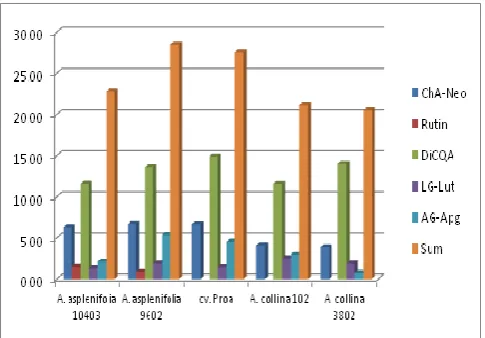
*ChA - Neo (sum of neochlorogenic and chlorogenic acid), DiCQA (sum of 3,5- and 4,5-dicaffeoylquinic acid), LG-Lut (sum of luteolin-7-O-glucoside and luteolin), AG-Apg (sum of apigenin -7-luteolin-7-O-glucoside, apigenin-O-acetyl-glycoside and apigenin).
Fig. 4: Content (mg.g-1DM) of polyphenols in wild speciesof A. millefolium group and cv. Proa.
On Figure 4 is presented the mean content of chlorogenic acids, rutin, luteolin and luteolin-7-O- glucoside, 3,5-and 4,5-dicaffeoylquinic acids, apigenin, apigenin-7-O-glucoside and apigenin-O-acetyl glycoside in the four species belonging to A. millefolium
group and cv. Proa. As it is seen on Figure 4, the major polyphenol components are the caffeoylquinic acids. A. asplenifolia 9608 and cv. Proa are characterized with the highest content of mono-(6.69 mg.g-1 and 6.67 mg.g-1), dicaffeoylquinic acids (13.6 mg.g-1 and 14.9 mg.g-1) and sum of polyphenols (28.49 mg.g-1 and 27.56 mg.g-1), respectively. The data for chlorogenic acid in the species of A. millefolium group follow the same pattern as reported previously. [18] However, they are showing higher values, which suppose higher RSA of the extracts. The reported relationships have shown strong correlations between RSA, total flavonoids (R2=0.97) and chlorogenic acid (R2=0.90) in the species of A.
Int. J. Pharm. Sci. Drug Res. May-June, 2018, Vol 10, Issue 3 (131-138) explored recently by Bardarov et al. [33] RSA of M. citrata
(IC50 12.13μg.mL-1) is close to the radical scavenging activity of Cl. vulgare. The polyphenol complex of M. citrata contains high amounts from the same compounds (4.22 mg.g-1 rosmarinic acid and 7.32 mg.g-1 luteolin and apigenin glycosides) (Table 1). On the contrary, these compounds are in lower amounts in M. piperita (0.60 mg.g-1 rosmarinic acid and 2.19 mg.g-1 luteolin and apigenin glycosides). This fact correlates very well with the lower RSA of M. piperita extract (IC50 32.2μg.mL-1). M. suaveolens shows average amounts of polyphenol components and corresponding radical scavenging activity IC50 22.8μg.mL-1. The relationship between rosmarinic content and RSA of the three
Mentha species correlates in high extend (Table 1). Despite the fact that, containing high amount (40.6 mg.g-1) of caffeoylquinic acids, A. vulgaris’s IC50 is 30.0μg.mL-1 being close to those of M. piperita. The dicaffeoylquinic acids (3,5-dicaffeoylquinic acid and 4,5-dicaffeoylquinic acid) are the predominant compounds in A. vulgaris polyphenol complex (Figure 2). Corresponding to their structure, they are strong radical scavengers. RSA of dicaffeoylquinic acids is less investigated. Most of the data published up to now suggest higher RSA of dicaffeoylquinic acids in comparison to chlorogenic acid. [34-35] Despite of using the same radical (DPPH) for determining the radical scavenging activity, the data differs in great magnitude, probably due to differences in methodology and the way of presentation of results. Data on RSA of isolated 3,5-dicaffeoyl- quinic acid and 1,3-dicaffeoyl- epi-quinic acid from Chrysanthemum morifolium
Ramar showed IC50 5.6 and 5.8μg.mL-1, respectively. [36] By researching the caffeoyl derivatives in wild herbs of the Asteraceae family, the RSA towards DPPH radical of pure chlorogenic acid and the dicaffeoylquinic acids was determined. 3,5- and 4,5-dicaffeoylquinic acid possess higher radical scavenging activity 7.62 and 7.99μmol.L-1, respectively by comparing to chlorogenic acid 13.80μmol.L-1. High contribution of main caffeoyl derivatives to total antioxidant power of the Asteraceae
wild herbs is reported by expressing highly correlative relationships. [6] Nevertheless, it must be assumed that for the different species the correlation relationships extend with limitations, determined by the diversity of matrix composition. The lowest RSA of Ch. botrys
extract (IC50 260μg.mL-1) corresponds to its polyphenol composition, which comprises predominantly of hispidulin and other metoxylated flavonoid aglycones and very low amount quercetin glycosides (Table 1). [17] In summary of all data, it can be assumed that the radical scavenging activity of extracts is greatly dependent on the composition of the polyphenol complex as well as the amount and structure of the compounds. The number and amount of components, which possess high radical scavenging potential, in high extent predetermines the activity of the extracts. It is of great importance to choose the proper solvent
which is able to extract as much as possible of the components from the polyphenol complex with simultaneously high yields and appropriate structure for analysis or medicinal use. The influence of the matrix composition has to be taken into account.
ACKNOWLEDGEMENTS
This work was supported by the Fund of Scientific Research of the Plovdiv University, project ФП17-ХФ-013.
REFERENCES
1. Edreva A, Velikova V, Tsonev T, Dagnon S, Gürel A, Aktaş L, Gesheva E. Stress – protective role of secondary metabolites: diversity of functions and mechanisms. Gen. Appl. Plant Physiology, 2008; 34: 67-78.
2. Pereira DM, Valentão P, Pereira JA, Andrade PB. Phenolics: From Chemistry to Biology. Molecules, 2009; 14: 2202-2211. 3. Seyoum A, Asres K, El-Fiky FK. Structure–radical scavenging
activity relationships of flavonoids. Phytochemistry, 2006; 67: 2058–2070.
4. Heleno S, Martins A, Queiroz M, Ferreira I. Bioactivity of phenolic acids: Metabolites versus parent compounds: A review. Food Chemistry, 2015; 173: 501–513.
5. Ali SI, Gopalakrishnan B, Venkatesalu V. Pharmacognosy, phytochemistry and pharmacological properties of Achillea millefolium L.: A Review. Phytotherapy Research, 2017; 31: 1140–1161.
6. Fraisse D, Felgines C, Texier O, Lamaison Jean-Louis. Caffeoyl derivatives: major antioxidant compounds of some wild herbs of the Asteraceae family. Food and Nutrition Sciences, 2011; 2: 181–192.
7. Gil M, Wianowska D. Chlorogenic acids – their properties, occurrence and analysis. Annales Universitatis Marie Curie-Sklodowska Lublin-Polonica, 2017; LXXII:61–104.
8. Rice-Evans CA, Miller NJ, Paganga G. Structure-antioxidant activity relationships of flavonoids and phenolic acids. Free Radical Biology and Medicine, 1996; 20: 933–956.
9. Rice-Evans CA, Miller NJ, Paganga G. Antioxidant properties of phenolic compounds. Trends in Plant Science, 1997; 2: 152– 159.
10. Clarke G, Ting KN, Wiart C, Fry J. High Correlation of 2,2-diphenyl-1-picrylhydrazyl (DPPH) Radical scavenging, ferric reducing activity potential and total phenolics content indicates redundancy in use of all three assays to screen for antioxidant activity of extracts of plants from the Malaysian rainforest. Antioxidants, 2013; 2: 1–10.
11. Li X, Wu X, Huang L. Correlation between antioxidant activities and phenolic contents of Radix Angelicae Sinensis (Danggui). Molecules, 2009; 14: 5349–5361.
12. Kasangana PB, Haddad PS, Stevanovic T. Study of polyphenol content and antioxidant capacity of Myrianthus arboreus (Cecropiaceae) root bark extracts. Antioxidants, 2015; 4: 410–426.
13. Dias MI, Barros L, Dueñas M, Pereira E, Carvalho AM, Alves RC, Oliveira MB, Santos-Buelga C, Ferreira ICFR. Chemical composition of wild and commercial Achillea millefolium L. and bioactivity of the methanolic extract, infusion and decoction. Food Chemistry, 2013; 141: 4152–4160.
14. Bourgou S, Bettaieb RI, Mkadmini K, Isoda H, Ksouri R, Ksouri WM. LC-ESI-TOF-MS and GC-MS profiling of Artemisia herba-alba and evaluation of its bioactive properties. Food Research International, 2017; 99: 702–712.
Int. J. Pharm. Sci. Drug Res. May-June, 2018, Vol 10, Issue 3 (131-138) 16. Tistaert C, Dejaegher B, Heyden YV. Chromatographic
separation techniques and data handling methods for herbal fingerprints: A review. Analytica Chimica Acta, 2011; 690: 148–161.
17. Bojilov D, Dagnon S, Ivanov I. New insight into the flavonoid composition of Chenopodium botrys. Phytochemistry Letters, 2017; 20: 316-321.
18. Edreva A, Vitkova A, Dagnon S, Konakchiev A, Gesheva E, Bojilov D. Field-cultivated medicinal plants of Achillea millefolium group: a source of bioactive compounds. Genetics and Plant Physiology, 2017; 7: 22–33.
19. Docheva M, Dagnon S, Statkova-Abeghe S. Flavonoid content and radical scavenging potential of extracts prepared from tobacco cultivars and waste. Natural Product Research, 2014; 28: 1328-1334.
20. Christapher PV, Parasuraman S, Raj PV, Saghir SAM, Asmawi MZ, Vikneswaran M. Influence of extracting solvent on pharmacological activity and cytotoxicity of Polygonum minus, a commonly consumed herb in Southeast Asia. Pharmacogn Magazine, 2016; 12: 424–430.
21. Dai J. Mumper R. Plant Phenolics: Extraction, analysis and their antioxidant and anticancer properties. Molecules, 2010; 15: 7313-7352.
22. Khoddami A, Wilkes M, Roberts T. Techniques for analysis of plant phenolic compounds. Molecules, 2013; 18: 2328-2375. 23. Chen Y. Extraction and HPLC characterization of chlorogenic
acid from tobacco residuals. Separation Science and Technology, 2007; 42: 3481-3492.
24. Biesaga M. Influence of extraction methods on stability of flavonoids. Journal of Chromatography A, 2011; 1218: 2505-2512.
25. Yang J, Ou XQ, Zhang X, Zhou ZY, Ma LY. Effect of different solvents on the measurement of phenolics and the antioxidant activity of Mulberry (Morus atropurpurea Roxb.) with accelerated solvent extraction. Journal of Food Science, 2017; 82: 605–612.
26. Zhang Y, Zhang X, Ma Y, Wang J, Yongxiang K, Wang D. Correlation analysis between the high-performance liquid chromatography (HPLC) fingerprint of antioxidants and flavonoids of Polygonatum odorantum. Journal of Medicinal Plants Research, 2013; 7: 1114–1120.
27. Yordi EG, Pérez EM, Matos MJ, Villares EU. Antioxidant and pro-oxidant effects of polyphenolic compounds and structure-activity relationship. Chapter 2, Nutrition, Well-Being and Health, 2012, pp. 24-48.
28. Amić D, Davidovic-Amić D, Bešlo D, Trinajstić N. Structure-radical scavenging activity relationships of flavonoids. Croatica Chemica Acta, 2003; 76: 55–61.
29. Velkov ZA, Kolev MK, Tadjer AV. Modeling and statistical analysis of DPPH scavenging activity of phenolics. Collection of Czechoslovak Chemical Communications, 2007; 72: 1461– 1471.
30. Cai YZ, Mei SJX, Luo Q, Corke H. Structure–radical scavenging activity relationships of phenolic compounds from traditional Chinese medicinal plants. Life Sciences, 2006; 78: 2872–2888.
31. Piluzza G, Bullitta S. Correlations between phenolic content and antioxidant properties in twenty-four plant species of traditional ethnoveterinary use in the Mediterranean area. Pharmaceutical Biology, 2011; 49: 240–247.
32. Fidrianny I, Ayu D, Hartati R. Antioxidant capacities, phenolic, flavonoid and carotenoid content of various polarities extracts from three organs of Sechium edule ( Jacq.) Swartz. Journal of Chemical and Pharmaceutical Research, 2015; 7: 914–920.
33. Bardarov K, Todorova T, Miteva D, Bardarov, V.; Atanassov, A.; Chankova, S. Preliminary screening for study of the chemical composition of Clinopodium vulgare L. water extract. Comptes rendus de l'Académie bulgare des Sciences, 2016; 69: 717-724.
34. Hong S, Joo T, Jhoo Jin-Woo. Antioxidant and anti-inflammatory activities of 3,5-dicaffeoylquinic acid isolated from Ligularia fischeri leaves. Food Sci. Biotechnol, 2015; 24: 257–263.
35. Cho JY, Kim JY, Lee YG, Lee HJ, Shim HJ, Lee JH, Kim SJ, Ham KS, Moon JH. Four new dicaffeoylquinic acid derivatives from Glasswort (Salicornia herbacea L .) and their antioxidant activity. Molecules, 2016; 21: 1097.
36. Kim HJ, Lee YS. Identification of new dicaffeoylquinic acids from Chrysanthemum morifolium and their antioxidant activities. Planta Medica, 2005; 71: 871–876.
HOW TO CITE THIS ARTICLE: Dagnon S, Bojilov D, Docheva M, Edreva A. The Relationship between Main Polyphenol Components and Free Radical Scavenging Activity of Selected Medicinal Plants. Int. J. Pharm. Sci.