Recruiters Selection Strategy and its
Effectiveness: An Analysis of Soft Set
Approaches
Bhabani Sankar Ratha
Department of Computer Science & Application NIIS, Bhubaneswar, Odisha, India.
Kailash Chandra Nayak
Department of Mathematics & StatisticsUSBM, Bhubaneswar, Odisha, India.
Abstract- Recruiters are the opportunity providers for young professionals and given them initial entry into the corporate sector. This become a driving force for new employees to start-up their career and help to achieve long term sustainability and growth of the organization. The recruitment process not only define career development of young masses but also allow them to work in an environment which is best suited as per their qualification, expertise & area of interest to work. To reach long term objectives of organization, recruiter decisions are vital and also force them to map the candidates as per organization guidelines and also use their own intelligence or mental calculator for best suit of the organization. The selected professionals when justify their requirements in the organization, which enhances the recruiter capabilities and encourages in choosing the next slot of candidates in best possible manner. Such decision making capabilities uses certain parameters as per job description and number of candidates going to be selected for the organization. But a well define approach always help the recruiters to bring accuracy in collection of data on different parameters and to take final decision for selection. Sometimes predefined parameters are not sufficient to take accurate decisions and hence allow the recruiters to revise (addition/subtraction) some of the parameters of the existing set to reduce time, cost as well as to select the best professionals. A well define computational analysis helps the recruiters to overcome the said difficulties and use them to implement efficient policies to bring consistency in the selection process. The study discussed in the paper is focused on fuzzy soft set, literature and well define models like Weighted Matrix Approach Selection (WMAS), Pyramid Approach Selection (PAS) and Weighted Ratio Approach of Selection (WRAS) for best selection of candidates.
Keywords – Fuzzy Soft Set, Parameters, Recruiters, Selection, Mental Calculator, Computational Analysis
I.INTRODUCTION
Selection is the process of picking individuals who can most successfully perform the job from the pooled of relevant qualified candidates available for recruitment. To meet this goal, the corporate houses are matched jobs with profile of candidates. The most suitable person is then picked up after eliminating unsuitable candidates through successive stages of selection process. It is also necessary to focus how well an employee is matched to a job because it directly affects the amount and quality of employees work. Any deviation to above can cost a great deal of money, time and trouble in terms of training and operating cost. Sometimes employee may find the job distasteful and leave in frustration and spread negative information about the organization causing harm in the long run. Hence effective selection demands constant monitoring of the fit between person and the job.
During the analysis, different parameters and their values allow decision makers to take right decision at right time from list of best options available. The decision making process involves series of activities to draw final conclusion from listed data available for analysis. A preplanned decision process might not help to conclude an analysis rather it forced to add other parameters in the existing analysis process to derive an effective solution to a specific problem. It is sometimes difficult to draw a conclusion related to vagueness and uncertainty aspects like partial definition, lack of information, having less time to think, etc. Therefore classical mathematics is not very effective in dealing with such problems.
The paper described fuzzy soft set and use different methods to solve decision making problems. The practical aspects used in selection of best candidates from the lists is to make the selection process more comfortable, accepting low cost selection and consuming less time are discussed in the study. Most of the Recruiters would find difficulties in selection of candidates based on certain circumstances due to too many characteristics and involvement of various parameters. It is also difficult to find all sorts of satisfaction in all the required parameters and therefore there is a need to use recruiters own thought process from earlier practical experience for selection of candidates.
II.PROPOSED ALGORITHM
2.1 Preliminaries–
Soft set theory is a generalization of fuzzy set theory that was proposed by Molodtsov in 1999 to deal with uncertainty in a non-parametric manner. A soft set is a parameterized family of sets - intuitively, this is "soft" because the boundary of the set depends on the parameters. Formally, a soft set, over a universal set X and set of parameters E is a pair (f, A) where A is a subset of E, and f is a function from A to the power set of X. For each e in A, the set f(e) is called the value set of e in (f, A).
The basic notion of all soft theory and some useful definition from Maji et al. (2002;2003) are discussed here, where U to be an initial universal set and E to be a set of parameters of A,B С E.
Definition 2.1 (Soft Set)
A pair of (E,f) is called a soft set over if and only if F is a mapping of E into the set of all subsets of the set U. In order words, the soft set is a parameterized family of subsets of the set U. Every set F(e), e є E, from this family may be considered as the set of e-approximate elements of the soft set.
Definition 2.2 (Operation with Soft Sets)
Suppose a binary operation denoted by *, is defined for all subsets of the set U. Let (F, A) and (G, B) be two soft sets over U. Then the operation * for the soft sets is defined in the following way: (F, A) * (G, B) = (H, A x B), where H (α, β) = F (α) * G (β), α є A, β є B and A x B is the Cartesian product of the sets A and B.
Definition 2.3 (NOT Set of a Set of Parameters)
Let E= {e ,e ,e en be a set of parameters. The Not set of E denoted by E and is defined by E={e ,e ,e ..en , where ei =not ei for all i. It may be noted that and are two different operations.
Definition 2.4 (Complement of a Soft Set)
The complement of a soft set (F, A) is denoted by (F, A)c and is defined by (F, A)c =(Fc, A), where Fc: A P(U) is a mapping which is defined by Fc(α) = U-F( α), for all αєA.
Definition 2.5 (Relative Complement of a Soft Set)
The relative complement of a soft set (F, A) denoted by (F, A)r and is defined by (F,A)r=(Fr,A), where Fr:A P(U) is a mapping given by Fr(α)=U-F(α), for all αєA.
Definition 2.6 (NULL Soft Set)
A soft set (F, A) over U is said to be a NULL soft set denoted by ɸ, if for all ɛєA, F(ɛ)=ɸ (null set). Definition 2.7 (Relative NULL Soft Set)
A soft set (F, A) over U is said to be a NULL soft set with respect to parameters set A denoted by ɸ A, if ɛ є A, F(ɛ)=ɸ (null set).
Definition 2.8 (Relative Whole Soft Set)
A soft set (F, A) over U is said to be a relative whole soft set with respect to parameters set A denoted by UA, if for all ɛ є A, F(ɛ)=U.
Definition 2.9 (Absolute Soft Set)
The relative whole soft set U(E) with respect to the universe parameters E is called the absolute soft set over U. Definition 2.10 (AND Operation on Two Soft Sets)
Definition 2.11 (OR Operation on Two Soft Sets)
If (F, A) and (G, B) be two soft set then (F, A) OR (G, B) denoted by (F, A) (G, B) and is defined by (F, A)(G, B)=(O, A x B), where O(α, β) = F(α) , G(β) for all (α, β) ϵ A x B.
2.2 Literature Review:
Firstly, Zadeh in 1965 proposed Fuzzy set theory, which become a very important tool to solve problems and provides an appropriate framework for representing vague concepts by allowing partial membership. Fuzzy set theory has been studied by both mathematicians and computer scientists and may applications of fuzzy set theory have arisen over the years, such as fuzzy control systems, fuzzy automata, fuzzy logic, fuzzy topology etc. Beside this theory, there are also theories of probability, rough set theory, which deal with to solve these problems. Each of these theories has its inherent difficulties as pointed out in 1999 by Molodtsov who introduced the concept of soft set theory which is completely new approach for modeling uncertainty.
The origin of soft set theory could be traced to the work of Pawlak [1982; 1982A] in 1993 titled Hard sets and soft sets [Pawlak, 1994]. His notion of soft sets is a unified view of classical, rough and fuzzy sets. This motivated by Molodtsov in 1999 titled soft set theory; first result, thee in, the basic notions of the theory of soft sets and some of its possible applications were presented.
Maji et al., (2001) presented the combination of fuzzy and soft set theories, fuzzy soft set theory is a more general soft set model which makes descriptions of the objective world more general, realistic, practical and accurate in some cases of decision making. In 2003 again presented soft set theory with some implementation in their work. Roy & Maji (2007) presented a novel method of object recognition from an imprecise multi observer data in decision making problem. Pei & Miao (2005) have discussed the relationship between soft sets and information systems. It is showed that soft sets are a class of special information systems. After soft sets are extended to several classes of general cases, the more general results also show that partition type soft sets and information systems have the same formal structures, and that fuzzy soft set and fuzzy information systems are equivalent. Xiao et al., (2005) in his paper, an appropriate definition and method is establishing the information table based on soft sets theory and at the same time the solutions are proposed corresponding to the different recognition vectors.
In Mushrif et al., (2006) studied the texture classification via Soft Set Theory based in a classification Algorithm. In Aktas & Cagman (2007) have int5roduces the basis properties of soft sets and compare soft sets to the related concepts of fuzzy sets and rough sets. In the same year, Kovkov et al., have presented the stability of sets given by constraints is considered within the context of the theory of soft sets.
Yao et al., (2008) presented the concept of soft fuzzy set and its properties. Xiao et al., (2008) in his paper data analysis approaches of soft sets under incomplete information is calculated by weighted average of all possible choice values of the object and the weight of each possible choice value is decided by the distribution of other objects. In Ali et al.,(2009) gives some new notion such as the restricted intersection, the restricted union, the restricted difference and the extended intersection of two soft sets. Herawan et al.,(2009) proposed an approach for visualizing soft maximal association rules which contains for main steps, including discovering, visualizing maximal supported sets, capturing and finally visualizing the maximal rules under soft set theory.
2.3 Methods of Selection
2.3.1 Weighted Matrix Approach of Selection: Algorithm:
To analyze the best possible solution in Weighted Matrix Approach of Selection (WMAS) algorithm the following steps are to be used.
1. Define population with minimum eligible criteria for selection.
2. Define sequence parameters which are to be analyzed one after another.
3. Assign weightage for each level as per performance of candidates. For example weighted may be considered as >=90%, weightage=1, >=70%, weightage =.7, >=50%, weightage =.5, >=30%,
weightage =.3, <30%, weightage =.1
(The value of weightage may depend upon the researcher and this may same for all level or may vary from level to level.)
4. The next step is to start the selection process and carry all candidates to the next level and keep their weight.
5. The process will continue until all the parameters are successfully verified.
6. Finally add the weights of all parameters and then select the candidates as per their weightage.
In the above algorithm the process of selection is easy but it is time consuming because weights of all candidates are to be considered for next round. Finally totaling of weights of each level for all candidates are calculated and as per available vacancies required numbers of candidates are selected as per ranking of total weights from top to bottom. 2.3.2. Pyramid Approach of Selection:
Algorithm
The following steps are to be followed to analyze the best possible solution in Pyramid Approach of Selection (PAS).
1. Define population with minimum eligible criteria for selection.
2. Define level of priority of each parameter as per maximum importance to less importance criteria of selection in bottom –up manner just like pyramid structure.
3. The next step is to start the selection process and carry those candidates to the next level who have successfully completed in the present round.
4. The process will continue until to reach the top most eligibility criteria of selection.
5. Finally those who are able to reach the top most parameter are the eligible candidates for corporate. The algorithm ensures that the recruiters will use a larger pool of candidates and help to select only those candidates who are beneficial to the organization. This is again not beneficial to the organization because it requires more time to get the needful candidates and sometimes selected candidates are more as compared to available vacancies. 2.3.3 Weighted Ratio Approach of Selection:
Algorithm:
The following steps are to be followed to improvise the existing solution in Weighted Ratio Approach of Selection (WRAS).
1. Define population with minimum eligible criteria for selection.
2. Define level of priority of each parameter as per maximum importance to less importance criteria of selection in bottom –up manner just like pyramid structure.
weightage =.5, >=30%, weightage =.3, <30%, weightage =.1
(The value of weightage may depend upon the researcher and this may same for all level or may vary from level to level.)
4. The next step is to start the selection process and carry those candidates as per ratio to the next level. 5. The process will continue till to reach the top most eligibility criteria of selection by repeating step-3. 6. Finally those who are able to reach the top most parameter their weights are calculated as per parameter
wise and accordingly eligible candidates are selected.
The proposed algorithm bridges the gap in the earlier algorithm (mentioned 4.1) and fulfills the requirement of identifying suitable candidates from a pool. It also overcomes time delay and tries to reduce the mismatch between vacancies and selected candidates available for selection.
III.EXPERIMENT AND RESULT
3.1. Research Design
The proposed study is implemented in an institution for different recruitment drives. Every selection process includes 240 candidates (few candidate information used in selection procedure to justify the practical work) and the population includes same branch students of different reputed institutions. Recruiter wants to select best candidates within the lot who met the eligibility criteria but how many candidates they will select is depend upon the vacancies or some cases they may select more if matching candidates are available in the pool.
The criteria of selection includes ready to work with company profile (RTW-Ready to Work), ready to move outstation as when required (RTM-Ready to Move), good communication skill (GCS - Good Communication Skill), presentable (P) and I/Q to solve the problem (IQ). Basically the company informs the candidates about job profile and told jobs are many but we need those candidates who are ready to work as per need of organization. This is first criteria because its shows who are interested to work for the organization. The second criteria indicates when a candidate is asked to go outstation to sorted out any problem then the candidate will go for that or not because it is a service based organization where customer satisfaction and quality matters. Company also knows communication skill is an important and a key criteria for service based organization but it become third priority due availability of good numbers of well spoken candidates in the organization. The role of selected candidates is to coordinate them to carry out the work. The next step is to identify presentable candidates because such candidates are generally less but if they are available, they will be selected first and also they will support the organization in many ways. At last there is a need to select intelligent candidates because they will effectively implement managerial activities in the organization but company given lowest importance to them due to unavailability of such candidates in larger manner. They will adjust in different level of organization hierarchy or to be worked as manager to control over organizations activities.
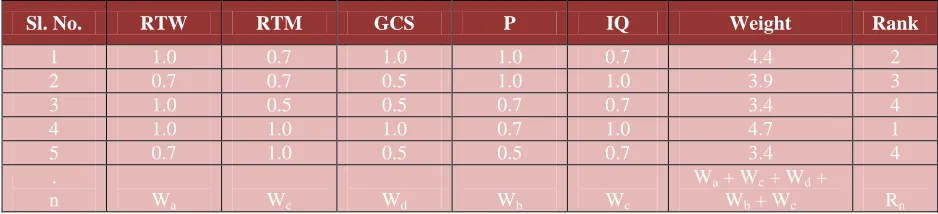
As per algorithm 2.3.1, the following matrix is prepared to know the selected candidates in the pool.
Table 3.1: Weighted Matrix Approach of Selection
Sl. No. RTW RTM GCS P IQ Weight Rank
1 1.0 0.7 1.0 1.0 0.7 4.4 2
2 0.7 0.7 0.5 1.0 1.0 3.9 3
3 1.0 0.5 0.5 0.7 0.7 3.4 4
4 1.0 1.0 1.0 0.7 1.0 4.7 1
5 0.7 1.0 0.5 0.5 0.7 3.4 4
.
n Wa Wc Wd Wb Wc
Wa + Wc + Wd +
Wb + Wc Rn
As per algorithm 2.3.2, a pyramid structure is formed as per performance of the candidates. As the algorithm defines only the selected candidates will move to the next round and others shall be rejected. The table shows pyramid approach of selection in the following table.
1f 1l 1f 0h 1l 0t 0d 1f 0g 1h 1l 0q 1t
0a 1d 0e 1f 1g 1h 0j 1l 0n 0p 1q 1t
1a 0b 0c 1d 1e 1f 1g 1h 0i 1j 0k 1l 0m 1n 0o 1p 1q 0r 0s 1t As per algorithm 2.3.3, a pyramid structure is formed as per performance of the candidates and the ratio that have been finalized for selection. As the algorithm defines the selected candidates will move to the next round as per ratio and their weight and others shall be rejected. The table shows weighted ratio pyramid approach of selection in the following table.
Table 3.3: Weighted Ratio Approach of Selection (Ratio for each Parameter Level – 2/3)
Wt. 4.7 4.2 .5 1.5 1.9 4.1 3.5 4.1 .5 1.5 .5 4.4 4.4 1.5 1.9
L-5 1 1 1 .7 1 1
L-4 1 .5 .7 .5 .7 .7 1
L-3 .7 1 .5 .7 1 1 .7 1 .5
L-2 1 1 .5 .7 .7 1 1 .5 1 .7 .5 .7
L-1 1 .7 .5 1 .7 1 1 .7 .5 1 .5 1 .7 1 .7
Candidate a b c d e f G h i j k l m n O
The above design carries a particular ratio from one parameter to another. According to the weight value of parameter required numbers of candidates are selected to the next level. Sometimes ratio shows less but higher numbers of candidates are selected to the next level due equal weights of candidates. If less candidates are available as per value of ratio then only that number of candidates move to next level. Hence the algorithm is faster and some allow the recruiters to carry maximum candidates for final round that may be back-up candidates. Recruiters may reduce the value of ration to carry more candidates for final selection.
3.2. Result
From the above experiments conducted at different requirement drives the following results have been obtained to draw conclusion regarding best selection process among set of algorithms.
In the first experiments with weighted matrix approach of selection (WMAS), it was found that it is easier to implements for any recruiters. It is suitable for less number of candidates and also allows every candidate to participate at all level of selection parameters. After calculating weights of each parameter, total weight is calculated for all candidates and then ranked them in ascending order. The selected candidates were chosen from top of the list as per ranking. If the recruiter wants to see three candidates in the final round then 4th, 1st and 3rd candidates are chosen for final selection as their ranking is better than others. The difficult part of this algorithm is that all candidates are to be considered for all level of parameters which is a lengthy process.
Similarly, the second experiment used pyramid approach of selection (PAS) where the selected candidates of a level were move to the next level. At the end, those candidates reached the final level were selected by recruiter. In the selection the candidates were selected are f and l. Hence it shows that if more vacancies exist then only those candidates are in the final round are available for selection.
In the third experiment, the weighted ratio approach of selection (WRAS) weights calculated for each candidate at each level of parameter and then a ratio of 2/3 were moved to the next round. Sometimes one or more candidates were moved to the next level due to availability of same weight at a particular level. The process was continued at same ratio to the next level and at the end of final round total weight each finalized candidate is calculated. At last maximum weights were considered for selection. In this method three candidates i.e. a, l and m were selected and also two other candidates are available for waiting list i.e. b and h, where their weights are close to the chosen candidates. This experiment is not only reduce time of selection and create a list of reserve candidates but also suitable to chose required candidates from a large pool.
IV.CONCLUSION
Selection of candidates is not an easy task but the best procedure followed at each level of parameter bringing efficiency in the selection, which might justify recruiters or the agency that they have done the right work to choose the candidates. The algorithms applied in the study not only describe different process of selection but also allow the recruiters to do the selection as per availability of size of candidate pool. It uses qualitative and quantitative data for decision making which encourage the recruiters to carry out their work efficiently. It also ensures that the time spent on the selection is minimized to a large extent by automating the level of selection process. The fuzzy set has done its basic in the selection process and it can be enhanced by implementing additional techniques of fuzzy soft set. Future research can be made to implement expert knowledge system at every level, so that emotional decisions can be avoided as much as possible.
REFERENCES
[1] Molodtsov P.v (1999) soft set theory first result ,computers and mathematics with application vol.37 [2] Ahmad B.and Karal a( 009) “on fuzzy soft sets” advance in fuzzy system .
[3] Majhi P.K, BISWAS R.& Roy A.R ( 00 ) “fuzzy soft sets “ journals of fuzzy MATHEMATICS.
[4] Bora ,Neog & Sut ( 0 ) “some new operations on intuitions fuzzy soft set” international jouranal of soft computing and engg(ijsce).issn:2231-2307.
[5] Atanassov .k.( 986) “intuitionist fuzzy set and system “ 0.87-96
[6] Gua .w.l.& Buehrer .d.j (1993) vague sets.IEEEtrans.system man cabernet 23(2),610-614 [7] Atanassov .k (1994) operator over interval valued intuition fuzzy set and system 64 ,159-174
[8] Yao .y.y (1998).relational interpretation of neighborhood operators and rough set operator .111(1-4) 239-259 [9] Pawalak .z.(1982) rough set international journal of information science 11 341-356
[10] Cagman N,enginoglu s. and CITAK F ( 0 ) “ Fuzzy soft set theory and it its application “ Iranian journal of fuzzy &system vol-8,n-3 [11] Thielle,(1999), On the concepts of qualitative fuzzy sets, IEEE International Symposium on Multiple valued Logic, 20-22,
[12] Molodtsov .D.(1999), Soft set theory-first results, Computers Math. Applic 37 (4/5)19-31
[13] Yao.H.Y.Y.(1998), Relational interpretations of neighborhood operators and rough set approximation operators, Information Sciences 111 (1-4), 239-259
[14] Gorzalzany.M.B,(1987) A method of inference in approximate reasoning based on interval-valued fuzzy sets, Fuzzy Sets and Systems 21, 1-17
[15] Atanassov.k, (1986). Intuitionist fuzzy sets. Fuzzy Sets and Systems 20. 87-96
[16] Pawlak.Z (1982), Rough sets, International Journal of Information and Computer Sciences 11, 341-356. Zadeh, L.A, (1965) Fuzzy Sets, In/or, and Controls. 338-353.
[17] _23_ W. Xu, J. Ma, S. Wang, and G. Hao, “Vague soft sets and their properties,” Computers & Mathematics with Applications, vol. 59, no. 2, pp. 787–794, 2010.
[18] X. Yang, T. Y. Lin, J. Yang, Y. Li, and D. Yu, “Combination of interval-valued fuzzy set and soft set,”Computers & Mathematics with Applications, vol. 58, no. 3, pp. 521–527, 2009.
[19] F. Feng, C. Li, B. Davvaz, andM. I. Ali, “Soft sets combined with fuzzy sets and rough sets: a tentativeapproach,” Soft Computing, vol. 14, no. 9, pp. 899–911, 2010.
[20] S. Bhattacharya and B. Davvaz, “Some more results on IF soft rough approximation space,” International Journal of Combinatorics, Article ID 893061, 10 pages, 2011.
[21] P. K. Maji, R. Biswas, and A. R. Roy, “Intuitionistic fuzzy soft sets,” Journal of Fuzzy Mathematics, vol. 9, no. , pp. 677–692, 2001. [22] P. K. Maji, A. R. Roy, and R. Biswas, “On intuitionistic fuzzy soft sets,” Journal of Fuzzy Mathematics, vol. , no. , pp. 669–683, 2004. [23] K. T. Atanassov, “Intuitionistic fuzzy sets,” Fuzzy Sets and Systems, vol. 0, no. , pp. 87–96, 1986.
[24] Y. Jiang, Y. Tang, Q. Chen, H. Liu, and J. Tang, “Interval-valued intuitionistic fuzzy soft sets and their properties,” Computers & Mathematics with Applications, vol. 60, no. 3, pp. 906–918, 2010.
[25] A. Aygunoglu and H. Aygun, “Introduction to fuzzy soft groups,” Computers & Mathematics with Applications, vol. 58, no. 6, pp. 79– 1286, 2009.
[26] J. M. Mendel, Uncertain Rule-Based Fuzzy Logic Systems: Introduction and New Directions, Prentice-Hall, Upper-Saddle River, NJ, USA, 2001.
[27] L. A. Zadeh, “The concept of a linguistic variable and its application to approximate reasoning. I,” Information Sciences, vol. 8, pp. 99– 249, 1975.
[28] N. N. Karnik and J. M. Mendel, “Applications of type- fuzzy logic systems to forecasting of timeseries,” Information Sciences, vol. 0, no. 1, pp. 89–111, 1999.
[29] N. N. Karnik and J. M. Mendel, “Operations on type- fuzzy sets,” Fuzzy Sets and Systems, vol. 122, no. 2, pp. 327–348, 2001.
[30] J. M. Mendel, R. I. John, and F. Liu, “Interval type- fuzzy logic systems made simple,” IEEE Transactions on Fuzzy Systems, vol. , pp. 327–348, 2001.
[31] H. B. Mitchell, “Pattern recognition using type-II fuzzy sets,” Information Sciences, vol. 170, no. 2–4, pp. 409–418, 2005.
[33] H. Wu, Y. Wu, and J. Luo, “An interval type-2 fuzzy rough set model for attribute reduction,” IEEE Transactions on Fuzzy Systems, vol. 17, no. 2, pp. 301–315, 2009.
[34] J. Zeng and Z. Q. Liu, “Type- fuzzy hidden Markov models and their application to speech recognition,” IEEE Transactions on Fuzzy Systems, vol. 14, no. 3, pp. 454–467, 2006.
[35] F. Liu, “An efficient centroid type-reduction strategy for general type- fuzzy logic system,” Information Sciences, vol. 78, no. 9, pp. 2224–2236, 2008.
[36] J. M. Mendel, F. Liu, and D. Zhai, “α-Plane representation for type- fuzzy sets: theory and applications,” IEEE Transactions on Fuzzy Systems, vol. 17, no. 5, pp. 1189–1207, 2009.
[37] J. M. Mendel and D. R. Wu, Perceptual Computing: Aiding People in Making Subjective Judgments, Wiley and IEEE Press, 2010. [38] A. R. Roy and P. K. Maji, “A fuzzy soft set theoretic approach to decision making problems,” Journal of Computational and Applied