3
EMI/EMC group, LRDE, Bangalore, India
Abstract— System-Level electrostatic discharge (ESD) has become increasingly demanding with silicon technology scaling towards lower voltages and the need for designing cost-effective and ultra-low power components. Indirect ESD test and direct air discharge test has been conducted on theMSP-EXP430G2 Launch Pad Development Board which has the state-of-the-art protection for system level ESD. The recognized industry-wide standard IEC61000-4-2 for end-product ESD rating is used. The primary purpose of this test is to determine the immunity of systems to external ESD events during operation. We have observed all the IEC specified system-level failure criteria classifications during the conduction of the ESD test.
Keywords— System level ESD, IEC standard, MSP430 launch pad, 16 bit microcontroller, Indirect discharge
I.
INTRODUCTION
The MSP-EXP430G2 low-cost experimental board called LaunchPad is a complete development solution of the Texas Instruments MSP430G2xx series. Its integrated USB-based emulator offers all the hardware and software necessary to develop applications for all MSP430G2xx series devices. The LaunchPad has an integrated DIP target socket that supports up to 20 pins, allowing MSP430 Value Line devices to be dropped into the LaunchPad board [1]. The MSP-EXP430G2 uses the IAR Embedded Workbench Integrated Development Environment (IDE) or Code Composer Studio (CCS) to write, download and debug an application [2].
The impact of increasing MCU (microcontroller unit) sensitivity and low-cost application design is being felt in all markets: consumer, industrial, automotive, etc. While there are significant differences in the design and use of products for these markets, the susceptibilities induced in all microcontroller-based applications are essentially the same. Typical susceptibilities include unexpected state changes on input pins (reset, interrupt request, or general purpose inputs), corruption of on-chip clock signals, or even damage to the silicon [3-5].
Low-cost microcontroller-based embedded applications are particularly sensitive to performance degradation during electrostatic discharge (ESD) or electrically fast transient (EFT) events. This sensitivity to fast transients is to be expected, even for those microcontrollers running at relatively low clock frequencies, due to the process technologies used to fabricate the chips. Modern microcontrollers are implemented with technologies using nanometer range transistor gate lengths. These gate lengths are capable of generating and responding to signals with a rise time in the sub nanosecond range [6]. Integrated circuits (ICs) based on submicron process technologies are capable of responding to fast transients injected onto its pins. Controlling ESD/EFT events at the IC level is particularly important for microcontrollers, since these ICs are used in very cost sensitive safety-critical applications, where it may not be practical to solve ESD/EFT [7, 8] problems at the board level and where IC failures can have much more significant consequences.
The susceptibility of the 16-bit microcontroller MSP430 LaunchPad to electrostatic discharge was tested by conducting indirect discharge at horizontal coupling plane (HCP) and vertical coupling plane (VCP) for different distances and discharge voltages. Also direct air discharge has been conducted on the general purpose input output (GPIO) pins. When testing a system to the system-level standards, the end-products are required to remain functional in the presence of or following an ESD event [9].
II.
MSP-EXP430G2
LAUNCHPAD
FEATURES
Ultra low power 16 bit Microcontroller unit
USB debugging and programming interface featuring a driverless installation and application UART serial communication with up to 9600 Baud
Supports all MSP430G2xx and MSP430F20xx devices in PDIP14 or PDIP20 packages
Two general-purpose digital I/O pins connected to green and red LEDs for visual feedback and a power LED
Two push button for user feedback and device reset
Easily accessible device pins for debugging purposes or as socket for adding customized extension boards
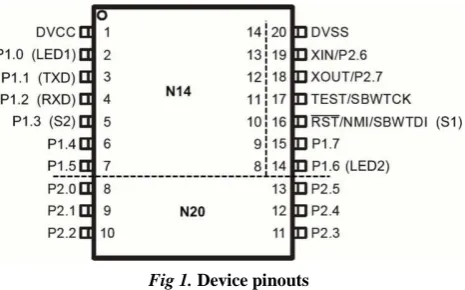
Fig 1. Device pinouts
Jumper connection between emulator and target device
1. TEST - Test mode for JTAG pins / Spy-Bi-Wire test clock input during programming and test 2. RST - Reset / Spy-Bi-Wire test data input/output during programming and test
3. RXD - UART receive data input 4. TXD - UART transmit data output
5. VCC - Target socket power supply voltage (power consumption test jumper)
III.
PROGRAMMING
EXAMPLE
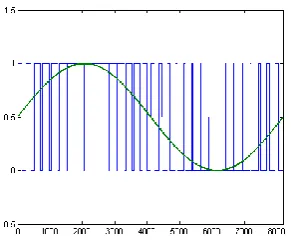
The code used for testing the working of LaunchPad MSP-EXP430G2 shown in Fig. 2 is the code for generating a pulse width modulation (PWM) wave. The output is filtered out using a band pass filter (BPF) as shown in the Fig. 3. The PWM wave is converted to a sine wave. The output of the LaunchPad and the band pass filter is shown in the Fig. 4.
Fig. 2 MSP-EXP430G2 LaunchPad overview
Fig. 4 The output of LaunchPad and band pass filter
IV.
EFFECTS
OF
ESD
When testing a system to the system-level standards, the end-products are required to remain functional in the presence of or following an ESD event. The IEC specified system-level failure criteria classifications are as follows [10]:
Normal performance within limits specified by the manufacturer.
Temporary loss of function or degradation of performance that ceases after the disturbance ceases. Equipment under test recovers its normal performance without operator intervention.
Temporary loss of function or degradation of performance. Recovery requires operator intervention.
Temporary loss of function or degradation of performance which is not recoverable, caused by damage to hardware or software, or loss of data.
V.
INDIRECT
DISCHARGE
AT
HORIZONTAL
COUPLING
PLANE
(HCP)
AND
VERTICAL
COUPLING
PLANE
(VCP)
For an indirect discharge of 4kV at a distance of 0.3m on the HCP, the PWM waveform from the LaunchPad is unaffected but there is a transient of 8V in the sine wave output of the discrete circuit which is the band pass filter as shown in Fig. 5. When a pulse is discharged at a voltage of 8kV at a distance of 0.3m on the HCP, the PWM waveform from the LaunchPad is unaffected but there is a transient of 8V in the sine wave output of the discrete BPF circuit as shown in Fig. 6. For an indirect discharge of 15kV at a distance of 0.3m on the HCP, the PWM waveform from the LaunchPad is unaffected but there is again a transient of 8V in the sine wave output of the discrete BPF circuit as shown in Fig. 7.
When a pulse is discharged at a voltage of 4kV in the top left corner of the VCP, the PWM waveform from the LaunchPad is unaffected but there is a large double transient in the sine wave output of the discrete circuit as shown in Fig. 8. When a pulse is discharged at a voltage of 15kV in the top right corner of the VCP, the PWM waveform from the LaunchPad is unaffected and the sine wave output of the discrete BPF circuit has transients as shown in Fig. 9
VI.
DIRECT
AIR
DISCHARGE
TO
THE
GPIO
PINS
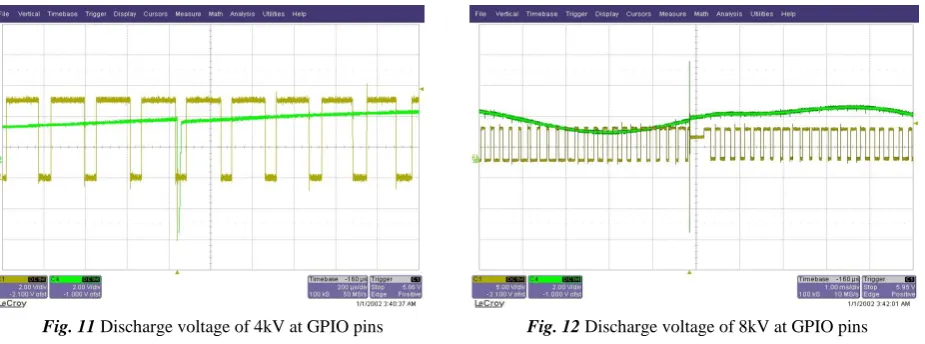
For an air discharge of 2kV, the PWM waveform from the LaunchPad has a dip in the voltage losing its modulated pulse width characteristic for around 0.2ms whereas there is a large transient in the sine wave and also a change in the sine waveform as shown in Fig. 10. For an air discharge of 4kV, the PWM waveform from the LaunchPad goes to zero at the point of occurrence of the trigger whereas the sine wave output of the discrete BPF circuit gradually decreases to zero as shown in Fig. 11. For an air discharge of 8kV, the PWM waveform from the LaunchPad goes to zero at the point of occurrence of the trigger whereas the sine wave output of the discrete BPF circuit decreases to an intermediate value as shown in Fig. 12. All these waveforms come back to their original shape on hard RESET (power ON).
Fig. 7 Discharge Voltage of 15kV at a distance 0.3m. Fig. 8 Discharge of 4kV on the VCP
3. Temporary loss of function or degradation of performance which is not recoverable, caused by damage to hardware or software, or loss of data or Permanent degradation
For direct air discharge of 4kV and 8kV, the PWM waveform from the LaunchPad goes to zero at the point of occurrence of the trigger whereas the sine wave output of the discrete BPF circuit decreases to an intermediate value. On hard reset the output of the launchpad is restored but the opamp ICs in the bandpass filter are spoilt.
The launchPad is quite immune to ESD owing to its careful design and ESD considerations, therefore the device soft or hard resets in majority of the ESD stress it is subjected to.
REFERENCES
[1]. MSP430 - Texas Instruments Embedded Processors Wiki processors.wiki.ti.com/index.php/MSP430 [2]. MSP430 Microcontroller | 16 bit Microcontroller ... - Texas Instruments www.ti.com/msp430
[3]. R. Carlton, G. Racino and J. Suchyta, “Improving the transient immunity performance of microcontroller-based applications,” Freescale Semiconductor Inc. application note AN2764.
[4]. S. B. Dhia, M. Ramdani and E. Sicard, “Electromagetic Compatibility of Integrated Circuits”, Springer 2006. [5]. E. Lamoureux, A. Boyer, S. Dhia and E. Sicard, “Investigations on conducted agrresion insider a digital integrated
circuit”, 5th International EMC Compo 05 (EMC Compo 2005) Munich, Allemagne (November2005)
[6]. Beetner Daryl G., Carlton Ross, Han Lijun, Koo Ja Yong, Pommerenke David, “Experimental investigation of the ESD sensitivity of an 8-bit microcontroller”, Institute of Electrical and Electronics Engineers IEEE, 2007. [7]. International Electro-technical Commision, “IEC 61000-4-2, Testing and Measurement Techniques – Section 2:
Electrostatic Discharge Immunity Test,” IEC standard, 2002, www.ied.ch.
[8]. International Electro-technical Commision, “IEC 61000-4-4, Testing and Measurement Techniques – section 4: Electrical Fast Transient/Burst Immunity Test,” IEC standard, 2002, www.ied.ch.
[9]. System-Level ESD/EMI Protection Guide, Texas Instruments 2010, www.ti.com/esd