DEVELOPMENT OF A COURSE ASSESSMENT PROTOTYPE REAL ANALYSIS THROUGH
RMT (RIGOROUS MATHEMATICAL THINKING) APPROACH BASED ON GENDER
Iyay Robia Khaerudin
Faculty of Teaching Training and Education Universitas Swadaya Gunung Jati, Indonesia
A R T I C L E I N F O
INTRODUCTION
Assessment instruments development is one of the efforts to improve academic quality and subject learning achievement (in this case students). Before the assessment instrument is implemented, an analysis of the subject's learning needs and situations is carried out first. Then, it is so tested for its validity, practicality and effectiveness that produces an assessment product that can be useful for lecturers and subjects. The problems now is the assessment instruments in an educational institution are not optimally developed. So far, almost all assessments of lectures are only centered on the results of midterm (UTS), final examinations (UAS), and structural and independent assignments. However, t personal assessment indicators are not so well cared that lecturers are not able to assess objectively. This is in line with the opinion (James Beyers, 2011) which says that educators should make a structured and personal assessment system for students that starts from the maturity process in thinking mathematically so that it will look more just and wise. In addition, Muhammad.
International Journal of Current Advanced Research
ISSN: O: 2319-6475, ISSN: P: 2319-6505,
Available Online at www.journalijcar.org
Volume 8; Issue 12 (A); December 2019
DOI: http://dx.doi.org/10.24327/ijcar.2019
Copyright©2019 Iyay Robia Khaerudin and Herri Sulaiman
License, which permits unrestricted use, distribution, and reproduction in any medium, provided the original work is properly Article History:
Received 6th September, 2019 Received in revised form 15th October, 2019
Accepted 12th November, 2019 Published online 28th December, 2019
Key words:
Course Assessment, Gender, Real Analysis, RMT, Prototype.
*Corresponding author: Iyay Robia Khaerudin Faculty of Teaching Training and Education Universitas Swadaya Gunung Jati, Indonesia
DEVELOPMENT OF A COURSE ASSESSMENT PROTOTYPE REAL ANALYSIS THROUGH
RMT (RIGOROUS MATHEMATICAL THINKING) APPROACH BASED ON GENDER
Iyay Robia Khaerudin and Herri Sulaiman
Faculty of Teaching Training and Education Universitas Swadaya Gunung Jati, Indonesia
A B S T R A C T
This study uses Research and Development (RnD) method with the aim of looking at assessment sheet that has existed so far, developing a prototype assessment of the Real Analysis subject, and testing its validity, reliability and effectiveness. Development of assessment prototypes refers to the Borg and Gall model
consists of RMT ability test and a Real Analysis course assessment instrument designed to measure the subject cognitive domain with the RMT approach, and adjusted to the style of thinking according to gender. The technique of collecting data is by
material in the real function line, followed by documentation, observation, interviews, and questionnaires. The initial product data analysis is validated by experts to obtain content validity. Furthermore, the instrument is tested on a limited basis to subjects who contracted 15 Real Analysis courses. The results of the trial assessment instrument with the RMT approach are measured by the product moment formula, while the reliability test uses alpha formula. The difficulty level of the test questions for the ability of the RMT and the distinguishing power are also measured. In the assessment instrument with the RMT approach adjusted to the subject's thinking style based on gender, the validity and reliability are measured. The results show that the Real Analysis course assessment instrument through a gender-based RMT approach that has been developed is valid, reliable, practical and effective.
Assessment instruments development is one of the efforts to improve academic quality and subject learning achievement (in this case students). Before the assessment instrument is analysis of the subject's learning needs and situations is carried out first. Then, it is so tested for its validity, practicality and effectiveness that produces an assessment product that can be useful for lecturers and assessment instruments in an educational institution are not optimally developed. So far, almost all assessments of lectures are only centered on the results of midterm (UTS), final examinations (UAS), and structural and independent assignments. However, these personal assessment indicators are not so well cared that lecturers are not able to assess objectively. This is in line with the opinion (James Beyers, 2011) which says that educators should make a structured and personal assessment system for s that starts from the maturity process in thinking mathematically so that it will look more just and wise. In
YM (2018) explained that the scoring system should pay attention to the mathematical mindset of the subject and one of these can be seen from his or her thinking habits according to gender.
The increase in rigor mathematical thinking (RMT)
the subject is closely related to the intelligence level both intellect and emotional. According to Firmasari
(2019) stated that "subjects with low cognitive categories have not been systematic and not thorough in solving mathematica problems.” It is known that individual intelligence is largely determined by the work of the brain. This is confirmed by the statement (Evania, 2011) that "brain development is closely related to the development of the prefrontal cortex which requires the longest time than other brain regions". So that it becomes the main responsibility in developing the RMT. Thus, learning activities during lectures must pay attention to brain function and performance. This is again reinforced by a statement (Jensen.TS, 2012) namely "the brain is involved in everything we do in school, so if we ignore it, it means we are not responsible". One of the results of the research explained that “In particular, my position was (and still is) that the cognitive and brain system th
movement in and the representation of three
space are more highly elaborated in boys and men than in girls and women” (Geary, 1998). Geary revealed that three
International Journal of Current Advanced Research
6505, Impact Factor: 6.614
www.journalijcar.org
2019; Page No.20584-20591
//dx.doi.org/10.24327/ijcar.2019.20591.4029
Iyay Robia Khaerudin and Herri Sulaiman. This is an open access article distributed under the Creative Commons Attribution License, which permits unrestricted use, distribution, and reproduction in any medium, provided the original work is properly
Iyay Robia Khaerudin Faculty of Teaching Training and Education Universitas
DEVELOPMENT OF A COURSE ASSESSMENT PROTOTYPE REAL ANALYSIS THROUGH
RMT (RIGOROUS MATHEMATICAL THINKING) APPROACH BASED ON GENDER
Faculty of Teaching Training and Education Universitas Swadaya Gunung Jati, Indonesia
This study uses Research and Development (RnD) method with the aim of looking at the assessment sheet that has existed so far, developing a prototype assessment of the Real Analysis subject, and testing its validity, reliability and effectiveness. Development of assessment prototypes refers to the Borg and Gall model. The assessment prototype consists of RMT ability test and a Real Analysis course assessment instrument designed to measure the subject cognitive domain with the RMT approach, and adjusted to the style of thinking according to gender. The technique of collecting data is by giving written tests for material in the real function line, followed by documentation, observation, interviews, and questionnaires. The initial product data analysis is validated by experts to obtain content on a limited basis to subjects who contracted 15 Real Analysis courses. The results of the trial assessment instrument with the RMT approach are measured by the product moment formula, while the reliability test uses alpha the test questions for the ability of the RMT and the distinguishing power are also measured. In the assessment instrument with the RMT approach adjusted to the subject's thinking style based on gender, the validity and ts show that the Real Analysis course assessment based RMT approach that has been developed is valid,
YM (2018) explained that the scoring system should pay attention to the mathematical mindset of the subject and one of these can be seen from his or her thinking habits according to
The increase in rigor mathematical thinking (RMT) ability of the subject is closely related to the intelligence level both intellect and emotional. According to Firmasari & Sulaiman (2019) stated that "subjects with low cognitive categories have not been systematic and not thorough in solving mathematical problems.” It is known that individual intelligence is largely determined by the work of the brain. This is confirmed by the statement (Evania, 2011) that "brain development is closely related to the development of the prefrontal cortex which e longest time than other brain regions". So that it becomes the main responsibility in developing the RMT. Thus, learning activities during lectures must pay attention to brain function and performance. This is again reinforced by a 2012) namely "the brain is involved in everything we do in school, so if we ignore it, it means we are not responsible". One of the results of the research explained that “In particular, my position was (and still is) that the cognitive and brain system that have evolved to enable movement in and the representation of three-dimensional space are more highly elaborated in boys and men than in girls and women” (Geary, 1998). Geary revealed that
three-Research Article
dimensional spatial abilities of men are better or faster than women. Furthermore, this study shows that women learn differently from men because of their abilities and different ways of thinking. According to Firmasari et al, (2019) the confidence of male students in mathematical abilities is higher than that of women.
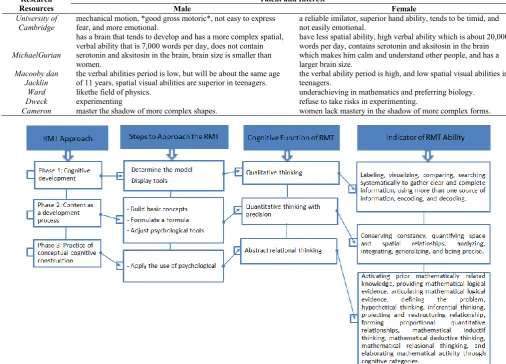
Nurhayati (2017) states that differences in intellectual abilities between women and men include three things, namely: (1) verbal ability, (2) visual-spatial ability, and (3) mathematical ability. Women have oral ability better than boys, boys excel in visual-spatial and mathematical abilities. Alifah (2012) summarized the differences in abilities between men and women based on expert opinion in the form of the table below.
Based on the background of the problems stated above, it is necessary to develop a assessment prototype with a RMT approach based on gender that is able to represent each thinking style of the two different sexes. The ability development of the RMT is very necessary so that the subject understands the concepts learned and to exercise sharpness, critical power and can develop and improve the subject's high-level thinking skills (Yunitadkk, 2018). It is very important to know the RMT's capabilities because it requires a valid and reliable assessment instrument. Rigorous Mathematical Thinking (RMT) according to Kinard, (2007) “The RMT invention defines mathematical rigor as that quality of thought that reveals itself when learners are engaged through a state of
vigilance – driven by a strong, persistent, and inflexible desire to know and deeply understand.” The real analysis course is a very suitable course for applying the RMT because it contains compatible indicators with the RMT. To be clearer, the following is a chart of the relationship between the RMT approach and the RMT ability.
From the picture above, it can be seen that the RMT approach can be closely related to the RMT ability indicator. This can be seen from the thinking process of the subject which begins with the RMT approach and ends with an indicator of the ability of the RMT.
From this indicator, a Real Analysis course assessment instrument is prepared which is adjusted to the subject's cognitive thinking style according to gender. Thus the objectives of this study are (1) to make an assessment prototype for the Real Analysis course, (2) to design the Real Analysis course assessment instrument, (3) validate the results of the assessment instruments by expert validators, and (4) test the effectiveness and practicality of assessment instruments for the Real Analysis course that have been compiled. Therefore, the product produced from this study is a valid, practical and effective course assessment instrument sheet for Real Analysis.
Table 1 Differences in Cognitive Ability between Men and Women in the Opinion of Experts
Research Resources
Talent and Interest
Male Female
University of Cambridge
mechanical motion, *good gross motoric*, not easy to express fear, and more emotional.
a reliable imilator, superior hand ability, tends to be timid, and not easily emotional.
MichaelGurian
has a brain that tends to develop and has a more complex spatial, verbal ability that is 7,000 words per day, does not contain serotonin and aksitosin in the brain, brain size is smaller than women.
have less spatial ability, high verbal ability which is about 20,000 words per day, contains serotonin and aksitosin in the brain which makes him calm and understand other people, and has a larger brain size.
Macooby dan Jacklin
the verbal abilities period is low, but will be about the same age of 11 years, spatial visual abilities are superior in teenagers.
the verbal ability period is high, and low spatial visual abilities in teenagers.
Ward likethe field of physics. underachieving in mathematics and preferring biology.
Dweck experimenting refuse to take risks in experimenting.
Cameron master the shadow of more complex shapes. women lack mastery in the shadow of more complex forms.
on Gender
LITERATURE REVIEW
RMT (Rigorous Mathematical Thinking)
RMT (Rigorous Mathematical Thinking) are first coined by James T. Kinard. According to Kinard (2007: 3) “The RMT invention defines mathematical rigor as that quality of thought that reveals itself when learners are engaged through a state of vigilance – driven by a strong, persistent, and inflexible desire to know and deeply understand.” In here, RMT defines accuracy in mathematics, when students are involved in complex problems, students are driven by a strong desire, persistence, and an understanding concepts to understand problems. In thinking naturally involves the presence of cognitive functions, according to Meilantifa et al(2018: 2) cognitive function is a mental process that has special meaning conveyed for certain thinking actions needed to describe abstractions and generalize geometry directly. According to Kinard (2007: 4) for rigorous mathematical thinking three cognitive function levels are needed,namely level 1 (qualitative thinking), level 2 (quantitative thinking with accuracy), and level 3 (abstract relational thinking). According to FitriyanidanKhasanah (2017: 2) these three levels of cognitive function define mental processes of general cognitive skills to a higher level of mathematical knowledge. The RMT theory is based on two learning theories, namely socio-cultural Vygotsky whose emphasis is on his psychological equipment and mediated learning theory (Mediated Learning Experience or MLE) which was coined by ReuvanFeurstein. But the focus of this study is only on identifying students' ability to think mathematically in solving mathematical problems, not learning designs that involve intervention in RMT.
According to Pertiwi (2016: 106) there is a difference between mathematical thinking and rigor mathematical thinking where mathematical rigor thinking requires a higher level of precision and accuracy as well as more structured specific cognitive functions. According to Sumarmo in Fitriyani and Khasanah (2017: 1) "defined mathematical thinking as a way of thinking with regard to the process of math (doing math) or in solving mathematical tasks both simple and complex.”According to Fitriati and Sopiana (2015: 46) in thinking rigor mathematically students have begun to realize the importance of the accuracy of the basic principles underlying a proof. Students can apply axioms, theorems, definitions and mathematical concepts that are appropriate for completing a proof. Students reason according to concepts in the mathematical system and can analyze the consequences of the axiom manipulation of theorems and definitions for proof, can understand the relationship between forms that are not defined, can solve mathematical problems in accordance with the rules or concepts that are right (Sholihah and Afriansyah, 2017 : 291).
In this research, Rigorous Mathematical Thinking is a high-level thinking skill that involves several cognitive functions. It requires an abstract and complicated thinking stage, students can determine and apply the right concepts to solve problems. Rigor is also often referred to as accuracy, and in mathematical thinking accuracy and logic are also needed, while according to Kinard the requirement to be precise and logical is the existence of rigorous, so rigorous mathematical thinking is needed in learning and solving mathematical problems.The development of Rigorous Mathematical Thinking skill is
indispensable so that students better understand the concepts learned and can apply them in various situations, to train students 'sharpness in focus, perception, critical power and can develop and improve students' high-level thinking skills. Because accuracy is the highest stage in understanding geometry.
According toFitriyaniandKhasanah (2017: 3) the RMT process requires the use of cognitive function from low-level to high-level cognitive functions.Mathematically-specific cognitive functions is specific thinking actions that are needed to deal directly with the abstractions and generalizations of mathematical stimuli” (Kinard, 2007: 4).
Prototype Assessment
Specifically in education Gronlund& Linn (Suprananto, 2012: 7) defines assessment as "asystemic process and includes the activities of collecting, analyzing, and interpreting information to determine how far a student or group of students achieves set learning goals, both aspects of knowledge, attitude, and skill.”According to Nitko (1996) assessment is a process that is taken to obtain information used in order to make decisions regarding students, curriculum, programs, and education policies, methods and or other educational instruments by an agency, the institution that organizes a certain activities. According to Suwandi (2010: 7) assessment is "a process to know whether the process and results of an activity program are in accordance with the objectives or criteria that have been set."Based on the above understanding it can be concluded that assessment is a systematic process and includes the activities of collecting, analyzing, and interpreting information to know whether the process and results of an activity program are in accordance with the objectives or criteria that have been set. Where the assessment is not separate from the measurement process.
Habits of Gender-Based Mathematical Thinking
In essence, all beings are created in pairs. In humans, for example, there are men and women. Both are created in the same degree, dignity and dignity. Even if they have different forms and functions, they are all so that they complement each other. However, in the course of human life, there are many changes in the roles and status of both, especially in society. The process has gradually become habitual and cultured which has the potential to result in discrimination against one sex in the community.Gender is an English word absorption. Gender is a basic element of self-concept. Knowledge "I am a woman" or "I am a man" is one of the core parts of our personal identity (David O.Sears, Jonathan L. Freedman and L. Anne Peplau, 2005). The term "gender" is stated by social scientists with the intention of explaining the differences between women and men who have innate traits (god creation) and cultural formations (social construction).Often people mix up human characteristics that are natural (unchanging) with those that are non-natural (gender) that can change and be changed. This difference in gender roles also makes people think again about the division of roles that are considered inherent in both women and men.
is the physical difference. Boys usually have a bigger and stronger physique even though almost all girls mature faster than boys. Boys are also said to be superior in terms of spatial skills than girls. Even so, boys often experience problems in terms of language, so girls are declared superior in terms of verbal abilities. This gender difference also seems to influence the amount of motivation of students to achieve. This is because of the assumption that boys are superior in the fields of science and mathematics, while girls will be superior to more feminine tasks such as art and music. The next difference is the level of aggressiveness, boys tend to be more aggressive than girls. Boys and girls are different, and as a result, differences arise about how they learn. For example, Orhun (in Trisniawati, 2013) investigated the relationship between gender and learning styles. The results show that there are differences between learning styles that are preferred by male and female students. The study found that female students preferred convergent learning styles. Convergent dominant learning ability uses abstract conceptualization and active experimentation. Students with this learning style prefer inquiry type discovery. While most male students in this study preferred the assimilator learning style. Dominant learning ability assimilators use abstract conceptualization and reflection observation. They learn by seeing and thinking. Some studies to examine how gender differences relate to mathematics learning, men and women are compared using variables including innate abilities, attitudes, motivations, talents, and performance (Good child & Granholm in Trisniawati, 2013). Some researchers believe that the influence of gender factors (the influence of male and female differences) in mathematics is due to biological differences in the brains of boys and girls that are known through observation, that girls, in general, are superior in the field of language and writing, while boys are superior in the field of mathematics, because of their better spatial abilities (Geary, Saults, Liu, in Trisniawati, 2013).
As a result, gender differences in mathematics are quite difficult to change. However, on the other hand, various studies state that there is no role for gender, male or female, that excels in each other in mathematics and in the end, women can be superior in various fields related to mathematics. Various studies have found that gender differences influence mathematics learning.This occurs during elementary school age. Another study states that the influence of gender differences can be observed in junior high school students and in high school students. In high school, gender disparities that tend to men are found to be more general, especially in the area of problem solving and application. However, these differences are not significant and gender differences can also be reduced over time. Recent findings relating to research on gender differences in mathematics, both in national and international studies, show that gender differences in mathematics have decreased year after year. The results of international comparative studies show that there are differences in mathematics learning outcomes between boys and girls in various countries. However, lately, the results of research on gender differences in mathematics show that there is no significant difference between men and women in terms of mathematical abilities. This happens along with the same treatment between men and women in the educational environment (Mullis, 2004). The results of the research described in this section show the diversity of research results regarding gender roles in mathematics learning. Some results
indicate the existence of gender factors in mathematics learning, but on the other hand, several studies reveal that gender does not have a significant effect on mathematics learning.
METHODOLOGY
Research methods can be interpreted as scientific procedures to obtain data with specific purposes and uses (Sugiyono, 2009). This study uses a mix method simultaneously to obtain a comprehensive analysis of research problems as stated by Creswell, (2013) or can be known as the concurrentmix method. This study uses research and development design, also known as R&D research. The results of this study are in the form of a Real Analysis course assessment instrument through the Rigorous Mathematical Thinking (RMT) approach based on gender.
Research Questions
From the explanation that has been explained in the introduction, then the formulation of the problem from this study are: (1) how to make an assessment prototype for the Real Analysis course?, (2) how to design an assessment instrument for Real Analysis?, (3) how to validate the instrument results assessment by expert validators, and (4) how the results test the effectiveness and practicality of the Real Analysis course assessment instruments that have been compiled. So the purpose of this study will be to produce an assessment prototype in the form of a valid, practical and effective course assessment instrument sheet for Real Analysis. aripemaparan.
Modeling Volatility
The development model in this study will follow the steps of Borg and Gall (2003) which are more detailed and operational. The development model of Borg and Gall (2003) that should have been taken in development research has ten steps, but this research only reached the eighth step. The eight steps are: (1) preliminary study, (2) planning, (3) hypothetical model development, (4) hypothetical model review, (5) revision, (6) limited trial, (7) revision of trial results, (8) wider trial.This research only reached the eighth stage because this product was not to be tested en masse.
Data
Data collection techniques used are the method of written tests, documentation, observation, interviews, and questionnaires. Data analysis in the instrument development process, that is, the initial product is validated by the expert board to obtain valid instrument contents. Furthermore, this instrument was tested on a limited basis to the subject, namely FKIP UGJ students of mathematics education study program. The results of trial assessment instruments using the RMT approach based on gender are measured empirical validity using the product moment formula. While the reliability test uses alpha formula. The difficulty level of the question and the distinguishing force are also measured. In the instrument for evaluating democratic characters, the validity and reliability are measured using SPSS version 22 software.
RESULTS AND DISCUSSION
on Gender
technique used by researchers in assessing aspects of mathematical thinking style is based on gender by making observations from the results of answers and lecture activities in the classroom and interview. The following is a question of RMT ability tests and then analyzed subject thinking styles based on gender.
No. RMT Ability Test Questions for Sequence Materials and Real
Functions
1. Show that the sequence (1+1/2!+1/3!+...+1/n!) is a Cauchy sequence and show that (n+(-1)n) / n is not a Cauchy sequence.
2. Show if each sequence (xn) and (yn) is Cauchy, then (xn+yn) and
(xn.yn) are alsoCauchy.
3. Show that the monotonically up and limited line is the Cauchy line. 4. Suppose that (xn) is a Cauchy sequence so that (xn) (xn) is a sequence
of integers for each natural number n. Show that the sequence (xn) is
finally constant.
5. Suppose that y1, y2is real number and y1< y2. Defineyn = 1/3yn-1
+2/3yn-2for n > 2. Show the sequence (yn) convergent and specify the
limit.
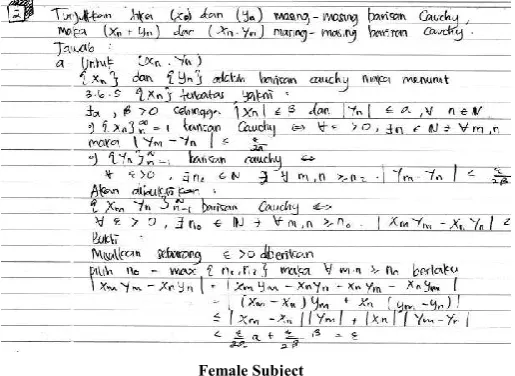
From the test questions above, the following is one of answers from classified subjects according to gender, namely men and women with random sampling techniques.
Question No.1
Male Subject
Female Subject
Question No.2
Male Subject
Female Subject
From the picture above, it can be seen that differences in thinking styles with the RMT approach will later be adjusted to gender. From the results of the answers, at first glance, there seems to be no difference in thinking style, but after being examined more deeply by interviewing each subject, there is a difference from the thinking style that is in accordance with his gender. The following are the results of the test for the ability of the RMT of line material and real functions with the product moment correlation that are made into table forms.
Table 2 Results of the RMT Ability Test for Sequence Materials and Real Functions
No. NK IV TS Validity DR TK DP
1 0.640 High = 5 %
n = 15
rTabel =
0.304 rxy>rTabel
Valid High Medium 2.905
2 0.425 Medium Valid High Medium 3.973
3 0.619 High Valid High Medium 5.970
4 0.545 Medium Valid High High 2.433
5 0.689 High Valid High High 5.523
Keterangan :
NK : Validity Correlation Score
IV : Questions Validity Index
TS : Questions Significance Level
DR : Questions ReliabilityDegree
TK : Questions Difficulty Level
DP : Questions Differential Force
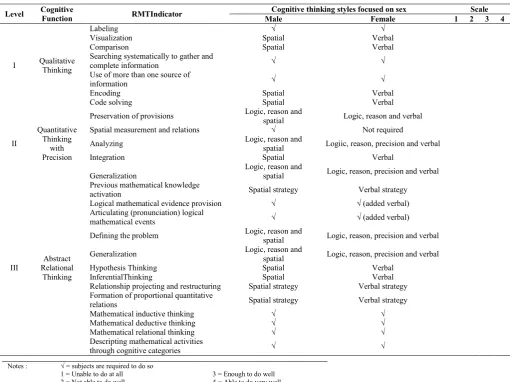
From the table above, it can be seen the results to prove the validity criteria, the degree of reliability of the question is calculated by alpha formula and the results obtained with high criteria and for the level of suitability of the problem depends on the medium and difficult region. After the validity test for ability test with RMT, below is a Real Analysis course assessment instrument with RMT adjusted for cognitive thinking style based on gender table.
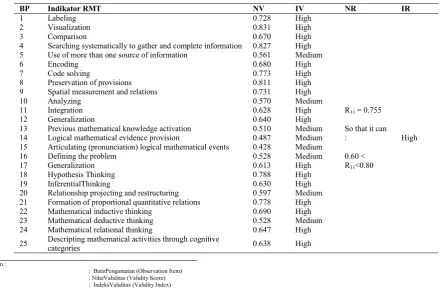
From the table above, it can be seen that the results of validity tests for task assessment instruments and course test results of Real Analysis based on gender with the RMT approach is valid with a medium to high validity index. The validity and reliability test of this instrument is conducted by an expert validator (rater) of two people who had doctoral degrees in mathematics education. Thus, the final conclusions from the validity and reliability test for this assessment instrument have a decent result or can be used properly.
Development of a course assessment prototype Real Analysis through a gender-based RMT approach is carried out with a preliminary study phase in order to establish and define the provisions when lecturing in class, as well as literature studies related to the problems studied to formulate a research framework. Activities carried out in this study include curriculum analysis, analysis of subject situations, lecture material analysis of Real Analysis, independent task analysis, and instructional objectives formulation.
Furthermore, questions about the ability of the RMT are made to measure the subject cognitive abilities and test the validity, reliability and index of the difficulties first. After that, a Real Analysis course assessment instrument is created, which is focused on gender-thinking cognitive styles.
The practicality of the developed prototype assessment of the Real Analysis course can be determined by the following indicators: 1) the use of lecture devices; 2) the observations results of the lecturers ability in managing lectures using assessment instruments in very good categories; 3) subject response to positive lecture ratings, indicated by a percentage more than 80% (Amidi 2012: 106). The results of the developed course assessment prototype usage of Real Analysis can be seen from the total average value of all meetings. The average total use of the developed prototype assessment of the Real Analysis course is 3.98, so it is concluded that the use of prototypes is in the category of "good". The results of the researchers' responses in using lecture assessment instruments of Real Analysis are obtained a total average of two raters, namely 85. This means that the use of the developed prototype is classified as "very good". While the subject response showed positive results, the course assessment prototype of Real Analysis with the RMT approach based on gender is said to be practical. The test results of the course assessment prototype effectiveness of Real Analysis with the RMT approach based on gender can be seen if the assessment instrument meets the criteria of valid, reliable, objective, systematic, economical, and practical (Sudiyatno 2010: 239). In general, the rater assesses that the prototype assessment course of Real Analysis with a gender-based RMT approach
Table 3 Assignment Assessment Instruments and Course Test Results of Real Analysis Based on Sex with the RMT
Approach
Level Cognitive
Function RMTIndicator
Cognitive thinking styles focused on sex Scale
Male Female 1 2 3 4
I Qualitative Thinking
Labeling √ √
Visualization Spatial Verbal
Comparison Spatial Verbal
Searching systematically to gather and
complete information √ √
Use of more than one source of
information √ √
Encoding Spatial Verbal
Code solving Spatial Verbal
II
Quantitative Thinking
with Precision
Preservation of provisions Logic, reason and
spatial Logic, reason and verbal
Spatial measurement and relations √ Not required
Analyzing Logic, reason and
spatial Logiic, reason, precision and verbal
Integration Spatial Verbal
Generalization
Logic, reason and
spatial Logic, reason, precision and verbal
III
Abstract Relational
Thinking
Previous mathematical knowledge
activation Spatial strategy Verbal strategy
Logical mathematical evidence provision √ √ (added verbal)
Articulating (pronunciation) logical
mathematical events √ √ (added verbal)
Defining the problem Logic, reason and
spatial Logic, reason, precision and verbal
Generalization Logic, reason and
spatial Logic, reason, precision and verbal
Hypothesis Thinking Spatial Verbal
InferentialThinking Spatial Verbal
Relationship projecting and restructuring Spatial strategy Verbal strategy
Formation of proportional quantitative
relations Spatial strategy Verbal strategy
Mathematical inductive thinking √ √
Mathematical deductive thinking √ √
Mathematical relational thinking √ √
Descripting mathematical activities
through cognitive categories √ √
Notes : √ = subjects are required to do so
1 = Unable to do at all 2 = Not able to do well
on Gender
has a very good value of objectivity, economics and systematic.
It is illustrated by the average for each aspect, namely Objectivity 3.56 (very good), 3.45 (very good) and Systematic 3.56 (very good), while the validity, reliability and practicality have also been tested. Overall, it can be concluded that the effectiveness criteria have been fulfilled.
CONCLUSIONS AND RECOMMENDATIONS
Based on the results of research and discussion, it can be concluded as follows: (1) The lecturer has not so fully used the Real Analysis course assessment prototype with a gender-based RMT approach that it is expected that in the future it can use and assess the subject's cognitive abilities more fairly and measurably, (2) development of a course assessment prototype of Real analysis with a gender-based RMT approach produces valid, reliable, practical and effective assessment instruments, (3) the results of the trial of prototype assessment course of Real Analysis with the RMT approach based on gender are measured empirical validity using the product moment formula which produces 5 items declared valid. For reliability test, the researcher uses alpha formula with results of the assessment prototype having a high degree of reliability. The difficulty level is balanced, where there are difficult and moderate questions. As for the differentiating force, the results of the test questions can distinguish between high, medium and low ability subjects. Positive responses from interested lecturers in using a course assessment prototype of Real analysis with a gender-based RMT approach provide excellent comments on the assessment instruments that have been prepared. Based on the results of observations of lecture management capabilities, the researcher obtains scores from a maximum score of 36.
The subject also give a positive response, as indicated by the results of a questionnaire that shows interest in joining the next lecture which is equal to 95.00%.
The developed course assessment prototype of Real analysis with a gender-based RMT approach was is effective. It is indicated by the fulfillment of valid, reliable, objective, systematic, economical, practical and effective criteria with an average score obtained at 3.54 which means the product effectiveness is very high.
Acknowledgments
The author conveys acknowledgments to Swadaya Gunung JatiUniversity (UGJ) which has so provided internal research grants that this scientific article can be completed. In addition, the author also so expresses his or her gratitude to the involved parties that the research and writing of this article could be carried out smoothly.
References
Alifah, S. K. (2012). Identifikasi Tingkat
BerpikirGeometriSiswaMenurutTeori Van
HieleDitinjau Dari Perbedaan Gender
PadaMateriPokokSegiempat (StudiKasusKelas VII SMPN 2 Gedangan). Surabaya: StudiPendidikan Matematika SunanAmpel.
Anthony J. Nitko, Educational Assessment Of Students, (New Jersey/Columbus, Ohio: Merril, an Imprint of Prentice Hall, 1996), p. 4
Beyers, James. (2011). Development and Evaluation Of an Instrument to Assess Prospective Teachers Dispositions With Respect Mathematics. International Journal
Table 4 Validity Test Results of Assignment Assessment Instruments and Course Test Results of Real Analysis Based on Gender with the RMT Approach
BP Indikator RMT NV IV NR IR
1 Labeling 0.728 High
R11 = 0.755
So that it can :
0.60 < R11<0.80
High
2 Visualization 0.831 High
3 Comparison 0.670 High
4 Searching systematically to gather and complete information 0.827 High
5 Use of more than one source of information 0.561 Medium
6 Encoding 0.680 High
7 Code solving 0.773 High
8 Preservation of provisions 0.811 High
9 Spatial measurement and relations 0.731 High
10 Analyzing 0.570 Medium
11 Integration 0.628 High
12 Generalization 0.640 High
13 Previous mathematical knowledge activation 0.510 Medium
14 Logical mathematical evidence provision 0.487 Medium
15 Articulating (pronunciation) logical mathematical events 0.428 Medium
16 Defining the problem 0.528 Medium
17 Generalization 0.613 High
18 Hypothesis Thinking 0.788 High
19 InferentialThinking 0.630 High
20 Relationship projecting and restructuring 0.597 Medium
21 Formation of proportional quantitative relations 0.778 High
22 Mathematical inductive thinking 0.690 High
23 Mathematical deductive thinking 0.528 Medium
24 Mathematical relational thinking 0.647 High
25 Descripting mathematical activities through cognitive
categories 0.638 High
Keterangan :
BP : ButirPengamatan (Observation Item)
NV : NilaiValiditas (Validity Score)
IV : IndeksValiditas (Validity Index)
NR : NilaiReliabilitas(Reliability Value)
OfBisnis and Social Sciences: Vol 2 No. 16. September 2011.
Borg, W and Gall, M. (2003).Educational Research: An introduction 7th edition. New York: Longman Inc.
Creswell, J.W. (2013). Research Design:
PendekatanKualitatif, Kuantitatifdan
Mixed.TerjemahanFawaid, A. Yogyakarta: PustakaPelajar.
Elliot, S. N., Kratochwill, T. R., Cook, J. L. & Travers, J. F. (2000).Educational Psycology: Effective Teaching, Effective Learning, Third Edition. United States of America: McGraw-Hill Companies, Inc.
Evania, Putri. (2011). MenguakRahasiaOtakPerempuan. Yogyakarta: SinarKejora.
Firmasari, S. &Sulaiman, H.
(2019).KemampuanPembuktianMatematisMahasiswa MenggunakanInduksiMatematika. Journal OfMedives: Journal Of Mathematics Education IKIPVeteran Semarang, 3(1), 1-9.
Firmasari, S. Sulaiman, H. Hartono, W. & Noto, M.S. (2019). Rigorous Mathematical Thinking Based On Gender In The Real Analysis Course. IOP Conference Series: Journal of Physics. Vol. 1157, pp. 1-9.
Fitriati. danSopiana, L. (2015). PenerapanTeori Van HieledalamMeningkatkanKemampuanBerpikirSiswaSe kolahMenengahPertamapadaMateriBangunRuangLimas (vol.2).JurnalPendidikanMatematika.
Fitriyani, H. & Khasanah, U. (2017). Student’s Rigorous Mathematical Thinking Based on Cognitive Style. Journal of Physics:Conference Series 943.
Geary, David C. (1998). Sex Differences in Mathematical Abilities: Commentary on the Math-FacRetreival Hypothesis. University of Missouri of Columbia. Hamid, Said, H. (2010), Bahan Pelatihan Penguatan
Methodologi PembelajaranBerdasarkan Nilai – NilaiBudayauntuk Membentuk Daya Saingdan KarakterBangsa: Pengembangan Pendidikan Budayadan KarakterBangsa, Jakarta, Kemendiknas: BadanPenelitiandanPengembanganPusatKurikulum.
Handoyo, Eko danTijan.(2010). Model
PendidikanKarakterB erbasisKonservasi, Semarang:Cipta Prima Nusantara.
James, AbigallNorfleet. (2007).”Gender Differences and the Teaching of Mathematics”.Virginia Community College System.12, (1), 14-25.
Jensen, TS et al. (2012). A New Definition Of Neuropathic Pain. Journals International Association for the Study of Pain (IASP), Wolters Kluwer Health Inc, USA, p.2204. Kinard, J. (2007). Method and Apparatus For Creating
Rigorous Mathematical Thinking. US.
Kinard, James T. “Creating Rigorous Mathematical Thinking: A Dynamic that Drives Mathematical and
Science Conceptual Development”.
www.umanitoba.ca/unevoc/conference/papers/kinard.pd f, 8 Desember 2015.
Meilantifa., dkk. (2018). The Development of Learning Tool Models on Triangle using Problem Solving Based of Rigorous Mathematical Thinking in WijayaKusuma Surabaya University. Journal of Physics:Conference Series 1028.
Muhammad, Yoga Muklis., Sri Subiantidan Imam Sujiadi.(2018). Development of Mathematical Skill Assesment Instruments in Secondary School based on Bloom’s taxonomy.IOP Conferences Series : Journal of Physics . 1028.
Mullis, I. V. S., Martin, M. O., Gonzalez, E. J., &Chrostowski, S. J. 2004. TIMSS 2003 International Mathematics Report: Findings from IEA’s Trends in International Mathematics and Science Study at The Four and Eight Grades. Boston: TIMSS & PIRLS International Study Center, Boston College.
MZ, Z. A. (2013). PerspektifGender
dalamPembelajaranMatematika. Marwah: Jurnal Perempuan, Agama dan Gender, 12(1), 15-31.
Nurhayati, E., &Subekti, F. E.
(2017).DeskripsiKemampuanPenalaranMatematis
Siswa Ditinjaudari Gaya Belajardan
Gender. ALPHAMATH, 3(1).
Pertiwi, D.B. danWijayanti, P.
(2016).IdentifikasiKemampuanMatematikaSiswadalam MenyelesaikanMasalahGeometri SMP Ditinjaudari Level FungsiKognitif Rigorous Mathematical Thinking.JurnalIlmiahPendidikanMatematikaMATHEd unesa. 3(5): 102-111.
Sears, David O.(2005). PsikologiSosial.Jakarta :PenerbitErlangga.hlm. 269-275.
Sholihah, S.Z. danAfriansyah, E.A.
(2017).AnalisisKesulitanSiswadalam Proses PemecahanMasalahGeometriBerdasarkanTahapanBerpi kir Van Hiele.JurnalMosharafa. 6(2): 287-298.
Sudiyatno.(2010). “Pengembangan Model
PenilaianKomprehensifUnjukKerjaPesertadidikPadaPe mbelajaranBerbasisStandarKompetensi di SMK TeknologiIndustri”.Disertasi. Yogyakarta: Program PascaSarjanaUniversitasNegeri Yogyakarta.
Sugiyono.
(2009).MetodePenelitianPendidikanPendekatanKuantit atif, Kualitatif, dan R&D. Bandung: Alfabeta.
Suprananto & Kusaeri. (2012). Pengukuran dan Penilaian Pendidikan. Yogyakarta: Graha Ilmu.
Suwandi, Sarwiji. (2010). Model Asssmen dalam Pembelajaran. Surakarta: Yuma Pustaka.
Trisniawati, (2013).Perbedaan GenderDalamPembelajaran Matematika.http://trisniawati87.blogspot.co.id/2013/05/
perbedaan-gender-dalam- pembelajaran.
htmldiaksespadatanggal 4 April 2019.
Yunita, D. R., Maharani, A., &Sulaiman, H. (2018). Identifying of Rigorous Mathematical Thinking on Olympic Students in Solving Non-routine Problems on Geometry Topics. Dipresentasikandalam Seminar Internasional: Asian Education Symposium.