49
The Influence Of Globalisation And Modern
Technological Changes On Manufacturing
Industries In Libya
Nuri M. Triki
Abstract: Globalisation and new technologies are having an intense impact on the manufacturing industries. This is affecting business global and might demand new strategies and policies for manufacturing companies. Libya like several other countries in the Middle East and also is among the few developing African economies has been facing problems related to its productivity in industrial sector. Manufacturing industries in Libya was reared to offer better products and services as part of the government plans to reconstruct their economy and improve its industrial companies. So as to face these problems, manufacturing sectors need to increase their production and they also require a clear strategy and policies towards an efficient supply chain about modern technology. A new technology is one of the improvement initiatives that can be used to enhance industrial performance, competitiveness and decrease its costs by eliminating of waste and increasing added value activities. The significance of new technology and modern systems in the industrial world has enhanced in this decade because of the benefits that they bring to the factories and companies. The aims of this research is to investigate new technology strategies that will enable the Libyan manufacturing industries to shift towards an increase production and reduce its costs; as well as to quantify the modern technological changes and the role of globalisation in addition to declaration of its effect on the growth additionally development of the Libyan industrial sector and competitiveness; lastly, moreover this survey make a recommendations to establish systems that improve the emergent needs of the national industrial sector.
Index Terms: Globalisation, Modern Technological, Manufacturing Industry, Development of Employee, Libya
————————————————————
1
INTRODUCTION
Rapid global technological changes have resulted in an increase in the demand for skilled labour with higher education in particular manufacturing industries. However, technologies are playing a crucial role in allowing the globalisation of economic and social activities. A growing literature has shown that technology agreements have become an important and growing channel to transfer know-how across countries [9]. Manufacturing sector is one of the enhancement inventiveness that can be executed to achieve business excellence, and many industrial companies are spinning towards new technology to sever costs and boost profits. In addition, the industrial sector guarantees the increase of value added and helps to ensure self-sufficiency, improve economic balances, employ labour, reduce unemployment and provide jobs for future generations [7]. In modern huge development in technology has place most of the world’s industrial companies under great pressure, making the opportunity of endurance in both the domestic and global markets increasingly remote. The competitors in the world markets know that they must meet the variable needs of customers by competitive prices and high quality [3]. Additionally, several companies have come to realise that certain new technologies can optimise efficiency and make processes more effective. The opportunity to achieve competitive advantage through the quick adoption of new technology has increased the drive to improve and develop new applications.
The competitiveness at all manufacturing environments and business companies depend on the ability of highest quality of its products and lowest cost, which make them focuses in adopting modern systems that may help in achieving their goals to control the production strategy by increase the flexibility of its manufacturing, and production productivity, and reduce products costs. Information technology is one of these modern systems that has attracted many business in this time because it is refer to link between production quality and production cost, in addition it drives long-term economic growth, productivity and improved standards of living [15]. As a result, new technologies devastate jobs in some industries, especially among the low-skilled, while creating jobs which are often in different industries and require different skills. Industrial sector in Libya developed considerably after the exploration of crude oil and natural gas through the 60's of the last century, the country subsequently had very little human resources to manage and operate a sizeable modern petroleum industry. The foreign oil companies not to mention a very weak government then played major role in establishing the prerequisites for the establishment of linkage and minor change capabilities, especially in developing human resources for the petroleum industry. Since then, the economic growth rate has started to increase and the country has turned to industrialisation by engaging in processing of crude oil in addition to cement, textile and iron steel industries [17]. Nevertheless, manufacturing industry in Libya faces insurmountable challenges in the new economic era. In an attempt to overcome these challenges, manufacturing sector in Libya require adapting an effective technology approach [16]. This study is an effort to recognise the useful technological development and its effect on the enlargement of the industrial sector production, which gives importance specially in Libya, at a time when the Libyan manufacturing industry has traditionally suffered from a shortage of skilled manpower and applying new technology, which are required to accelerate the interest productive activity to take its contribution to the solving these
________________________
50
economic problems during their function in the development and increase the size of the national production and to achieve self-reliance and supply job opportunities for the unemployed. Within this context, the present paper aims to study the effect of globalisation and new technology on manufacturing sector in Libya, as well as investigating the existence of skill biased technological change.
2 SIGNIFICANCE OF STUDY
This study is a novelty in Libya because it is one of the first few studies that aim to study the application of technologies and its impact on industrial companies in Libya and the problems associated with it. Therefore, this study in the research and educational system is very rare in Libya, so this will be the basis of further studies in this area in the near future.
This study will encourage the researcher in Libya to care and consider this area as an important research field that should improve the economy of Libya in general and industrial sector in particular.
3 THE IMPORTANCE OF THE INDUSTRIAL
SECTOR
The industrial sector is one of the most important components in the national economy, especially in light of the policy of economic diversification adopted by countries in view of the success achieved by countries in recent years [7]. Furthermore, this sector plays a major and active role in the process of the economic balance of any country as well as is one of the most important pillars of comprehensive economic development. However, industrial sector works to provide and attract foreign investment and the use of modern technology which leads to increasing competitive factors and providing various facilities in industries and to open more markets to the national industries, which proved their progress in the world of competition with the high quality. Due to the importance of industry the following are the main advantages of industrial development [4]:
The industrial sector contributes to the creation of jobs, and the greater the volume of industrial production, the less the number of unemployed.
Contributes to the increase of national income. When the contribution of the industrial sector to the Gross Domestic Product (GDP) increases, exports increase and the dependence on the export of raw materials such as oil will reduce.
Contributes to raising the level of productivity, because it is one of the sectors most able to apply the use of modern technology and this contributes to productivity. It contributes to raising the rate of growth in the national economy and helps to increase growth in other sectors.
The Libyan government’s approach to strengthening the role of the industrial sector in the national economy comes in the context of addressing some of the fundamental challenges, including the creation of suitable employment opportunities for citizens. The fact is that there is a distinction between the industrial sector and the industrial zones, specifically the ability to create a large number of jobs by attracting diverse projects. Therefore, the national industrial sector needs to be protected from competing with similar foreign products imported from abroad and the ministry gives a real opportunity to encourage this sector to increase the volume
of investment [19]. As a result of encouraging this sector through positive steps, this work will contribute to increasing the volume of investment in the industrial sector, increasing production and contribution to national output, as well as re-employment by favoring and encouraging the purchase of local products instead of imported foreign products, which achieve purpose and objective in product quality and efficiency.
4 OVERVIEW OF THE MANUFACTURING
INDUSTRY IN LIBYA
51
1975-1980, 1980-1986) and the development plans and programmes that have been followed, will notice variations and changes in the adopted strategies and the objectives of those plans. Instead of making use of the opportunity to change planning objectives, economic administrators during the period 1986 to 1996 suspended development plans and relied upon annual development budgets [24]. The economic development programme plan through 1996- 2000 was derived from economic and social transformations in production and service sectors, aiming at providing goods and services that satisfied the requires of the local market and lowered the importation levels. The integration of the total local production did not reach 8% during the 1970s. This verifies that the industrial sector depends strongly on the oil sector, as in investment operations or to gain raw materials due to reduction in oil revenues during the 1980s and 1990s [1]. As a result, decrease in oil prices was one of the most important reasons behind the low production rates of the industrial sector, as its contribution to GDP declined from 77.4% in 1973 to 24.9% in 1997 and to 27.9% in 2002 [12]. One of the studies indicated that the increase or decrease in oil prices with 10% caused an increase or decrease in the gross domestic product with 3% [18]. Libya experienced a strong economic growth during 2004, and partly due to higher oil export revenues with real GDP growth of 2.3 and 2.6% is estimated, by consumer price inflation of 1.9 and 3.5%. Notwithstanding, Libya’s quite
strong recent economic growth, unemployment remains high since the country's population grows quickly and new jobs are not shaped rapidly enough. Moreover, Libya’s comparatively poor infrastructure (i.e. roads and logistics), unclear legal structure, arbitrary government decisions, a bloated public sector with as much as 60% of government spending going towards paying public sector employees’ salaries, huge public works programmes i.e., and all these assorted structural rigidities have posed impediments to foreign investment and to economic growth [20].. The above mentioned plans aim to minimise the complete dependence upon oil revenues on the GDP by exporting these industrial product to rectify the oil–dependent economic structure, this trial to diversify the exported products shall include agricultural products whose contribution is considerable and manufacturing industry [4]. Table 1 provided by [14] review the full picture of the development of the industrial sector during (1980-2000). The table indicates the main companies involved in the field of manufacturing industry, their places, and regarding the location of these industrial companies through the country. It should be noted that in terms of location the majority are concentrated on the coastal area. The reason behind this concentration on the Mediterranean is that it can be easy to ship their products through Mediterranean to the near European industrial countries, besides setting the facilities of the cooling water.
Table 1: Manufacturing industries establishment by location, No. of Workers, Capital Investment LD Million and Annual Production
Name of Company Location No. of
Workers
Capital Investment LD Million
Annual Production
The Libyan Cement Company Benghazi 589 30.7 760,791 ton cement
Suke El Khamis Cement and Building Material Company Suke El- Khamis 405 20.0 492,673 ton cement
Pipes Company Benghazi 582 22.1 4,335 bricks
Tractors Company Tripoli 450 22.5 695 Tractors
The General Company for Chemical Industry Abo- Kamash 1150 69.0
120,000 ton salt; 62,500 ton Vinyl Chloride Monomer (VCM); 60,000 ton Poly Vinyl Chloride (PVC)
Iron and Steel complex Musrata 870 53.5 020,42111 ton of liquid steel
Cement and Building Material Company Al-Khomes 270 1.6 133,006 ton cement
Source: GAIT, 2003, different pages.
5 MANUFACTURING TECHNOLOGY STATUS
Modern technology and globalisation is moving the world from an industrial era to an information era. On the other hand development of technological is very low in developing countries, and most of them status lowest according to diverse international technology and innovation catalogs for instance the Technological Achievement Index and the Innovation Capability Index [15]. New development of technology is a vital to efforts of country in improving productivity, efficiency and competitiveness of its industrial sector. Technological capabilities can be best illustrated in expressions of three stages: the fundamental level involves the capability to operate and retain a new production plant derived from imported technology, the second level consists of the ability to duplicate and adapt the design for imported sow and technique somewhere else in the country or abroad, while an advanced stage engrosses facility to undertake innovative designs and to develop new production systems and components [25]. And just like nowadays, the
revolution of technology has not only improved communications systems, while make it more economic to productivity and cost competing in international market. Consequently, globalisation and new technologies such as information technology enables the formation of a host of devices to generate, organise, transmit, store and act on information in digital shape in novel ways and during new organisational forms [8]. To successfully implement advanced technologies, an organisation must allow manufacturing’s evolving competencies to be a driving force in strategy formulation. These technologies encourage firms to implement cross-functional teams that reduce time and costs as well as improve quality in both product design and manufacturing. Additionally, it can provide the tools to help enterprises achieve goals widely regarded as critical to the future of manufacturing industry, including:
52
More intimate and detailed interactions with customers; Fuller utilisation of capital and human resources;
Streamlining of operations to focus on essential business needs; and
Elimination of unnecessary, redundant, or wasteful activities.
Therefore, Information and Communication Technology (ICT) has been instrumental in enabling the emergence of much globalised markets in finances, services and goods. Nevertheless, globalisation is a great vision, but only if
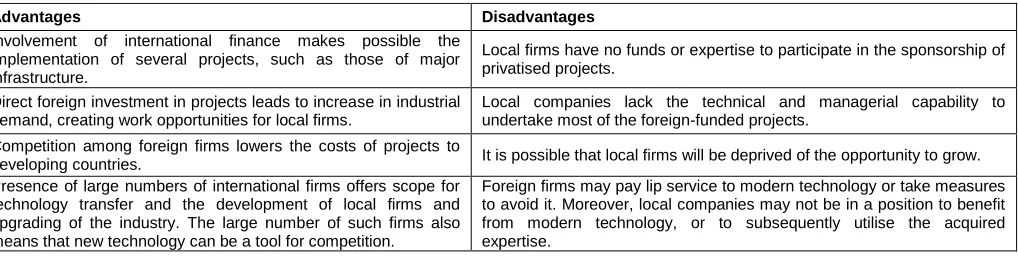
nations discard negative-sum mercantilist policies and embrace growth economics policies focused on raising productivity for all sectors including the industrial sector, and making certain that all persons can gain from this growth. If that happens, developed and developing countries will benefit greatly of it [8]. Table 2 shows the advantages and demerits of globalisation to the manufacturing industries of developing countries, Libya one of them. In addition, the table indicates the all companies involved in the field of manufacturing industry, and regarding to modern technology and globalisation through the developing nation.
Table 2: Advantages and Disadvantages of Globalisation Considering Manufacturing Industries in Developing Countries
Libyan manufacturing sector has a low of technological competitiveness and to attempt the catch-up international frontier in phrases of process technology and product design capability, Libya has a number of high qualities Research and Development institutions particularly in Petroleum Sector, but the industry–institute relations are still weak, thus reducing the probabilities of formation of commercially viable technologies. The benefits attributable to high availability of value experts and engineers is missing, partly as a result of stagnation of skill sets of Libyan engineers and experts; in contrast, manufacturing industry has a relative weakness with revere to both process technologies and product [27]. In the case of the manufacturing sector in Libya, the human resources dedicated to design and engineering activity below in other developed countries. In spite of the fact that Libyan companies are able of accomplishing high ranks of accuracy, they are unable to produce high quality products due to be short of supporting process technologies such as measuring of precision, process control and material engineering. Like the manufacturing sector in general, the machine tool industry also suffers from low volume production, high cost of finance and poor quality of power supply, and that because of little apply new technologies in all industrial companies and firms.
5.1. Advanced Manufacturing Technology
Over the last decade, flexibility became the mark of new technologies called advanced manufacturing technology (AMT). Several conceptual schemes have been offered to grapple with the flexible nature of advanced manufacturing technology. These schemes make valuable contributions to understanding AMT [26]. Implementation of AMT has become a source of competitive advantage for companies. From an operational perspective there are many benefits from investing in cutting edge capital equipment [13]. Greater flexibility, cost reduction, improved customer service and quality all contribute to making the introduction of AMTs
profitable. To fully exploit the potential of AMTs, companies should consider the need for a supporting infrastructure. Shortcomings registered in these new technologies are frequently the result of insufficient attention to company organisation, infrastructure and maintenance. These are necessary for advanced manufacturing technologies to work smoothly and show successful results. Advanced manufacturing technology is the application of computer-enhanced, applied science to a firm’s production system. Advanced manufacturing technology is a resource that enables a firm to efficiently produce multiple products across the same asset base [26]. AMTs provide a variety of operational benefits which include better coordination between different departments, greater control of the processes, reduced product design time, shorter lead time, and stable high quality outputs [28]. . Successful adoption of AMTs requires employee support. In fact, lack of employee backing prior to the implementation of technologies would have detrimental effects [11].
5.2 Development of Employee
Employees are vital factors for maintaining the achievement of production compared with technology. Employee development plays an important role in careers, work lives and in achieving the goals of the company. One way to streamline the funds for the development is to analyse the job description of each job [7]. Employee must be treated humanely so as to obtain positive culture in the firm. The developments of employee can be measured by testing goals, learning qualities, learning goals, previous involvement, perceived require and support of job [21]. The development of employee that can drive manufacturing sector to a higher level of development will have to be knowledge-based, creative and skilled. It is these features that employees have to acquired and developed, and thus reach developed country status. Moreover, it is believed that building a knowledge-based workforce is imperative,
Advantages Disadvantages
Involvement of international finance makes possible the implementation of several projects, such as those of major infrastructure.
Local firms have no funds or expertise to participate in the sponsorship of privatised projects.
Direct foreign investment in projects leads to increase in industrial demand, creating work opportunities for local firms.
Local companies lack the technical and managerial capability to undertake most of the foreign-funded projects.
Competition among foreign firms lowers the costs of projects to
developing countries. It is possible that local firms will be deprived of the opportunity to grow. Presence of large numbers of international firms offers scope for
technology transfer and the development of local firms and upgrading of the industry. The large number of such firms also means that new technology can be a tool for competition.
53
particularly in the manufacturing sector. The achievement of applying new technologies depends on well-trained workforce. Lack of employee development will effect on operational process of the firms. Employee must have motivation, skill, integrity, and professionalism so as to have a successful technologies implementation. Management has to sensitive about employee development so as to effectively implement new technologies in the firm. Successful human resource management is a vital procedure to improve and increase the facilities of a company, thus affecting the company's performance [23]. In fact, employee’s practitioners in these manufacturing firms are observed to be confronted by the individual employee-negotiated character of learning other than the necessary resources required to support such learning. Indeed, these dimensions are said to be an important adaptation in fostering learning and development in the workplace [2]. As a result, training and development of employees in the manufacturing sector is vital in preparing a capable and skilled workforce with the expertise to meet current and future challenges by providing them with technological skills as well as critical thinking abilities [5].
6 CONCLUSIONS AND RECOMMENDATIONS
In summary, this study considers spatial development in Libya and to what extent the industrial sector is answering to the requirements of the new economy and the influence of globalisation and modern technology. With the aid of modern technology in a global context companies are now in a position to achieve increasing returns to scale, increasing efficiency and profits far beyond that previously possible. Globalisation and modern technology created a “new
economy” that is characterised by markets free of trade and import barriers, large volumes of cross border trade between countries and the application of modern technology, especially knowledge based, computer and communication technology. Notwithstanding, there is clear evidence that technological drive has not taken firm root in the Libyan industry. In sum, the disjointed policies in Libya with lack of focus have resulted in a weak innovation system and under-utilisation of research capabilities created during the first phase of growth. Thus, the overall problem relates to the lack of appropriate linkages between different actors of the national innovation system. However, there have been institutional gaps leading to poor industry-academia interaction. The outcome has been low practical orientation of Libyan research and lack of technology inputs to industry, increasing spending on research and development establishment of mission mode projects and enforcing interactions between research institutions and industry. Libya needs to address constraints on technology development as an important part of its overall strategy for improving manufacturing sector competitiveness. The role of government in enhancing technological competitiveness is critical to make this happen. The critically analysed of factors of study show that technological environment significantly add value to the growth and performance of manufacturing industries. Attention is drawn on other variables that have influence on the technological environment of manufacturing industries to include funds, skills, industrial regulations, technological unsuitability to local environment, workers attitude towards technological innovation and government’s efforts at encouraging manufacturing. Finally, the study
advocates that technological investment which is related to high level skills in manufacturing activities, staff training which enables better and efficient operation of machines and equipment, cost efficiency and investment in quality management are to be deliberately promoted in order to improve the performance of manufacturing industries. Furthermore the result however showed that where the technology is working properly, performance will increased. To sum up, it can be concluded that, based on the study’s general objective which is to determine the impact of technology changes on the performance of Libyan manufacturing industries, the study revealed as follows from the result of data collected and by exploring some of the literature that discusses how to manage and applying new technological on manufacturing industry so that it can improve the performance of its firms and organisations. Most Libyan workers do not have innovation-supportive
culture and the government is not doing enough in terms of incentives to boost the morale of manufacturers. This leads to difficulty in operation of the advanced manufacturing technology and high cost of maintenance when the machine breaks down.
Technological environment significantly affect the performance of manufacturing firm due to the fact that most manufacturers do not measure the acquired/imported and local technology in terms of adaptability, affordability, maintenance and waste of learning for maximum utilisation.
Most manufacturing industries do not conduct training for their workers because of lack of fund thereby exposing the workers and the public to industrial hazards.
On the basis of the above discussion and conclusions, the following recommendations can be made to carryout technological innovation which is aimed to improving manufacturing industries and its performance:
Government should make favorable monetary policies that will encourage easy access to fund which will enable manufacturers to purchase better equipment for production. It is also of the view that government should also provide them with incentives in form of equipments, infrastructural facilities and financial resources to encourage production.
Need to work on the development of infrastructure for information and communications technology (ICT), so that it can take advantage of what offered the enormous potential was able to achieve sustainable development. It is also of the view that technology should be made
suitable and adaptable to the local environment, it should also ensure that it is affordable, easy to maintain and operate. This is to avoid high cost of maintenance and to ensure maximum utilisation of the machine for proper performance.
Industrial policies should be reviewed to ensure reduction in pollution, waste recycling and industrial safety.
54
Government should be making more attention to communication skills which becoming more important in a globalised world, and this needs to be reflected in engineering curriculum, for manufacturing industry. Highlighting on better education and training of the labor
force and inform workers of the importance of their role in the production process.
Emphasis on the interaction between universities and industries, particularly with regard to curriculum and applied technical research, economic and manufacturing industry.
To evaluate engineering industry linkages, in particular, manufacturing industries should establish consensus which will provide skills required by specific occupations. Exploit the best of the factors of production, especially in unexploited production capacities in the industry through the use of modern technology.
ACKNOWLEDGEMENT
The author would like to express his appreciation to faculty of engineering, University of Sabratha, Regdaleen, Libya for their cooperation and the facilities provided. This support is gratefully acknowledged.
REFERENCES
[1] Abbas H., ―Industrial Development and Migrant Labour in Libya‖. PhD. Unpublished Thesis, Manchester University, UK. (1987).
[2] Abdullah, H. (2009). Major Challenges to the Effective Management of Human Resource Training and Development Activities. The Journal of International Social Research, Vol. 2, No. 8, PP. 11-25.
[3] Albarkoly, K. and Park, K., ―Implementing a Strategy of Reliability Centered Maintenance (RCM) in the Libyan Cement Industry‖. International Journal of Social, Behavioral, Educational, Economic, Business and Industrial Engineering Vo. 9, No.6, PP. 1903- 1912. (2015).
[4] Alrubaie, F., ―Manufacturing Sector and the Process of Structural Transformation in Libyan Economy‖. Journal of Humanities and Social Sciences Vol. 2, No. 20. (2005). (In Arabic).
[5] Agnaia, A. A., ―Assessment of Management Training Needs and Selection for Training: the Case of Libyan Companies‖. International Journal of Manpower Vol. 17, No. 3, PP. 31-51. (1996)
[6] Antipolis, S. ―Indicators for Sustainable Development in the Mediterranean Coastal Regions: National Report of Libya‖. (2002). http://www.planbleu.org/publications/idd_cotiers_ly. pdf . [Accessed on 27/2/2017].
[7] Ataalah,A., Hasnan,K., Mohammad,M., Ahmad, M. and Alkalani, A., ―Relation between Lean Manufacturing and Business Performance: A conceptual model Based on Libyan Manufacturing Industries‖. ARPN Journal of Engineering and
Applied Sciences Vol. 11, No. 14, PP. 8642 -8647. (2016).
[8] Atkinson, R., ―Globalisation, New Technology and Economic Transformation‖. Chapter 9. (2016). http://www.itif.org/files/Atkinson_chapter.pdf.
[Accessed on 27/12/2016].
[9] Archibugi, D and Pietrobelli, C., ―The Globalisation of Technology and Its Implications for Developing Countries Windows of Opportunity or Further Burden?‖ Technological Forecasting & Social Change Vol. 70, PP. 861–883. (2003).
[10]Bait El-Mal, A., ―Evaluation of Goals and Development Plan in Libya‖. Journal of Economic Research Vol.14, No.1, PP. 208-243. (2003).
[11]Barua, B., Islam, O. (2009). Key Success Factors for Implementation of Advanced Manufacturing Technologies (AMTs) Case Study Conducted on Selected Pharmaceutical Companies in Bangladesh. AIUB Journal of Business and Economics, 8(2), 53-67.
[12]CBL (Central Bank of Libya)., ―Research and Statistics, Economic Bulletin‖, (2002). 46th Annual Report, Tripoli, Libya.
[13]Darbanhosseiniamirkhiz, and Ismail, M., (2012) Advanced Manufacturing Technology Adoption in SMEs: an Integrative Model. Journal of Technology Management & Innovation. Vol. 7, Issue 4, pp.112-120
[14]GAIT (The General Authority for Information and Telecommunication). ―Statistics Book. General Authority for Information and Telecommunication Yearly Bulletin‖., (2003).. Tripoli: Libya, (In Arabic).
[15]Haile, G., Srour, I. and Vivarelli, M., ―The Impact of Globalisation and Technology Transfer on Manufacturing Employment and Skills in Ethiopia‖. IZA Discussion Paper No. 7820. (2013). http://ftp.iza.org/dp7820.pdf. [Accessed on 18/3/2017].
[16]Hawedi, H., Haron, H., Nordin, A. and Ahmed, A., ―Current Challenges and Future Perspective: The Influence of Organizational Intelligence on Libyan Oil and Gas Industry‖. International Journal of Computer Science and Network Security (IJCSNS), Vol.11 No.1, PP. 145-147. (2011)
[17]Hokoma, R., Khan, K., & Hussain, K., ―An investigation of total quality management implementation status for the oil and gas industry within Libya‖. Paper presented at the Proceedings of MEQA, 2nd Annual Congress, Dubai, UAE. (2008).
55
University Press, New York. (1999).
[19]Industry Secretariat, ―The Industrial Companies Positions Evaluation Committee‖. Tripoli, the Industry Secretariat. (1994).
[20]Masoud, N., ―A Review of Libyan’s Economy, Structural Changes and Development Patterns‖. Business and Economics Journal. Vol. 4, Issue 2. PP. 1-10. (2013).
[21]Maurer, J., and Chapman, F., ―Ten Years of Career Success in Relation to Individual and Situational Variables from the Employee Development Literature‖. Journal of Vocational Behavior, Vol. 83, No. 3, PP. 450-465. (2013).
[22]Münstermann, B., Eckhardt, A., and Weitzel, T., ―The Performance Impact of Business Process Standardization: An Empirical Evaluation of the Recruitment Process‖. Business Process Management Journal, Vol. 16, No. 1, PP. 29-56. (2010).
[23]Orr, M., Bush, D., and Vorhies, W., ―Leveraging Firm-level Marketing Capabilities with Marketing Employee Development‖. Journal of Business Research, 64(10), 1074-1081. (2011).
[24]Shareia, B. and Irvine, H., ―The Impact of Accounting Information in the Libyan Economy: A Qualitative Case Study Approach‖. American International Journal of Contemporary Research Vol. 4, No. 12, PP. 61- 81. (2014).
[25]Report on Indian Manufacturing Industry (2016): Technology Status and Prospects https://www.unido.org/fileadmin/user_media/Publica tions/Pub_f
ree/Indian_manufacturing_industry_technology_stat us_and_prospects.pdf. [Accessed on 29/11/2016].
[26]Tracey M., Vonderembse M., and Lim J. (1999) Manufacturing technology and strategy formulation: keys to enhancing competitiveness and improving performance . Journal of Operations Management Vol.17, PP. 411–428
[27]Triki, N., ―Exploring the Technical Skills Gaps in the Libyan Manufacturing Industry: Students' and Engineers' Reflection‖. 6th International Conference of Education, Research and Innovation, 18-20 November, 2013, Seville, Spain. PP.7264-7271. ISBN: 978-84-616-3847-5. ISSN: 2340-1095. (2013).