Simplex Method Linear Program Application In
Process Of Transition To Reduce Use Of Products
In Polyster Material In Indonesia
Sukanta, Anwar Ilmar RamadhanAbstract: PT Asia Pacific Fibers Tbk is a leading polyester producer in Indonesia precisely in Karawang, West Java. Production produced namely chip Semmidull (SD) and Chip Super Bright (SBR) in the production process of the company cannot make a product Chip simultaneously or only producing one type of product and if there is a request to change the product it must go through a transition phase in advance, in every transitional phase requires considerable material or suboptimal use of raw materials. In this study using the Simplex method in an attempt to minimize the amount of material used up activities of the transition process to be optimal. Research was conducted on the transition process of polyester chips which is one of the production process flow which often experience obstacles - obstacles or activities - activities that do not add value so that a lot of unused material optimally. Based on the research that has been done by using the Simplex method with the optimum solution is obtained by focusing the use of materials amounted to 1.4274 Kg PTA and EG at 0.2632 Kg material so as to minimize the cost of material amounted Rp.111967, 72. Calculated starting from the beginning of the transition process that begins by setting the level of 0.27% until the establishment titan SBR chip. With the amount of use of the material is expected to be enough to meet the transition process products, and the company also benefited from the use of the amount of material standards can reduce the production costs of the process of transition, and taking into account the quality of the product that has become the rule, such as the levels of phosphorus in Chips SBR should appropriate that has been set at 25 + 5 ppm, and does not contain compounds TiO2 (titan) which can reduce the quality of the SBR Chips.
Index Terms: Minimization, Total Material Usage, Simplex Method.
————————————————————
1.
INTRODUCTION
PT Asia Pacific Fibers Tbk is a leading polyester producer in Indonesia precisely in Karawang, West Java. Production produced in the form Chip, Chip is differentiated into two types of chips are chips Semmidull (SD) and Chip Super Bright (SBR), in the production process of the company can not make a product Chip simultaneously or only producing one type of product and if there is a demand replacement product then must go through a transition phase in advance, in every stage of transition requires considerable material or suboptimal use of raw materials. From the observations that are known within the flow of the production process of companies still often encounter obstacles or activities that do not add value so as to reduce the profit of the company. So that the company can still guarantee the continuity of the company's operations and can achieve the goal to maximize the value of the company, we need to hold an optimal action / optimization in the activities of production process, so as to reduce production costs will arise or occur. [1-4] the article is being submitted to and the manuscript identification number. Click the forward arrow in the pop-up tool bar to modify the header or footer on subsequent pages. Optimization is the scourge important in any industrial activity. Optimization can be done in every field of industry and optimizations made in the field of production is essential considering production activities is vital activities of an industry. The activities at the heart of an industry so that the industry can proceed smoothly. Optimization of production can be categorized as problems or Linear Programming (LP).
Translated linear program of Linear Programming (LP) is a way to solve the problem of allocating limited resources among several competing activities, in the best way possible. This allocation problems will arise when someone should choose the level of such activities. Some examples of situations from the description above, among others, is the problem of allocation of production facilities, the issue of allocation of national resources for domestic needs, production scheduling, the solution of the game, and the selection pattern of delivery (shipping). One thing that characterizes the situation above is the necessity to allocate resources to the activity. This linear program uses a mathematical model to explain the problems it faces. The nature of the "Linear" here meant that the entire mathematical function in this model is a linear function, while the word "program" is a synonym for planning. Thus, Linear Program is planning activities to obtain optimum results, ie an outcome that achieve the best among all feasible alternatives. [5-6] One method that can be used to solve problems is a Linear Program Simplex Algorithm. Simplex algorithm is the first method used to solve LP and is one of the most efficient method to solve the problem of Linear Programming. This method was first used by the Navy America or the American Air Force during World War 2 and then developed which could be used to solve optimization problems in the industrial world. Until now, the Simplex Algorithm become a popular method that is often used to solve LP problems [7]. Research was conducted on the transition process of polyester chips which is one of the production process flow which often experience obstacles or activities that do not add value so that a lot of unused material optimally.
2
R
ESEARCHM
ETHODThe data used in this study are primary data and secondary data. Primary data is data refers to information obtained first-hand related to variable interest for the specific purpose of study [8].
These data include: ____________________________
Department of Industrial Engineering, Faculty of
Engineering, Universitas Singaperbangsa Karawang, Indonesia.
Department of Mechanical Engineering, Faculty of
Engineering, Universitas Muhammadiyah Jakarta, Indonesia.
107 1) the flow of the production process;
2) The main types of materials used at the time of transition; 3) the price of each type of material;
4) the amount of materials used at the time of transition.
Secondary data is data refers to information gathered from existing sources, such as articles, internet, journals, and documentation of the company [9]. These data include: 1) linear programming;
2) the simplex method; 3) The company profile
2.2 Data analysis method
A method of data analysis used in this study is: a. Simplex method
The following given steps to resolve the linear programming model using the simplex method by [10]:
1. Getting Started: How to Make Mathematical Model of the Problem Case
2. Step Two: Create Table Initial Simplex
Step tops the simplex method is to change the shape model of linear programming problems that exist into a canonical form, then put the matter at the beginning of simplex tables were arranged as in Table 1. Table Simplex slack and artificial variables into a variable basis for these variables are the identity matrix with a coefficient of +1. If there is any additional slack variables, surplus, and artificial in a model then made new objective function, the objective function that includes variables. Coefficient slack variable costs and the surplus is zero, artificial variable is the case -M + M to maximize and minimize cases of objective function. M represents a very large number.
3. Step Three: Testing the optimum value Resolution
The third step aims to examine the settlement obtained in an iteration simplex table. A decent settlement case basis linear programming problem maximize the objective function is said to have optimum if zj - cj ≥ 0, while minimizing settlement cases have optimum decent base if zj - cj ≤ 0, for each j, j = 1, 2, .. ., n. If settlement obtained in an iteration table has been optimum, then steps simplex method stops. However, if the settlement is not yet obtained optimum simplex table needs to be improved to obtain a better solution that optimizes the completion of a more objective function. Fixing this simplex table is the third step of the simplex method.
4. The fourth step: Fix the table this stage aims to create a new simplex table that produces better solution than the preceding table.
This is done by selecting a non-base variable to be used as a new base variable in the new simplex table that will be created and the selection of a variable base out of the base because it will be replaced by a new base variable selected. Having obtained a new table is continued testing the optimum value of the settlement. When the solution has been optimized, the iteration is stopped, but if the solution is not optimal then followed the third step; stage repairs the table. Variable non-base into a variable basis for the case to maximize the objective function is non-base variable xk in k-th column that has a value zj - cj smallest (j = 1, 2, ..., n). In the case of minimization, non-base variable xk of the column that has a value k zj - cj most (j = 1, 2, ..., n). When there are several columns that have a value zj - cj the same, it can have one of them at random. The next column is called the selected key
column. The variable base that should come out well in the case of maximizing or minimizing the objective function is the same, namely variables derived from the smallest line Ri. Ri value obtained from the following calculation: with aik> 0 row selected named as the key line. Elements which became the intersection of columns and rows of keys called a key element, which is used to repair the table. The value of this key element should be made equal to 1 and the other values in the same column must be zero by performing several operations elementary row.
b. The sensitivity analysis is an analytical tool that can be used as a parameter to measure the magnitude of the changes that can be tolerated from optimal table before the optimum solution to lose optimization. [10]
2.3 Analysis of Results Comparison Product
Transition Process
In this case the calculation results will be compared to the new transition process with a transition process that is based on the leadership of the PT. Asia Pacific Fibers Tbk. In terms of: (a) The amount of material that is used during the process of transition; (b) the cost of materials used in the process of transition
3 RESULTS AND DISSCUSSION
PT. Asia Pacific Fibers is a company engaged in the field of polyester, the production of which is produced in the form Chip, Chip is differentiated into two types of chips are chips Semmidull (SD) and Chip Super Bright (SBR), in the production process of the company is not able to produce the product Chip in simultaneously or only producing one type of product and if there is a request to change the product it must go through a transition phase beforehand, the transition process companies still often encounter obstacles or activities that do not add value to the use of materials at the time of the transition to be not optimal. So that the company can still guarantee the continuity of the company's operations and can achieve the goal to maximize the value of the company, we need to hold an optimal action / optimization in the activities of production process, so as to reduce production costs will arise or occur. The data obtained from research directly into the production process, namely:
Table 1. Transition Process Research Data for Chips [12]
The type of data obtained in this study are primary data through interviews and direct observation in PT.Asia Pacific Fibers. The data analysis method used in this study consisted of:
1. The simplex method is a mathematical procedure to find the optimal solution of a linear programming problem based on the iteration process.
can be tolerated from optimal table before losing optimum solution.
In order to simplify the calculation, the first step is to define the variables for the decision is the amount of PTA is used in the process of transition (X1), Number of EG are used in the transition process (X2), Total Phosphorus is used in the process of transition (X3), and the amount of catalyst which is used in the process of transition (X4), and the data that have been obtained are converted into modeling in mathematical form as follows:
1. Function Purpose
Minimization = (Rp 15,000 x Number PTA is used in the process of transition) + (Rp 12,000 x Number of EG are used in the process of transition) + (Rp 14,000 x amount of TMP is used in the process of transition) + (Rp 626,000 x amount of catalyst used in the the transition process). Z = 15,000 + 12,000 X1 X2 X3 + 344,000 + 626,000 X4
2. Function Constraints
a. Obstacle 1: In the process of transitioning to-1 is a transition process that aims to determine the minimum quality products Gread.A grading 0.27% TiO2 with a number of raw material consumption as much as 17 535 Kg PTA, EG 7515 Kg, and Catalyst 150 kg with unused production capacity of 25 030 kg. 17535 X1 + 7515 X2 + X4 ≥ 150 25 030
b. Obstacle 2: In the process of transitioning to-2 is a transition process that aims to reduce the levels of TiO2 to 0.01% with the use of raw material such amount as much as 7420 kg of PTA, EG 3180 Kg, and the catalyst was 105.8 kg with a production capacity that is unused amounting to 10500 Kg. 7420 X1 + 105.8 + 3180 X2 X4 ≥ 10500
c. Obstacles 3: In the process of transition to the 3rd is a transition process that aims to reduce the levels of TiO2 be 1ppm or close to 0 (zero) by the amount of raw material consumption is as much as 6748 kg of PTA, EG 2892 Kg, and the catalyst was 144.5 Kg capacity unused production amounted to 9628 Kg. 6748 X1 + 144.5 + 2892 X2 X4 ≥ 9628 d. Obstacles 4: Once the levels of TiO2 reached 1ppm SBR product formation process can be performed so that the process of transition to 4th raw material usage amount is as much as 6271 kg of PTA, EG 2687 Kg, 25 Kg and Catalyst TMP 134.5 kg with production capacity were used for 8958 Kg. 6271 X1 + 25 + 2687 X2 X3 X4 + 134.5 = 8958
Formulation of the problem in fully:
Objective Function: Min. Z = 15 000 X1 X2 + 14 000 + 12 000 + 626 000 X3 X4
Function Constraints: 17 535 X1 + 7 515 X2 + 150 ≥ X4 20 030
7 420 X1 + 3 180 X2 + 105.8 X4 ≥ 10 500 6 748 X1 + 2 892 X2+ 144.5 X4 ≥ 9 628
6 271 X1 + 2 687 X2 + 25 X3 + 134.5 X4 = 8 958 X1, X2, X3, X4 ≥ 0
Steps to resolve the problem:
a) Changing the objective function and restrictions Initial objective function,
Z = 15.000 X1 + 12.000 X2 + 14.000 X3 + 626.000 X4 (Minimum)
In the case of this problem there is a minimization problem that is characterized by inequality constraints ≥ kind. Minimization problem using the steps - the same steps as in
the maximization problem, but there are some adjustments to be made. For inequality constraints kind ≤ then Si is added, and the constraints of inequality type Si ≥ then subtracted, add fake variable Ri on the barrier marked ≥ or =. If problems minimization add MRI in the objective function (for each Ri) to spend the resources used in the constraint. This method can not be applied to the inequality constraints and constraint types ≥ equation (=). Because each Ri will be at home base, then the entire variable is false must be eliminated from row 0 before simplex. If the entire variable worthless false positive in the optimal solution, then the solution to the problem is considered optimal. If there is a variable false positive value in the optimal solution, then the question of the origin is not feasible. So that the objective function becomes
Z=15.000X1+12.000X2+14.000X3+626.000X4+0S1+0S2+0S3 +0S4+MR1+MR2+MR3+MR4+MR5
Converted into an implicit function, meaning that all shifted left: Line 0 Z-15.000X1-12.000X2-14.000X3-626.000X4-MR1-MR2-MR3-MR4-MR5 = 0
Line 1 17535 X1 + 7515 X2 + 150 X4 – S1 + R1 = 20030 Line 2 7420 X1 + 3180 X2 + 105,8 X4 – S2 + R2 = 10500 Line 3 6748 X1 + 2892 X2 + 144,5 X4 – S3 + R3 = 9628 Line 4 6271 X1 + 2687 X2 + 25 X3 + 134,5 X4 + R4 = 8958 Line 5 X1 + X2 + X3 + X4 – S4 + R5 = 0
Subsequently remove the R1, R2, R3, R4, and R5 of line 0. The trick replace row 0 with:
Line 0 + M (line 1) + M (line 2) + M (line 3) + M (line 4) + M (line 5); thus obtained:
Figure 1. the objective function and constraints
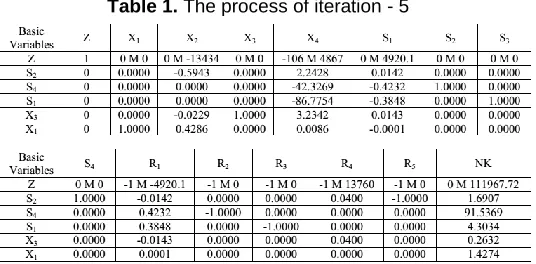
The results of the calculation functions of the goals and limits of each of these factors can be made calculations on iteration – 5, can be seen in the following Table 1:
Table 1. The process of iteration - 5
109 production process flow which often experience obstacles -
obstacles or activities - activities that do not add value so that a lot of unused material optimally. This study was conducted to analyze the application of the Simplex method in an effort to minimize the amount of material used up activities of the transition process to be optimal.
Sensitivity Analysis
Based on the results of the processing of the above to prove that the results of the calculations were correct then used a sensitivity analysis, calculation of analytical sensitivity used in this research is to add (to the equation ≤) or decrease (for the equation ≥) value X optimum on the left side of the function Constrain, then see what happens if the value changes violate the constraint function equation calculation is correct and if it changes the value of fixed follow function equation constrain the calculation is wrong, it can be seen in the following sensitivity analysis:
Function Constraint 1
The optimum value X1 = X3 = 1.4274 and 0.2632 for calculation prove the optimum value is converted into X1 = 1 and X3 = 0.2632 (fixed). Then the results of the calculation are:
Function Constraint 2
The optimum value X1 = X3 = 1.4274 and 0.2632 for calculation prove the optimum value is converted into X1 = 1 and X3 = 0.2632 (fixed). Then the results of the calculation are:
Function Constraint 3
The optimum value X1 = X3 = 1.4274 and 0.2632 for calculation prove the optimum value is converted into X1 = 1 and X3 = 0.2632 (fixed). Then the results of the calculation are:
Function Constraint 4
The optimum value X1 = X3 = 1.4274 and 0.2632 for calculation prove the optimum value is converted into X1 = 1 and X3 = 0.2632 (fixed). Then the results of the calculation are:
Judging from all the above calculation value changes had violated the accounts shall constrain function properly. Based on the calculations above, the fifth iteration is the optimal outcome for the fake variable in the equation Z are all non-positive, with a focus on the use of PTA (X1) = 1.4274 kg, and the use of TMP (X3) = 0.2632 Kg to obtain the optimum solution (Z) of = Rp. 111,967.72. And the results of these calculations proved by a sensitivity analysis to validate the results of these calculations. The optimum solution resulting from the simplex method of linear programming is the cost amount of material usage standards during the transition process. Calculated starting from the beginning of the transition process that begins by setting the level of 0.27% until the establishment titan SBR chip. With the amount of use of the material is expected to be enough to meet the transition process products, and the company also benefited from the use of the amount of material standards can reduce the production costs of the process of transition, and taking into account the quality of the product that has become the rule, such as the levels of phosphorus in Chips SBR should appropriate that has been set at 25 + 5 ppm, and does not contain compounds TiO2 (titan) which can reduce the quality of the SBR Chips.
4 CONCLUSION
Results from this research is an analysis of the application of Simplex Method Linear Program in an effort to minimize the amount of material used up activities of the transition process to be optimal in the production department of PT. Asia Pacific Fibers Tbk. As for the techniques or methods used in conducting observation for data retrieval and processing of data using Linear Method Programming With Simplex Technique.
a. Through observations have been done using the simplex method known optimal solutions by focusing on the use of materials amounted to 1.4274 Kg PTA and EG at 0.2632 Kg material so as to minimize the cost of material amounted Rp.111967,72.
b. From the results of these observations for consideration or could be created and perfected the process of transition is done to be more optimal.
REFERENCES
[1] F. Bonar, 1998, Management Training for Polysindo Eka Perkasa, Jakarta
[2] H. A. Taha, 1996, Operations Research: An Introduction, Binapura Aksara, Jakarta
[3] R. Ibnas, 2014, Optimization of Linear Programming Case with graphs and Simplex Method, Journal of MSA, Vol. 2 No 1, pp. 1-8
[5] T. Sriwidadi and E. Agustina, 2013, Production Optimization Analysis with Linear Programming Through Simplex Method, Journal of Binus Bussiness Review, Vol. 4 No 2, pp. 725-741
[6] D. Wirdasari, 2009, Simplex Method in Linear Program, Journal of Saintikom, Vol. 6 No 1, pp. 276-285
[7] D. A. Wahab and A. P. Dewi, 2008, Product Mix Optimization Method Using Simplex (Case Study on Domestic Industry Gitrek Sawargi Cassava Village Cisalak, Cisalak District of Subang Regency), Journal of Dimensia, Vol. 5 No 3, pp. 61-92
[8] T. T. Dimyanti, and A. Dimyanti, 2006, Operations Research (Model Decision), Bandung
[9] P. Subagyo, A. Marwan and T. H. Handoko, 2004, Introduction fo Operations Research, Yogyakarta
[10]B. Susanta, 1994, Linear Programming, Yogyakarta
[11]H. A. Taha, 1996, Operations Research: An Introduction, Binapura Aksara, Jakarta
![Table 1. Transition Process Research Data for Chips [12]](https://thumb-us.123doks.com/thumbv2/123dok_us/9005416.1438094/2.612.314.571.542.635/table-transition-process-research-data-chips.webp)