IJEDR1704123
International Journal of Engineering Development and Research (
www.ijedr.org
)
747
Supporting Issues for Expression Recognition and
Classifications
G.P. Hegde
1, M. Seetha
2, Nagaratna Hegde
31Dept. of ISE, 2 Dept. of CSE, 3 Dept. of CSE
1Shri Dharmastala Manjunatheshwar Institute of Technology Ujire, VTU, Belagavi, India 2 G. Narayanamma Institute of Technology and Sciences, JNTU, Hyderabad, India
3 Vasavi College of Engineering, Osmania University, Hyderabad, India
________________________________________________________________________________________________________
Abstract— Higher energy subspace creation is a challenging task due to corruption of intermediate pixels. This paper switches on to illustrate the basic issues required for efficient recognition of expressions during the construction of linear and non-linear subspace models. Recognition accuracy of facial expression reclined on region of detected area of face. Feature extraction methods expose required features for formation of subspace model. Among multi spaces of high dimensional data one space may have accurate information without any redundant data and it would generate minimum time classification of expression data. Some of the bench mark data bases have been utilized for testing of various subspace methods such as JAFFE, FD and YALE. The performance issues of subspace methods exhibits good results compare to state of art methods.
IndexTerms—Expression, Feature extraction, Subspace, Dimensional reduction
I.INTRODUCTION
Today biometrics domain finds lot of applications in various fields like computer vision, human computer interaction, security fields etc. Human identification cannot be achieved with the help of single template of biometric. Due to various interferences in the face templates human identification results might be poor. The face biometrics can yield better result for certain subspace methods which have been designed by holistic and geometric principles. Hence in face expression recognition human emotional states makes an important role. Two novel subspace approaches have been illustrated in article [1]. These approaches can preserves the local and global contents of images, by recognizing human expressions with low dimensional subspace domains. The problem issue is protection of pixel attributes in face images either locally or globally without omitting any original information and increasing the discrimination power of subspace model by minimizing singularity issues [2]. Fig. 1 shows all the necessary basic steps involved during expression classification. In any one of the field of these basics steps if obstacles appears then it would causes the wrong classification of expressions. Hence performance of each stage should be made high. Analysis of various classes of these stages has been carried out. Higher level to lower level work constructs the framework for expression recognition task.
II.SUPPORTING ISSUES
Essential components for efficient recognition of expressions are discussed below. The stages are cascaded in linear pipeline fashion. Each next stage depends on previous stage property. The attributes and behavior of associated stages causes enhancement of accuracy of expression recognition.
Face Detection
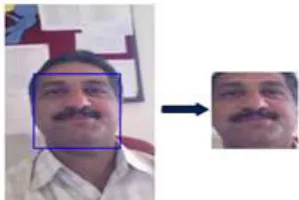
This finds primary step for supporting efficient way of recognition of expressions entities. The purpose of face detection is to obtain required region of interest to determine whether face image is present as shown Figure 2. The difficulty associated with face detection can be attributed to many variants in scale location orientation pose, facial expression, occlusion and lightning conditions. Sometimes it would be difficult to detect the face if the image is degraded with darkness and highly occluded variations in poses. Image is covered by some interference. Face detection determines the location of a face in an image by distinguishing the face from all other pattern present in the scene. Viola Jones algorithm [3] for face detection method frame wok is capable of processing of images extremely rapidly while achieving high detection rates. It has high detection accuracy with high speed.
Image Pre-processing and Scaling
IJEDR1704123
International Journal of Engineering Development and Research (
www.ijedr.org
)
748
Figure 1.Supporting issues for expression recognition during formation of Subspace Models.
Figure 2 Face detection by placing boundary box
Feature Extraction
There is various face image feature extraction methods have been utilized in earlier works [5]. Local Binary Pattern technique
[6] is highly effective to describe the image texture features. Local Binary Pattern (LBP) has certain advantages such as high speed computation and rotation invariance. LBP is more effective to extract texture features. Other methods like LDN are also an effective method used for feature extraction. Higher-Order Local Auto-Correlation (HLAC) features are proposed by Otusu [7].
HLAC features, an extension of autocorrelation features (second-order statistics), are based on higher-order statistics (HOS), however the dimensionality of the resulting data is so high. The dimensionality reduction can be achieved by selection more informative features based on mutual information [8]. Fig. 4 shows typical extraction procedure of features from image.
Figure 3. Preprocessing and scaling
Some of the features help for accurate recognition of expressions. But it is a difficult task to have the required features. Usually human can deliver 21 expressions based on internal emotions. Few categories of expressions are exhibited by human during various situations are given in Fig. 5.
Subspace Formation
Loss of information would cause lower energy in the data pixels. Attributes of the each pixel vanishes when it is loosely coupled with other pixels. Sustained relationship between the pixels would increases the efficiency of image classification. Nonlinear variations in feature space have been seriously considered for the problem of curse of dimensionality. Dimensional reduction of feature space increases the computational performance of the subspace methods. Principal Component Analysis (PCA) [9] is one of the most basic subspace formation methods. LDA [10] is another subspace formation method used for class discrimination. The low-dimensional feature images are extracted from the originally high dimensional face feature dataset using subspace methods. It reduces redundant face feature information, thus raising the efficiency of the data processing. Non-linear subspace methods LLE, LE and LTSA [11-15] were selected for experiment analysis, they are based on solely preserving the properties of small neighbourhoods around the data points. They are initiated by constructing a nearest neighbourhood graph for each data point, and the local structures are then used to obtain a global manifold.
IJEDR1704123
International Journal of Engineering Development and Research (
www.ijedr.org
)
749
Figure 5 Deep form of expressions conflicted with basic expressions.
IIIRESULTS AND DISCUSSIONS
In this work SVM classifier has been implemented to classify the expressions. To create input dataset, all 210 images of JAFFE database and 90 images of YALE database were considered. In this work images were recognized using Euclidean distance metric between trained and testing images. Using “Leave One Item Out” SVM strategy all the expressions classes of images were classified. All the public databases have been tested with all the subspace methods by reducing proposed feature level fusion dataset. In addition to a drastic reduction in the feature level fused dataset dimension highest recognition rates have been noted. It has been observed that a considerable improvement in the recognition rate relative to the facial expression recognition. In this section to analyze the performance of subspace approaches for proposed feature level fusion three databases have been tested such as JAFFE, YALE and FD respectively. In this work CEGKPCA, CEGLPP, CEGFLDA, CEGLFDA, CEGKLFDA, CEGKLSWFDA and CEGKGLSWFDA subspace approaches have been compared. These approaches are framed for dimensionality reduction of higher dimensional baseline proposed feature level fused dataset. Effectiveness of proposed feature level fusion can be measured by analyzing the individual expression recognition rates. The performance of different subspace approaches varies due to variation in subspace projection vector dimension and discriminative properties. Gabor filter features are modified by adding small amount of geometrical features. It would cause the improvement for efficiency of expression recognition for several linear and non linear subspace methods. From the results it has been noted that proposed approaches such as CEGKGLSWFDA and CEGKGLSWFDA approaches improves the recognition rate by consistently outperforming the CEGKPCA, CEGLPP, CEGFLDA, CEGLFDA and CEGKLFDA expression recognition approaches.
Figure 6: Comparison of OFERR Vs Dimensional reduction of subspace approaches at m=5 and n=8 for JAFFE database
IJEDR1704123
International Journal of Engineering Development and Research (
www.ijedr.org
)
750
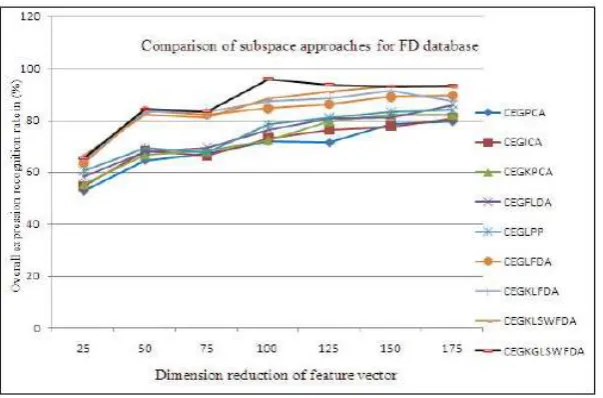
Figure 8: Comparison of OFERR Vs Dimensional reduction of subspace approaches at m=5 and n=8 for FD database
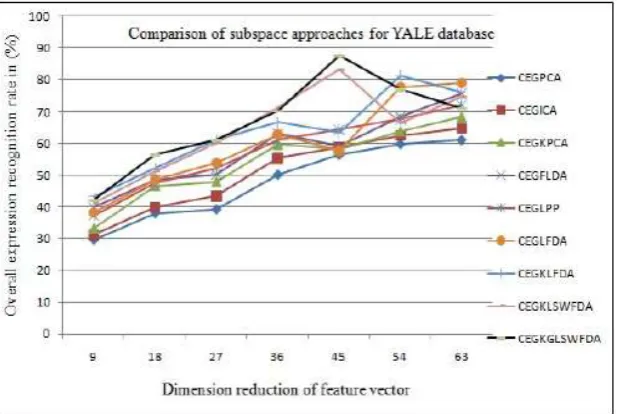
Figure 6, Figure 7, Figure 8 presents comparison of Overall facial expression recognition rate Vs Dimensional reduction of subspace approaches at m=5 and n=8 for JAFFE, YALE and FD databases respectively.
IVCONCLUSIONS
Facial expression recognition with preservation of local transitions is a challenging task. Global data variations took place during dimensionality reduction. Systematic study of various stages involved during expression recognition is delivered in this paper. Various subspace methods designed for labeled and unlabeled data structure needs efficient face detection criteria. Efficient feature extraction method leads to enhance the accuracy rates of face recognition. Results obtained for three standard bench mark databases depicts that expression recognition was found to be maximum for number scales and number orientations of Gabor filter has been set to 5 and 8 respectively. Due to nominal values of m and n of Gabor filter sufficient amount of features were utilized for subspace projection and this leads to high recognition rates. Two approaches CEGKLSWFDA and CEGKGLSWFDA are more prominent for preservation of data structure and recognition of various expressions.
REFERENCES
[1] G.P. Hegde, , M. Seetha, Nagaratna Hegde, . “Kernel Locality Preserving Symmetrical Weighted Fisher Discriminant Analysis based subspace
approach for expression recognition”, Engineering Science and Technology, an International Journal. Elsevier Publishers, Vol-19,
pp-1321-1333, ISBN-2215-0986, 2016.
[2] G.P.Hegde, M. Seetha and Nagaratna Hegde, “Study of Singularity Problems in Discriminative Based Subspace of Facial Expression Class
Features,” International Journal of Trend in Research and Development, Vol-3, 96-98, 2394-9333, 2016.
[3] Bettadapura V., “Face Expression Recognition and Analysis: The State of the Art,” In: IEEE Trans. on Pattern Analysis and Machine
Intelligence, vol. 22, pp.
[4] Kresimir Delac,Mislav Grgic and Panos Liatsis “ Appearance-based Statistical Methods for Face Recognition” 47th International Symposium
ELMAR -2005, 08-10 June 2005.
[5] Zhang, Y. Gao, S. Zhao and J. Liu, "Local derivative pattern versus local binary pattern: Face recognition with high order local pattern
descriptor", IEEE transaction Image Process, Volume 19, Issue 2, Pages 533-544, February 2010.
[6] X. Tan and B. Triggs, "Enhanced local texture feature sets for face recognition under difficult lighting conditions", IEEE Transaction, Image
Processing, Volume 19, Issue 6, Pages 1635-1650, June 2011.
[7] Adin Ramirez Rivera, Jorge Rojas Castillo, Oksam Chae, “Local Directional Number Pattern for Face Analysis: Face and Expression
Recognition”, IEEE Transactions on Image Processing, Volume 22, Issue 5, Pages 1740 – 1752, March 2013.
[8] Kresimir Delac,Mislav Grgic and Panos Liatsis “ Appearance-based Statistical Methods for Face Recognition” 47th
International Symposium ELMAR -2005, 08-10 June 2005.
[9] Shan, C., Gong, S., & McOwan, P. W.,” Facial expression recognition based on local binary patterns: A comprehensive study”,. Image and
Vision Computing, 27, 803–816., 2009.
[10] Rahulamathavan, Y., Phan, R. C.-W., Chambers, J. A., & Parish, D. J., “ Facial expression recognition in the encrypted domain based on local
fisher discriminant analysis.,” IEEE Transactions on Affective Computing, 4(1), 83–92.
[11] T.Ahonen, A. Hadid, and M. Pietik¨ainen, “Face description with local binary patterns: Application to face recognition,” IEEE Trans. Pattern
Anal. Mach. Intell., vol. 28, no. 12, pp. 2037–2041, Dec. 2006.
[12] Feng, X. Y., Hadid, A., & Pietik¨ainen, M.,”. Facial expression recognition with local binary patterns and linear programming.” Pattern
Recognition and Image\ Analysis, 15(2), 546–548. 2005.
[13] W. Zhao, R. Chellappa, P. J. Phillips, and A. Rosenfeld, “Face recognition: A literature survey”, ACM Computing Survey, Volume 35, Issue
4, Pages 399–458, December 2003.
[14] Ying-li Tian, Takeo Kanade and Jeffrey F. Cohn, “Evaluation of Gabor-Wavelet-Based Facial Action Unit Recognition in Image Sequences of
Increasing Complexity”,Proceedings of the Fifth IEEE International Conference on Automatic Face and Gesture Recognition (FGR02), Pages:
229 – 234, May 2002.
[15] T. Ahonen, Abdenour Hadid and Matti Pietikainen, “Face description with local binary patterns: Application to face recognition", IEEE
IJEDR1704123
International Journal of Engineering Development and Research (
www.ijedr.org
)
751
November 2011.
[17] G. P. Hegde , M. Seetha, “Subspace based Expression Recognition Using Combinational Gabor based Feature Fusion,” I.J. Image, Graphics
and Signal Processing, Vol. 1, pp 1, 50-60, 2017.
First Authors Profile
Mr. G. P. Hegde received M. Tech. degree in Computer Science and Engineering from Visvesvaraya Technical University (VTU) Belgavi,
India, in 2009. Presently he is pursuing PhD in Computer Science Engineering from Visvesvaraya Technical University (VTU) Belgaum. He is a faculty of SDM Institute of Technology, Ujire , India affiliated to Visvesvaraya Technical University(VTU) Belgavi. India. He has published over 32 technical publications and proceedings. His research interests include Image processing, Pattern recognition, Computer Networks, Software engineering, Software architecture.
Second Authors Profile