IJEDR1702002
International Journal of Engineering Development and Research (www.ijedr.org)10
Sustainable Parking
Faheem Ahmed Malik
Depart ment of Civ il Engineering, Isla mic University of Science & Technology, Awantipora, Kashmir. India/ School of Civ il Engineering & Geosciences, Newcastle Unive rsity,
________________________________________________________________________________________ _______________
Abstract—It’s high time to have a paradig m shift to multi modal trans port system and also move towards sustainable parking. All the three pillars of sustainability have to be ke pt in mind for any policy. The climate c hange is affecti ng the human life, it’s essential to have a modal shift so as to achieve a smarter and sustainable travel. It’s essential to have parking policy that supple ments this concept of sustainability. On-Street, Off-Street and Peri pheral parking have to be designe d in such a way so as to supple ment each other and shoul d follow a particular polic y. Parking price has to be designed in the same manner. It’s essential to assimilate the disabled people in any policy. Sustainable Parking is an important ste p towar ds sustainable travel and it shoul d take into acc ount the land use pattern and the local environment/surroundi ngs.
Index Terms—: Sustainable travel, S mart travel, On-Street Parking, Off-Street Parking, Periphery Parking, Parking
Charges/fees, disable d pe ople, Land use patter , Environment, surroundi ngs..(Keywords)
________________________________________________________________________________________________________
I. IN TRO DUC TION.
It‟s high time to move to mu lti modal planning. If congestion is looked fro m socio-economic point of view then it is a good indication as it shows economic activity. The cities in the present world look more like car parks. The future of the transpo rt is to move towards mobility as a service. Veh icle does not move on at roads at all times. Usually there are two spaces that are taken up by a car one at the commuter‟s residence and other at its work place.
For sustainable transport we need a modal shift towards public transport which has dire ct as well as indirect benefits. Direct benefits include reduction in congestion. Indirect Benefits more impetus for Public transport which brings money into the public transport and therefore help in up gradation of the service as well as quality of public transport. Allied benefits include improvement in a ir quality.
There are three E‟s of Transportation Engineering are Engineering, Education and Enforcement. Any transportation system should follow this cycle. For parking usually the education is done and then policy planners think that it will be enforced. We usually see that people don‟t park the vehicles in parking lots and many multistoried parking lots never reach to as close to capacity as they were designed for. The Cost-Benefit ratios of these parking lots differ fro m what it is usually conceptualized by the designer/planner. The reason behind this is lack of policy to facilitate such an investment.
II.PARKING
“Parking is the most important consideration for all cities”(Sustainable Urban Transport (IUT)).Well designed and Balanced parking control help in maximizing the efficiency of Road Space, allow clients to visit business, customers to visit retail establishments and the people residing/owners of business establishments to improve their mob ility whi le undertaking Economic and Social Activities. It is essential to encourage Retail and Co mmerc ial activities for a Central Business District so as to satisfy the Visitor De mand as well as Demand of the People involved with the activities of the CBD. Due to a high increase in the number of private owned Vehicles it becomes imperative to provide Parking Control in order to limit Public Space allocated to parking thereby encouraging the Public Modes of Transport.
Parking as a system has to be designed and a po licy should drive it. According to the policy the On -Street, Off-St reet and Peripheral Parking should be designed. The parking should complement the land use pattern and the local environment.
Parking System
Veh icles not only need street space to move, but also require space where occupants can be loaded and unloaded as well as park for some duration of time. Briely(1960) estimated that on an average out of 8,760 hours in an year, car runs only for 400hours(4.6% of time), leaving 8360 hours when it has to be parked. Parking may be On-Street or Off Street. An ill effect of on-street parking is the loss of on-street space and allied traffic congestion, thereby reducing the capacity of roadway, unnecessa ry delay and a decrease in journey speed.
There are three types of Parking System 1. On-Street Parking: -
2. Off-Street Parking: -
3. Peripheral Parking System: - Parking at the periphery of an area and inducing motorist to park their and travel to the busy town Centre by some other mode. There are three basic sch emes of Peripheral Pa rking system:-
IJEDR1702002
International Journal of Engineering Development and Research (www.ijedr.org)11
2. Park and Ride: - Motorists park their vehicle at periphery and ride a Public Transport to reach their destination. The schemeis usually designed in such a way that Peripheral Parking charges plus to and fro Public Transport charges are less than cost of travel by car plus parking at town Centre
3. Kiss and Ride: - This scheme has derived its name fro m the good bye kiss of a spouse dropping their partner from where he goes to work to perform the specified function in a Public Transport (e.g in a bus). Pre -requisite for success of this scheme is that adequate spacing for parking of car near the stop from where spouse can be dropped off or picked up or in some cases waited for arrivals for a short duration of time. .
III.LITERA TURE REVIEW
“The earlier concept of sustainability was to focus primarily on economic development and as there will be rise in the economy as well as wealth of the country as a whole, then there will be what is known as tickle down effect to the rest of the popula tion which will ensure social development. Then there will be enough resources for cleaning up the environment. It was realized way back in 1987 by The Brundtland Report (1987) that this approach needs to be readdressed and a more balanced approach is needed”.
The ma jor step towards climate change was Kyoto Protocol (1992) of United Nations Fra mework on Climate Change (UNFCC) which committed to reduce the Green House Gas emission. Developed countries had legal binding whereas developing countries although didn‟t have any legal binding but were committed to reduce emissions. Idea driving this concept was that it is the developed countries that are responsible for the high level of emissions. The problem with this was that only a handful of co untries had legal binding and U.S.A pulled out and other most countries failed to comp ly.
COP 21 or 21st Conference of Paris is considered the landmark event of the 21st Century. It was pledged to limit the change o f temperature to 2⁰C whereas desirable to limit only up to 1.5⁰C. In 2015 the earth was warmer by 0.89⁰C. For achieving this target the net Green house emission has to be brought down to zero in the coming decade. Transport is the second main source of CO2 emission and contributes around 11% to total emissions . India ratified COP 21 on October 2nd 2016, on the birth anniversary of Gandhi ji. India is the 4th largest production of CO2 e mission of 2,341,000 kt. In 2007 in top producers of CO2 only in India and China the CO2 e mission was increasing whereas in other countries it is decreasing.
Institute of Urban Transport have completely eliminated free On-Street Parking as well as parking fees which truly represent the price of the land.
IV.PARKING FEES.
The Roads are built to provide mobility to people and goods, not to provide space to the private owned vehicles to park their vehicles for the whole day there. The National Urban Transport Policy (NUTP) of India recommends that for making Public Transport ore Attractive it is essential to levy high Parking Fees which truly represents the value of Land Cost. This fees c an be used for the Contribution of the Sustainability and therefore success of the Parking Control. Parking fees has to be such that they ma ke sustainable modes more attractive , so that modal shift can be achieved. The car parking scheme should be such that the resources are used efficiently and effectively. The ma in idea should be making most of the scare resource
Ministry of Urban Develop ment‟s Initiative of Multi-level Parking Lots were given priority under Jawaharlal Nehru National Urban Rura l Mission (JNNURM). Such a proposal had to clearly indicate the Strategy of Parking Controls in that area.
V.RECO MMENDED PARKING POLIC Y
The recommended parking policy should have the following features
1. Minimizing the Impact of On-Street Parking and Encourage Off-Street Parking particularly for long term parkers such as commuters.
2. Optimizing Existing Parking Fac ilities
IJEDR1702002
International Journal of Engineering Development and Research (www.ijedr.org)12
4. Penalizing On-Street parking for a prolonged duration of time.5. Strong Enforce ment of illegal Parking
6. All the three types of Parking should follow a same policy and comple ment each other.
VI.CASE STUDY O F PROPOSED PARKING POLIC Y OF CEN TRAL BUSINESS DISTRIC T (SRINAGAR, JAMMU & KASHMIR)
Srinagar is the summer capital of the state of Jammu and Kashmir, kno wn for its beautiful landscape, majestic Ch inars, lofty mountains, beautiful rivers and lakes. The nature has given this place a lot but it‟s the human mess that needs to be cleared . Transportation problems are taking sheen of this heaven on earth. The Cen tral Business District of Srinagar is La l Cho wk-Residency Road.
Parking Problems
As per the Parking Survey Conducted more than 75% of the Vehicles are parked on the Road Space for more than 2-consective 15 minutes. The present state of on-Street Parking is wh ich badly affects the carriageway and results in the creation of Unnecessary Bottlenecks. The smoothness of the flow is affected as well as drop in the level of Se rvice
At present there are Four Parking Lots in the vicinity which are not properly design ed and Parking vehicle there is a cumbersome Effort which needs to be properly designed. Technically they are just a piece of land where people park their vehicles as per their wish of the people associated with the Revenue Collection (Government has emplo yed Private Public Partnership mode their). So metimes 3-4 lines of cars are parked adjacently there and to move the vehicle out of the Parking Area all these cars are first moved so as to make way for the car to leave. There is also a security concern for the people to leave their valuable Items in the car as the keys are to be deposited with these revenue collecting people which is not acceptable for a Central Business D istrict as people are expected to do their ma ximu m shopping in this area which usually contain a lot of valuable ite ms.
Why choose Central Business District
This place has a Politica l, Social Impact as well as Historic.
It is a place to which whole province of Kashmir Division look up to. It is the Crown of the State as well as place of Main Co mmerc ial Activity.
If we see Opera House in pictures it is enough to take our thought directly to Australia, Statue of Liberty represents France, Similarly Clock Tower at Ganta Ghar represents Kashmir.
Poloview as well Bund Market are the oldest Tourist Markets (Tourism is one of the main Sectors on which the economy of the State Depends).
Parking Policy
1. Minimizing the Impact of On-Street Parking and Encourage Off-Street Parking particularly for long term parkers such as commuters.
2. Optimizing Existing Parking Fac ilities
3. Parking Priority is given in the following descending order Physically Disadvantaged, Short term visitor, Co mmerc ial Activity, Long term parkers such as work commuters.
4. Penalizing On-Street Parking for a Period of more than 3 hours. 5. Minimizing the Illegal Parking with a heavy Fine.
IJEDR1702002
International Journal of Engineering Development and Research (www.ijedr.org)13
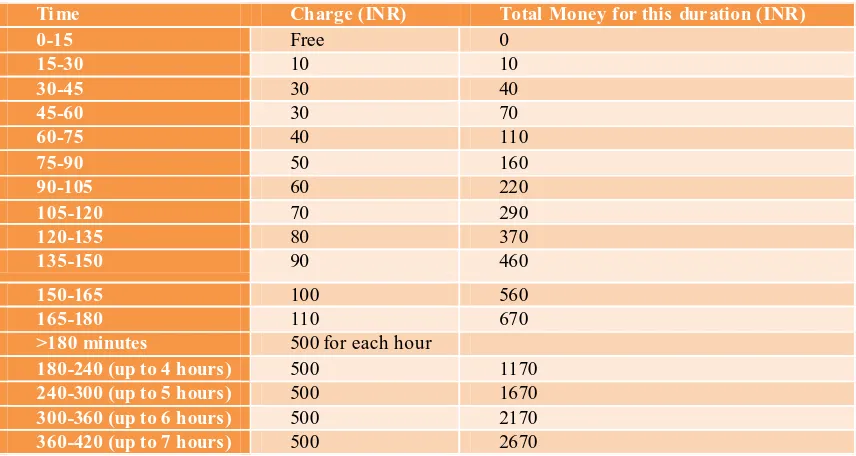
Table 1: Parking ChargesTi me Charge (INR) Total Money for this dur ation (INR)
0-15 Free 0
15-30 10 10
30-45 30 40
45-60 30 70
60-75 40 110
75-90 50 160
90-105 60 220
105-120 70 290
120-135 80 370
135-150 90 460
150-165 100 560
165-180 110 670
>180 minutes 500 for each hour
180-240 (up to 4 hours) 500 1170
240-300 (up to 5 hours) 500 1670
300-360 (up to 6 hours) 500 2170
360-420 (up to 7 hours) 500 2670
On-Street Parking is free for a ll Physically Disadvantaged people.
7. Off-Street Parking at INR 30 for the requisite duration of time. A Parking Pass of INR 700 per month for the persons associated with the establishments at CBD. For parking lots in the CBD a Parking Fees of INR 30 for 3 hours should be applied .
8. Peripheral Parking at INR 20 for the requisite duration of time. A Parking Pass of INR 400 per month for the persons associated with the establis hments at CBD.
Stopping Point/ Pick up Point: - It is essential to provide the Stopping Locations/ Pick up Points on the Carriageway as there are many Shopping bags need to be carried for such a location especially for Fa mily Shopping or even Tourists Shop ping in the location having their own Vehic les or a hired Cab for their whole stay which is a usual Practice here. Making On -Street Parking free for first 15 minutes serves this purpose.
Eliminating Park ing for Prolonged Duration:- There is very high Parking Price for any anyone Parking their vehicles there for lo ng duration of time which will eliminate Parking of Long durations Completely. With the Introduction of this Parking Policy Full day On-Street Parking will be completely e liminated
VII. CO NCLUSION
Parking policy has to now move so as to move to a sustainable transport. The main a im of a central business district is economic activity which should not be compromised. All the three pillars of sustainability should be kept in mind while designing any policy. This policy encourages pick n drop facility for free and a nominal fees for short duration of time whereas for prolonged dura tion such as 3 hours or even for the full day will levy a heavy fine.
VIII.AC KNOWLEDGMEN T
This project “Development of Sustainable Urban Transport for CBD ” has been funded and facilitated by Design Innovation J&K. I would like to than Er. Riyaz Ah med Qasab , Assistant Professor, Department of Civ il Engineering IUST for his guidance during this project. I would also like to thank the Administration of IUST , Design Innovation Center J&K especially Coordina tor DIC and Depart ment of Civil Engineering faculty and staff in particular Er. Saqib Ali, Er. Uzair Zahid Zahoor.
REFER ENC ES
[1] Banister, D. 2005. Unsustainable transport: City transport in the new century (Transport, development and sustainability). London: Routledge.
[2] Co mpendiu m of Modules, „Capacity Building Plan under “Sustainable Urban Transport Project”‟, Ministry of Urban Develop ment, Govern ment of India , New De lhi.
[3] Develop ment of Aesthetic Designs for Roadside Furniture, State of Art Report, M inistry of Surface Transport, prepared by Dr. L.R.Kadiyali and associates, New Dehli,1996.
[4] J.Briely,(1960) Parking of Motor Vehic les, C.R.Books Ltd, London.
[5] Kyoto Protocol 1992, Un ited Nations Fra me work Convention on Climate Change.
[6] Module 4 Parking guidelines, Capacity Bu ilding Plan under “Sustainable Urban Transport Project”‟, Min istry of Urban Develop ment, Govern ment of India , New De lhi.
IJEDR1702002
International Journal of Engineering Development and Research (www.ijedr.org)14
[8] Malik, F.A., Lone,M.A., Qasab, R.A, Gul, A. (2016) “Traffic Census and Analysis A Case Study”, International Journalof Research in Eng ineering and Technology (IJRET). Vo lu me 5, Issue03; March 2016, Page 69 -76. [9] Ortúza r S., J., & W illu msen, L. 2001. Modelling transport (3rd ed.). New York: J. Wiley.
[10] Road Transport year book,2007-09, Min istry of Sh ipping, Road Transport and highway, Govern ment of India, Ne w-Delh i.
[11] United Nat ions Conference on Road and Motor Transport, United Nations Publications, Lake Success, New Yo rk, 1950. [12] Urban Road Traffic System, „Capacity Building Plan under “Sustainable Urban Transport Project”‟, Ministry of Urban