a detection system on the Earth surface. Their transverse dimensions are increased by the distance they must travel as well by the terrestrial magnetic field which extends muon cloud and separates positive muons from negative ones. The extended wide transverse dimensions allow increasing the rate of detection of EAS produced by high energy CR by means of a single detector which samples the muon density in the shower. This concept has been already applied in the NEVOD-DECOR experimental complex at MEPhI in Moscow that could detect local muon density (LMD) of showers produced by very high energy CR up to more than 1018eV. By adding to the LMD the measurement of the local energy density (LED) the determination of the
primary energy E0can be substantially improved. A few embodiments of such a device can be envisaged
and one of them is discussed. The substantial rate increase of the area explored by a multimuon detection system measuring LMD and LED allows to conceive an array constituted by a relatively small number of such stations for measuring UHECR up to 1012eV and higher.
1. INTRODUCTION
The muon content of EAS produced by UHECRs increases at the increasing of the zenith angle. Quasi horizontal showers are exclusively constituted by muons, the other components being absorbed in the thick layer of the atmosphere they must cross for reaching the Earth surface.
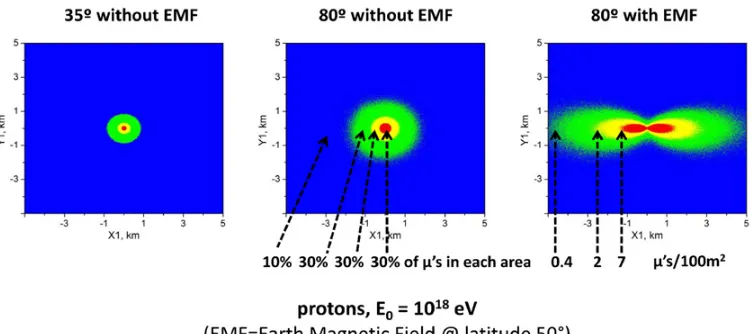
The transverse dimensions of the muon cloud are increased by the distance they must travel to reach ground as well by the terrestrial magnetic field which tends to extend their width and also separate positive muons from negative ones (Fig.1).
These facts increase the rate of UHECR EAS that impinge on a fixed ground position: muons and muon bundles can be detected at large distances from the core of the shower on a very wide region (several 106m2), quite sufficient for obtaining statistically significant results up to primary particle energies of 1018eV and higher. Muon bundles are for one order of magnitude nearer to the core of the shower than single muon, and their muons are for one order of magnitude more energetic than the single muon spectrum. Therefore the measurement of local muon density Dis highly sensitive to the most energetic hadrons produced in the forward region of hadron interactions. It carries important information where the uncertainties in model predictions are maximal and there are not accelerator data.
2. MEASUREMENT OF THE MUON DENSITY IN UHECR EAS
The increase of rate is substantial. It depends from the area of the muon detector which measures D. Requiring D>7 on a≈100m2detector, at Eo=1018eV the collection area of one station measuring EAS arriving from 80◦zenith angle is of the order of 0.6×2.5 km2perpendicularly to the shower axis, i.e. 3×2.5 km2on ground (see right plot in Fig.2).
Figure 2. Effective area of EAS collection in Local Muon Density Spectra technique. The content of muons is 30%
in each area. In third figure the averaged density of muons is indicated for Eo=1018eV energy of the primary CR.
The easier parameter to be measured is the local areal density Dof the impinging muon bundles. This is the method used by the DECOR instrument [1] deployed around the Cherenkov water calorimeter NEVOD [2] at MEPhI in Moscow, which could detect local muon densities of showers produced by UHECR up to more than 1018eV.
Due to the vertical orientation of DECOR planes and the presence of coordinate detector modules faced in two orthogonal azimuth directions, the azimuth acceptance of NEVOD-DECOR complex is nearly uniform (25−40m2) and allows collection of nearly horizontal multimuon events arriving from all azimuth angles. The data collected during several years allowed distinguishing different production models of shower in the atmosphere up to the very high energy 1018eV [3] by one relatively simple measurement station.
3. MEASUREMENT OF THE MUON ENERGY DENSITY IN UHECR EAS
The initial energy Eoof the UHECR originating the shower is determined with a large error ((log Eo)≈ 0.4) on the basis of a statistical treatment [4].
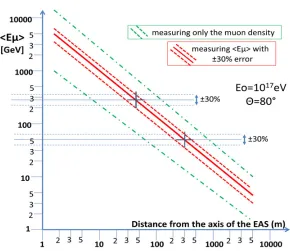
Figure 3. Correlation between the averaged muon averaged energyEand the distance from the core of the shower for=80◦and Eo=1018eV. The two dash-dotted lines correspond to the wide range of variability of the
correlation. By measuringEwith an error (±30%, dashed lines in the figure) the correlation is improved.
to determine the flux and the energy spectrum of the UHECR. This is represented in Figure3, where in double log scale the local muon averaged energyEis reported vs the distance from the axis of the shower for Eo=1018eV1.
In the figure the two dash-dotted lines indicate the wide range of variability of this correlation. By measuringEwith an error (e.g. 30%, dashed lines in the figure) the correlation with the distance from the EAS core is greatly improved. The Dmeasurement (to be conceived as a third axis perpendicular to the plane of the figure) can determine Eowith a relatively small error.
4. EMBODIMENTS OF THE APPARATUS FOR MEASURING EIN THE MULTIMUON
DETECTION SYSTEM
4.1 Measurement of muon momentum by a magnetized iron spectrometer
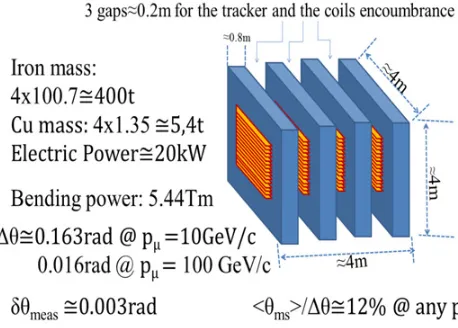
A possible embodiment of an apparatus for measuring Ecan be based on one magnetized iron system surrounded by tracking detectors for measuring the muon directions (and also D); the energy of each muon is measured by tracking it before and after the magnetized iron. The measurement of the energy of each muon not only measures the energy density Ebut also the local muon energy spectrum, further improving the determination of the position of the core of the shower and of the energy Eoof the primary particle.
The thickness of the iron to be crossed by the muons depends from the precision we require to reach in the muon momentum measurement. In order to obtain <20% error the thickness of the magnetized iron to be crossed must be in the range 3–4 m. The iron cannot be one block because of the need to
Figure 4. Scheme of the magnetized iron magnet to be inserted in the muon density measurement system for
measuring the muon momentum.
Figure 5. Dimensions and main parameters of a possible magnetized iron spectrometer.
follow each muon to be measured, and also to identify and measure those that are stopped by range inside the magnet. A possible scheme for the magnetized iron magnet is reported in Figure4.
The magnetized iron block can be similar to that proposed thirty years ago for the project of the “Jura neutrino experiment” [5]. It can be subdivided in 4 layers, each magnetized as indicated in Figure4. The main parameters reported in Figure5are evaluated for the dimensions reported in the figure.
The required electric power is somewhat low, about 5kW per iron layer, what can be provided also in desert areas by a relatively small solar panel plant. A system of three detectors for the pattern recognition of the muons of the bundle must be interleaved between the iron layers.
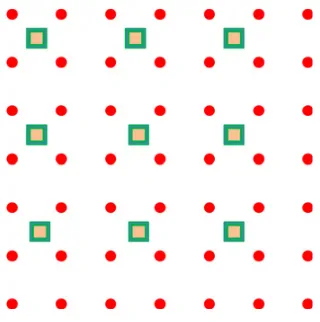
Figure 6. Layout and main components of a multimuon measurement station.
Figure 7. A system of multimuon measurement stations (pitch 3 km) over imposed to the AUGER surface array
(pitch 1.5 km).
4.2 Other possible systems for measuring the muon energy in the multimuon detection station
Other embodiments of the idea are possible, such as the energy measurement of the most energetic muons by large area TRDs based on the detection of the very hard X-rays produced in dense radiators at large angles respect to the direction of the crossing muon [6], or the measurement of the density of clusters along the muon track. Their needed large geometrical dimensions require a dedicated R&D in order to be discussed in some detail and evaluated their convenience.
5. SYSTEM OF MULTIMUON DETECTORS FOR QUASI HORIZONTAL UHECR SHOWERS
It is interesting and worthwhile considering how the increase of rate of detection of UHECR can be used for extending the collection area of giant UHECR detection systems.
References
[1] N.D. Barbashina et al., Instrum.Exp.Tech. 43, 743–746 (2000) [2] V.M. Aynutdinov et al., Astrophys. Space Sci. 258, 105–116 (1997)
[3] A.A. Petrukhin, “Cosmic Ray above the knee; experimental results and their interpretation” Proc. 32nd ICRC, Beijing, China 1, 50–53 (2011). Available in http://icrc2011.ihep.ac. cn/new.htm
[4] A.G. Bogdanov et al., Phys. Tom. Nucl. 73, 1852–1869 (2010)
[5] A. Grant et al., “Search for neutrino oscillations in the SPS wide-band beam”, CERN/SPSC/81-14, SPSC/P158 (1981)
[6] M.L. Cherry and G.L. Case, “Compton scattered transition radiation from very high energy