Processes in massive nuclei reactions and the way to complete fusion
of reactants. What perspectives for the synthesis of heavier superheavy
elements?
G. Mandaglio1,2,3,a, A.K. Nasirov4,5,b, F. Curciarello2,3, V. De Leo2,3, M. Romaniuk2,3, G. Fazio2,3, and G. Giardina2,3,c
1 Centro Siciliano di Fisica Nucleare e Struttura della Materia, 95125 Catania, Italy
2 Dipartimento di Fisica e di Scienze della Terra dell’Universit´a di Messina, 98166 Messina, Italy 3 Istituto Nazionale di Fisica Nucleare, Sezione di Catania, 95123 Catania, Italy
4 Joint Institute for Nuclear Research, 141980 Dubna, Russia 5 Institute for Nuclear Physics, 100214 Tashkent, Uzbekistan
Abstract. By using the dinuclear system (DNS) model we determine the capture of reactants at the first stage of reaction, the competition between the DNS decay by the quasifission (QF) and the complete fusion (CF) process up to formation of the compound nucleus (CN) having compact shape. Further evolution of the CN is considered as its fission into two fragments or formation of evaporation residues (ER) by its cooling after emission of neutrons or/and charged light particles. Disappearance of the CN fission barrier due to its fast rotation leads to the fast fission (FF) by formation of fissionlike fragments. The results of calculations for the mass symmetric
136Xe+136Xe reaction, almost mass symmetric108Mo+144Ba reaction, and mass asymmetric like24Mg+238U and 34S+248Cm reactions are discussed. The fusion probabilityP
CN calculated for many massive nuclei reactions
leading to formation of superheavy nuclei have been analyzed. The reactions which can lead in perspective to the synthesis of superheavy elements in theZ = 120−126 range and, eventually, also to heaviest nuclei, are discussed.
1 Introduction
The analysis of reaction dynamics and competition between the processes which take place at various steps of reaction with massive nuclei can explain why it is practically im-probable to reach the stage of CN in many reactions: we will discuss as an example the case of136Xe+136Xe reac-tion. The study of the hypothetical collision between the
108Mo and144Ba nuclei allows us to demonstrate why the
fusion of massive reactants is not the inverse process of fis-sion with almost symmetric fragments which are formed in the case of the252Cf spontaneous fission. The failure of many experiments is connected not only with the diffi cul-ties in the measurement of the evaporation residue cross sections which are lower than 0.5 pb but also in the in-adequacy of estimation of the complete fusion probability [1–3]. The reported difficulties are related not only with the theoretical estimation of the complete fusion and evapora-tion residue cross secevapora-tion but also in the not univocal exper-imental identification of fusion-fission fragments among the quasifission and fast fission fragments. We will dis-cuss the limits of reaching CN with charge heavier than
Z = 120 due to the dominant repulsive Coulomb effects and strong centrifugal forces in very massive nuclei reac-tions. The partial fusion cross sections present the effect of the angular momentum on the intrinsic fusion barrier and quasifission barrier, and the effect of the angles of the symmetry axes of the two deformed projectile and target
a e-mail:[email protected] b e-mail:[email protected] c e-mail:[email protected]
nuclei relative to the beam direction on the Coulomb bar-rier values and depth of potential well in nucleus-nucleus interaction. It will be shown that the evaporation residue cross sections decrease by increasing the angular momen-tum due to its influence on the fission barrier of the rotating CN.
In order to give realistic estimations of cross sections of the reaction products by mass symmetric or almost sym-metric entrance channel an adequate model allowing us to describe by a likelihood way the complex dynamics of the mechanisms during all stages of reaction has to be de-veloped. In fact, in the last stage of nuclear reaction, the formed CN may de-excite by fission (producing fusion-fission fragments) or by emission of light particles. The re-action products that survive fission are ER. The registration of ER is clear evidence of the CN formation, but in case of reactions with massive nuclei, generally, the knowledge about ER’s only it is not enough to determine the complete fusion cross section and to understand the dynamics of the de-excitation cascade of CN if the true fission fragments are not included into consideration. On the other hand, the correct identification of an evaporation residue nucleus by the observation of itsα-decay chain does not assure if the target material contains other isotopes of the nucleus un-der consiun-deration. In fact, for example, in the case of the
48Ca+249Cf reaction, the identification of the294Hs nucleus
as the evaporation residue of the297Hs CN after the
emis-sion of 3 neutrons (see the experiment reported in Ref. [4]) cannot assure that the collected events corresponding to the
294Hs nucleus are obtained only due to the mentioned
re-action leading to the formation of297Hs CN because in the
interaction of projectile48Ca with250Cf nucleus which is
DOI: 10.1051/ C
Owned by the authors, published by EDP Sciences, 2012 epjconf 20123/ 801001
This is an Open Access article distributed under the terms of the Creative Commons Attribution License 2 0 , which . permits unrestricted use, distributi and reproduction in any medium, provided the original work is properly cited.
inevitably present in the target due to the finite resolution of the mass separation. Therefore, it is also necessary to consider the contribution of this reaction to the ER forma-tion. In the last case the 48Ca+250Cf reaction (leading to
the298Hs CN) the same294Hs evaporation residue nucleus
is formed after emission of 4 neutrons from CN. This ef-fect depends on theECN∗ excitation energy of CN which is determined by the collision energy E∗c.m.. In addition, the
use of some assumptions about the reaction mechanisms leading to the formation of the observed fissionlike frag-ments, does not allow for sure correct determination of the fusion-fission contribution in the case of overlapping of the mass fragment distributions of different processes (quasi-fission, fast fission and fusion-fission). The exigence and importance to have a multiparameter and sensitive model is strongly connected with the requirement to reach reliable results and with the possibility to give reliable estimations of perspectives for the synthesis of superheavy elements. If the estimations reported in figures 3 (a) and (b) of Ref. [5] about evaporation residue cross section after 2n, 3n, and 4n emission which are peaked at about the sameE∗=40 MeV of the298116 excitation energy are reliable results, then im-mediately arises the question: what process and barriers can describe with appreciable probabilities the emission of 2 and 3 neutrons that take away about 43 and 48 MeV (or also more) of excitation energy from the298116 and299118 CN, respectively? These results mean that each neutron in the evaporation of 2n is emitted with a kinetic energy of about 15 times the nuclear temperature of the298116 CN,
and 10 times the nuclear temperature of299118 CN in the
3n evaporation process. That is a fully improbable result.
2 Model and formalism
By using the DNS model [6], the first stage of reaction is the capture formation of a DNS after full momentum transfer of the relative motion of colliding nuclei into a rotating and excited nuclear system. In the deep inelastic collisions DNS is formed but the full momentum transfer does not occur. Therefore, the deep inelastic collisions are not capture reactions.
The partial capture cross section at a given energyEc.m.
and orbital angular momentumℓis determined by formula
σℓ
cap(Ec.m.)=πλ−2Pℓcap(Ec.m.), (1)
wherePℓcap(Ec.m.) is the capture probability meaning the
path of collision is trapped into the well of the nucleus-nucleus potential after dissipation of the part of the initial relative kinetic energy and orbital angular momentum [7, 8]. The capture probabilityPℓcap is equal to 1 or 0 for a givenEc.m.energy and orbital angular momentumℓ. Our
calculations showed that, depending on the center-of-mass system energyEc.m., there can be “window” in the orbital
angular momentum for capture with respect to the follow-ing conditions [7, 8]:
Pℓ
cap(Ec.m.)=
1, if ℓmin≤ℓ≤ℓd and Ec.m.>VCoul
0, if ℓ < ℓmin or ℓ > ℓdand Ec.m.>VCoul
0, for allℓ if Ec.m.≤VCoul.
The boundary valuesℓminandℓdof the partial waves lead-ing to capture depend on the dynamics of collision and they
are determined by solving the equations of motion for the relative distance R and orbital angular momentumℓ [9– 11]. At lower energies,ℓmin decreases to zero and we do
not observe theℓ“window”: 0≤ℓ≤ℓd. The range of the
ℓ“window” is defined by the size of the potential well of the nucleus-nucleus potentialV(R,Z1,Z2) and the values of the radialγRand tangentialγtfriction coefficients, as well as by the moment of inertia for the relative motion [8, 10].
The quasifission process competes with formation of complete fusion. This process occurs when DNS prefers to break down into two fragments instead of transforming into the fully equilibrated CN.
The fusion excitation function is determined by prod-uct of the partial capture cross sectionσℓcapand the fusion probabilityPCNof DNS, at variousEc.m.values
σfus(Ec.m.;βP, αT)=
ℓf
∑
ℓ=0
(2ℓ+1)×
×σcap(Ec.m., ℓ;βP, αT)PCN(Ec.m., ℓ;βP, αT). (2)
Obviously, the quasifission cross section is defined by
σqfis(Ec.m.;βP, αT)=
ℓd
∑
ℓ=0
(2ℓ+1)×
×σcap(Ec.m., ℓ;βP, αT)(1−PCN(Ec.m., ℓ;βP, αT)). (3)
For more specific details and descriptions of the model see Refs.[7, 8, 12–14].
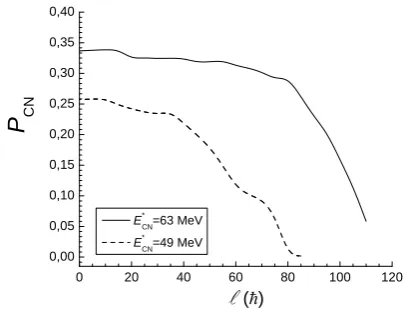
Here, in order to show the sensitivity of our model, in figure 1, we present the calculated PCN fusion probabil-ity as a function of the orbital angular momentum ℓ(~), at excitation energies E∗CN = 49 MeV (dashed line) and 63 MeV (full line) of the202Pb CN which is formed in the 48Ca+154Sm reaction. The figure shows how much thePCN
0 20 40 60 80 100 120
0,00 0,05 0,10 0,15 0,20 0,25 0,30 0,35 0,40
P
CN
() E*
CN=63 MeV
E*CN=49 MeV
Fig. 1.ThePCNfusion probability calculation versus the orbital
angular momentumℓ(~) for the48Ca+154Sm reaction, at two
dif-ferentE∗CNvalues of the202Pb CN.
fusion probability changes with the ℓ(~) value at a fixed
E∗CNexcitation energy of CN, and how much does thePCN
trend change at two different ECN∗ values. Therefore, the methods that do not take into account in calculation the dependence of thePCNfusion probability on the collision
energyEc.m., angular momentumℓ(~), and on the
The fast fission cross section is calculated by summing the contributions of the partial waves corresponding to the rangeℓf ≤ℓ ≤ℓd leading to the formation of a mononu-cleus where the fission barrierBf is zero in such range of ℓ, and the system promptly decays into two fragments
σfastfis(Ec.m.;βP, αT)=
ℓd
∑
ℓf
(2ℓ+1)×
×σcap(Ec.m., ℓ;βP, αT)PCN(Ec.m., ℓ;βP, αT). (4)
The capture cross section in the framework of the DNS model is equal to the sum of the quasifission, fusion, and fast fission cross sections
σℓ
cap(Ec.m.;βP, αT)=σℓqfiss(Ec.m.;βP, αT) (5)
+σℓ
fus(Ec.m.;βP, αT)+ σℓfastfis(Ec.m.;βP, αT). It is clear that the fusion cross section includes the cross sections of evaporation residues and fusion-fission prod-ucts. The ER cross section is calculated by the advanced statistical code[15–17] that takes into account the damping of the shell correction in the fission barrier as a function of nuclear temperature and orbital angular momentum in determination of the survival probabilityWsur(x−1)(E∗x, ℓ)
σER(x)(E∗x)=
ℓd
∑
ℓ=0
(2ℓ+1)σℓ(x−1)(Ex∗)Wsur(x−1)(E∗x, ℓ). (6)
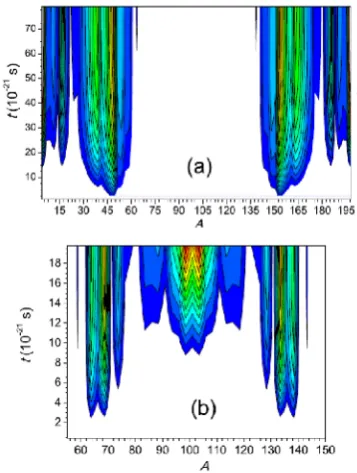
We able to calculate mass- and angle distribution of quasifission and fusion-fission fragments, anisotropy of the fission fragment angular distribution and the dependence of cross sections, Coulomb barrier, intrinsic fusion barrier and quasifission barrier as a function of the orientation an-gle of the symmetry axes of colliding nuclei (see Refs. [14, 18]). In figure 2, for example, we present the mass distribution of quasifission fragments (see figure 2 for the
48Ca+154Sm reaction). In many cases, in dependence on
the entrance channel peculiarities, the mass distributions of fusion-fission, quasifission and the fast fission fragments can overlap [14, 19], as a result the real difficulties arise in the analysis of experimental data in order to identify the true yields of fragments according to corresponding pro-cesses in heavy ion collisions. Figure 2 shows that at lower
Ec.m.energy the mass distribution of quasifission products
populate the asymmetric mass region at any lifetime value of DNS (see figure 2 (a)), while at higherEc.m.energy it is
also populated the symmetric mass region for longer DNS lifetimes (see figure 2 (b)).
The lifetime of an excited DNS for a given reaction depends on the initial collision energyEc.m. and angular
momentum distribution values [19]. The nuclei constitut-ing the DNS change their mass and charge by nucleon ex-change, as well as their shapes during evolution of DNS. The evolution of DNS depends on its excitation energy, orientation angles of the axial symmetry axes and shell structures of reacting nuclei. Therefore, the DNS during its evolution can evolve to complete fusion (fusion process) or can decay into two fragments (quasifission process). The competition between these two processes is related to the values of intrinsic fusion barrierB∗fusand quasifission bar-rierBqf[20–22] depending on the peculiarities of reacting nuclei, beam energy and angular momentum distribution.
Fig. 2.(a) The mass distribution of the quasifission products yield in the48Ca+154Sm reaction atE
c.m.=140 MeV as a function of the
lifetime of DNS formed at capture stage. (b) The mass distribu-tion of the quasifission product yields in the48Ca+154Sm reaction
atEc.m.=160 MeV as a function of the lifetime of DNS.
3 Study of the
136Xe+
136Xe and
108Mo+
144Ba
reactions
In order to check, can always any projectile and target com-bination lead to the complete fusion of reactants (having enough beam energy to overcome the Coulomb barrier) and to synthesize the wanted superheavy element (SHE), as an example, we consider the mass symmetric 136Xe+
136Xe reaction leading to the272Hs CN. By using the
pro-cedure presented in previous Sec. 2, for this reaction we obtain the results which are shown in figure 3. In figure 3, (a) the capture, quasifission, fusion and fast fission cross sections versus Ec.m. energy are reported, while figure 3
(b) shows the fusion probabilityPCNin the same explored Ec.m. energy range. As on can see the capture cross
sec-tion for the 136Xe+136Xe reaction is about 10 mb in the
explored energy range while the fusion cross section lead-ing to the272Hs CN ranges between 0.1 and 10 pb (with a fusion probability of about 10−14−10−11) in the sameE
c.m.
interval. From our investigations we can conclude that the evaporation residue cross section is much lower than 10−10
pb. Such a value practically means that no synthesis events of reacting nuclei occur136Xe+136Xe.
For a comparison with the results of the last reaction, in figure 4 (a), we present the results obtained in this work for the mass asymmetric24Mg+248Cm reaction leading to
the same 272Hs CN where at lower-medium E
c.m.energy
range the fusion process is dominated in the reaction dy-namics, while at high energy the quasifission process pre-vails. At energiesEc.m.≈135 MeV the fusion-fission cross
section is about 150 mb and mass distribution of the sym-metric fission fragments are peaked around the mass of the
136Xe nucleus, while the ER cross section is about some pb
fusion-(b)
320 325 330 335 340 345 350 355 360 1E-15
1E-13 1E-11 1E-9
PC
N
Ec.m.(MeV)
320 325 330 335 340 345 350 355 360 1E-15
1E-13 1E-11 1E-9 1E-7 1E-5 1E-3 0,1 10
E c.m. (MeV)
C
ro
s
s
s
e
c
ti
o
n
s
(
m
b
)
Capture Quasifission Fusion Fast fission
136
Xe+136Xe =>272Hs
σQuasifission _ σ Capture
(a)
Fig. 3.The capture, quasifission, fusion and fast fission cross sec-tions (panel (a)), and thePCNfusion probability (panel (b)),
ver-sus theEc.m.energy of the136Xe+136Xe reaction.
fission cross section in the 24Mg+248Cm reaction at E∗ CN
of about 55 MeV is about 150 mb, while the results for the above-mentioned fusion-fission cross section with the mass symmetric distribution in the 136Xe+136Xe reaction is about some pb (because the reaction dynamics is com-pletely dominated by the quasifission process) that is about 10−11 times lower than the136Xe fusion-fission fragment
yield obtained by the24Mg+248Cm reaction. Such a result means that, at the present experimental conditions, it is im-possible to register 1 event of synthesis by the136Xe+136Xe
reaction during 10 billion of years of beam dose. Experi-mentalists and laboratories are friendly invited to disavow such an estimation.
An analogous consideration attains for the study of the
108Mo+144Ba reaction in order to obtain the252Cf CN by
fusion of reactants and to compare such a process - be-lieved as the possible inverse process of the fission - with the 252Cf spontaneous fission leading to the asymmetric mass fragment distribution peaked at108Mo (for the light
fragment) and144Ba (for the heavy one).
In figure 5 (a) the capture, quasifission, fusion, and fast fission excitation functions are presented. Figure 5 (b) shows thePCNfusion probability in the sameEc.m.energy
range. This quantity is determined as a ratio of complete fusion cross section to the capture cross section:PCN(Ec.m.)= σfus(Ec.m.)/σcap(Ec.m.). The results demonstrate that, also
in this case of almost mass symmetric reaction, the quasi-fission process strongly dominates over complete fusion and thePCNfusion probability ranges between 10−11−10−4
30 35 40 45 50 55 60
1E-4 1E-3 0,01 0,1 1 10 100
(b)
E
R
c
ro
ss
s
ec
ti
o
n
(
p
b
)
E*CN (MeV)
4n 5n 6n
110 120 130 140 150 160 170 180 190 200 210 1E-7
1E-6 1E-5 1E-4 1E-3 0,01 0,1 1 10 100 1000 10000
24
Mg+248Cm => 272Hs
C
ro
ss
s
ec
ti
o
n
s
(m
b
)
Ec.m.(MeV)
Capture Quasifission Fusion Fast fission
(a)
Fig. 4.The capture, quasifission, fusion and fast fission cross sec-tions (panel (a)) versus theEc.m.energy, and the individual evapo-ration residue cross sections (panel (b)) versus theECN∗ excitation energy of CN, for the24Mg+248Cm reaction. In panel (b) are
re-ported the calculation when the masses and barriers of Ref. [23] (black lines) or Refs. [24, 25] (blue lines) are used.
in the explored energy range. Moreover, in figures 6 (a) and 6 (b), we report the angular momentum distribution of the capture and complete fusion stages of the108Mo+144Ba
re-action, respectively. As one can see, the capture is strongly contributed by the 50-100 ~ orbital angular momentum range, while the largest contribution of complete fusion is peaked at around 25~. The results presented in figures 5 and 6 showed smallness of the fusion probability of two colliding nuclei which are 108Mo and144Ba being fission products of252Cf observed with largest probability. So, we can conclude that complete fusion can not be considered as inverse channel to fission of compound nucleus hav-ing large probability. Therefore, it is impossible to believe to the statement that the fusion process can be considered as the inverse process of fission. Due to mentioned above the dependence of the entrance channel dynamics on the characteristics of each beam-target combination, it is im-possible to obtain the same CN (with the sameZ,A, and
220 230 240 250 260 270 280 1E-11 1E-10 1E-9 1E-8 1E-7 1E-6 1E-5 1E-4 1E-3 0,01 (b) P C N
Ec.m.(MeV)
220 230 240 250 260 270 280
1E-8 1E-7 1E-6 1E-5 1E-4 1E-3 0,01 0,1 1 10 100
Ec.m.(MeV) 108
Mo+144Ba => 252 Cf
C ro ss s ec ti o n s (m b ) Capture Quasifission Fusion Fast fission
σQuasifission
σCapture
(a)
Fig. 5. Cross sections (panel (a)) and PCN fusion probability
(panel (b)) versus theEc.m.energy, for the108Mo+144Ba reaction.
0 10
2030
4050
6070 80
90 100110
220 230 240 250 260 270 280 0,000 0,001 0,002 0,003 0,004
(b)
P arti al f usi on cro ss s ecti o n ( mb / ) E c.m. (M eV)
() 0 20 40 60 80 100 120 240 260 280 0,0 0,5 1,0 1,5 2,0 2,5 3,0 3,5 () Ec.m. (M
eV)
P arti al c ap ture cro ss sec tio n ( mb
/
)
(a)
Fig. 6. Spin distribution of capture (panel (a)) and fusion (panel (b)) cross sections as a function ofEc.m. energy, for the
108Mo+144Ba reaction.
4 Investigation on the superheavy nuclei
and perspectives for heavier superheavy
elements
In order to estimate the realistic possibilities to synthesize superheavy elements by massive nuclei reactions, we cal-culated the ER cross sections for a set of reactions forming fissile compound nuclei withZ ≥100 at the same excita-tion energy (ECN∗ ≃37 MeV). In Table 1 we present the set of studied reactions by various entrance channels with different charge (mass) asymmetry parameters.
Table 1.The listed reactions are reported as a function of the chargeZCNof CN (if it can be reached), and the parameterz =
Z1×Z2
A1/31 +A1/32 representing the Coulomb barrier of reacting nuclei in
the entrance channel.
Reaction ZCN z Reaction ZCN z
16O+238U 100 84 86Kr+208Pb 118 286 48Ca+208Pb 102 172 132Sn+174Yb 120 328 50Ti+208Pb 104 188 64Ni+238U 120 253 136Xe+136Xe 108 284 58Fe+244Pu 120 242 58Fe+208Pb 108 218 54Cr+248Cm 120 229 48Ca+226Ra 108 181 132Sn+176Hf 122 337 26Mg+248Cm 108 125 54Cr+249Cf 122 234 48Ca+243Am 115 193 132Sn+186W 124 343 48Ca+248Cm 116 194 58Fe+249Cf 124 251 48Ca+248Bk 117 196 84Kr+232Th 126 307 48Ca+249Cf 118 198 64Ni+249Cf 126 267
It is interesting to observe and analyze the overall trend of the fusion probabilityPCNand the evaporation residue yields in different reactions as a function of the chargeZCN
of CN and of the parameter z = Z1×Z2
A1/31 +A1/32 (related to the Coulomb barrier in the entrance channel) in order to draw some useful indications on the reactions which may lead to synthesize heavy nuclei withZCN≥100 and superheavy elements withZCN≥120.
95 100 105 110 115 120 125 130
1E-14 1E-13 1E-12 1E-11 1E-10 1E-9 1E-8 1E-7 1E-6 1E-5 1E-4 1E-3 0,01 0,1 1 10 P C N Z CN E*CN ~ 37 MeV
(a)
Fig. 7.Fusion probabilityPCN calculated at the same excitation
energyE∗CN≃37 MeV versus chargeZCNfor the reactions listed
in Table 1.
Fig. 8.Fusion probabilityPCNversus the parameterz
(represent-ing the Coulomb barrier of react(represent-ing nuclei in the entrance chan-nel) for many reactions with charge of CNZCN included in the
ZCN=100-126 range.
figure thatPCNslowly decreases by increasingZCNbut it decreases strongly for more symmetric reactions in the en-trance channel leading to the sameZCN. The PCNvalues decrease for less asymmetric reactions. The trend ofPCN
appears more clear for the same investigated reactions if we presentPCNas a function of the parameterz= Z1×Z2
A1/31 +A1/32 representing the effect of the Coulomb barrier of interact-ing nuclei in the entrance channel (see figure 8). As figure 8 shows the trend ofPCNatECN∗ ≃37 MeV strongly de-creases by increasing thezparameter and by decreasing the charge (mass) asymmetry parameter of reactions in the en-trance channel. The hindrance to complete fusion increases for more symmetric reactions and for higher Coulomb bar-riers of reactions in the entrance channel.
Fig. 9.Evaporation residue cross sectionσER(after neutron
emis-sion only) versus the parameterzrepresenting the Coulomb bar-rier in the entrance channel, for reactions withZCN=100-120.
Figure 9 shows the evaporation residue cross sections, after only neutron emission from CN, obtained for the in-vestigated reactions as a function of the parameter z, at
E∗CN ≃37 MeV. In this figure the horizontal dotted line marks the value of 1 pb for the ER cross section. The evaporation residues after neutron emission only from the de-excitation cascade of CN can be observed for reactions with parameterzlower than the values of about 200. For values set of parameterzincluded in the range about 200-235 the observation of residues is at limit (or it appears to be a very problematic task) of the current experimental
possibilities. For reactions withzhigher than 235 it is im-possible to observe ER of CN after neutron emission only.
5 Reactions leading to compound nuclei
with
Z
≥
120
The results of calculations obtained for the reactions lead-ing to CN withZ =120, 122, 124, and 126, at excitation energy of compound nuclei of about 37 MeV are presented in Table 2.
Table 2.Reactions leading to compound nuclei withZCN=120,
122, 124, 126, as a function of the parameterzrepresenting the Coulomb barrier in the entrance channel.σERis the ER cross
sec-tion after the neutron emission only from the de-excitasec-tion cas-cade of CN;Pres/capis the ratio between the yields of evaporation
residueσERand the captureσcap.
Reaction ZCN z σER(mb) Pres/cap
54Cr+248Cm 120 229 1.05×10⁻¹⁰ 0.3×10⁻¹¹ 58Fe+244Pu 120 242 5.4×10⁻¹² 0.17×10⁻¹³
64Ni+238U 120 253 3.1×10⁻¹⁵ 0.14×10⁻¹⁵ 54Cr+249Cf 122 234 1.4×10⁻¹⁰ 0.13×10⁻¹¹ 58Fe+249Cf 124 251 1.61×10⁻¹⁵ 0.18×10⁻¹⁶ 64Ni+249Cf 126 267 4.4×10⁻²⁰ 6.5×10⁻²²
Figure 10 shows the theoretical results of ER as a func-tion of the parameterz= Z1×Z2
A1/31 +A1/32 atE ∗
CN≃37. The dotted
line the value ofσERof 1 pb. Our estimations showed that
Fig. 10.As figure 9, but for reactions leading toZCN=120-126.
6 Conclusions
On the basis of dynamical and statistical calculations we studied a formation of a dinuclear system in the entrance channel and its subsequent evolution to be transformed into compound nucleus in a competition with quasifission. The distribution of the PCN fusion probability versus the CN chargeZCN, angular momentum in the entrance channel andEc.m.energy has been estimated for a wide set of
re-actions. From the study of such systematics we can under-stand the effect of the entrance channel mass asymmetry on the fusion probability and evaporation residue yields in many reactions forming various compound nuclei at the same excitation energyE∗CNof about 37 MeV.
The trend ofPCNis represented by a slow decrease with
the increase of the chargeZCN, a significant decrease of the
PCN values by decrease of the mass (charge) asymmetry parameter of reactants in the entrance channel forming the same CN, and a fast decrease of thePCNvalues and ER
yields versus the parameterz= Z1×Z2
A1/31 +A1/32 .
Regarding the results of the investigated reactions lead-ing to the formation of compound nuclei withZCN=120, 122, 124, and 126 we affirm that there is still possibility to reach and observe the ER of the 120 superheavy element by a reaction withzparameter value of about 230, while it is a very doubtful venture to synthesize the 122 superheavy element by reactions withzparameter value of about 234 or higher by the current experimental resources and meth-ods of observing evaporation residues.
A possibility to observe evaporation residue of super-heavy elements disappears in reactions withzparameter in the entrance channel higher than 240. Therefore, it is impossible to form the 124 and 126 superheavy nuclei in these kind of reactions.
The quasifission is the main process causing the hin-drance to complete fusion and the contribution of this pro-cess strongly increases for reactions with large values of
zparameter and also with the increase of the colliding en-ergyE∗c.m.. The fast fission and fusion-fission are the subse-quent hindrances competing with formation of evaporation residues after surviving system against to quasifission. In this context, the mass symmetric or nearly symmetric re-actions in the entrance channels do not give a realistic pos-sibility to synthesize superheavy elements, and the use of the132Sn beam is of scarce usefulness for this kind of re-actions.
Consequently, it is an unrealizable dream to think of performing the132Sn+208Pb (withz=373) and132Sn+249Cf (withz=431) reactions in order to reach the 340132 and
381148 superheavy elements, respectively, and by the mass
symmetric reactions as136Xe+136Xe (withz=184) and 139,149La+139,149La (withz=317 and 306, respectively) to
synthesize heavy and superheavy elements to cause of the absolute dominant contribution of the quasifission process after capture, and the fast fission process presents at stage of the small probable formation of complete fusion.
Moreover, we discussed the role of the entrance chan-nel characteristics and Coulomb forces on the reaction dy-namics, complete fusion, and formation of the evaporation residues which are a synthesized superheavy elements. As the example, the evaporation residue cross sections, which were calculated for the 136Xe+136Xe and 24Mg+
248Cm reactions leading to the same272Hs CN, have been
compared. In addition, we also discussed the reason for which the complete fusion process of two massive reac-tants (for example in the108Mo+144Ba reaction) cannot be considered as the inverse process of fission (for example in the252Cf spontaneous fission) leading to fragments (for
example108Mo and144Ba) that are the same nuclei used in
the proposed fusion reaction.
References
1. K. Siwek-Wilczynska, et al., Int. J. Mod. Phys. E 16, 493 (2007)
2. R. Smolanczuk, Phys. Rev. C63, 044607 (2001) 3. V. I. Zagrebaev and W. Greiner, Nucl. Phys. A787, 363
(2007)
4. Yu. Ts. Oganessian, et al., Phys. Rev. C 74, 044602 (2006)
5. V. I. Zagrebaev, A. V. Karpov, and W. Greiner, Phys. Rev. C85, 014608 (2012)
6. N. A. Antonenko,et al., Phys. Lett. B319, 425 (1993); Phys. Rev. C51, 2635 (1995)
7. G. Fazioet al., Phys.Rev. C72, 064614 (2005) 8. A. Nasirov,et al., Nucl. Phys. A759, 342 (2005) 9. G. Fazio,et al., Eur. Phys. J. A19, 89 (2004)
10. G. Giardina, S. Hofmann, A. I. Muminov, A. K. Nasirov, Eur. Phys. J. A8, 205 (2000)
11. G. Fazio,et al., J. Phys. Soc. Japan72, 2509 (2003) 12. A. K. Nasirov,et al., Phys. Rev. C79, 024606 (2009) 13. G. Fazio,et al., J. Phys. Soc. Japan77, 124201 (2008) 14. G. Fazio,et al., Mod. Phys. Lett. A20, 391 (2005) 15. A. D’Arrigo,et al., Phys. Rev. C46, 1437 (1992) 16. A. D’Arrigo,et al., J. Phys. G20, 365 (1994) 17. R. N. Sagaidak,et al., J. Phys. G24, 611 (1998) 18. G. Giardina,et al., J. Phys. CS282, 012006 (2011) 19. A. K. Nasirov,et al., Phys. Rev. C79, 024606 (2010) 20. H. Q. Zhang,et al., Phys. Rev. C81, 034611 (2010) 21. G. Fazio,et al., Eur. Phys. J. A22, 75 (2004) 22. G. Fazio,et al., Phys. Rev. C72, 064614 (2005) 23. P. M¨oller and J. R. Nix, J. Phys. G: Nucl. Part. Phys.
20, 1681 (1994)
24. I. Muntian, Z. Patyk, and A. Sobiczewski, Phys. Atom. Nucl.66, 1015 (2003)