An
ab initio
theory of double odd-even mass differences in nuclei
E. E. Saperstein1,a, M. Baldo2, N. V. Gnezdilov1, U. Lombardo3, and S. S. Pankratov1,4 1 Kurchatov Institute, 123182, Moscow, Russia
2 INFN, Sezione di Catania, 64 Via S.-Sofia, I-95125 Catania, Italy
3 INFN-LNS and University of Catania, 44 Via S.-Sofia, I-95125 Catania, Italy 4 Moscow Institute of Physics and Technology, 123098 Moscow, Russia
Abstract. Two aspects of the problem of evaluating double odd-even mass differencesD2in semi-magic nuclei are studied related to existence of two components with different properties, a superfluid nuclear subsystem and a non-superfluid one. For the superfluid subsystem, the differenceD2 is approximately equal to 2∆, the gap∆ being the solution of the gap equation. For the non-superfluid subsystem,D2is found by solving the equation for two-particle Green function for normal systems. Both equations under consideration contain the same effective pairing interaction. For the latter, the semi-microscopic model is used in which the main term calculated from the first principles is supplemented with a small phenomenological addendum containing one phenomenological parameter supposed to be universal for all medium and heavy atomic nuclei.
1 Introduction
Recently, a progress has been made in the’ab initio’ the-ory of nuclear pairing, first, by the Milan group [1–3], a bit later by Duguet et al. [4, 5], and finally by the Moscow-Catania group [6–10]. By ’ab initio’ we mean a theory of Brueckner type starting from a free NN-potential, not a realab initioapproach based on the QCD theory. The quotes indicate the fact that, in any of the cited references, the authors deal with a calculation which is not completely
ab initioeven at such lowest level. Indeed, the self-consistent mean field used in each of them is calculated by means of an Energy Density Functional (EDF) containing phe-nomenological parameters. Solving the BCS equation for the gap∆with a realisticNN-potential for the pairing inter-action is the main ingredient of all of them. This is exactly the prescription of the simplest version of the Brueckner theory as the ladder diagram summation is already per-formed in the gap equation itself.
In the first paper of the Milan series, the BCS gap equa-tion for neutrons with the Argonne v14potential was solved
for the nucleus120Sn, the Saxon-Woods Shell-Model
ba-sis with the bare neutron massm∗ =m. Rather optimistic result was obtained for the gap value,∆BCS = 2.2 MeV
which is bigger, but not dramatically, than the experimen-tal one,∆exp ≃1.3 MeV, leaving some hope of achieving
a good agreement by finding corrections to the scheme. In Refs. [2, 3], the effective massm∗,mwas introduced into the gap equation within the Skyrme–Hartree–Fock (SHF) method with the Sly4 force [11]. In this case the eff ec-tive massm∗(r) is space dependent and essentially diff er-ent from the bare onem. E.g., in nuclear matter the Sly4 effective mass is equal to m∗ = 0.7m. In the weak cou-pling limit of the BCS theory, the gap is exponentially dependent, i.e.∆ ∝ exp(1/g), on the inverse dimension-less pairing strengthg = m∗VeffkF/π2, whereVeff is the
a e-mail:[email protected]
effective pairing interaction. Therefore, a strong suppres-sion of the gap takes place in the case of m∗ < m. The value of ∆BCS = 0.7 MeV was obtained in Ref. [2] and
∆BCS=1.04 MeV, in Ref. [3]. In both cases, the too small
value of the gap was explained by invoking various many-body corrections to the BCS approximation. The main cor-rection is due to the exchange of low-lying surface vibra-tions (“phonons”), contributing to the gap around 0.7 MeV [2], so that the sum turns out to be ∆ = 1.4 MeV very close to the experimental value. In Ref. [3], the contribu-tion of the induced interaccontribu-tion caused by exchange of the high-lying in-volume excitations was added either, the sum again is equal to∆ ≃ 1.4 MeV. Thus, the calculations of Refs. [2, 3] showed that the effects ofm∗,mand of many-body corrections to the BCS theory are necessary to ex-plain the difference of (∆BCS−∆exp). In addition, they have
different sign and partially compensate each other. Unfor-tunately, both effects contain large uncertainties. This point was discussed in Refs. [7, 9, 10].
To avoid such uncertainties, a semi-microscopic model for nuclear pairing was suggested in Refs. [8–10]. It starts from the ab initio BCS gap equation with the Argonne force v18treated with the two-step method. The complete
Hilbert space S of the problem was split into the model subspaceS0and the complementary oneS′. The gap
equa-tion is solved in the model space with the effective inter-actionVeffwhich is found in the complementary subspace
in terms of the initialNN-potentialVwithm∗ =m. This
ab-initio term of Veff was supplemented by a small
ad-dendum proportional to the phenomenological parameter γthat should hopefully embody all corrections to this sim-plest BCS scheme. This parameter is supposed to be the same for all heavy and medium nuclei, either for neutrons and protons.
The “experimental” gap value∆expfor semi-magic
nu-clei is usually identified with one half of one of that ob-tained from the following double odd-even mass diff
er-EPJ Web of Conferences DOI: 10.1051/
C
Owned by the authors, published by EDP Sciences, 2012 ,
epjconf 20123/
05002 (2012)
38
805002
ences:
D+2n(N,Z)=M(N+2,Z)+M(N,Z)−2M(N+1,Z), (1)
D−2n(N,Z)=−M(N−2,Z)−M(N,Z)+2M(N−1,Z), (2)
D+2p(N,Z)=M(N,Z+2)+M(N,Z)−2M(N,Z+1), (3)
D−2p(N,Z)=−M(N,Z−2)−M(N,Z)+2M(N,Z−1), (4) whereZ value is magic in Eqs. (1),(2) andN is magic in Eqs. (3),(4). More explicitly, in Refs. [9, 10] the experi-mental gap values were defined as follows:
2∆expn (N,Z)=1/2(D+2n(N,Z)+D−2n(N,Z)), (5)
2∆expp (N,Z)=1/2(D+2p(N,Z)+D−2p(N,Z)). (6)
The accuracy of such a prescription was estimated in [9] as ≃0.1÷0.2 MeV. Approximately the same accuracy holds for the “developed pairing” approximation in the gap equa-tion, with conservation of the particle number only on av-erage [12], used in [1–10].
There is one more physical quantity in semi-magic nu-clei which can be evaluated in terms of the same eff ec-tive interaction as the pairing gap. This is the set of the same double odd-even mass differences (1-4), but for the non-superfluid subsystem, so that nowN is magic andZ
arbitrary in Eqs. (1), (2) andvice versa in Eqs. (3), (4). In non-superfluid nuclei, the mass differences, Eqs. (1), (2), coincide with poles in the total energyEplane of the two-particle Green function K(1,2,3,4) for normal sys-tems [13] in thenn-channel, and Eqs. (3), (4), in the pp -channel. The equation forKin the channelS =0,L = 0 could be expressed in terms of the same effective interac-tionVeff as the pairing gap. This point was marked in the
old paper [14], where these differences for double-magic nuclei were analyzed within the theory of finite Fermi sys-tems (TFFS) [13]. In this article, the density dependent ef-fective pairing interaction was introduced for the first time and arguments were found in favor of of the surface domi-nance in this interaction.
It is worth to stress that this calculation of mass dif-ference for the non-superfluid subsystem is a more rigor-ous operation than the identification with the double gap ∆in the superfluid one. The first results of such calcula-tions with the use of the semi-microscopic model for the effective pairing interaction are presented in [15].
2 The semi-microscopic model for nuclear
pairing
The general many-body form of the equation for the pair-ing gap is [13]
∆τ=UτGτGsτ∆τ, (7) where τ = (n,p) is the isotopic index, Uτ is the NN -interaction block irreducible in the two-particleτ-channel, and Gτ (Gs
τ) is the one-particle Green function without
(with) pairing. A symbolic multiplication denotes the inte-gration over energy and intermediate coordinates and sum-mation over spin variables as well. The BCS approxima-tion in Eq. (7) means, first, the change of the blockU of irreducible interaction diagrams with the freeNN-potential Vand, second, the use of simple quasi-particle Green func-tionsGandGs, i.e. those without phonon corrections and
so on. In this case, Eq. (7) iss greatly simplified and can be reduced to the form typical of the Bogolyubov method,
∆τ=−Vτκτ, (8)
where
κτ=
∫
dε
2πiGτG
s
τ∆τ (9)
is the anomalous density matrix which can be expressed explicitly in terms of the Bogolyubov functionsuandv,
κτ(r1,r2)=
∑
i
uτi(r1)vτi(r2). (10)
Summation in Eq. (10) scans the complete set of Bogolyubov functions with eigen-energiesEi>0.
Then we split the complete Hilbert space of the pair-ing problem,S =S0+S′, where the model subspaceS0
includes the single-particle states with energies less than a separation energyE0. The gap equation is solved in the
model space
∆τ=VBCSτ,effGτG
s
τ∆τ|S0, (11)
with the effective pairing interaction VBCS
τ,eff instead of the
blockVτin the BCS version of the original gap equation (7). It obeys the Bethe–Goldstone type equation in the sub-sidiary space
VBCS
τ,eff =Vτ+VτGτGτV BCS
τ,eff. (12)
In this equation, the pairing effects can be neglected pro-vided the model space is sufficiently large,E0≫∆. That is
why we replaced the Green functionGsτfor the superfluid system with its counterpartGτ for the normal system. To solve Eq. (12) in non-homogeneous systems a new form of the local approximation, the Local Potential Approxima-tion (LPA), was developed by the Moscow–Catania group. Originally, it was developed for semi-infinite nuclear mat-ter, then applied to the slab of nuclear matter (see review article [16]) and, finally, to finite nuclei [6, 7]. It turned out that, with a very high accuracy, at each value of the aver-age c.m. coordinateR=(r1+r2+r3+r4)/4, one can use
in Eq. (12) the formulae of the infinite system embedded into the constant potential well U = U(R). This signifi-cantly simplifies the equation forVeff, in comparison with
the original equation for∆. As a result, the subspaceS′can be chosen as large as necessary to achieve the convergence. The accuracy of LPA depends on the separation energyE0.
For finite nuclei, the value ofE0=40 MeV guarantees an
accuracy higher than 0.01 MeV for the gap∆.
To avoid uncertainties that affect the corrections to the BCS scheme discussed above, a semi-microscopic model was suggested in Refs. [8–10]. In this model, a small phe-nomenological addendum to the effective pairing interac-tion is introduced which embodies approximately all these corrections. The simplest ansatz for it is
Vτ
eff(r1,r2,r3,r4)=VBCSτ,eff(r1,r2,r3,r4)
+γτC
0ρ
(r1)
¯ ρ(0)
4
∏
i=2
δ(r1−ri). (13)
NSRT12
105 110 115 120 125 130
0,8 1,0 1,2 1,4 1,6 1,8
DF3 = 0
DF3 = 0.06 DF3a = 0.06 Exp.
Sn isotopes
F
(
M
e
V
)
A
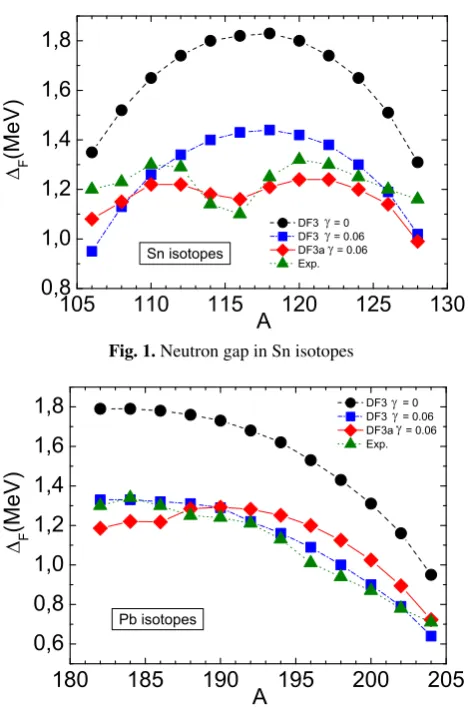
Fig. 1.Neutron gap in Sn isotopes
180 185 190 195 200 205
0,6 0,8 1,0 1,2 1,4 1,6 1,8
DF3 = 0 DF3 = 0.06 DF3a = 0.06
Exp.
Pb isotopes
F
(
M
e
V
)
A
Fig. 2.Neutron gap in Pb isotopes
parameters. To avoid any influence of the shell fluctuations in the value ofρ(0), the average central density ¯ρ(0) is used in the denominator of the additional term. It is averaged over the interval ofr<2 fm. The first,ab initio, term in the r.h.s. of Eq. (13) is the solution of Eq. (12) in the frame-work of the LPA method described above, withm∗=min the subspaceS′.
In Ref. [9], the above equations were solved in the self-consistentλ-basis of the EDF by Fayans et al. [17, 18]. Two sets of the functional were used, the original one DF3 [18] and its modification DF3-a [19]. In the latter, the spin-orbit and effective tensor terms of the original functional were modified. The results for the pairing gap in three chains of semi-magic nuclei are displayed in figures 1–3.
In accordance with the recipe of Ref. [3], we represent the theoretical gap with the “Fermi average” combination
∆F=
∑
λ
(2j+1)∆λλ/∑
λ
(2j+1), (14)
where the summation is carried out over the states λ in the interval of|ελ−µ|<3 MeV. The “experimental” gap is determined by the symmetric 5-term odd-even mass diff er-ences (5), (6).
Let us begin from neutron pairing and consider first the tin isotopes, figure 1. We see that the BCS gap (γ=0) is approximately 30% greater than the experimental one. Switching on the phenomenological addendum withγ=0.06 makes the theoretical gap values closer to experiment. How-ever, the predictions of the two versions of the functional
135 140 145 150
0,8 1,2 1,6 2,0
N=82 isotones
DF3 no Coulomb, = 0
DF3 = 0 DF3 = 0.06
DF3a = 0.06
Exp.
F
(
M
e
V
)
A Fig. 3.Proton gap forN=82 isotones
used are significantly different, being much better for the DF3-a functional. In particular, the A-dependence of the experimental gap is reproduced with a pronounced mini-mum in the center of the chain. As the analysis in Ref.[9] has shown, this strong difference between results for two functionals is due to the strong influence on the gap of the highjintruder state 1h11/2. Its position depends essentially
on the spin-orbit parameters and is noticeably different for DF3 and DF3-a functionals.
In the lead chain, see figure 2, the overall pattern is quite similar. Again the BCS gap is approximately 30% bigger of the experimental one and again the inclusion of the phenomenological term withγ=0.06 gives a qualitative agreement. Now, the difference between the two function-als is much smaller. In this case, the agreement is rather perfect for the DF3 functional and a little worse for the DF3-a one, but also within limits for the accuracy dis-cussed above.
Let us go to proton pairing,N=82 chain, see figure 3. In this case, the Coulomb interaction should be included into the pairing effective interaction,
Vp
eff=V
n
eff+VC. (15)
As it is argued in Ref.[9], the bare Coulomb potential could be used in this equation with high accuracy. The strong Coulomb effect in the gap is demonstrated in figure 3. It is also explained with the exponential dependence of the gap on the pairing interaction. It should be mentioned that Duguet and co-authors [5] were the first who inserted ex-plicitly the Coulomb interaction into the pairing force for protons. Only after inclusion of the Coulomb interaction intoVeff, we can use the same value ofγ =0.06 for
pro-tons and neutrons. As for tin isotopes, the difference be-tween DF3 and DF3-a results is rather strong, now in favor of the DF3 functional. This effect is again due to different positions of the 1h11/2level, but now for protons. Overall
agreement with experiment is for protons worse, maybe, because of closeness of some nuclei to the region of the phase transition to deformed state.
As it is argued in Introduction, we may expect to reach accuracy for the gap of the order of≃ (0.1÷0.2) MeV. In practice, the overall disagreement of the theory with the
data is √
(∆th−∆exp)2≃0.13 MeV for the DF3 functional
er-encesD2 these numbers should be multiplied by a factor
of two.
3 Double mass differences in
non-superfluid subsystems
The Lehmann expansion for the two-particle Green func-tionKin a non-superfluid system reads, in the single-particle wave functions|1⟩=|n1,l1,j1,m1⟩representation, [13]:
K3412(E)= ∑
s
χs
12χ
s∗
34
E−E+s,−±iγ
, (16)
whereEis the total energy in the two-particle channel and
E+s,−denote the eigen-energies of nuclei with two particles
and two holes, respectively, added to the original nucleus. They are often interpreted as the “pair vibrations” [20]. In-stead of the Green functionK, it is convenient to use the two-particle interaction amplitudeΓ:
K=K0+K0ΓK0, (17)
where K0 = GG. The amplitudeΓ obeys the following
equation [13]:
Γ=U+UGGΓ, (18)
whereU is the same irreducible interaction block as in Eq. (7). Again, within the Brueckner theory, the blockU should be replaced with the realistic potential V which does not depend on the energy. Then the integration over the relative energy can be readily carried out in Eq. (18)
A12=
∫
dε
2πiG1
(E
2+ε )
G2
(E
2−ε )
=1−n1−n2
E−ε1−ε2
, (19)
whereε1,2are the single-particle energies andn1,2=(0; 1),
the corresponding occupation numbers. As the result, we obtain
Γ=V+VAΓ. (20)
Simple transformations in Eq. (17) or (20), in vicinity of the poleE=E+s,−, lead to the following equation for the
eigenfunctionsχs:
(Es−ε1−ε2)χ12s =(1−n1−n2)
∑
34
V34 12χ
s
34. (21)
It is different from the Shr¨odinger equation for two in-teracting particles in an external field only for the factor (1−n1−n2) which reflects the many-body character of the
problem, in particular, the Pauli principle. The direct solu-tion of this equasolu-tion is complicated by the same reasons as of theab initioBCS gap equation described in Sec. 2. The same two-step method is used. The usual renormalization of Eq. (21) transforms it into the analogous equation in the model space
(Es−ε1−ε2)χs12=(1−n1−n2)
∑
34 0
(Veff)3412 χ
s
34, (22)
where the effective interactionVeff coincides with that of
pairing problem, Eq. (12), provided the same value of the separation energyE0is used. The next step consists in the
use of ansatz (13) to take into account corrections to the
180 184 188 192 196 200 204 208 212 216 -2.5
-2.0 -1.5
exp =0 =0.06
M
(
M
e
V
)
A Pb
Fig. 4.Double mass differencesD+2pfor adding to Pb isotopes of two protons
180 184 188 192 196 200 204 208 212 216 0.5
1.0 1.5
M
(
M
e
V
)
A exp
=0 =0.06
Pb
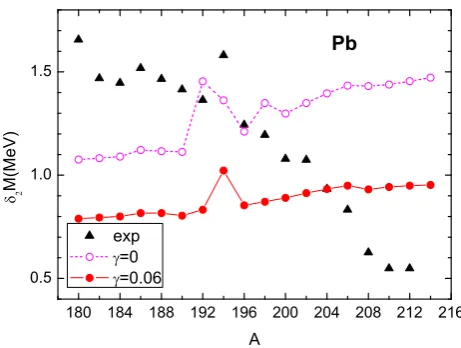
Fig. 5.Double mass differencesD−2pfor adding to Pb isotopes of two proton holes
Brueckner theory with a phenomenological addendum (∼ γ).
The double mass differences (1– 4) are identified with the two first solutionsE+s,−of Eq. (22), corresponding to
the addition of two particles (holes) to the magic core into the state ε1 = ε2 = µ+,−, where the chemical potentials
µ+,− are defined in a usual way as mass differences, e.g., µ+
p =EB(N,Z+1)−EB(N,Z). Then, the energy difference
in the left-hand side of Eq. (22) isE+s,−−2µ+,−=D+,−. If
we are interested only in these solutions, we may rewrite Eq. (22) as follows:
Es−2µ=(1−2n1)(Γ′(Es))1111, (23)
where (Γ′
(Es)
)34
12 =(Veff)3412+
∑
56
′ (Veff)5612
× 1−n5−n6
Es−ε5−ε6
(Γ′ (Es)
)34
56. (24)
The accent on the sum denotes that the two-particle state 5=6=1 is excluded. In all formulas (22 – 24) the angular momenta of two-particle states |12⟩,|34⟩ are coupled to the total angular momentumI=0.
NSRT12
100 104 108 112 116 120 124 128 132 -3,0
-2,5 -2,0 -1,5 -1,0
2
M
(
M
e
V
)
A
exp
DF3 =0
DF3 =0.06
Sn
Fig. 6.Double mass differencesD+2pfor adding to Sn isotopes of two protons
100 104 108 112 116 120 124 128 132 1,5
2,0 2,5 3,0
2
M
(
M
e
V
)
A
exp
DF3 =0
DF3 =0.06
Sn
Fig. 7.Double mass differencesD−2pfor adding to Sn isotopes of two proton holes
132 136 140 144 148 152 -1,8
-1,5 -1,2 -0,9
2
M
(
M
e
V
)
A
=0
=0.06
exp
N82
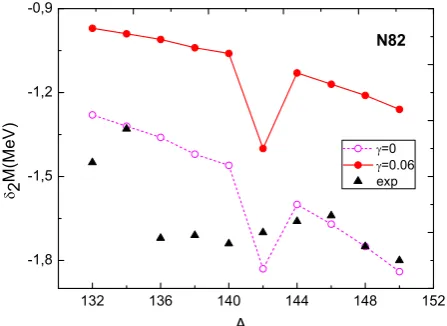
Fig. 8.Double mass differencesD+2n for adding toN =82 iso-tones of two neutrons
D+2p are displayed in figure 4 and the differences D−2p, in figure 5 and for the tin isotopes, analogously, in figure 6 and 7. In similar way, the neutron double differences for isotonesN=82, are displayed in figures 8 and 9. Note that the opposite signs of the quantitiesD+2 andD−2 occur owing to the factor of (1−2n1) in Eq. (23): particles attract each
other whereas holes, repel. The results of theab initio cal-culation (γ=0) and with the phenomenological addendum (γ=0.06) are shown. To quantify the accuracy of calcula-tions, just as for the pairing gap in Sec. 2, we calculated
132 136 140 144 148 152 2,0
2,5 3,0
M
M
e
V
)
A
=0 =0.06 exp N82
Fig. 9.Double mass differencesD−2n for adding toN = 82 iso-tones of two neutron holes
the rms deviations of the theory from experiment
δM2p,2n=
√ 1
Np,n
∑
i
(
D(theori) −D(expi)
)2
, (25)
with obvious notation. For the lead isotopes, we find δM2p(γ=0)=0.64 MeV andδM2p(γ=0.06)=0.42 MeV,
Np=26. For the tin isotopes, we getδM2p(γ=0)=0.68 MeV
andδM2p(γ=0.06)=0.45 MeV, Np=21. For isotones with
N=82 we obtainδM2n(γ=0)=0.66 MeV andδM2n(γ=0.06)
=0.42 MeV,Nn=19. We included into analysis only nuclei
with the experimental error of the double difference less than 0.1 MeV. The total disagreement for neutrons and pro-tons is δMtot(γ=0)=0.66 MeV and δMtot(γ=0.06)=0.43
MeV. Thus, introducing the phenomenological addendum makes the agreement with data better but not so much as for the gap.
One can see that the agreement is worse for lighter iso-topes and isotones which are close to the drip line, the chemical potential µin Eq. (23) being small. The reason is that in vicinity of drip line the concept of energy in-dependent mean field becomes erroneous [21, 22]. If we limit the analysis to nuclei with µ<−4 MeV, we obtain δM2p(γ=0)=0.53 MeV andδM2p(γ=0.06)=0.27 MeV,Np=
10 for lead isotopes andδM2p(γ=0)=0.64 MeV and
δM2p(γ=0.06)=0.40 MeV,Np=16 for the tin chain. For
isotonesN=82 we haveδM2n(γ=0)=0.71 MeV and
δM2n(γ=0.06)=0.39 MeV,Nn=16. It is worth mentioning
that for the D+2n quantity, figure 8, inclusion of the phe-nomenological addendum makes agreement significantly worse. The total disagreement for neutrons and protons is nowδMtot(γ=0)=0.64 MeV andδMtot(γ=0.06)=0.36 MeV.
Thus, after the inclusion of the phenomenological correc-tion, we obtain the agreement only a little worse than for the superfluid subsystem.
We observe that our calculations, which reproduce the value ofD2 on average, do not catch the trend of the A
-dependence of this quantity. We can suppose that it could be due to the fact that phonon corrections, included into the parameterγ, are not considered explicitly. Estimations show that for this problem they are not so universal as in the gap problem as far as the diagonal element (Veff)1111in
g
g L
L
g g
Γ0
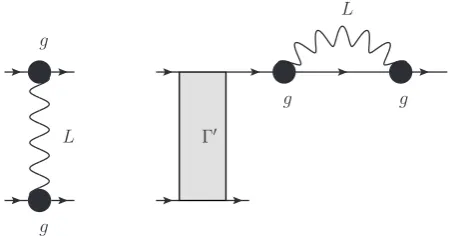
Fig. 10.Phonon corrections to the interaction amplitudeΓ′
the phonon corrections could strongly depend on the state |1⟩.
The main corrections to Eq. (23) caused by theL -pho-non are shown in diagrams of figure 10. The first one is the so-called induced interaction, the second one is the “ends correction”. In magic and semi-magic nuclei, the vertexgas a rule can be considered as a small parameter, and the so-calledg2-approximation can be used. Theg2 -corrections are displayed in figure 10. The wavy line cor-responds to the phononD-function,D(ω)=2ωL/(ω2−ω2L),
whereωLis the excitation energy of theL-phonon, and the
transferred energyω=0 for the diagonal matrix element. The vertexg(r) of creatingL-phonon and the frequencyωL
were found [23] by within the self-consistent TFFS [24]. Note that all low-lying phonons possess the normal parity π=(−1)L, therefore we do not show it explicitly. The first
diagram can be easily evaluated
δ(1) phD2=−
2(⟨j1l1||YL||j1l1⟩g11)2
ωL(2j1+1) ,
(26)
where⟨ ||YL|| ⟩denotes the reduced matrix element [25],
andg11is the radial matrix element ofg(r).
As to the second diagram, one has the same correc-tions for each of the ends. They can be readily summed [13]. As the result, each of the ends should be multiplied by√Z1, whereZ1is the residue of the Green functionG(ε)
at the pointε=ε1. The corresponding correction to the
dou-ble mass difference is equal to
δ(2) phD2=(Z
2
1−1)D2. (27)
This expression contains terms of higher order ing2 but such partial summation has clear physical meaning. In ad-dition, sometimes the differenceZ1 −1 is not small. The
matter is that the ratio ¯g=g12/δε12, whereδε12=ε1−ε2±ωL,
is the actual dimensionless “small” parameter. For collec-tiveL-phonons the matrix elementsg12 ≃1 MeV, whereas
the typical value of the denominator isδε12 ≃ εF/A1/3,
εFbeing the Fermi energy andAthe mass number of the
nucleus under consideration. Thus the condition ¯g ≪ 1 is valid. However, sometimes the “resonance” cases oc-cur when the quantityδε12is anomalously small. Then the
g2-approximation does not work and higher order terms
should be summed up. In such cases, it is natural to multi-ply by √Z1also the ends of the first diagram in figure 10.
Then the expression for the double mass difference with phonon correction is as follows:
˜
D2=
(
D2+δ(1)phD2
)
Z12. (28)
Let us calculate from this formula the corrections to the proton double mass differenceD2pfirst for the
double-magic208Pb nucleus. In this nucleus the collective 3−
-pho-non with the energyω3=2.684 MeV plays the main role.
Adding two proton particles, we haveD+2p(γ=0)=−2.35 MeV,|1⟩=1h9/2,Z1=0.98,δ
(1)
phD2p=−0.14 MeV and
˜
D2p=−2.38 MeV. Thus, in this case the phonon
correc-tion,δphD2p=D˜2p−D2p=−0.03 MeV is negligible. Adding
two proton holes, we have D−2p(γ = 0)= + 1.43 MeV, |1⟩=3s1/2, obviously, we haveδ(1)phD2p=0 due to the
angu-lar momentum conservation. Then, we haveZ1=0.96 and
˜
D2p=1.32 MeV, thus the phonon effectδphD2p=−0.11 MeV
is more than for the 1h9/2 state but also less than 10%.
Another situation takes place for the semi-magic nucleus
204Pb. Here the phonon corrections appear mainly due to
the low-lying 2+-phonon, ω2=0.882 MeV. In this case,
for the state 1h9/2we haveZ1=0.74,δ(1)phD2p=−0.55 MeV,
˜
D2p=−1.53 MeV andδphD+2p=0.72 MeV. For the state 3s1/2
again we have δ(1)phD2p=0, but Z1=0.82, ˜D2p=0.93 MeV
andδphD−2p=−0.47 MeV. Thus, for both states the phonon
correction is approximately of the same magnitude as the effect of the phenomenological addendum in Eq. (13) at γ=0.06. Hence now we must take smaller value ofγ. In particular, for the state 3s1/2the value ofγ=0 looks
prefer-able. Evidently, more consistent approach is necessary with systematic account for the phonon corrections with a new readjustment of the parameterγ.
4 Conclusions
Two aspects of the problem of evaluating double odd-even mass differencesD2in semi-magic nuclei are analyzed. A
semi-magic nucleus contains two components with diff er-ent properties, a superfluid subsystem and a non-superfluid one. For the superfluid subsystem, D2 is supposed to be
equal to 2∆, the gap∆being solution of the gap equation. Such equalization contains an inherent inaccuracy for∆of the order of≃0.1÷0.2 MeV [9] and an additional one due to particle number non-conservation effects ≃ 0.1 MeV [12]. For D2 value they should be multiplied by a factor
of 2. In Ref. [9] the gap equation was solved with the ef-fective pairing interaction of the semi-microscopic model in which the main term found from first principles is sup-plemented with a small phenomenological addendum con-taining one phenomenological parameterγsupposed to be the same for all medium and heavy atomic nuclei. The data for 34 nuclei were analyzed for isotopes of the lead and tin chains and isotonesN = 82. Neighbors of the double magic nuclei were excluded, as for them particle number non-conservation effects are especially large [12]. Overall
disagreement of the theory with the data is √
(∆th−∆exp)2≃
0.13 MeV for the DF3 functional [18] and≃0.14 MeV, for the DF3-a one [19]. For the mass differencesD2 it
corre-sponds to accuracy a little better then 0.3 MeV.
For the non-superfluid subsystem, D2 is found
NSRT12
of the phenomenological parameters are presented here in figures 4–9. It is worth to note that the problem for non-superfluid nuclei, in principle, does not contain so serious inaccuracies as the pairing problem. The main approxima-tion which is made is that the two-particle Green funcapproxima-tion
K which concerns the array of A,A±1,A±2 nuclei is described in the basis of theA-nucleus. Estimation of the accuracy of this approximation is ∼ 2/A. However, the agreement turned out to be a little worse than for super-fluid case, δMtot=0.36 MeV. The reason is, evidently, in
phonon corrections which are in this case not so regular as in the gap equation. Estimation of these corrections shows that, indeed, a more consistent approach is necessary with systematic account for the phonon corrections, the param-eterγbeing readjusted anew.
Acknowledgments
We thank S. V. Tolokonnikov for valuable discussions. The work was partly supported by the DFG and RFBR Grants Nos.436RUS113/994/0-1 and 09-02-91352NNIO-a, by the Grants NSh-7235.2010.2 and 2.1.1/4540 of the Russian Ministry for Science and Education, and by the RFBR Grants 11-02-00467-a and 12-02-00955-a. Two of us (E. S. and S. P.) thank the INFN, Seczione di Catania, for hospitality.
References
1. F. Barranco, R. A. Broglia, H. Esbensen, and E. Vigezzi, Phys. Lett. B390, 13 (1997)
2. F. Barranco, R. A. Broglia, G. Colo,et al., Eur. Phys. J. A21, 57 (2004)
3. A. Pastore, F. Barranco, R. A. Broglia, and E. Vigezzi, Phys. Rev. C78, 024315 (2008)
4. T. Duguet and T. Lesinski, Eur. Phys. J., Special Topics
156, 207 (2008)
5. K. Hebeler, T. Duguet, T. Lesinski, and A. Schwenk, Phys. Rev. C80, 044321 (2009)
6. S. S. Pankratov, M. Baldo, M. V. Zverev, U. Lombardo, E. E. Saperstein, S. V. Tolokonnikov, JETP Lett.90, 612 (2009)
7. M. Baldo, U. Lombardo, S. S. Pankratov, E. E. Saper-stein, J. Phys. G: Nucl. Part. Phys.37, 064016 (2010) 8. S. S. Pankratov, M. Baldo, M. V. Zverev, U. Lombardo,
E. E. Saperstein, JETP Lett.92, 92 (2010)
9. S. S. Pankratov, M. V. Zverev, M. Baldo, U. Lombardo, E. E. Saperstein, Phys. Rev. C84, 014321 (2011) 10. E. E. Saperstein, M. Baldo, U. Lombardo,
S. S. Pankratov, M. V. Zverev, Phys. At. Nucl. 74, 1644 (2011)
11. E. Chabanat, P. Bonche, P. Haensel, J. Meyer, and R. Schaeffer, Nucl. Phys. A627, 710 (1997)
12. Abhishek Mukherjee, Y. Alhassid, and G. F. Bertsch, Phys. Rev. C83, 014319 (2011)
13. A. B. MigdalTheory of finite Fermi systems and ap-plications to atomic nuclei(Wiley, New York, 1967) 14. E. E. Saperstein, M. A. Troitsky, Yad. Fiz. 1, 400
(1965)
15. N. V. Gnezdilov, E. E. Saperstein, JETP Lett., to be published.
16. M. Baldo, U. Lombardo, E. E. Saperstein, and M. V. Zverev, Phys. Rep.391, 261 (2004)
17. A. V. Smirnov, S. V. Tolokonnikov, S. A. Fayans, Sov. J. Nucl. Phys.48, 995 (1988)
18. S. A. Fayans, S. V. Tolokonnikov, E. L. Trykov, and D. Zawischa, Nucl. Phys. A676, 49 (2000)
19. S. V. Tolokonnikov and E. E. Saperstein, Phys. At. Nucl.73, 1684 (2010)
20. A. Bohr and B. R. Mottelson,Nuclear Structure (Ben-jamin, New York, Amsterdam, 1974.), Vol. 2.
21. M. Baldo, U. Lombardo, E. E. Saperstein, and M. V. Zverev, Phys. Lett. B533, 17 (2002)
22. E. E. Saperstein, S. V. Tolokonnikov, JETP Lett.78, 343 (2003)
23. S. V. Tolokonnikov, S. P. Kamerdzhiev, D. Voytenkov, S. Krewald, and E.E. Saperstein, arXiv: 1107.2432v2[nucl-th]; Phys. Rev. C84, 064324 (2011) 24. V. A. Khodel and E. E. Saperstein, Phys. Rep.92, 183
(1982)