EUV, X-ray and Optical Studies of
W hite Dwarf Binary Systems
Ch r is t ia n Ma r c Jo m a r o n
Mullard Space Science Laboratory
Department o f Space and Climate Physics University College London
A thesis submitted to the University of London for the Degree of Doctor of Philosophy
ProQuest Number: 10018505
All rights reserved
INFORMATION TO ALL USERS
The quality of this reproduction is dependent upon the quality of the copy submitted.
In the unlikely event that the author did not send a complete manuscript and there are missing pages, these will be noted. Also, if material had to be removed,
a note will indicate the deletion.
uest.
ProQuest 10018505
Published by ProQuest LLC(2016). Copyright of the Dissertation is held by the Author.
All rights reserved.
This work is protected against unauthorized copying under Title 17, United States Code. Microform Edition © ProQuest LLC.
ProQuest LLC
789 East Eisenhower Parkway P.O. Box 1346
Abstract
This thesis describes an EUV, X-ray and optical study of white dwarfs, concen trating on those in binary systems with a late-type companion star.
C o n ten ts
In trod u ction 15
1.1 R O SA T : an in tro d u ctio n ... 15
1.2 EUV and X-ray astro n o m y ... 16
1.3 W hite d w a r f s ... 17
1.4 W hite dwarf s u r v e y s ... 18
1.4.1 Isolated s t a r s ... 18
1.4.2 Binary s y s t e m s ... 18
1.5 Classification of white dwarfs ... 19
1.6 Formation of a white dwarf: in th e o ry ... 22
1.6.1 An isolated s t a r ... 22
1.6.2 A binary s t a r ... 25
1.7 Evolutionary c o n s id e ra tio n s... 30
1.8 Why study white dwarfs? ... 32
1.9 Physical p aram eters... 33
1.9.1 Effective tem peratures, radii and m a s s e s ... 33
1.9.2 Magnetic f i e l d s ... 34
1.9.3 Rotational v e lo c itie s ... 34
1.10 Cataclysmic and pre-cataclysmic b in a rie s ... 35
1.10.1 Close binary remnants of CE e v o lu tio n ... 38
1.10.2 Long period remnants of CE e v o lu tio n ... 38
4 C O N T E N T S
1.12 W hite dwarf atmospheres ... 44
1.12.1 Physics of white dwarf a tm o sp h e re s... 44
1.12.2 Current p ro b le m s... 48
1.12.3 The evolutionary s c e n a r i o ... 48
1.12.4 Thick or thin H l a y e r s ... 49
1.12.5 Rotation, magnetism, a c c r e tio n ... 51
1.12.6 Atmospheric content of DB stars ... 53
1.12.7 ZZ Ceti s t a r s ... 55
1.13 Ionisation effect of white dwarf p o p u la tio n ... 55
1.14 S u m m a r y ... 56
2 W h ite dwarfs d e te c te d w ith th e W FC 59 2.1 In tro d u c tio n ... 59
2.2 Optical ID p ro g ra m m e ... 59
2.3 Optical d a t a ... 60
2.4 Sample p a r a m e te r s ... 72
2.5 Comparison to optically-selected s a m p l e ... 79
2.6 Colour d iagram s... 86
2.7 Late-type binary sy ste m s... 91
2.8 Search for further binary s y s t e m s ... 93
2.9 S u m m a r y ... 95
3 R E 1 0 1 6 —05: D iscovery and follow -up 99 3.1 A b s t r a c t ... 99
3.2 Optical observations and id e n tific a tio n ... 100
3.2.1 Classification of stellar ty p e s ... 104
3.2.2 Stellar parameters ... 109
3.2.3 Emission line v a r ia b ility ...112
3.2.3.1 Continuum v a r ia b ility ...115
C O N T E N T S 5
3.3.1 W FC Survey EUV d a t a ... 120
3.3.2 W FC Survey EUV data: model f i t t i n g ... 121
3.3.3 W FC Pointed mode EUV d a t a ...123
3.3.4 X R T Pointed mode X-ray d a t a ...125
3.3.4.1 Light c u r v e s ... 125
3.3.5 Optical data: absorption line f ittin g ... 130
3.3.5.1 Spectral m o d e llin g ... 132
3.3.6 M-star p a r a m e t e r s ... 135
3.3.7 A third component? ...136
3.4 D iscu ssio n ... 137
3.4.1 Line emission m e c h a n ism s... 138
3.5 S u m m a r y ... 142
3.6 A d d en d u m ... 142
4 R O SA T D A -p dM binaries 145 4.1 Countrate correction and combined f i t s ...148
4.1.1 RE1629-H 78...151
4.1.1.1 H i s t o r y ... 151
4.1.2 Pointed mode d a t a ...151
4.1.3 R E 20134-40 ...153
4.1.4 RE2024+20 ... 156
4.1.5 R E 1 7 1 1 + 6 6 ...158
4.1.6 RE1340-K 60...160
4.1.7 RE1426-K 50...162
4.2 S u m m a r y ... 165
5 K now n D A + d K -M sy stem s 169 5.1 In tro d u c tio n ...169
5.2 RE1036-f46: GD123 ... 170
6 C O N TEN TS
5.4 V471 T a u ...175
5.5 Additional s tu d ie s ...176
5.6 D iscu ssio n ...178
5.6.1 H - la y e rs ... 187
5.6.2 Levitation or s tr a tific a tio n ? ...188
6 C onclusions 193 6.1 S u m m a r y ...193
6.2 In the future... 195
A D a ta R ed u ctio n 197 A .l In tro d u c tio n ... 197
A.2 Software w ritten for Optical ID P r o g r a m m e ... 197
A.2.1 The Faint Object S p e c tro g ra p h ... 198
A.2.1.1 D e b ia s in g ...200
A. 2.1.2 F la tfie ld in g ... 202
A.2.1.3 E x tra c tio n ... 203
A.2.1.4 Optimal versus S ta n d a rd ...203
A.2.1.5 Curved and straight s p e c tr a ... 204
A.2.1.6 Wavelength calib ratio n ...205
A.2.1.7 Flux calib ratio n ...206
A.2.1.8 Correcting for atmospheric absorption lines . . . . 206
A.2.1.9 Correcting for atmospheric e x tin ctio n ... 207
A.2.1.10 Spectral r e s u l t s ...209
A.2.2 The Intermediate Dispersion S p e c tro g ra p h ... 209
A.2.3 IDS autom atic reduction so ftw a re ... 209
A.2.4 FOS autom atic reduction softw are... 211
A.2.5 Software perform ance...214
A.2.6 Spectral problem: ripple e f f e c t s ...215
C O N T E N T S 7
A.3 Other reduction techniques u s e d ... 217
A.3.1 W hite dwarf line profile f ittin g ... 217
A.4 ROSAT data re d u c tio n ... 218
A.4.1 X-ray d a t a ... 218
A.4.2 EUV d a t a ... 219
A.4.2.1 Temperature vs. Column density modelling with WFC points ...219
A.5 W hite dwarf photometric re g re s s io n s ... 220
B T h e R O SA T m ission and follow -up 223 B .l In stru m e n ta tio n ...223
B.1.1 The WFC ... 224
B.1.2 The X R T ... 224
B.2 WFC survey D ata p r o c e s s in g ...227
B.3 Optical ID p ro g ra m m e ...228
B.3.1 Strategy & s c h e d u lin g ... 229
B.3.2 Observations ... 229
B.3.3 S o ftw a re ...230
List o f F igures
1.1 Schematic illustration of evolutionary routes to a white dwarf . . . 29
1.2 Mass and interior composition of a white dwarf... 31
1.3 Mass of a white dwarf as a function of the progenitor mass and mass-loss scenario... 32
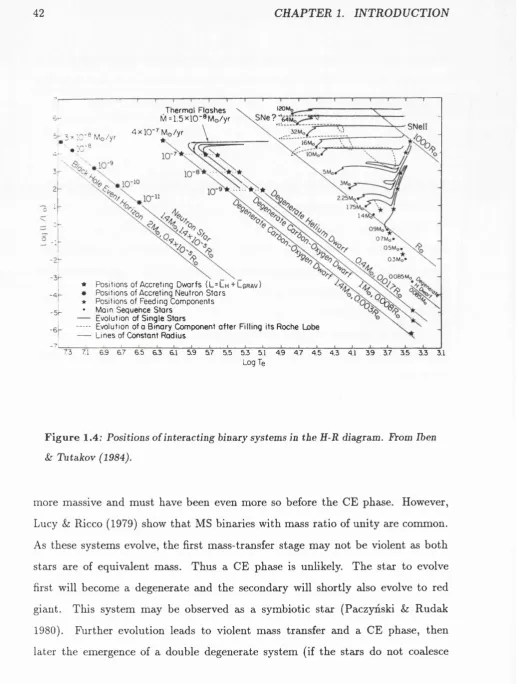
1.4 Positions of interacting binary systems in the H-R diagram. From Iben & Tutakov (1984)... 42
2.1 Example of a DWARF model fit to the Balmer profiles in RE0648—25 63 2.2 Example of a PHOTAN fit to WFC EUV counts rates... 63
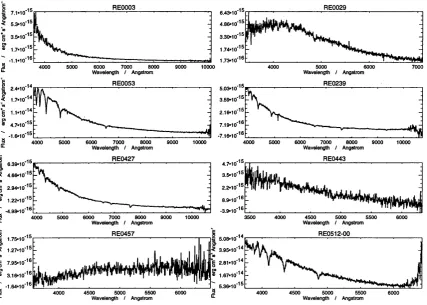
2.3 Optical spectra of my sample of white dwarfs... 66
2.3 ...c o n tin u e d ... 67
2.3 ...c o n tin u e d ... 68
2.3 ...c o n tin u e d ... 69
2.3 ...c o n tin u e d ... 70
2.3 ...c o n tin u e d ... 71
2.4 V Magnitude versus number for PFFC-selected white dwarfs... 73
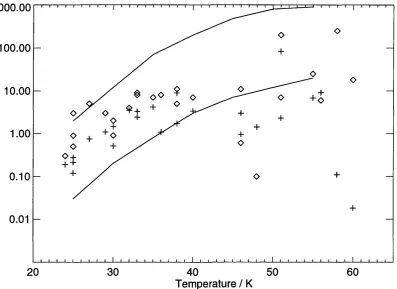
2.5 Balmer tem perature versus EUV tem perature for the white dwarf sample... 80
2.6 Normalised fluxes for EUV-selected white d w arfs... 83
2.7 Magnitude-Colour diagrams for the white dwarf samples... 88
10 L IS T OF FIGURES
2.9 Balmer tem perature versus U —B and B —V colours for EUV selected
white dwarf sample... 92
3.1 Optical finding chart centred on the WFC position of RE1016—05. 101 3.2 FOS spectrum of star A(N )...104
3.3 FOS spectrum of A(S)...108
3.4 IDS spectra of the M stars in A(S) and A (N )...109
3.5 Modelling of the white dwarf and M star components of A(S): indi vidual spectra of a 40 000 K DA white dwarf atmosphere and an M2 dwarf star are shown alongside the combined spectrum ... 110
3.6 Modelling of the white dwarf and M star components of A(S): the observed spectrum is compared to the simulated spectrum ... I l l 3.7 ISIS ‘red arm ’ spectrum of A(S)...112
3.8 ISIS ‘blue arm ’ spectrum of A(S)...113
3.9 IDS ’red’ s p e c t r a ... 115
3.10 IDS ’blue’ s p e c tr a ...116
3.11 EUV images of RE1016—05...121
3.12 W FC EUV timelines of RE1016—05...122
3.13 Curves of constant WFC count rate plotted in the log ( Nh) versus Teff plane... 124
3.14 XRT PSPC image of the field centred on RE1016—05... 126
3.15 XRT PSPC timelines of R E 1016-05...127
3.16 Power spectra of the XRT PSPC timelines of RE1016—0 5 ... 129
3.17 PHD of the PSPC data on RE1016—0 5 ...131
3.18 Contour plots of tem perature-gravity confidence levels derived from optical line profile fitting... 133
3.19 Spectrum of M star in A(S) extracted from the composite FOS spec trum by removal of a white dwarf model atmosphere... 135
L IS T OF FIGURES 11
4.2 RE2013+40 FOS sp e c tru m ... 154
4.3 Extracted companion spectrum in RE2013+40 ... 154
4.4 FOS spectrum of RE2024-|-20... 157
4.5 Extracted companion spectrum in RE2024 ... 157
4.6 RE1711+66 FOS sp e c tru m ... 159
4.7 Extracted companion spectrum in R E 1 7 1 1 ... 159
4.8 FOS spectrum of RE1340+60... 161
4.9 Extracted spectrum of companion in RE1340 ... 161
4.10 FOS spectrum of RE1426+50... 163
4.11 Balmer line profile fit to FOS spectrum of RE1426... 163
4.12 Extracted companion spectrum in RE1426+50... 165
5.1 PHOTAN fit to GD123 data, plot of Tef f versus log N h...173
5.2 Normalised fluxes for EUV-selected white dwarf binaxy systems . . 182
5.3 Normalised flux ratios for EUV-selected white dwarf binary systems 182 5.4 Relative flux ouput of model atmospheres with differing metal abun dances... 191
A .l FOS in stru m e n t...199
A.2 FOS th ro u g h p u t...201
A.3 Undersampling ripple in the FOS s p e c tr a ... 215
B .l A schematic of the WFC assembly ...225
B.2 Effective areas of the WFC filters, at the beginning of the survey phase...225
B.3 A schematic of the XRT assem b ly ...226
List o f Tables
1.1 W hite dwarf classification scheme... 21
1.2 Detached binaries with P < 1.5d... 39
1.3 Example detached binaries with P > 1 . 5 d ... 40
2.1 Parameters of observing instrum ents... 62
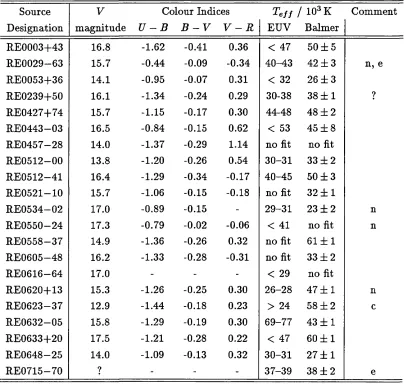
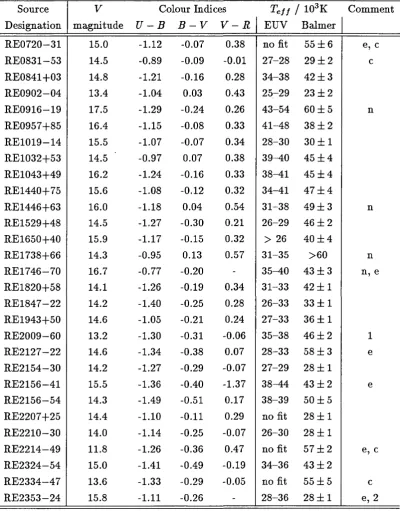
2.2 Effective tem perature, magnitude and colours for W hite Dwarfs in the WFC survey... 64
2.2 ...c o n tin u e d ... 65
2.3 Radius, luminosity and magnitudes for white dwarf s a m p le ... 77
2.3 ...c o n tin u e d ... 78
2.4 Systems postulated to have late-type companions. An ‘e’ indicates possible emission features in the optical spectra... 94
3.1 Astrometric position-magnitude listing for COSMOS finding chart of sky region containing RE1016—05... 102
3.2 Observing log for RE1016—05...103
3.3 Johnson magnitudes and colours for stars in the field containing R E 1016-05... 105
3.4 Johnson colours for standard stars similar* to RE1016—05... 106
3.5 Comparison of the long-wavelength spectral slope of the M-star in RE1016—05 with standard M stars... 107
3.6 Optical emission line parameters for RE1016—05... 114
3.7 Power law fits and ‘V /R ’ for RE1016—05 spectra... 118
14 L IS T OF TABLES
3.8 W hite dwarf atmospheric parameters from EUV fit to RE1016—05. 123
3.9 W hite dwarf atmospheric param eters from RE1016—05 line profile
analysis...132
4.1 Optically determined Param eters for DA + dM binaries discovered with the W F C .... 149
4.2 R O S A T count rates for DA + dM binaries discovered with the WFC. 150 4.3 Corrected R O SA T count rates for DA + dM binaries discovered with the W F C ....150
4.4 Line fluxes for RE2013+40... 155
4.5 Atmospheric param eters from RE1426+50 Balmer line profile fits. . 164
4.6 Balmer profile fits to DA + dM binaries discovered with the WFC. 166 4.7 PHOTAN Homogenous atmosphere fits to DA + dM binaries dis covered with the W F C ....166
4.8 XSPEC stratified atmosphere fits to DA -f- dM binaries discovered with the W F C .... 167
5.1 Optically determined parameters for WD -f dK-M b in a r ie s ... 171
5.2 R O SA T count rates for WD -f dK-M binaries...171
5.3 Corrected R O S A T count rates for WD -f dK-M binaries...171
5.4 PHOTAN homogenous atmosphere fits to WD -f dK-M binaries. . 176
5.5 XSPEC stratified atmosphere fits to WD -f dK-M binaries... 177
5.6 Normalised fluxes and flux ratios for DA -f dM binaries discovered with the W F C .... 180
Chapter 1
Introduction
Of
all the communities available to us, there is not one I would want to devote m yself to except for the society o f the true searchers, which has very few living members at any one time.Albert Einstein, quoted by Max Born
This chapter provides a historical introduction to the current state of under
standing of white dwarfs (WD), both in isolated and binary systems, gained from
data obtained in the optical, EUV and X-ray bands. I shall summarise the relevant
knowledge about these stars’ structure, their formation, and their evolution. This
knowledge has recently been modified due to the availability of R O SA T data, and new conclusions will be summarised at the end of this thesis.
1.1
R O S A T
: an introduction
R O SA T (an abbreviation of Rontgensatellit) is a m ultinational space-borne obser vatory designed to carry out the first ever simultaneous all-sky extreme-ultraviolet
(EUV) and X-ray survey. This is now being followed up by an extensive ‘pointed’
phase during which many individual targets are observed for extended periods.
16 C H A P T E R 1. IN T R O D U C T IO N
The X-ray and EUV energy bands are two regions of the electromagnetic spec
trum which, until fairly recently (~ 1970), received little attention compared to
th at given the optical. Inf particular, the, EE[y and X-ray.em.i§8ion from astronom
ical sources has been poorly studied due to the problems of transmission through
the E arth ’s atmosphere. Absorption of the EUV (and to a lesser extent X-rays) by
Galactic neutral hydrogen has also proved a problem, requiring the development
of extremely sensitive detectors.
The R O S A T Wide Field Camera ( WFC ) conducted a six m onth all-sky survey in two EUV bandpasses: one defined by the S la filter (90-190 eV or 65-135 Â) and
one by the S2a filter (60-110 eV or 110-200 Â). The WFC, which has a 5° diam eter held-of-view, is co-aligned with the German imaging X-ray Telescope (XRT; spec
tral range 0.05-2.5keV). During the survey, both of these instrum ents scanned a
swath normal to the ecliptic plane, and this scan plane rotated (because of the
E a rth ’s orbital motion) by 1° per day in ecliptic longitude. The data collected were
stored and transm itted back to Earth each day. For a more detailed description of
the R O SA T mission, see appendix B.
The wealth of data returned by the various instrum ents aboard R O SA T has provided a fertile ground for astrophysical research in many areas where current
knowledge is limited. Much still needs to be done in order to gain an understand
ing of many of the fundamental properties of stellar structure and evolution, the
interstellar m edium and extragalactic astronomy.
One of the areas to benefit most from R O SA T EUV data is th at of degenerate- star research. The study of some of these objects—white dwarfs—forms the basis
of this thesis.
1.2 EUV and X-ray astronomy
The first EUV observations were performed by sounding rocket experiments car
1.3. W H IT E D W AR FS 17
luminosity of sources in certain areas of sky (10“ ^erg s“^ cm“ ^; Riegler &: Garmire
1974; Henry et a i 1975, 1976), but otherwise failed to produce direct observational evidence for any extra-Solar EUV sources. One of the first successful EUV in
strum ents was the Apollo-Soyuz EUV telescope (Margon & Bowyer 1975) which returned about 20 hours of observations and led to the discovery of the first non-
Solar EUV source—the hot white dwarf HZ43 (Lampton ei al. 1976).
HZ43 was also observed in X-rays as early as in 1972 (Hayakawa et al. 1975a, 1975b); X-ray astronomy also began via sounding rockets, but by this tim e was
more advanced than EUV astronomy, having progressed to the use of satellites
such as UHURU.
The first UV and EUV satellite observations of hot white dwarf stars were
made using the Astronomical Netherlands Satellite (Wesselius & Koester 1978) and the International Ultraviolet Explorer (Greenstein Sz Oke 1979; Bohm-Vitense, D ettm an Sz Kapranidis 1979).
Since these early observations, the study of white dwarfs (and many other
objects) with EUV and X-ray instrum ents has become an invaluable tool in under
standing their structure. This is especially so because the bulk of the luminosity
of a white dwarf is em itted in the U V /EUV region, and it is here th at many of the
im portant spectral features form, as we shall see later in this chapter.
1.3 White dwarfs
In general a star can be classified as a white dwarf if it lies five or more magnitudes
below the Main Sequence (MS). The name ‘white dwarf’ was attributed to this
class of objects because the first such star to be studied, 40 Eri B (Adams 1914),
was classified as spectral type A, yet appeared very sub-luminous. Until this time,
all dwarf stars had been found to be red. Thus the term was coined to point
out the apparent discrepancy between the luminosity and the colour of the star.
18 C H A P T E R 1. IN TRO D U C T IO N
degenerate m atter ^. Thus it was seen to be an im portant task for the completeness
of stellar evolution theory to determine if any more of these stars existed.
1.4 White dwarf surveys
1.4.1
Isolated stars
The first real white dwarf survey was carried out by Luyten from 1931 onwards.
He isolated a set of nearby stars, based on their proper motions, then extracted the
subset of stars with unusually blue colours. This eventually led to the production
of a catalogue of some 3000 degenerate stars. Humason & Zwicky (1947) employed
a different technique: a spectroscopic search for blue objects, in an area of the
Hertzsprung-Russell diagram where no intrinsically luminous stars are expected
to lie. An example of a more recent, and one of the more im portant surveys for
degenerate stars, is the Palomar-Green survey (Fleming, Liebert & Green 1986).
Covering a 10 000 square degree region of sky and extending down to B = 16.2, 3000 stars with blue colours were selected and observed. From these, 700 degenerates
were selected.
1.4.2
Binary system s
Luyten (1969, 1979) searched for wide binary systems containing white dwarf com
ponents by looking for nearby stars exhibiting similar proper motions. He found
th a t degenerate stars are present in a remarkably high number of nearby systems
containing MS stars. In most cases, the degenerate was the fainter of the two com
ponents (explaining their non-detection until this survey technique was utilised).
^ In degenerate matter the electrons and/or nucleons are forced so close together that they
occupy every available energy state. There are essentially no free energy levels to allow movement
of a particle from one energy state to another. Since the same state cannot be occupied by more
than one fermion (electron or nucleon), expressed as the Pauli exclusion principle, further inward
1.5. CLASSIFICATION OF W H IT E DW ARFS 19
These degenerates included a CMa B, a CMi B, 40 Eri B, L145-141. Very few binary systems were observed to contain two degenerate stars.
Searching for close binary systems is much harder, since it must be done purely
on the basis of the colours or spectra of the systems. Thus it is easiest to detect
binaries combining a degenerate with a late (K-M ) star than an early (0 -G ) star
since the stars’ flux output will occupy largely exclusive spectral regions.
Such searches were performed by Greenstein Sz Sargent (1974), banning (1982), Probst (1983) and, prior to R O SA T , ~ 10 spectroscopic binaries of this type (WD + dK-M , with P < 1.5 d) were known.
More recent surveys (Berg et al. 1992; Zuckerman & Becklin 1992) have shown th at many faint white dwarfs (up to 27%) have low mass MS companions. Most
of these systems do not appear to interact, in the sense th at the two stars are
structurally unaffected by the presence of their companion. Apart from their orbital
motions the stars behave as if they were isolated. However, white dwarfs are also
present in the type of close, interacting binary systems which have provoked much
study in modern astronomy: the cataclysmic binary system.
1.5 Classification of white dwarfs
As white dwarfs were discovered after non-degenerate stars, their classification has
tended to follow the stellar classification system. Thus, they have been classified
on the basis of the elements visible in their optical spectra.
The classification of degenerate stars as a separate class was begun by Kuiper
in 1940. Until recently, the classification used was based on th at proposed by
Luyten (1952) and Greenstein (1958). Nearly all white dwarf stars appeared upon
discovery to have either mono-elemental hydrogen or helium atmospheres (i.e. H
and He are the only elements whose absorption lines were visible in the optical
spectra). These were termed DA (H lines only), DB (HeI lines only) and DO
20 C H APTE R 1. IN T R O D U C T IO N
all degenerate stars. A few stars were found with other elements present, and with
elements co-existing (DF, DG, C2), but degenerates could be broadly divided into two categories; DA and non-DA stars, since very few showed hydrogen co-existing
with other elements (only 3 out of 600 stars exhibited both H I and He lines, and
a handful showed both H i and C a ll [Greenstein 1979]). Some stars appeared to
have no lines in the optical region, these being termed DC (for ‘continuous’ spectra
stars). However, upon examination with superior resolution and/or signal-to-noise,
many of these have been reclassified.
Today, the classification is based on the scheme proposed by Sion et al. (1983). This is a more satisfactory scheme in th a t it not only classifies the stars based on
spectra, b ut also takes into account other parameters im portant in degenerate star
structure. The refinement of spectroscopic equipment and observing techniques,
plus the opening up of other m ajor portions of the electromagnetic spectrum such
as UV and EUV, has revealed more anomalous stars showing trace elements and
co-existent elements than known before.
The scheme is as follows (see table 1.1). An uppercase D denotes th a t the star
is degenerate. A second uppercase letter denotes the predominant atmospheric
species, and an optional third uppercase letter for a secondary atmospheric species
if necessary. Appended to this is a tem perature index ranging from 0-9, given by
bO 4:00/T e ff where Teff is the effective tem perature measured for the star. Fur ther symbols may be assigned for other peculiarities, such as magnetic stars (H),
polarised magnetic stars (P), or variable stars (V).
In this scheme, DA stars account for 75% of all known white dwarfs. The helium
stars (DO and DB) account for another 10%, as do the DC stars. The remainder
are metal-lined, carbon or peculiar type stars.
The visual classifier of spectra may also use other suffixes, such as wk (weak
lines), e (emission features), s (sharp lines), or n (wide lines).
W hite dwarfs, as any other type of star, can be divided into two further cate
1.5. CLASSIFICATION OF W H IT E DW ARFS 21
Designation Old class
Features visible in spectra
Examples
DC DC No hnes deeper than 5% of continuum EG 1 (DC6)
DA DA Hi hnes only EG 157 (D AI)
DB DB He I hnes only L 1573-31 (DB3)
DO DO Hell hnes. May have H or He I HZ21 (D 02?)
DZ D F/D G Metal hnes only Ross 640 (DZA7)
DQ C2 Atomic or molecular Carbon L 879-14 (DQ6)
DX Unclassifiable spectra GD 229 (DXH3)
T a b le 1.1: W hite dw arf classification scheme, based on Sion et al. (1983).
star systems. This division is useful, since there is a vast difference in the evolu
tionary path of a star not only once it becomes a white dwarf but also on its way to
becoming a white dwarf, depending on whether it is isolated or part of a multiple
system.
This thesis discusses RO SAT EUV and X-ray data and optical follow-up data, obtained on white dwarf stars both as isolated objects (chapter 2) and as part of
binary systems (chapters 3-5). It contains work covering two types of systems: the
normal WD -f red-dwarf binaries, and interacting WD -f red-dwarf binaries. That
is, binary systems where the gravitation and/or radiative energy from one star
(usually the white dwarf) can be seen to have an effect on the other star. There is
apparently no large scale mass transfer taking place in these binary systems, which
is a characteristic of the class of interacting binaries called cataclysmic binaries
(CB, also called cataclysmic variables). These CB exhibit many effects due to the
mass transfer from a normal star onto the degenerate companion and the possible
presence of an accretion disc around the white dwarf. However, th at is not to
22 C H A P T E R 1. IN T R O D U C T IO N
phases. Indeed, these phases may be quite common in the evolutionary history of
many of the WD + MS binary systems currently known.
1.6 Formation of a white dwarf: in theory
There are many sources which give detailed accounts of the theoretical and ob
servational evidence for the formation mechansims of white dwarf stars. I present
here a condensed overview of the currently accepted formation routes. For more
thorough treatm ents (and the source of much of the information in the following
overview) see Iben 1991, 1985; Bowers Sz Deeming 1984; Weidemann 1990; Sion 1986; de Kool Sz R itter 1993; Smith Sz Jacobs 1973; Vassiliadis & Wood 1993; Jaschek Sz Jaschek 1987.
1.6.1
An isolated star
A white dwarf is one possible endpoint of stellar evolution. However, there is more
than one way to form a white dwarf assuming a MS star as the progenitor. For
an isolated MS (hydrogen-burning) star, the situation is straightforward. When
its central fuel source is diminished to a low level, the core (and initially also the
envelope) will slowly begin to contract due to the loss of the (fusion-generated)
radiation pressure which normally counterbalances the gravitational attraction.
Eventually, all the hydrogen in the core is exhausted. Owing to gravitational
attraction, m aterial just around the core is pulled inwards and a hydrogen-burning
shell forms around the now helium-rich core, gradually increasing its mass. The
core initially has a steep enough pressure gradient to support most of the weight
above it, so contraction is slow until the mass of the core exceeds the Schonberg-
Chandrasekhar limit (0.12M© ; Bowers & Deeming 1984). As more mass is added
the core becomes denser and gravitational pressure further exceeds the gas pressure.
Now the core contracts more rapidly. Energy production in the shell is accelerated
1.6. FO RM ATIO N OF A W H IT E DWARF: IN T H E O R Y 23
forced to expand outwards, cooling as it does so. This expansion causes a deep
convective layer to develop in the stellar envelope, increasing the effectivity of the
energy transport, thus halting the cooling. This is the red-giant phase. The core
will continue to heat up as it becomes denser. A brief ignition of core helium-
burning (via the triple-CK process) occurs, but soon extinguishes and the star cools
once more (Iben 1991). The next stages depend critically on the mass of the
progenitor star.
Eventually, the core tem perature will be forced high enough to re-ignite he
lium fusion. If the star is of low mass (<2.3 M© ), the core will become electron-
degenerate before this ignition. The efficient electron superconduction in the de
generate core effectively holds the core at a much lower tem perature than th at of
a high-mass star whose core is not degenerate. At the point of helium ignition, the
core of a star above 2.3 Mq will comprise approximately one-tenth the total stellar
mass, whereas the core of a low mass stars must grow to 0.4-0.5 M© before igni
tion. Helium burning in a degenerate core is violent and initially generates energy
faster than it can be conducted outwards. This is termed the ‘helium core flash’.
Degeneracy is lifted and the helium burning continues quiescently, as is the case
for helium burning in a higher mass star from the point of ignition. The envelope
once again heats up significantly as the core helium burning dominates over the
shell hydrogen burning. The outer atmosphere of the star may become unstable
with the introduction of two energy generation processes, leading to the formation
of variable ionisation zones of hydrogen and helium. The star may appear as one
of the variable class of stars such as a Cepheid if it is a higher mass star (>2.3 M© )
or RR Lyrae if it is a lower mass star (~1 M© ).
When the helium in the core is exhausted, the now carbon-oxygen rich core
contracts, becoming highly degenerate. This tim e a helium burning shell is formed
around the core. The star’s envelope may again expand, placing the star on the
asymptotic giant branch (AGB) of the Hertzsprung-Russell diagram, as a super
24 C H APTE R L IN TRO D U C T IO N
carbon fusion; the electron conductivity and neutrino losses efficiently diffuse all the
energy (released by gravitational collapse and the influx of m aterial from the shell-
burning). As before, the contraction of the core accelerates th e shell burning and
the extra energy generation causes the outer envelope to expand and cool extremely
rapidly. Mass is often lost due to a ‘wind’ emanating from the stellar surface, ap
proximately quantified by the Reimers equation: Mq yr~^ = L^R^M~^ (with L*, R* and M* in Solar units). The dominant fusion process alternates between
the hydrogen-burning and helium-burning shells, leading to eventual thermonuclear
runaway in the helium shell. This therm al pulse process (Weigert 1966) occurs up
to ten times during this evolutionary phase (the star may become a Long Period
Variable—LPV). The envelope expansion becomes so violent th at the entire outer
atmosphere separates from the core in a radiatively-driven ‘superwind’ (Vassiliadis
&: Wood 1993). The initial stages of this heavy mass loss may be the cause of
the IRAS (O H /IR ) sources (Weidemann 1990) and later on some Wolf-Rayet stars
(Sion 1993). This superwind terminates the AGB evolution of the central star (now
essentially the giant core surrounded by a thin hydrogen shell) which continues to
contract. The m aterial thrown off becomes a planetary nebula (PN) when it is
photoionised by radiation from the heating pre-white dwarf star (>30 000 K), now
called the planetary nebula nucleus (PNN). The PNN continues to contract until
the pressure becomes so great th at the m atter is forced into a degenerate state.
The resultant star is a conventional white dwarf, with no significant core fusion
processes remaining. However, the white dwarf does not necessarily only radiate
away the therm al energy from the non-degenerate ions as is usually assumed. There
may still be significant shell hydrogen-fusion (Iben 1985) contributing up to 50%
of the total luminosity.
There is one final possible variation. Depending on the mass of the helium-rich
zone (below the hydrogen-burning shell) when the star leaves the AGB, it may
undergo one final helium shell flash either during or after the phase of significant
1.6. F O R M A T IO N OF A W H IT E DWARF: IN T H E O R Y 25
porarily ‘born-again’ red giant. This may occur in up to 25% of all PNN. The
im portant result is that the remaining vestiges of the hydrogen envelope may be
almost completely stripped away. In fact, whether this envelope is ejected or not
may lead to the formation of some of the different classes of white dwarf star: ‘thick’
or ‘th in ’ hydrogen envelopes retained on the core may alter the stellar appearance
between DA and non-DA (by affecting whether He and metals are visible at the
surface). The masses of the various types of white dwarf star are very similar since
there is little mass contained even in the ‘thick’ envelope. However, it would be
over-simplistic to suggest this is the only reason for the divergence into different
types of white dwarf star. At most it is only a part of the story, since several en
suing processes are efficient at altering the visible stellar surface composition and
structure.
Examples of degenerate stars which may have evolved via these two different
routes include PG 0108-flOl, a hot DO (Reynolds 1987), and P C 0950-1-139, a hot
DA still losing mass (Liebert et al. 1989). Both stars are still embedded in faint PN.
For a somewhat less massive isolated star ( ^ 0.45 Mq ), the core helium-burning may never become dominant due to insufficient central tem peratures. In this case,
the star may contract to become a white dwarf without ejecting significant portions
of its outer envelope. However, stars below 1 Mq will not yet have evolved off the
MS, and thus cannot constitute any of the degenerate stars we see today. In
the distant future, these stars may evolve into a significantly different class of
degenerate star than those we see today (if mass is not lost in the form of a wind
after the white dwarf stage is reached [Liebert et al. 1989]).
1.6.2
A binary star
More massive stars (up to ~ 1 0 Mq ) may also become white dwarfs, but only if
they are part of a binary system. Isolated massive stars will ignite carbon fusion in
26 C H APTE R 1. IN TRO D U C TIO N
tion. Many heavy elements will be produced in these nuclear reactions, forming a
central portion of the core rich in heavy nuclei, such as ®^Fe. When the carbon is in
tu rn exhausted, this central core contraction is extremely violent. The imploding
core emanates a shock wave strong enough to blow away the entire mantle, driven
by neutrino energy deposition (Wilson 1980, 1983) and the outer core ‘bouncing’
when nucleon pressure becomes im portant (Bowers & Deeming 1984). This en
ergy deposition simultaneously causes the photo-disintegration of the m antle and
heats up the envelope sufficiently to synthesize post-iron peak elements. These
phenomena are what we observe as a type II supernova explosion. The inner core
continues collapsing, yet the available degeneracy pressure is only a finite quan
tity: if the mass of the core is greater than the Chandrasekhar limit (1.4 M© ),
the gravitational attraction will overcome the degeneracy pressure and the star
will collapse further. The core will become a neutron star, in which most of the
protons and electrons are forced to combine into neutron rich m atter. The core
contraction may halt here, supported by the nucleonic degeneracy. Cores which
are more massive than the Tolman-Oppenheimer-Volkoff limit (~2 M© ; Bowers &
Deeming 1984) may undergo further gravitational collapse and form a black hole
(Woosley &: Weaver 1986).
Thus only stars whose core mass remains below this 1.4 M© threshold can end
up as white dwarfs (not proceed to form neutron stars or black holes). A star does
not have to be below this mass threshold as a hydrogen-burning MS star, as long
as there is a mass-loss mechanism which can drop it below this threshold. This is
where the binarity of a star comes in: there is a mass-loss mechanism th at may
allow initially massive stars to become white dwarfs.
The more massive star in a binary system will evolve off the MS before its
companion. It will essentially follow the path described in § 1.6.1, as its core
contracts and its envelope expands outwards. It may fill its Roche lobe^ while
^ The Roche lobe of a star is its equipotential zero-gravitational surface (Roche 1849a, 1849b,
1.6. FO RM A T IO N OF A W H ITE DWARF: IN T H E O R Y 27
the envelope has a deep convective layer. After this point, events depart from
those followed by an isolated star. The m atter overflowing the Roche lobe will
create dynamically unstable mass transfer between the primary and its companion
(Paczynski 1976; Webbink 1979; Law & R itter 1983) creating a common-envelope
(CE) around the two stars. This is termed a ‘mode IIP mass-transfer event in the
notation of de Kool & R itter (1993). The stars will lose angular momentum inside
the CE due to friction, magnetic braking (Eggleton 1976; Spruit & R itter 1983) and
gravitational radiation (Rappaport, Joss &: Webbink 1982). The stars thus spiral
in towards each other. Eventually, so much angular momentum is transferred into
the envelope th at it breaks up. The whole envelope is ejected. This rapid mass-
loss from the primary terminates its evolution early, preventing a climb up the
AGB as for isolated stars; rather, these objects evolve directly from the Horizontal
Branch (HB) and Extended Horizontal Branch (E-HB), and hydrogen shell-fusion
is extinguished early (Wood, Zhang & Robinson 1993).
If the mass transfer occurs before the donor star has ignited helium in its core, it
may uncover layers previously within a large convective core during the MS phase.
This m aterial has experienced significant hydrogen burning, and its exposure tru n
cates the mass-loss before all of the envelope is lost. The star continues to contract,
however, and subsequently burns helium in the core, then later in a shell, after a
second brief phase of Roche-lobe overflow driven mass-loss.
In either case, the material thrown off from the prim ary becomes a PN, and
the system is observed as a double-cored planetary nebula (DCPN).
The pre-white dwarf primary appears as a sub dwarf (sd) star on the H-R dia
gram (midway between the MS and the white dwarf cooling track). These sub dwarf
stars exhibit lines of He II and ionised metals, which are the visible effects of the
exposure of the processed material. As before, the larger the mass of the primary,
the smaller is the ratio of hydrogen to helium at the surface after mass-loss ter
minates. Thus a massive core He-burning remnant may appear as a sdO star (or
28 C H APTE R 1. IN TRO D U C TIO N
surface hydrogen content), whereas a less massive example (<0.50 Mq ; Caloi 1989)
appears as an sdOB star, or sdB star. This hydrogen layer gradually diminishes
in mass due to either nuclear burning at its base or a wind loss mechanism. High-
mass systems will thus become WD + MS binaries before the dispersal of the PN.
Lower mass sub dwarf stars will tahe longer to reach the stage of white dwarf, and
thus appear as sd -f MS stars devoid of a planetary nebula shell for some time
before evolving into a WD -f MS binary. Some very low mass progenitors may
not even become classifiable as sub dwarf stars until after the PN has dispersed
(Iben & Tutukov 1986a), and if the contracting star has not become hot enough to
photoionise the PN by this time, the PN may never be observed.
It may be th a t, due to the increased mass loss possible in binary systems,
all high surface-density planetary nebulae are formed in binaries. Isolated stars
produce much fainter nebulae due to the reduced mass of the ejecta shell.
It is possible for the massive star in a binary system to evolve into a white
dwarf without a CE stage if the prim ary has a radiative envelope when it initiated
mass transfer. The mass-transfer will then be conservative rather than unstable
(a ‘mode IP mass-transfer event). The evolution of this star will be similar to an
isolated star with an added mass-loss mechanism. It should lead to a binary of
larger separation/ period than the CE type, since there will be less orbital angular
momentum loss. Such a system is thus a good candidate for the formation of a
double degenerate system, since the two stars may be prevented from merging at
this stage. There will be a CE stage when the secondary evolves off the MS, and
if the two again avoid coalescence will emerge as a binary degenerate system. If
the two stars do merge, they may form a sub dwarf or R CrB star. That white
dwarf and PN b irth rates agree (Weidemann 1977) would suggest th at nearly all
stars do pass through a PN stage in forming a white dwarf. However, there is some
evidence th at PN can be formed via other mechanisms and th at not all white dwarf
pre-cursors produce appreciable PN (see Iben 1991).
1.6. FORMATION OF A WHITE DWARF: IN THEORY 29
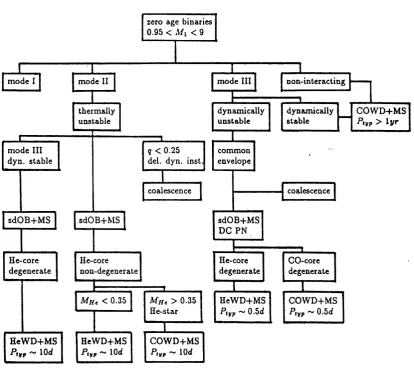
systems. In the notation of de Kool & Ritter (1993), a ^mode III’ mass-transfer event is one in which the primary has a convective envelope when it fills its Roche lobe. This leads to dynamically unstable mass-transfer and a CE phase. A ‘mode II’ mass-transfer event occurs if the primary fills its Roche lobe when it haa a radiative envelope. In this case, mass-transfer is considered to be conservative and no CE phase follows.
m ode I mode II mode III
sdOB+M S sdO B +M S
coalescence coalescence
^ H e < 0.35
common envelope therm ally
unstable
sdO B+M S DC PN
Be-core degenerate CO-core degenerate He-core degenerate m ode III dyn. stable
dynam ically unstable
HcW D+M S
P ty, - lOd
HeW D+M S
H eW D +M S
Ptyp ~ lOd
> 0.35
He-star
C O W D +M S
q < 0.25
del. dyn. inst
COW D+M S
Ptyj, ~ 0.5d
He-core non-degenerate
zero age binaries
0.95 < M l < 9
30 CHAPTER 1. INTRODUCTION
1.7 Evolutionary considerations
We can ascribe an upper mass-limit of ^ 10 Af©to the stars in binary systems able to evolve into white dwarfs. Above this mass they will almost certainly form neutron stars (or black holes) irrespective of which mass loss mechanism is in operation. Isolated stars cannot lose as much mass as those in a binary system, thus the progenitor must be initially somewhat less massive (< 7 Mq ).
There is also in practice a lower mass-limit, since stars below a certain mass will not have had enough time in which to evolve off the MS since the Galaxy was formed. In theory, any star which contains enough matter 0.05 M q ) in order for
the core to heat to fusion temperatures will eventually provide enough pressure to force the matter into degeneracy, when the star does evolve. The practical lower limit for stars to have formed into white dwarfs within the lifetime of the Galaxy is ~ 1 M q (de Kool & Ritter 1992). The formation method of the white dwarf may
also be constrained by observations, since isolated evolution within the lifetime of the Galaxy could not account for enough mass loss to produce degenerates with final mass below 0.5 M© (the He core limit). In a study performed by de Kool &: Ritter (1992) the number of binary systems formed which contain white dwarfs and sub dwarf stars are calculated. They estimate that 10% of all zero-age binaries will undergo and survive a CE phase, whereas about 50% are too wide to interact at all. This agrees with observational studies, such as that of Bergeron, Saffer & Liebert (1992), who deduce that 10% of DA stars are the product of close binary evolution, from a low-mass tail to the observed mass distribution of DA degenerates. Bergeron, Saffer & Liebert also conclude that the appearance of some high-mass degenerates is due to the coalescence of double degenerate systems.
1.7. EVOL U T IO N A R Y CONSIDERATIONS 31
degenerate core has developed.
1.5
g 1.0
o q O.5
IE
0
-I 1---1---1---1---1---1--- r
C a r b o n - O x y g e n W h i l e D w a r f s
Single Stars end Wide Binaries
Close Binaries
J
DwarfsC O W h it e D w a r f s
H e W h i t e D w a r f s
0 4 6 8 10
Primordial Mass (M©) 12
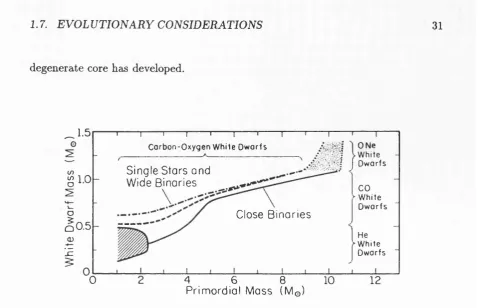
F ig u r e 1.2: Mass and interior composition o f a white dw arf as a function o f the progenitor mass, for single stars and binary components after a case B m ass-transfer
event. A case C event (in an initially wide binary) will result in a remnant o f sim ilar
mass to that produced by an isolated progenitor. Taken from Iben (1991)
Accurate assessments of the fractions of white dwarfs evolving through each of
the above channels is not yet possible. It is estimated that roughly one third form
via each of the the post-AGB, binary, and non-PN channels, with little contribution
via direct evolution from the HB or E-HB (Weidemann 1990). The channel followed
by an individual star depends both on its initial mctss and binarity, but also on
many, as yet poorly understood, factors. Which type of white dwarf is formed
by each mechanism is also a m atter of controversy; many people believe all white
dwarfs are initially DO, and later evolve into DA, given the absence of very hot DA
stars in the PN stage. However Napiwotzki & Schonberner (1993) report the recent
discovery of many very hot DAO stars embedded in PN, and argue that there is
32 CHAPTER 1. INTRODUCTION
1.5
M w o ( L a t e C o s e C )
1.0
0.5
Mup for C o s e B t v e n t s - i Mup= for C o s e C
Muo for S in g le S to rs
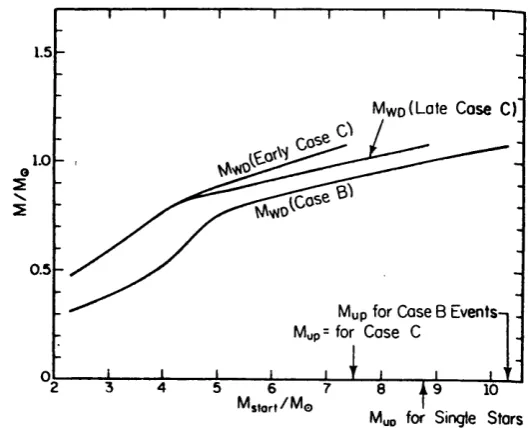
Figure 1.3: Mass of a white dwarf as a function of the progenitor mass and mass-loss scenario. Mup is the progenitor mass upper limit. This assumes a Population I progenitor. Taken from Iben (1991)
1.8 Why study white dwarfs?
The study of degenerate stars is important because it can in principle be used to reconstruct the entire history of star formation in the Galactic disc. To do this both the luminosity function and the mass distribution of degenerate stars need to be determined precisely, and we need to understand the relationship between the initial mass and final mass of a star. In fact, theoretical relationships between progenitor mass and white dwarf mass have been calculated, which are in agreement with the observed mass distribution functions (e.g., Mazzitelli 1989).
mod-1.9. PH YSIC AL P A R A M E T E R S 33
els. The mass distribution is also an im portant physical param eter. The width of
this distribution puts constraints on the theories of stellar formation in the Solar
neighbourhood (Fusi-Pecci & Renzini 1976), so accurate determinations are vital.
1.9 Physical parameters
1.9.1
Effective temperatures, radii and masses
Fleming, Liebert & Green (1986) find th at DA degenerates account for 21% of faint
blue stars (identified from the Palomar-Green survey) to a limiting m agnitude of
B = 16.1. Field white dwarfs have tem peratures ranging up to 150 000 K (the hotter of which are non-DA). W hite dwarf radii are clustered narrowly around a
mean of 0.0127 Rq (Shipman 1979). W ith a Hamada-Salpeter mass-radius relation (Hamada & Salpeter 1961) this implies a mean mass of 0.55 M© , and a mean
surface gravity of log(^) = 8.0. The typical mass of white dwarfs in CB was long
thought to be somewhat larger, ~1 M© (Robinson 1976). This has now been shown
to be almost entirely a selection effect (R itter & Burkert 1986); the true average
mass of the degenerates in CB is 0.62 M© .
In calculating the luminosity function of their sample, Fleming, Liebert & Green
note a problem with the hottest stars (>70 000 K) which are very young and still
contracting to their final radii (Koester & Schonberner 1986). They arrive at a
figure of ^ 0.5 white dwarfs per 1000pc^, for M y < 12.75. These authors find no evidence for any DA stars with Tg// >100 000 K or log(^) < 7.0.
Bergeron, Saffer & Liebert (1992) derive a mean DA mass of 0.56 M© (log(^) =
7.9). They find th at 75% of DA stars lie within only ± 0 .1 M© of the mode of the
sample, which lies at 0.50-0.55 M© . The mass distribution appears remarkably
symmetric, unlike th at suggested by earlier determinations (e.g. McMahan 1989).
There is a sloping tail-off from the low-mass end (0.4-0.45 M© ) due to binary star
evolution, and a sloping tail-off towards high masses (1 M© ), which results by con
34 C H APTE R 1. IN TRO D U C TIO N
tion (Weidemann &: Koester 1983, 1984), plus the merger products of binary star
evolution. These data support a single cooling evolutionary sequence for DA stars
rather than a two-sequence model. The extremely narrow mass-distribution sup
ports the galactic evolution and mass-loss theories of Fusi-Pecci & Renzini (1976)
and Weidemann & Koester (1983). The data also requires a narrow mass distribu
tion in the extragalactic PNN formation; PNN do appear to have such a narrow
mass-distribution, centred about 0.58 Mq (Schonberner 1983) and mostly contained within ±0.03 M q . This may mean th at over half of white dwarfs develop with
insignificant (low surface brightness) nebulae.
1.9.2
M agnetic fields
The highest stellar magnetic fields measured are found to occur in degenerate stars,
as evidenced by the Zeeman splitting of absorption lines. Neutron stars may exhibit
field strengths of up to 10^^ G, wheares white dwarfs have field strengths roughly a
million times less intense. For example, the H/? line in the spectrum of GD90 implies
a field strength of 5 x 10® G (Angel et a i 1974) and fields of up to 50 x 10® G have been found in some polars (a class of highly magnetised, accreting white dwarfs,
which emit polarised radiation; see Cropper 1990). However, it appears th at large
magnetic fields are not particularly common among white dwarf stars, since most
spectra show no Zeeman splitting of line components.
1.9.3
R otational velocities
W hite dwarfs stars show a remarkably low average rotational velocity of ~ 2 7 k m s “ ^
(Trimble Sz Greenstein 1972; Pilachowski & Milkey 1984), implying th at they have lost most of their angular momentum during earlier evolutionary stages. This fits
in with the expulsion of the atmosphere explained in § 1.6.2, as there is postulated
1.10. CATACLYSMIC AND PRE-CATACLYSMIC B IN A R IE S 35
braking mechanism.
It should be noted th at there is not enough m atter contained in the cooled-down
degenerate component of the stellar population to affect the Oort limit deficit (dark
m atter/m issing mass), unless the formation rate was much higher in the past or
most degenerates cannot be observed (Fleming, Liebert & Green 1986).
Iben (1984) postulated that the difference between DA and non-DA stars is
of primordial origin (i.e. before the object becomes degenerate) and depends only
upon the thickness of the H-layer left over when the star undergoes its final therm al
pulse. This scenario predicts little difference in the masses and kinematics of the
two types of stars, which is indeed what is observed. Furthermore, it may also
account for the fraction (25%) of non-DA stars. However, it cannot be the full
solution: at the hottest tem perature ranges (> 80000K), DO stars outnumber
the DA stars (Wesemael, Green Sz Liebert 1985). Between 45 000-30 000 K this situation is reversed, with many more DA stars, but no DB star is known (Sion
1984). Below this tem perature He stars reappear, and by very cool tem peratures
(< 6000 K) they dominate over the H-rich DA stars once more (Sion 1984). These
data indicate th at there is at least some evolutionary change in the structure of
degenerate stars.
1.10 Cataclysmic and pre-cataclysmic binaries
Cataclysmic binaries (CB) are historically those binary systems which were found
to exhibit sudden brightening events. In general, they comprise a late-type star
near the MS (usually the less massive of the two) which fills its Roche lobe and
which is transferring m atter via the inner Lagrangian point onto a more massive
white dwarf. In many systems the transferred m aterial accretes onto the white
dwarf via a disc, a bright spot forming where the stream of m atter impacts the
disc. The secondary star is tidally distorted by the white dwarf’s gravitational
36 C H APTE R 1. INTRO D U C TIO N
which arises from the disc and bright spot. In a few cases, the secondaries may not
be a near-MS star; they may be a giant star (e.g. T CrB), a subgiant (e.g. V1341
Cyg), an H degenerate (possibly WZ Sge?) or an He degenerate (possibly AM
CVn?). If the degenerate star is highly magnetised (polars) then accretion may
be via a magnetically channelled flow rather than an accretion disc. Low mass
X-ray binaries (LMXB) are similar to CB in many respects, but have a neutron
star prim ary instead of a white dwarf.
While it is not the intent of this introduction to provide a complete insight into
the various classes of CB, 1 will briefly outline the types and their makeup, as they
are closely related to the white dwarf systems studied in this thesis: they are the
evolutionary descendants of PCB and the type of CB formed depends upon the
param eters of the ancestor PCB.
Cataclysmic binaries are classified into four categories based on their optical
light variations: novae, recurrent novae, dwarf novae (subclasses U Gem, Z Cam
and SU UMa) and nova-like variables (subclasses UX UMa, VY Scu, DQ Her or
‘interm ediate polars’, AM Her or ‘polars’ and AM CVn). The cause of outbursts in
novae may be a thermonuclear runaway in a degenerate, accreted, hydrogen shell
around the white dwarf. Dwarf novae suffer outbursts caused by a brightening of
the accretion disc, which is due to a disc instability or tem porary increase in the
accretion rate onto the white dwarf. Comprehensive reviews of the subject may be
found in Cordova & Mason (1981), Patterson (1979), Robinson (1976), Webbink et a l (1987).
Pre-cataclysmic binaries (PCB) are those systems which are thought to be the
progenitors of fully fledged cataclysmic systems (Bond 1985), They do not exhibit
the eruptive behaviour of the CB, but are comprised of similar stellar types, and it
is thought th at they eventually evolve into CB. The systems discussed in chapters
3, 4 and 5 of this thesis include some pre-cataclysmic binary systems. There are
three classes of PCB, and they have been described in §1.6: DCPN, close sd -f MS,
1.10. CATACLYSMIC AN D PRE-CATACLYSM IC B IN A R IE S 37
into CB, and in a sense they belong to the same category, being related by an
evolutionary sequence: DCPN sd + MS —> WD + MS (§1.6).
The early assertion that CB are evolved from contact binaries of the W UMa
type (Kraft 1967) was disproven by Webbink (1976) showing th a t these systems
would coalesce before the primary has left the MS, The current view is as follows:
A CB is formed when the late-type star in a PCB overflows its Roche lobe
and initiates mass transfer onto the degenerate companion. As mentioned above,
there are two ways in which a late-type star might flll its Roche lobe. In the case
of the earlier type secondary stars (G-K) the star might evolve off the MS, (i.e.
it physically expands to overflow its Roche lobe). However, a later (M-type) star
cannot have evolved off the MS within the current age of the Galactic disc. The only
other possibility is that some mechanism must have drained angular momentum
from the system causing the two companions to spiral in until they are close enough
for the secondary star to fill its Roche lobe under the influencing gravitational field
of the degenerate star (i.e. the Roche lobe contracts to meet the stellar surface).
It is thought th at the binary systems which evolve into the PCB must have an
initial period ranging from months to years. The secondaries should all be lower
MS stars. In the evolutionary sequence (described in § 1.6.2) for the formation of
a white dwarf in a binary system, if the stars are too close together (P < months),
they may merge to form a single star. If they are very far apart (P > years), they
may emerge from the CE phase still too wide to form a CB. W ith initial periods
in the range months to years they should emerge as close binaries (Eggleton 1976;
Paczynski 1976; R itter 1976; Livio 1982). Their orbital periods should be < 2
days in order for the CB to form via orbital decay rather than secondary evolution.
As for the masses of the resultant stars, if the primary is above ~ 10 M© , the
system may become a neutron star binary. These may progress to form LMXB as
38 CH APTE R 1. IN TRO D U C TIO N
1.10.1
Close binary remnants of CE evolution
The param eters of several short-period remnants of binary evolution (thought to
have formed via orbital decay) are summarised in table 1.10.1.
There are two principle mechanisms thought to be responsible for the angular
m om entum loss: gravitational radiation and magnetic braking (during the CE
phase or in a stellar wind from the secondary). CB should thus be the short period
tail of a whole distribution of WD -f MS binaries, many of which are left too
far apart for significant angular momentum loss (and whose companions are not
massive enough to evolve off the MS) within the current lifetime of the Galactic
disc. Bond (1985) calculated the likely rate of loss of angular m om entum /period
change of two typical PCB due solely to gravitational radiation, based upon the
equations of Kraft, Mathews &: Greenstein (1962). He concludes th at systems with
periods over 10 h cannot evolve to CB in less than the age of the Galactic disc if
gravitational radiation is the only momentum sink. There is, however, evidence
for another angular momentum sink: both UU Sge and V471 Tau were detected
as soft X-ray sources by van Buren, Charles & Mason (1980) who attrib u te the
activity to coronal emission from a late type star forced into rapid rotation by tidal
synchronism. There is also evidence for chromospheric activity and stellar winds
in some PCB e.g., V471 Tau and Feige 24. These winds should lead to magnetic
braking, and when this is included into the momentum-loss equations (Verbunt &
Zwaan 1981; Patterson 1983) it is estim ated th at PCB with periods of up to 1.5 d
may have evolved into CB via angular-momemtum loss.
1.10.2
Long period remnants of CE evolution
Many systems with periods longer than 1.5 d are also known. They will not be
come CB via orbital decay, but may do so via evolution of the secondary (if it is
massive enough). In fact several systems already show evidence for evolution of the
secondary (FF Aqr, 39 Cet, HD 128220). A long-period nova similar to GK Per
1.10. CATACLYSMIC AN D PRE-CATACLYSMIC B IN A R IE S 39
Name Components M s / M p
Mq Tp 10^ K Porb d-1 Ref.
(i) D C P N
MT Ser sdO + MS 0.6? ? 0.11 17, 18
KV Vel sdO + MS 0.55/0.25 ? 0.36 17, 18
UU Sge = Abell 63 sdO + dK 0.7/0.5 ? 0.46 1 V477 Lyr = Abell 46 sd + dK-M ? ? 0.47 2
V664 Cas ? ? ? 0.58 17, 18
VW Pyx neu? + MS ? ? 0.67 3
Abell 65 ? ? ? 1.00 17, 18
(ii) sd + M S
Abell 41 sdO + dM ? ? 0.11 4
HW Vir sdB + MS 0.25/0.12 33 0.12 12
Feige 36 sdB + sd/MS 0.5? 30 0.21 15
AA Dor = LB 3459 sdO + MS 0.25/0.04 ? 0.26 5 HZ 22 = UX CVn sdB + MS/D? 0.39/0.42 28 0.57 6 (iii) WD -h M S
NN Ser DA + dM5 0.54/0.12 60 0.13 16
RE2013+400 DAO + dMe ? 50 0.15? 11
PG0308+096 DA4 + dM2 ? 0.29 17, 18
RR Cae DAwk + dMe ? ? 0.30 17, 18
GK Vir DAO + dM3 0.7/0.4 50 0.34 7
V471 Tau DA2 + dK2e 0.71/0.73 33 0.52 8
HZ 9 DA2 + dM4.5e 0.51/0.28 22 0.56 9
PG1026+002 DA + dM2 ? ? 0.60 17, 18
Case 1 = EG UMa DA + dM4,5e 0.38/0.26 13 0.67 10
R E 1016-053 DAO + dM2e 0.57 56 < 13
PG 0824+289 DA + dC ? 40 < 14
T a b le 1 .2 : D etached binaries with P < 1.5 d (P C B ). Mp and Tp are the m ass and surface tem peratu re o f the prim ary. Porb is the system ic orbital period.