Take Home Assignment And Performance Of
Grade 11 Students
Cherly C. Cordova, Denis A. Tan, Jenyliza T. Ucang
Abstract: Teachers often complain that students show a negative attitude on their participation in class. They oftentimes go to school unprepared for the lessons, they showed passive attitude towards activities in the classroom, and their awareness on their own learning process is very limited. Thus, this study examined the effect of assignment on the performance of the grade 11 students. The study adopted a quasi-experimental research design. Homework assignments were used in the study to determine if there is a significant difference between two groups namely, the with-assignment group with 57 students and without-assignment with 58 students. In addition, significant difference on the performance of the student when grouped according to gender was analyzed. Mean, standard deviation, t-test for independence and ANCOVA were used in the study. Results revealed that there is no significant difference on the performance of students for both with assignment and without assignment group. Findings also showed that there was no statistical significant difference in the mean achievement of male and female students exposed to with assignment.
Index Terms: student engagement, homework, assignments, students’ performance, achievement
————————————————————
1 INTRODUCTION
Education, a very important key to success, is a lifelong process. We learn not only in through education. We learn in our everyday lives, that is, we learn every second and every minute in our lives. One of the types of education is the formal education. This is usually done in the four walls of the classroom. In this place, teacher clears the concepts which the students find it erroneous or ambiguous. To avoid spoon feeding, and to empower the students, the teacher emphasized that the role of the student in the class is to have an advance study of the topics to be discussed. But, the classroom has changed since the students of this generation which we call the millennials began to transform today’s school systems. As teachers teach the millennials, they face a lot of challenges which includes students’ boredom, students using gadgets inside the classroom, looking at their watches counting out the seconds for the bell to ring, and pervasively disengaged from the learning process [12]. Teachers commonly complain that students do not prepare for class, most of them do not use the instructional materials given and they lack preparation and engagement outside school that leads to a passive attitude in class [3] - [2]. High expectations for students are necessary to achieve excellence in Mathematics.
Math is best learned through new knowledge from previous knowledge and Mathematics is learned when previous knowledge is utilized to develop new ones as stated by Fulgencio and Tan [8]. In the study of Asparin which aimed to establish a causal model on mathematics achievement of the second year high school students of the Bukidnon National High School (BNHS) SY 2012-2013 he found out that students’ level of mathematics achievement is destitute and students’ levels of understanding the problem, devising a plan, carrying out the plan, and looking back are very poor [1]. In a descriptive-correlational survey conducted by Cordova & Tan on Attitude towards Mathematics, Mathematics Proficiency , and Performance , results of their study show that mathematics proficiency and performance level of Grade 9 students were described as beginning which means that the students lack the basic mathematical skills necessary for them to master Grade 9 Mathematics. Furthermore, a moderate positive correlation between mathematics performance and parent’s (mother and father) educational attainment was found. The result showed that the mother’s educational attainment best predicts mathematics performance [5]. Davis (2013) also found out that occupation and educational attainment of parents are the variables that best predict the students’ mathematics achievement. He also discovered that parental support is another ingredient for the growth of learners not only intellectually but also morally and spiritually [6]. Various strategies have been tried by researchers to improve the performance of students in Mathematics and these strategies were found to be effective. Taylaran (2015) studied the effects of Students Participation Dominated (SPD) and Lecture Discussion Dominated (LDD) instructions on the performance and anxiety level of the students in Mathematics 9 of Quezon National High School. The results of the study showed that students’ performance in the Students Participation Dominated (SPD) instruction were significantly higher than those of the Lecture Discussion Dominated (LDD) instruction regarding the pretest, posttest, and retention test scores [19]. The study of Villaver (2014) which aimed to determine the effects of Experiential Learning Approach on the Mathematics Performance and Attitude of the students showed that the students’ level of performance in the pre- and post-exposure of the experiential learning environment were at the beginning level. The increase in scores is statistically significantly ____________________________
Cherly C. Cordova is a faculty of the College of Education, Central Mindanao University (CMU), Philippines. She is assigned to teach Mathematics courses in the Laboratory High School. +639979140353,
Denis A. Tan is a faculty of the College of Education, Central Mindanao University (CMU), Philippines. She is currently the School Principal of the CMU Laboratory High School and the Director of the Office of Admissions, Scholarships and Placement in the same university. +639177103100, [email protected]
Jenyliza T. Ucang is a faculty of the College of Education, Central Mindanao University (CMU), Philippines. She is assigned to teach Assessment courses in the Professional Education Department. +639178531872,
higher compared to the pre-test [22]. Increase in the mathematics performance of students in the study of Taylaran and Villaver agrees with the result of the study of Miñao (2013) on the effects of Multiple Intelligence-based Instruction in the students’ performance and attitudes in Intermediate Algebra. Accordingly, performance of students exposed to Multiple Intelligence-based Instruction (MIBI) was significantly higher than those in the Non-Multiple Intelligence-based Instruction group in terms of posttest scores, as found by Salingay and Tan [17]. The study of Saligumba and Tan (2018) showed that there was a highly significant difference in the posttest scores of those students exposed to GRRIM compared to those exposed to non-GRRIM [16]. These are the efforts exerted by teachers to address the basic challenges of the 21st century. A lot of strategies had been studied and one of the many techniques of the teachers to keep the students engaged is by giving them assignment. According to Instructional Assessment Resources, IAR [10], assignment means tasks or piece of work assigned to someone as part of a job or course of study. It equally includes activities given to learners by the teacher which is in the school setting and period. So that students will do an advance study, the teachers give the students an assignment. Students usually find it unpleasant since they believe that studying in the school is already enough. Students sometimes fail to realize that assignments are given as a review on the topic previously discussed and a preparation on the topics that are to be discussed. In addition, giving of assignments will ensure that students will come back to school well prepared for the next topic, and this will help students catch up with their deficiencies. Assignments given to students are expected to be of good qualities. Assignments if well administered or assigned to learners have some benefits. Such benefits according to Goldstein and Zentall [6] include the following: it provokes new insights in the learners and as well reveals things of interest to them, it exposes the real or practical aspect of the theory given in the classroom to what are obtainable at the real world, different individuals with varied experiences which learners sometimes consult while doing assignments help in enhancing their communicative skills as well as their interpersonal relationship when team assignment is involved. When group assignment is involved, it is capable of enhancing learner’s leadership skills as well as collaborative and team spirits. When it is home assignment, it serves as an intersection between home and school. Teachers generally give assignments to students either before a lesson is delivered (pre-lesson assignment) or after a lesson has been delivered (post-lesson assignment). Whatever choice of any form of assignment a teacher makes depends on the objectives the teacher wishes to achieve as they all have their inherent merits. Pre-lesson assignment awakens student’s curiosity and as well as prepares him for up-coming lesson. Post-lesson assignment on the other hand increases student’s previous knowledge and improves his abilities to apply what was learnt into real life situations. With these, teachers must design assignment in order to meet specific purposes and goals and in that case many of the students will complete their assignment and thus, benefit from the results‖ [7]. Giving of assignments leads to both positive and negative effects. When the assignments given are not taught or are not taught explicitly, students loose his interest on the intellectual experiences that assignments
offer. Harvard researchers who have studied classroom dynamics, said that the "task predicts performance" [4]. If assignments given are not relevant to the curriculum and are not of high quality, then learning will also be of low quality. In this case, learning loses energy and meaning and the purpose for doing the activities is lost. On the contrary, an assignment that is well-crafted ensures that instruction will provide students with a goal and the power to get there, enabling the students to engage in rigorous and interesting academic contexts as they acquire the content and skills necessary to participate in academic coursework. Most important, assignments create teaching and learning opportunities to think and learn about ideas, topics, events, and questions—about specific content in the curriculum. This is the reason why it is considered that the hallmark of effective instruction is a quality assignment. However, Former Education Secretary Armin Luistro signed last September 16, the DepEd Memorandum No. 392, that mandates all teachers to minimize the giving of assignments (at least) ―to a reasonable quantity to give their pupils ample time to rest and relax at home for the rest of the day.‖There is no quarrel about the good intention of the education department. At least it gives time for the entire family to stay together, relax and enjoy each other’s company. On the other hand, the main purpose of assignments which is to increase the learning capabilities of students will be defeated knowing the fact that the more we use our brains, the more they develop. This is a proven scientific fact and this is the principle behind giving extremely creative and involving activities. Thus, this study focused on the significant difference of the performance of the grade 11 students who were given and those were not given assignment. Specifically, it determined the level of students performance after the intervention (with-assignment and without assignment groups); ascertained the significant difference on students’ performance when exposed with-assignment and those without-assignment instruction; and determined if there is a significant difference on the performance with-assignment and without-with-assignment classes when grouped according to gender.
2 METHODOLOGY
The study was conducted in Central Mindanao University Laboratory High School, in the province of Bukidnon, Philippines. Two-intact classes were used in the study. Section A with 57 students (26 males and 31 females) and Section B with 58 students (22 males and 36 females), a total of 115 respondents of the study. The study was conducted for seven weeks. Students who belonged to with-assignment group were given with-assignments in their Math class from time to time. Section without-assignment were not given take home activities only quizzes and major exams just like what were given to the with-assignment group. The mean, standard deviation, t-test and analysis of covariance (ANCOVA) were the statistical tools used to analyse the data for answering the research questions raised in the study.
3 RESULTS AND DISCUSSION
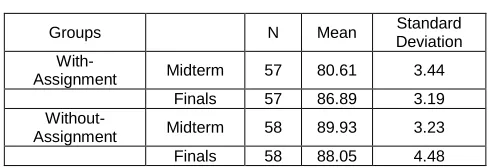
Table 1. Students’ Performance
Groups N Mean Standard
Deviation With-
Assignment Midterm 57 80.61 3.44 Finals 57 86.89 3.19 Without-
Assignment Midterm 58 89.93 3.23 Finals 58 88.05 4.48
As shown, the with-assignment group had a mean grade of 80.61 and 86.89 during midterm and final examinations, respectively. On the other hand, without-assignment group had a mean midterm grade of 89.93 and the final grade of 88.05. It shows that the students in the with-assignment group improved their performance from midterm to finals. Whereas, the without-assignment group slightly decreased their mean grade. Research studies revealed that when teachers present students with low-rigor tasks or no task at all, they create low achievement even when students do well on these tasks. It contributes to the boredom of students. When students perform low-rigor tasks, they are unsure of why they are doing them and how they will benefit, even if standards are posted on the wall. Such teaching results in damaging experiences for struggling students as well as their more skilled peers. According to national and international data, even strong students aren't progressing as much as they can or should [13]. If, on the other hand, assignments are given with high expectations and pressure to achieve, then students gain the knowledge and skills they need to take on a wide range of environments and opportunities. Moreover, if students spend their school day repeating, retelling, writing paragraphs, and filling in blanks rather than applying those skills to explore interesting questions and issues or to solve problems, they won't achieve to new levels. The good news is that teaching that produces low achievement can be changed. Following Richard Elmore's common sense advice, you can change the task to produce better results since the "task predicts performance" (2010, p. 4). In the study of Segumpan, results revealed that the the mathematics performance of the students exposed to Flipped Classroom became significantly comparable with the mathematics performance of the students exposed to Non-Flipped Classroom in the retention test. Moreover, the mathematics anxiety of the students exposed to Flipped Classroom is lower after the implementation and it is even significantly lesser than the anxiety of the students exposed to Non-Flipped Classroom [18]. Assignments, well-crafted and well taught, can help the teacher and the students make that transformation. Segumpan opined stating ―students, in a conventional classroom, don’t have enough preparation before the class, learn while the teacher is presenting and discussing the concepts and complete the day’s concern with a take home activity that will be submitted before the next session. This cycle goes on and on, but then, retention became more of a problem, not to mention, the perceptions of the students on what mathematics nature is [18].
Table 2. Test for Difference between the With-Assignment and Without-Assignment Groups
Groups Mean square Mean F p-value
With-assignment 86.89
17.116 1.18 0.280
Without-assignment 89.93
Table 2 shows that the test for difference between the with-assignment and without with-assignment groups. As presented, t-test resulted to a p-value=0.280>.05 level of significance. This means that there is no significant difference between the two groups. This result is quite interesting because as seen on table 1, the midterm result of both groups differ by 9.32 points in favor of the without-assignment group. Meaning, before the experiment, students in the without-assignment class had higher mean grade compare to the other group. The group with the lowest mean score during the midterm was given assignment to ensure that these students studied the lessons at home. The result indicates that indeed the with-assignment group had improved significantly their performance after exposure to varied tasks to be done at home. This result confirms with the study of Trautwein [20] and he concluded that completing homework has a positive effect on students’ achievements. In addition, Cooper and his colleagues [4] found a ―generally consistent evidence for a positive influence of homework on achievement‖. They found out that the average student in a class assigned appropriate homework scored 26 percentile points higher on tests than the average student in a class not assigned homework. With only rare exceptions, the relationship between the amount of assignment students complete and their achievement was found to be positive and statistically significant [13]. Also, Epstein and Van Voorhis [7] concluded that students performed better in school when they spent more time in general on their assignment. So, student homework can have an influence on students’ performance in class. The researchers also tried to determine if gender has something to do with performance in Mathematics within groups. Table 3 reflects the test for difference between male and female in the with-assignment class and those with-out assignment class. As shown in the table, for the with-assignment class, males (81.88) had higher mean grade in the midterms than females (79.55). After the intervention, the females had higher mean (87.39) compared to males (86.31). This indicates that females were able to benefit better the assigned homework by the teacher.
Table 4. Test for Difference between Males and Females in the With-Assignment Group
Groups N mean SD p-value
With Assignment
Male Midterm 26 81.88 3.61 0.009
Female 31 79.55 2.94
With Assignment
Male Finals 26 86.31 3.94 0.207
Female 31 87.39 2.36
0.009, where males have greater mean grade. On the other hand, during finals, results revealed that there is no significant difference between males and females in there mathematics performance upon exposure to with-assignment class. The result confirms the findings of researchers [15] that there were no significant differences between boys and girls in increase in time on task and in class participation. So, the effects of the assignments were not different for boys and girls. Although females scored higher than boys on both time on task and class participation, the difference is not statistically significant. It is noteworthy to mention that females had lower performance before the exposure to assigned activities together with the males. In addition, assignment has the potential to be an extremely valuable part of students’ learning experience. The increasing frequency of inclusive classroom settings, however, makes designing and implementing effective homework a challenge for teachers. Fortunately, research has provided teachers with valuable tools and knowledge to meet this challenge successfully. It is the teacher’s responsibility to create effective homework assignments and to provide students and parents with the tools necessary for the process to be as successful as possible. If teachers make a concerted effort to utilize classroom strategies to assist students, design homework in a manner research suggests is most effective, provide opportunities for positive parent involvement, and actively teach self-regulation, they will create a homework program that sets all students up for success. Creating assignments that meet the five hallmarks of effective homework (purpose, efficiency, ownership, competence, and aesthetic appeal) will facilitate student interest in homework and promote the belief among students and parents that homework is meaningful and important [21]. Educators can set students up for success by communicating with parents about homework expectations and student needs, taking into account varying exceptionalities in assignment, and teaching students self-regulation techniques through assignments. Salingay opined that ―a good foundation in Mathematics will lead to a greater performance of the students in their advance Mathematics‖ [17].
4 CONCLUSION
The following conclusions were made based on the results of the study: The performance of the students in the with-assignment group drastically increased from midterm to finals. However, a slight increase in the performance of students in the without-assignment group is determined. There is no significant difference on the mathematics performance between students in the with-assignment and without-assignment class. This indicates that students who are given assignments are now comparable to those high performing students who were not given assignments at all. Assignments has potentially increase the performance of the low performance class before the intervention. In the with-assignment group, males have significantly higher mean grade compare to females before the treatment. Eventually, females perform comparably with males upon exposure to assigned tasks together with their male classmates. Recommendations. Based on the findings, the following recommendations were put forward: Classroom teachers are encouraged to prepare a well-crafted assignment to their students to stimulate understanding and learning.
Mathematics can be best learn when practice accurately in school and even at home. More studies will be conducted in relation to giving of take home assignment to students. Relationship of other factors affecting their attitude towards assignment may be considered. Curriculum makers may designed capability building seminar-workshop to beginning and developing teachers in the preparation and development of good quality assignment that will enhance students’ critical thinking skills and independence.
5 REFERENCES
[1]. Asparin, A. (2013). Problem Solving Abilities and Psychological Attributes of Sophomore Students: A Causal Model on Mathematics Achievement. Unpublished Master’s Thesis. Central Mindanao University (Graduate School).
[2]. Allen, J., Coenen, J. Kaiser, F. & De Weert, E. (2007). WO-monitor 2004-2005 VSNU-kengetallen, analyse en interpretatie. VSNU Den Haag.
[3]. Battin-Pearson, S., Newcomb, M. D., Abbott, R. D., Hill, K. G., Catalano, R. F., & Hawkins, J. D. (2000). .Predictors of early high school dropout: a test of five theories. Journal of Educational Psychology, 92, 568–582.
[4]. Cooper, H., Robinson, J. C., & Patall, E. A. (2006). Does homework improve academic achievement? A synthesis of research, 1987–2003. Review of Educational Research, 76, 1–62.
[5]. Cordova, C., Tan, DA. (2018). Mathematics Proficiency, Attitude and Performance of Grade 9 Students in Private High School in Bukidnon, Philippines‖. Asian Academic Research Journal of Social Sciences and Humanities, vol. 5, issue 2, pp. 103-116, February 2018.
[6]. Davis, R. (2013). Parental Scaffolding, Psychosocial Attributes and Students’ Mathematics Achievement. Unpublished Master’s Thesis. Central Mindanao University (Graduate School).
[7]. Epstein, J. L., & Van Voorhis, F. L. (2001). More than minutes: teachers’ roles in designing homework. Educational Psychologist, 36, 181–193.
[8]. Fulgencio, N., & Tan, D. (2018). Effects of mathematics communication strategies on attitude and performance of grade 8 students, Asian Academic Research Journal of Multi-disciplinary, Volume 5, Issue 2, February 2018.
[9]. Goldstain, S. and Zentail, S. (1999). The Importance of Homework in your Child’s Education. Retrieved on 14/10/14 at www. Hizu.org/adhd/homework.I.htm.
[10]. Instructional Assessment Resources (IAR). (2011). Retrieved at www.yourarticlelibrary.com on 8/10/14
Available at: http://www3.hi.is/~jtj/greinar/Back%20on%20track% 20JTJ%20og%20Stella%202005.pdf. Accessed 4 Sept 2008. (2005).
[12]. Larson, R. W., & Richards, M. H. (1991). Boredom in the middle school years: blaming schools versus blaming students. American Journal of Education, 99, 418–443.
[13]. Marzano, R. J., Pickering, D. J., & Pollock, J. E. (2001). Classroom instruction that works: Research-based strategies for increasing student achievement. Alexandria, VA: ASCD. (2001).
[14]. Miñao, R. (2013). Multiple Intelligence-based Instruction: Effects on Students’ Performance and Attitudes in Intermediate Algebra. Unpublished Master’s Thesis. Central Mindanao University (Graduate School).
[15]. Okwudili, M. , Ovute, A.O. & Ede. (2015). Effect of Pre-Lesson Assignments on Secondary School Academic Achievement in Some Selected Statistical Concepts in Economics, 3(2), 45–49.
[16]. Saligumba, I.P., & Tan, D. (2018). Gradual Release of Responsibility Instructional Model: Its Effects On Students’ Mathematics Performance And Self-Efficacy. International Journal of Scientific & Technology Research. Volume 7, Issue 8, August 2018.
[17]. Salingay, N., & Tan, D. (2018). Concrete-Pictorial-Abstract Approach On Students’ Attitude And Performance In Mathematics, International Journal of Scientific & Technology Research, Volume 7, Issue 5, May 2018.
[18]. Segumpan, L., & Tan, D. (2018). Mathematics performance and anxiety of junior high school students in a flipped classroom, European Journal of Education Studies, Volume 4 ,Issue 12.
[19]. Taylaran, R. (2015). Participatory Teaching Methods: Effects on Students’Anxiety Level and Performance in Mathematics. Unpublished Master’s Thesis. Central Mindanao University (Graduate School).
[20]. Trautwein, U. (2007). The homework–achievement relation reconsidered: differentiating homework time, homework frequency, and homework effort. Learning and Instruction, 17(3), 372–388.
[21]. Vatterott, C. (2010). Five hallmarks of good homework. Educational Leadership, 68(1), 10–15.