Fuzzy Logic Bandwidth Prediction
and Policing in a DiffServ-Aware Network
Norashidah Md Din
Electronics and Communication Engr. Dept., College of Engineering,
Universiti Tenaga Nasional, Malaysia Email: [email protected]
Norsheila Fisal
Faculty of Electrical Engineering, Universiti Teknologi Malaysia, Malaysia
Email: [email protected]
Abstract—Differentiated Services (DiffServ)-aware network potentially can provide the next generation platform for multimedia support in the Internet. In this work we look at improving bandwidth allocation in such a network. We study how to implement bandwidth predicting and policing in a DiffServ aware network using fuzzy logic. A token bucket fuzzy logic bandwidth predictor for real time variable bit rate traffic class is proposed. Here, the AF traffic class is associated with real time variable bit rates traffic. The fuzzy logic bandwidth predictor facilitates bandwidth predicting and dynamic policing based on the class based packet aggregates. This improves the admission control of connections to the network. A simulation study was performed for the fuzzy logic predictor using Network Simulator-2. The simulation results show that the fuzzy logic predictor gave commendable bandwidth prediction value compared to a deterministic bandwidth allocation for the traffic class.
Index Terms— Fuzzy Logic, Bandwidth Prediction, DiffServ, Policing
I. INTRODUCTION
In traditional traffic control, traffic parameters from deterministic or statistical models based on Markov-based techniques are used to estimate the condition of the network and amount of resources required to sustain as well as accept new connections. It is often quite difficult to model the traffic conditions and patterns accurately resulting in estimates being given for worst-case scenarios which results in over-booking of network resources and low network utilization especially for bursty traffic [1]. Fuzzy logic has been used to tackle many of the ATM problematic traffic management issues such as admission control, policing, traffic shaping, and congestion control, among others. Many of the proposed solutions to these problems were simple and very successful in demonstrating their effectiveness either as “stand-alone” or in augmentation with conventional approaches as discussed by [2, 3, and 4].
A connection admission control scheme that uses fuzzy logic in an IP over MPLS network was proposed by [5]. A fuzzy controller was used to decide whether to
admit or reject connections or to supply a new bit rate that’s within the network’s ability. The fuzzy inputs were the link occupation and demand request and the output is the link rate. This work did not incorporate the aspects of Quality of Service (QoS) requirements such as service class and QoS bounds in allocating bandwidth. Another work proposed the development of a fuzzy logic-based DiffServ model to implement the differentiated services in the internet. A fuzzy meter is used that is based on dynamic rate leaky bucket mechanism with Random Early Discard (RED) [6]. The fuzzy meter detects violation of traffic by comparing the metered traffic to its profile and remarks the traffic to a lower class upon violation detection. The lowest class would be the best effort Internet traffic. The issue of bandwidth allocation is not addressed here since the bandwidth remains a constant based on the average rate chosen by the DiffServ provider.
Our work introduces the fuzzy logic predictor for gauging bandwidth requirements for the real time variable bit rate traffic. The predicted bandwidth will be used as the token bucket policing rate and can be fed back as the actual bandwidth reserved by the network for admission control decision making. The fuzzy predictor is simple in construct with only two fuzzy inputs and one output.
Section II describes the fuzzy logic bandwidth prediction and policing components. Section III presents the simulation work and Section IV explains the simulation fuzzy logic predictor. We present our conclusion in Section V.
II. FUZZY LOGIC BANDWIDTH PREDICTION AND POLICING Fuzzy logic is a set of mathematical principles for knowledge representation based on degree of membership rather than crisp membership of classical binary logic. Fuzzy logic is based on the theory of fuzzy sets, where an object’s membership of a set is gradual rather than just a member or not a member of the set [8].
A fuzzy logic based predictor component is proposed for real time variable bit rate traffic. The predictor predicts the actual bandwidth required by the traffic aggregates instead of allocating peak rate bandwidth to it. Once the bandwidth is predicted, the bandwidth value can be used to tune the traffic class token bucket rate and thus the token bucket policer is able to service actual bandwidth requirements of the AF traffic class in the network. The bandwidth value can also be made available to the admission control component to be used in gauging the actual available traffic class bandwidth.
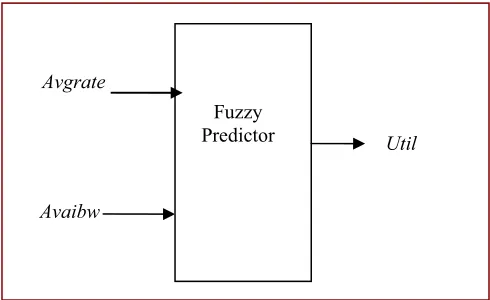
The fuzzy logic predictor predicts the amount of bandwidth required by the class based on the average rate and available bandwidth of the traffic class. The fuzzy inputs are the ratio of the average measured bandwidth over the peak rate bucket rate denoted by Avgrate and the ratio of available bandwidth over the peak rate denoted as Avaibw as shown in Figure 1. The output is the utilization weightage denoted by Util.
The universe of parameters, Y, for the fuzzy predictor is represented by the following linguistic variables,
Y = {Avgrate, Avaibw,Util} And the linguistic values, are given below:
S(Avgrate) = {L,M,H} S (Avaibw) = {L,M,H} S (Util) = {1,2,3,4,5}
where L = Low, M=Medium and H = High The input membership functions for both inputs are based on the membership functions of Figure 2. The membership functions use triangular and trapezoidal functions again based on the simplicity of these kinds of functions. The linguistic truth values are represented by the Low, Medium and High linguistic variables.
The input membership value assignments can be mathematically described as follows:
PeakRate gRate MeasuredAv
Avgrate (1)
Figure 1. Fuzzy logic predictor inputs and output parameters.
Figure 2. Input membership functions.
AFPeakRate
gRate MeasuredAv PeakRate
Avaibw (2)
The fuzzy rules are shown in Table 1. The fuzzy engine has seven rules that relate the two inputs with the fuzzy output. The construction of the rules are based on logical reasoning of how the system can track bandwidth usage. Rules 1 and 2 indicates that bandwidth usage is low since Avgrate is low and Avaibw is high or medium. Here the output weightage is the lowest. As Avgrate becomes higher and Avaibw becomes lower, the output weightage increases. This increment reaches a maximum when the Avgrate is high and Avaibw is low and medium. The instances when Avgrate is low and Avaibw is low, and Avgrate is high and Avaibw is high are omitted since these cases would not happen.
TABLE 1
RULES FOR TOKEN BUCKET FUZZY PREDICTOR
Rules Avgrate Availbw Weightage
1 L M 1
2 L H 1
3 M L 4
4 M M 3
5 M H 2
6 H L 5
7 H M 5
Avgrate
Avaibw
Util Fuzzy
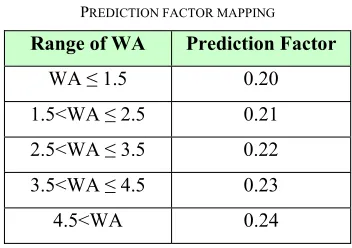
To obtain a single crisp solution for the output variable, the Sugeno inference process is used. Figure 3 shows the output singletons based on Sugeno’s method where 1 represents the lowest weightage value and 5 the highest. For defuzzification the weighted average of the singletons are obtained. This value is then mapped to a prediction factor, as in Table 2. The prediction factors are chosen based on several evaluation runs. It is found that setting a baseline at 20% above the average rate gave satisfactory performance response. An increment of 0.01% are then added for each higher weights. The prediction factor is then added to the average rate to peak rate ratio and multiplied to the current token bucket rate to give the new token bucket rate and bandwidth prediction value.
Figure 3. Fuzzy predictor’s output membership function.
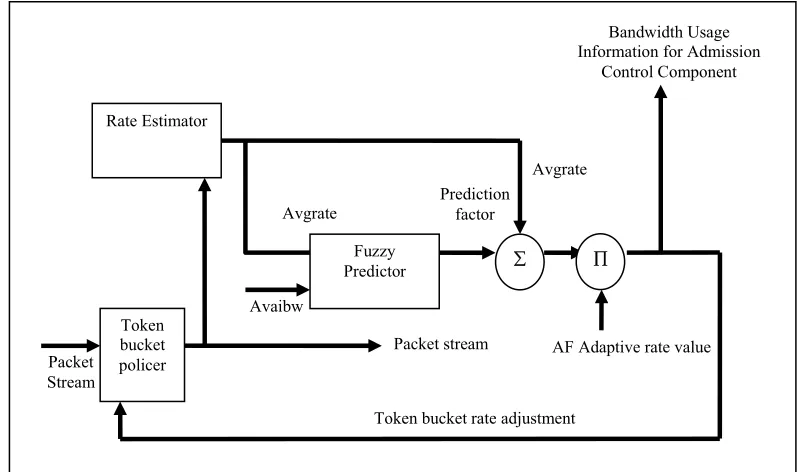
Figure 4. Fuzzy logic predictor in token bucket policer.
The fuzzy logic based token bucket policer comprise of a rate estimator, a fuzzy predictor, a summer and a multiplier as depicted in Figure 4. The output of the multiplier is fed back to the token bucket policer for rate adjustment.
A rate estimator is used to get the running average bandwidth. The rate estimator used is based on Time Sliding Window (TSW) algorithm [9]. This rate estimator takes into account burstiness and smoothes out its estimate to approximate the longer-term measured sending rate of the traffic stream.
The fuzzy logic predictor is used to predict the bandwidth based on the available bandwidth and average rate, both calculated using the measured average rate of the TSW algorithm. As illustrated in Figure 4, once the fuzzy predictor obtained the prediction factor it will be summed up with the calculated average rate value. Then it would be multiplied by the adaptive rate value to get the required token bucket rate. The mathematical relationship is as follows:
New Token Bucket Rate =
(PF +Avgrate) *Adaptive Rate value (3)
where PF is the prediction factor obtained from the fuzzy predictor.
TheAdaptive Rate value is the current token bucket rate value. The adaptive rate value will take on the value of New Token Bucket Rate after each evaluation cycle. This process is a continuous real time process.
Bandwidth Usage Information for Admission
Control Component
Avgrate
AF Adaptive rate value
Token bucket rate adjustment Packet
Stream
Prediction factor Avgrate
Packet stream Avaibw
Rate Estimator
Fuzzy
Predictor ¦
Token bucket policer
TABLE 2 PREDICTION FACTOR MAPPING
Range of WA Prediction Factor
WA 1.5 0.20
1.5<WA 2.5 0.21
2.5<WA 3.5 0.22
3.5<WA 4.5 0.23
4.5<WA 0.24
III. SIMULATION WORK
The network model used to test the fuzzy logic predictor is shown in Figure 5. Three DiffServ traffic types are used in the investigation. The traffic models are based on DiffServ Expedited Forwarding (EF) [10] per hop behaviour, the Assured Forwarding (AF) per hop behaviour and the best effort (BE) Internet traffic. Each traffic class has 10 flows each.
The PHB that have been identified suitable to cater for real time traffic with deterministic rate is the EF PHB. EF PHB should provide a loss latency, low-jitter, guaranteed bandwidth, end-to-end service through DiffServ domains [10].
To end hosts the service received is equivalent to a “virtual leased line”. In this work, the EF traffic class is modeled using a Constant Bit Rate (CBR) traffic generator and UDP transport protocol. The CBR traffic generator generates traffic according to a deterministic rate while UDP provides a connectionless data transfer platform.
The real time variable bit rate model is associated with AF PHB here. The AF PHB provides better than best effort forwarding assurance [11]. AF traffic types are assumed to carry video streaming traffic that has adaptive traffic rates such as MPEG-4. Pareto on and off distribution with UDP protocol is used to represent real time variable bit rate traffic.
The BE traffic is modeled using an exponential traffic with TCP transport protocol. The exponential traffic generator generates traffic according to an exponential on/off distribution. Packets are sent at a fixed rate during on periods, and no packets are sent during off period. Both on and off periods are taken from an exponential distribution. The exponential-TCP traffic combination provides a means of representing non-real time traffic, i.e. the traditional best effort internet traffic [12]. The traffic parameters are shown in Table 3 and the token bucket parameters are given in Table 4.
IV. SIMULATION RESULTS
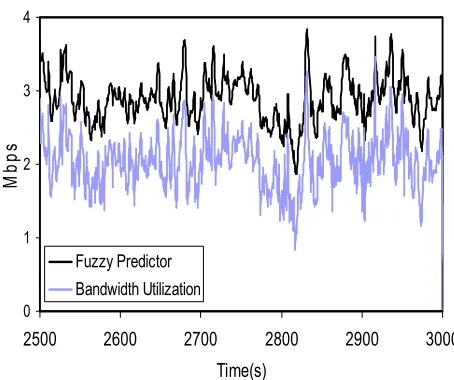
The investigation involves incorporating the fuzzy predictor at the AF ingress edge, i.e. node E2 in Figure 5. The network simulator ns-2 [12] is used for modeling and simulation work. Matlab’s fuzzy logic toolbox [13] is used to develop the fuzzy predictor engine. Three sets of simulation work are conducted to investigate the effect of changing AF traffic mean rates to the fuzzy bandwidth prediction ability. The mean rates used are 25%, 50% and 75% of the peak rate and obtained by adjusting the traffic burst time.
s1
C
E4 D2
EF Real time
AF Assured
BE Best Effort
Token Bucket Edges
Core Router 10 ms delay
10 ms delay
15 ms delay
10 ms delay
15 ms delay 15 ms delay
25 ms delay
10 ms delay E1
E2
E1 s2
s3
Ingress Router
Egress Router
D1
D3
TABLE 3
DIFFSERV AND BEST EFFORT TRAFFIC PARAMETERS Type of
Service
Traffic Rate (kbps)
Traffic type and Packet
Size
Traffic parameters
EF premium
284 UDP 200 bytes
Constant bit rate
AF assured
Adaptive 384
UDP 200 bytes
Pareto with burst time: 0.5s, idle time: 0.5s
and Hurst parameter:
1.2
BE best effort
512 TCP 576
bytes
Exponential with burst time: 0.5s, Idle time:
0.5s
TABLE 4
TOKEN BUCKET PARAMETERS Type of
Service
Token Bucket Rates (kbps)/flow
Bucket Size (Bytes) 10 EF
flow
Peak rate 284 50000
10 AF flows
Peak Rate 384 (Becomes dynamic
with the fuzzy predictor )
50000
10 BE flows
Mean rate 256 50000
0 1 2 3
2500 2600 2700 2800 2900 3000
Time(s)
Mb
p
s
Fuzzy Prediction Bandwidth Utilization
Figure 6. Bandwidth utilization and fuzzy prediction at AF ingress edge when mean rate in 25% of peak rate.
0 1 2 3 4
2500 2600 2700 2800 2900 3000
Time(s)
Mb
p
s
Fuzzy Predictor Bandwidth Utilization
Figure 7. Bandwidth utilization and fuzzy prediction at AF ingress edge when mean rate in 50% of peak rate.
2 3 4
2500 2600 2700 2800 2900 3000
Time(s)
M
bps
Fuzzy Predictor Bandwidth Utilization
Figure 8. Bandwidth utilization and fuzzy prediction at AF ingress edge when mean rate in 75% of peak rate.
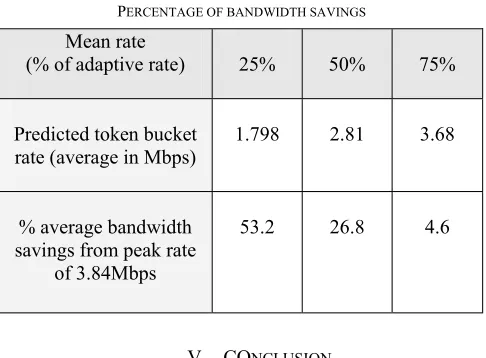
Table 5 presents the average bandwidth savings observed on the AF traffic. The bandwidth saving value is obtained by comparing the traffic mean rate to the deterministic peak rate value. A 53.2% of bandwidth savings is obtained when the AF mean rate is 25% and 26.8% is bandwidth savings is obtained when the AF mean rate is 50%. The savings get lesser at higher mean rates when it draws near to the peak rate bandwidth limit. This can be seen in the instance when the AF mean rate is 75%, the bandwidth savings is just 4%. More bandwidth savings means more connections can be accepted into the network by admission control and network resources are better utilized. The improved network performance increases efficiency and in the long run reduces network costs by optimal usage of resources.
TABLE 5
PERCENTAGE OF BANDWIDTH SAVINGS Mean rate
(% of adaptive rate) 25% 50% 75%
Predicted token bucket rate (average in Mbps)
1.798 2.81 3.68
% average bandwidth savings from peak rate
of 3.84Mbps
53.2 26.8 4.6
V. CONCLUSION
A fuzzy logic predictor is proposed that is able to track the bandwidth usage and give feedback to the token bucket to adopt the new rates as well as informing the admission control component the amount of used bandwidth of the AF class. A study is made on the fuzzy predictor algorithm by varying the mean rates of the source traffic. Results show that the fuzzy predictor is successful in feeding bandwidth prediction value to the token bucket policer enabling dynamic policing through bandwidth prediction. The bandwidth redeemed reaches 53% for low mean rates and becomes smaller for higher mean rates, i.e. mean rates that are closer to the peak rate.
REFERENCES
[1] Breslau, L., Jamin, S. and Shenker, “S. Measurement-based Admission Control: What is the Research Agenda,” Seventh International Workshop on Quality of Service, pp. 3-5, June 1999.
[2] Lim, H. H. and Qiu, B., “A predictive measurement-based fuzzy logic connection admission control,” Proceedings of IEEE International Conference on Communications, pp. 920-924, June 2001.
[3] Liang, Q., Karnik, N. and Mendel, “J. Connection Admission Control in ATM Networks Using Survey-Based Type-2 Fuzzy Logic Systems,” IEEE Transaction. Of Systems, Man and Cybernetics – Part C: Applications and Reviews, vol. 30. no 3, pp. 329 – 339, August 2000. [4] Catania, V., Ficili, G., Palazzo, S. and Panno, D, “Using
Fuzzy Logic in ATM Source Traffic Control: Lessons and Perspectives,” IEEE Communications Magazine, vol. 34, pp. 70 – 74, November 1996.
[5] Resende, R. A., Rossi, S. M., Yamakami, A., Bonani, L. H. and Moschin, E.,”Traffic Engineering with MPLS Using Fuzzy Logic for Applications in IP Networks,” IEEE International Conference on Fuzzy System. vol. 2, pp. 1146 – 1151, 2003.
[6] Yaghmaee, M. H. and Safavi, S. M., “A New FLC Based Model for Differentiated Services,” Proceedings of the Seventh International Symposium on Computers and Communications, IEEE Computer Society, pp. 802 – 807, 2002.
[7] Fernandez, M. P., Pedroza, A. and de Rezende, J. F., “QoS provisioning across a DiffServ domain using policy-based management.,” Proceedings of IEEE GLOBECOM. pp. 2220 – 2224, 2001.
[8] Negnevitsky, M. Artificial Intelligence, A Guide to Intelligent Systems, Essex, England: Addison Wesley, 2002.
[9] Clark, D. and Fang, W., “Explicit allocation of best-effort packet delivery service,” IEEE/ACM Transactions on Networking, pp 362-373., 1998.
[10] V. Jacobson, K. Nichols, K. Poduri, “An Expedited Forwarding PHB”, RFC 2598, IETF, June 1999.
[11] J. Heinanen, F. Baker, W. Weiss, J. Wroclawski, “Assured Forwarding PHB Group”, RFC 2597, IETF, June 1999. [12] Ns-2,http://www.isi.edu/nsnam/ns/