Testing an IP-based Multimedia Gateway
R. F. DIORIO1, V. S. TIMÓTEO2ANDE. L. URSINI2
Grupo de Óptica e Modelagem Numérica - GOMNI Faculdade de Tecnologia - FT
Universidade Estadual de Campinas - UNICAMP 13484-332, Limeira - SP, Brasil
1
(varese,ursini)@ft.unicamp.br
Abstract.This paper describes the preliminary results from the development of an IP-based multimedia gateway, using free software resources, to the identification, classification and forwarding of different traffic flows (elastic, more sensitive to packet loss, and stream, more sensitive to communication delays), both with pre-defined traffic profiles. The multimedia gateway performs the traffic selection by inspect-ing the ToS field of the IPv4 header and the TC field of the IPv6 header, taken as DSCP and ECN. The multimedia traffic corresponding to audio, voice, video and data services are provided by our multimedia traffic generator, which generates traffic according to given distributions. Our tests show that the func-tional mechanisms of the multimedia gateway are valid and that it can be used as an addifunc-tional tool for the study and performance evaluation of wireless and wired multimedia networks.
Keywords:Multimedia Networks; Traffic Modelling; Simulations / Emulations.
(Received April 29th, 2014 / Accepted June 19th, 2014)
1 Introduction
The evolution of communication systems and the pop-ularization of broadband residential access contributed significantly to the users of the network to explore the various applications and services offered by it. Among these services and applications, those that focus on mul-timedia content, such as access and sharing of audio and video and phone calls and videoconferencing over the Internet, among others, have become extremely popu-lar. As an example, according to statistics provided by YouTube [1], more than 4 billion videos are watched per day, totaling about 3 billion hours watched per month for more than 800 million users each month accessing their content. Another example refers to the statistics provided by Skype [2], showing that only in the first quarter of 2012 more than 115 billion minutes worth of phone calls were made and at record peak of about 32 million users accessing its services simultaneously in March 2012.
On the other hand, these new services and applica-tions make the network traffic more detailed and com-plex, requiring the use of specific approaches, such as traffic modeling, for the design, dimensioning and op-timization of modern communications networks. As an example, some studies focused their approach on the understanding and analysis of network traffic [3, 4]. Similarly, other recent works addressing questions re-lated to the modeling of multimedia traffic, focused on the use of distribution functions and compression algo-rithms for wireless networks [5, 6]. The customization of content distribution was analyzed in [7, 8], and stud-ies of timing and quality of service were investigated in [9, 10].
gateway separates the traffic types by inspecting the in-formation contained in ToS field of the IPv4 header and TC field of the IPv6 header, both with 8 bits of length, reformulated as the DSCP field, with size of six bits [RFC 2474], and the ECN field, with a size of two bits [RFC 3168]. The multimedia traffic used to test the gateway is generated by an IP-based Multimedia Traf-fic Generator (MTG) [11], which generates a real trafTraf-fic of IP packets based on a given traffic profile character-ized by few parameters: mean arrival rate of service re-quests, mean service duration and the maximum num-ber of simultaneous services. Here we consider that the first two parameters initially follow an exponential dis-tribution, but the MTG can also generate traffic follow-ing other distributions, like gaussian, Erlang or Pareto. We use iptables in the transmitter system as an adapter to change the IP header according to the service type before the packets are delivered to the network to reach the multimedia gateway.
In order to achieve this aim, the Multimedia Gate-way is described in Section 2. In Section 3, the initial tests performed with the Multimedia Gateway are de-scribed. Finally, this paper describes in Section 4, the concluding remarks for future work.
2 Multimedia Gateway
2.1 Overview
A multimedia gateway is a network element designed to distinguish and forward network traffic associated with different multimedia services such as audio, video and voice services to their respective receiving applications. This process must be made in real time, considering the traffic type (stream or elastic) and the network en-vironment where the multimedia traffic flows through (guided and mainly wireless transmissions).
In this scenario, multiple multimedia applications typically generate stream traffic of packets on the net-work. The packets that are classified and labeled by a multimedia traffic adapter and then sent over the net-work. Once the packets reach the multimedia gateway, they are forwarded to the destination system according to the service type. The end-user systems may be any computer system or mobile device running TCP/IP.
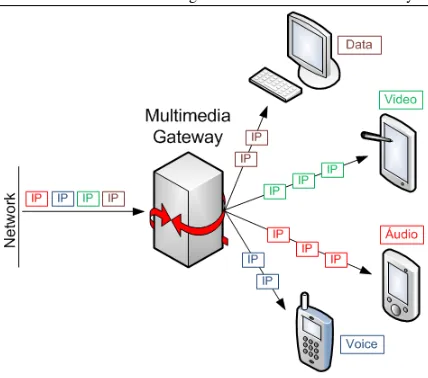
Figure 1 illustrates the traffic selection based on the service type and the forwarding of audio, voice, video, and data services to their respective applications by a multimedia gateway.
2.2 Functional structure for the traffic selection
The functional structure of our multimedia gateway is based on the ToS and TC fields of the IP header. In
gen-Figure 1:Overview of the Multimedia Gateway: service-based traffic selection.
eral, by inspecting these fields, one can select the ser-vice type and different flows within a particular serser-vice. In particular, the DSCP field can be used to provide a unique identifier for audio, voice and video services, amongst others.
Since the DSCP field has only 6 bits in length, it can support the definition of up to 64 different traffic types associated with a particular traffic class, for example:
• BE or DF: for best-effort traffic;
• EF: dedicated to low-loss, low-latency traffic;
• AF: gives assurance of delivery under prescribed conditions;
• CS: which maintain backward compatibility with the IP Precedence field.
Figure 2:Test configuration: the multimedia traffic generator and adapter which forms the transmitter system, the multimedia gateway and the receiver system.
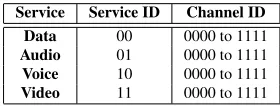
In order to supplement such scheme, Table 1 dis-plays the identifiers proposed for data, audio, voice and video services and their respective traffic channels.
Note that this bit configuration can be easily modi-fied to support more or less multimedia services by in-creasing or dein-creasing the bits used to identify the ser-vice and/or the bits used for flow identification associ-ated to the respective service, respecting the limit of the six bits available in the DSCP field.
Figure 3:Setting of the DSCP field, especially to IPv4.
Table 1:Setting of the Multimedia Traffic Tags (DSCP Field).
Service Service ID Channel ID
Data 00 0000 to 1111
Audio 01 0000 to 1111 Voice 10 0000 to 1111 Video 11 0000 to 1111
2.3 Network organization with the Multimedia Gateway
Functionally, the multimedia gateway is responsible for identifying and forwarding the various multimedia
traffics flows incoming in their network interfaces to the corresponding applications running on user devices served by the network. A schematic representation of our test environment is displayed in Fig. 3.
The multimedia traffic generator and the multimedia traffic adapter subsystems compose the transmitter sys-tem, which provides real traffic of packets containing information about the corresponding services that can be used by the receiver system to determine the perfor-mance of the multimedia gateway network. The mul-timedia gateway separates the traffic according to the service type and channel identifier and the receiver sys-tem store the service statistics. The service labeling and selection by the multimedia adapter and gateway are completely transparent to the end-user applications in the same way as the network of routers and switches is transparent to the end-to-end transport connections over the Internet. The packets are generated by the MTG with the default value in the ToS/TC fields, and next they pass through the multimedia adapter and to have their service fields updated according to Table 1. Then the packets are sent over the wired or wireless network to finally reach the receiver system were the service de-tails, like the mean service duration and arrival service time, are collected from the packets to build the service statistics.
3 Test Results
the multimedia adapter as an IP header labeler. In the upper panel of Fig. 4 we show how the packets are tagged using iptables at the multimedia adapter. The packets destined to the multimedia gate-way (fd00:0:0:2::2) in port TCP 6001 will have the DSCP field tagged as 0x00. Similarly, the packets des-tined to UDP ports 7001, 8001 and 9001 will have the DSCP field tagged as 0x10, 0x20 and 0x30 respectively.
Figure 4: Partial list of DSCP identification to IPv6 datagrams in the Multimedia Traffic Adapter (upper set of four lines) and in the Multimedia Gateway (lower set of four lines).
In the bottom panel of Fig. 4 we display the traffic selection process at the multimedia gateway, showing that the traffic is selected according to the service type in the DSCP field and then redirected to the appropriate port in the receiver system.
To generate the multimedia traffic used to test the Multimedia Gateway, the MTG implements a random number generator to discretize the points used for the distribution function used to generate such traffic in the network. These random values are generated between the values 0 and 1. The Fig. 5 displays some of these values, showing that they are properly generated, filling in a distributed and randomly manner, the spaces be-tween the values 0 and 1, represented by the variables αandβ:
Figure 5: Sample of 1000 pairs(α, β)of randomly generated val-ues in the interval [0,1] obtained from the MTG’s random number generator.
Based on the random number generator, the MTG allows traffic generation using various distribution functions, such as exponential, gaussian, Erlang and Pareto, among others. To demonstrate that these func-tions are correctly implemented in MTG and in accor-dance with the selected theoretical distribution func-tion, the Fig. 6 displays an example of multimedia traf-fic and the theoretical distribution function using, in this case, an exponential distribution, with 150000 random points with mean 0.5, 1.0 and 2.0, respectively, to gen-erate these traffic.
Figure 6: Probability distribution function of a exponential distri-bution using the MTG’s random number generator compared to the corresponding theoretical distributions.
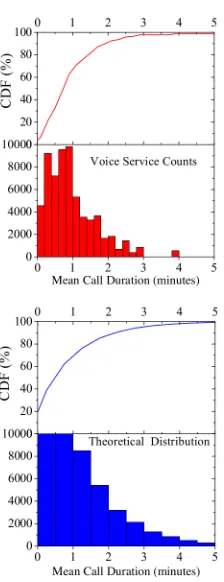
In Fig. 7 we display an example for voice traffic considering a mean arrival rate of 1000 call requests per hour and a mean call duration of 1 minute, which gives a mean service rate of 60 processed calls per hour. The top panel of Fig. 7 shows the traffic generated by the MTG but measured at the receiver system while the bot-tom panel shows the theoretical distributions with the same parameters we used in the MTG. Considering the simplicity of our model, the results are very satisfac-tory. Also, given that the main objective of the gateway (emulator) would get the values of packet loss, delay and jitter, our results show that there is no degradation in the network performance due to the introduction of the multimedia adapter to label the packet headers ac-cording to the traffic type.
4 Concluding Remarks
different CPU clock, the time units have to be adjusted so that we have the correct service parameters.
In future work, we plan to improve our MTG by replacing the multimedia traffic adapter with a modi-fied TCP/IP stack and socket interface that includes the possibility for service tagging. The new stack can also be used as a multimedia gateway in receiver systems since it will be able to separate IP packets by service type and channel ID. This could simplify the distribu-tion of multimedia content over IP networks. New per-formance tests will also be performed, in particular to check issues associated with timing (delays and jitter) and packet loss, among others.
Figure 7: Example of voice traffic measured at the receiver system (top) and the corresponding theoretical distribution (bottom) when the marked packets are transmitted over a guided transmission media (wired network).
Acknowledgements
The authors would like to thank the funding agencies FAEPEX, FAPESP and CNPq for financial support.
References
1. YouTube Statistics. Available at
http://www.youtube.com/yt/press/ statistics.html.
2. Caukin, J. 35 Million People Concurrently Online at Skype, 2012. Available at blogs.skype.com.
3. Wang, W. Zhang, X.; Shi, W.; Lian, S.; Feng, D. Understanding and Analyzing Network Traffic. IEEE Journals and Magazines, v.26, p.4-5, 2012.
4. Dahmouni, H.; Girard, A.; Ouzineb, M.; Sanso, B. The Impact of Jitter on Traffic Flow Optimization in Communication Networks. Network and Ser-vice Management, IEEE Transactions on. IEEE Journals and Magazines, v.9, p.279-292, 2012.
5. Khalifa, O. O.; Issa, S.; Olanrewaju, R. F.; Al Khazmi, El M. A. Development of a scalable video compression algorithm. Computer and Commu-nication Engineering (ICCCE), 2012 International Conference on. IEEE Conference Publications, p.755-759, 2012.
6. Golaup, A.; Holland O.; Aghvami , H. Concept and Optimization of an Effective Packet Schedul-ing Algorithm for Multimedia Traffic over HS-DPA. University of London UK, 2005.
7. Haimi-Cohen, R.; Hearn, J.; Scheutzow, M.; Levy, E.P.; Wu, L.J.; Livescu, D.; Wilford, P.A. Flex-ible and robust video delivery based on self-contained multimedia segments. Sarnoff Sympo-sium (SARNOFF), 2012 35th IEEE. IEEE Con-ference Publications, p.1-5, 2012.
8. De Schepper, K.; De Vleeschauwer, B.; Hawinkel, C.; Van Leekwijck, W.; Famaey, J.; Van de Meerssche, W.; De Turck, F. Shared Content Ad-dressing Protocol (SCAP): Optimizing multimedia content distribution at the transport layer. Net-work Operations and Management Symposium (NOMS), 2012. IEEE Conference Publications, p.302-310, 2012.
9. Tian, H.; Yang, W. Study on QoS of Multimedia Traffics in MAC Layer Based on 802.11. Infor-mation Science and Applications (ICISA), 2012 International Conference on Information Science and Applications. IEEE Conference Publications, p.1-6, 2012.
10. Kamadyta, A.; Bandung, Y.; Langi, A. Z. R. Per-formance analysis of supporting QoS for multime-dia in IEEE 802.11e. Cloud Computing and Social Networking (ICCCSN), 2012. IEEE Conference Publications, p.1-4, 2012.
![Figure 5: Sample of 1000 pairs (α, β ) of randomly generated val-ues in the interval [0,1] obtained from the MTG’s random numbergenerator.](https://thumb-us.123doks.com/thumbv2/123dok_us/8364422.1672859/4.612.85.281.582.710/figure-sample-randomly-generated-interval-obtained-random-numbergenerator.webp)