AN IMPACT OF THE EFFICIENT FUNCTIONING OF THE VENTILATION
AND AIR-CONDITIONING SYSTEM ON THERMAL COMFORT
OF THE MEDICAL STAFF IN THE OPERATING ROOM
Tomasz Jankowski1, Magdalena Młynarczyk2
1 Department of Chemical, Aerosols and Biological Hazards, Laboratory of Aerosols, Filtration and Ventilation, Central Institute for Labour Protection – National Research Institute, Czerniakowska 16, 00-701 Warsaw, Poland, e-mail: [email protected]
2 Department of Ergonomics, Laboratory of Thermal Loads, Central Institute for Labour Protection – National Research Institute, Czerniakowska 16, 00-701 Warsaw, Poland, e-mail: [email protected]
Volume 17, Issue 5, Nov. 2016, pages 114–119
DOI: 10.12911/22998993/65459 Research Article
ABSTRACT
Ventilation and air conditioning systems are necessary for developing proper pa-rameters of indoor environment in operating rooms. The main task of ventilation and air conditioning in those specific areas consists in creating desirable tempera -ture, reducing the number of microorganisms and the concentrations of hazardous gases and substances in the air, as well as ensuring the proper direction of airflow. In Poland, indoor environment in operating rooms has to comply with the require -ments set out in three regulations (Journal of Laws of 2002 No. 75, item 690, as amended, Journal of Laws of 2002 No. 217, item 1833, Journal of Laws of 2011 No. 31, item 158, as amended) and the document entitled “Guidelines for the de -sign of general hospitals”. Given insufficient accuracy of the abovementioned na -tional documents, it is a common practice to use foreign standards, i.e. ASHRAE Standard 170–2013, DIN 1946-4: 2008 and FprCEN TR 16244: 2011. When con -sidering the conditions for thermal comfort, it is important to bear in mind a close link between air flow velocity and air temperature. Air in the zone occupied by patients and medical staff must not cause the sensation of draft. Furthermore, air velocity should be sufficient to eliminate interference caused by the presence of people and other sources of heat. It should also reduce the turbulence level in the air in the operating room. Efficient functioning of ventilation and air conditioning was tested during treatments and operations carried out on three wards of a War -saw hospital. Tests were performed with the participation of medical staff from various surgical units. They were asked to perform minor manual tasks to simulate work on the operating table, and to complete a questionnaire on subjective thermal sensation. The applied methodology is widely used during testing of general and local ventilation in public buildings. Air temperature, relative humidity, air flow supply and exhaust air from the operating room were determined on the basis of VelociCalc 8360 and Testo 435 anemometers with a 3-function probe and 3 vane probes with the diameter of 16 mm, 60 mm and 100 mm. Throughout the study, microclimate conditions in the operating rooms were controlled by the EHA MM101 microclimate meter. Test results showed that the microclimate parameters met the requirements of the aforementioned documents. However, individual ther -mal sensations reported by the medical staff pointed to the lack of ther-mal comfort and, in extreme cases, e.g. when using lead aprons during operations, perception of the thermal environment as ‘very hot’. The efficiency and type of air distribu -tion in operating rooms has a decisive effect on the results.
Keywords: ventilation, air velocity, microclimate, operating room, hospital Received: 2016.08.11
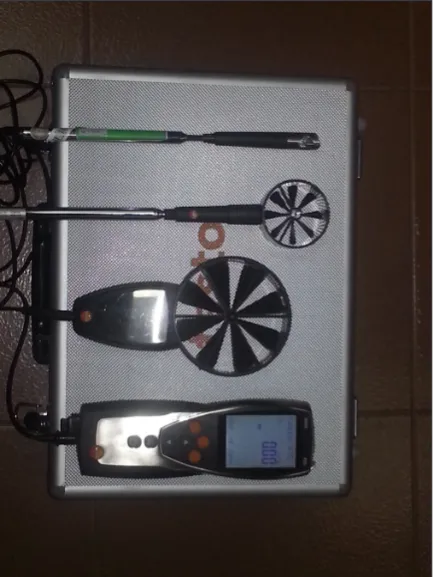
Figure. 1. A view of the Testo experimental set
INTRODUCTION
Air-conditioning and ventilation systems are necessary for creating proper parameters of in-door environment in hospital operating rooms. The main task of air-conditioning and ventilation systems in those specific areas consists in creat-ing desirable temperature, reduccreat-ing the num-ber of microorganisms and the concentrations of hazardous gases and substances in the air, as well as ensuring the proper direction of airflow [Różycki 2013].
In Poland indoor environment of the operat-ing room has to comply with the requirements set out in three regulations [Journal of Laws of 2002 No. 75, item 690, as amended, Journal of Laws of 2002 No. 217, item 1833, Journal of Laws of 2011 No. 31, item 158, as amended], and the document entitled “Guidelines for the design of general hospitals”. Given insufficient accuracy of the above-mentioned national documents, it is a common practice to use the foreign standards, i.e. ASHRAE Standard 170–2013, DIN 1946–4: 2008 and FprCEN TR 16244: 2011.
The task of creating microclimate in hospital rooms, in comparison to other types of facilities, is distinguished by a significant degree of diffi-culty. Given critical importance of rigorous clean-liness and hygiene in healthcare settings, indoor air quality in operating rooms is undoubtedly an important goal for air-conditioning and ventila-tion engineers [Uścinowicz 2015].
The microclimate of operating rooms is not only limited to ensuring proper conditions for thermal comfort but, first and foremost, it in-volves establishing and maintaining zones of con-trolled cleanliness [Charkowska 2012]. The key microclimate parameters determining thermal comfort include: indoor air temperature, humid-ity, airflow velocity. In contrast to air temperature and airflow velocity, an impact of humidity on the occupant’s satisfaction with the surrounding thermal conditions is marginal because a human is able to acclimatise to a wider range of tempera-tures [Zwolińska 2012]. Fluctuations of humid-ity in the range of 30–70% are acceptable. The specificity of operating rooms equipped with the air-conditioning and ventilation system requires reducing the range of air humidity. The automatic control system controls air-conditioning and ven-tilation to ensure ca. 50% humidity in the operat-ing room with the indoor temperature at 200C.
It is therefore important to assess the effect of room air distribution on air parameters in the zone of direct impact on the patient and near the operating table, taking into particular considera-tion the breathing zone of medical personnel.
MATERIALS AND METHODS
Tests of indoor air parameters were performed with the 435–2 TESTO measuring set. They in-cluded measurements of air velocity, temperature and relative humidity. The set together with a 3-function probe and 3 vane probes with the di-ameter of 16 mm, 60 mm and 100 mm (Testo AG, Germany) (Figure 1) allows measurement of air velocity, temperature and relative humidity in the following ranges:
• air velocity: 0 ÷ 20 m/s,
• air temperature: -20 ÷ 70 0C,
• relative humidity: 0 ÷ 100 %RH.
range between 0.2 m/s and 1.0 m/s. Anemometer inputs were recorded for analysis.
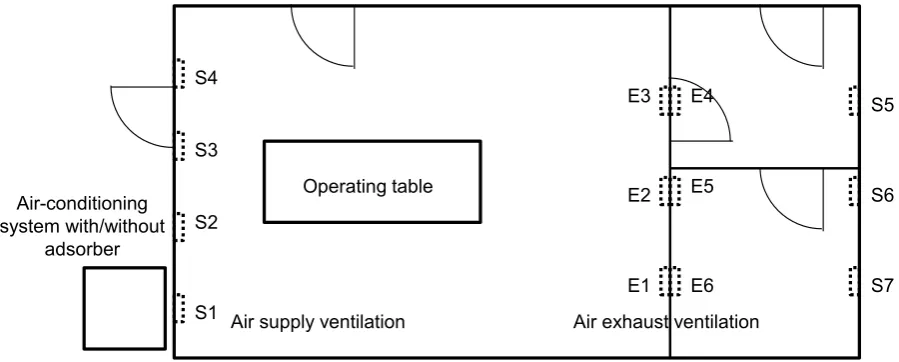
The probes of the device were placed in meas-uring points, on a specially constructed mobile supporting structure, thus enabling measurements in different locations of the room (Figure 2). The system efficiency was tested on a Warsaw hos-pital ward. Tests were conducted with the par-ticipation of medical staff who performed minor manual tasks to simulate work at the operating ta-ble. Given the specificity of surgical procedures, the operating room was equipped with, amongst others, X-ray tubes, which in the opinion of the medical personnel were the main source of heat and noise. The operating room had a one-way air conditioning and ventilation system (Figure 2). The zone surrounding an operating table did not have a laminar ceiling.
The medical personnel wore surgical clothing and aprons for the tests. Given that the operating room was also used for surgical operations with-out the need of a lead apron, such variant was de-veloped, as well. Three members of the medical personnel participated in the tests performed in the operating room i.e. a surgeon assistant, a scrub nurse and a technician handling the equipment.
The measurements were made with a thermal
anemometer. Its probes were placed in the
mid-dle of each of the measuring point and the sensor was located so as to make measuring direction perpendicular to the interior of a measuring plane (the measurement displayed the maximum air ve-locity). Interference at the sensor counter current
(air movement caused by the presence of person-nel, equipment, etc.) was reduced to the minimum during measurements. Individual velocities Vi perpendicular to the interior of a measuring plane were measured and recorded at regular intervals, i.e. every 1.0 second or more frequently, at least for 60 seconds. For each measuring point mean values Vśr,n of measured constituents of air veloc-ity Vi,n [m/s] were calculated on the basis of the following equation:
ni in
n
śr
n
V
V
1 ,
,
1
(1)where: Vi,n – temporary constituent of air velocity
in the ‘n’ measuring point [m/s],
n – the number of measurements made in the period of 60 seconds.
The measurements defined air temperature distribution T [0C] and relative humidity RH [%] in each measuring point of local airflow velocity.
In order to determine the influence of changes in the ventilation and air conditioning system on the parameters related to air distribution in the working space of the medical staff, three ventila-tion variants were used. Different values of sup-plied air volume served as a variable input param-eter for the system. In the measurements three values of airflow were used, which corresponded to 25, 50 and 75% of the maximum value.
The variant with and without the tubular ad-sorber with silica gel was used as a variable pa-rameter for the air-conditioning system.
Operating table Air-conditioning
system with/without adsorber
E1 S1
E4 E3
E2 E5
Air supply ventilation Air exhaust ventilation
S6
E6
S5
S7 S4
S3
S2
RESULTS
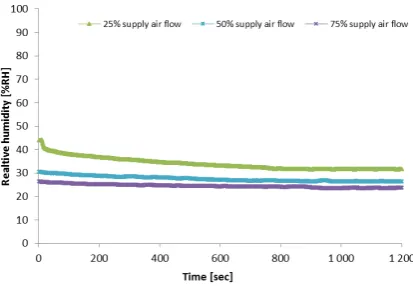
Figures 3, 4 and 5 show changes of local air-flow velocity, temperature and relative humidity in the working area of medical personnel, accord-ing to the ventilation variant.
From the data analysis shown in Figures 3 ÷ 5, it transpires that changes in the air volume cause a change of air parameters in the operating room. A 50% increase in low enabled shaping air pa-rameters in the following manner:
• increase of air velocity from 0.76 to 1.73 m/s,
• increase of air temperature from 23.70 to 26.98 0C,
• decrease of relative humidity from 34.05 to 24.54% RH.
It was furthermore observed that air parame-ters were not stable. The bigger the air volume was
• the bigger fluctuations of air velocity, ranging between 0.12 and 0.16 m/s
• the smaller fluctuations of air temperature, ranging between 0.63 and 0.260C and relative humidity, between 2.60 and 0.71% RH.
Figures 6, 7 and 8 show changes in air ve-locity, temperature and relative humidity at dif-ferent distances from air supply ventilation in the operating room.
Measurements of air parameters in different zones of the operating room revealed that a work cycle of the cooling unit in the air conditioning system had no influence on fluctuations of air ve-locity and temperature in given measuring points.
Air velocity at the breathing zone of the medi-cal staff did not exceed design values of 0.5m/s and ranged between 0.1 and 0.4 m/s.
Fluctuations of relative humidity occurred in all three measuring points. The moment power was supplied to the cooling unit air humidity dropped, whereas when the unit was automatical-ly switched off air humidity increased. The bigger the distance from the front panel of air supplier the smaller the range in air humidity fluctuations:
• outlet of the air supplier – from 25.67% to 79.41%
• the mid-point of the room – from 32.86% to 45.65%
• human breathing zone – from 33.67% to 40.24%.
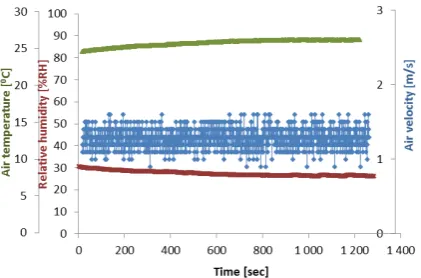
The use of a tubular adsorber in ventila-tion ducks and air condiventila-tioners of the operating room stabilised all air parameters in the direct
air supply zone and in the breathing zone of the medical staff. The geometry of openings in air suppliers allowed reaching linear air velocity at their outlets in the range up to 2 m/s. Air tem-perature could be smoothly adjusted between 10 and 250C. It was furthermore found that relative humidity did not exceed 50% when the device was in use (Figure 9).
Figure 5. Changes of relative air humidity in the operating room using various ventilation settings Figure 4. Changes of air temperature in the operating
room using various ventilation settings Figure 3. Changes of air velocity in the operating
CONCLUSIONS
An analysis of the results showed that the choice of a ventilation variant in an operating room had a significant influence on the param-eters of thermal comfort of medical personnel.
Microclimate parameters in the hospital oper-ating room satisfied the requirements set out in nor-mative documents. The efficiency and type of air distribution had a decisive effect on such results.
Anemometric measurements of airflows are of considerable importance for research on air distribution in an operating room. The said methods allow depicting and defining the role of parameters characteristics for thermal comfort sensation of personnel in the zone of direct im-pact on the patient and near the operating table, taking into particular consideration the breathing zone of the medical staff.
By defining the aforesaid dependencies an observer is able to determine an influence of par-ticular local factors and assess the correctness of the applied concept of air distribution, bearing in mind different specifities of medical treatments and surgical operations.
Acknowledgements
This publication was developed on the basis of the results of the project no. III.P.08 carried out in the framework of the 3rd stage of multiannual programme ”Improvement of safety and working conditions” co-financed in the years 2014–2016 by the Ministry of Science and Higher Education in the area of research and development work. Main performer: CIOP-PIB.
Figure 8. Changes of relative air humidity at different distances from air supply ventilation
Figure 6. Changes of air velocity at different distanc -es from air supply ventilation
Figure 9. Changes in air temperature, relative humid -ity and veloc-ity in the operating room equipped in the
air conditioning system with the tubular adsorber
REFERENCES
1. ASHRAE Standard 170–2013. Ventilation of health care facilities, ASHRAE.
2. Charkowska A. 2012. Klimatyzacja szpitali w do -kumentach prawnych – teraźniejszość i przyszłość. Chłodnictwo i Klimatyzacja, 11, 38–44.
3. DIN 1946–4:2008. Ventilation and air condition -ing – Part 4: VAC systems in build-ings and rooms used in the health care sector, DIN.
4. FprCEN TR 16244:2011(E). Ventilation for hospi -tals, CEN.
5. Journal of Laws of 2002 No. 75, item 690, as amended: Rozporządzenie Ministra Infrastruktury z dnia 12 kwietnia 2002 r. w sprawie warunków technicznych, jakim powinny odpowiadać budynki i ich usytuowanie, wraz z późniejszymi zmianami. 6. Journal of Laws of 2002 No. 217, item 1833. Roz -porządzenie Ministra Pracy i Polityki Społecznej z dnia 29 listopada 2002 r. w sprawie najwyższych dopuszczalnych stężeń i natężeń czynników szko
-dliwych dla zdrowia w środowisku pracy.
7. Journal of Laws of 2011 No. 31, item 158, as amended. Rozporządzenie Ministra Zdrowia z dnia 2 lutego 2011 r. w sprawie wymagań, jakim powinny odpowiadać pod względem fachowym i sanitarnym pomieszczenia i urządzenia zakładu opieki zdrowotnej, wraz z późniejszymi zmianami. 8. Kruczkowski P. 1984. Wytyczne projektowania
szpitali ogólnych. Instalacje sanitarne. Zeszyt 5 – Wentylacja i Klimatyzacja, Ministerstwo Zdrowia i Opieki Społecznej.
9. Różycki A. 2013. Czystość, bezpieczeństwo i eko -nomia sal operacyjnych w standardach europej -skich, Infrastruktura techniczna szpitala, 1, 43–50. 10. Uścinowicz P., Chludzińska M., Bogdan A. 2015. Thermal environment conditions in Polish op-erating rooms. Building and Environment, 94, 296–304.