Background: The immunization card is revised with addition of general information about child health and is
later called as child health card. This card is a tool used by Health Management Information System in Nepal. It
is important for tracking the records of immunization. Aim is to identify the factors determining the availability,
utilization and retention of the child health card in Western Nepal.
Methods: A cross sectional study was conducted among mothers having children < 24 months old from Gorkha
(Western Hill) and Nawalparasi (Western Terai) districts. The sample size for the study was 600 and systematic
random sampling was used to select the mothers having less than 24 months old children. Data entry and analysis was
done by using SPSS. Qualitative data was analyzed by making matrix.
Results: The average age of respondents was 24 years. The majority of respondents have gained higher level
education. Retention of the card was found to be 82.2%. 90.3% retention was seen among 0-12 months children
age group whereas it was 74 % among12 to 24 months age group. The reasons for less retention were torn by the
child/played by child (54.6%) followed by lack of proper place,unaware about importance and poor quality of card.
The new child health cards were insufficient, compelling use of both new and old cards which created problem in
consistency. Regarding utilization of child health card, it was found to be used for birth registration and for further
studies in abroad.
Conclusions: The areas of utilization of child health card should be broadened so that the retention of card can
be increased. The main reasons for less retention of the card are torn by children and lack of the proper place.
Keywords: Availability; retention; utilization; vaccination card
Factors Determining Availability, Utilization and
Retention of Child Health Card in Western Nepal
Paudel KP,1 Bajracharya DC,2 Karki K,2 K.C. A31Child Health Division, Department of Health Sciences, Ministry of Health, 2Group for Technical Assistance, 3UNICEF Country Office Nepal, Nepal.
Correspondence:
Dr Krishna Prasad Paudel, Kanti Children’s Hospital Maharagunj,
Kathmandu, Nepal. Email: [email protected],
ABSTRACT
INTRODUCTION
Immunization is one of the most successful and cost effective public health interventions which saved countless lives.1 WHO developed the child health card which was a record based format which later included details on growth and general information about child health.2 This is an inexpensive yet effective instrumentwhich is under-utilized.3 The card is important for tracking the vaccinated children and it should be retained for minimizing the duplication and missing from immunizing the children.
The card was introduced in Nepal in 2008 with records on Immunization, Vitamin A and a Weight-for-age growth chart.4 Child health card was produced by 34 percent of mothers of children age 12-23 months in 2011.5 Low retention and use of CHC caused difficulty for both
the mother and health worker to monitor the growth of children.6 A cross sectional study was conducted in Divyapuri, Nawalparasi in 2010 found card retention of 41%.7 This study was conducted to identify the factors determining the availability, utilization and retention of the child health card in Western Nepal.
METHODS
This is a cross sectional study, which was conducted among health personnel with qualitative method for their views while a quantitative study was conducted among mothers having children less than 24 months old with semi-structured questionnaires.
The study sites were in Gorkha and Nawalparasi districts of Western development region. Nawalparasi district is located at the midpoint of Nepal’s east–west highway.
J Nepal Health Res Counc 2016 May - Aug;14(33):99-103
Original
Geographically, this district can be subdivided into hilly and mountain regions, and administratively into urban and rural regions. The districts are selected for comparing the differences between hill and terai regions. The study populations were mothers with children less than 24 months of age and health personnel (Health Facility In-charge).
A total of 12 village development committees (VDCs) (6 in each district) were randomly selected by systematic stratified sampling based on immunization coverage for this study. Each district’s sampled VDCs have covered at least 2 PHCCs, 2 HPs and 2SHPs. The Sample size of this study was equally distributed to all 12 VDCs. Similarly, three wards (30%) were selected randomly from each VDC. The lists of mothers having less than 24 months old children were collected from health facilities and selected based on systematic random sampling.
Women with children less than 24 months old were the study population at household level. The following formula was used to calculate the sample size.
Sample size n=
Hence, required sample size = calculated sample size X deff (WHO, 2002). So, Sample size (n) for this study was 600 which was representative for the districts. One health personnel from each health facility was selected for the interview.
In case of quantitative data, a number of quality check mechanisms such as range checks and skip instructions were developed which helped to detect the errors during the data entry stage. Data entered was converted into SPSS software package for analysis. Once the cleaned data from the computer was available, the analysis began. Analysis was carried out using frequencies, percentages and cross-tabulation. Similarly, the qualitative data were recorded in digital tape recorder. Then these data were transcribed and then translated in English language. The qualitative data were then analyzed by preparing matrix tables. The matrix table contained the answer with similarities and differences to questionnaires and the relevant verbatim. Then matrix table were merged in respect to each district and then coded and analyzed.
Ethical approval was taken from Nepal Health Research Council Nepal (NHRC). The official letter was taken from Child Health Division (CHD), DoHS to district level health office. Verbal and written consent were taken from the respondents mothers.
RESULTS
Out of 600 respondents, more than four-fifth (82.7%) of respondents were settled in rural areas whereas nearly one fifth were settled in urban area. Mostly male were the head of the households.
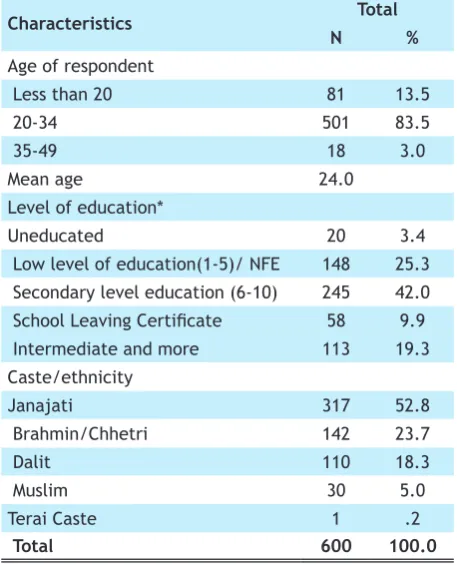
Table 1.Background characteristics of respondents.
Characteristics Total
N %
Age of respondent
Less than 20 81 13.5
20-34 501 83.5
35-49 18 3.0
Mean age 24.0
Level of education*
Uneducated 20 3.4
Low level of education(1-5)/ NFE 148 25.3 Secondary level education (6-10) 245 42.0 School Leaving Certificate 58 9.9 Intermediate and more 113 19.3 Caste/ethnicity
Janajati 317 52.8
Brahmin/Chhetri 142 23.7
Dalit 110 18.3
Muslim 30 5.0
Terai Caste 1 .2
Total 600 100.0
Most of the respondents (83.5%) were from age group 20-34 years followed by less than 20 (13.5%) and 35 to 49 years (3.0%). Mean age of the respondents was 24 years.
More than two-fifth (42%) respondents had completed secondary level education and very few(3.4%) were uneducated.
Janajati were more among the respondents Muslim and terai caste were very few. Likewise, most of the respondents were Hindu in both districts.
Table 2.Wealth quintile.
Characteristics Total
N %
Wealth Quintile
The poorest 120 20.0
Poor 120 20.0
Middle 119 19.8
Rich 123 20.5
Richest 118 19.7
Total 600 100.0
Wealth quintile was computed with the data from set of questionnaires related to income, farming and
agriculture, housing condition, communication facilities, sanitation and other facilities as in Nepal Demographic Health Survey. One-fifth of the respondents were in all categories of wealth quintile. Poorest and richest respondents were found more in Nawalparasi than in Gorkha district.
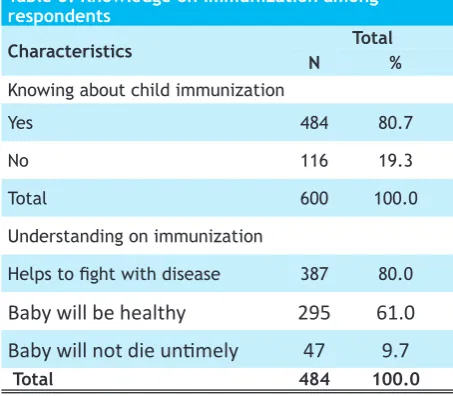
The study revealed that most of the respondents had known about immunization and the rest did not. Most of them immunized their children because of preventing from diseases and having their children healthy.
Table 3. Knowledge on immunization among respondents
Characteristics N Total%
Knowing about child immunization
Yes 484 80.7
No 116 19.3
Total 600 100.0
Understanding on immunization
Helps to fight with disease 387 80.0
Baby will be healthy
295
61.0
Baby will not die untimely
47
9.7
Total 484 100.0
Majority (60.8%) of respondents had correct knowledge on number of times measles vaccine (one time) should be given. More than half (58%), one third (34.3%), 31.8%of respondents had correct knowledge on number of times BCG (one time), DPT (three times), Polio (three times) should be given respectively. Above all, the correct comprehensive knowledge about introduction of four types of vaccines (Measles, BCG, DPT and Polio) is 23% followed by 77% who do not have correct comprehensive knowledge.
In this Fiscal Year 2014/2015, the new child health cards were not received in sufficient amountin majority of health facilities. Out of fourteen visited facilities, only 7.1 % said child health card were received sufficiently. The main reason explained behind the insufficient situation was due to inadequate supply of new child health card from district or central level. It was found that all the health facilities were using old child health card when shortage of card was experienced.
All the health facilities made demand on child health card on the basis of target population served including wastage rate. During shortage, in order to fulfill the immediate need of child health card, 57.1 % borrowed
from nearby health facility and 42.9 % reported and waited response from district/ central level.
More than four-fifth (82.3%) respondents had card during visit while 17.7% had not. Likewise, nearly half of the respondents (47.2%) had lost the baby’s card. Similarly, others threw the card because of dose completed (12.3%), due to torn (16%), no key of locked cupboard at the time (12.3%), kept in health institution (11.3%) and new card version was not provided instead of old card (0.9%). More cards were found for the boy than girl children.
Most of the literate had kept the card. However, the half of the uneducated had child health card of their baby.Similarly, those respondents who had one or two currently living children had slightly more baby’s child health card than in more than two children.
Likewise, most of the respondents who had baby’s child health card were in middle (85.7%), rich (87.8%) and richest (83.8%) respectively. Further more,three quarter (76.5%) respondents had baby’s child health card, who were at distance of 30 to 60 minutes from home to immunization center.
More than four-fifth (84.8%) cards were in safe and nice condition. Among those cards that were not in safe and nice condition, more than half (54.6 %) of the cards were torn by children whereas about one quarter (22.7%) did not have proper place to keep it safely. Likewise, other reasons were not aware about the importance of card (13.3%); due to poor quality of paper (5.3%) and due to careless (4%).
Further more, most of the respondents had safe condition of card among richest (91.9%) wealth quintile. Likewise, more than three fourth respondents had baby’s child health card in safe among the poorest (75.8%) wealth quintile.
Regarding the distance of immunization center from home, more than four-fifth of respondents (82.1%) had safe condition of card, where they have to travel 30 to 60 minutes from home.
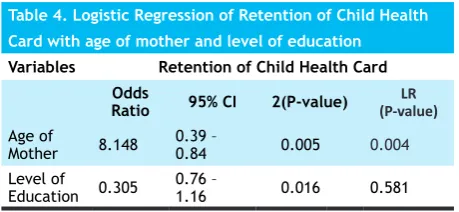
Table 4. Logistic Regression of Retention of Child Health Card with age of mother and level of education
Variables Retention of Child Health Card Odds
Ratio 95% CI 2(P-value) (P-value)LR Age of
Mother 8.148 0.39 – 0.84 0.005 0.004
Level of
Education 0.305 0.76 – 1.16 0.016 0.581
A result of logistic regression shows that the mother’s age has helped for the retention of child health card (P-value = 0.004). The variables significant for bivariate analysis were included for logistic regression.
DISCUSSION
The selected respondents for household survey were mothers with children less than 24 months old i.e. 300 each in Gorkha and Nawalparasi districts. This type of study is a rare study. The average age of respondents was 24 years. The majority of respondents have received high level education. Majority of respondents belonged to Janajati group (52.8 %).
Only two districts from Western Development Region of Nepal were selected and the study cannot be generalized which is the limitation for this study.
In our study, the retention of child health card was found to be 82.2 %. When the age was categorized, 90.3% retention was seen among 0-12 months children age group whereas retention decreased to 74 % when the child reached 12 to 24 months of age group. The reasons explained by the respondents for not showing the card during visit were: loss of the card (47.2) followed by torn, thrown away due to completion of dose, unavailability of key of cupboard for security, kept in the health institution etc. A study conducted among 12-23 months of children in2010 by Bhandari R has reported higher retention (88.9 %) of child health card8. This is higher than our study findings and the reason may be due different study location.
In our study, we found that 84.8 % of the cards were in safe and good condition, while in the remaining, the cards were torn, wet and black due to smoke. The reasons explained for not keeping the card safe were (1) torn by the child/played by child (54.6 %) followed by (2) don’t have proper place to keep it, (3) not aware about its importance, (4) poor quality of paper/cards and (5) carelessness.
In contrary, the study conducted by Pahari DP revealed that there was 41% of retention of child health card. This
might be due to the reason that the study conducted by Pahari DP was among the child with age group 0 months to 36 months7. The study conducted by Pahari included mean age of children as 19.3 months old, while the average age of youngest child was 11.1 months in our study.
Similarly, the findings reported by the study conducted by CARE Nepal 2007, revealed that 37.5 % of children aged 0 to 23 months had child health card.6 The reason for low retention of child health card was that the most parents didn’t find the usefulness of child health card `and the need to preserve it.
Almost all (98.8 %) the respondentsvisited the health centers for pregnancy check up. Among them, 72.7 % were provided with information on child health card by health workers. The information provided were: keep the card safely; bring the card every time; complete all vaccine as per child age; it will help them to know the child’s health condition.
Similarly, the report of NDHS (2011) found that there was 34 % of retention of vaccination card among 12-23 months old children whereas it was found to be 74.0% in our study. The reason may be that our study is restricted to two districts only and differences in age group. The children of respondents with secondary and higher level education showed 46% of card retention whereas it was found to be 29% in our study. The cards were most likely to be produced for boys during the interview as reported in NDHS (2011). In our study the similar result was found that the cards were most likely to be produced for boy’s(54.2%).
CONCLUSIONS
The availability of new child health card in health facilities were insufficient, thus, compelling one to bring into use of both new and old card which created problem in consistent use of cards. Only one of 14 facilities noted sufficient stock levels of updated home-based records.
Mainly the practice of utilizing the child health card was not in general practice, but 13.4% had used for birth registration process. Likewise, 82.2% were retaining the child health card. The reasons for not showing the card during the visit were: due to lost (47.2%) followed by completion of dose (12.3%), torn (16%), unavailability of key of cupboard (12.3%), kept in the health institution (11.3%)and new card version is not provided instead of old card (0.9%). Thus, in comparison to past studies, the card retention has been found to be increased.
We would like to acknowledge UNICEF Country Office Nepal, Child Health Division of Department of Health Services, District Health Offices, Nepal Health Research Council and Dr. Shyam Raj Upreti, former Director of Child Health Division, Department of Health Services,
Ministry of Health.