Asha. World Journal of Engineering Research and Technology
STRATEGY TO IDENTIFY COGNITIVE LEVEL OF QUESTION
USING BLOOM'S TAXONOMY
Asha B. Sattane*
Advanced Computing Training School, Centre for Development of Advanced Computing, Pune.
Article Received on 14/01/2017 Article Revised on 05/02/2017 Article Accepted on 26/02/2017
ABSTRACT
An important component of question answering systems is question categorization. Questions are provided to fulfill learning objectives in the subject content learned by students. Challenging thing in question answering system is to prepare good quality questions. Quality questions are prepared by assigning cognitive level. Learning and assessment are the two sides of education system. Thus, Bloom's taxonomy is common reference point for it. Exam questions categorization presents a main challenge in categorizing short questions which will have small text. Short questions text are very sparse and far in terms of features also. In order to solve this issue, methodology is proposed to categorize exam questions automatically to the cognitive levels of Bloom's taxonomy. This provides a strategy based methodology using three machine learning classifiers. The classifiers adopted in this work are, Support Vector Machine (SVM),Naive Byes (NB), and k-Nearest Neighbour (k-NN) .The study found that applying feature selection methods, namely Chi-square, Mutual Information and Odd Ratio on question categorization not only make categorization more time efficient, but it also improves the categorization accuracy . Furthermore, it is discovered that combination of classifiers can be applied to categorize the question with feature selection methods.
KEYWORDS: Question categorization, Machine Learning, Cognitive level, Assessment, Bloom’s taxonomy.
World Journal of Engineering Research and Technology
WJERT
www.wjert.org
SJIF Impact Factor: 4.326*Corresponding Author
Asha B. Sattane
Advanced Computing
Training School, Centre for
Development of Advanced
INTRODUCTION
Education is a process of receiving and giving systematic instruction. Important stages in education are planning, teaching, learning and assessment. Aims of these stages are to make learner capable of knowledge gaining skill, decision making, good reasoning and critical thinking. The objective is achieved by implementing assessment which is the crucial step of determining learner's conceptual development. Therefore the examinations are the medium to measure learners' cognitive levels.[1] Further, critical thinking ability developed through using the higher-level thinking[2] skills of Bloom’s Taxonomy. Zoller and Tsaparlis[3] defined higher order cognitive skills (HOCS) items. Level of learning is identified by the assessment using Bloom's taxonomy. Benjamin Bloom[4] invented the taxonomy of educational objectives in 1956, called Bloom's Taxonomy who is an educational psychologist at the University of Chicago. The revised Bloom taxonomy is invented in 2001.[5]
Bloom defined three domains of taxonomy : Cognitive, Affective and Psychomotor. The most used domain in this study is cognitive domain as it is closely related to knowledge structure of education process. Cognitive domain is organized as a series of levels. Levels in the domain are covered sequentially from lower to higher to perform effectively at higher levels. Bloom divided thinking skills into six cognitive levels such as knowledge, then comprehension, application, analysis, synthesis and, finally, evaluation. To overcome the criticism of original taxonomy, Anderson and Krathwohl in 2001 revised bloom's categorisation by moving from noun to verb as Remembering, Understanding, Applying, Analysing, Evaluating and Creating.[5] Revised taxonomy describes learners' thinking processes rather than behaviors.
knowledge explains how to use methods, skills, techniques and algorithms. (4) Metacognitive knowledge is awareness and knowledge of one's own cognition.
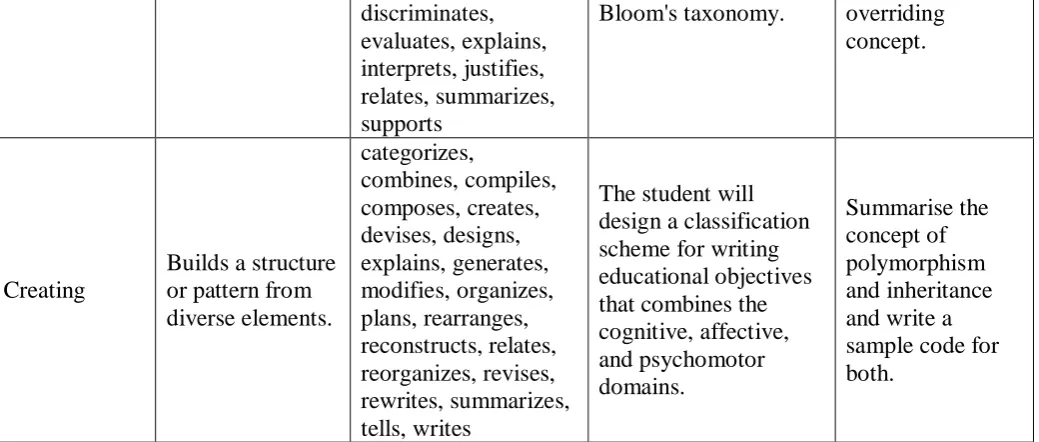
Table I: Six categories of the cognitive domain of bloom's taxonomy.
Level Definition Sample Keywords Sample Behaviors Sample Question
Example Remembering recall or recognizes information, ideas, and principles from previous learned information defines, describes, identifies, knows, labels, lists, matches, names, outlines, recalls, recognizes, reproduces, selects, states
The student will define
the 6 levels of Bloom's taxonomy of the cognitive domain. Define polymorphism concept. Understanding ranslates, comprehends, or interprets information based on prior learning. comprehends, converts, defends, distinguishes, estimates, explains, extends, generalizes, gives an example, infers, interprets, paraphrases, predicts, rewrites, summarizes, translates
The student will explain
the purpose of Bloom's taxonomy of the cognitive domain.
Explain class 'person' with it's datatypes in the program.
Applying
use a concept in a new situation what was leraned in a classroom
applies, changes, computes, constructs, demonstrates, discovers, manipulates, modifies, operates, predicts, prepares, produces, relates, shows, solves, uses
The student will write an instructional objective for each level of Bloom's taxonomy.
Demostarte the relationship of package and class in a program.
Analysing distinguishes, classifies, and relates the assumptions into components to understand its structure analyzes, breaks down, compares, contrasts, diagrams, deconstructs, differentiates, discriminates, distinguishes, identifies, illustrates, infers, outlines, relates, selects, separates
The student will compare and contrast the cognitive and affective domains.
List types of inheritance with example and its benefits.
Evaluating
Make judgments about the value of ideas or materials. appraises, compares, concludes, contrasts, criticizes, critiques, defends, describes,
The student will judge the effective- ness of writing objectives using
Write a JAVA program to explain
discriminates, evaluates, explains, interprets, justifies, relates, summarizes, supports
Bloom's taxonomy. overriding concept.
Creating
Builds a structure or pattern from diverse elements. categorizes, combines, compiles, composes, creates, devises, designs, explains, generates, modifies, organizes, plans, rearranges, reconstructs, relates, reorganizes, revises, rewrites, summarizes, tells, writes
The student will design a classification scheme for writing educational objectives that combines the cognitive, affective, and psychomotor domains. Summarise the concept of polymorphism and inheritance and write a sample code for both.
Table II: Knowledge and cognitive level matrix. Knowledge
Dimension
Cognitive level
1. Remember 2. Understand 3. Apply 4. Analyze 5. Evaluate 6. Create Factual Label map
List names Interpret paragraph Summarize book Use math algorithm Categorize words Critique article Create short story Conceptual Define levels of cognitive taxonomy Describe taxonomy in own words Write objectives using taxonomy Differentiat e levels of cognitive taxonomy Critique written objectives Create new classificatio n system Procedural
List steps in problem solving
Paraphrase problem solving process in own words Use problem solving process for assigned task Compare convergent and divergent techniques Critique appropriatene ss of techniques used in case analysis Develop original approach to problem solving Metacogniti ve List elements of personal learning style Describe implications of learning style Develop study skills appropriate to learning style Compare elements of dimensions in learning style Critique appropriatene ss of particular learning style theory to own learning Create an original learning style theory
assessment systems, information retrieval and educational environment this paper presents a methodology based on combination strategy of classifiers.
Literature Survey
An ideal assessment should meet all the course outcomes. To fulfil above criteria assessment should consist of set of well-aligned questions and correspond to the different levels of Bloom’s taxonomy.[6]
proposed and described a framework to achieve outcome-based assessment. Framework is consist of various phases which ensure high quality examination assessment as well as achieves all the course outcomes with different levels of Bloom’s taxonomy.
Features are the key to obtain an accurate question classifier. A compact and effective feature set presented in.[7] There are two approaches in QC: statistical and non-statistical. The statistical approach predicts the question class based on patterns that are found after statistically analyzing the question sentences. The statistical approach is typically performed using machine learning. Non-statistical approaches, on the other hand, uses hand-crafted rules that are formulated based on question and answer structures to predict the question class. In this model depth of hypernym feature is optimized through cross validation which results in less amount of noise in information. and it require consideration of larger datasets with extended feature sets.
In question bank, questions are annotated, stored and retrieved based on predefined criteria such as bloom's cognitive levels. For question bank management, the automatic classification of questions according to Bloom’s cognitive levels has significant benefit.[9]
explores the effectiveness of support vector machines (SVMs), in tackling the problem of question classification into Bloom's cognitive levels. To do so, a dataset of pre-classified questions has been collected. Each question is processed through removal of punctuations and stop words, tokenization, stemming, term weighting and length normalization. SVMs classifiers, namely linear kernel, have been built and evaluated on approximately 70% and 30% of the dataset respectively, using SVM-Light software package. The results show a satisfactory effectiveness of SVMs. However, due to the small size of the used dataset, the results of the classifiers' need further experiments with larger dataset to obtain accurate results.
To extract information from a series of text,[10] presents use of natural language processing techniques and the Bloom's Cognitive model. Four main properties should be considered for creating exam questions. Properties are topic, focus, comment and perspective. After question creation basic step is pre-processing. Pre-processing of questions were carried and output question text given to the rule-based system as a input. The processing of question consists of: (1) Converting the question text to lower case characters (2) Stop words removal (3) Stemming: stemming the tokens with Porter Stemmer. (4) Chunking of word into tokens. (5) POS tagging: tokens then tagged using Stanford Parser.
However, due to pre-defined use of rules it doesn't achieve accurate results.
PROBLEM STATEMENT AND PROPOSED SYSTEM A. Problem Statement
B. Proposed Statement
Proposed system provides solution in conceptual model and prototype designing. A methodology is proposed as : automatic categorization of exam questions based on cognitive levels of Bloom's taxonomy. To implement this methodology three classifiers adopted in this work are, Support Vector Machine (SVM),Naive Byes (NB), and k-Nearest Neighbour (k-NN).
The study found that applying feature selection methods, namely Chi-square, Mutual Information and Odd Ratio on question categorization not only make categorization more time efficient, but it also improves the categorization accuracy. Then a combination methodology is used to integrate the overall strength of the three classifiers.
Architecture Of Proposed System Model
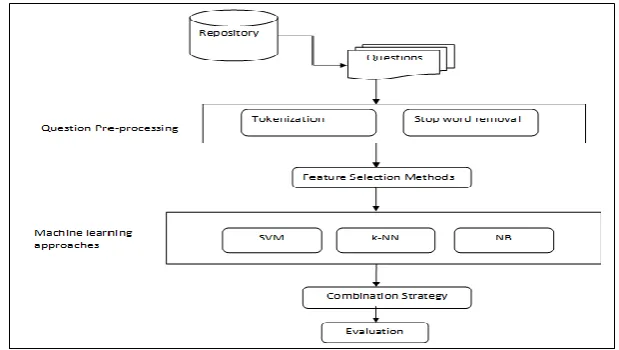
The proposed method of this study incorporates a combined strategy utilizing three machine learning approaches to classify the question components that match Bloom’s cognitive level. To determine the question category, this method initially assigns three categories using three machine learning classifiers. Next, combination methodology is used for final categorisation of question . In this decisions from these approaches are considered. Figure 1 shows the proposed combination model used to classify the question components into their corresponding Bloom’s cognitive level.
Figure 1: Proposed Combination model for question categorization.
2)The machine learning algorithm uses some computational steps for categorization.
3)The steps include in this computational phase are dataset compiling, preprocessing, feature selection, categorization, combination strategy, performance measure and results.
4)In feature selection step, it eliminates the redundant and noisy data from dataset. Used feature selection methods are: Odd ratio, Mutual information and Chi-square.
5)The classifiers used for the categorization on dataset are SVM, NB and k-NN.
6)A combination methodology is designed for the combination of all base classifiers. To predict an unknown instance, the methodology uses every classification model from its sub-process to determine the predicted class from the maximum selection count given to the unknown test sample.
7)This strategy determines test sample x class i with the most component predictions after counting the output of individual classifiers.
8)The performance of this system is calculated in terms of its precision (P), recall (R) and Fmeasure metrics.
Mathematical Model
Before starting to solve the any problem, we have to decide the difficulty level of problem. Difficulty level calculated by using three classes as follows
9) P Class: The problems solve by some algorithm within a number of steps in polynomial time.
10)NP-Class: NP-hard problem is solved in polynomial time which will make it possible to solve other all problems in class NP in polynomial time. Some NP-hard problems are also NP-complete, some are not.
A. Notations and Preliminaries
Let S be Closed system defined as, S = {s, e, X, Y, P} S = {s, e, X, Y, P}
Where,
s= is the initial state e= is the end state
X = Set of inputs in the system X = {U, Q, Fs, Ml,CM}
U=User
U = {u1, u2,… un}
Q = Question Set Entered by User Q = {q1, q2, q3,…qn}
Fs = Feature Selection Methods Fs = {Mi, Or, Cs}
Ml = Machine Learning algorithm Ml = {svm, nb, knn}
CM = Combination Methodology P = Process
Y = Set of outputs
P = {PRE, FS, ML, CS, EVAL}
PRE: Pre-processing on question datasets
FS: Feature Selection Method will be applied to pre-processed data
ML: Machine learning algorithm will be applied on feature extracted dataset CS: Combination methodology is applied to evaluate the categorization
EVAL: Result is evaluated which Bloom’s cognitive level is applied for which question data.
B. Feature Selection 1) Mutual Information
2) Chi-Square
(2)
where A is the number of times t and c co-occur, B is the number of times t occurs without c, C is the number of times c occurs without t, D is the number of times neither c nor t occurs, and N is the total number of training questions.
3)Odd Ratio
(3)
Given a category yi ϵY, a feature term t belongs to one or more documents in X.
C. Max Score for FS
Max score for each FS methods between term t and category c as
(4)
D.Categorization: Classifiers used are: SVM, NB and k-NN.
1) Support Vector Machine (SVM)
(5)
2) Naive Bayes (NB)
(6)
where (7)
Where Ni is the number of documents associated with class Ci, and N the number of classes, and
Where nki is the total number of documents that contain feature tk and belongs to class Ci, l is the total number of distinct features in all training documents that belong to class Ci.
3) k-Nearest Neighbour (k-NN)
The weighted sum in k-NN classification can be written as:
Where k-NN (d) indicates the set of k nearest neighbours to exam question d. If dj belongs to ci, δ (dj, ci) is equal 1; otherwise, it is equal to 0. Exam question d should belong to the class with the highest resulting weighted sum. In order to
compute sim(d, dj), the Euclidean distance is used.
Performance Measures
This produces the results from different classifiers of exam questions based on Bloom's taxonomy. To examine the classifiers performance : SVM, NB, k-NN is primerily applied to the complete sample term. Experimental results for each Bloom's Taxonomy Cognitive Level using SVM, NB, k-NN are shown in results section.
RESULTS
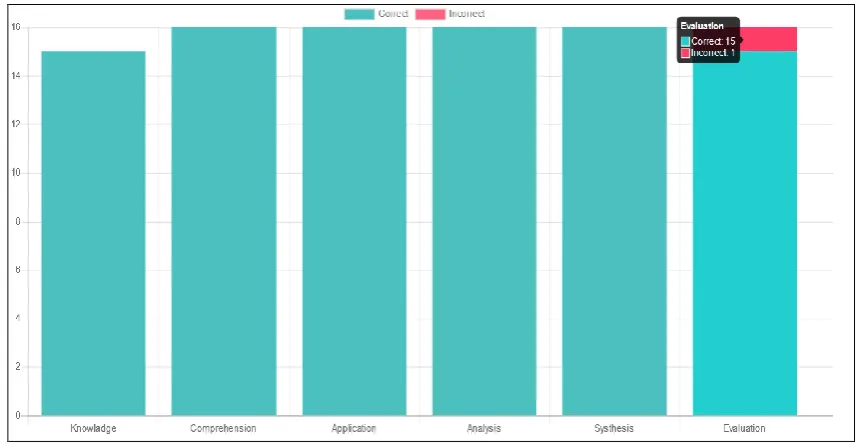
Figure 3: Combination Strategy to analyse cognitive levels of questions. CONCLUSION
This paper has attempted to provide a solution for the improvement in categorization of questions by proposing a combination method which is linked to Bloom's taxonomy cognitive levels that combined machine learning approaches and feature selection methods. The classification powers of all base classification models were combined.
So at conclusion, the design of the proposed combination framework is based on the pedagogical priniciple : cognitive domain of thinking. Using this framework , prototype can be developed, which will efficiently addresses the problem of cognitive category determination for questions and achieves satisfactory results. Scope for future work could be to analyse the learning outcome with assessment outcome with additional padegogical features.
REFERENCES
1. A. J. Swart, “Evaluation of Final Examination Papers in engineering: A case study using Bloom's taxonomy”. Education, IEEE Transactions on, 2010; 53(2): 257-264. DOI: 10.1109/TE.2009.2014221.
2. http://www.ascd.org/publications/educational-leadership/mar97/vol54/num06/Seven-Strategies-That-Encourage-Neural-Branching.aspx
4. Bloom (Ed.), “Taxonomy of Educational Objectives: The Classification of Educational Goals”; pp. 201-207; B. S. Susan Fauer Company, Inc. 1956.
5. Anderson, L.W" & Krathwohl (Eds.). “A Taxonomy for Learning,Teaching, and Assessing: A Revision of Bloom's Taxonomy of Educational Objectives,” New York: Longman, 2001.
6. Alhazmi, A.K.; Zafar, H.; Al-Hammadi, F, “Framework for integrating outcome-based assessment in online assessment: Research in progress,” Science and Information Conference (SAI), 2015; 28-30 July 2015, London.
7. Huang, Z., Thint, M. & Qin, Z.," Question Classification Using Head Words and Their Hypernyms", In Proceedings of the Conference on Empirical Methods in Natural Language Processing, Honolulu, Hawaii, Association for Computational Linguistics, 2008; 927–936,.
8. D. Zhang, W. S. Lee, “Question classification using support vector machines,” Proc. Of 26th annual international ACM SIGIR conference on Research and development in information retrieval, ACM, 2003; 26-32,; doi:10.1145/860435.860443.
9. A. A. Yahya and A. Osman, “Automatic classification of questions into Bloom's cognitive levels using support vector machines,” Proc. The International Arab Conference on Information Technology, Naif Arab University for Security Science (NAUSS), 2011; 1-6.
10.S. S. Haris, N. Omar, “A rule-based approach in Bloom's Taxonomy question classification through natural language processing,” Proc. of 7th International Conference on Computing and Convergence Technology (ICCCT), 2012; 410-414, Dec. 3-5.
11.T. Fei, W. J. Heng, K. C. Toh, and T. Qi, “ Question Classification for E-learning by Artificial Neural Network”, Information, Communications and Signal Processing, 2003 and Fourth Pacific Rim Conference on Multimedia. Proceedings of the 2003 Joint Conference of the Fourth International Conference, 2003; 1757-1761.
12.D. Metzler, W. B. Croft, “Analysis of Statistical Question Classification for Factbased Questions,” Journal of Infomation Rerieval, 2005; 8(3): 481-504.
13.X. Li. and D. Roth, "Learning question classifiers," Proc. of the 19th International Conference on Computational Linguistics, ACM, 2002; doi: 10.3115/1072228.1072378. 14.N. Yusof and C. J. Hui, “Determination of Bloom's cognitive level of question items