ABEPRO
DOI: 10.14488/BJOPM.2018.v15.n4.a10
ELECTRE ME: A PROPOSAL OF AN OUTRANKING MODELING
IN SITUATIONS WITH SEVERAL EVALUATORS
ABSTRACT
Highlights: This paper describes an original proposal for modeling Multicriteria problems taking into account more than one evaluator. It allows each evaluator to have its own set of criteria. It also avoids the incoherency of adopting compensatory techniques into non-compensatory algorithms.
Goal: This paper describes an original proposal for modeling multicriteria situations where multiple evaluators take part of the evaluation process. This proposal allows each evaluator to have its own set of criteria, including their weights, and also avoids the usual inconsistency of adopting pre-processing compensatory methods for introducing it into non-compensatory algorithms.
Design / Methodology / Approach: In order to better describe how ELECTRE ME works, a multicriteria-multiple evaluator situation is modeled by ELECTRE TRI ME (as we have called the ELECTRE TRI variation that incorporates the principles of multiple evaluators).
Results: ELECTRE ME was able to avoid the inconsistency of adopting contradictory mech
-anisms of aggregating preferences while modeling multicriteria & multiple evaluators problems (first called here as MCDA-ME).
Limitations: Although the proposal focuses in situations with multiple evaluators, there is no restriction for its application in situations where there is only one decision maker. Practical implications: Another important feature of ELECTRE ME is that it allows each evaluator to consider its own set of criteria and its own scale for evaluation.
Originality / Value: ELECTRE ME avoids a contradictory approach to use compensatory al
-gorithms (such as weighted mean) as an input in non-compensatory outranking methods. Despite the fact that non-compensatory principle is in the heart of the ELECTRE methods, it has not found a previous proposal with the attributes shown in this study: to incorpo
-rate outranking concepts in situations where more than one evaluator is present and, by extension, allow each evaluator to have its own set of criteria.
Keywords: Decision Analysis; Multiple Criteria; Multicriteria; MCDA; MCDM.
Helder Gomes Costa [email protected] Fluminense Federal University – UFF, Niterói, Rio de Janeiro, Brazil
Livia Dias de Oliveira Nepomuceno [email protected] Federal Center for Technological Education Celso Suckow da Fonseca – CEFET, Rio de Janeiro, Rio de Janeiro Brazil
Valdecy Pereira
1. INTRODUCTION
While dealing with group decision or evaluation situations in which the opinions or perceptions of several or multiple evaluators appears, there are two mains streams and basic approaches: the consensus and the voting systems. The con
-sensus is reached through dialogue and, as reported in So
-bral and Costa (2012), the first approach can produce good solutions, once it usually incites discussions and induces a better comprehension about the problem. Unfortunately, the dialogue and interactive-discussion-based approaches are limited to a small number of evaluators.
On the other hand, are the voting systems, designed for situations where there is no way to adopt a consensus through a dialogue approach, such as when there is a great number of evaluators, which makes the use of consensus approaches based on dialogue unaffordable. In this second type of situation, there is an attempt to apply a voting sys
-tem and consolidate the different evaluations in an overall number that should be an approximation of the consensus among the evaluations as a whole. There are several mod
-els that apply more refined techniques to reach such overall number, as a sample cited in: Nordström et al. (2009), Yu and Lai (2011), Leyva López and Alvarez Carrillo (2015), Pereira and Costa (2015), Sant’Anna et al. (2016), Ding et al. (2017), Zeng et al. (2018) and Wu and Liao (2019). Despite this fact, in the voting systems, it is still usual to apply a weight sum algorithm for aggregating the preferences.
Following another stream, there are situations with uni
-tary evaluations (evaluations made by only one evaluator or a group of evaluators whose opinions are expressed by a unique number or evaluation). For such situations, Roy (1968a) proposed the outranking approach, that is in the ba
-sis of ELECTRE (ELimination Et Choix Traidusaint la REalité) family of MCDA (Multicriteria Decision Aid) methods. If the seminal references that appear in Table 1 are analyzed, it could be concluded that ELECTRE methods were proposed for situations with unitary evaluations. As reported in Roy (1968a), such outranking procedure is so-called a non-com
-pensatory method, once it focuses on eliminating the com
-pensatory undesirable effects that appear in algorithms usually adopted for aggregating the Decision Maker (DM) evaluations, such as the weighted means. Compensatory ef
-fects also appear in other Multicriteria methods, such as Top
-sis (Hwang et al., 1993) and AHP (Saaty and Vargas, 2006). Despite the outranking appeal of ELECTRE methods, when dealing with opinions or evaluations that come from differ
-ent evaluators, the ELECTRE-based models usually adopt a compensatory approach in order to get an overall number from aggregating individual preferences and introduce such number as an input to the non-compensatory outranking ELECTRE procedure, as it occurs in Galo et al. (2018), Kamali et al. (2018), Sant’Anna et al. (2016) and Nepomuceno and
Costa (2015), among others. The main problem observed in this last approach is that the determination of this overall number is generally based in a compensatory aggregation method, which is not in agreement with the non-compensa
-tory principles of ELECTRE method.
The main question that arises from this problem is: How to deal with the opinions from different evaluators when there is no way to find out consensus? This paper aims to describe an original and simple variation on the usual ELEC
-TRE methods, to deal simultaneously with both multicriteria and multiple decision maker situations, and that also incor
-porates the non-compensatory and non-dominance princi
-ples of ELECTRE while dealing with multiple decision makers evaluations.
2. BACKGROUND: THE FUNDAMENTALS OF ELECTRE
Roy (1968a) proposed the ELECTRE method, that is based on non-compensatory outranking principles. Costa et al. (2007) established an analogy with a volleyball game in or
-der to provide a more comprehensive explanation about the main differences between a compensatory approach (such as the weight sum) and a non-compensatory outranking ap
-proach. Thus, in order to well-establish the difference be
-tween a compensatory and a non-compensatory approach, it should be considered an analogy with a volleyball match, in which team A wins team B by 25 to 5 in the first set, but loses all the three following sets to team B by 25 to 20. In this situation, one could then imagine the following proce
-dures to identify the winner of the match:
a) A compensatory approach: Uses the sum of the points gained by the team in each set. In this case, A would be the winner by 85x80 points.
b) A non-compensatory approach: Uses the number of game sets that each team wins. In this case, team B would be the winner by 3x1 sets. This procedure, which is actually adopted in volleyball matches, could be classified as an outranking approach. The main outranking principle is very similar to the sec
-ond procedure described above, if each game set is consid
-ered as a criterion.
Since the first appearance of ELECTRE in Roy (1968a) a large variety of MCDA methods have followed the non-com
-pensatory outranking principles that are in the core of ELEC
-TRE - Table 1 shows some of these variations. As it can be seen, ELECTRE TRI (Mousseau et al., 2000) and its variants ELECTRE TRI-C (Almeida-Dias et al., 2010) and TRI-nC (Almei
It is interesting to notice that ELECTRE II, III, and IV are classified as ranking methods because they first and fore
-most build a rank, even though they are usually adopted to solve choice problems.
Table 1. The ELECTRE methods
Method Reference Problematic
-ELECTRE I Roy, 1968b Choice
ELECTRE II Roy and Bertier, 1971 Ranking
ELECTRE III Roy, 1978 Ranking
ELECTRE IV Roy and Hugonnard, 1981 Ranking ELECTRE IS Roy and Skalka, 1985 Choice ELECTRE TRI Yu, 1992 and Mousseau et al., 2000 Sorting
ELECTRE
TRI-C Almeida-Dias et al., 2010 Sorting ELECTRE
TRI-nC Almeida-Dias et al., 2012 Sorting Source: Nepomuceno and Costa, 2015
3. THE PROPOSAL: ELECTRE ME
The proposal reported in this paper was designated as ELECTRE ME (ELECTRE Multi Evaluators), in order to distin
-guish it from previous ELECTRE methods. The following as
-sumptions were made in ELECTRE ME:
• Alternatives
◦ A= {a1, a2, ... , ai, ..., am} is a set composed by m alternatives.
• Evaluators
◦ E= {e1, e2,...,ej,..., en} is a set of n evaluators.
• Criteria
◦ Fe1 = {k1e1, k2e1, ..., kve1} is the subset composed by the v criteria adopted by the evaluator e1.
◦ Fe2 = {k1e2, k2e2, ..., kxe2} is the subset composed by the x criteria adopted by the evaluator e2.
◦ Fej= {k1ej, k2ej, ..., kyej} is the subset composed by the y criteria adopted by the evaluator ej.
◦ Fen = {k1en, k2en, ..., kzen} is the subset composed by the z criteria adopted by the evaluator en.
• Weight of the criteria
◦ We1 = {w1e1, w2e1, ..., wve1} is the subset composed by the weights of the v criteria under the per
-spective of the evaluator e1. So that, in this vec
-tor, w2e1 means the weight of criterion 2, under the opinion of evaluator e1.
◦ We2 = {w1e2, w2e2, ..., wxe2} is the subset composed by the weights of the x criteria under the per
-spective of the evaluator e2.
◦ Wej = {w1ej, w2ej, ..., wyej} is the subset composed by the weights of the y criteria under the per
-spective of the evaluator ej.
◦ Wen = {w1en, w2en, ..., wzen} is the subset composed by the weights of the z criteria under the per
-spective of the evaluator en.
• Performance of the alternatives
◦ Ge1(ai) = {g1e1(ai), g2e1(ai), ..., gve1(ai)} is the subset composed by the performance of alternative ai under the perspective of the evaluator e1 and
the set of v criteria adopted by this evaluator. So that, in this vector, g2e1(ai) means the perfor
-mance of alternative ai under criterion 2, under the viewpoint of the evaluator e1.
◦ Ge2(ai) = {g1e2(ai), g2e2(ai), ..., gxe2(ai)} is the subset composed by the performance of alternative ai under the perspective of the evaluator e1 and the set of y criteria adopted by the evaluator e2.
◦ Gej(ai) = {g1ej(ai), g2ej(ai), ..., gyej(ai)} is the subset composed by the performance of alternative ai under the perspective of the evaluator e1 and the set of y criteria adopted by the evaluator ej.
◦ Gen(ai) = {g1en(ai), g2en(ai), ..., gzen(ai)} is the subset composed by the performance of alternative ai under the perspective of the evaluator e1 and the set of z criteria adopted by the evaluator en. The present proposal differs from the previous ELEC
-TRE-based approaches in two ways:
• It allows each evaluator to have its own set of crite
-ria, and is its own scales for the evaluation of criteria weights and even alternative performances.
• It makes use of a non-compensatory approach to deal with the individual preferences of the evalua
-tors.
To do this, it makes a unique and simple assumption: it assumes the whole criteria set (F) of overall criteria as the
F = Fe1U Fe2 U…U Fej U…U Fen-1 U Fen [eq. 1] where
• Fe1 is the subset of criteria adopted by evaluator e1
• Fe2 is the subset of criteria that evaluator e2 consid
-ers relevant
…
…
• Fen is the subset of criteria that evaluator e3 takes into account.
In other words:
F = {{k1e1, k2e1, ...,kve1},{k1e2, k2e2, ...,kxe2},…,{k1ej, k2ej, ...,kyej}, …,{k1en, k2en, ...,kzen}}
As a consequence of this assumption, it follows that:
W = We1U We2 U … UWejU … UWen-1UWen [eq. 2]
Or
W = {{w1e1, w2e1, ..., wwe1},{w1e2, w2e2, ..., wxe2},…,{w1ej, w2ej, ..., wyej}, …,{w1en, w2en, ..., wzen}}
where W is the overall vector of criteria weights.
G(a) = Ge1(a) U Ge2(a) U … U Gej(a) U … U Gen-1(a) U Gen
[eq. 3]
or
G(a)={{g1e1(a), g2e1(a), …, ge1(a)},{g1e2(a), g2e2(a), …, gxe2(a) },…,{g1ej(a), g2ej(a), …, gyej(a)},
{g1en(a), g2en(a), …, gzen(a)}}
where G(a) is the overall performance of a generic alter
-native a ε A.
After these assumptions, an ELECTRE ME-based model plays in the same way the previous ELECTRE models do.
4. THE ELECTRE TRI ME
Without losing generality, from this point, the focus is shifted to describing ELECTRE TRI ME: an outranking sort
-ing method that adds the ME principles to ELECTRE TRI (Yu,
1992; Mousseau et al., 2000). The ELECTRE TRI ME was cho
-sen as a background to show the ME adaptation of ELECTRE methods, since ELECTRE TRI-based methods are the most recent variations of ELECTRE non-compensatory method (as shown in Table 1). Therefore, the authors highlight that this decision does not result in any loss of generality and that the reasoning proposed in this study, by extension, could be ap
-plied to all the other ELECTRE methods. Next sections focus on presenting a short introduction to ELECTRE TRI, followed by an insertion about ELECTRE TRI ME and two numerical samples.
4.1 A briefing on the ELECTRE TRI
As reported in Mousseau et al. (2000) and shown in Fig
-ure 1, ELECTRE TRI sorts an alternative into a category from a set C of categories. These categories are delimited by a set of profiles or borders B, which are defined for each criterion, as it can be seen in Figure 2. The categories are ranked from the worst (C1) to the best (Cp+1). Observe that a generic profile bh is both the superior limit of Ch, and the inferior limit of Ch+1.
?
Category A
Category B
Category C
Category D
Category E
“x”
Figure 1. The sorting problem Source: Nepomuceno and Costa, 2015
The following two steps are played when running ELEC
-TRE TRI for sorting the alternatives on the categories:
• To build outranking relationship S, among the alter
-natives to be sorted and the profiles or boundaries of the categories.
• To exploit the relation S in order to assign each alter
-native to a category.
The statement aSbh means that “alternative a does not have performance worse than the profile bh”. In the valida
-tion of this statement aSbh, a credibility degree σ (a, bh) is calculated, so that it expresses that the confidence with the statement “a is not worse than bh” is calculated. To define the outranking relation, a credibility cut-plane λ, is adopted. So that:
aSbh ↔ σ (a, bh) ≥ λ
The credibility degree σ(a, bh) is calculated as it fol
-lows:
σ(a, bh) = c(a, bh) ΠjєFc [(1 - dj(a, bh))/ (1 – c(a, bh))] [Eq. 1]
Where
Fc = {jєF/ dj(a, bh) > c(a, bh)}
cj(a, bh) = [ΣjєFc wj cj(a, bh)]/ ΣjєFc kj
In these equations:
• cj(a, bh) expresses the concordance degree with the statement “a is not worse than bh under the criterion gj”
• dj(a, bh) expresses the discordance degree with the statement “a is not worse than bh under the criterion gj”
• q, p and v express, respectively, the indifference, preference, and veto threshoulds.
To assign an alternative to a category, the ELECTRE TRI method defines two sorting procedures:
• The pessimistic (or more exigent) sorting procedure, described as follows:
◦ Compare a successively with bj, for j = p; p – 1, …, 1.
◦ Consider bh as the first profile limit so that aSbh, and classify a into class Ch+1 (denoted by a Ch+1 ).
◦ If there is no one profile bj such that aSbj, then a is classified into the lowest class: Class C1.
• The optimistic sorting procedure (or disjunctive) is described as follows:
◦ Compare bj, j = 1; 2, …, p successively with a.
◦ Consider bj as the first profile such that bj > a, and classify a into class Ch (denoted by a Ch).
◦ If there is no one profile bj such that bjSa, then a is classified into the highest class: Class Cp+1.
4.2 Adding ME principles into ELECTRE TRI: the ELECTRE TRI ME
Thus, in ELECTRE TRI ME it is necessary to add two new assumptions to those previously shown:
• C= {C1, C2, ..., Ch, ..., Cp+1} is the set of p categories that are ranked from the worst (C1) to the best (Cp+1 ).
• Bkej = {b1kej, b2kej, ..., bhkej, ..., bpkej} is a set composed by p profiles or boundaries that delimit the categories for a criterion k, under the view point of an evaluator
ej. As the categories are adjacent, bh is both the su
-perior limit of Ch, and the inferior limit of Ch+1. In a more general way, taking into account that there should exist n evaluators:
B = Be1U Be2 U … U BejU … U Ben-1U Ben [eq. 2]
Or
B = {{b11e1, b21e1, ..., bp1e1}, {b12e1, b22e1, ..., bp2e1}, {b1ve1, b2ve1, ...,
bpve1},
{b11e2, b21e2, ..., bp1e2}, {b12e2, b22e2, ..., bp2e2}, {b1ve2, b2ve2, ...,
………... ,
{b11ej, b21ej, ..., bp1ej}, {b12ej, b22ej, ..., bp2ej}, {b1vej, b2vej, ... , bpvej}, ………... ,
{b11en, b21en, ..., bp1en}, {b12en, b22en, ..., bp2en}, {b1ven, b2ven, ... ,
bpve}},
where B is the overall vector of profiles, and p is the num
-ber of profiles.
After these assumptions, ELECTRE TRI ME performs in the same way that ELECTRE TRI does.
4.3 Numerical example 1: a complete sample of applying ELECTRE TRI ME
Now take into account a situation where a meal X had its performance evaluated by three evaluators (E1, E2 and E3), in order that X could be assigned to one category of perfor
-mance. Table 2 summarizes the data of this numerical sam
-ple, which is commented as follows:
• The set A of alternatives is unitary, that is, it has only one alternative: X.
• The set of categories comprehends five possibilities: Very good, Good, Middle, Poor, and Very poor. So that: C = {VG; G; M; P; VP}
• Each evaluator has its own criteria set and criteria weights, so that:
◦ Fe1 = {Appeal; Taste}
◦ We1={4; 6}
◦ Fe2 = {Taste; Proteins; Vitamins}
◦ We2={2; 4; 4}
◦ Fe3 = {Aroma}
◦ We3={10}
Table 2. Summary of the data for the numerical example 1
Evaluator E1 Evaluator E2 Evalua-tor E3
Appeal Taste Taste Pro-teins mins Aroma Vita-Criterion
Weight 4 6 2 4 4 10
Performance
of X 8 6 8 7 7 6
Boundary b4 2 4 2 4 4 6
Boundary b3 4 6 6 6 6 7
Boundary b2 6 8 8 8 8 8
Boundary b1 8 9 9 9 9 9
Each evaluator has its own perception about the perfor
-mance of X under its own criteria set.
◦ Ge1(x)={8.5; 6.8}
◦ Ge2(x)={8.3; 8.3; 9.7}
◦ Ge3(x)={8.4}
Each evaluator should have its own perception about the
boundaries of each class in C. So that:
◦ B Appeal e1 ={2; 4; 6; 8}
◦ B Taste e1={4; 6; 8; 9}
◦ B Taste e2 ={2; 6; 8; 9}
◦ B Proteins e2 ={4; 6; 8; 9}
◦ B Vitamins e2 ={4; 6; 8; 9}
◦ B Aroma e3={6; 7; 8; 9}
An extensive search on Scopus data base, looking for pre
-vious works in MCDA fields was performed and it was not found in the literature a previous MCDA-based model with more than one evaluator in which each evaluator uses its own set of criteria and its own scale while evaluating the performance of alternatives. In the scope of ELECTRE TRI-based models, the fact that each evaluator uses its own set of profiles in order to define the limits of the categories in C is also unheard. Although in some decision situations it should be necessary to standardize these parameters, there are some situations in which it is interesting that the evalua
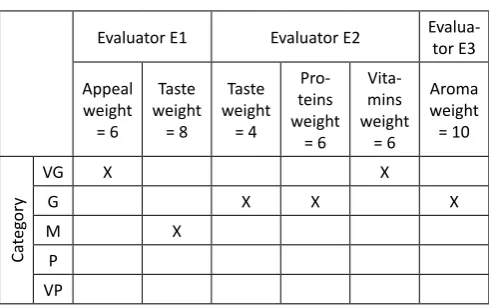
As shown in figure 3, comparing the evaluations in G(x) vector with the profiles in B, it is possible to conclude that:
• E1 classifies the meal X into the category Very Good, while analyzing X’s appeal, and classify X as Middle while evaluating it under the Taste criterion.
• E2 classifies X as Good under the criteria Vitamins and in the category Very Good under the Taste view
-point.
• X is classified as Poor by evaluator E3 that has taken into account only one criterion: Aroma.
Evaluator E1 Evaluator E2 Evaluator E3
-Appeal weight
= 6
Taste weight
= 8
Taste weight
= 4
Pro
-teins weight
= 6
Vita -mins
weight = 6
Aroma weight
= 10
Ca
teg
or
y
VG X X
G X X X
M X
P VP
Figure 3. Performance of X under the criteria set and an ELECTRE TRI ME perspective.
From this point, we assume the thresholds p = q= 0, and no veto restriction. This assumption does not imply in any restriction or loss of generality to the description of ELECTRE TRI ME whatsoever.
The meal X is at least Very Good in two criteria (Appeal for evaluator E1 and Vitamins for E2), whose weights sum 12. Since 40 is the sum of all the weights in the vector W, the credibility degree in which X is at least Very Good is equal to 12/40; e.g. σ(X,VG) = 0.3.
Applying analog reasoning, it results in X being at least Good in five criteria (Appeal for E1; Taste, Protein, and Vi
-tamins for E2; and, Aroma for E3), whose weights sum 32. Thus, the credibility degree in which X is at least Good is equal to 32/40; e.g. σ (X,G) = 32/40 = 0.8. It also results in σ (X,M) = σ (X,P) = σ (X,VP) = 40/40 = 1.0.
Therefore, adopting a cutting plane sequal to 1.0, the meal X is classified into category Middle. However, if one wishes to adopt a less exigent cutting plane, such as σ=0.8, X would be classified as Good, since σ (X,G) = 0.8 ≥ σ.
4.4 Numerical example 2: comparing the results from ELECTRE TRI and ELECTRE TRI ME
Now, let us take into account another data set that refers to a situation where three evaluators (E1, E2 and E3) con
-sider the same set of three criteria (C1, C2 and C3). Table 3 shows the performance of a generic alternative Y, and also the criteria importance, under the viewpoint of the evalua
-tors. The data in Table 3 show that all the three evaluators (E1, E2 and E3) have assigned a weight equal to 1.00 to all the criteria, and they show that evaluators E1 and E2 agree that the performance of the alternative Y is equal to 2.50, in all the criteria. In order to simplify the explanation and without loss of generality, it was assumed that, for all criteria and all categories, p=q=0, and also the veto threshold was not taken into account.
Table 3. Weight of the criteria and performance of the alternative Y Performance of Y Weight of the criteria
Evalua-tor g1 g2 g3 w1 w2 w3
E1 2.50 2.50 2.50 1.00 1.00 1.00
E2 2.50 2.50 2.50 1.00 1.00 1.00
E3 1.50 1.50 1.50 1.00 1.00 1.00
In this example, three categories are considered: CA, CB, and CC , where CA is better than CB that is better than CC. Table 4 shows the profiles that are the border of these categories. For simplicity and without loss of generality, in this example it was considered that the boundaries of the categories are the same for all the criteria.
Table 4. Boundaries of the classes
Category Inferior boundary boundarySuperior
CA 2.00 + ∞
CB 1.00 2.00
CC - ∞ 1.00
So:
• C= {CA, CB, CC}
• B= {1.00; 2.00}, for any criterion. In other words:
B= {{1.00; 2.00}, {1.00; 2.00}, {1.00; 2.00},
Figure 4 shows an overview of the data: the performance of the alternatives in each criterion and the categories and their boundaries.
Performance of Y
Evaluator E1 Evaluator E2 Evaluator E3
g1e1 g2e1 g3e1 g1e2 g2e2 g3e3 g1e3 g2e3 g3e3
Category CA
b2 = 2.0
Y Y Y Y Y Y
Category CB
b1 = 1.0
Y Y Y
Category CC
Figure 4. Performance of an alternative under the criteria set and each evaluator’s view point.
4.4.1 Applying the traditional ELECTRE TRI
In situations where there is more than one evaluation for each criterion, it is usual to assume that, for each criterion, the mean from all evaluations could represent the evalua
-tions of all evaluators, as a whole, so that, for example, the performance of the alternative Y should be represented by the following vector:
G(Y) = {2.17; 2.17; 2.17}
These values in vector G(Y) were calculated as the mean of the evaluations that come from of the three evaluators, for each criterion (C1, C2 and C3). This vector means that Y has the median of its performance equal to 2,17 in the three criteria, taking into account the perceptions of the three evaluators.
Thus, if one uses this mean as the evaluation of alterna
-tive Y, there is a credibility degree equal to 1.0 that Y out
-ranks the floor of category CA; e.g. σ(YSCA) = 1.00. Therefore, ELECTRE TRI would classify Y into category CA without hesi
-tation or doubt, by using the mean as the value to match the performance of the alternative.
4.4.2 Applying the ELECTRE TRI ME
On the other hand, while applying ELECTRE TRI ME, it is not necessary to aggregate the evaluations into a unique number that represents the evaluators’ opinions as a whole. Table 5 shows the performance of the alternatives.
Table 5. Performance of the alternatives
gEvaluator E1 Evaluator E2 Evaluator E3
1e1 g2e1 g3e1 g1e2 g2e2 g3e3 g1e3 g2e3 g3e3
Perfor-mance
of Y 2.50 2.50 2.50 2.50 2.50 2.50 1.50 1.50 1.50
Applying equation 3 to these data, one can obtain: G(Y) = {2.50; 2.50; 2.50; 2.50; 2.50; 2.50; 1.50; 1.50; 1.50}. Thus, the result from computing the credibility index is: σ(YSCA) = 7/9 = 0.78 and σ(YSCB) = 1.00. Therefore, by main
-taining the same credibility cut-level adopted in the previ
-ous ELECTRE TRI modeling (λ=1.00), Y would be classified into category CB.
4.4.3 Comparing the results
As one can see, the results shown in section 4.2 differ from those in section 4.3. This is because in section 4.3 the use of the mean as a representation of the evaluations from the overall evaluators introduces a compensatory effect, which does not agree with the non-compensatory outranking prin
-ciples that are in the basis of all the ELECTRE TRI methods. On the other hand, the results in section 4.4, generated by the ELECTRE TRI ME, preserve the outranking principle of ELECTRE methods, since it does not adopt a compensatory way to deal with the evaluations that come from different evaluators.
5. CONCLUSION
This paper has described the ELECTRE ME, an original variation of the ELECTRE methods. This method is able to incorporate the non-compensatory principles of ELECTRE while dealing with both multicriteria and multiple decision makers’ evaluations.
The two main contributions of this approach are:
• It allows each evaluator to have its own criteria set and also its own evaluation scale. Thus, it solves a relevant issue, performing the categorization even if the evalua
-tors have different perceptions in terms of the compo
-sition of the criteria set.
• It allows each evaluator to have its own evaluation scale for the evaluation of the alternatives. Thus, it reduces the problem complexity once it avoids the need to develop a sole scale that should be under
• It avoids the usage of compensatory procedure, such as the arithmetical mean, to generate inputs for a non-compensatory algorithm, as one of the previous ELECTRE methods.
Despite the simplification assumptions made while build
-ing the examples, the comparison of the application of ELECTRE TRI and ELECTRE TRI ME to the same problem has shown relevant differences in the results. These differenc
-es were caused by compensatory effects while adopting the arithmetical mean for generating the inputs to ELECTRE TRI. The adoption of ELECTRE TRI ME has avoided such undesir
-able effects.
Even though the examples are based on ELECTRE TRI ME, the ELECTRE ME proposal is general and can be extended to the ELECTRE family of methods as a whole. As a matter of fact, it should be extended to all multicriteria methods that are based on a table-grid, such as the Promethee family of methods.
REFERENCES
Almeida-Dias, J.; Figueira, J. R.; Roy, B. (2010), “Electre Tri
--C: A multiple criteria sorting method based on characteristic reference actions”, European Journal of Operational Research, Vol. 204, No. 3, pp. 565-580.
Almeida-Dias, J.; Figueira, J. R.; Roy, B. (2012), “A multiple criteria sorting method where each category is characterized by several reference actions: The Electre Tri-nC method”, Eu
-ropean Journal of Operational Research, Vol. 217, No. 3, pp. 567-579.
Costa, H. G.; Mansur, A. F. U.; Freitas, A. L. P. et al. (2007), “ELECTRE TRI aplicado a avaliação da satisfação de consumi
-dores”, Production, Vol. 17, No. 2, pp. 230-245.
Ding, J.; Xu, Z. S.; Liao, H. C. (2017), “Consensus-reaching methods for hesitant fuzzy multiple criteria group decision making with hesitant fuzzy decision making matrices”, Fron
-tiers of Information Technology and Electronic Engineering, Vol. 18, No. 11, pp. 1679-1692.
Galo, N. R.; Calache, L. D. D. R.; Carpinetti, L. C. R. (2018), “A group decision approach for supplier categorization based on hesitant fuzzy and ELECTRE TRI”, International Journal of Production Economics, Vol. 202(C), pp. 182-196.
Hwang, C.-L.; Lai, Y.-J.; Liu, T.-Y. (1993), “A new approach for multiple objective decision making”, Computers & Operations Research, Vol. 20, No. 8, pp. 889-899.
Kamali, M.; Hewage, K.; Milani, A. S. (2018), “Life cycle sus
-tainability performance assessment framework for residential modular buildings: Aggregated sustainability indices”, Buil
-ding and Environment, Vol. 138, No. 15, pp. 21-41.
Leyva López, J. C.; Alvarez Carrillo, P. A. (2015), “Accentua
-ting the rank positions in an agreement index with reference to a consensus order”, International Transactions in Operatio
-nal Research, Vol. 22, No. 6, pp. 969-995.
Mousseau, V.; Slowinski, R.; Zielniewicz, P. (2000), “A user
--oriented implementation of the ELECTRE-TRI method inte
-grating preference elicitation support”, Computers & Opera
-tions Research, Vol. 27, No. 7-8, pp. 757-777.
Nepomuceno, L. D. O.; Costa, H. G. (2015), “Analyzing per
-ceptions about the influence of a master course over the pro
-fessional skills of its alumni: A multicriteria approach”, Pesqui
-sa Operacional, Vol. 35, No. 1, pp. 187-211.
Nordström, E. M.; Romero, C.; Eriksson, L. O. et al. (2009), “Aggregation of preferences in participatory forest planning with multiple criteria: An application to the urban forest in Lycksele, Sweden”, Canadian Journal of Forest Research, Vol. 39, No. 10, pp. 1979-1992.
Pereira, V.; Costa, H. G. (2015), “Nonlinear programming applied to the reduction of inconsistency in the AHP method”, Annals of Operations Research, Vol. 229, No. 1, pp. 635-655.
Roy, B. (1968a), “Classement et choix en presence de points de vue multiples (la methode ELECTRE)”, Recherche Opérationelle, Vol. 2, pp. 57–75.
ROY, B. (1968b), “Classement et choix en présence de points de vue multiples (la méthode ELECTRE), Lausanne Presses Polytechiniques et Universitaires Romandes.
Roy, B. (1978), “ELECTRE III: Un alghoritme de méthode de classements fonde sur une representation floue des préfé
-rences em présence de critéres multiples”, Cahieres de CERO, Vol. 20, pp. 3-24.
Roy, B.; Bertier, P. M. (1971), La méthode ELECTRE II: Une méthode de classement en présence de critéres multiples, SEMA (Metra International), Paris.
Roy, B.; Hugonnard, J. C. (1981), Classement des prolonge
-ments de lignes de stations en banlieu parisienne, Université Dauphine et RATP, Paris.
Roy, B.; Skalka, J. M. (1985), ELECTRE IS: Aspécts methodo
-logiques et guide d´utilization, Cahier du LAMSADE, Universi
-té de Paris–Dauphine, Paris.
Saaty, T. L.; Vargas, L. G. (2006), Decision making with the analytic network process: economic, political, social and tech
-nological applications with benefits, opportunities, costs and risks, New York, Springer.
Sobral, M. F. F.; Costa, A. P. C. S. (2012), “Negotiation model for group decision with ELECTRE TRI - The ELECTRE TRI-NG”, Journal of Decision Systems, Vol. 21, pp. 121-136.
Wu, X.; Liao, H. (2019), “A consensus-based probabilistic linguistic gained and lost dominance score method”, European Journal of Operational Research, Vol. 272, pp. 1017-1027.
Yu, L.; Lai, K. K. (2011), “A distance-based group decision
--making methodology for multi-person multi-criteria emer
-gency decision support”, Decision Support Systems, Vol. 51, pp. 307-315.
Yu, W. (1992), ELECTRE TRI - Aspects methodologiques et guide d’utilisation. Document du LAMSADE, Université de Pa
-ris–Dauphine, Paris.
Zeng, W.; Li, D.; Yin, Q. (2018), “Distance and similarity measures of Pythagorean fuzzy sets and their applications to multiple criteria group decision making”, International Jour
-nal of Intelligent Systems, Vol. 33, pp. 2236-2254.
ACKNOWLEDGMENTS
This study was financed in part by the Coordenação de Aperfeiçoamento de Pessoal de Nível Superior - Brasil (CAPES)- Finance Code 001, and also by Conselho Nacional
de Desenvolvimento Científico e Tecnológico - Brasil (CNPq)
– grant: 312228/2015-5. The authors also thank the Editorial Team of the BJO&PM.
Received: 26 Aug 2018 Approved: 15 Oct 2018
DOI: 10.14488/BJOPM.2018.v15.n4.a10