JNHRC Vol. 17 No. 1 Issue 42 Jan - Mar 2019
15
Correspondence:
Nilaramba Adhikari, National Tuberculosis Center/Global Fund Program, Thimi, Bhaktapur, Nepal. Email: [email protected], Phone:+9779841000432.ABSTRACT
INTRODUCTION
World Health Organization (WHO) estimated around 45,000 new tuberculosis (TB) cases in Nepal in 2016.1 However only 32,056 cases equivalent to 71% of estimated TB cases were notified by the National Tuberculosis Program (NTP).2 Finding missing TB cases have been a major challenge for NTP. Meanwhile, concentrated epidemics of human immunodeficiency virus
(
HIV) in Nepal have augmented the risk of tuberculosis. TB and HIV co-infection is the leading causeof mortality among TB patients and people living with Human Immunodeficiency Virus (PLHIVs). Moreover,the prevalence of HIV among TB patients also indicates the spread of HIV into the general population. Despite the provision of HIV testing for all TB patients, routine information system shows very limited coverage of HIV testing among TB patients in Nepal.2 Hence, based on the available information, it is difficult to reflect its actual burden. Hence, NTP carried out sentinel surveillance at various DOTS Center to assess the prevalence of HIV among TB patients in Nepal.
Background:
National Tuberculosis Program has envisioned to provide human immunodeficiency virus testing
for all tuberculosis patients. However, human immunodeficiency virus testing coverage among notified tuberculosis
patients is very low in Nepal. Hence, it is difficult to reflect the prevalence of human immunodeficiency virus infection
among tuberculosis patients based on the information available from the routine system. Hence National Tuberculosis
Program carried out sentinel surveillance to assess the prevalence of human immunodeficiency virus infection among
tuberculosis patients and its associated factors in Nepal.
Methods:
This study was cross-sectional study type, conducted at six sentinel sites across the country. This study
lasted for six months starting from March 2017 to August 2017. The sample size was calculated using Epiinfo STATCAL
application assuming confidence interval at 95%, 85% power and 5% non-response rate. The required sample size
was 1672 tuberculosis patients. Ethical approval was obtained from Nepal Health Research Council. All types of
tuberculosis patients who were equal or above 15 years were included in the study. Human immunodeficiency virus
testing was performed among tuberculosis patients as per the testing algorithm recommended by national guideline.
Results:
The study was carried out among 1664 tuberculosis patients registered for tuberculosis treatment during the
study period. More than two thirds of tuberculosis patients (67%) were male. The median age of tuberculosis patients
was found 32 years. During human immunodeficiency virus testing, 41 out of 1664 tuberculosis patients were found
human immunodeficiency virus positive resulting seroprevalence of human immunodeficiency virus infection among
tuberculosis patients to 2.5%. Prevalence of human immunodeficiency virus infection was significantly associated with
age (P=0.002), caste/ethnicity (P=0.025), religion (P=0.015) and occupation (P=0.014) of tuberculosis patients.
Conclusions:
Prevalence of human immunodeficiency virus infection among tuberculosis patients was found 2.5%.
Information and access to tuberculosis and human immunodeficiency virus services need to be increased to address
tuberculosis-human immunodeficiency virus co-infection in Nepal.
Keywords:
HIV; prevalence; TB; TB-HIV coinfection.
J Nepal Health Res Counc 2019 Jan-Mar;17(42): 15-20
Prevalence of Human Immunodeficiency Virus
Infection among Tuberculosis Patients in Nepal
Nilaramba Adhikari,1 Ratna Bhattarai, 1 Rajendra Basnet,1 Bhim Singh Tinkari,2 Badri Nath Gyawali,2 Lok Raj Joshi1
1National Tuberculosis Center/Global Fund Program, Bhaktapur, Nepal. 2National Tuberculosis Center, Bhaktapur, Nepal.
METHODS
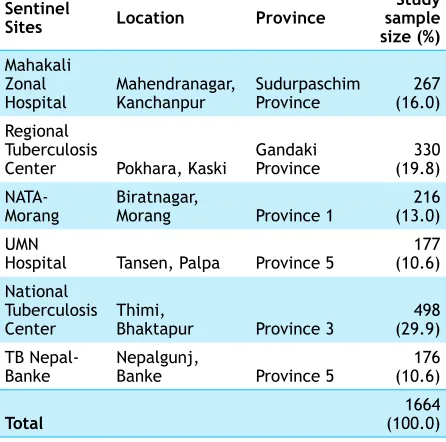
A cross-sectional study design was adopted for this sentinel sero-prevalence survey.The survey was conducted at six sentinel sites namely Mahakali Zonal Hospital, Kanchapur, Western Regional Tuberculosis Center (WRTC), Kaski, National Anti-tuberculosis Association (NATA), Morang, United Mission Nepal (UMN), Palpa, National Tuberculosis Center (NTC), Bhaktapur and TB Nepal, Banke. These sites were selected based on the number of TB patients registered for anti-tuberculosis therapy (ATT). These treatment centers, with high caseload of TB patients, were assumed to have greater population coverage representing all geographical regions and socio-demographic characteristics like caste, ethnicity, religion and culture. Under NTP, these sites have been serving as a referral treatment centers providing advanced TB treatment and care services. This study continued for six months starting from March 2017 to August 2017.
The sample size was calculated by using Epi-info STATCAL application assuming a two-sided confidence level at 95%, 80% power (1-B) of the study. The proportion of HIV among TB patients was assumed to be 1.1%, based on the finding from the similar sentinel surveillance conducted by NTP on fiscal year 2013/14.3 The required sample size for the study to monitor the trend of HIV prevalence among TB patients came to be 1,672 TB patients assuming 5% non-response rate. The number of samples from each sentinel sites were selected proportionately considering TB caseloads at respective sites. Consecutive sampling method was used; every patient who meets the eligibility criteria at the particular site was included in the study until the required sample size was reached. Based on the objectives of the study, a structured questionnaire was prepared and finalized by Technical Working Group (TWG) for the sentinel survey comprised of HIV, TB and Laboratory specialists. Statistical Package for Social Science (SPSS version 20) was used for analysis.
Ethical approval for this survey was obtained from Nepal Health Research Council (NHRC). All types of TB patients (smear positive, smear negative, extra-pulmonary) who are equal or above 15 years of age at the time of TB treatment at selected sentinel sites were eligible to take part in the study. TB patients not meeting above inclusion criterions were excluded from the sampling frame. However their right to know the serological status was protected through counselling and referring them to appropriate treatment and testing site. Informed consent, both verbal and written, from each eligible TB patient was obtained prior the participation in the
survey. Similarly participants were informed about their voluntary participation in the survey as well as assured them their right to leave survey at any time for any reasons. All eligible respondents who gave their consent for the participation in the survey were counselled prior (pre-counselling) and after (Post-counselling) testing for HIV infection. Information obtained from all the eligible TB patients who went through the HIV testing were kept confidential and secured at the respective sentinel sites.
Health workers at treatment centers (Laboratory Technician, Survey Coordinator, Counselor) were provided one day orientation, prior the survey, to build their capacity for HIV testing as well as proper recording in the questionnaire. HIV testing was performed as per the testing algorithm recommended by national consolidated guidelines for treating and preventing HIV in Nepal 2014 for the diagnosis of HIV.4 The standard national strategy for HIV testing is based on the serial HIV testing algorithm using three different HIV test kits (Determine HIV ½, Uni-Gold HIV and HIV ½ Stat-Pak test kits). Similarly socio-demographic information of the TB patients was also collected through face-to-face interviews using a structured questionnaire. Collected information by health workers were reviewed by Provincial TB Coordinators for the possible errors. Once the information from the respondents was collected in sufficient number, data entry and analysis was assigned to third party to minimize possible biases.The data were entered directly into Statistical Package for Social Science (SPSS version 20) and were analysed for the statistical analysis. The association between socio-demographic characteristics with outcome variable i.e. HIV status were explored using bivariate logistic regression analysis. Value of P<0.05 was considered significant where the confidence interval was set at 95% (95% CI).
RESULTS
Table 1. Detail information regarding the sentinel sites.
Sentinel
Sites Location Province
Study sample size (%) Mahakali
Zonal
Hospital Mahendranagar, Kanchanpur Sudurpaschim Province (16.0)267 Regional
Tuberculosis
Center Pokhara, Kaski Gandaki Province (19.8)330
NATA-Morang Biratnagar, Morang Province 1 (13.0)216 UMN
Hospital Tansen, Palpa Province 5 (10.6)177 National
Tuberculosis
Center Thimi, Bhaktapur Province 3 (29.9)498 TB Nepal-
Banke Nepalgunj, Banke Province 5 (10.6)176
Total (100.0)1664
Table 2.HIV co-infection among TB patients.
Type of TB
HIV Testing Result
Total (%) HIV
Negative PositiveHIV
Pulmonary TB 1208 34 1242
(74.6%)
Extrapulmonary TB 415 7 422
(25.4%)
Total (%) 1623
(97.5%) (2.5%)41 (100%)1664
Table 3. HIV co-infection among TB patients at different Sentinel sites.
Sentinel Sites Number (n)
HIV Testing Result HIV
Negative (%)
HIV Positive (%) Mahakali Zonal
Hospital, Kanchanpur 267 99.6 0.4
Regional Tuberculosis
Center, Kaski 330 97.3 2.7
NATA-Morang 216 95.4 4.6
UMN Hospital, Palpa 177 93.8 6.2
National Tuberculosis
Center, Bhaktapur 498 98.6 1.4
TB Nepal- Banke 176 98.3 1.7
Total (%) 1664
(100%) (97.5%)1623 (2.5%)41
Table 3 shows the detail information regarding the prevalence of HIV among TB patients at the selected
sentinel sites. Table 4 demonstrates the socio-demographic characteristics of TB patients as well as their association with the prevalence of HIV. More than two third of TB patients (67%) in the study were male. The median age of tuberculosis patients was 32 years with the range of (15-97) years. Majority of the respondents (42%) belonged to age group category of (25-44) years.However, around 9.9% (164) TB patients choosenot to disclose their age. Nearly two out of five TB patients were Janajatis (40%), followed by Brahmin/ Chhetri (28%), Dalits (20%), Madhesi/Muslim (12%) respectively.
Table 4. Association between demographic
characteristics of TB patient and prevalence of HIV.
Characteristics
HIV status
P value Number
(n) Negative (%) Positive (%)
n=1623 n=41 Age group **
Less than 25 374 98.9 1.1
0.002
25-44 692 96.7 3.3
45 and above 434 98.8 1.2
Age missing (age not
disclosed) 164 94.5 5.5
Sex
Female 548 97.6 2.4
0.0866
Male 1116 97.5 2.5
Caste/Ethnicity *
Dalit 334 97.9 2.1
0.025
Janajati 671 98.2 1.8
Madeshi/
Muslim 198 94.4 5.6
Brahmin/
Chhetri/other 461 97.6 2.4 Religion *
Hinduism 1291 97.5 2.5
0.015
Buddhism 280 98.9 1.1
Islam/
Christian 93 93.5 6.5
Marital status
Ever married 1267 97.3 2.7
0.302
Unmarried 397 98.2 1.8
Illiterate 1139 97.3 2.7
0.717
Literate 525 97.6 2.4
Occupation *
Agriculture 649 98 2
0.014
Labourer 233 95.3 4.7
Housewife 236 95.8 4.2
Job 133 98.2 1.8
Others 323 99.3 0.7
*Significant ** Highly significant
The prevalence of HIV among male TB patients (2.5%) was found comparatively higher than among the female TB patients (2.4%). However, the difference was not statistically significant (P=0.866). Similarly, the prevalence of HIV was found significantly (P<0.01) higher among the TB patients who choose not to disclose their age (5.5%) than in TB patients belonging to (25-44) yearsage group (3.3%) and was found lowest among less than 25 years TB patients (1.1%). Prevalence of HIV was found significantly higher among Madhesi/Muslim TB patients (5.6%, P<0.05), among Christian/Islam TB patients (6.5%, P<0.05) and among the labour (4.7%, P<0.05) respectively. Although the prevalence of HIV was found comparatively higher among married (2.7%) and illiterate (2.7%) TB patients, but the association was not found statistically significant.
DISCUSSION
Prevalence of HIV among TB patients was found 2.5%. The prevalence has increased sharpely in comparison to the findings from the similar study conducted by NTC in 2013 (i.e. 1.1%).3 However, it has increased slightly in comparision to the study conducted in 2011 (i.e. 2.4%).5 Similar studies conducted in different neighbouring countries in Asia have found different results (0.5% in Guangxi, China, 1.0% to 13.8% in different districts of Eastern India, 0.34% in Sindh, Pakistan) which could be due to different socio-geographical, economic context as well different epidemics of HIV and TB.6-8 It was observed that the prevalence of HIV was found more prominent in pulmonary TB patients than extrapulmonary TB patients. In this study, pulmonary TB patients were 1.58 times more likely to have co-infection with HIV than extrapulmonary TB patients. Several other studies conducted in India and China have also found the similar association between TB classification types and HIV status.6,9,10 However, this finding contrasts with studies conducted in India and Pakistan which have shown higher prevalence of HIV infection among extrapulmonary TB cases.11,12
This study found that prevalence of HIV among TB patients differed with different gender. Although the association wasn’t statistically significant, male TB patients were more likely to have HIV-TB co-infection than female. Global trends have also shown that incident and mortality of TB occurs more in male than female.1,13 Similarly for the developing countries like Nepal, where social structure prefers more male dominance than female, male are more involved in outdoor activities involving risky behaviors (like extramarital sexual activities, intravenous drug injection, alcohol consumption and smoking) which could have put them at increased risk for TB and HIV. Movement as well as migration pattern to India could also have affected the result as such TB and HIV endemic areas of India have been the preferred destination among Nepalese migrants for earnings. Similarstudies conducted in Nepal, China have also found no any significant association between gender of TB patients and prevalence of HIV.5,6 However a study conducted in India found the association highly significant.8 This study found that the prevalence of HIV was significantly associated with the age of TB patients. The prevalence of HIV was 3.00 times higher among TB patients aged 25 to 44 years; 1.09 times higher among TB patients aged 45 years and above in comparison to the TB patients aged below 25 years. In this study, TB patients aged (24-44) years were the most affected age group. It could be due to high prevalence of TB and HIV among people belonging to (25-49) years age group.1,2,14 Howeverstudies conducted in China and Indiacouldn’t detect any significant relationship between age of TB patients and prevalence of HIV.6,8 This study found that prevalence of HIV was significantly higher among the Madhesi/Muslim TB patients that TB patients belonging to other caste/ethnic groups (i.e. Brahmin/Chhetri, Dalit, Janajati).This could be due to fact that Madhesi/ Muslim population are largely concentrated acrossTerai region where the epidemic of TB and HIV ishigh.2,14 However, a study conducted in Guangxi China couldn’t establish any significant association between caste/ ethnicity of TB patients and prevalence of HIV.6
TB patients and prevalence of HIV.6,15 In this study, ever married TB patients were 1.5 times more likely to have HIV than unmarried TB patients. However, this study couldn’t find anystatistically significantrelation between prevalence of HIV and marital status of TB patients. Similar studies conducted in China, Nigeriaalso couldn’t establish marital status as a significant predictor for increased risk of HIV among TB patients.6,15 Similarly, this study couldn’t find any significant association between prevalence of HIV and literacy status of TB patients. Finding is similar to a study conducted in Nigeria.15 However the prevalence of HIV was slightly higher among illiterate TB patients than literate.
This study couldn’t escape out of limitations. This study was conducted among six selected sentinel sites which couldn’t cover all the TB cases notified during the study period as well as lacks adequate geographical representation. Similarly, patients receiving TB diagnosis, treatment and care services from the private sector were missed by this study. Information regarding important predictors for TB and HIV like smoking habit, alcohol consumption, diabetic status was missed in this study, which could have otherwise explored additional evidences to strengthen TB-HIV co-infection program in Nepal.
CONCLUSIONS
Prevalence of HIV among TB patients has increased gradually in Nepal. TB patient characteristics like age, caste/ethnicity, religion and occupation were found significantly associated with theprevalence of HIV. Hence,information on the availability of diagnostic and treatment services as well as access to HIV prevention, diagnosis and treatment services need to be increased in these sub-groups of the population. Similarly, interventions like universal HIV testing among TB patients, TB/HIVcollaborative activities are necessary to scale up across the country.
ACKNOWLEDGEMENT
We would like to remember all the Provincial TB Coordinators (Barsha Thapa, Bimal Subedi, Sailesh Bhujel, Bharati KC, Diwas Acharya, Rajesh Sah) for their support throughout the study period. We express our deep gratitude to all the sentinel sites for conducting this study on time. Similarly, we would also like to thank all the laboratory technicians, survey coordinator and counsellor for their support during the study period. At last, we would like to remember and thank all the respondents who gave their valuable time for interview.