Volume-7 Issue-2
International Journal of Intellectual Advancements
and Research in Engineering Computations
An experimental investigation on high strength self compacting concrete
using jute fibre
A J. Briscilla
1, B K. Selvi
2 1P.G Student (M.E Structural Engineering), Nandha Engineering College (Autonomous),
Erode
2
Assistant Professor (Department of Civil Engineering), Nandha Engineering College
(Autonomous), Erode,
ABSTRACT
Self-Compacting Concrete gets dense and compacted due to its own self weight. Experimental investigations have to been carried out to determine different characters like workability and strength of Self Compacting Concrete (SCC) with jute fibre. Short discrete vegetable fibers namely sisal, coir and jute have been examined for their suitability for incorporation in cement concrete. Jute is a natural fibre obtained from a plant which look like giant pineapples, and during harvest the leaves are cut as close to the ground as possible. The soft tissues are scrapped from the fibres by hand or machine. The fibres are dried and brushes remove the remaining dirt, resulting in a clean fibre. The concrete is required to have properties like high strength, high durability, better serviceability and long life of concrete structures. Tests involving various fiber proportions for a particular mix design of SCC. Test methods used to study the properties of fresh concrete were slump test, V - Funnel and L - box test. Then materials were hand mixed with 1% addition of Jute fiber in M25 mix
design and casted in cubes (150mm x 150mm x 150mm), cylinders (150mm x 300mm) and prism (75mm x 75mm x 300mm). The super plasticizers are used. The obtained specimens were subjected to test the compressive, split tensile and Flexural strength. And the compressive, split tensile and Flexural strengths of the specimens were analyzed after 7 days and 28 days of curing.
Keywords: Self-compacting concrete, workability, segregation, aggregate, super plasticizer, fly ash, jute fiber.
INTRODUCTION
Self-Compacting Concrete (SCC), which flows under its own weight and does not require any external vibration for compaction, has revolutionized concrete placement. SCC, was first introduced in the late 1980‟s by Japanese researchers, is highly workable concrete that can flow under its own weight through restricted sections without segregation and bleeding. Such concrete should have a relatively low yield value to ensure high flow ability, a moderate viscosity to resist segregation and bleeding, and must maintain its homogeneity during transportation, placing and
curing to ensure adequate structural performance and long term durability. The successful development of SCC must ensure a good balance between deformability and stability. Researchers have set some guidelines for mixture proportioning of SCC, which include i) reducing the volume ratio of aggregate to cementitious material; (ii) increasing the paste volume and Water-cement ratio (w/c);(iii) carefully controlling the Maximum coarse aggregate particle size and total volume; and (iv) using various viscosity enhancing admixtures (VEA).
Adding a large volume of powdered material or viscosity modifying admixture can eliminate segregation. The powdered materials that can be added are fly ash. Since, self-compatibility is largely affected by the characteristics of materials and the mix proportions, it becomes necessary to evolve a procedure for mix design of SCC. Okamura and Ozawa have proposed a mix proportioning system for SCC. [1-6]
This paper describes a procedure specifically developed to achieve self-compacting concrete. In addition, the test results for acceptance characteristics for self-compacting concrete such as slump flow, V-funnel and L-Box are presented. Further, the strength characteristics in terms of compressive strength for 7-days and 28-days are also presented. [7-10]
Objectives
To determine the workability of SCC using slump come test, U-tube test, L-box test, V- funnel test.
To study the strength characters of SCC like compressive strength, flexural test and split tension strength.
To study the strength and behaviour of SCC while using jute fibres to the SCC
To study the mix proportion for SCC material with jute fibres using standard codes of practice.
LITERATURE REVIEW
Jasmine Jeba P(2017) this project deals with the self- compacting concrete where the cement is partially replaced with fly-ash and silica fume. Here Ordinary Portland Cement is replaced with 5%, 10%, 15%, 20% and 25% of fly-ash and 2.5%, 5%, 7.5%, 10% and 12.5% of silica fume. From the experimental investigations, it is observed that there is increase in the fresh properties (workability) and increase in the hardened properties (split-tensile strength and compressive strength) for replacement of silica fume. Similarly, there is increase in the fresh properties (workability) and decrease in the hardened properties (split-tensile strength and compressive strength) for replacement of fly ash.
Athulya Sugathan (2017) carried out to check the fresh and hardened properties of sisal fiber
reinforced self –compacting concrete with different percentage of fiber addition. Degree of workability of concrete mix with 0.2% super plasticizer and water cement ratio 0.31 had good workability which is effective, was obtained. Materials were hand mixed with 0.5%, 1%, 1.5% and 2% addition of fiber in M40 mix design and casted in cubes and cylinders. The super plasticizers are used in different percentages like 0.15%0.2%,1%&2%. The obtained specimens were subjected to test the compressive and split tensile strength. And the compressive and split tensile strengths of the specimens were analyzed after 7days and 28days of curing.
Sai Vijaya Krishna .T (2016) this work aims to study the behaviour of jute fibers mixed in concrete as a reinforcing material for improving the mechanical properties of concrete. Several experiments were conducted on jute fibers, jute-cement mortar and jute fiber reinforced concrete in this research. For this study, a total of 24 mortar specimens for compressive strengths and 144 concrete specimens i.e. 48 cubes, 48 prisms and 48 cylinders each consisting of ordinary concrete, 0.5%, 1% and 2% Jute fiber reinforced concrete are tested for their compressive, flexural and split tensile strengths respectively for different curing periods such as 7, 28, 56 and 90 days. It is observed that the JFRC specimens with 1% jute content, cured up to 56 days has significant improvement of mechanical properties such as compressive strength, flexural strength and split tensile strength with respect to ordinary concrete.
Rahul R. Kshatriya (2016) in the present work the tensile, compressive, mechanical properties of jute fibre without modification and after modification with 0.5% alkali and 0.5% latex polymer has been modified by taking quantity of jute as 1% of cement. This modification of jute fibre improves tensile strength. These properties are compared by taking tests on plain, with and without modification of jute fibre casting cube, cylinder and beams after curing of 7 days. From our project we had seen that there is considerable increase in strength of concrete by adding treated jute in concrete.
with regard to identification of mix proportions and properties for different applications was carried out around the world. the paper mainly focuses on the mix proportions by partial replacement of cement and fine aggregate by various eco-friendly materials and to critically
review the mechanical properties of self-compacting concrete.It was observed that fine materials improve the properties of self-compacting concrete at low water binder ratio and addition of super plasticizer.
METHODOLOGY
TESTING OF MATERIAL
Cement
The Portland pozzolana cement of 43 grade conforming to IS: 8112: 1989 was used for the present experimental study. The important
properties of this cement have beem tested and given below
Specific gravity of cement = 3.16 Normal consistency of cement = 34% Initial setting time of cement = 35 min Fineness modulus of cement = 1.75 Collection of literature
Study of literature
Collection of material
Testing of material
Mix design for M25
Fresh concrete test
Conclusion Casting of the
Fly ash
Table: Physical properties of fly ash SI.NO PROPERTIES VALUES
1 Fineness modules 78.60
2 Specific gravity 2.10
Table II: Chemical properties of fly ash SI.NO Properties Value in %
1 Silica 59.62
2 Alumina 26.43
3 Iron oxide 6.61 4 Calcium oxide 1.2
5 Magnesium oxide 0.76 6 Sulphur trioxide 0.58 7 Titanium oxide 1.56
8 Loss of ignition 1.76
Fine aggregate
Nature river sand or M-sand with fraction passing through 4.75mm sieve and on 150um sieve was used and tested as per IS:2386:1983. The important properties tested for fine aggregate are given below
Specific gravity of fine aggregate = 2.72 Fineness modulus of fine aggregate = 2.85
Bulk density of fine aggregate = 1487.6kg/m3
Course aggregate
Crushed granite coarse aggregate of size 12.5mm was used and tested as per IS: 2386:1983. The important properties tested for coarse aggregate are given below
Specific gravity of coarse aggregate = 3.02 Bulk density of fine aggregate =1652.89 kg/m3
Water
Portable tap water available in laboratory with pH value of 7.0 + 1 and confirming to the
requirement of IS:456:2000 was used for mixing concrete and curing the specimen as well
Admixtures
Glenium b233 and glenium stream 2 are confirming to the to the requirement of IS: 9103:1979 as a high range water reducing admixture and viscosity modifying agent was used in this study.
Jute fibres
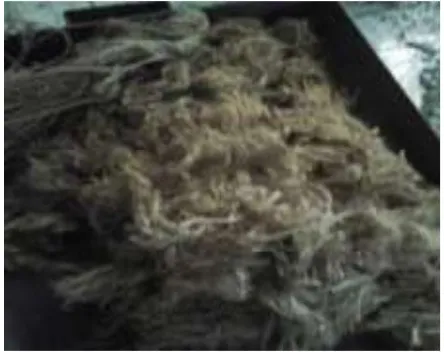
Fig 1. Jute fibres
From the tests conducted on jute fibers, the water absorption, tensile strength and the percentage elongation are observed as follows: Water absorption = 205.26%
Tensile strength = 262.6 MPa % elongation = 1.16%
Fresh Concrete Tests
The fresh properties test such as slump flow test, L-box test and V-funnel test
Slump Flow Test
The slump flow is used to assess the horizontal free flow of SCC in the absence of obstructions. It was first developed in Japan for use in assessment of underwater concrete. The test method is based on the test method for determining the slump. The diameter of the concrete circle is a measure for the filling ability of the concrete.
V-funnel
The test measures the flow rate of mortar through the orifice under self-weight, and the flow time is an indication of its plastic viscosity. Test procedure and data recording
Place the clean V-funnel vertically on a flat, firm ground, with the top opening horizontal. Wet the interior of the funnel with a moistened towel so that it is „just wet‟.
Close the trapdoor and position the bucket below it.
Fill the funnel completely with a representative sample of the mortar SCC without applying any
compaction or rodding. Strike off any surplus mortar. Do not knock or move the V-funnel until it is empty.
Open the trapdoor and simultaneously start the stopwatch. Look vertically down inside the funnel, and stop the time at the instant that daylight can be seen through the opening. This is the flow-time.
Repeat operation two more times using the same sample and without any cleaning between tests. Record the flow-times from the second and the third runs.
6. The funnel should be cleaned after testing is complete
L-Box test
Principle The method covers evaluation of passing ability of self-compacting concrete. It it is possible to measure properties such as blocking behaviour, with a visual indication of flow ability and segregation. Execution of the test
The vertical part of the box, with the extra adapter mounted, is filled with 12.7 litres of concrete.
The concrete is allowed to rest for one minute. During this time the concrete will show whether it is stable or not (i.e. any tendency to segregation).
Mix design
Mix design is the process of choosing the optimum quantities of different constituents of concrete to attain a specific minimum compressive strength and durability in a most economic composition.
Design consideration for M25 Mix Design as per BIS.
Characteristic compressive strength 28-days : 25Mpa
Aggregate size (Max.) : 12.5mm
Compaction Factor : 0.9
Quality control : Good
Exposure : Severe
Steps Followed
1. Target mean strength calculation fck* = fck + ks
fck* = 25 + 1.65*6.0 = 34.9 N/mm2 Where,
fck* = mean target strength in MPa k= Probability factor for 5% tolerance. s= Standard deviation for degree of control.
2. The w/c ratio for the mean target strength of 34.9 MPa
is 0.38.
3. Find water and sand quantity for 12.5 mm max aggregate size and the sand in compliance to ZONE -II. Water quantity per m3 of concrete = 186 kg/m3. Sand quantity as % of net aggregate quantity = 65% Compaction Factor = 0.9
Next is application of corrections Corrections
Change in Condition Water Sand W/C (.22) 0 -4.4%
C.F. +3% 0
Rounded -15Kg -7% Zone II 0 0
As the above corrections
Water Content = 208 + (0.03*208) -15 = 199.24 MPa As per correction the sand content as percentage of total
aggregates = 65- 11.4 = 53.6%
4. Determine the content of water and cement. 5. Determination of coarse and fine aggregate contents. Assuming 3% air entrapment.
V= [W/SW+C/SC+ fa/ (P*SFA)]*0.001; V= [W/SW+C/SC+ Ca/ ((1-p)*SCA)]*0.001; F.A. =788.77kg/m3.
C.A.=773.06kg/m3.
Hence the mix proportion becomes
Table III - Mix Design Proportions
CEMENT SAND COARSE AGGREGATE WATER
524.31 kg 788.77 kg 773.06 kg 199.24 kg
1 1.5 1.47 0.38
Converting to SCC proportions
The normal design mix is converted to SCC proportions and then the fresh properties of concrete are considered and we arrive at a final mix design.
Cement = 524.31 kg
Fine aggregate (F.A.) = 788.77 kg Coarse aggregate (C.A.) = 773.06 kg
Total aggregate (T.A) = 788.77+773.06 = 1561.83 kg.
Taking F.A. : C.A. as 3:2
TABLE IVSCCMIXPROPORTIONS
CEMENT SAND COARSE AGGREGATE WATER
524.31 kg 937.09 kg 624.73 kg 199.24 kg
1 1.78 1.19 0.38
EXPERIMENTAL PROCEDURE
The ingredients of SCC were weighed according to the mix proportion. The water cement ratio taken as 0.38. The required quantity of water was calculated and added thoroughly to get a fine paste. To this various % of superplasticizer was added and mixed thoroughly. The entire mix was thoroughly mixed once again. At this stage, almost the concrete was in a flow able state. Now, the flow characteristic experiments for self-compacting concrete like slump flow test, V-funnel test and L-box test were conducted. After conducting the flow characteristic experiments the concrete mix was poured in the moulds required for the strength assessment. After pouring the concrete into the moulds, no compaction was given either through vibrated or through hand compaction. Cubes were casted for compressive strength, cylinders were casted for split tensile test and prisms were casted for flexural strength. Even the concrete did not require any finishing operation. After 24 hours of casting, the specimens were demoulded and were transferred to the curing tank wherein they were allowed to cure for7 & 28
days. After7day & 28 days of curing the specimens were tested for their respectively strengths
RESULT AND DISCUSSION
Fresh Properties of Concrete: Based on the SCC mix obtained through the sequential mix proportion and through various tests, the characteristics of fresh concrete properties are discussed in this paper. The fresh properties test such as slump flow test, T50 slump flow in sec,
L-box test and v-funnel test are done. The value and test result are explained below.
The SCC without jute fibre shows the slump flow highest of 660mm (acceptable range 600 to 800mm). The time for the concrete to reach 50cm diameter flow is noted as 3sec (acceptable range 2 to 5 sec). The l- box test result shows the height difference between the 2 compartment as 20 mm (acceptable range < 30mm ).The V-funnel test shows for the emptying the funnel is 6 sec (acceptable range 6 to 12 sec).
Fresh properties of SCC are carried out to check the optimum percentage of superplasticizer and percentage addition of fibres.
TABLE V: Result of Fresh Concert
S.NO TEST METHODE SCC (NORMAL) SCC WITH JUTE FIBRE
1 SLUMP FLOW IN mm 660 630
2 V-FUNNEL IN sec 6 7
3 L-BOX TEST IN mm 20 30
Hardened Properties of Concrete: The hardened properties of concrete such as compressive strength, split Tensile Strength and flexural strength of SCC were checked.
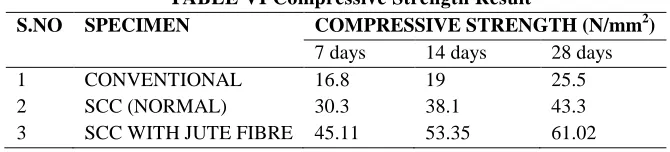
TABLE VI Compressive Strength Result
S.NO SPECIMEN COMPRESSIVE STRENGTH (N/mm2)
7 days 14 days 28 days
1 CONVENTIONAL 16.8 19 25.5
2 SCC (NORMAL) 30.3 38.1 43.3
Fig 2: Compressive Strength Result
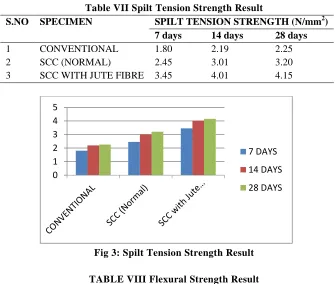
Table VII Spilt Tension Strength Result
S.NO SPECIMEN SPILT TENSION STRENGTH (N/mm2) 7 days 14 days 28 days
1 CONVENTIONAL 1.80 2.19 2.25
2 SCC (NORMAL) 2.45 3.01 3.20
3 SCC WITH JUTE FIBRE 3.45 4.01 4.15
Fig 3: Spilt Tension Strength Result
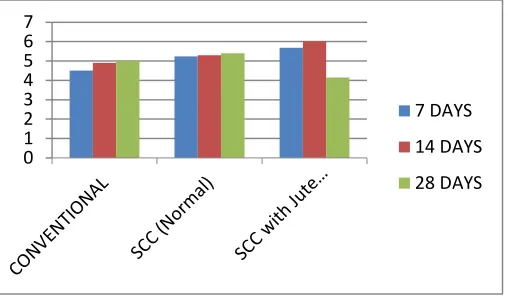
TABLE VIII Flexural Strength Result
S.NO SPECIMEN FLEXURAL STRENGTH (N/mm2)
7 days 14 days 28 days
1 CONVENTIONAL 4.5 4.9 5.01
2 SCC (NORMAL) 5.23 5.30 5.40
3 SCC WITH JUTE FIBRE 5.68 6.01 6.25
0 10 20 30 40 50 60 70
7 DAYS
14 DAYS
28 DAYS
0 1 2 3 4 5
7 DAYS
14 DAYS
Fig 4: Flexural Strength Result
REFERENCES
[1]. Dinesh. A, Harini.S, Jasmine Jeba.P, Jincy.J, Shagufta Javed “Experimental Study on Self Compacting Concrete” Ijesrt Journal of Engineering, 2017
[2]. Krishna Murthy. N, Narasimha Rao. A.V, Ramana Reddy I. V and Vijaya Sekhar Reddy. M, Mix Design Procedure for Self-Compacting Concrete, Iosr Journal of Engineering, 2(9), 2012, 33-41.
[3]. Dhiyaneshwaran. S, Ramanathan. P, Baskar. L Andvenkatasubramani. R, Study on Durability Characteristics of Self-Compacting Concrete with Fly Ash, Jordan Journal of Civil Engineering, 7(3), 2013.
[4]. B. Mahalingam and K. Nagamani, Effect Of Processed Fly Ash on Fresh and Hardened Properties of Self-Compacting Concrete, International Journals of Earth Science and Engineering, Issue 0974-5904, 4(5), 2011.
[5]. T. Sai Vijaya Krishna and B. Manoj Yadav, A Comparative Study of Jute Fiber Reinforced Concrete with Plain Cement Concrete, Ijret: International Journal of Research in Engineering and Technology Eissn: 2319-1163 | Pissn: 2321-7308
[6]. Rahul R. Kshatriya, Vikas L. Kumavat, Mansi S. Kothalkar, Chetan C.Chaudhary, Roshan A. Khode, Chetan N. Mahale, Sanyogita S. Pawar, Use and Development of Jute Fibre in Reinforced Cement Concrete Grade M40,Internation Journal of Innovation Research, 2(3), 2013
[7]. Dhiyaneshwaran. S, Ramanathan. P, Baskar. L and Venkatasubramani. R, Study on durability characteristics of self-compacting concrete with fly ash, Jordan journal of civil engineering, 7(3), 2013.
[8]. B. Mahalingam and K. Nagaman, Effect of processed fly ash on fresh and hardened properties of self-compacting concrete, International journals of earth science and engineering, ISSN 0974-5904, 4(5), 2011.
[9]. IS: 4031 (Part 4)–1988. Methods of physical tests for hydraulic cement. Part 4. Determination of consistency of standard cement paste. Bureau of Indian Standards. New Delhi, India, Reaffirmed; 2005.
[10].IS: 4031 (Part 5)–1988. Methods of physical tests for hydraulic cement. Part 5. Determination of initial and final setting Times. Bureau of Indian Standards. New Delhi, India, Reaffirmed; 2005.
0 1 2 3 4 5 6 7
7 DAYS
14 DAYS