Development and Validation of an Information
Booklet Aimed at Promoting Mental Health for
Pregnant Women with a History of Abuse
Diksha Sapkota,1,2,3 Kathleen Baird,1,4 Amornrat Saito,1,3 Shyam Sundar Budhathoki,5 Rita Pokharel,6 Susma Basnet,7 Debra Anderson1,3
1School of Nursing and Midwifery, Griffith University, Queensland, Australia, 2Department of Nursing, Kathmandu University School of Medical Sciences, Dhulikhel, Kavre, 3Women’s Wellness Research Program, Menzies Health Institute Queensland, Brisbane, Queensland, Australia, 4Gold Coast University Hospital, Gold Coast, Queensland, Australia, 5Golden Community Nepal, Patan, Nepal, 6College of Nursing, B.P. Koirala Institute of Health Sciences, Dharan, Nepal, 7Department of General Medicine, Lifeline Hospital Institute of Health Sciences, Jhapa, Nepal.
ABSTRACT
Correspondence:
Diksha Sapkota, School of Nursing and Midwifery, Griffith University, Queensland, Australia. Email: [email protected], Phone: +9779841573888, +61468424923.INTRODUCTION
Domestic and Family Violence (DFV) is highly prevalent in developing countries1,2 and literature indicates significant dearth of effective support mechanisms.3,4 Despite evidence on significant need for information among victims5 and recommendation on use of information via leaflets or posters for addressing DFV,6
there is a substantial lack of interactive educational activities in healthcare settings of developing countries.4
Educative tools guide service providers; help users in understanding the information being transmitted7 and provide opportunity for ongoing learning.7,8 They can motivate participants for healthy behaviour change9 and improve their self-competence10 and ability to access resources.9
The justification for developing such a booklet is based on three premises: first, the depleted self-confidence and self-worth of victims can be regained through the
Background:
Mental health needs of victims of domestic and family violence are often overlooked. A booklet was
designed to help women update their knowledge and skills in effective coping with domestic and family violence and
support them in developing effective stress reduction and problem management techniques. In addition, this booklet
is believed to serve as a reference for further use. This paper describes the development process and validation of the
information booklet. This booklet was used during an intervention trial conducted in Nepal to educate abused pregnant
women.
Methods:
This methodological study involved three stages: bibliographical survey, development of the booklet, and
validation by specialists in the relevant fields and representatives of the target audiences. A total of eight experts, currently
working in the field of domestic violence and/or midwifery, and 15 representatives of the target participants were involved
in the validation process. A minimum Content Validity Index of 0.78 was considered for content validation, and minimum
agreement of 75% for face validation.
Results:
The booklet presented a global Content Validity Index of 0.92. The overall level of agreement within the target
participants was 86.3%, which was higher than the minimum recommended level. Both subject experts and participants
positively evaluated the adequacy, coverage and readability of contents of the booklet.
Conclusions:
The booklet was validated using content and face validity. This validated booklet is expected to be an
effective tool for communication that would help pregnant women cope better with domestic and family violence and
adopt strategies to remain emotionally healthy.
Keywords:
Booklet; development; domestic violence; validation studies.
J Nepal Health Res Counc 2019 Oct-Dec;17(45): 456-62
DOI
https://doi.org/10.33314/jnhrc.v17i4.2017
education on effective coping mechanisms; second, a printed booklet can provide a reference for future use; and finally, a need of a scientific contribution to bridge the knowledge gap.
METHODS
This booklet was used as one of the intervention components in a trial conducted in a tertiary hospital of Nepal, to provide basic information about DFV to victims of DFV.11 The process was based on common steps in
developing healthcare information booklets12 and was conducted between September 2017 and May 2018.
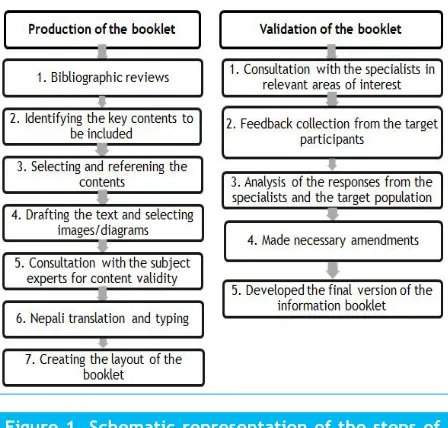
Figure 1. Schematic representation of the steps of production and validation of the booklet.
The informative booklet was developed based on the researchers’ professional experience and a bibliographic review. Electronic databases, cross-references of publications, current available information materials, training materials, clinical handbook and guidelineswere examined. The information was compiled, and relevant pictures/images were added into the booklet. Page layout was designed using the Microsoft Word 2013 and Paint.
After the production of the booklet, validation was achieved in three different phases: i) English version was validated by subject experts; ii) Information booklet translated into Nepali was validated by experts working in one or more of the following relevant areas: domestic violence, midwifery, psychological health, public health or midwifery; and iii)Nepalese pregnant women validated the completed booklet.
In the first phase, three subject experts were asked to read the material and suggest changes in relation to the
content, coherence, clarity and language of each sub-topics. The principal author, who has fluency in both English and Nepali language, then translated the English version into Nepali version. The Nepali version of the booklet was then reviewed and cross-checked with the English version by the person not involved in the study.
The Nepali version of the booklet was then distributed to the specialists working in the relevant fields in Nepal. In line with the recommendations of other studies, which state a minimum of three and a maximum of ten experts should be used to avoid possible random
consensus13,14 a total of nine experts were selected
through the non-probabilistic convenience snowball method. The professionals identified by this sampling method were invited to participate in the validation
process. They were asked to provide their feedback
regarding understandability, relevance, structure and adequacy of the information included in the booklet.
Latterly, a total of 15 randomly selected women attending ANC clinic of a hospital different than that proposed for the main study were also asked to evaluate the booklet. The eligibility criteria of the targeted participants were: gestational age of 24-34 weeks; presence of a history of abuse as measured by Abuse Assessment Screen (AAS) tool15 and able to read and understand Nepali language.
Two tools were used during data collection, one directed to the specialists, and another directed to the target population. The tools were adapted from a study conducted in Brazil to develop and evaluate an educational booklet for childbirth companions.9 The first tool, prepared for experts, consisted of 19 items organised into four sections: organisation; relevance; literary presentation; and visual appeal. The responses to the items were presented in the form of a four-point Likert rating scale. The second tool, prepared for target women, contained 16 items grouped into four evaluation aspects (organisation, writing style, presentation, and motives). In this case, answers to the questions included yes, no, and do not know.
more reviewers, I-CVIs≥0.78 is considered significant.14,16 For calculating S-CVI/UA, the number of items receiving either 3 or 4 by all of the experts was divided by the total number of items. The mean of I-CVIs of each item gave the value of S-CVI/Ave. Both S-CVI/UA and S-CVI/Ave were considered valid, if the value was greater than or equal to 0.78.16 Face validity was assessed by calculating
the proportion of items with positive responses in a checklist given to target participants. The items that obtained a concordance rate or level of agreement of at least 75% were considered validated.9,17
This study complied with the national and ethical standards concerning research involving human subjects and has obtained approval from the Griffith University Human Research Ethics Committee (GUHREC) and the Nepal Health Research Council (NHRC).
RESULTS
The booklet was developed through the systematic search of electronic as well as grey materials. The booklet contents were organised into five main sections: i) Stressful life events; ii) Stress management techniques; iii) Problem solving techniques; iv) Strengthening social support, and v) Safety behaviours and referral list.
Content was written in simple Nepali language and was complemented by illustrations or pictures. Examples were used to explain how stress reduction and problem-solving techniques can be applied depending on the context. The booklet was developed in size similar to the ANC card (5.5*2.25 inches) and consisted of 12 pages. The idea behind making the booklet similar to the size of ANC card was that the booklet could be kept easily in between the ANC card thereby ensuring confidentiality.
One expert from Nepal suggested increasing the content on pregnancy and childbirth, however, extra content was not added as extensive materials might be difficult to read and understand by target participants.
“It would be great if information related to taking
calcium supplements and vaccination during pregnancy are also added in the booklet” [Expert 7]
Furthermore, the main objective of the booklet was to inform the women about DFV and ways to manage its emotional consequences. There were also some suggestions on the use of alternative words for better clarity. Most of the experts suggested to include comprehensive referral lists. In addition to the contact details of local support DFV organizations, local emergency contacts, such as ambulance services,
hospital services, fire services, were also included in the booklet.
“The referral list needs to be updated and it would be better to include contact details of emergency support services” [Expert 3 and 4]
The booklet was validated by experts and by target audience. Initially nine experts were selected, four were males and five were females. There were two experts from midwifery and nursing, two were psychiatrists, one was psychiatric nurse, two were DV experts, one was expert in human ethics and one was expert in violence and health services research. There were two experts with doctoral degree and remaining others had master’s degree. One expert did not complete the evaluation checklist even after three reminders and hence, final sample included eight experts.
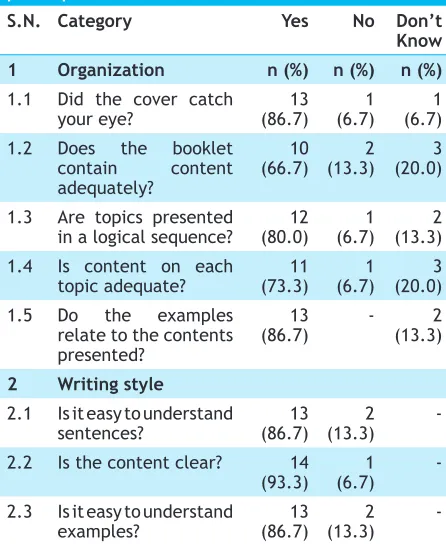
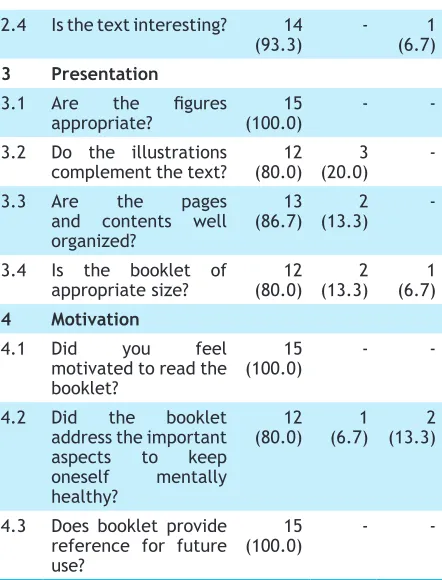
Fifteen potential research participants evaluated the organisation, style of writing, presentation of the booklet (Table 1). Pregnant women positively assessed the booklet and indicated that the material was relevant with respect to the illustrations included, motivation to read and use it in future, clarity of writing, and ease to understand the text. Three participants were unsure about the adequacy of the content and equal number disagree the complementary role of illustrations.
Table 1. Evaluation of the booklet by target participants.
S.N. Category Yes No Don’t
Know
1 Organization n (%) n (%) n (%)
1.1 Did the cover catch
your eye? (86.7)13 (6.7)1 (6.7)1 1.2 Does the booklet
contain content adequately?
10
(66.7) (13.3)2 (20.0)3
1.3 Are topics presented
in a logical sequence? (80.0)12 (6.7)1 (13.3)2 1.4 Is content on each
topic adequate? (73.3)11 (6.7)1 (20.0)3 1.5 Do the examples
relate to the contents presented?
13
(86.7) - (13.3)2
2 Writing style
2.1 Is it easy to understand
sentences? (86.7)13 (13.3)2 -2.2 Is the content clear? 14
(93.3) (6.7)1 -2.3 Is it easy to understand
-2.4 Is the text interesting? 14
(93.3) - (6.7)1
3 Presentation
3.1 Are the figures
appropriate? (100.0)15 - -3.2 Do the illustrations
complement the text? (80.0)12 (20.0)3 -3.3 Are the pages
and contents well organized?
13
(86.7) (13.3)2
-3.4 Is the booklet of
appropriate size? (80.0)12 (13.3)2 (6.7)1
4 Motivation
4.1 Did you feel motivated to read the booklet?
15
(100.0) -
-4.2 Did the booklet address the important aspects to keep oneself mentally healthy?
12
(80.0) (6.7)1 (13.3)2
4.3 Does booklet provide reference for future use?
15
(100.0) -
-Level of agreement among the target participants was calculated individually for four evaluative aspects as well as for total items. The level of agreement was higher than the established minimum of 75% for all aspects and ranged from as low as 78.7% in ‘organization’ aspect to as high as 93.3% in the aspect ‘motives of the booklet’(Figure 2).
Figure 2. Agreement among the target audiences.
The I-CVI calculations for the relevancy of each item are provided in Table 2. The I-CVIs ranged from 0.63 to 1.00. Ten out of 19 items had an I-CVI=1.00, seven had a score of 0.88, one scored 0.75 and one scored 0.63. Most of the items were considered relevant (I-CVI>0.78), except for two items: one on the applicability of the booklet on daily clinical practice, and another on the inclusion of updated list of referral services. Based on the experts’ feedback, referral list was updated. Two
experts expressed their doubts on applicability of the regular clinical practice.
“The booklet is very nice, but I don’t know if it can be used regularly in our out-patient department. You know
we have 300-400 patients per day…” [Expert 1 and 3]
The S-CVI/UA =0.53 and the S-CVI/Ave was 0.92. The universal agreement was calculated by adding all I-CVIs having values equal to 1.00 (10 items) and then dividing it by total number of items (19 items). The S-CVI/Ave was calculated by taking the average of I-CVI of all 19 items. Overall, the obtained values indicated the high content validity of the booklet (Table 2).
Table 2. I-CVIs and S-CVI values of the booklet.
S.N. Items agreementNo. of Item- CVI
1. Organization
1.1 Consistent research objectiveswith the 7 0.88
1.2 Sufficiently specific and comprehensive material 7 0.88
1.3 Provides guidance to the clientsappropriate 7 0.88
1.4 Logical sequence of the contents 7 0.88
1.5 Information presented is scientifically sound. 8 1.00
1.6 Examples content covered.reflect the 8 1.00
2. Relevance
2.1
Booklet portrays key aspects of mental health impact of domestic violence.
8 1.00
2.2 Booklet covers simple stress reduction
techniques. 8 1.00
2.3 Booklet addresses relevant aspects of problem solving
techniques. 8 1.00
2.4 Applicability booklet in regular clinical of the
practice. 5 0.63
2.5 Booklet includes updated list of local referral
services. 6 0.75
3. Literary presentation
3.1 Messages are presented clearly and concisely. 8 1.00
3.2 Material is socially and culturally appropriate for
3.3
Information is well-structured in terms of syntax, conjugation, and spelling.
7 0.88
3.4
Writing style is appropriate to the level of understanding of target audience.
8 1.00
4. Illustrations (Visual Appeal)
4.1 Booklet is of appropriate size with suitable number
of pages. 8 1.00
4.2 Illustrations meaningful and sufficient.are 8 1.00
4.3 Titles and text are of suitable size. 7 0.88
4.4 Front interest cover among arouses the
readers. 7 0.88
Scale level Content
Validity Index S-CVI/AveS-CVI/UA 0.53 0.92
DISCUSSION
Creating a written and validated information document is a crucial step in enhancing patient communication and ensuring uniformity of the information delivered by the health care professionals.18 An iterative approach was
used to develop and validate this booklet14 which aimed
to assist pregnant women to have better understanding of the DFV and its health consequences. The results of the validation study displayed acceptance of the booklet, although it was difficult to satisfy every reviewer on all attributes.
Adhering to the WHO ethical guidelines for DFV intervention research19 contact details of locally available support services were provided to all participants. Along with information on DFV and its coping strategies, booklets contained general information about pregnancy and childbirth. The booklet was given a neutral title, “Healthy mother makes healthy child”. It was believed that these strategies would make participation of women in DFV related study less conspicuous and thus, can ensure safety and confidentiality to the participants.11
The results of the validation process revealed a high level of agreement among participants i.e. >75%. Similarly, the overall content validity was also high (S-CVI-Ave=0.92), which was in accordance to other studies.9,14,18 It means that the participants and the experts considered the content, organization, and presentation of the booklet relevant and accessible for women with a history of abuse.
In addition to the objective assessment represented by the calculation of CVI and proportion of agreement, the subjective evaluation from target participants and experts were also considered. The experts and target participants indicated that the booklet was written in such a way that it was clear and easy to read and compiled in such a way that it would help to motivate one to read it. In addition, they stressed the importance of regular use of booklet to ensure continued education on DFV to pregnant women. Experts recommended some spelling corrections and changes in the sentence structure. Similar to the approach adopted in this study, other studies had demonstrated the importance of step-by-step evaluation to ensure good quality of educational materials.17,20
Motivation is essential to stimulate learning and the preparation of written education materials require interactions between the text and graphics. For this reason, context-specific figures were used to complement the text.7 Furthermore, it is important that the development of the information meets the needs and expectations of those who read it; therefore it is essential that the material is well-developed and easy to understand.20 In addition, the material should improve the knowledge and meet the satisfaction of the users.9 Hence, literature has recommended the involvement of target audience during the validation process.17
The target population evaluated the booklet in a positive way, considering it relevant and important for the promotion of knowledge, with adequate content combined with clarity and examples, appropriate organization, and explanatory illustrations, which is in agreement with findings from other studies.7,20
Written materials are no substitute for a one–to–one verbal discussion, but they can play an important part in supplementing and reinforcing information, as long as they conform to the highest standard of scientific accuracy, comprehensibility and relevance.17
Based on the recommendations from previous studies, multidisciplinary experts were involved in the review process, thereby ensuring that the keyinformation wasincluded.13,17 The main purpose of the booklet was to
The booklet was validated by both subject experts and target participants. However, an evaluation of the actual impact of the booklet on the behaviour of the HCPs and pregnant women is beyond the scope of the study and warrants further research. This booklet has been prepared as a part of the pilot randomised trial and if found to be effective, it will be recommended to be integrated into regular clinical practice. Such integration requires organizational commitment and support. Furthermore, the support of government and/ or non-government agencies is crucial for reproduction, dissemination and distribution of the materials in a larger scale. To maintain the rigor of the booklet, it is necessary to update it periodically with latest evidence.
CONCLUSIONS
The information booklet was developed with an intention to guide, standardise and systematise the counselling process as an approach to improve emotional wellbeing and use of community resources among victims of DFV.
The booklet was validated by experts and representatives from target participants and modifications were made to ensure that the messages delivered were as comprehensible as possible. This booklet with its validated content could be considered as a viable tool in service delivery and mental health education among women with a history of abuse. In addition to encouraging the communication between HCPs and victims of DFV, it will facilitate women in acquisition of knowledge related to DFV and its consequences, and locally available support services. Furthermore, and importantly it is expected to empower women as well as provide a means to standardise the counselling delivered by HCPs.
ACKNOWLEDGEMENTS
This study is being conducted as a part of PhD of Ms Diksha Sapkota, who is a recipient of Griffith University International Postgraduate Research Scholarship and Griffith University Postgraduate Research Scholarship. We are very thankful to the target participants and subject experts who have evaluated and provided feedback to validate the information booklet.