EDUCATING TEACHERS FOR CONTENT
AND LANGUAGE INTEGRATED LEARNING
IN KAZAKHSTAN: DEVELOPING POSITIVE
ATTITUDES
Artyom Sergeyevich Dontsov, Elena Ivanovna Burdina
S. Toraighyrov Pavlodar State University, Republic of Kazakhstan E-mail: [email protected]
Abstract
The aim of the present research is to identify whether teachers' attitudes towards the use of Content and Language Integrated Learning (CLIL) in the Republic of Kazakhstan can undergo significant changes if they study a course introducing them to the fundamentals of CLIL. Despite the country's plans to adopt English as one of the languages of education, stakeholders’ attitudes towards teaching through the medi-um of this language remain rather skeptical. A survey was held among Master’s degree students majoring in Education (n = 59) at Pavlodar State University before the course and after its completion. Since it is the affective component that largely determines the quality of attitudes, the levels of participants' anxiety, self-esteem and motivation were used as the indicators. The tools for measuring these variables were the State-Trait Anxiety Inventory, Dembo-Rubinstein's Method of Self-esteem Measurement and Dubovitska-ya's Diagnostics of Learning Motivation Orientation. The end-of-course results show a marked reduction in the level of participants' state anxiety, a growth in self-esteem in terms of the readiness to use CLIL, and a shift towards intrinsic motivation. It is argued that for attitudes shift to take place, it is necessary to adopt a constructivist approach to teaching and learning.
Keywords:content and language integrated learning, CLIL, attitude, teacher training, affective filter, anxiety, self-esteem, learning motivation.
Introduction
In the Republic of Kazakhstan, plans were announced to start using English as one of the languages of education (Nation's Plan, 2015). This means that some school subjects and certain university courses will soon be delivered through the medium of this language. However, re-search shows that transition to English in the mode of total immersion is hardly feasible due to the insufficient level of English, both on the part of learners (see, for example, Dontsov, 2016) and teachers (National Academy of Education, 2016).
Thus, in the present conditions, the use of Content and Language Integrated Learning (CLIL) is deemed most promising, as it has a dual focus: learning the content of a non-language subject through the medium of a foreign language and learning a foreign language by studying a content-based subject. At the initial stages of CLIL implementation, English can be used only at certain stages of the lesson to perform specific types of work. Then, as the language knowledge and speech skills of the learners improve, the proportion of the use of English can be gradually increased. It is also important that this approach is less demanding in relation to teachers, as it is not necessary for them to be fully proficient in English at the start of working with CLIL. They will be able to gradually improve their English while preparing for each subsequent lesson.
-Vol. 76, No. 2, 2018
141 ers should be educated to be able to use CLIL. Formally, the work in this direction is only just beginning, but at least two significant shortcomings in its implementation can already be identi -fied.
First of all, such training is often limited to teaching intensive courses of English. The number of hours for studying English has been significantly increased at higher education in -stitutions. As for in-service teachers, special courses are held for them throughout the country, with some of the work done remotely, i.e. with the use of ICT. This is undoubtedly very im-portant, as teachers' current level of English needs to be improved. However, it is also essential to realize that language training alone is not enough. A teacher working with CLIL is not just a teacher of a certain subject – he or she also becomes the English language teacher, which is a completely new role for most teachers of non-linguistic disciplines. Moreover, this approach requires significant changes in the entire work of the teacher, from planning to assessment. At the moment, there are only some sporadic events devoted to CLIL (conferences, round tables, as well as short-term training courses for in-service teachers), which is obviously not enough to cover the entire range of issues that need to be considered. At the level of pre-service teachers training, there is no preparation for CLIL at all. As long as this is so, implementation of CLIL in Kazakhstan will be neither sustainable nor systemic.
Secondly, insufficient attention is paid to subjective factors, in particular to teachers' at -titudes towards the introduction of CLIL. The roots of this problem go back to the Soviet period of the country's history. Just like other social and human sciences of that time, pedagogy was constrained in its development by the boundaries of the prevailing ideology that was based on the philosophy of materialism. Total regulation led to the emergence of the concept of teaching as a “technological process” carried out in accordance with a “technological map”, i.e. a de-tailed step-by-step instruction for the teacher that leads to a “guaranteed” achievement of the re-sult. With this approach, learners obviously could not play an active role, did not have freedom to discover new knowledge by themselves, and could not use their personal experience as the basis for learning. Instead, pre-selected contents of academic disciplines were given to them in ready-made form and the process of learning was totally teacher-led and teacher-centered. Al-though this approach made it possible to cover the entire vast territory of the country with mass education relatively quickly, it should also be noted that it made learning rather impersonal. People's individuality was not taken into consideration, though the main goal of education was declared to be the all-round development of the individual.
Meanwhile, international practice shows that it is the subjective factors that play a deci-sive role in teaching humanities in general and foreign languages in particular. The Theory of Second Language Acquisition (Krashen, 1981) contains the affective filter hypothesis, accord -ing to which individual emotions experienced by learners can significantly contribute to (or, on the contrary, impede) the effectiveness of learning. Motivation, self-confidence and anxi -ety were identified as the key factors that determine the “height” of the affective filter. Later Gardner (1985) hypothesized that students with a positive attitude towards the target language culture and people who speak this language make better progress in learning. Numerous subse-quent studies (Dörneyi, 1990; Dörneyi, 2001; Heckhausen, 1991) show that a positive attitude enhances learning. A number of works emphasize the importance of a positive attitude for suc-cessful implementation of CLIL (Johnson, 2012; McDougald, 2015; Papaja, 2012).
Vol. 76, No. 2, 2018
142 order to obtain a visible result, i.e. certain desired behavior in relation to the attitude object (the behavioral component), it is not enough to simply provide the person with new information about this object (the cognitive component) – it is of no less importance to make sure that the object is associated with positive emotions and feelings (the affective component). Therefore, the affective component is the focus of attention in the present research.
It is necessary to understand that a positive attitude is important not only for learners, but also for teachers. Since an attitude results in a readiness to act in a certain way, it can be argued that it directly affects the teacher's methods, actions and behavior in general (Pajares, 1992). Moreover, an attitude not only determines our reaction to the circumstances, but also largely affects the circumstances themselves. For example, when implementing CLIL in Kazakhstan, educators are likely to face many problems, but of the decisive importance is how they are go-ing to react to these problems. If the teacher has an attitude based on the belief that the imple-mentation of CLIL is an unrealistic task, then all his or her actions will be aimed at realization of this attitude, which will hamper the effectiveness of teaching and learning, and in the end will lead to the fact that the use of this approach will really fail to yield the expected results. Positive attitude and belief in success of CLIL, on the contrary, guides the teacher towards seeking solu-tions and overcoming obstacles, which eventually leads to a gradual elimination of the initially existing problems.
Unfortunately, studies show that negative attitudes currently prevail among teachers, both towards teaching in English in general and with the use of CLIL in particular. These nega-tive attitudes are manifested, inter alia, in low levels of self-confidence in one's own readiness for teaching in English. A large-scale survey conducted by the National Academy of Education named after I. Altynsarin (2016) revealed that only 9.5% of school teachers, 7.6% of college teachers and 10.7% of university lecturers believe that they are ready to teach in English.
Thus, there are reasons to argue that one of the most serious obstacles on the way to CLIL implementation in Kazakhstan is teachers' negative attitudes based on the belief that teaching in English is absolutely impossible for them. Although such problems as an insuffi -cient level of English or the lack of methodological training are far from being solved, it is this “mental block” that can prove to be the decisive factor.
Despite the fact that attitudes are quite stable, they may still be modified over time with exposure to training or new experiences which serve to challenge the existing beliefs. Pena Díaz and Porto Requejo (2008) note that one of the peculiarities of the teaching profession consists in the fact that even an absolute beginner, who has not yet worked a single day, already has many years of experience of being in the system of education as a learner. Elaborating this idea, Johnson (2012) argues that certain beliefs about how teaching should be carried out are formed at the stage of learning and then, consciously or not, transferred into one's own teaching. Working with an attitude is also possible at the level of professional development of in-service teachers. Guskey (2002) concluded that experienced teachers tend to be skeptical about any in -novation until they have seen it work in their classroom with their students.
It can be inferred from the above that a positive attitude towards a particular object re-quired by teachers in their work can be formed as a result of training. Special attention must be given to the work with the affective component of the attitude, as it is the most stable of all the three components, and in many respects, it determines the quality of the whole attitude. Since CLIL implies the use of a foreign language and its objective is to improve not only learners' knowledge of the content of a specific subject but also their foreign language proficiency, it might be reasonable to use the affective filter components (anxiety, self-confidence and motiva -tion) from Krashen's Theory of Second Language Acquisition (1981) as variables that can be monitored to determine the state of the affective component of the attitude.
Vol. 76, No. 2, 2018
143 passive recipient of information, a choice needs to be made in favor of an approach based on the philosophy of constructivism (Piaget, 1995; Vygotsky, 2005; Bruner, 1960). Such an approach assumes that 1) learning objectives are formulated by the learners themselves and are hence perceived by them as personally meaningful and significant; 2) learners are active participants of the learning process, new information is discovered by them independently through personal experience, reflection, teamwork and discussions; 3) a comfortable and safe learning environ -ment is created and maintained, initiative, fresh ideas and experi-ments are encouraged, and ev -eryone is free to express their opinion; 4) different learning styles are taken into consideration. Thus, the aim of the research is to identify changes in the participants' attitudes towards CLIL based on an analysis of changes in the affective component variables resulting from studying the Fundamentals of Content and Language Integrated Learning course developed and taught in accordance with the principles of constructivism.
Methodology of Research
General Characteristics
Since the research was aimed at determining the presence (or absence) of statistically significant changes in the affective component variables rather than explaining the reasons and nature of these changes, a quantitative research methodology was utilized. According to Aliaga and Gunderso (2002), quantitative research implies “explaining phenomena by collecting nu -merical data that are analyzed using mathematically based methods (in particular statistics).” More specifically, the present research utilized a survey-based research methodology. A ques -tionnaire consisting of three sections (one for each variable) was answered by research par-ticipants twice (prior to the commencement of the course and after its ending), which enabled statements of opinion to be directly translated into numerical data and analyzed.
Participants
Master's Degree students majoring in Education at S. Toraighyrov Pavlodar State Uni-versity (Pavlodar, the Republic of Kazakhstan) were selected as the target population (N = 107). This was a pilot research, so it was decided to conduct it at one institution only, before carrying it out on a wider scale. S. Toraighyrov Pavlodar State University is the largest higher educa-tion institueduca-tion in Pavlodar region, and the 5th largest university in the Republic (by number of students).
The reasons for choosing Master's degree students majoring in Education as the target population were as follows. First of all, their major implied subsequent work in the system of education. They knew that they would have to use English as one of the languages of teaching in the near future, so they were seen as motivated to learn about CLIL. Secondly, the very fact that they entered their programs implied that they had successfully passed their entrance ex -amination in the English language (which is obligatory for any postgraduate studies in Kazakh-stan). Therefore, their level of English (B1 at the very least) was unlikely to become a major barrier to using CLIL. Thirdly, they had already had some teaching experience (at least during the obligatory teaching practice within their Bachelor’s programs), which allowed for a deeper reflection on their experiences during the course.
Vol. 76, No. 2, 2018
144 after receiving their first degree and returned to studying for Master’s some years afterwards. The number of years of teaching experience varied from 0 to 14 years.
Since all participants of the research were free to choose whether or not to take part in it, the research complies with the principle of voluntary participation. The objective, methods and procedure of the research were explained to all participants in detail before the start of the course, and a written consent to participation in the research was obtained from all of them. Thus, the principle of informed consent was observed as well. Finally, all research participants were assured that no information provided by them within the research would be made avail-able to anyone who was not directly involved in the research, which ensured compliance with the principle of confidentiality.
Instruments and Procedure
The course on the Fundamentals of Content and Language Integrated Learning lasted 1 semester. Teaching and learning within the course were carried out in accordance with the basic principles of the constructivist approach. The lectures were held in the form of teacher-led discussions. Students were invited to articulate their understanding of the topic under consid-eration, share their views and ideas, while the teacher guided the discussion towards specific points that needed to be covered according to the course program. Thus, the students were highly involved in the learning process, the environment was democratic, and all activities and discussions were student-centered. The aim was to make new knowledge relevant and personally-significant for the students by involving them in co-construction of meaning. The practical classes were aimed at providing the students with some hands-on experience of using CLIL and showing how important it is to reflect on one's own teaching in order to be able to im -prove it. Each student was required to conduct one micro-lesson (15-20 minutes) followed by a joint discussion. The lesson topics were chosen by the students. The very first micro-lesson was delivered by the course teacher who then gave some practical tips on the structure of the lesson, materials used in the classroom, etc., and provided each student with a check-list for observa-tion and discussion of lessons. Thus, each student had a chance to act in the capacity of a teacher and then receive some feedback from his or her peers. Overall, the course was organized and delivered in such a way as to empower the Master’s students to maximally benefit from their own ideas, observations, and practical experience, as well as joint activities and discussion.
In order to determine if such student-centered teaching style based on the constructivist approach leads to statistically significant changes in the affective component of participants' attitudes towards CLIL, the following variables were measured prior to the commencement of the course and after its completion: students’ levels of anxiety, self-confidence and motivation. The measurements were carried out with the use of the following instruments:
1. The State-Trait Anxiety Inventory. The tool used in this research for measuring partici -pants' anxiety levels was developed by Spielberger et al. (1983) and is based on the state-trait distinction proposed by Cattell and Scheier (1961). Trait anxiety can be defined as a relatively enduring disposition to feel stress, worry, and discomfort, whereas state anxiety shows fear, nervousness, discomfort, and the arousal of the autonomic nervous system induced temporar-ily by situations perceived as dangerous (i.e. how a person is feeling at the time of a perceived threat) (Spielberger & Sydeman, 1994).
This distinction was important for the research, since one of its tasks was to determine, first of all, the level of anxiety experienced in a particular situation (studying the developed course). For the overwhelming majority of research participants, that was the first experience of working with CLIL, so it was important to determine how stressful and psychologically threatening that experience was perceived to be, and how those results would change at the end of the course.
Vol. 76, No. 2, 2018
145 students had to rate how much each statement applied to them using a 4-point scale where 1 was “not at all” / “almost never” and 4 was “very much so” / “almost always”.
2. Dembo-Rubinstein’s Method of Self-esteem Measurement. In order to determine how confident the students were in their own readiness to use CLIL in practice, Dembo-Ruben -stein’s Method of Self-esteem Measurement modified by Yanshin (2004) was used. It includes a number of scales that correspond to various aspects of self-esteem. The first four scales (for self-assessment of one's own health, intelligence, character, and happiness) are obligatory for ensuring the validity and reliability of the test. Other scales depend on the objectives of the re-search. In the present research, the following scales were added: “self-confidence”, “command of the English language”, “knowledge of CLIL”, and “readiness to use CLIL”.
Each scale is in the form of a vertical line, the bottom end of which symbolizes the low-est degree of development of the attribute under consideration, and the upper one corresponds to the maximum level. Participants of the research were asked to draw a short horizontal line (–) on each scale at the place that they thought corresponded to the current level of that attribute development. Then they drew a circle (о) at the place showing the level at which they would feel totally satisfied with themselves. Finally, they put a cross (x) showing what level of the at -tribute development they could achieve based on an objective assessment of their capabilities.
Thus, the main parameters under consideration were the height of self-esteem (its actual level), its ideal level (the desired but unattainable level), and the level of aspiration (the level that a person desires to attain). The maximum possible result for each scale was 100 points. There were two more indicators directly related to self-esteem. The distance between one's level of aspiration and the actual self-esteem is referred to as “the interval of achievable”, and the distance between the ideal self-esteem and the level of aspiration is known as “the interval of unachievable”. The level of a person's optimism in the assessed area is determined by com-paring these two indicators.
3. Diagnostics of Learning Motivation Orientation (Dubovitskaya, 2002). It is common to distinguish between intrinsic and extrinsic motivation (Ilyin, 2000). Intrinsic motivation is based on the person's internal need to be involved in a certain activity and the feeling of plea-sure from the process of being engaged in it. Learners with a high level of intrinsic motivation are actively involved in the learning process, find this process interesting and gratifying. Extrin -sic motivation in learning means that good knowledge of a certain subject is perceived not as a goal, but as a means of achieving something else. This can be getting a good mark, winning a scholarship, gaining recognition from peers, avoiding criticism, etc. In this case, the subject being learned is not truly “accepted” by the learner, and new knowledge does not become a personal value.
The purpose of using this diagnostic tool was to identify the orientation of learning moti-vation of the research participants when they study the Fundamentals of Content and Language Integrated Learning course, as well as to determine the level of the intrinsic learning motivation development.
Master's degree students were given blanks with the description of the procedure and 20 statements. Answers in the forms of pluses or minuses had to be written next to each statement, depending on whether the statement applied to the person or not.
Data Analysis
Each of the three abovementioned instruments used in the present research included the key for the interpretation of results.
Vol. 76, No. 2, 2018
146 According to the Manual for The State-Trait Anxiety Inventory (Spielberger et al., 1983), low scores (below 30 points) suggest low anxiety, median scores (from 30 to 45 points) suggest moderate anxiety, while high scores (above 45 points) suggest severe anxiety.
Thus, all participants of the research were categorized into three groups: high, medium (moderate), and low levels of anxiety. The percentage of each group from the total sample size was calculated. Besides, mean scores were calculated for both types of anxiety with the use of IBM’s statistical analysis software program SPSS version 21.
Dembo-Rubinstein's Method of Self-esteem Measurement, which was the second in-strument, utilized the following data processing technique. Each scale (vertical line) was 100 millimeters long. 1 millimeter corresponded to 1 point. For example, if a cross was placed 25 millimeters above the bottom end of the line, the score was 25 points.
According to the model of the self-esteem height interpretation suggested by Yanshin (2004), results in the range of 50-70 points are considered to correspond to a normal (adequate) self-esteem. A result from 25 to 50 points indicates a low self-esteem, from 0 to 25 points – an extremely low self-esteem. In the same way, scores in the range from 70 to 90 points are deemed high, and from 90 to 100 points – extremely high.
Mean scores for each of the 3 parameters (actual level, ideal level, and level of aspira -tion) on each of the 8 scales were calculated with the use of SPSS version 21. Then, the interval of achievable was determined for each scale by subtracting the mean score for the actual level of self-esteem from the mean score for the level of aspiration. In the same way, interval of un-achievable was calculated as the difference between the ideal level of self-esteem and the level of aspiration.
The third instrument, Diagnostics of Learning Motivation Orientation, also included an answer key which served to determine each participant’s score. One point was given for every answer that corresponded to the key. Low scores suggest the predominance of extrinsic motiva -tion.
According to Dubovitskaya (2002), the following ranges can be used for determining the level of intrinsic motivation development: low level (0-5 points), medium level (6-14 points), and high level (15-20 points).
The mean score for the entire sample and the standard deviation were calculated using SPSS version 21.
Finally, a paired-sample Student’s t-test was used to determine if the means of the pre-course and post-pre-course results for each of the parameters under consideration were different from each other and how significant the differences were. The null hypothesis was that the two means were equal. The calculated t-value was compared to the critical t-value with the degree of freedom of 58 (df = n – 1) from the t-distribution table for the confidence level of 99% (p ≤ .01). If the calculated t-value was greater than the critical t-value, the null hypothesis was rejected. In that case, it was concluded that the means were significantly different.
Results of Research
Vol. 76, No. 2, 2018
147 The First Survey Results
The means scores for trait and state anxiety were 45.49 and 46.54 points respectively. Figure 1 shows the percentage of participants with each of the three levels of anxiety (high, moderate and low).
Figure 1: Results of the first anxiety levels research (in % of the total number
of participants).
In terms of trait anxiety, its high level was identified in the majority of respondents (52.54%), moderate anxiety was shown by more than a third of survey participants (38.98%), and only a few people (8.48%) had score corresponding to the low level. The predominance of high level of trait anxiety was an unexpected result, as it showed that more than a half of par -ticipants felt stress, worry and discomfort not in specific situations only, but rather on a regular basis. This is clearly something that requires further research.
As for state anxiety, its high level was shown by nearly 60% of participants. The scores of approximately a third of respondents correspond to a moderate level. A low level of state anxiety, which may indicate an indifferent attitude towards CLIL, was shown by 10.17% of research participants.
Overall, the results clearly show that at the initial stage of the course, working with CLIL was perceived as highly disturbing by the majority of the research participants.
Vol. 76, No. 2, 2018
148
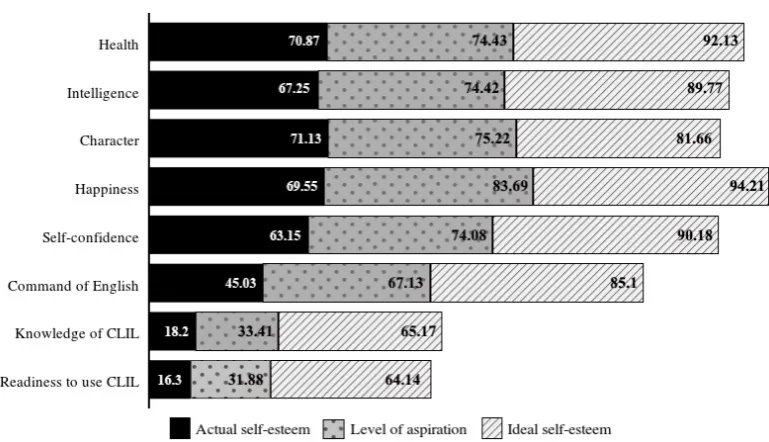
Figure 2: Results of the first self-esteem research (in points, from 1 to 100). The mean scores show that the height of the actual self-esteem of the research partici-pants corresponds to the normal (adequate) level on such scales as “intelligence” (67.25 points out of 100), “happiness” (69.55) and “self-confidence” (63.15). The results for “health” (70.87) and “character” (71.13) correspond to the high level of self-esteem, while the scores for “com -mand of the English language” (45.03), “knowledge of CLIL” (18.2), and “readiness to use CLIL” (16.3) indicate low self-esteem (in case with the latter two – extremely low).
Mean scores for the height of the ideal self-esteem range from 64.14 (“readiness to use CLIL”) to 94.21 (“happiness”). As with the actual self-esteem, the distribution of results is uneven: in spite of the fact that the fluctuation range for the first six scales is roughly 10 points (from 81.66 to 94.21), the scores on the seventh and the eighth scales are significantly lower (65.17 and 64.14 respectively).
The same trend is observed with the level of aspiration. The mean scores for the last two parameters (“knowledge of CLIL” and “readiness to use CLIL”), 33.41 and 31.88 points respectively, are in the range corresponding to a low self-esteem.
The last two indicators directly related to self-esteem were the intervals of achievable and unachievable. The level of participants' optimism for each of the assessed parameters was measured by comparing these two values.
Table 1. The intervals of achievable and unachievable after the first survey (in
points).
Health Intel-ligence Character Happi-ness Self-con-fidence Com-mand of
English
Knowl-edge of
CLIL
Readi
-ness to use CLIL
The interval of
achievable 3.56 7.17 4.09 14.14 10.93 22.1 15.21 15.58
The interval of
Vol. 76, No. 2, 2018
149 As can be seen from Table 1, for the last two parameters under consideration, the interval of unachievable was twice as high as the interval of achievable, which indicated a low level of optimism in these areas.
Overall, the results of the first research of participants' self-esteem showed that “knowl -edge of CLIL” and “readiness to use CLIL” were the areas where the research participants were least confident and had low levels of optimism.
As for results of the motivation research, the mean score for the entire sample amounted to 4.41 with the standard deviation of 3.2. The data obtained indicate a predominance of ex -trinsic motivation over in-trinsic at the initial stage of the course. The indicator of the in-trinsic motivation development is within the range corresponding to a low level (from 0 to 5 points).
To sum up, the results of the first survey conducted prior to the beginning of the Fun -damentals of Content and Language Integrated Learning course revealed a high level of state anxiety in the majority of participants, an extremely low self-esteem in terms of the knowledge of CLIL and one's own readiness to use it. The levels of aspiration and ideal self-esteem for these parameters were also the lowest. In addition, a pronounced predominance of the extrinsic learning motivation was recorded.
The Second Survey Results
The second survey aimed at identifying the levels of participants' trait and state anxiety was held at the end of the course. The mean scores were 45.32 and 39.78 respectively. Figure 3 shows the percentage of Master's degree students with high, medium (moderate) and low levels for each of the two types of anxiety.
Figure 3: Results of the second anxiety levels research (in % of the total number
of participants).
This repeat survey revealed that the levels of trait anxiety in general remained the same. The results were distributed as follows: high anxiety – 50.85% of respondents, moderate anxi -ety – 42.37%, and low anxi-ety – 6.78%
Vol. 76, No. 2, 2018
150 from 59.32% to 42.37%. Due to this, as well as a slight decrease in the number of students with low anxiety (from 10.17% to 6.78%), the percentage of respondents with moderate (optimal) level of state anxiety increased (from 30.51% to 50.85%).
The results of the end-of-course research of participants' self-esteem are shown in Figure 4.
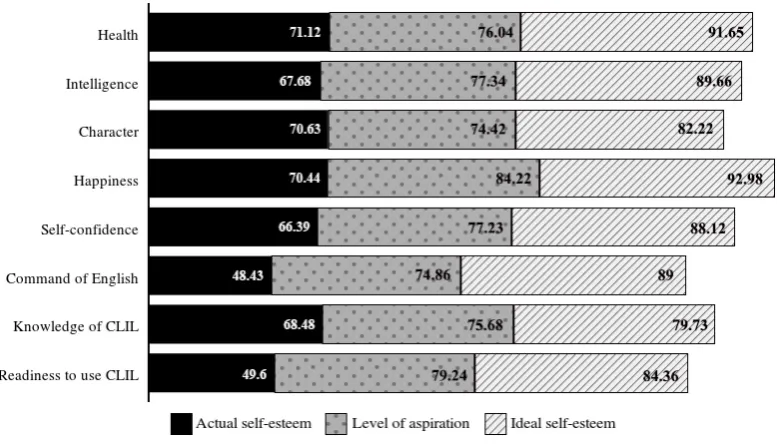
Figure 4: Results of the second self-esteem research (in points, from 1 to 100). The results for the actual self-esteem show that no significant changes (1 point or more) were identified regarding the first four scales compared to the first survey. The mean score for “self-confidence” increased by 3.24 points (from 63.15 to 66.39). The result for “command of the English language” went up by 3.4 points (from 45.03 to 48.43). The most significant growth can be observed on the last two scales. The mean score for “knowledge of CLIL” increased roughly by four times (from 18.2 to 68.48), and the results for “readiness to use CLIL” were approximately three times as high as they were at the time of the first survey (49.6 and 16.3 points, respectively).
As for the height of the ideal self-esteem, significant changes in comparison with the first research can be observed only regarding the last two scales. The mean score for “knowledge of CLIL” was 79.73 points, and 84.36 points for “readiness to use CLIL”. Compared with the results of the first research, the difference was 14.56 and 20.22 points respectively.
Vol. 76, No. 2, 2018
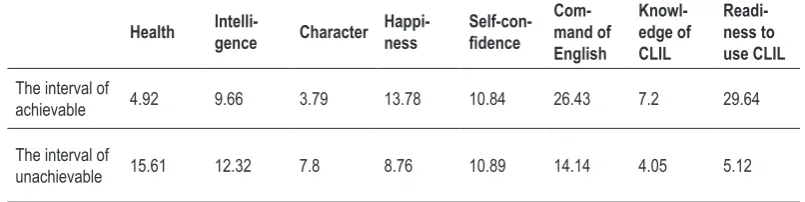
151 To identify how students' optimism level has changed since the time of the first survey, let us once again look at the intervals of achievable and unachievable (see Table 2).
Table 2. The intervals of achievable and unachievable after the second survey
(in points).
Health Intelli-gence Character Happi-ness Self-con-fidence Com-mand of
English
Knowl-edge of
CLIL
Readi
-ness to use CLIL
The interval of
achievable 4.92 9.66 3.79 13.78 10.84 26.43 7.2 29.64
The interval of
unachievable 15.61 12.32 7.8 8.76 10.89 14.14 4.05 5.12
In comparison with the results of the first research, two important differences can be noted. First of all, the level of optimism regarding the possibility of mastering the English language has significantly increased. The results of the second survey showed that the interval of achievable is almost twice the interval of unachievable, whereas the first survey showed an approximate equality of these values. Secondly, there was a dramatic growth in the level of optimism regarding the readiness to use CLIL in teaching. At the time of the first survey, the interval of achievable was two times lower than the interval of unachievable. Now it is almost six times higher, and this is one of the most important course results.
As for the results regarding motivation, the mean score for the entire sample of the research was 13.05 with the standard deviation of 2.9. Thus, the results of the second survey showed a predominance of intrinsic (rather than extrinsic) motivation. The indicator of the in -trinsic motivation development was within the range corresponding to the medium level (from 6 to 14 points).
Vol. 76, No. 2, 2018
152 Table 3. Results of the paired-sample Student’s t-test.
Parameter Mean score from survey 1 Mean score from survey 2 Calculated t-value Critical t-value for p ≤ .01
Null hypothesis can be rejected
Anxiety
Trait anxiety 45.49 45.32 0.4 2.66 no
State anxiety 46.54 39.78 4.4 2.66 yes
Self-esteem: actual self-esteem
Health 70.87 71.12 0.3 2.66 no
Intelligence 67.25 67.68 0.4 2.66 no
Character 71.13 70.63 0.7 2.66 no
Happiness 69.55 70.44 0.6 2.66 no
Self-confidence 63.15 66.39 4.4 2.66 yes
Command of English 45.03 48.43 2.1 2.66 no
Knowledge of CLIL 18.2 68.48 47.1 2.66 yes
Readiness to use CLIL 16.3 49.6 25.2 2.66 yes
Self-esteem: level of aspiration
Health 74.43 76.04 2.3 2.66 no
Intelligence 74.42 77.34 1.6 2.66 no
Character 75.22 74.42 1.4 2.66 no
Happiness 83.69 84.22 0.1 2.66 no
Self-confidence 74.08 77.23 2 2.66 no
Command of English 67.13 74.86 5.4 2.66 yes
Knowledge of CLIL 33.41 75.68 25.5 2.66 yes
Readiness to use CLIL 31.88 79.24 28.7 2.66 yes
Self-esteem: ideal self-esteem
Health 92.13 91.65 1.3 2.66 no
Intelligence 89.77 89.66 0.7 2.66 no
Character 81.66 82.22 1.3 2.66 no
Happiness 94.21 92.98 4.1 2.66 yes
Self-confidence 90.18 88.12 4.2 2.66 yes
Command of English 85.1 89 7 2.66 yes
Knowledge of CLIL 65.17 79.73 14.1 2.66 yes
Readiness to use CLIL 64.14 84.36 28.6 2.66 yes
Motivation
Intrinsic motivation devel
Vol. 76, No. 2, 2018
153 Overall, the second survey results showed that there was a significant reduction in the level of state anxiety, a considerable growth in the level of self-esteem in terms of the knowl -edge of CLIL and readiness to use it, and a clear shift from extrinsic towards intrinsic motiva -tion of learning about CLIL.
Discussion
As has been shown above, the results of the first research of the affective component of participants' attitudes towards CLIL indicate a predominance of high level of anxiety, low self-esteem and extrinsic motivation.
The anxiety levels research results showed that at that stage, even thoughts of getting familiar with CLIL caused discomfort and anxiety in many participants of the research. Ac -cording to Johnson (2012), this is typical for the initial phase of CLIL training: teachers with no prior knowledge and/or experience in CLIL tend to hold beliefs that teaching and learning pro -cess will be automatically more difficult in a second language. This is especially true for teach -ers adhering to the traditional “banking model” (Freire, 1972) of teaching and learning where knowledge is transmitted from the expert (the teacher) into the memory bank of the novice (the learner). If the teacher is the main source of information in the classroom, insufficient command of the language of instruction on his or her behalf becomes a real barrier to the learning process effectiveness. This is in line with the findings of the present research: as the first survey showed, the participants' perceived command of English was poor and they were likely to adhere to the traditional views of the teacher's role as they were not familiar with the pedagogical theories underpinning CLIL. Therefore, these potential language-related problems might have been the cause of high levels of state anxiety.
The results regarding participants' self-esteem revealed their perceived inability to use CLIL, and also showed that they did not believe in achieving success in this field in the future and did not aspire to it. This is important because self-evaluation of one's own abilities is di-rectly linked with self-efficacy (Bandura, 1986). Jooaan Alblooshi (2017) conducted a research in a similar context (where teachers had no prior training in CLIL, poor command over using English as the medium of instruction, and there was a conflict between pedagogical theories held by teachers and those underpinning CLIL) and obtained a similar result: a conclusion was made that the majority of the teachers exhibited low self-efficacy and, therefore, lack of control over the changes wrought by CLIL implementation. Thus, unresolved concerns about the use of CLIL and absence of prior training in this field might lead to low self-evaluation of one’s own readiness to use CLIL. This is especially true at early stages of CLIL introduction (see, for example, Pena Díaz & Porto Requejo, 2008).
The results of the motivation research were rather surprising as they showed the pre-dominance of extrinsic motivation of learning about CLIL and a low level of intrinsic motiva -tion development. This means that the need to master the content of the course was perceived by the Master's degree students as imposed from the outside, not as meaningful and significant for them personally, even though it was their decision to take the course. Similar studies, where participants volunteered to take a certain course or undergo specific training in CLIL, usually do not report any problems with motivation whatsoever (see, for example, Johnson 2012). The obtained results might be explained by the specificity of the context. The initiative to start us -ing English in the system of education in Kazakhstan comes from the government, so teachers might feel pressurized to comply with the new demands of the state. They might feel that with-out being able to teach in English, it would be difficult for them to continue working as teachers. Overall, judging by the condition of the affective component of participants' attitudes, it can be inferred that at the beginning of the course, strong negative attitudes towards CLIL were prevailing.
Vol. 76, No. 2, 2018
154 First of all, there was a significant reduction in the level of state anxiety: the majority of participants of the research had a moderate (optimal) level of anxiety, whereas the first sur -vey showed clear predominance of high anxiety. This can be explained by the fact that most of the knowledge gained within this course is based on the participants' personal experience obtained as a result of independent research of literature, joint discussions and practical use of CLIL. Genuine interiorization leads to the fact that new information begins to be perceived by the person as an integral part of his or her own inner world. Therefore, the situations when he or she has to deal with such information are no longer perceived as potentially threatening or uncomfortable.
It is also worth mentioning that the nature of teacher-student relationship in CLIL is cooperation, not strict subordination, which is also beneficial for students' well-being in the classroom and may lead to a reduction in anxiety levels. As Papaja (2012) points out, positive relationship between the teacher and the students leads to positive attitude towards subjects be-ing taught in a foreign language.
Secondly, there was a considerable growth in the level of their self-esteem in terms of the readiness to use CLIL. It applies to all the three aspects: the actual and ideal self-esteem, as well as the level of aspiration. This can be explained by the practice-oriented nature of the course and high involvement of the research participants in the learning process. It was the students who formulated the goals and achieved them in each lecture and gained their own practical ex -perience of working with CLIL in each practical class. Undoubtedly, all this contributed to the growth of self-confidence and self-esteem. Aguilar (2015), who studied engineering lecturers' views on CLIL, arrived at a similar conclusion: “after the first experience, their confidence... had boosted in ways they had never thought before”.
The results also show that the participants seem to have overcome the misconception that only a teacher with an advanced level of English can start teaching in this language using CLIL: in comparison with the first survey, their actual self-esteem of English proficiency changed only by a few percent, whereas the readiness to use CLIL grew by several times.
Nevertheless, the participants still assess their current readiness to work with CLIL low-er than the knowledge of the theoretical foundations of this approach. Thus, despite a rathlow-er high level of the cognitive component (knowledge of the CLIL fundamentals) development, problems at the level of the affective component (the aforementioned high level of anxiety, as a result of which CLIL is still perceived by many as a stressful, psychologically threatening scenario) make it difficult to develop the behavioral component, which is why self-assessment of one's own readiness to work with CLIL is still somewhere between the low and moderate levels. However, it should also be noted that the level of aspiration and the height of the ideal self-esteem for the readiness to use CLIL in practice noticeably exceed similar values for the knowledge of CLIL, which was not the case with the results of the first research. This increased focus on practical results may indicate the participants' willingness to continue working in this area and use CLIL in their everyday work.
As for the participants' levels of optimism, the interval of achievable now significantly exceeds the interval of unachievable for “command of English”. The growth of optimism in this area might be explained by better understanding of the foundations of CLIL: the students have experienced a fundamentally different, more effective approach to language teaching and learning based not on memorizing isolated lexical units and grammatical constructions, but on using new language material for communication-based activities in the context of specific sub -jects. A significant growth in optimism regarding the readiness to use CLIL shows that, despite the fact that the current self-evaluation of that parameter is still at a low level, the participants have gained greater confidence that they will succeed if they continue working in this direction.
Vol. 76, No. 2, 2018
155 was replaced by intrinsic motivation. The objectives of the course began to be perceived by many of the research participants as coinciding with their personal goals. Having learned about CLIL and received some personal experience, students could see its advantages and, therefore, were more motivated to continue their development in this field. This is in line with Vilkanciene & Rozgiene (2017), who reported on results of the Development of Content and Language In-tegrated Learning (CLIL) in Education project in Lithuania. They emphasized that, as a result of the training received, “teachers see CLIL as beneficial, both for them and their students”.
It should be noted, however, that the number of students with high levels of anxiety, low self-esteem and extrinsic motivation still remained high. This can be explained by the length and intensity of exposure to CLIL. The research participants studied only one course within one semester. Johnson (2012), who reported on the research that lasted two and a half years, argued that “a change in attitudes and beliefs is unlikely to occur in the short term... more extended timeframe was deemed necessary in order to produce observable changes of worth”.
Nevertheless, there are reasons to argue that the Fundamentals of Content and Language Integrated Learning course has contributed to the development of more positive attitudes to-wards the use of CLIL among the Master's degree students who took part in the research. The cognitive component of the attitude includes a stock of knowledge about CLIL. The affective component, on which the present research was focused, plays a decisive role in many respects, because it gives the acquired knowledge a certain emotional coloring, affects perception that determines the behavioral component, that is, specific actions, the behavior of the teacher when working with CLIL. This dependence of the behavioral component on the affective component makes it possible to suggest that the participants of this research will be able to successfully use CLIL to teach their disciplines in English in the future.
This shift in attitudes towards CLIL was achieved owing to the use of the constructiv-ist approach to teaching and learning within the course. The participants did not just passively “receive” new information the way they usually do in other courses. They constructed their own understanding of CLIL, gained new ideas through their own practical experience, shared views and opinions with their peers. Since people's attitudes and beliefs are strongly influenced by personal experience, such personalized learning led to what Coyle, Hood & Marsh (2010) called a shift from a “fixed mode” (where learners believe they can do nothing to alter their capabilities) to a “developmental mode” (where the belief is that they can work towards self-improvement). Thus, even such a relatively short exposure to CLIL can cause changes in learn -ers' beliefs and attitudes provided that they are given a chance to build their own vision of what CLIL is and experiment with it in a safe and supporting environment.
This leads to a wider issue that is very important for the context under consideration: making teaching and learning more person-centered. This “person-centeredness” in education is often understood as applying to the learners only. However, it is also extremely important to view the teacher not as a faceless element of “pedagogical technology”, but as a person with his or her own feelings, emotions, concerns and, therefore, attitudes towards what surrounds him or her. Success of any innovation in education to a large extent depends on the teachers, as they are the ones who are responsible for its implementation. The attitudes they hold towards this innovation can exert a significant impact on the outcomes. As Stoller (2009, as cited in Jooaan Alblooshi, 2017, p. 132) notes, “when teachers have favorable attitude toward an innovation, they are likely to be supportive of implementation efforts” whereas “if teachers are reticent about the innovation, they are likely to exhibit resistance to implementation”. Therefore, if the use of CLIL is to become a mainstream practice, more attention should be paid to what attitudes are held by the teachers towards this approach.
Conclusions
Vol. 76, No. 2, 2018
156 decrease in anxiety levels, a substantial growth in self-esteem, and a marked change in motiva -tion. This relatively short course introduced students to CLIL only at the level of general foun-dations, and it is difficult to call such training exhaustive. Nevertheless, due to the fact that the use of CLIL no longer causes anxiety and is perceived as achievable and personally significant, it is very likely that the participants of the research will continue their independent professional development in this field, seek and successfully find solutions to emerging problems and make CLIL an integral part of their daily teaching practice.
Thus, effective training of educators for teaching in English in general and with the use of CLIL in particular should include work aimed at the development of all components of a positive attitude, and not just the cognitive one. It is not enough simply to provide learners with certain information. CLIL will be truly accepted only by those who manage to develop a posi-tive attitude to this approach, having overcome the so-called “affecposi-tive filter”. As the present research showed, the use of the main principles of constructivism as the basis for teaching and learning can make a significant contribution towards achieving that goal.
It is important to note some limitations of the present research. The first of these consists in a small size of the sample covering only one institution. The second limitation is that the monitoring of the behavioral component of the attitude was carried out only during the “micro-teaching” sessions. Obviously, more observations of how the participants use CLIL in practice are needed to be able to make final conclusions regarding the quality of their attitudes. Finally, the third limitation is due to the stability of the attitude. Changing it requires not only an in-tensive impact of new experience, but also time. 1 discipline taught during 1 semester cannot cause radical changes, which was clearly demonstrated by the present research results: although the students with a high level of anxiety, low self-esteem and prevailing external motivation of learning are no longer the largest group, their number still remains significant.
Nevertheless, despite existing limitations, this research makes its contribution to the development of CLIL research in the context under consideration. Ever since it was officially declared that the English language will soon gain a new status in the system of education in Ka-zakhstan, CLIL has become a topic of interest for many researchers in this country. However, to the best of the authors’ knowledge, there is still no research available on how positive attitudes towards CLIL implementation can be developed among teachers in Kazakhstan with emphasis on the affective component of these attitudes. New, more extensive research in this field might help make the process of CLIL introduction smoother and easier for teachers.
However, the prospects for further research also include going beyond the use of CLIL. The very idea of the learning process built on the basis of the constructivist paradigm with spe-cial attention to subjective perception and personal experience can be applied on a wider scale. A careful research of the ideas of the philosophy of constructivism in education, their adapta-tion to the condiadapta-tions of life of modern Kazakh society, and the development of specific educa -tional programs on their basis can make the education system more person-centered, which will be beneficial for both teachers and learners. This will certainly require much time and effort but the use of CLIL, the philosophical basis of which is the ideas of constructivism, can be the first step in this direction.
References
Aguilar, M. (2015). Engineering lecturers’ views on CLIL and EMI. International Journal of Bilingual Education and Bilingualism, 20 (6), 722-735.
Aliaga, M., & Gunderson, B. (2002). Interactive statistics. Thousand Oaks: Sage.
Bandura, A. (1986). Socialfoundations of thought and action: A social cognitive theory. Prentice-Hall, Inc.
Breckler, S. J., & Wiggins, E. C. (1992). On defining attitude and attitude theory: Once more with feeling. In A. R. Pratkanis, S. J. Breckler, & A. G. Greenwald (Eds.), Attitude structure and function (pp. 407–427). Hillsdale, NJ: Erlbaum.
Vol. 76, No. 2, 2018
157 Cattell, R. B., & Scheier, I. H. (1961). The meaning and measurement of neuroticism and anxiety. New
York: Ronald Press.
Coyle, D., Hood, P., & Marsh, D. (2010). Content and language integrated learning. Cambridge: Cam-bridge University Press
Dontsov, A. S. (2016). Measuring students' abilities to research academic subjects taught in English at postgraduate level in the Republic of Kazakhstan. Level 3, 14. Retrieved September 10, 2017, from http://level3.dit.ie/html/Issue14/Dontsov/dontsov.pdf.
Dörneyi, Z. (1990). Conceptualizing motivation in foreign language learning. Language Learning, 40, 45-78.
Dörneyi, Z. (2001). Teaching and researching motivation. Harlow, England: Longman.
Dubovitskaya, T. D. (2002). Metodika diagnostiki napravlennosti uchebnoy motivatsii [A method for di-agnostics of orientation of learning motivation]. Psychological Science and Education, 2, 42-45. Freire, P. (1972). Pedagogy of the oppressed. New York: Herder and Herder.
Gardner, R. C. (1985). Social psychology and second language learning: The Role of Attitudes and Mo-tivation. London, England: Edward Arnold.
Guskey, T. R. (2002). Professional development and teacher change.Teachers and Teaching, 8 (3), 381-391.
Heckhausen, H. (1991). Motivation and action. New York, NY: Springer.
Howe, L. C., & Krosnick, J. A. (2017). Attitude strength. Annual Review of Psychology, 68, 327-351. Ilyin, E. P. (2011). Motivatsiya i motivy [Motivation and motives]. St. Petersburg: Piter.
Johnson, M. (2012). Bilingual degree teacher's beliefs: A case study in a tertiary setting.Pulso Revista de Educación, 35, 49-74.
Jooaan Alblooshi, A. (2017). Teachers’ and students’ understandings of and attitudes towards the policy of content and language integrated learning (CLIL) in the United Arab Emirates (UAE). Thesis (Doctor of Philosophy (PhD)). University of Bath.
Krashen, S. D. (1981). Second language acquisition and second language learning. Oxford University Press.
McDougald, J. (2015). Teachers' attitudes, perceptions and experiences in CLIL: A look at content and language. Colombian Applied Linguistics Journal, 17 (1), 25-41.
McLeod, S. A. (2014). Attitudes and behavior. Retrieved September 10, 2017, from www.simplypsychol-ogy.org/attitudes.html.
National Academy of Education named after I. Altynsarin (2016). Sostoyaniye trekhyazychnogo obra-zovaniya v Kazakhstane. Analiticheskaya spravka [Current state of trilingual education in Ka-zakhstan. Analytical report]. Astana: National Academy of Education named after I. Altynsarin. Nazarbayev, N. A. (2015). Plan natsii – 100 shagov po realizatsii pyati institutsionalnykh reform
[Na-tion's plan “100 steps towards the implementation of 5 institutional reforms”]. Kazakhstanskaya Pravda, 92 (27968).
Pajares, M. F. (1992). Teachers' beliefs and educational research: Cleaning up a messy construct. Review of Educational Research, 62 (3), 307-332.
Papaja, K. L. (2012). The impact of students' attitudes on CLIL. Latin American Journal of Content & Language Integrated Learning, 5 (2), 28-56.
Pena Díaz, C., & Porto Requejo, M. D. (2008). Teacher beliefs in a CLIL education project.Porta Lin-guarum, 10, 151-161.
Piaget, J. (1955). The child's construction of reality. London: Routledge & Kegan Paul Limited. Spielberger, C. D., Gorsuch, R. L., Lushene, R., Vagg, P. R., & Jacobs, G. A. (1983). Manual for the
state-trait anxiety inventory. Palo Alto, CA: Consulting Psychologists Press.
Spielberger, C. D., & Sydeman, S. J. (1994). State-trait anxiety inventory and state-trait anger expression inventory. In M. E. Maruish (Ed.), The use of psychological testing for treatment planning and outcome assessment (pp. 292-321). Hillsdale, NJ: Lawrence Erlbaum Associates.
Vaughan, G., & Hogg, M. A. (2005). Introduction to social psychology. Sydney: Pearson Education Aus-tralia.
Vilkancienė, L., & Rozgienė, I. (2017). CLIL teacher competences and attitudes. Sustainable Multilin-gualism, 11 (1), 196-218.
Vygotsky, L. S. (2005). Psikhologiya razvitiya cheloveka [Psychology of human development]. Moscow: Smysl; Eksmo.
Vol. 76, No. 2, 2018
158
Received: February 07, 2018 Accepted: April 08, 2018
Artyom Sergeyevich Dontsov MSc., Reseacher, S. Toraighyrov Pavlodar State University, 140008, 64 Lomov Street, Pavlodar, Republic of Kazakhstan.
Elena Ivanovna Burdina PhD, DSc., Professor, S. Toraighyrov Pavlodar State University, 140008, 64 Lomov Street, Pavlodar, Republic of Kazakhstan.