Volume-5 Issue-1
International Journal of Intellectual Advancements
and Research in Engineering Computations
ISSN:2348-2079
Abstract: Study the effect of using commercial red iron oxides as concrete admixtures in percentage do not exceed 2.5% of each oxide from the amount of cement. This study tested the effect of every portion from the each oxide at different ages on the compressive strength as well as the workability represented as values of slump. We conclude that the optimum portion of RIO 2.5% is coloring material & mineral admixture, through the compressive strength increased as 5.5-12.8%. Iron oxide classified as coloring materials admixture in addition it improves some mechanical properties. Partial replacement of cement (up to 40%)with GGBS admixtures to improve high strength of concrete and 2.5% replacement of iron oxide to improve the workability and increase the slump & coloring of concrete. The river sand with full replacement (100%) of M-sand. The GGBS admixtures using different level of concrete is 25%,30%,35%,40%.The iron oxide admixtures using different level of concrete is 1%,1.5%,2%,2.5%. The maximum strength of concrete is by 40% of GGBS & 2.5% of iron oxide replacement of concrete.
Key words: GGBS, RIO, M-Sand, compressive strength, slump, colour concrete
I. INTRODUCTION
Concrete is heterogeneous mix of cement, aggregates and water. The global consumption of natural sand is too high due to its extensive use in concrete. The demand for natural sand is quite high in developing countries owing to repaid infrastructural growth which results supply scarcity. To overcome from this crisis, partial replacement of natural sand with quarry sand is economic alternative. The concrete industry is constantly looking for supplementary cementations material with the objective of reducing the solid waste disposal problem.
Ground granulated blast furnace slag (GGBS) among the solid waste generated by industry. Substantial energy and cost savings can results when industrial by-products are used as partial replacements for the energy –intensive Portland cement. Hematite ranges in color from a reddish-brown to gray and even black. The most widely available forms are the result of weathering iron bearing
minerals. Hematite often occurs with intermixed layers of quartz. Named from the Greek word for blood, hematite often coats igneous and sedimentary rocks with a reddish color similar to rust, a form of hydrated iron oxide. The hardness value of Hematite is 5.5to6.5. The astrological signs of Aries and Aquarius are represented by Hematite. Hematite was used for thousands of years as amulets and talismans and was used by Egyptians in religious ceremonies. Some believe hematite enhances physical energy and vitality. It‟s believed to calm emotions and boost self-esteem. It is also said to enhance memory and intellect. GGBS cement can be added to concrete in the concrete manufacturer's batching plant, along with Portland cement, aggregates and water. The normal ratios of aggregates and water to cementitious material in the mix remain unchanged. GGBS is used as a direct replacement for Portland cement, on a one-to-one basis by weight. Replacement levels for GGBS vary from 30% to up to 85%. Typically 40 to 50% is used in most instances. Some say it helps with mental clarity and concentration and it‟s sometimes used for help when studying.
ACE 30 is an innovative second generation of polycarboxylic ether polymers superplasticiser. The particular molecular configuration of BASF – (ACE 30) accelerates the cement hydration. Rapid adsorption of the molecule onto the cement particles, combined with an efficient dispersion effect, exposes increased surface of the cement grains to react with water.
As a result of this effect, it is possible to obtain earlier development of the heat of hydration, rapid development of the hydration products and, as a consequence, higher strengths at very early age. The super plasticizer adding on the concrete reduce the water content level & increase the strength of concrete.
In this research we prepared specimen of cubes for compressive strength tests cylinder for split tensile strength tests, beams for flexure strength test and permeable voids test. Three samples for each set of percentage have been taken for conducting test and average of results taken. The samples were tested at the age of 7days and 14days and 28days.
The effects on properties of concrete using red iron oxide & ggbs as
partial replacement for cement
T. Savitha1, N.Dhivyabharathi2, P.Radhika3, K.Selvi4
1,2,3,4
UG student, Department of Civil Engineering, Nandha Engineering college, Perundurai.
4
II. EXPERIMENTAL INVESTIGATION
Properties of Material
1. Cement
2. Ground-granulated blast-furnace slag (GGBS) 3. Red Iron oxide(RIO)
4. Fine aggregate (M-sand) 5. Coarse aggregate 6. Water
7. Super plasticizer
Cement
Ordinary Portland Cement (OPC) is one of the most popular building materials used all across the globe. There is a fascinating story behind the naming of this widely used cement product. The name „Portland‟ was given by the British cement manufacturer, Joseph Aspdin in 1824, due to its strong resemblance to Portland Stone, a type of white grey limestone found in the isle of Portland, Dorset in England. Joseph Aspdin is also credited to have patented the first true artificial cement, which he named as the Portland cement.While the chief chemical constituents of ordinary Portland Cement (OPC) are Calcium, Silica, Alumina and Iron, cement manufacturers continuously research and make efforts to further strength and improve the quality and other features of this particular type of cement.we offer the 53 Grade OPC Cement which gives even higher cement strength to match the rising demands of higher strength building material in the urban world. Property of cement details given below the table 2.1.1:
S.NO TEST VALUE
1 Specific Gravity 3.15
2 Bulk density 1330 kg/m3
3 Normal Consistency 34%
4 Initial Setting Time 30 Min
5 Final Setting Time 10 Hrs
GGBS: (Ground-granulated blast-furnace slag)
To obtain a good slag reactivity or hydraulicity, the slag melt needs to be rapidly cooled or quenched below 800 °C in order to prevent the crystallization of merwinite and melilite. To cool and fragment the slag a granulation process can be applied in which molten slag is subjected to jet streams of water or air under pressure. Alternatively, in the pelletization process the liquid slag is partially cooled with water and subsequently projected into the air by a rotating drum.
GGBS cement can be added to concrete in the concrete manufacturer's batching plant, along with Portland cement, aggregates and water. The normal ratios of aggregates and water to cementitious material in the mix remain unchanged. GGBS is used as a direct replacement for Portland cement, on a one-to-one basis by weight. Replacement levels for GGBS vary from 30% to up to 85%. Typically 40 to 50% is used in most instances. Property of cement details given below the table2.2.1:
S.NO TEST VALUE
1 Specific Gravity 2.90
2 Bulk Density 1290 kg/m3
3 Initial Setting Time 2-10 min
4 Fines Modulus 3.36
5 Final Setting Time 3-15 min
GGBS:
(Ground-granulated blast-furnace slag)
RIO: (Red Iron Oxide)
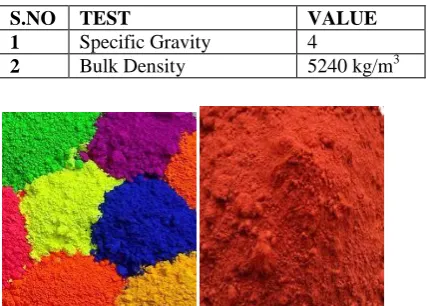
Hematite is an important ore of iron and it's blood red color (in the powdered form) lends itself well in use as a pigment. Hematite gets its name from a Greek word meaning blood-like because of the color of its powder. Ancient superstition held that large deposits of hematite formed from battles that were fought and the subsequent blood that flowed into the ground. Hematite is the most important source of iron ore in the world. The production of iron has been important to nations of the world for over 2500 years. Today the addition of other minerals to iron has lead to the production of steel which is vital to the economy of the major countries on Earth. Hematite has a red or black colour but the streak is always red. Property of cement details given below the table 2.3.1:
S.NO TEST VALUE
1 Specific Gravity 4
2 Bulk Density 5240 kg/m3
Fig 2.3.1 various colorFig2.3.2 RIO2.4 M-Sand (Manufactured Sand)
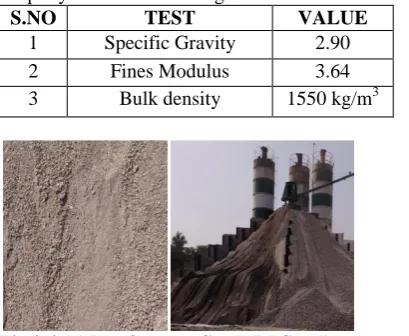
However the intense construction activity is resulting in growing shortage and price increase of the natural sand in the country in addition the aggregate and concrete industry are presently facing a growing public awareness related to environmental threats. Therefore, looking for a viable alternative for natural sand is a must. One alternative used as replacement is the use of M sand. Property of cement details given below the table 2.4.1:
S.NO TEST VALUE
1 Specific Gravity 2.90
2 Fines Modulus 3.64
3 Bulk density 1550 kg/m3
Fig 2.4.1 Manufacture- Sand (M-Sand)
2.5CoarseAggregate (20mm&12.5mm aggregate)
It is the aggregate most of which is retained on 4.75 mm IS sieve and contains only so much finer material as is permitted by specification. According to source, coarse aggregate may be described as:
Uncrushed Gravel or Stone– it results from
natural disintegration of rock
Crushed Gravel or Stone– it results from
crushing of gravel or hard stone.
Partially Crushed Gravel or Stone– it is a
product of the blending of the above two aggregate.
According to size coarse aggregate is described as graded aggregate of its nominal size i.e. 40 mm, 20 mm, 16 mm and 12.5 mm etc. for example a graded aggregate of nominal size 20 mm means an aggregate most of which passes 20 mm IS sieve. A coarse aggregate which has the sizes of particles mainly belonging to a single sieve size is known as single size aggregate. For example 20 mm single size aggregate mean an aggregate most of which passes 20 mm IS sieve and its major portion is retained on 10 mm IS sieve.
12.5mm size of aggregate:
Aggregates of this fraction are mainly used in road concrete mixes. This size provides the most adhesion in the mixture, which subsequently makes the most solid type of concrete and also provides surface evenness of concrete blocks. This minimizes the preparation of walls, floors and ceilings of buildings for the final stage of treatment - putting up wallpaper, laying tiles, etc. This given fraction is the most used, percentage wise, in all construction work. This given aggregates fraction is in the most demand in road construction. Property of cement details given below the table:
20mm size of aggregate:
It is used for road construction as a lower layer beneath the asphalt surface. Currently this fraction is the most commonly used in Ukraine's construction industry. It is used both for small private construction and for construction of large industrial spaces. Aggregates of this
fraction are used as sub-bases in construction of highways and railways and in production of concrete and massive structures from reinforced concrete. Property of cement details given below the table 2.5.1:
S.NO TEST SIZE OF
AGGERGATE
20 mm 12.5
mm
1 Specific Gravity 2.95 2.9
2 Crushing value 60% 50%
3 Impact value 14% 12%
4 Water absorption 0.50% 0.50%
Fig2.5.1 (20mm Aggregate & 12.5mm Aggregate) 2.6 WATER:
Water is an important ingredient of concrete as it actually participates in the chemical reaction with cement. Since it helps to form the strength giving cement gel, the quantity and quality of water are required to be looked into very carefully.
Super Plasticizer [BASF (ACE-30)]:
Achieve high early strengths.
Optimise curing cycles by reducing curing time
or curing temperatures.
Eliminate heat curing.
Increase productivity/ reduction in cycle time.
Improve surface appearance.
Produce durable precast concrete elements.
Improved engineering properties, compared to traditional superplasticiser such as early and ultimate compressive and flexural strengths, reduced shrinkage and low permeability.
III MIX PROPORTION
General:
Mix design is the process of selecting suitable ingredients of the concrete and determining their relative proportion with object of producing concrete possessing certain minimum desirable properties like workability in fresh state minimum desirable and durability in hardened state.
Design mix based on 10262-2009 method: Target Mean Strength:
fck = fck +1.65*s
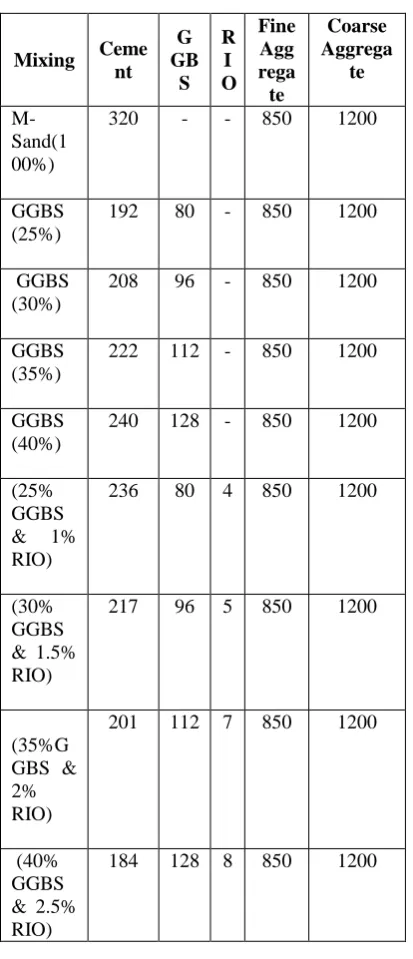
Table 3.1 Mix Proportion For Trial Number:
Material Weight(kg) Volume(m3)
Cement 320 kg/ m3 0.101 m3
Water 148 kg/ m3 0.148 m3
fine aggregate 850 kg/ m3 0.336 m3
coarse aggregate 1200 kg/ m3 0.411 m3
Chemical Admixture
0.4 kg/ m3 0.003 m3
Table 3.2 Mix composition of partial replacement of concrete:
Mixing Ceme
nt G GB
S R
I O
Fine Agg rega te
Coarse Aggrega
te
M-Sand(1 00%)
320 - - 850 1200
GGBS (25%)
192 80 - 850 1200
GGBS (30%)
208 96 - 850 1200
GGBS (35%)
222 112 - 850 1200
GGBS (40%)
240 128 - 850 1200
(25% GGBS & 1% RIO)
236 80 4 850 1200
(30% GGBS & 1.5% RIO)
217 96 5 850 1200
(35%G GBS & 2% RIO)
201 112 7 850 1200
(40% GGBS & 2.5% RIO)
184 128 8 850 1200
IV RESULT AND DISCUSSION
Test on Fresh Concrete
1. Slump cone test 2. Compaction factor test Slump cone test
Mix 1 : M-Sand = 85mm Mix 2: GGBS(40%) = 92mm
Mix3:GGBS(40%)&IronOxide(2.5%) = 95mm 2.Compaction factor test
Mix 1 : M-Sand = 0.78 Mix 2: GGBS(40%) = 0.82
Mix 3: GGBS(40%) & RIO(2.5%) = 0.89
Test on Hardened Concrete
1. Compressive strength test 2. Split tensile strength test 3. Flexural strength test
1. Compressive strength test
One of the important properties of concrete is strength in compression. The strength in compression has definite relationship with all other properties of concrete. These properties are improved with the improvement in compression strength.
The aim of the experiment test is to determine the maximum load carrying capacity of test specimens. The compression test specimens were tested on a compression tested on a compression testing machine (CTM) of capacity 2000KN.The specimen was placed on machine in such a way that its position is at right angle to it shown position which it had at the time of casting. Load is applied gradually as the rate 14N/mm2/min or 320KN/min. Test results given below the table:
Table 1.1 Compressive Strength at 7, 14 and 28 Days
Typeof Concrete
Compressive
Srtength(N/mm2)
7 Days
14 Days
28 Days
M-Sand 16 18 24
GGBS(25%) 20 22 24
GGBS(30%) 22 24 26
GGBS(35%) 24 26 28
GGBS(40%) 26 28 30
GGBS(25%)&RIO(1%) 24 26 30
GGBS(30%)&RIO(1.5%) 26 30 32
GGBS(35%)&RIO(2%) 28 32 34
Chart 1.1 Compressive Strength at 7, 14 and 28 Days.
2. Split Tensile Strength
The tensile strength is one of the basic and important properties of the concrete .The concrete are not usually expected to resist, the direct tension because of its low tensile and brittle in nature.
However the determination of tensile strength of concrete in necessary to determine the load at which the concrete members crack.
The cracking forms a tensile failure. The main of this experimental test is to determine the maximum load carrying capacity of test specimens. Cylinders of size 150mm in Diameter and 300mm height were cast for split tensile test. Two numbers of specimens were tested 28days.
The splitting test is well known as indirect tests used for determining the tensile strength of concrete. They are sometimes referred as split tensile strength of concrete.
The load was increased until the specimen fails, and the maximum load applied to the specimen during the test was recorded. The mean value of the three specimen of each type is taken as final split tensile strength value. Test results given below the table:
Table 6.4.1 Split Tensile Strength at 7, 14 and 28 Days
Type Of Concrete
Split Tensile
Strength(N/mm2)
7
Days 14days 28days
M-Sand 3.3 4.1 4.8
GGBS(25%) 3.8 4.6 5.1
GGBS(30%) 4.2 5.1 5.7
GGBS(35%) 4.7 5.4 6
GGBS(40%) 4.9 5.9 6.4
GGBS(25%)&RIO(1%) 4.9 5.7 6.3
GGBS(30%)&RIO(1.5%) 5.4 6.2 6.9
GGBS(35%)&RIO(2%) 5.8 6.7 7.3
GGBS(40%)&RIO(2.5%) 6.2 6.9 7.5
V CONCLUSION
For RIO 2.5% and GGBS 40% is the optimum percent, it increase the slump 50% and the compressive strength increased by 3-5%. So it can be used as retarder.
The natural sand demand also reduced by introducing the M-Sand as it provides greater strength and being economical.
In case of non – availability of natural sand can be replaced by manufactured sand which proves as an effective replacement of natural sand. Concrete can be obtained by reducing water
content by adding the super plasticizer.
Reference
[1] A.S.Wayal,NimithaVijayaraghavan; “Effects of
manufactured sand on compressive strength and workability of concrete”,Vol.2,2013.
[2] M.AdamsJoe,A.MariaRajesh, P.Brightson, M.Prem Anand;
“Experimental Investigation on The Effect Of M-Sand In High Performance Concrete”,Vol.2,2013.
[3] M.Ghowtham,T.M.Jeyashree;Vol.3, “Study on Mechanical
Properties of Concrete Using Ground Granulated Blast Furnace Slag and Silica Fume as Replacement for Cement”,2016.
[4] MuhammadY.Alasqalani,Essam A.Kishar; Yahya R.sarraj,
Doaa A. Ahmed ; “The effect of using commercial red & black iron oxides as a concrete admixtures on its physiochemical land mehanical properties”,2013.
[5] Sonali.K.Gadapalliwar,R.S.Deotale,AbhijeetR.Narde;“To
study the partial replacement of cement by GGBS & RHA and natural sand by quarry sand in concrete”Vol.11,2014.
[6] V.Syamprakash ; “Ready mixed concrete using
manufactured sand as fine aggregate”,2007. 0
5 10 15 20 25 30 35 40
M
-S
an
d
G
G
B
S
(30%)
G
G
B
S
(40%)
G
G
B
S
(30%)
&
R
IO
(1.5%)
G
G
B
S
(40%)
&
R
IO
(2.5%)
1 2 3 4 5 6 7 8 9
C
om
pre
ssive
Srt
ength(
N
/m
m
2)
COMPRESSI VE
[7] A.S.Wayal,NimithaVijayaraghavan; “Effects of manufactured sand on compressive strength and workability of concrete”,Vol.2,2013.
[8] M.AdamsJoe,A.MariaRajesh, P.Brightson, M.Prem Anand;
“Experimental Investigation on The Effect Of M-Sand In High Performance Concrete”,Vol.2,2013.
[9] M.Ghowtham,T.M.Jeyashree;Vol.3, “Study on Mechanical
Properties of Concrete Using Ground Granulated Blast Furnace Slag and Silica Fume as Replacement for Cement”,2016.
[10] MuhammadY.Alasqalani,Essam A.Kishar; Yahya R.sarraj,
Doaa A. Ahmed ; “The effect of using commercial red & black iron oxides as a concrete admixtures on its physiochemical land mehanical properties”,2013.
[11] Sonali.K.Gadapalliwar,R.S.Deotale,AbhijeetR.Narde;“To
study the partial replacement of cement by GGBS & RHA and natural sand by quarry sand in concrete”Vol.11,2014.
[12] V.Syamprakash ; “Ready mixed concrete using
manufactured sand as fine aggregate”,2007.
[13] A.S.Wayal,NimithaVijayaraghavan; “Effects of
manufactured sand on compressive strength and workability of concrete”,Vol.2,2013.
[14] M.AdamsJoe,A.MariaRajesh, P.Brightson, M.Prem Anand;
“Experimental Investigation on The Effect Of M-Sand In High Performance Concrete”,Vol.2,2013.
[15] M.Ghowtham,T.M.Jeyashree;Vol.3, “Study on Mechanical