Journal of Information Literacy
ISSN 1750-5968
Volume 13 Issue 1
June 2019
Article
Scolari, C. and Contreras-Espinosa, R. 2019. How do teens learn to play video games? Informal learning strategies and video game literacy. Journal of Information Literacy, 13(1), pp. 45–61.
http://dx.doi.org/10.11645/13.1.2358
This work is licensed under a Creative Commons Attribution-ShareAlike 4.0 International License. Copyright for the article content resides with the authors, and copyright for the publication layout resides with the Chartered Institute of Library and Information Professionals, Information Literacy Group. These Copyright holders have agreed that this article should be available on Open Access and licensed under a Creative Commons Attribution ShareAlike licence.
"By ‘open access’ to this literature, we mean its free availability on the public internet, permitting any users to read, download, copy, distribute, print, search, or link to the full texts of these articles, crawl them for indexing, pass them as data to software, or use them for any other lawful purpose, without financial, legal, or technical barriers other than those inseparable from gaining access to the internet itself. The only constraint on reproduction and distribution, and the only role for copyright in this domain, should be to give authors control over the integrity of their work and the right to be properly acknowledged and cited.”
How do teens learn to play video games? Informal
learning strategies and video game literacy
Carlos A. Scolari, Researcher, Pompeu Fabra University.
Email: [email protected] Twitter: @cscolari
Ruth S. Contreras-Espinosa, Researcher, University of Vic- Central
University of Catalonia. Email: [email protected] Twitter:
@ruthsofhia
Abstract
The main objective of this article is to analyse informal learning processes in the field of video games. As many teenagers are engaged in these kinds of practices, the big question is: How do teens learn to play video games? In most cases they do not learn to play video games at school or with their parents, and therefore it is necessary to map and analyse these informal learning strategies (ILS). The aims of this article are to identify the main ILS that teens apply as they acquire and improve their video game literacy, and to develop a series of categoriesfor
analysing and classifying these informal learning experiences. After briefly outlining the situation of ILS and teens’ transmedia skills, in the context of a general reflection on information literacy (IL) and transmedia literacy (TL), the methodological aspects of research and fieldwork in eight countries is described. A taxonomy of ILS related to video game practices is also presented. The research team identified six modalities of ILS (learning by doing, problem solving, imitation, playing, evaluation and teaching) and expanded them with four main categories (subject, time, space and relationships) that contain a series of oppositions. This set of modalities, categories and oppositions should be considered as a first step in the construction of a set of analytical tools for describing and classifying ILS in the context of teens’ video game experiences.
Keywords
informal learning strategies; media literacy; teenagers; transmedia literacy, transmedia skills; video games; video game literacy
1. Introduction
The emergence of the World Wide Web in the 1990s and the explosion of social media and collaborative platforms in the 2000s have opened up a new set of spaces for informal learning. Any alternative educational methods that could supplement the formal classroom methods normally used to teach informal learning would be of benefit both to teenagers and to society at large (Bebbington & Vellino, 2015). Informal learning should be looked upon as a collection of skills that demands critical thinking, collaboration and communication and that applies to everyone, not just students, librarians and academics (Martin, 2012). Whatever definition we choose for informal learning, it should be able to include new and evolving information environments (Campbell, 2008).
basic understanding of how to interact with games in order to become critical participants in today’s media culture. Normally this set of skills and practical knowledge is not acquired at school or in any other formal learning environment. Nass, Taubert, and Zolotykh (2014) found that the game Legend of Zelda requires players to search for information sources to solve puzzles and evaluate the relevance of information in a way that resembles the information search and evaluation strategies usually used to write a research paper. Martin (2011) noted that, to play Second Life or World of Warcraft requires players to be information literate. Without sufficient informal learning skills, a player may not be able to identify when information is
necessary, where to find it or how to determine what information would be most effective. In this context the aims of this article are:
To present the main informal learning strategies (ILS) that teens are applying as they acquire and improve their video game literacy.
To develop and apply a series of categories for analysing and classifying these ILS.
This article is just one output of a broader international research project on teens, media and collaborative cultures developed in 8 countries (Australia, Colombia, Finland, Italy, Portugal, Spain, United Kingdom and Uruguay). The research involved an interdisciplinary team of 50 researchers with expertise in fields such as: media literacy, transmedia storytelling, user-generated content and participatory cultures, traditional and virtual ethnography and pedagogy and innovation in education.
Before continuing, it should be clarified that the main objective of the research was not to
establish the level of digital literacy or video game literacy of teens but to identify the transmedia skills and ILS that teens are developing outside of formal learning settings. The main research questions were ‘What are teens doing with media?’ and ‘How and where did they learn to do that?’ The primary research question of the article is ‘How do teens learn to play video games?’
Obviously, not all teens are dedicated video gamers or apply the same ILS. As many other similar research projects have shown, the relationships between teens, video games, social media, and collaborative cultures are very complex (Ito et al., 2010; Jenkins, Purushotma, Clinton, Weigel & Robinson, 2006; Livingstone & Sefton-Green, 2016). In this research, the team detected a broad range of situations, skills, strategies, content production, sharing, consumption processes and alternative uses of media.
The following section provides an introduction to ILS, a concept that has been used by educators and researchers for over a century. In Section 3 the research methodology is
described; as already indicated this article represents just one part of a broader research project on teens, media and collaborative cultures. Section 4 presents the main ILS identified during the fieldwork, and classifies them according to a series of modalities, categories and oppositions. Finally, the article concludes with a summary of the research outputs and recommendations for future work in this field.
2. Informal learning strategies and video game literacy
2.1. Informal learning strategies
Although the concept of informal learning was introduced by Knowles in his book Informal Adult
Education (1950), Dewey and other early 20th century education philosophers like Mary Parker
Follett encouraged and valued informal learning practices (Conlon, 2004). In Experience and
Education John Dewey (1938) theorised that:
Research on informal learning took yet longer to develop and consolidate. In the beginning, researchers were especially interested in defining these practices and exploring adult informal learning processes in workplaces. In a seminal study Marsick and Watkins (1990) concluded that only 20% of what employees learn comes from the formal education structure. Over the next two decades the research into informal learning practices expanded to new fields. A classic definition of the concept of informal learning comes from Coombs and Ahmed (1974):
(Informal education is) the lifelong process by which every person acquires and accumulates knowledge, skills, attitudes and insights from daily experiences and exposure to the environment. (p.8)
Informal learning is intentional but not highly structured (Marsick & Watkins, 2001). It is
predominantly experimental and non-institutional, and can be found in many different situations. After reviewing a series of studies about informal learning in the workplace, Marsick and Volpe (1999) characterised this specific way of learning in the following terms:
It is integrated with daily routines.
It is triggered by an internal or external jolt.
It is not highly conscious.
It is haphazard and influenced by chance.
It is an inductive process of reflection and action.
It is linked to the learning of others. (Marsick & Volpe, 1999, p.5)
The acquisition of new skills in informal learning settings may be influenced by many contextual factors, from ‘the availability of appropriate resources (time, money, people from whom to learn, available knowledge about an unknown or ambiguous phenomena)’ to the ‘willingness and motivation to learn, and the emotional capacity to take on new capabilities in the middle of what could be a stressful challenge’ (Marsick & Watkins, 2001, p.30).
Technological advances have expanded traditional informal learning spaces such as libraries, museums, and zoos, and created new spaces including social media, websites and online communities. Humans seem to learn more deeply and more equitably when they learn outside of school in areas they choose and for which they are motivated (Gee, 2004). The role of families, schools, and the interactions and media practices of teens during breaks should also be taken into account. Consequently, research into informal learning has expanded to include digital collaborative environments and how teens are using social networking sites (SNS) for learning (Sefton-Green, 2004, 2013).
In 2004 the Future Lab published a review of the informal learning practices applied outside school (Sefton-Green, 2004). This review was not direct research but it offered a panorama of European research into informal learning. Sefton-Green’s review was an attempt to ‘map out the different approaches to understanding how young people may be learning with ICTs in a range of settings outside the school – especially in contexts not traditionally associated with education’ (2004, p.5). The review focused on the use of digital resources such as computer games, chat rooms, digital media and digital television, that are viewed as leisure activities and perceived by formal educational establishments as outside the realm of valued educational. Sefton-Green raised many questions about how to analyse informal learning practices outside the school. His notes have been very useful for defining the research methodology behind this article. At the same time, Sefton-Green reflected on traditional learning theories that support this kind of research, arguing that none:
He concluded that ‘young people’s use and interaction with ICTs outside of formal education is a complex “educational” experience’ (2004, p.30). This resulted in two key recommendations of relevance to this research:
Teachers, parents and other educators need to find a way beyond ‘narrow’ or simplistic definitions of learning and education to value and build upon the learning described in the study to enrich and support the curriculum;
The kinds of knowledge and modes of learning exemplified in out-of-school informal learning are very relevant to learning how to become a modern kind of worker; the formal education system needs to find ways to intersect with this kind of learning as a valid curriculum aim. (Sefton-Green, 2004, p.30)
Recently, Sefton-Green (2013), Williamson (2013) and others have expanded their exploration of informal learning practices. According to Black, Castro, and Lin (2015):
Formal learning environments remain important while informal learning environments are gaining increasing significance as they play a key role in the modern education of our youths (…) Youths in our digital age are self-taught, forming communities of culture as they immerse themselves in social media outside of our classrooms. (p.2)
Supported by researchers like Buckingham (2007) and Clark, Logan, Luckin, Mee, and Oliver (2009), Black et al. (2015) suggest that there is a gap between the savvy ways in which our young people use media outside school in everyday life and the structured, controlled, and often stilted ways they are regularly used within schools; this gap has been defined as ‘digital
dissonance’. A better understanding of the skills young people develop in informal learning settings is the first step towards reducing this gap and starting to exploit these skills inside formal institutions.
2.2. Video game literacy
The use of games for promoting IL skills among students has been underway for a long while (Brown & Kasper, 2013; Smith, 2007; Walker, 2008; Walsh, 2014). But, the category ‘video game literacy’ should be understood in the context of a more general reflection on transmedia literacy (Scolari, 2018). Transmedia literacy focuses on the ever-evolving media practices used by young people outside informal institutions. Previous research in this field (Jenkins et al., 2006) has identified numerous skills that could be considered as basic competencies of transmedia literacy:
Playing – capacity to experiment with one’s surroundings as a form of problem-solving. Performing – ability to adopt alternative identities for the purpose of improvisation and
discovery.
Appropriating – ability to meaningfully sample and remix media content.
Judging – ability to evaluate the reliability and credibility of different information sources. Transmedia navigating – ability to follow the flow of stories and information across
multiple modalities.
Networking – ability to search for, synthesize and disseminate information.
Negotiating - ability to travel across diverse communities, discerning and respecting multiple perspectives, and grasping and following different norms.
This dynamic ecosystem creates a synergy between varieties of learning models and a range of pedagogies that take students and teachers around the world into new realms (Fleming, 2013).
can be defined as: having the ability to play games, having the ability to understand meanings with respect to games, and having the ability to make games. Each part of games literacy is related to influences, and is influenced by the others. These
interrelationships can be complicated, especially when we consider additional literacies. For instance, the ability to play a game can often encompass more than just knowledge of the rules, goals, and interface of a game. Playing a game can also include the ability to participate in the social and communicational practices of play. (Zagal, 2008, p.2)
In their analysis of young people’s digital life in the US, Ito et al. (2010) identified different kinds of gaming practices inside the video game ecology. One of the most important outcomes of their research is that young people develop social networks of technical expertise:
The game has not directly and explicitly taught them technical skills, but game play has embedded young people in a set of practices and a cultural ecology that places a premium on technical acumen. This in turn is often tied to an identity as a technical expert that can serve a gamer in domains well beyond specific engagements with games. This is the kind of description of learning and ‘transfer’ that a more ecological approach to gaming suggests. (p.200)
Many video games involve social practices, from online playing in massively multiplayer online role-playing games to player-generated contents like machinima and video-based game walkthroughs (Ito et al., 2010; Lowood & Nitsche, 2011). Scholars consider that video game players develop and apply different skills from those necessary for reading: they learn to make decisions and act within a dynamically changing environment (Miller, 2008; Pérez and
Contreras Espinosa 2018; Wagner, 2006). However, as cited in Bebbington and Vellino (2015), previous studies have shown that video games provide cognitive competencies that build informal learning skills by means of letting players think, talk and read (Gee 2007; Steinkuehler 2008).
We agree with Lammers, Kurwood, and Magnifico (2012) that games provide abundant opportunities to analyse informal learning activities, especially literacy. We also concur with Barnes, Marateo and Ferris (2007) that the relationships that develop among participants in these environments can be the mainspring behind learning through collective information sharing, assessment, feedback, debate and consensus.
3. Methodology
As this research focused on teen-centred practices of video gaming, the ethnographic approach was the best option for charting the particular ways adolescents have of learning and doing in this specific field. The ethnographic approach has been proven to be a reliable and well-established methodology for studies in education (LeCompte & Preissle, 1993; Street, 2014; Wolcott, 1997), youth and digital and new media (Ito et al., 2010; Kraidy & Murphy, 2004; Leander, 2008; Livingstone & Sefton-Green, 2016; Valdivia, Herrera, & Guerrero, 2015; Winocur, 2016). Ethnographic research has also been proven to be effective for video game studies (Beavis, Muspratt & Thompson, 2015; Delwiche, 2006).
As in many other ethnographic works with children and teens, in this research a series of constraints and requirements prevented the research team from using conventional long-term ethnography; therefore, they moved towards another set of ethnographic methods and
nature of teams, the use of mixed data collection methods, and an emphasis on findings leading to applied interventions (Pink & Morgan, 2013).
Especially inspiring was the notion of ‘short-term ethnography’, which involves intensive explorations of people’s lives, and ‘which uses more interventional as well as observational methods to create contexts through which to delve into questions that will reveal what matters to those people in the context of what the researcher is seeking to find out’ (Pink & Morgan, 2013, p.352). In this short-term focus, the ethnographer is situated at the centre of the action right from the start, and engages participants in the project with this intention clearly stated.
The fieldwork followed a sequence of five complementary phases:
1. As schools are the interface to teenagers, the team approached different kinds of institutions and followed an ethical protocol to obtain the informed consents of the institutions, parents and teens. These first sessions with the teens were also useful for explaining the research aims and introducing the research team members.
2. To get to know the teens' socio-cultural backgrounds and their media uses and perceptions the team distributed a questionnaire in the second session. Although the research was not based on quantitative techniques, the data obtained from the questionnaire were used to divide the teens into two groups for the following double session: one oriented towards textual production and the other focused on video game practices. The questionnaire was also very useful for starting conversations with the teens about their media consumption and production practices.
3. The two participatory workshops oriented towards textual production and video games made it possible for the team to explore the teens' transmedia storytelling practices in depth and engage them in media production and gameplay. The workshop about video games included discussions about games and a Trivial Pursuit session about video games in which the question cards were created by the teens. In the following session the teens played the Trivial Pursuit game and more data were obtained from this
gamified activity. The Trivial Pursuit double session was fundamental for obtaining more information about video game skills and selecting the teens to be interviewed in the last phase.
4. The teens that showed most interest in consuming and producing media practices, and specifically in video gaming, were selected for the interview and were invited to write a media diary during a week. The in-depth interviews focused on their video game playing practices and ILS.
5. The data-gathering process finished with an online observation of the teens’ favourite websites, celebrities, and online communities (netgraphy).
This methodology was tested in Spain in 2015 and later formalised into a Researcher’s Kit that could be applied in the different countries. The fieldwork was carried out in eight countries (Australia, Colombia, Italy, Finland, Portugal, Spain, United Kingdom and Uruguay) at different times during 2016. The participants were aged from 12 to 18 years old. The Researcher’s Kit proposes a flexible protocol so that it can be applied and adapted to different national contexts. Each national team included one principal investigator and a team of between four and eight senior and junior researchers.
Schools were selected with the aim of covering as many situations as possible in each country according to a series of oppositions including: urban/rural, public/private,
questionnaires, 58 workshops (participatory culture and video games) and 311 interviews were carried out.
Throughout the study the team respected the participants’ privacy and anonymity in accordance with European standards of personal data protection. An external Ethics Committee approved the data security protocols. Therefore, the participants’ names were changed for anonymity.
4. Analysis
For the data processing, workshops and in-depth interviews were video-recorded (showing the PC or mobile phone screen, never the teens’ face) and transcribed before being coded using a qualitative data analysis software. The team used NVivo 11 Pro For Teams to analyse the data. This is a server-based software for qualitative data analysis which is useful for organising, storing and retrieving data in different sets of sources, and which allows several users to work simultaneously. The software makes it possible to combine different kinds of multimedia source materials into observation units (cases), and create analytical matrices by cross-matching and merging previous nodes. After two coding rounds of the different research materials
(questionnaires, workshops, interviews, field notes, etc.), a heterogeneous set of informal learning processes and settings emerged, which was used in the final phase of the data-analysis to develop a taxonomy of ILS.
It was a challenge for the research team to classify the ILS that emerged during the research. How can ILS be classified? Although there are many taxonomies of skills and competences, there are only limited references to classifications of ILS. In the case of this specific research, the team identified six ILS modalities and expanded this early classification with four categories (subject, time, space and relationships) and oppositions. This section shows, through a series of examples, how those modalities, categories and oppositions work.
4.1. ILS: modalities
With an eye on previous research in this field (see Section 2.1), the team identified six ILS. In this research context they were defined as ‘modalities’:
Learning by doing: the strategy in which the learner puts into practice a set of activities related to the skill they want to acquire. These activities usually involve trial and error processes that gradually help the learner perfect said skill.
Problem solving: the strategy in which the learner is faced with a problem or issue that motivates them to acquire the right skill to solve it.
Imitating / Simulating: refers to the learner’s ability to self-manage resources and time, as well as their own identity, feelings and emotions.
Playing: the strategy in which the learner acquires a certain skill by engaging in gamified environments.
Evaluating: the strategy in which the learner acquires or perfects a skill by examining their own or others’ work, or others appraise the learner’s work.
Teaching: the strategy in which the learner acquires a skill by transmitting knowledge to others, inspiring the learner to master an existing skill or to add another one that helps them in the teaching tasks.
This first approach to ILS presented a series of limits. The most important is that the different modalities do not follow a formal categorisation. In other words: these ILS modalities are not exclusive and may be implemented by video gamers either separately or at the same time. Furthermore, some modalities lie across or overlap with multiples strategies. For instance, ‘learning by doing’ may function as a big umbrella concept for the rest of the ILS modalities, as they are essentially practical and require the learner’s active participation. However, all
learning process such as watching a gameplay on YouTube to learn tricks to apply later when they play. Finally, as all of the practices are related to video game activities, they should be considered primarily inside the ‘playing’ modality (Contreras Espinosa, Gómez, & Solano, 2011). In this context, the research team developed a set of categories and oppositions for improving the analysis and classification of the different informal learning practices identified during the fieldwork.
4.2. ILS: categories and oppositions
To build up a set of categories and oppositions to organise the informal learning practices identified in the research, Hidi and Renninger’s distinction between situational interest (short lived, typically evoked by the environment) and individual interest (more stable and specific to an individual (as cited in Bell, Lewenstein, Shouse & Feder, 2001, p. 131) provided a useful starting point. In addition, Bell et al. (2001) proposed three venues or configurations for learning: everyday informal environments (such as family or peer discussions and activities, personal hobbies, mass media engagement and technology use), designed environments (such as museums, science centres, botanical gardens, zoos, aquariums and libraries), and out-of-school and adult programs (such as summer programs, clubs and science centre programs). According to these scholars the distinction between everyday learning and learning in designed settings and programs is blurry and imperfect. This is perhaps becoming ever more true as informal teaching settings increase online.
After identifying the six ILS modalities, the research team worked on a basic set of categories to facilitate the analysis and classification:
Subject: Who are the actors of the informal learning practice?
Time: How does the temporal dimension of the informal learning practice develop?
Space: How does the spatial dimension of the informal learning practice develop?
Relationships: What are the relationships between the different actors of the informal learning practice?
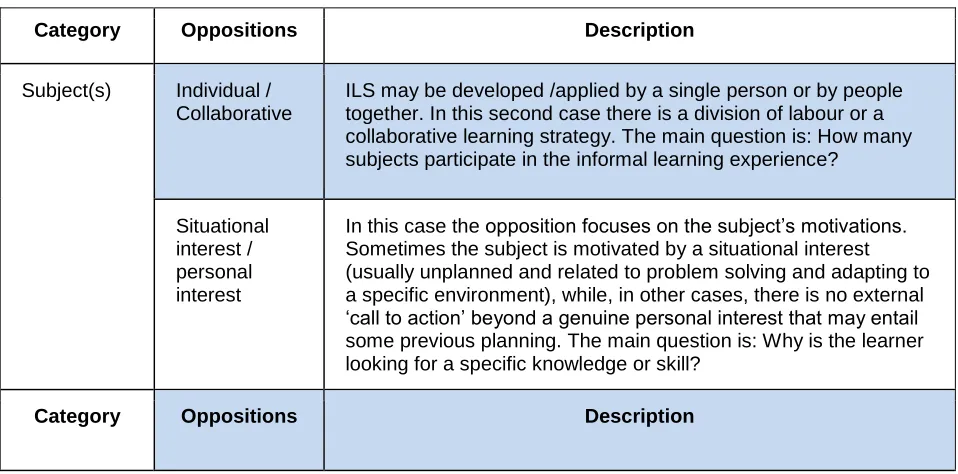
To expand and deepen these categories the team developed a set of oppositions for each. For example, the ‘subject’ category included oppositions like individual/collaborative or situational interest/personal interest. Table 1 summarises the different categories and oppositions:
Table 1: Informal learning strategy categories and oppositions
Category Oppositions Description
Subject(s) Individual / Collaborative
ILS may be developed /applied by a single person or by people together. In this second case there is a division of labour or a collaborative learning strategy. The main question is: How many subjects participate in the informal learning experience?
Situational interest / personal interest
In this case the opposition focuses on the subject’s motivations. Sometimes the subject is motivated by a situational interest (usually unplanned and related to problem solving and adapting to a specific environment), while, in other cases, there is no external ‘call to action’ beyond a genuine personal interest that may entail some previous planning. The main question is: Why is the learner looking for a specific knowledge or skill?
Time Sequenced/ Exceptional
ILS may develop as a continuous activity following a sequential or serial model (very close to the formal learning experience) over time or it could be reduced to specific and single interventions. The main question is: What are the time patterns of the informal learning experience?
Short-term/ Long-term
ILS may be limited to short-term actions (a few minutes) or long-term actions (a gameplay video may last many hours). The main question is: How long is the informal learning session?
Planned/ Unplanned
ILS may be planned with an objective in mind, deliberately following a series of steps, etc., or without any kind of planning, in a casual way. The main question is: Has the informal learning experience been planned or not?
Offline/ Online spaces
ILS can be developed in online spaces (e.g., social media) and offline spaces (e.g., a theatre play). The main question is: Is the informal learning experience performed in a virtual space or in a physical location?
Relationship and roles
Knowledge transmission
In these cases it is possible to identify two roles, a ‘teacher’ and a ‘learner’ (pedagogical strategy). The main question is: How is knowledge transmitted from subject to subject?
From adult to teen: The teen receives help from an adult, who acts as a ‘teacher’.
From peer to peer: The teen receives help from a peer, who acts as a ‘teacher’.
From teen to adult: The adult receives help from a teen, who acts as a ‘teacher’.
Knowledge construction
Subjects learn together, both are ‘learners’ (non-pedagogical strategy). The main question is: How do subjects create knowledge collaboratively?
Adult and teen: Both subjects participate in the construction of knowledge.
Between teens: Both subjects participate in the construction of knowledge.
4.3 Towards a taxonomy of informal learning strategies in video game literacy
The last step was to cross the modalities (4.1) with the categories and oppositions (4.2) and verify the strength of the taxonomy by applying it to different informal learning situations identified during the research. The following ten situations serve as an example of how the analytical and taxonomical tool works.
Informal learning situation n. 1: [Rodrigo, male, 15, Portugal]
addicted... I used to read the instructions of the games but now I know how FIFA begins... in a new game it’s different, I always read the instructions because I think it helps me. I search for guides on the Internet but only when I want to pass missions and I learn how to do it when I’m stuck.
Modality: Learning by doing
Categories
Subject: collaborative (peer support) and individual (reading instructions) / situational
Time: long-term / planned / sequenced
Space: designed / online (playing with peers) and non-designed / offline (reading instructions)
Relationships and roles: knowledge transmission (peer to peer)
Informal learning situation n. 2:[Ismo, 17, male, Finland]
I’ve played video games since I was a kid… Call of Duty took me a while to learn. Someone who had played more taught me online how to play the game, but I learn new rules quickly. I think I learn quickly because I’ve played a lot and I can take on rules for myself easily. I usually don’t read the manuals, maybe if the game is hard I check the controls from there, but that’s it. The best way to learn is just to play.
Modality: Learning by doing
Categories
Subject: collaborative (online peers) / individual (self-learning by playing)
Time: long-term / unplanned / sequenced
Space: non-designed / online
Relationships and roles: knowledge transmission (peer to peer)
Informal learning situation n. 3:[Nestor, male, 13, Colombia]
While we are playing against other teams, we set up our strategies for winning through Skype conferences. In our clan we tell each other when we are going to play, when we are going to fight with another clan, when we want to create a server or simply when we want to collect xp… when a topic is interesting, such as a fight with the most powerful clan of the game, we have to talk because we want to show them that they are not the best team... and sometimes we win and sometimes we lose.
Modality: Problem solving
Categories
Subject: collaborative (online peers) / situational (while playing against other teams) Time: short-term / planned / exceptional
Space: non-designed / online
Relationships and roles: knowledge construction (peer to peer)
Informal learning situation n. 4:[Arwen, female, 17, United Kingdom]
Modality: Problem solving
Categories
Subject: individual / personal interest (‘I am really into Minecraft’)
Time: short-term / planned / exceptional
Space: non-designed / online
Relationships and roles: knowledge transmission (peer to peer through YouTube)
Informal learning situation n. 5:[Manuel, male, 16, Spain]
I watched the gameplay of one youtuber for hours trying to copy what he was doing. The youtubers that I follow make gameplays, but not tutorials. In other words, the gameplay is like a player playing and commenting on it. And once in a while, it's true that seeing some gameplays you say ‘well look, that’s good for me’ then you use it in your game routine.
Modality: Imitating / Simulating
Categories
Subject: individual /personal interest (‘I watched the gameplay of one youtuber for hours…’)
Time: long-term / planned / sequenced
Space: non-designed/ online
Relationships and roles: knowledge transmission (peer to peer through YouTube)
Informal learning situation n. 6:[Maria, female, 16, Spain]
I watched a friend make some moves on FIFA... then I did the same alone. I would have had to spend a lot of time and effort to figure out how to do these moves successfully.
Modality: Imitating / Simulating
Categories
Subject: individual / personal interest (‘I went to a professional e-sports convention and I learnt different actions…’)
Time: long-term / planned / exceptional
Space: non-designed places / offline
Relationships and roles: knowledge transmission (peer to peer)
Informal learning situation n. 7:[Andrés, male, 17, Spain]
Before a League of Legends game, this mate of mine showed me some useful combos [a set or series of different actions] with his character and I got mine to do the same as his. I practiced these combos alone because I can’t practice playing with others… when we are four or five in a team, I can’t practice. I could lose or do something silly.
Modality: Imitating / Simulating
Subject: collaborative (‘this mate of mine showed me’) and individual (‘I practice alone…’) / personal interest
Time: long-term / planned / sequenced
Space: non-designed place / offline
Relationships and roles: knowledge transmission (peer to peer)
Informal learning situation n. 8:[Pierce, male, 12, Australia]
In Clash Royale you have to know where to place the troops as well and what sort of strengths they have. The different troops have different abilities. So one of them is a wizard and he shoots lightning. There are also giants. I play once or twice a week.
Modality: Evaluating
Categories
Subject: individual / personal interest Time: sequenced
Space: non-designed / online Relationships and roles:
Informal learning situation n. 9:[Lucho, male, 15, Colombia]
I am very good at League of Legends and I played in a game tournament and lots of people asked me about my strategies and for advice. There are a lot of techniques and strategies, and that is very important for new players.
Modality: Teaching
Categories
Subject: collaborative / situational
Time: short-term / unplanned / exceptional Space: non-designed / online
Relationships and roles: knowledge transmission (peer to peer)
Informal learning situation n. 10:[Rathelos, male, 15, Australia]
My father’s friend is very good at GTA and he teaches me a lot of tricks, but one day I found a new one and I showed him how to do it. There are cheat codes. If you use cheat codes you can’t get trophies, so you have to restart the game. I used mods [the act of modifying a game
].
I also changed my hard drive; I can’t go back to playing the gameand get trophies, so I have to restart all over again. But I just use it for fun, not to advance in the game.
Modality: Teaching
Categories
Subject: collaborative / personal interest
Time: short-term / unplanned / exceptional (‘one day I found a new one and I showed him how to do it’)
Space: non-designed / offline
Relationships and roles: knowledge transmission (from adult to teen and from teen to adult)
function: they facilitate the description of any informal learning situation, and at the same time, they allow each situation to be classified according to different formal parameters. In some cases, categories and oppositions don’t apply to a specific modality of informal learning. For example, learning by teaching is never individual.
When we consider the categories and oppositions, and in the specific case of the subject, it is possible to identify different learning situations in these examples: individual, collaborative or even mixed experiences. In terms of time, the examples show a broad spectrum of short and long-term situations, planned and unplanned sessions, and sequenced and exceptional activities. The space for learning is another critical issue for the analysis: in most of the cases the informal learning experience was performed in a place that was not designed for learning (YouTube, Skype, video games). The team found online and offline learning experiences but in the specific case of video games the online spaces tend to prevail. Some kinds of YouTube videos such as tutorials may be considered as content that is designed for learning inside an interface that is not designed for learning. Finally, relationships and roles were demonstrated to be one of the most useful set of categories for analysing informal learning experiences. During the research many different situations were detected, from peer-to-peer learning in collaborative environments to teaching modalities where the teen explains how to play to other less skilled players. Self-learning by trial and error is another alternative that may be combined with the collaborative forms.
As one of the main objectives of the research was to create a map of transmedia skills and informal learning strategies, short-term ethnography was implemented in 8 countries. The geographical extension of the research made it very difficult to apply long-term methodologies, such as those applied by Livingstone and Sefton Green (2016) in a single UK school. Future work in this research area should sacrifice the geographical extension of the fieldwork so that it can focus on a limited group of schools and / or families. However, many collateral issues emerged during the project, and the team is already working on research into learning by teaching strategies, especially from an inter-generational perspective.
5. Conclusions
The previous sections show that the number of different ILS used by teens and identified during the research was not very high. The research team’s general impression was that traditional ILS were being applied to new media environments.
We have organised these strategies here into six modalities, some of which are already recognised in the formal educational context: learning by doing, problem solving, imitating / simulating, playing, evaluating and teaching. What varies in these cases is the context in which the strategies are applied (such as video games and social media) and the form they adopt (including real-time collaboration with peers from other countries in online spaces).
In this context the team observed that imitation is one of the main ILS that teens apply. For example, teens watch YouTube videos of their favourite gamers to observe how they perform tasks such as problem solving or managing characters, and imitate them in their own game sessions. This practice calls into question the growing popularity of claims about the endless creative capacity of youth. Adolescents acquire many of their skills by just imitating online situations and processes. Even when they produce their own contents, they still look for
inspiration from other users (Scolari, 2018). However, the imitating / simulating informal learning modality, not only in video game playing, works very well.
have become aspirational models for teens (many claim to want to become YouTubers in the future, as this is considered a profession), which entails elements of identification and attraction towards them (Scolari & Fraticelli, 2017).
The team considers that the introduction of categories and oppositions for describing and analysing the different informal learning strategies is a useful approach that should be expanded and tested with more situations and processes. The core activity of this kind of analysis is to apply the categories and oppositions to new situations to check the ‘ultimate tensile strength’ of the analytical tool. New categories and oppositions may emerge from this dialectical process between informal learning situations – not only in relation to video games – and theoretical models.
6. References
Barnes, K., Marateo, R., & Ferris, S. P. (2007). Teaching and learning with the net generation.
Innovate:Journal of Online Education, 3(4), 1–8.Available at:
https://nsuworks.nova.edu/innovate/vol3/iss4/1 [Accessed: 21 August 2018].
Beavis, C. Muspratt, S., & Thompson, R. (2015). Computer games can get your brain working: Student experience and perceptions of digital games in the classroom. Learning, Media and
Technology, 40(1), 21–42. https://doi.org/10.1080/17439884.2014.904339
Bebbington, S. & Vellino, A. (2015). Can playing Minecraft improve teenagers’ information literacy? Journal of Information Literacy, 9(2), 6–26. https://doi.org/10.11645/9.2.2029
Bell, P., Lewenstein, B., Shouse, A. W., & Feder, M. A. (Eds.) (2001). Learning science in
informal environments: People, places, and pursuits. Washington, DC: National Research
Council.
Black, J., Castro, J., & Lin, C. (2015). Youth practices in digital arts and new media: Learning in
Formal and Informal Settings. Palgrave. https://doi.org/10.1057/9781137475176
Brown, R. T. & Kasper, T. (2013). The fusion of literacy and games: A case study in assessing the goals of a library video game program. Library Trends, 61(4), 755–778.
https://doi.org/10.1353/lib.2013.0012
Buckingham, D. (2007). Beyond technology: children's learning in the age of digital culture. Cambridge: Polity.
Campbell, S. (2008). Defining information literacy in the 21st century. In J. Lau (Ed.),
Information literacy: International perspectives (pp.17–26). The Hague: IFLA Publications.
Clark, W., Logan, K., Luckin, R., Mee, A., & Oliver, M. (2009). Beyond Web 2.0: mapping the technology landscapes of young learners. Journal of Computer Assisted Learning,25, 56–69. https://doi.org/10.1111/j.1365-2729.2008.00305.x
Conlon, T. (2004). A review of informal learning literature, theory and implications for practice in developing global professional competence. Journal of European Industrial Training, 28(2), 283–295. https://doi.org/10.1108/03090590410527663
Contreras Espinosa, R. S., Eguia Gómez, J. L., & Solano, L. (2011). Videojuegos como un entorno de aprendizaje. El caso de Monturiol el joc. Icono14, 9(2), 249–261.
Coombs, P. H. & Ahmed, M. (1974). Attacking rural poverty: How non-formal education can
help. Baltimore, MA: Johns Hopkins University Press.
Crabtree, A. (1998). Ethnography in participatory design. In Proceedings of the 1998
Participatory design Conference: 12–14 November 1998 (pp.93–105). Stanford, CA: Computer
Professionals Social Responsibility.
Delwiche, A. (2006). Massively multiplayer online games (MMOs) in the new media classroom.
Educational Technology &. Society, 9(3), 160–172. Available at:
https://www.j-ets.net/ets/journals/9_3/14.pdf [Accessed: 1 May 2018].
Dewey, J. (1938). Experience and education. New York, NY: Collier Books.
Fleming, L. (2013). Expanding learning opportunities with transmedia practices: Inanimate Alice as an exemplar. Journal of Media Literacy Education,5(2), 370–377.
Gee, J. P. (2004). Situated language and learning: A critique of traditional schooling. London: Routledge.
Gee, J. P. (2007). What video games have to teach us about learning and literacy (2nd ed.). New York: Palgrave MacMillan.
Halse, J. & Boffi, L. (2016). Design interventions as a form of inquiry. In R. C. Smith, K. T. Vangkilde, M. G. Kjaersgaard, T. Otto, J. Halse & T. Binder (Eds.), Design anthropological
futures (pp.89–103). London: Bloomsbury.
Handwerker, P. W. (2001). Quick ethnography: A guide to rapid multi-method research. Walnut Creek, CA: AltaMira Press.
Ito, M., S. Baumer, M. Bittanti, D. Boyd, R. Cody, B. Herr-Stephenson,…Tripp, L. (2010).
Hanging out, messing around, and geeking out: kids living and learning with new media. MIT
Press. https://doi.org/10.7551/mitpress/8402.001.0001
Jenkins, H., Purushotma, R., Clinton, K., Weigel, M., & Robinson, A. (2006). Confronting the
challenges of participatory culture: Media Education for the 21st Century. Chicago: MacArthur.
Available at: https://www.macfound.org/media/article_pdfs/JENKINS_WHITE_PAPER.PDF [Accessed: 2 August 2018].
Jordan, B. (Ed.) (2012). Advancing ethnography in corporate environments: Challenges and
emerging opportunities. Walnut Creek, CA: Left Coast Press.
Knowles, M. (1950). Informal adult education. New York, NY: Association Press.
Kraidy, M. & Murphy, P. D. (Eds.) (2004). Global media studies: An ethnographic perspective. Routledge. https://doi.org/10.4324/9780203505441
Lammers, J. C., Kurwood, J. S., & Magnifico, A. M. (2012). Toward an affinity space
methodology: Considerations for literacy research. English Teaching: Practice and Critique,
11(2), 44–58.
Leander, K. M. (2008). Toward a connective ethnography of online/offline literacy networks. In J. Coiro, M. Knobel, C. Lankshear, & D.J. Leu (Eds.), Handbook of research on new literacies
LeCompte, M. D. & Preissle, J. (1993). Ethnography and qualitative design in educational
research. San Diego, CA: Academic Press.
Livingstone, S. & Sefton-Green, J. (2016). The Class. Living and learning in the digital age. NYU Press. https://doi.org/10.18574/nyu/9781479884575.001.0001
Lowood, H. & Nitsche M. (2011). The machinima reader. MIT Press. https://doi.org/10.7551/mitpress/9780262015332.001.0001
Marsick, V. J., & Volpe, M. (1999). The nature of and need for informal learning. In V. J. Marsick & M. Volpe (Eds.), Informal learning on the job, advances in developing human resources, (pp.1–9). San Francisco, CA: Berrett Koehler.
Marsick, V. J. & Watkins, K. (1990). Informal and incidental learning in the workplace. London and New York: Routledge.
Marsick, V. J. & Watkins, K. (2001). Informal and incidental learning. New Directions For Adult
and Continuing Education, 89, 25–35. https://doi.org/10.1002/ace.5
Martin, C. (2011). An information literacy perspective on learning and new media. On the
Horizon, 19(4), 268–275. https://doi.org/10.1108/10748121111179394
Martin, C. (2012). Information literacy in interest-driven learning communities: Navigating the
sea of information of an online affinity space (Doctoral dissertation). University of
Wisconsin-Madison. Available at:
http://depot.library.wisc.edu/repository/fedora/1711.dl:V7BSD4HX5ZZYV9C/datastreams/REF/c ontent [Accessed: 30 March 2018].
Miller, K. (2008). Grove Street Grimm: Grand Theft Auto and digital folklore. The Journal of
American Folklore, 121(481), 255–285. https://doi.org/10.1353/jaf.0.0017
Nass, M., Taubert, A., & Zolotykh, S. (2014). Serious games in information literacy: The creation
and analysis of games to teach information literacy. Worchester Polytechnic Institute. Available
at: https://www.wpi.edu/Pubs/E-project/Available/E-project-031214-143058/unrestricted/IQP.pdf [Accessed: 29 March 2018].
Pérez, Ó. & Contreras Espinosa, R. (2018). Performative skills. In C. A. Scolari (Ed.), Teens,
media and collaborative cultures (pp.44–51). Barcelona, Spain:CeGe.
Pink, S. & Morgan, J. (2013). Short-term ethnography: intense routes to knowing. Symbolic
Interaction, 36(3), 351–361. https://doi.org/10.1002/symb.66
Scolari, C. A. (Ed.) (2018). Teens, media and collaborative cultures. Exploiting teens’
transmedia skills in the classroom. Barcelona, Spain:CeGe.
Scolari C. A. & Fraticelli, D. (2017). The case of the top Spanish YouTubers: Emerging media subjects and discourse practices in the new media ecology. Convergence.
https://doi.org/10.1177/1354856517721807
Sefton-Green, J. (2004). Literature review in informal learning with technology outside school. London: Future Media Lab. Available at:
https://www.nfer.ac.uk/publications/FUTL72/FUTL72.pdf [Accessed: 21 August 2018].
Sefton-Green, J. (2013). Learning not at school: A review for study, theory and advocacy for
Smith, F. A. (2007). Games for teaching information literacy skills. Library Philosophy & Practice, 9(2), 1–12.
Steinkuehler, C. (2008). Massively multiplayer online games as an educational technology: An outline for research. Educational Technology, 48(1), 10–21.
Street, B. V. (2014). Social literacies: Critical approaches to literacy in development,
ethnography and education. Routledge. https://doi.org/10.4324/9781315844282
Valdivia Barrios, A., Herrera, M., & Guerrero, M. (2015). Aprendizaje y producción mediática digital en la escuela: Un abordaje etnográfico del aprendizaje como práctica cultural en Artes Visuales. Estudios Pedagógicos, 41, 231–251.
https://doi.org/10.4067/S0718-07052015000300015
Wagner, M. (2006). Computer games and the three dimensions of reading literacy. In
Proceedings of the 2006 ACM SIGGRAPH symposium on videogames: July 30–31 2006
(pp.139–142). https://doi.org/10.1145/1183316.1183336
Walker, B. E. (2008). This is Jeopardy! An exciting approach to learning in library instruction.
Reference Services Review, 36(4), 381–388. https://doi.org/10.1108/00907320810920351
Walsh, A. (2014). SEEK!: Creating and crowdfunding a game-based open educational resource to improve information literacy. Insights: The UKSG Journal, 27(1), 63–67.
https://doi.org/10.1629/2048-7754.113
Williamson, B. (2013). The future of the curriculum: school knowledge in the digital age. MIT Press. https://doi.org/10.7551/mitpress/9457.001.0001
Winocur R. (2016). Tensiones generacionales mediadas por las pantallas. In S. Corona (Ed.),
Diálogos educativos dentro y fuera del aula (pp.271–284). Guadalajara, Mexico:Universidad de
Guadalajara.
Wolcott, H. (1997). Ethnographic research in education. In R. Jaeger (Ed.), Complementary
methods for research in education (pp.327–353). London: Routledge.
Zagal, J.P. (2008). A Framework for games literacy and understanding games. In Proceedings