[Martínez Soto, F.* et al., Vol.5 (Iss.2), February 2018]
ISSN: 234-5197
Impact Factor: 3.765
I
NTERNATIONAL
J
OURNAL
OF
R
ESEARCH
S
CIENCE
&
M
ANAGEMENT
http: // www.ijrsm.com © International Journal of Research Science & Management
[90]
IMPROVEMENTS IN THE MIX-DESIGN, PERFORMANCE FEATURES AND
RATIONAL METHODOLOGY OF RUBBER MODIFIED BINDERS FOR THE
THERMAL EVALUATION OF THE RAILWAY SUB-BALLAST
Fernando Martínez Soto*; Gaetano Di Mino
2* Department of Civil, Environmental, Aerospace, Materials Engineering (DICAM), University of Palermo, Viale Delle Scienze, Ed.8, 90128 PALERMO (ITALY) E-mail: [email protected]
2 Associate Professor at the Faculty of Engineering, University of Palermo (UNIPA), Italy.
DOI: 10.5281/zenodo.1175219
Keywords: Dry process, HMA, Rubber Modified, Ndes, Superpave, Thermal susceptibility, Post-compaction,
Bituminous mixtures, Sub-ballast, Railway, Rubber modified asphalt.
Abstract
The objectives of this study are focused on the ideal methodology and the dimensioning of the railway super-structure, involving the use of a bituminous sub-ballast layer modified with recycled natural rubber tire out-of-use. The previous study of the thermal transmission in each Railtrack layer, the analysis of the traffic in high-speed lines and the revision of the thermal-mechanical models have motivated this research. An experimental methodology has been optimized for the application of the volumetric mix-design with the gyratory compactor (SGC). According to the meteorological situation and applying experimental models based on thermal conductivity interpolated by sinusoidal functions, a laboratory study of conventional bituminous mixtures and improved mixtures of asphalt modified with coarse rubber waste tires is illustrated. The enhanced methodology entails a case study where compacted mixes are used by SGC, replacing rubber between 1.5 and 3 percent of rubber (particle size 0.2-4 mm) in the total weight of the blend. After the evaluation of the average seasonal temperatures, the mixtures were designed considering the dry process, as an advanced measure of sustainability and for their demonstrated improvements in thermal behavior and resistance to fatigue. A step-by-step manufacturing process is provided to avoid swelling problems in the post-compaction phase characteristic of dry mixes. The purpose of using rubber modifiers in the hot mix asphalt has been achieved to obtain an elastic sustainable material for the evaluation of its behavior in sub-ballast layers.
Introduction
The fine-coarse crumb rubber incorporated into asphalt mixes by using “dry process” method which refers to technology that mixes the recycled tire rubber out of use with the aggregates before mixing it with asphalt binder. Two aggregate gradations were considered under this investigation, dense graded (asphaltic concrete with 22.4mm nominal maximum aggregate size) and gap graded (stone mastic asphalt with 31.5mm maximum aggregate size). For each particle size distribution, of an aggregate sieving process, the percentages of crumb rubber added varied from 1.5 % to 3 % by weight of the total aggregates. The European standard for sub-ballast in high-speed rail-lines as grading curve and Superpave gyratory compactor technique as mix-design were used. This article describes the benefits that can be derived from conducting the Volumetric mix-design with Superpave gyratory compactor (SGC) analysis developed as a reviewed method for railways. The rubberized sustainable solution can offer advantages such as reducing greenhouse emissions, fuel consumption and, a suitable performance as sub-ballast for railways tracks from mechanical behavior.
[Martínez Soto, F.* et al., Vol.5 (Iss.2), February 2018]
ISSN: 234-5197
Impact Factor: 3.765
I
NTERNATIONAL
J
OURNAL
OF
R
ESEARCH
S
CIENCE
&
M
ANAGEMENT
http: // www.ijrsm.com © International Journal of Research Science & Management
[91]
Scrap tire rubber (STR) can be incorporated into asphalt mixtures in two different methods or techniques, which are referred to as the wet-dry process [7-12]. The blending of recycled rubber with asphalt cement has been used for years, and several manufacturing processes have been developed in Europe as well as in the United States. The use of a bituminous sub-ballast layer has been pointed out as an exciting alternative to the granular sub-ballast design traditionally applied in most European railroad tracks [13-15]. Frequently, unbound granular materials are replaced by bituminous sub-ballast that provide additional benefits to the subgrade protection. Much research has been conducted on finding other alternative material to be used as a modifier in asphalt mixes to improve its properties [16-18]. Rubberized asphalt mixtures are regarded as a proper solution for improving the strength of the rail-track section. In comparison with traditional granular sub-ballast, these materials allow an increase in bearing capacity and more excellent protection of the substructure. The recycled rubber has become a significant enhancer of the modified bituminous mixtures, and in this work, it has been shown as a sustainable improvement [19-20] option in Hot mix asphalt (HMA) mixes due to the elastic behavior exposed by the rubber particles especially in reducing the fatigue cracking potential [21-25].
Volumetric mix-design: a review
The Volumetric blend design method provides a complete means for creating asphalt blends that will achieve a performance level consistent with the unique demands of traffic, weather, pavement structure and reliability for the project [26-27].
The purpose of using rubber modifiers in HMA to obtain a stiffer-elastic sustainable material has been achieved for the assessment of its behavior in sub-ballast/base layers. Rubber-Asphalt mixes (RUMAC) have shown a higher resistance to fatigue cracking compared to the conventional blends without rubber [28-29].
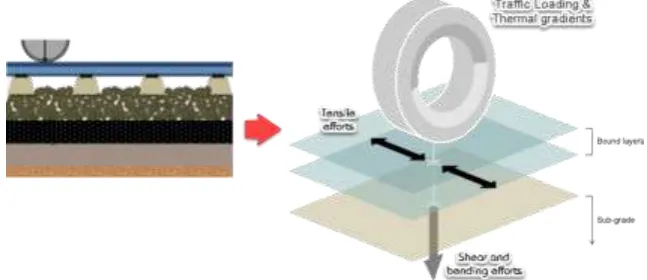
The Volumetric mix design procedure [30] developed in the Asphalt Research Program of the Strategic Highway Research Program (SHRP) does not include a simple, mechanical “proof” test analogous to the Marshall stability and flow tests method [31]. Instead, the original “Volumetric mix-design” method relied on strict conformance to the material specifications and volumetric mix criteria to ensure satisfactory performance of mix design intended for higher traffic (NCHRP 513). Cracking performance is significantly affected by the pavement structure and traffic [32-33]. This analysis procedure required a rigorous evaluation of the mix design’s potential for fatigue cracking (Fig. 1).
Fig. 1. Movements due to thermal variations and traffic loads
The Volumetric mix-design [34-35] is the crucial step in developing a well-performing HMA_DRY mixture according to NCHRP (2007) [31]. Under SHRP, additional laboratory analysis tests and material performance models were developed to determine the capabilities of Superpave mixtures further to perform well for the specific project design traffic and climatic condition. The values established in the first regulations of Superpave contemplated several levels of gyration, that represent seven traffic levels for each of four climates. In the years
following the improved Ndesign value, the climatic region factors were eliminated and incorporated in the bitumen
selection process depending on the performance grade [29].For the past years, trackbed construction has used the
[Martínez Soto, F.* et al., Vol.5 (Iss.2), February 2018]
ISSN: 234-5197
Impact Factor: 3.765
I
NTERNATIONAL
J
OURNAL
OF
R
ESEARCH
S
CIENCE
&
M
ANAGEMENT
http: // www.ijrsm.com © International Journal of Research Science & Management
[92]
Kentrack@ software [48] is used to consider the asphalt grading trackbed system and their properties inside the computer program. Therefore, the program maintains the previous asphalt grading system and incorporates information of the new asphalt grading system for comparison purposes (NCHRP 2007). In this study, the recent updates of Superpave values were applied (Fig. 2).
Fig. 2. Ndesign recommended by Superpave standards
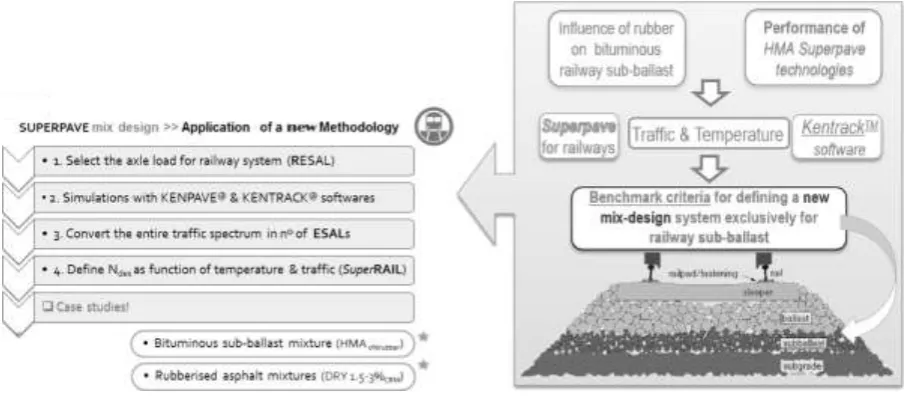
During a previous investigation [36], a new methodology to characterize bituminous mixtures has recently been accepted through the methodology of the gyratory compactor (SGC) suitable for the section of high-speed railway layers (Fig. 3). The Superpave system developed for railways [37-38], considering the necessary parameters of the temperature profile, rail traffic and thermal gradient in the multi-layer system, has proved to be efficient and therefore applicable to HMA with or without modification of scrap tire rubber (SCR).
At the higher traffic levels, extensive performance testing is recommended to assure the highest reliability. A unique feature of the Superpave test is its performing at temperatures and aging conditions that more realistically represent those encountered by in-service sub-ballasts [39].
Fig. 3. Steps procedure of Super-rail mix-design methodology proposed
[Martínez Soto, F.* et al., Vol.5 (Iss.2), February 2018]
ISSN: 234-5197
Impact Factor: 3.765
I
NTERNATIONAL
J
OURNAL
OF
R
ESEARCH
S
CIENCE
&
M
ANAGEMENT
http: // www.ijrsm.com © International Journal of Research Science & Management
[93]
Improvements in the railway sub-ballast
Traditional railway track consists of rails, sleepers, fastenings, ballast and a formation layer over the ground (Fig. 4). The materials and the thickness of track layers composing the railway structures are assigned by practice [42-43], but the constant demand for high speed and loading capacity increasing, involve the incorporation of the required sub-ballast layer. The thickness of sub-ballast and ground layers have been increased in modern tracks with the aim of obtaining higher bearing capacity, and durability of the system [44].
The bituminous sub-ballast is composed of a dense-graded bituminous mixture similar to the base course for road pavements [45-46]. The bitumen in the sub-ballast usually is increased to 0.5% compared to the base layer, and the air voids decreased to 1-3% to enhance the impermeability of the layer resulting in a mixture characterized by an intermediate permanent deformation resistance [47-48].
Fig. 4. Section of railway track showing the multi-layer system [29]
In the case of ballasted tracks, sub-ballast layers are determining elements in the mechanical performance of the rail track and for the protection of the ballast. Using a bituminous sub-ballast layer has been recognized as an environmental solution for the necessary enhancement of the track structure. Substantial development research has been showed during the last years [49]. Asphalt underlayment has shown to apply to track features with weak subgrades, soft soils, and poor drainage [50]. The railway structure seeks to optimize a reliable performance while at the same time with a minimum thickness it is possible to resist the stresses-deformations allowed along the railway due to traffic and temperature variations [51-52].
Temperature profile models
Some of the temperature models based on mechanical methods, energy balance and finite difference equations are purely empirical regressions. The use of computer modeling is validated under certain misgivings about the experimental methodology. Recent additions to real practice provide guidelines on how to determine input parameters (convection, air temperature, material unit weight, moisture content, material classification, and thermal conductivity) which are difficult to obtain [53].
A FEM model that predicts pavement temperatures during summer condition based on the heat transfer was presented by Hermansson (2001) [54]. The input data per hour per day are solar radiation, air temperature, and wind speed, seeing a concordant relationship between measurements. In this experiment, the effects of solar radiation and depth were added to the analysis layer. Crispino (2001) measured the thermal fluctuations of the
sub-ballast layer, to evaluate the average seasonal temperature [55-56].Barber´s theory [57] was used to find the
temperature in the road base course and, the modifications purposed by M. Crispino were used in the sub-ballast layer [58-59].
[Martínez Soto, F.* et al., Vol.5 (Iss.2), February 2018]
ISSN: 234-5197
Impact Factor: 3.765
I
NTERNATIONAL
J
OURNAL
OF
R
ESEARCH
S
CIENCE
&
M
ANAGEMENT
http: // www.ijrsm.com © International Journal of Research Science & Management
[94]
calculation of thermal prediction model could be carried out in the sub-ballast after knowing the max/min temperatures on the railway trackbed [63-64].
Traffic spectrum
The amount of traffic is measured regarding the number of repetitions of application of loads of different axles, characteristic of the passages of vehicles on the rail-track during the service life. The traffic information to be used for the thickness design includes the magnitude of wheel loads and the number of repetitions per year. Considering an average of increased rate industrial traffic of 1%, and service life of 30 years, the rail equivalent
single axle load (ESAL) obtained for high-speed lines with 160kN/axle tandem in long-distance trains is 3.7x10⁷
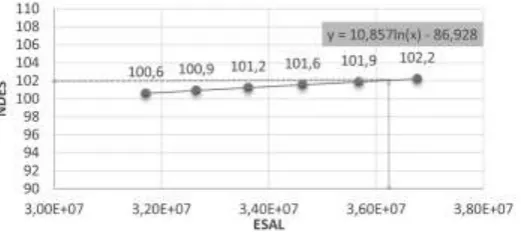
(Level 3 of “volumetric mix-design method”). Therefore, considering the recently logarithmic regression from the interpolation of the values of ESAL-Ndes (AASHTO R35-2015) showed in Fig. 2, a correspondence between
the number of Ndes gyrations and the rail axle load value has been well-defined. Due to the imprecision of Ndes
values between 100 and 125 gyrations inside the SGC, it has been chosen to interpolate the values in the Fig. 2, and obtain the regression trendline. Using the regression equation proposed by the number of Energetic
parameters, Ndes =10,857·Log (ESAL)-86,928, the Ndes is 102 cycles (Fig. 5).
Fig. 5. Logarithmic regression by interpolation of Ndes values
During the development of this methodology of “Volumetric mix-design” for railways, we have analyzed the main European high-speed lines considering a 16ton equivalent axle. The advantage and more magnificent achievement with this study are that it offers a unique solution for the traffic-temperature predictive model of any
other world zone. It is possible to develop real values of Ndes for the bituminous mixtures in each particular case.
Scope and Objectives
The goal of the present research study is to analyze the behavior of asphalt rubber mixtures (ARC) obtained by the dry process compared with a conventional HMA through different rubberized mixtures (DRY) by reducing and controlling the fatigue life and cracking effect. The purpose is to optimize the reference conventional HMA and the rubber-aggregate blends DRY 1.5%, DRY 2%, and DRY 3% according to the optimal recipes found in the laboratory after trial mixtures with SGC under cyclic loads for a 30-year life cycle for railways [65].
[Martínez Soto, F.* et al., Vol.5 (Iss.2), February 2018]
ISSN: 234-5197
Impact Factor: 3.765
I
NTERNATIONAL
J
OURNAL
OF
R
ESEARCH
S
CIENCE
&
M
ANAGEMENT
http: // www.ijrsm.com © International Journal of Research Science & Management
[95]
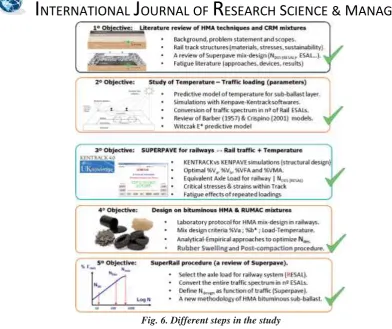
Fig. 6. Different steps in the study
Thus, it is needed to know the temperature within the layer and the relationship with the mechanical characteristics. Barber´s theory was used to determine the temperature in the road base course and, the modifications purposed by Crispino were applied in the sub-ballast layer. Using the average seasonal temperature analysis by simulating the thermal sub-ballast and road-base layer behavior respectively, was possible to predict the medium-layer temperatures, which obtained results are shown after different computer simulations [28-29]. The last section is dedicated to exploring through the optimized mixtures obtained with the gyratory compactor [66-67], whose experimental details are widely reported in previous research [68-69]. The volumetric mix-design of the mixtures in the laboratory using the gyratory compactor (SGC) is developed in this work exclusively for the railway sector since until now it was applicable only on roads.
This investigation, therefore, evaluates the optimum parameters of temperature and traffic that characterize the optimal mixture for a sub-ballast layer [63-64]. Also, it provides the development to adapt the SGC methodology focused exclusively for roads but now in the railway field. The application of this procedure is needed for the volumetric mix-design of the underlayment rail-track [70-71].
Methodology
Analyzing the model factors
The performance of asphalt pavements is influenced by temperature distribution and environmental conditions to which it is exposed [72]. Barber (1957) observed that pavement temperature fluctuations roughly followed a sine curve with a period of one day. A reasonable estimation of asphalt surface temperature was seen by including both the solar radiation and the air temperature in the model. Pavement temperatures are of interest linking with the stabilization, curing and moisture movements of bituminous sub-ballast layers.
[Martínez Soto, F.* et al., Vol.5 (Iss.2), February 2018]
ISSN: 234-5197
Impact Factor: 3.765
I
NTERNATIONAL
J
OURNAL
OF
R
ESEARCH
S
CIENCE
&
M
ANAGEMENT
http: // www.ijrsm.com © International Journal of Research Science & Management
[96]
Precise prediction of asphalt pavement temperature at different depths based on air temperature measurements can help to perform retroactive calculations of the bituminous mixtures module and to estimate pavement deflections. Thus, the thermal and moisture regimen is critical to the choice of the long-term performance grade on the mechanical properties of the bituminous materials [75-76].
In this research, the conventional measures of temperature, relative humidity, atmospheric pressure, wind speed, wind direction, precipitation and, hours of sunlight during 12-months were chosen from statistics determined by using five elements: global horizontal radiation, direct standard radiation, dry bulb temperature, dew point temperature, and wind speed.
Temperature-traffic modelization
The linear viscoelastic behavior is a first step to understand the mechanical performance of high-speed line tracks with bituminous layers although its response is better described by viscoelastic constitutive laws [77-78]. The rail sub-ballast purpose needs the determination of temperature by the prediction model reviewed.
The track system model is divided from top to bottom into rails, springs, ties, and sleepers, which are modeled as prismatic elements by finite elements for trackbed design. The railway structure responds to a multilayer model from which the properties of each layer can be defined. The section (type and thicknesses of layers) and the solicitations points are shown in Fig. 7.
Fig. 7. (a) Rail-track considered with the loads concerning the ties; (b) Energy balance in railway track
The sustainable design method is the one proposed by the compaction methodology "Superpave" to be used in
asphalt mixtures for rail transport, considering the equivalent standard axial load for the railway lines (RESAL [36]).
Due to the existence of ballast aggregates for underlayment, the hot mix asphalt and subgrade in railroad trackbed are better protected from environmental effects as compared to highway pavements [29].
In this lab-research, the “volumetric mix-design method” requires specimens compacted with SGC at the design
number of gyrations of Ndes=102; Ninit=8 and Nmax=162 gyrations.
The design asphalt content is selected with a target air voids content of 3% at Ndes. Thus, the recent values are used in the volumetric mix-design for railways, and it has been determined from the rail traffic level expected and the design air temperatures for the site.
The dynamic modulus of HMA was calculated using the method developed by Witczak (1979) [79-80] to model the asphalt accurately; different temperatures should be utilized for the various periods since the dynamic modulus is dependent on the temperature.
Witczak-E* predictive model was merged into KENTRACK software [78-80], which was developed by the University of Kentucky, to calculate asphalt dynamic modulus [81-82].
[Martínez Soto, F.* et al., Vol.5 (Iss.2), February 2018]
ISSN: 234-5197
Impact Factor: 3.765
I
NTERNATIONAL
J
OURNAL
OF
R
ESEARCH
S
CIENCE
&
M
ANAGEMENT
http: // www.ijrsm.com © International Journal of Research Science & Management
[97]
Table 1. Parameters inserted in the Witczak formula
Air temperature 0°C Layer Ẋ Tª [°C] µ [106 poise] log |E*| |E*| [MPa] ν
Rail SB 1.94 59.5026 1.434 18929.8 0.4
Air temperature 35°C Layer Ẋ Tª [°C] µ [106 poise] log |E*| |E*| [MPa] ν
Rail SB 36.95 0.0074 -0.235 1185.68 0.4
(*)SB: sub-ballast layer
Temperature validation results
The thermal regime, within the pavement, is governed by the physical, chemical and thermal properties of the layer materials, as these affect the process of propagation of the temperature in the sub-ballast and the substrate. The operating methodology to calculate the temperature gradients is composed of different stages. First, the acquisition from the last 30-years of meteorological temperature values; then, a meteorological data processing,
dividing the year and calculate the average max/min temperatures Tªmax/min for each year-period. The following
graph shows the evolution of the temperature in each layer of railways (RW) for the most representative air temperatures (0ºC and 35ºC). It was applied based on the simulations made with the computer program, along with a sinusoidal cycle marked by the daily hours and the depth (z) to the layer bottom (Fig. 8).
Fig. 8. 24hour-Tª variation at different depths [Air Tª 0°C-35ºC]
Finally, it was made the average air temperature Ta(p) of the seasonal periods, and the temperature inside the
sub-ballast layer, in function of the relative average air temperature for each period, using Barber’s equation. Each simulation for various temperatures (0, 10, 20, 30, and 35ºC), has considered that in the case railways, the depth of interest is 47cm (bottom of the sub-ballast layer).
The simulations with KENTRACK® have been set at two air temperatures, 0ºC, and 35°C, based on low and high
temperatures respectively, and applying only 100 cycles to avoid the cumulative effect of damage. Subsequently, it was possible to calculate the mechanical characteristics of the bituminous materials with the Witczak predictive model based on the volumetric properties of the mixture and the characteristics of the binder.
Once the overall procedure for the temperature profile inside the sub-ballast layer was defined, a laboratory verification has been conducted with a conventional HMA mixture and different rubberized asphalt solutions by a dry process with gap-dense gradation mixtures.
Materials
Volumetric mix design with gyratory compactor (SGC), adopting a well-performing asphalt mixture according to NCHRP (2007), it was established as the optimal laboratory tool that more closely simulates field compaction of asphalt mixtures. The SGC is a 1.25º fixed angle, 600kPa pressure and rate of gyration (30rev/min) compactor that creates samples of Ø150x120mm in target height. The compacted samples are measured for specific gravity, and the volumetric properties are calculated.
The SGC also gives the ability to investigate the aggregates properties at void levels representing construction throughout its intended life cycle. The specifications for the bituminous sub-ballast are defined by the European standard (void content of 4-6%, a Marshall stability of 10kN, and a higher indirect tensile strength at 15ºC of
[Martínez Soto, F.* et al., Vol.5 (Iss.2), February 2018]
ISSN: 234-5197
Impact Factor: 3.765
I
NTERNATIONAL
J
OURNAL
OF
R
ESEARCH
S
CIENCE
&
M
ANAGEMENT
http: // www.ijrsm.com © International Journal of Research Science & Management
[98]
The content of bitumen based on the total mass of the aggregates will have to correspond to the excellent content obtained in the laboratory, with a tolerance of ± 0.5%.
The features of the materials used for the production of the bituminous sub-ballast are concise in Table 2.
Table 2. Characteristics of the materials used for the bituminous sub-ballast mixtures
Bitumen Properties Standard Value
Penetration at 25°C EN1426:2007 53
Penetration index [-] EN12591 Annex A -0.575
Softening point [°C] EN1427:2007 50
Bulk gravity [g/cm3] EN 15326:2007 1.033
Viscosity at 150ºC [Pa·s] ASTM D2493M-09 0.195
Equiviscosity values by Brookfield viscosimeter [°C] 0.28Pas EN 12695:2000 143.1
0.17Pas AASHTO T316-04 156.2
Aggregates properties Standard Value
Los Angeles abrasion loss [%] EN 1097-2:2010 20.8
Density of aggregates [g/cm3] EN 1097-3:1998 2.82
Density of sand [g/cm3] EN1097-6:2013 2.84
Density of filler [g/cm3] EN1097-7:2009 2.70
Resistance to fragmentation (%) EN1097-2 20.83
Determination of particle shape EN 933-3 (%) 10
Sand equivalent (>45) (%) EN 933-8 61
Total sulphur content (<0.5) (%) EN 1744-1 0
Rubber properties
Color Black
Particle morphology Irregular, undisclosed
Moisture content (%) <0.75
Textile content (%) <0.65
Metal content (%) <0.10
Maximum density according proportion 60% Ø0.4-2mm ; 40% Ø2-4mm). Standards: ASTM C128 ; UNE 12597-5:2009
Tª water: 27ºC (density 1.00025 gr/cm3) Pycnometer test
Weight of sample (gr) 500
Weight of pycnometer, m1(gr) 767
Weight of pycnometer with sample mass, m2 (gr) 1270
Weight of pycnometer + sample ssd + water, m3 (gr) 3106
Weight of pycnometer filled with water, m4 (gr) 3039
Maximum Specific Gravity of rubber (g/cm3) 1.154
The Volumetric mix design system has specific characteristics related to select acceptable aggregate materials (washed sieve analysis, mineral dust filler, control points, and Fuller’s curve).
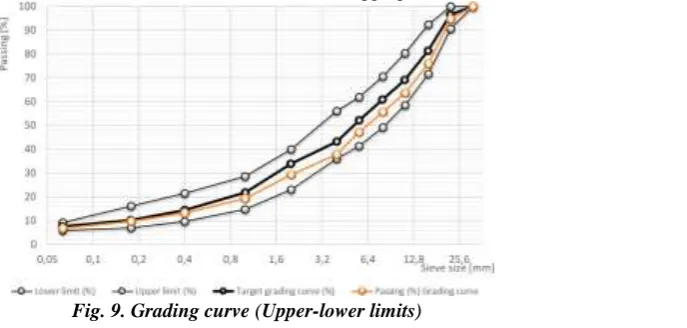
The grading curve of aggregates (Fig. 9) was perfected through the selected percentages of each aggregate fraction to produce asphalt mixtures which exhibit controlled levels of coarse aggregates interlock.
[Martínez Soto, F.* et al., Vol.5 (Iss.2), February 2018]
ISSN: 234-5197
Impact Factor: 3.765
I
NTERNATIONAL
J
OURNAL
OF
R
ESEARCH
S
CIENCE
&
M
ANAGEMENT
http: // www.ijrsm.com © International Journal of Research Science & Management
[99]
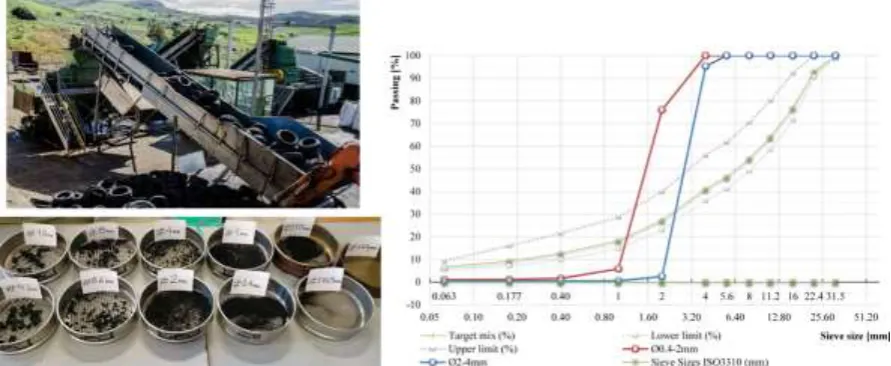
The crumb rubber used by the dry process had two particle sizes of 0.2-4mm and 2-4mm (sieving process and grading curve are shown in Fig. 10).
The rubber aggregate with gap-gradation is a two-component system in which the fine aggregates portion interacts with the asphalt cement while the coarse rubber performs as an elastic aggregate in the hot mix asphalt mixtures [83].
The percentage of rubber used in these mixes varies from 1 to 3 percent by the total weight of the mix. The mixes are not considered to be asphalt rubber since rubber is not blended with the asphalt cement before mixing it with aggregates.
The rubber-asphalt mixes which are produced by first mixing CRM and aggregates followed with an intimate mixing with asphalt cement are mentioned as “asphalt concrete rubber filled” or “rubber modified asphalt concrete mixes (RUMAC)” [84].
Fig. 10. (a) Sieve analysis for grading; (b) Rubber sieve analysis (Grading curves Ø2-4mm; Ø0.4-2mm)
[Martínez Soto, F.* et al., Vol.5 (Iss.2), February 2018]
ISSN: 234-5197
Impact Factor: 3.765
I
NTERNATIONAL
J
OURNAL
OF
R
ESEARCH
S
CIENCE
&
M
ANAGEMENT
http: // www.ijrsm.com © International Journal of Research Science & Management
[100]
Fig. 11. (a) Materials and mixtures specifications on this research; (b) HMA_DRY Specimens developed
The reference mix was a bituminous dense-graded mixture of the sub-ballast layer according to European High-Speed Rail Lines [85]. It was a hot mix asphalt with a maximum size of 31.5mm coarse aggregate, a limestone fraction and a 6.75% amount of filler passing sieve 63μmm. An amount of 72% of filler had a particle size smaller than 0.177mm. The mixtures were designed with a fine-aggregate fraction less than 2mm to guarantee excellent adhesion and chemical bonding.
Laboratory results and discussion
The manufacturing temperature for a conventional B50/70 bitumen was 160ºC, and the compaction temperature was at 145°C, were carried out with the Brookfield viscometer, according to the viscosity values (ASTM D2493, 2009). The higher temperature thus guaranteed the workability of the mix. Previously, for the HMA selected, to obtain the target air voids percentage of 3%, a volumetric mix-design procedure was developed with four different bitumen percentages (3.5%, 4%, 4.5%, and 5%) of the total weight of aggregates compacted using the gyratory compactor (SGC). Between three and four samples for each blend were mass-produced for determination of the
maximum theoretical specific gravity. Initially, for a 4% of binder content, a 2,74% of air voids at Ndesign was
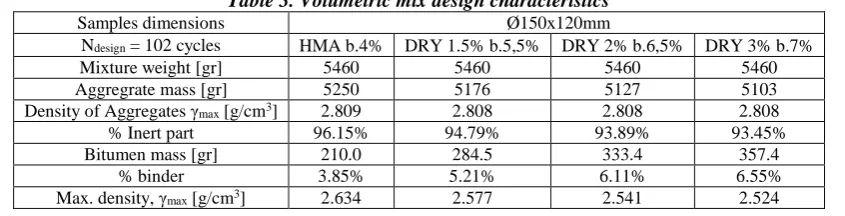
achieved as the target value in the case of HMA mixtures [86]. The volumetric mix-design is clarified in Table 3:
Table 3. Volumetric mix design characteristics
Samples dimensions Ø150x120mm
Ndesign = 102 cycles HMA b.4% DRY 1.5% b.5,5% DRY 2% b.6,5% DRY 3% b.7%
Mixture weight [gr] 5460 5460 5460 5460
Aggregrate mass [gr] 5250 5176 5127 5103
Density of Aggregates γmax [g/cm3] 2.809 2.808 2.808 2.808
% Inert part 96.15% 94.79% 93.89% 93.45%
Bitumen mass [gr] 210.0 284.5 333.4 357.4
% binder 3.85% 5.21% 6.11% 6.55%
[Martínez Soto, F.* et al., Vol.5 (Iss.2), February 2018]
ISSN: 234-5197
Impact Factor: 3.765
I
NTERNATIONAL
J
OURNAL
OF
R
ESEARCH
S
CIENCE
&
M
ANAGEMENT
http: // www.ijrsm.com © International Journal of Research Science & Management
[101]
For mixtures with rubber, the percentage of voids varied between 3.01% and 3.37%. Therefore, it was never possible to exceed the maximum value of an established 4% of voids for a suitable bituminous mixture in sub-ballast.
Testing program for HMA Mixtures
Each HMA specimen was compacted to the maximum number of gyrations, with data collected during the compaction process. During the post-compaction phase, the height of the specimen was frequently monitored. The density has been continually monitored knowing the initial weight of the mix, the fixed volume of the mold, and the measured height (Table 4).
Table 4. HMA final recipe. Volumetric analysis of recipes for laboratory
Sample H
[mm] Mass Aggr. [gr] Binder [%] Sample mass [gr] Binder mass [gr] Sample mass [gr] Binder mass [gr] Filler [gr] Sand [gr] fØ5-10mm [gr] fØ10-15mm [gr] fØ20-25mm [gr] fØ25-30mm [gr]
b.3.5% 120 5101 3.5 5280 179 5280 185 646 1162 380 1093 951 1047
b.4.0% 120 5250 4.0 5460 210 5350 214 655 1178 385 1108 963 1061
b.4.5% 120 5225 4.5 5460 235 5325 240 652 1172 383 1103 959 1056
b.5.0% 120 5167 5.0 5425 258 5270 264 645 1160 379 1091 949 1045
Table 5. HMA final recipe. Results after compaction
Ø150xh (mm) Binder (%) Sample mass [gr]
HNdes[mm] H24h
[mm] Eff. binder [gr] M1 24h [gr] M2 24h [gr] M3 24h [gr] ϒapp [g/cm3]
Γmax
[g/cm3]
Γmb*
[g/cm3]
Γmm [%] Va [%] VMA [%] VFA [%] Δ%b*
HMA3.5_1 3.5 5280 116.1 116.3 178.4 5280 3227 5284 2.557 2.656 2.565 96.6 3.65 12.10 69.87 3.36
HMA3.5_2 3.5 5275 116.4 116.1 177.7 5262 3216 5267 2.556 2.656 2.557 96.3 3.70 12.15 69.58 3.38
Averaged 3.5 5277.5 116.25 116.2 178.07 5271 3221 5275 2.556 2.656 2.561 96.4 3.68 12.12 69.73 3.37
HMA4.0_1 4.0 5250 114.3 113.33 201.3 5239 3202 5240 2.561 2.636 2.577 97.8 2.78 12.40 77.59 3.51
HMA4.0_2 4.0 5250 115.9 115.50 200.2 5209 3189 5214 2.563 2.636 2.553 96.8 2.70 12.32 78.12 3.48
Averaged 4.0 5250 115.1 144.40 200.73 5224 3195 5227 2.562 2.636 2.565 97.3 2.74 12.36 77.86 3.49
HMA4.5_1 4.5 5225 114.3 113.3 223.8 5201 3178 5204 2.558 2.617 2.567 98.1 2.15 12.90 83.30 3.76
HMA4.5_2 4.5 5224 114.2 112.9 224.3 5214 3186 5215 2.561 2.617 2.572 98.3 2.06 12.82 83.94 3.72
Averaged 4.5 5225 114.2 113.2 224.0 5208 3182 5209 2.559 2.617 2.569 98.2 2.11 12.86 83.62 3.74
HMA5.0_1 5.0 5452 119.5 116.33 258.6 5436 3322 5438 2.561 2.598 2.567 98.8 1.39 13.24 89.74 3.94
HMA5.0_2 5.0 5557 121.3 117.50 262.8 5525 3361 5526 2.544 2.598 2.561 98.5 2.05 13.82 85.44 4.21
Averaged 5.0 5452 119.3 116.11 258.1 5425 3312 5426 2.558 2.598 2.565 98.7 1.50 13.34 89.11 4.07
Table 6. Determination of air voids in HMA mixes
HMA Sample Wair
(m1) Wdry (m3) Wwater (m2) ϒw (Kg/m3) %b
ϒb (Kg/m3)
ϒaggr (g/cm3)
ϒbulk (Kg/m3)
ϒbulk
(Ẋ) (N%Va des) %Va
%Va (Ẍ) %b* (Ẍ) binder
3.5%
HMA3.5_1 5280 5284 3227 996.30 3.5 1033.3 2807.9 2556.9 2556.30 3.65 3.65 3.67 3.37
HMA3.5_2 5262 5267 3216 2555.7 3.69 3.70
binder 4.0%
HMA4.0_1 5239 5240 3202
996.30 4.0 1033.3 2807.9 2560.7 2561.74 2.78 2.79 2.74 3.49
HMA4.0_2 5209 5214 3189 2562.8 2.70 2.71
binder 4.5%
HMA4.5_1 5201 5204 3178 996.30 4.5 1033.3 2807.9 2558.1 2559.39 2.15 2.17 2.12 3.74
HMA4.5_2 5214 5215 3186 2560.7 2.06 2.07
binder 5.0%
HMA5.0_1 5436 3322 5438
996.30 5.0 1033.3 2807.9 2560.6 2557.85 1.39 1.39 1.50 4.00
HMA5.0_2 5525 3361 5526 2543.6 2.04 2.05
Once the experimentation on the sample range with different binder ratios was accomplished, the %Va-%b graph was constructed. The optimum binder content was established with a 4%. From this relationship, exponential and polynomial regression curves, and an optimal bitumen percentage of 3.91% to 4% was obtained to get a 3% air voids (Fig. 12). Volumetric characteristics, that is, air voids, VMA, VFA, and density were determined for each
specimen at 102 Ndesign gyrations. After compacting the specimens to Ndes gyrations, it has been found the bulk
specific gravity (Γmb) and the theoretical maximum specific gravity (Γmm) for two samples of each blend for the
[Martínez Soto, F.* et al., Vol.5 (Iss.2), February 2018]
ISSN: 234-5197
Impact Factor: 3.765
I
NTERNATIONAL
J
OURNAL
OF
R
ESEARCH
S
CIENCE
&
M
ANAGEMENT
http: // www.ijrsm.com © International Journal of Research Science & Management
[102]
Fig. 12. Air voids vs. Binder content in HMA samples (Ndes.102; φ150x120mm)
Densification curves were plotted for each mixture that stands for the measured relative density at Ndes or Nmax
cycles (%Γmm) versus the logarithm of the number of gyrations (Fig. 13).
Fig. 13. Densification curves for optimal HMA mixtures φ150·120mm
Testing program for DRY mixtures
As has been done with the conventional HMA blend, test mixtures with different bitumen content are made for DRY 1.5%, 2%, and 3% mixtures. The dry-process mixes were human-made with a digestion time between 60, 90 and 120min.
It was observed that the swelling effect in the specimens appeared at the end of the compaction with the SGC during 24h. In this case, in dry mixtures with a higher amount of rubber was greater the swelling effect in comparison with the mixtures at 1.5% and 2% of scrap tire rubber. Therefore, the increase in volume due to "swelling and rebounding effect" is solved increasing the number of gyrations in each case.
Thus, the method by which the number of gyrations to Ndes (102, 182, and 291) is modified in each case, it is
developed to better adjust to the requirements of each mixture with recycled rubber. In conclusion, the final regression equations are (Table 7, Fig. 14).
Table 7. Regression equations according to Superpave compaction curves
HMA (b.4.0%) → Γmm (Ndes. 102) = 8.365Log(x) + 80.954
DRY1.5 (b.5.0%) → Γmm (Ndes. 152) = 7.896Log(x) + 81.040
DRY1.5 (b.5.5%) → Γmm (Ndes. 152) = 7.546Log(x) + 81.595
DRY2.0 (b.6.0%) → Γmm (Ndes. 181) = 5.433Log(x) + 86.209
DRY2.0 (b.6.5%) → Γmm (Ndes. 181) = 5.311Log(x) + 86.881
DRY3.0 (b.6.5%) → Γmm (Ndes. 291) = 4.161Log(x) + 86.955
[Martínez Soto, F.* et al., Vol.5 (Iss.2), February 2018]
ISSN: 234-5197
Impact Factor: 3.765
I
NTERNATIONAL
J
OURNAL
OF
R
ESEARCH
S
CIENCE
&
M
ANAGEMENT
http: // www.ijrsm.com © International Journal of Research Science & Management
[103]
Fig. 14. (a) Densification curves for all SGC mixtures; (b) Trendline and regression equations
The compatibility of these mixes is entirely different even though 3% of air voids is the target value, being more sensitive to the gyration levels than the other. Another relevant aspect that can be observed in the results is that as the rubber content in the mixture increases, the workability (slope of the trend line) decreases (higher densification), due to several reasons:
The increase of bitumen content and the reaction of ground rubber – bitumen;
The adjustment of the grain size curve to introduce the optimal volumetric proportion of rubber replacing
part of the unbound aggregates.
By analyzing the results obtained for each of the mixtures, we can determine the optimum bitumen content to make any mix based on the percentage of rubber required.
Analyzing the regression curves of Fig. 14, the relationship between the proportion of voids and optimum asphalt content is obtained (Table 8).
Table 8. Air voids vs. Binder content in HMA_DRY samples (Optimal binder content)
%Va %b*(Ndes) %b*(24h) %b*(7d)
Dry 1.5% 3.0% 4.95% 5.34% 6.05%
Dry 2% 3.0% 4.91% 5.61% 6.38%
Dry 3% 3.0% 6.70% 7.13% 7.27%
(Averaged)
%Va* %b*(Ndes) %b*(24h) %b*(7d)
Dry 1.5% 3.0% 4.95% 5.40% 6.1%
Def. %b 5.0% 5.5% 6.0%
Dry 2% 3.0% 5.00% 5.70% 6.4%
Def. %b 5.0% 6.0% 6.5%
Dry 3% 3.0% 6.70% 7.20% 7.3%
Def. %b 7.0% 7.5% 7.5%
Conclusion
[Martínez Soto, F.* et al., Vol.5 (Iss.2), February 2018]
ISSN: 234-5197
Impact Factor: 3.765
I
NTERNATIONAL
J
OURNAL
OF
R
ESEARCH
S
CIENCE
&
M
ANAGEMENT
http: // www.ijrsm.com © International Journal of Research Science & Management
[104]
However, additional work is needed to verify the robustness of the methodology using other materials and different sizes of recycled rubber, other ratios. Also, the procedure based on experimental approximations still lacks strong aspects of turning it into a widely accepted method. In fact, this work has considered a simplified system of a bituminous matrix (aggregates, bitumen, air voids and rubber) and has been considered the compression as a determining factor that is exerted in compaction. It is proposed as a future line to carry out studies to decide the effect of real temperature according to the climatic zone, the behavior of rubber and the mutual interactions between rubber and bitumen.
To prove a repeatable laboratory procedure is necessary to control all the variables to keep the mixing and compaction conditions consistent. Even if this methodology represents the first step towards a new SCR blends design approach, it provides promising results in estimating the final void content after thermal stabilization and curing in mixtures of asphalt with rubber.
The protocol followed during the mix production of test specimens in the laboratory has been justified, with a section, since the behavior of the rubber requires care in the post-compaction phase that does not occur in conventional HMA mixtures.
A key point was the fact that the binder exerts a high influence on the final mechanical response of all the mixtures studied. The service life of asphalt pavements will directly depend on the type of binder used, and thus an adequate choice is crucial to design more durable sub-ballast layers. Using rubber in railways construction is a sustainable solution that ensures consumption of massive quantities of these waste materials.
Compliance with ethical standard
The author(s) declare(s) that there is no potential conflict of interest, also confirm that the manuscript has been read and approved by all named authors and that there are no other persons who satisfied the criteria for authorship but are not listed. We further confirm that the order of authors listed in the manuscript has been approved by all of us and, that we have followed the regulations of our institutions concerning intellectual property.
Acknowledgements
The research presented in this presentation was carried out as part of the Marie Curie Initial Training Network (ITN) action, FP7-PEOPLE-2013-ITN. This project has received funding from the European Union’s Seventh Framework Programme for research, technological development and demonstration under grant agreement number 607524.
References
[1] Amirkhanian S.N., and Williams B., (1993). “Recyclability of Moisture-Damaged Flexible Pavements.”
Journal of Materials in Civil Engineering, American Society, Vol. 5, No. 4, pp. 510-530.
[2] Buonanno A. and Mele R., (2000). “The use of bituminous mix sub-ballast in the Italian State Railways,”
2nd Eurasphalt & Eurobitume Congress. Barcelona, Spain.
[3] Epps J.A., (1994). “Uses of recycled rubber tires in highways.” Washington, DC: Synthesis of Highway
Practice No.198, TRB National Research Council. NCHRP Report.
[4] Feiteira Dias J L., Picado-Santos L.G., & Capitão S.D., (2014). “Mechanical performance of dry-process
fine crumb rubber asphalt mixtures placed on the Portuguese road network.” Construction and Building Materials, 73, 247–254. http://doi.org/10.1016/j.conbuildmat.2014.09.110.
[5] López Pita A., Teixeira P. F., Casas C., Ubalde L. and Robusté F., (2007). “Evolution of track geometric
quality in high-speed lines: the 10-year experience of the Madrid-Seville line”. Proceedings of the Institution of Mechanical Engineers, Part F, Journal of Rail and Rapid Transit, Volume 221, Number 2, 2007, pp. 147-155 (9). ISSN 0954-4097.
[6] Shulman V.L., (2000). “Tyre Recycling After 2000: Status and Options”, European Tyre Recycling
Association, Paris, France.
[7] Xiangwu D. Z., (2005). “Rubber-Modified Asphalt Concrete for High-Speed Railway Roadbeds; Final
Report for High-Speed Rail.” IDEA Project 40, Transportation Research Board, USA.
[8] Sienkiewicz, M., Borzędowska-Labuda, K., Wojtkiewicz, A., & Janik, H. (2017). Development of
[Martínez Soto, F.* et al., Vol.5 (Iss.2), February 2018]
ISSN: 234-5197
Impact Factor: 3.765
I
NTERNATIONAL
J
OURNAL
OF
R
ESEARCH
S
CIENCE
&
M
ANAGEMENT
http: // www.ijrsm.com © International Journal of Research Science & Management
[105]
[9] Wang, S., Cheng, D., & Xiao, F. (2017). Recent developments in the application of chemical approaches
to rubberized asphalt. Construction and Building Materials, 131, 101-113.
[10]J. Shen, S. Amirkhanian, F. Xiao, B. Tang, Influence of surface area and size of crumb rubber on
high-temperature properties of crumb rubber modified binders, Constr. Build. Mater. 23 (1) (2009) 304–310.
[11]J. Shen, Z. Xie, B. Li, Comprehensive evaluation of the long-term performance of rubberized pavement:
phase II: the influence of rubber and asphalt interaction on mixture durability, FHWA-GA-12-1229, Georgia Department of Transportation, Statesboro, GA, 2014.
[12]M. Yu, G. Wu, J. Zhou, S. Easa, Proposed compaction procedure for dry process crumb rubber modified
asphalt mixtures using air void content and expansion ratio BT – proposed compaction procedure for dry process crumb rubber modified asphalt mixtures using air void content and expansion (2014).
[13]Hidalgo-Signes, C., Garzón-Roca, J., Grima-Palop, J. M., & Insa-Franco, R. (2017). Use of rubber shreds
to enhance attenuation of railway sub-ballast layers made of unbound aggregates. Materiales de Construcción, 67(326), 115.
[14]Teixeira, P. F., Ferreira, P. A., Pita, A. L., Casas, C., & Bachiller, A. (2009). The use of bituminous
sub-ballast on future high-speed lines in Spain: structural design and economic impact. International Journal of Railway, 2(1), 1-7.
[15]Albalat, S. A., Domingo, L. M., Sanchis, I. V., Herráiz, J. I. R., & Segarra, A. V. (2011). Crumb Rubber
Modified Bitumen for the sub-ballast layer. 9th World Congress on Railway Research, Lille, France.
[16]Z. Xie, J. Shen, Performance of porous European mix (PEM) pavements added with crumb rubbers in a
dry process, Int. J. Pavement Eng. 17 (7) (Aug. 2016) 637–646.
[17]Shafabakhsh, G. H., Sadeghnejad, M., & Sajed, Y. (2014). A case study of rutting performance of HMA
modified with waste rubber powder. Case Studies in Construction Materials, 1, 69-76.
[18]Way, G., Carlson, D., Sousa, J., Kaloush, K., and Biligiri, K. (2010). "Introduction to asphalt-rubber pavement noise reducing characteristics," 39th International Congress on Noise Control Engineering, Lisbon, Portugal, pp. 7408–7417.
[19]Torretta, V., Rada, E. C., Ragazzi, M., Trulli, E., Istrate, I. A., & Cioca, L. I. (2015). Treatment and disposal of tires: Two EU approach. A review. Waste management, 45, 152-160.
[20]Machin, E. B., Pedroso, D. T., & de Carvalho Jr, J. A. (2017). Energetic valorization of waste tires. Renewable and Sustainable Energy Reviews, 68, 306-315.
[21]Robinson, M., & Kapoor, A. (Eds.). (2009). Fatigue in railway infrastructure. Elsevier.
[22]D'Andrea, N. Fiore. (2003). Fatigue life of asphalt concrete with rubber grains. 2003. In Fatigue Damage
of Materials – Experiment and analysis. (pp. 65-74). ISBN: 1-85312-979-8: WITpress (UK).
[23]H. Wang, Z. Dang, L. Li, Z. You, Analysis of fatigue crack growth laws for crumb rubber modified (CRM) asphalt mixture, Constr. Build. Mater. 47 (2013) 1342–1349.
[24]International Union of Railways. (2005). UIC Code 518 – “Testing and Approval of Railway Vehicles
from their Dynamic Behaviour” – Safety – Track Fatigue – Ride Quality. Paris, France.
[25]Ozer, H., Al-Qadi, I. L., Singhvi, P., Bausano, J., Carvalho, R., Li, X., & Gibson, N. (2018). Prediction
of pavement fatigue cracking at an accelerated testing section using asphalt mixture performance tests. International Journal of Pavement Engineering, 19(3), 264-278.
[26]SHRP 407 (1994). “Superpave design manual for new construction and overlays.”
[27]Kennedy, T. W., Huber, G. A., Harrigan, E. T., Cominsky, R. J., Hughes, C. S., Von Quintus, H., &
Moulthrop, J. S. (1994). Superior performing asphalt pavements (Superpave): The product of the SHRP asphalt research program (No. SHRP-A-410). Washington, DC, USA: Strategic Highway Research Program, National Research Council.
[28]F. Martinez-Soto, G. Di Mino (2017). “Optimization of the Mix-Design System for the sub-ballast
railroad,” (JTTE-E 20170721-1) Journal of Traffic and Transportation Engineering 5 (201) 246-259, DOI: 10.17265/2328-2142/2017.05.002, David Publishing Company, Valley Cottage, NY, USA.
[29]F. Martinez-Soto, G. Di Mino (2017). “Procedure for a temperature-traffic model on rubberized asphalt
layer for roads and railways,” (JTTE-E 20170721-1) Journal of Traffic and Transportation Engineering 4, ISSN: 2328-2142, DOI: 10.17265/2328-2142/2017.05.001, David Publishing Company, NY, USA.
[30]AASHTO R 35-151, “Standard Practice for Superpave Volumetric Design for Hot-Mix Asphalt,”
[Martínez Soto, F.* et al., Vol.5 (Iss.2), February 2018]
ISSN: 234-5197
Impact Factor: 3.765
I
NTERNATIONAL
J
OURNAL
OF
R
ESEARCH
S
CIENCE
&
M
ANAGEMENT
http: // www.ijrsm.com © International Journal of Research Science & Management
[106]
[31]Bonaquist, R. F., Christensen, D. W., & Stump, W. (2003). Simple performance tester for Superpave mix
design: First-article development and evaluation (Vol. 513). Transportation Research Board.
[32]Colorado Asphalt Pavement Association. (2000). Guideline for the Design and Use of Asphalt
Pavements for Colorado Roadways. CAPA. Englewood, CO.
[33]Matthews, J. M., Monismith, C. L., & Craus, J. (1993). Investigation of laboratory fatigue testing procedures for asphalt-aggregate mixtures. Journal of Transportation Engineering, 119(4), 634-654.
[34]AASHTO, T. (1999). The standard method for preparing and determining the density of hot mix asphalt
(HMA) specimens using the SHRP Gyratory Compactor. FHWA Multi-Regional Asphalt Training and Certification Group, 14.
[35]AASHTO, M. 323-13. 2013. Standard Specification for Superpave volumetric mix design.
[36]F. Martinez-Soto, G. Di Mino & F. Acuto (2017). “Effect of Temperature and traffic on mix-design of
bituminous asphalt for railway sub-ballast layer.” BCRRA2017 Conference Proceedings CRC Press Taylor & Francis Group.
[37]Soto, F. M., & Di Mino, G. (2017). Empirical Superpave Mix-Design of Rubber-Modified Hot-Mix
Asphalt in Railway Sub-Ballast. World Academy of Science, Engineering, and Technology. International Journal of Civil and Environmental Engineering, Vol. 4, Nº(9). urn:dai:10.1999/1307-6892/69025.
[38]Soto, F. M. (2018). Volumetric Mix-Design optimization of bituminous rubber-mixtures in railway
sub-ballast, (IJESRT/Q080/17) International Journal of Engineering Sciences and Research Technology, Coden: IJESS7, ISSN: 2277-9655, DOI: 10.5281/zenodo.1158653 [Volume 7, Issue 1, Nº61, pp. 483-507, January 2018].
[39]Prowell, B. D., & Brown, E. R. (2007). Superpave mix design: verifying gyration levels in the Ndesign
table (Vol. 573). Transportation Research Board.
[40]Witczak, M.W., Kaloush, K., Pellinen, T., et al. (2002). Simple Performance Test for Superpave Mix
Design. NCHRP Report 465, Transportation Research Board, Washington, D.C.
[41]Bairgi, B., Hossain, Z., & Hendrix, R. D. (2015). Investigation of rheological properties of asphalt rubber
toward sustainable use of scrap tires. In IFCEE 2015 (pp. 359-368).
[42]Esveld, Coenraad, and Coenraad Esveld. "Modern railway track." (2001).
[43]Esveld, C. (2003). Recent developments in slab track. European Railway Review, 9(2), 81-85.
[44]Sánchez‐Borràs, Marta, and Andrés López‐Pita. "Rail Infrastructure Charging Systems for High‐Speed
Lines in Europe." Transport Reviews 31.1 (2011): 49-68.
[45]Rose J. G., Bryson S. (2009) “Hot Mix Asphalt Railway Track-beds: Trackbed Materials, Performance
Evaluations, and Significant Implications.” Int. Conference on Perpetual Pavements 2009; Ohio.
[46]Rose J.G., Teixeira P.F., Veit P. (2011). “International Design Practices, Applications, and Performances
of Asphalt/Bituminous Railway Trackbeds,” GEORAIL, Paris, France.
[47]Fang, M.; Rose, J.G.; West, R.C.; Qiu, Y.; (2011) Ai C. Comparative analysis on the dynamic behavior
of two HMA rail-way substructures. J Transp. Res Board; 19(1):26-34.
[48]Rose, J.; Agarwal, N. K.; Brown, J. D., and Ilavala, N. (2010). KENTRACK, A Performance-Based
Layered Elastic Railway Trackbed Structural Design and Analysis Procedure – A Tutorial, Proceedings of the 2010 Joint Rail Conference, 38 pages.
[49]Rose, Jerry G., Dingqing Li, and Lindsay A. Walker. "Tests and evaluations of in-service asphalt trackbeds." Proceedings of the American Railway Engineering and Maintenance-of-Way Association, 2002 Annual Conference & Exposition, September. 2002.
[50]Teixeira, P., López-Pita, A., Casas, C., Bachiller, A., Robuste, F. (2006). "Improvements in High-Speed
Ballasted Track Design: Benefits of Bituminous Subballast Layers." Transportation Research Record: Journal of the Transportation Research Board, (1943), 43-49.
[51]Soto, F. M. (2018). “Eco-Sustainable optimization of the mix-design methodology in modified
bituminous mixtures with a high percentage of recycled tire rubber,” (GJESRM/A008/18) Global Journal of Engineering Science and Research Management, ISSN: 2349-4506, DOI: 10.5281/zenodo.1156460 [Volume 5, Issue 1, Nº5, pp. 37-59, January 2018].
[52]Soto, F. M., Di Mino, G., & Di Liberto, C. M. (2016). “Evaluation of Dry Asphalt Rubber Concrete in
[Martínez Soto, F.* et al., Vol.5 (Iss.2), February 2018]
ISSN: 234-5197
Impact Factor: 3.765
I
NTERNATIONAL
J
OURNAL
OF
R
ESEARCH
S
CIENCE
&
M
ANAGEMENT
http: // www.ijrsm.com © International Journal of Research Science & Management
[107]
[53]Naude, F., Fröhling, R. & Theron, N. (2005). Development of a methodology to calculate stresses in
track components. Proceedings of the Institution of Mechanical Engineers, Part F: Journal of Rail and Rapid Transit, 219(4), 213-224.
[54]Hermansson, A. (2001). A mathematical model for calculation of pavement temperatures: comparison
of calculated and measured temperatures. Transportation Research Board, (nº1764), 180-188.
[55]Crispino, M. "Valutazione delle temperature in esercizio del subballast ferroviario." Ingegneria Ferroviaria 1 (2001): 1-10.
[56]Crispino M., Festa B., Giannattasio P. (1998). “Valutazione delle temperature della sovrastruttura
ferroviaria per alta velocità attraverso una sperimentazione di laboratorio”. CIFI congress: la tecnologia del trasporto su ferro e l’orientamento al mercato, Napoli.
[57]Barber, E. S. (1957). Calculation of maximum pavement temperatures from weather reports. Highway
Research Board Bulletin, (168).
[58]Crispino, Maurizio. Sovrastrutture ferroviarie per alta velocità: sviluppo di una metodologia di calcolo
ed analisi teorico-sperimentale sul subballast per il miglioramento delle prestazioni. Diss. Tesi di Dottorato in Ingegneria dei Trasporti, 1996.
[59]Crispino, M., M. D’Apuzzo, and R. Lamberti. "Development and Experimental Validation of a
Prediction Model to Assess Railway Traffic Induced Vibrations." EURONOISE 2003, 5th European Conference on Noise Control. 2003.
[60]Ferreira, T. M., et al. (2012). Rail track performance with different sub-ballast solutions: Traffic and environmental effects on subgrade service life. Journal of Transportation Engineering, 138(12), 1541-1550.
[61]AASHTO (American Association of State Highway and Transportation Officials). (2001). “Superpave
Volumetric Design for Asphalt Mixtures.”
[62]AASHTO R 35-151, 444 North Capitol Street N.W., Suite 249 Washington, D.C.
[63]Martinez Soto, F., Di Mino, G. (2018) “Volumetric Mix-Design optimization of bituminous
rubber-mixtures in railway sub-ballast,” (IJESRT/Q080/17) International Journal of Engineering Sciences and Research Technology, Coden: IJESS7, ISSN: 2277-9655, DOI: 10.5281/zenodo.1158653 [Volume 7, Issue 1, Nº61, pp. 483-507, January 2018].
[64]Soto, F. M., & Di Mino, G. (2017) “Increased stability of rubber-modified asphalt mixtures to swelling,
expansion and rebound effect during post-compaction. World Academy of Science, Engineering, and Technology, International Journal of Transport and Vehicle Engineering Vol: 4, Nº7, 2017, Scholar.waset.org/1999.59/73683.
[65]Sadeghi, J., & Barati, P. (2010). Evaluation of conventional methods in Analysis and Design of Railway
Track System. International Journal of Civil Engineering, 8(1), 44-55.
[66]Faheem, A. F., & Bahia, H. U. (2004). Using the gyratory compactor to measure the mechanical stability
of asphalt mixtures (Doctoral dissertation, University of Wisconsin-Madison).
[67]Jitsangiam, P., Chindaprasirt, P., & Nikraz, H. (2013). An evaluation of the suitability of SUPERPAVE
and Marshall asphalt mix designs as they relate to Thailand’s climatic conditions. Construction and Building Materials, 40, 961-970.
[68]Roberts, F. L., Kandhal, P. S., Brown, E. R., Lee, D. Y., & Kennedy, T. W. (1991). Hot mix asphalt
materials, mixture design, and construction.
[69]Pierce, Linda M., and Ginger McGovern. Implementation of the AASHTO mechanistic-empirical
pavement design guide and software. No. Project 20-05, Topic 44-06. 2014.
[70]Rose, J. G., & Bryson, L. S. (2009, May). Hot mix asphalt railway trackbeds: trackbed materials, performance evaluations, and significant implications. International Conference on Perpetual Pavements.
[71]Paixão, A., Fortunato, E., Fontul, S., & Martins, F. (2011). A case study in construction optimization for
the sub-ballast layer. In Proceedings of 11th International Conference on Railway Engineering.
[72]Mohammad, L., Wu, Z., Zhang, C., Khattak, M., & Abadie, C. (2004). Variability of air voids and mechanistic properties of plant-produced asphalt mixtures. Transportation Research Record: Journal of the Transportation Research Board, (1891), 85-97.
[73]Di Mascio, P. & Moretti, L. (2013). Model for estimating temperatures in concrete pavements.
[Martínez Soto, F.* et al., Vol.5 (Iss.2), February 2018]
ISSN: 234-5197
Impact Factor: 3.765
I
NTERNATIONAL
J
OURNAL
OF
R
ESEARCH
S
CIENCE
&
M
ANAGEMENT
http: // www.ijrsm.com © International Journal of Research Science & Management
[108]
[74]Di Mascio, P., Loprencipe, G., & Moretti, L. (2014). Competition in rail transport: a methodology to
evaluate the economic impact of new trains on the track. In 3rd International Conference on Transportation Infrastructure ICTI2014, Pisa (pp.22-25).
[75]Rodriguez, R. G. (2017). An evaluation of the tensile strength of asphalt binder and mortar with recycled
asphalt additives at low temperatures (Doctoral dissertation).
[76]García-Travé, G., Tauste, R., Sol-Sánchez, M., Moreno-Navarro, F., & Rubio-Gámez, M. C. (2017).
Mechanical Performance of SMA Mixtures Manufactured with Reclaimed Geomembrane–Modified Binders. Journal of Materials in Civil Engineering, 30(2), 04017284.
[77]Huang, Y. H., Rose, J. G., & Khoury, C. J. (1987). Thickness design for hot-mix asphalt railroad track
beds. Annual Journal AAPT, Miscellaneous, 56(87), 427-453.
[78]Huang, Y. H., Lin, C., Deng, X. (1984). HOT MIX ASPHALT FOR RAILROAD
TRACKBEDS-STRUCTURAL ANALYSIS AND DESIGN. Asphalt Paving Technology, 53, 475.
[79]Yoder, E. J., & Witczak, M. W. (1975). Principles of pavement design. John Wiley & Sons.
[80]Andrei, D., Witczak, M.W., Mirza, M.W. (1999). “Development of a Revised Predictive Model for the
Dynamic (Complex) Modulus of Asphalt Mixtures,” NCHRP 1-37A, University of Maryland.
[81]Rose, Jerry G., and Konduri, Karthik Charan. 2006. A Railway Trackbed Structural Design Program.
Proceedings of the American Railway Engineering and Maintenance of Way Annual Conference. Louisville, Kentucky. September 2008.
[82]Rose, J., Su, B., and Twehues, F. (2004). “Comparisons of railroad track and substructure computer
model predictive stress values and in-situ stress measurements.” Annual Conf. and Exposition, American Railway Engineering and Maintenance-of-Way Association (AREMA), Nashville.
[83]Hassan, N. A., Airey, G. D., Jaya, R. P., Mashros, N., & Aziz, M. A. (2014). A review of crumb rubber
modification in dry mixed rubberized asphalt mixtures. Jurnal Teknologi, 70(4), 127-134.
[84]Shuler, T. S., Pavlovich, R. D., Epps, J. A., & Adams, C. K. (1985). Investigation of materials and structural properties of asphalt-rubber paving mixtures. Technical Rep. Prepared for Federal Highway Administration, Washington, DC.
[85]Teixeira, P. F. (2009, June). State-of-the-Art on the Use of Bituminous Subballast on European
High-Speed Rail Lines. In Bearing Capacity of Roads, Railways, and Airfields”. Pre-Conference Workshop.
[86]AASHTO R35, 2017 Standard Practice for Superpave Volumetric Design for Asphalt Mixtures.
![Fig. 4. Section of railway track showing the multi-layer system [29]](https://thumb-us.123doks.com/thumbv2/123dok_us/8458635.1707669/4.595.181.401.274.403/fig-section-railway-track-showing-multi-layer.webp)

![Fig. 8. 24hour-Tª variation at different depths [Air Tª 0°C-35ºC]](https://thumb-us.123doks.com/thumbv2/123dok_us/8458635.1707669/8.595.75.526.347.464/fig-hour-ta-variation-different-depths-air-ta.webp)