This article was published in an CASRP journal. The attached copy is furnished to the
author for non-commercial research and education use, including for instruction at the
authors institution, sharing with colleagues and providing to institution
administration.
Other uses, including reproduction and distribution, or selling or licensing
copied, or posting to personal, institutional or third party websites are prohibited.
In most cases authors are permitted to post their version of the article (e.g. in
Word or Tex form) to their personal website or institutional
repository
. Authors
requiring further information regarding CASRP΄s archiving and manuscript policies
encouraged to visit:
http://www.casrp.co.uk/journals
© 2015 CASRP Publishing Company Ltd. UK.
Provided for non-commercial research and education use.
Not for reproduction, distribution or commercial use.
Provided for non-commercial research and education use.
370
CASRP Publisher
International journal of Advanced Biological
and Biomedical Research 3(4) (2015) 370–377
doi: 10.18869/IJABBR.2015.370
Original Article Open Access
The effects of aqueous extract
of onion on performance and
some blood biochemical
parameters of the Cobb and
Ross broilers
M. Farahani
, M. Goodarzi, S. Nanekarani
Department of Animal Science, College of Agriculture, Boroujerd Branch, Islamic Azad University, Boroujerd, Iran.
Abstract
This study was carried out to evaluate the effect of onion extract on growth performance, carcass characteristics and some blood metabolites in Ross and Cobb broiler chickens. One hundred sixty, 1-d-old broiler chickens (mean initial weight: 36.5 ± 1 g) of male sex (Ross-308 and Cobb) were randomly conducted as randomized complete design with 4 treatment and 4 replication. The experimental groups included two treatments for Ross strain – control (RC) and the group receiving basal diet + onion extract as 1 % in drink water
*Corresponding author: Department of Animal Science, College of Agriculture, Boroujerd Branch, Islamic Azad University, Boroujerd, Iran. © 2015 The Authors. This is an open access article under the terms of the Creative Commons Attribution-Non Commercial- No Derives License, which permits use and distribution in any medium, provided the original work is properly cited, the use is non-commercial and no modifications or adaptations are made.
Received 12 November 2015 Accepted 13 December 2015 Available online 19 December 2015
M. Farahani et al. / International journal of Advanced Biological and Biomedical Research (2015) 3(4) 370-377
371 (RO) - and two treatments for Cobb strain –control (CC) and the group receiving basal diet + onion extract as 1 % in drink water (CO). The chickens received food and water freely for 6 weeks. The performance parameters were measured during the experimental period. Blood samplings were performed for determine of blood parameters on 42 days of age. The results showed that use of onion extract lead to significant increase (p<0.05) of yield traits in both strain. Maximum daily weight gain (49.97 g), body weight (2135.94 g), and the lowest feed conversion ratio (1.82) were related to RO group. The using of onion extract resulted in decreasing of triglyceride and glucose and increasing of HDL of blood serum in both strain. In general, the results of this experiment showed that onion extract at the level of 1% in drink water can improve the functional and some blood parameters in Ross and Cobb broiler chickens.
© 2015 Published by CASRP publishing company Ltd. UK. Selection and/or peer-review under responsibility of Center of Advanced Scientific Research and Publications Ltd. UK.
Keywords: Onion extract, Growth performance, Blood metabolites, Ross and Cobb broilers.
1. Introduction
In recent years, in order to responding to the increasing needs of the human to animal protein sources, the poultry industry has been developed considerably. This increase in production is necessary for supplying human food (Lee et al., 2004; Hernandez et al., 2004). Widespread and intensive poultry farming has increased the possibility of disease. For over 50 years the use of antibiotics to reduce the incidence of diseases and also help to increase growth and improve producing traits has been widely used in poultry feeding (Konjufca et al., 1997).
Recently, global pattern is shifting from emphasis on production efficiency to public health security. The World Health Organization (WHO) has been introduced resistance to antibiotics as a major problem for public health on a global scale. While excessive and inappropriate use in human medicine might be detected the most important source of risk, but the use of antibiotics in animal husbandry also plays an important role in the occurrence of this problem. Some scientists have been isolated antibiotic-resistant bacterial strains from the environment, products and gastrointestinal system of humans and animals (Ansari and Khatoon, 1999; Miles et al., 2006; Saleha et al., 2009). Hence, there are the evidences exist of possible antibiotic-resistant genes and transfer them from animal microbes to the human-specific microbes.
Medicinal plants due to effective compounds in their tissues including phenols and polyphenols, terpenoids and essential oils, alkaloids, lectins and polypeptides and other compounds applied antibacterial and immune stimulation effects (Giannenas, 2003), digestive process stimulation (Cross et al., 2007; Lee et al., 2003), reducing levels of blood fat and cholesterol (Chowdhury et al., 2002;Konjufca et al., 1997), antioxidant property (Faix et al., 2009; Radwan Nadia et al., 2008) and finally the growth stimulator (Ciftci et al., 2005).
Onion is plant that can be widely used in poultry nutrition due to multiple properties to improve feed efficiency and food safety. Onion, like garlic, belongs to Allium family and has been used widely in human nutrition. Onion contains sulfur compounds, sugar, calcium, sodium and potassium salts, iodine, silica, iron, phosphorus and A, B and C vitamins. It has been reported that onion has the properties of strengthening the immune system. Previous studies suggest that the biological properties of onion are widely related to sulfur-containing compounds (Kurita et al., 1979). Onion has Alliin and Gamma-glutamyl cysteine that are sulfur-containing components belong to the S-alk(en)yl-L-cysteine sulphoxide compounds.
According to the description given above, this experiment was conducted to investigate the effect of onion on the performance and some blood parameters of broilers and replacement onion instead of antibiotics in broiler diets.
2. Materials and methods
2.1. Animals and diet
372 two treatments for Ross strain – control (RC) and the group receiving basal diet + onion extract as 1 % in drink water (RO) - and two treatments for Cobb strain –control (CC) and the group receiving basal diet + onion extract as 1 % in drink water (CO).The birds were reared in ground cages on the wood chips with dimensions 100 cm × 100cm. The basal diet (Table 1) formulated according to the nutrient requirements (NRC 1994) of broilers based on corn and soybean meal: starter (1 to 21 d) and grower (22 to 42 d).The lighting program included of 23h light plus 1h of darkness. The birds were raised for 6wk and had free access to feed and water throughout the entire experimental period. The house temperature was maintained at 34ºC during the first week, and it was decreased by 3ºC in following weeks until it was stabilized at 22ºC.
2.2. Preparation of onion extract
First, the bulbs of onion layers were separated and washed. Second, the onion bulbs were put in particular container, and kept in freezer at -20°C for two days. This leads to the comfortably destroy of the cells and make it easier for extraction. After 48 h the onion bulbs were removed from the freezer and were defrosted in 30 minutes. Finally, the aqueous extracts were obtained with a filter and poured into particular containers (Wilson et al., 1997).
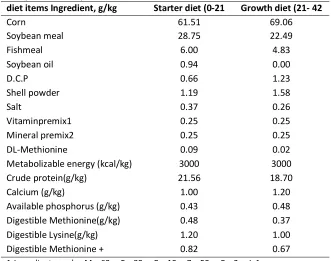
Table 1
Composition of experimental diet
diet items Ingredient, g/kg Starter diet (0-21 days)
Growth diet (21- 42 days)
Corn 61.51 69.06
Soybean meal 28.75 22.49
Fishmeal 6.00 4.83
Soybean oil 0.94 0.00
D.C.P 0.66 1.23
Shell powder 1.19 1.58
Salt 0.37 0.26
Vitaminpremix1 0.25 0.25
Mineral premix2 0.25 0.25
DL-Methionine 0.09 0.02
Metabolizable energy (kcal/kg) 3000 3000
Crude protein(g/kg) 21.56 18.70
Calcium (g/kg) 1.00 1.20
Available phosphorus (g/kg) 0.43 0.48
Digestible Methionine(g/kg) 0.48 0.37
Digestible Lysine(g/kg) 1.20 1.00
Digestible Methionine + Cysteine (g/kg)
0.82 0.67
1-Ingredients per kg: Mg, 60 g; Fe, 80 g; Cu, 10 g; Zn, 50 g; Co, 2 g; I, 1 g,
2- Ingredients per kg : vitamin A, 1000,000 IU; D3, 1500000 IU; E, 15000 IU; K, 3g; B1 2g; B2, 4 g; B6, 3g; B12, 0.015 g; pantothenic acid, 10 g; nicotinic acid, 2 g; folic acid, 1 g; choline, 250g ; Se, 100 g
2.3. Performance
Body weights and feed intake of birds were measured at d 1, 21, and 42 of age and daily body weight gain and feed conversion ratio (FCR) were computed. Mortality was recorded as it occurred and was used to adjust the total number of birds to determine the total feed intake per bird and FCR.
2.4. Carcass characteristics
M. Farahani et al. / International journal of Advanced Biological and Biomedical Research (2015) 3(4) 370-377
373 body (such as breast, thighs, liver, heart, pancreas and abdominal fat) measured with digital scale (with an accuracy of 0.01g).
2.5. Blood biochemical parameters
Blood samples were collected in non-heparin tubes by puncturing the brachial vein. Then the blood sample was centrifuged at 5000 rpm for 5 minutes to separate the serum (SIGMA 4 - 15 Lab Centrifuge, Germany). Individual serum samples were analyzed for glucose, total protein, triglycerides, high-density lipoprotein (HDL), low - density lipoprotein (LDL) and cholesterol. A Pars Azmoon Kit was employed to perform the tests(Allison Auto-analyzer set, USA).
2.6. Statistical analysis
Statistical analysis of data related to measured parameters was carried out using SAS 9.1 statistical software. The significance of differences between means was compared by using of the Duncan’s multiple range tests of SAS. Significance was declared at P≤ 0.05 for all variables measured.
3. Results
3.1. Daily weight gain and average live weight
Data analysis related to daily weight gain showed that there was significant (P<0.05) difference between experimental treatments in grower and total periods (Table 2). During the total period, the highest and the lowest daily weight gain related to RO and CC treatment respectively. The difference between Ross and Cobb groups with their control treatments was significant, but the difference between control groups was not significant. In general, the using of onion in both strains of broiler improved daily weight gain, but it seems that this effect has been more in Ross strain. There was the same trend for average live weight at the end of growth period (Table 3). The highest live weight was related to RO group. The ratio of body weight gain was more in RO (3.13%) than CO group (2.90%).The reason of weight gain caused by onion extract can be due to various compounds in onion. Onion has antibacterial and antifungal properties. It has been reported that onion extract was very effective against Gram-positive bacteria, dermatophyte fungi and growth and production of aflatoxin by Aspergillus (Zohri et al., 1995). In addition to the inhibitory effects against pathogenic bacteria, it has been shown that onion stimulates the growth of beneficial microorganisms. Onions contain Fructooligosaccharides(FOS) that belong to prebiotic components. The components are non-digestible substances that are fermented in the body by bifidobacteria. These compounds help to health maintaining of digestive system and colon (Gibson, 1998). Another reason can be the increase of feed intake. As can be seen in Table 4,onion extract increased feed consumption in chickens.
Aji et al. (2011) fed values of 25, 50 and 100 mg onion per day to broiler chickens and observed that body weight increased with 50 and 100 mg. Al-homidan (2005) used 2 and 6% of onion dry powder in diet of broiler chickens. At the end of the period the birds that received 2%onion dry powder had more weight. Goodarziet al. (2013& 2014) also reported improvement in weight gain of chickens that had received 10 and 30 grams of fresh onion in diet.
3.2. Daily feed intake
374 Table 2
The effects of treatments on daily weight gain (g).
Duration Treatments
RC RO CO CC SEM P value
1-21 days 24.98 21.50 24.63 23.76 0.266 0.338
21-42 days 71.88c 74.95a 73.60b 71.65c 0.382 0.000 1-42 days 48.43bc 49.97a 49.11ab 47.70c 0.267 0.004
abc,
averages within each row together with dissimilar letters are significantly different. (P<0.05). Ross Control (RC), The Ross Chickens receiving the basal diet + 1% onion extract (RO), Cobb chickens receiving the basal diet + 1% onion extract (CO) and Cobb Control (CC).
Table 3
The effects of treatments on average weight gain (g).
Duration Treatments
RC RO CO CC SEM P value
21 days 561.57 561.99 554.17 535.40 5.95 0.330
42 days 2070.94bc 2135.94a 2099.77ab 2040.62c 11.19 0.004
abc,
averages within each row together with dissimilar letters are significantly different. (P<0.05). Ross Control (RC), The Ross Chickens receiving the basal diet + 1% onion extract (RO), Cobb chickens receiving the basal diet + 1% onion extract (CO) and Cobb Control (CC).
Table 4
The effects of treatments on daily feed intake (grams per day).
Duration Treatments
RC RO CO CC SEM P value
1-21 days 36.44b 36.96ab 37.34a 36.55ab 0.134 0.077
21-42 days 143.54b 144.80a 145.13a 143.78b 0.204 0.001
1-42 days 89.99b 90.88a 91.26a 90.37b 0.142 0.000
3.3. Feed conversion ratio (FCR)
Results showed that there was no significant difference in the early period, but during the growing period and total period was significant difference (P<0.05) (Table 5). The best and the worst feed conversion ratio related to CC and RO groups in the whole growing duration, respectively. Onion extract improved the feed conversion ratio in both broiler strains. This using of onion extract improved feed conversion ratio in both strains of broilers. It can be due to the effect onion extract on body weight. Therefore, that reason that has been declared for weight gain due to the consumption of onions is true for FCR. Aji et al. (2011) also reported improving feed conversion ratio in all birds that had received the onions. Goodarziet al. (2013) also reported improving in feed conversion ratio by consuming 10 to 30 grams of fresh onion in the diet.
Table 5
Effects of treatments on feed conversion ratio FCR.
Duration Treatments
RC RO CO CC SEM P value
1-21 days 1.46 1.48 1.52 1.56 0.019 0.322
21-42 days 1.997ab 1.932c 1.972b 2.01a 0.008 0.001
1-42 days 1.860ab 1.820b 1.858ab 1.895a 0.009 0.038
3.4. Carcass characteristics
M. Farahani et al. / International journal of Advanced Biological and Biomedical Research (2015) 3(4) 370-377
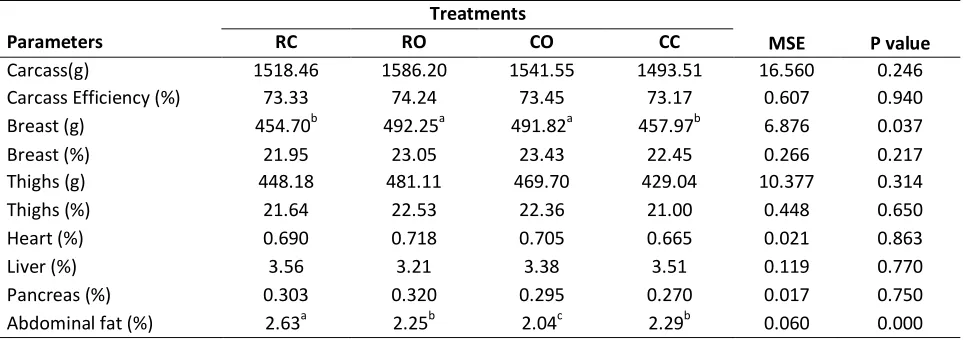
375 Other traits reported in the table are statistically not significant. Onion extract led to breast weight gain in both broiler strains which the maximum amount related to RO and CO groups. There are no significant differences between the control groups. In compare with control, two groups that received onion extract has lower abdominal fat and in general, the amount of abdominal fat in Cobb strain was less than Ross strain. The lowest value of this parameter corresponded to the CO group. Onion extract increased breast weight and reduced abdominal fat. Carcass efficiency also increased non-significantly. Non-significant improvement in the carcass efficiency can be due to effects of onion compounds on broiler chickens. Weight loss of digestive tract caused by the removal of harmful bacteria can be one of the possible causes (Gibson, 1998). The improving of immune system can increase muscle growth (Lancaster and Shaw, 1989). Goodarzi et al. (2013) reported that the using of 30 gr/Kg fresh onion in diet improved some immune system parameters such as bursa and spleen weight.
The using of onion extract in diet reduced abdominal fat in both strains. Sebastian et al. (1979) reported that onion reduced significantly the amount of triglycerides in the liver. Goodarzi et al. (2013) showed that the using of 30 gr/Kg onion reduced triglyceride concentration in blood serum. Suresh and Srinivasan (1997) also found that 3% onion powder reduced blood lipids, lipid peroxides and cholesterol. Onion effects attributed to its sulfur compounds that oxidize free thiol compounds or bind to protein and NADPH. These compounds are essential for the synthesis of fat in the body. Plants can affect the fatty deposits in the body by making changes in the mechanisms involved in lipid metabolism and antioxidant effects. Some active components in plants affect lipid metabolism by moving fatty acids, increase using of fat and reduce weight of abdominal fat (Cross et al., 2007). The potential of plant derivatives in reducing fat deposition in the abdominal area can also be attributed to their role in enhancing the immune response (Dong et al., 2007).
Table 6
Effects of treatments on carcass characteristics at 42 days of age. Treatments
Parameters RC RO CO CC MSE P value
Carcass(g) 1518.46 1586.20 1541.55 1493.51 16.560 0.246
Carcass Efficiency (%) 73.33 74.24 73.45 73.17 0.607 0.940
Breast (g) 454.70b 492.25a 491.82a 457.97b 6.876 0.037
Breast (%) 21.95 23.05 23.43 22.45 0.266 0.217
Thighs (g) 448.18 481.11 469.70 429.04 10.377 0.314
Thighs (%) 21.64 22.53 22.36 21.00 0.448 0.650
Heart (%) 0.690 0.718 0.705 0.665 0.021 0.863
Liver (%) 3.56 3.21 3.38 3.51 0.119 0.770
Pancreas (%)
0.303 0.320 0.295 0.270 0.017 0.750
Abdominal fat (%) 2.63a 2.25b 2.04c 2.29b 0.060 0.000
3.5. Blood serum metabolites
376 comparison with broilers fed basal diet. In contrast to the above experiment, Sklan et al. (1992) did not observed the effect of onion on liver cholesterol.
Using of onion extract in the diet decreased concentrations of Glucose in both strains of broilers. It was distinguished that onion consumption in high level reduced glucose level. Organic sulfur compounds including S - methyl cysteine sulfoxide (SMCS) and S-allyl cysteine sulfoxide (SACS) related to significant improvements in body weight reduction, high blood fat, low protein and glycogen of liver and other features related to diabetes in rats. Application 200 mg/kg per day of SMCS and SACS had similar results with insulin therapy, but without the negative side effects of stimulation in cholesterol synthesis (Sarica et al., 2005). The results of present study were consistent with the results of Al-homidan (2005).
Table 7
Effect of treatments on blood serum metabolites.
Duration Treatments
RC RO CO CC SEM P value
Triglyceride 126.25 a 113.20b 109.25b 117.50ab 2.15 0.0167
Cholesterol 139.00 131.50 133.50 138.00 4.79 0.944
LDL 39.50 37.00 34.50 44.00 3.16 0.798
HDL 80.75b 91.75a 90.00a 81.50b 1.46 0.005
Glucose 88.75a 77.50bc 74.00c 85.00ab 23.13 0.035
4. Conclusion
The results of this experiment showed that one percent onion extract in drinking water can improve performance parameters. Also, it can reduce blood triglyceride and glucose and increase HDL cholesterol in both Ross and Cobb broilers.
References
Aji, S.B., Ignatius, K., Adatu, A., Ado, Y., Nuhu, J.B., Abdulkarim, A., 2011. Effects of feeding onion (Allium cepa) and garlic (Allium sativum) on some performance characteristics of broiler chickens. R. J. Poult. Sci., 4, 22-27. AL-Homidan, A.A., 2005. Efficacy of using different sources and levels of Allium cepa, allium sativum and zingiber
officinal on broiler chicks performance. Saudi. J. Biol. Sc., 12(2), 96-102.
Ansari, F.A., Khatoon, H., 1999. A survey of antibiotic resistance among E. coli strains isolated from poultry in Karachi. Pak. J. Pharmaceut. Sci., 12, 7-14.
Chowdhury, S.R., Chowdhury, S.D., Smith, T.K., 2002. Effects of dietary garlic on cholesterol metabolism in laying hens. Poult. Sci., 81, 1856–1862.
Ciftci, M., Gϋler, T., Dalkiliç, B., Ertas, N., 2005. The effect of anise oil (Pimpinella anisum L.) on broiler performance. Int. J. Poult. Sci., 4, 851-855.
Cross, D.E., Mcdevitt, R.M., Hillman, K., Acamovic, T., 2007. The effect of herbs and their associated essential oils on performance, dietary digestibility and gut microflora in chickens from 7 to 28 days of age. Br. Poult. Sci., 48, 496-506.
Dong, X.F., Gao, W.W., Tong, J.M., Jia, H.Q., Sa, R.N., Zhang, Q., 2007. Effect of polysavone (alfalfa extract) on abdominal fat deposition and immunity in broiler chickens. Poult. Sci., 86, 1955–1959.
Faix, S., Faixová, Z., Plachá, I., Koppel, J., 2009. Effect of cinnamomum zeylanicum essential oil on antioxidative status in broiler chickens. Acta. Vet. Brunen., 78, 411-417.
Giannenas, I., Florou-Paneri, P., Papazahariadou, M., Christaki, E., Botsoglou, N., Spais, A.B., 2003. Effect of dietary supplementation with oregano essential oil on performance of broilers after experimental infection with eimeria tenella. Arch. Anim. Nut. 57, 99 – 106.
Gibson, G., 1998. Dietary modulation of the human gut microflora using prebiotics. Br. J. Nut., 80(2), 209-212. Goodarzi, M., Landy, N., Nanekaran, S., 2013. Effect of onion (Allium cepa L.) as an antibiotic growth promoter
M. Farahani et al. / International journal of Advanced Biological and Biomedical Research (2015) 3(4) 370-377
377 Goodarzi, M., Nanekaran, S., Landy, N., 2014. Effect of dietary supplementation with onion (Allium cepa L.) on performance, carcass traits and intestinal microflora composition inbroiler chickens. Asian. Pacific. J. Trop. Dis., 4(Suppl 1), S297-S301.
Hernandez, F., Madrid, J., Garcıa, V., Orengo, J., Megıas, M.D., 2004. Influence of two plant extracts on broilers performance, digestibility, and digestive organ size. Poult. Sci.., 83, 169–174.
Konjufca, V.H., Pesti, G.M., Bakalli, R.I., 1997. Modulation of cholesterol levels in broiler meat by dietary garlic and copper. Poult. Sci., 76, 1264–1271.
Kurita, N., Miyaji, M., Kurane, R., Takahara, Y., Ichimura, K., 1979. Antifungal activity and molecular orbital energies of aldehyde compounds from oils of higher plants. Agr, Boil. Chem. 43, 2365-2371.
Lancaster, J.E., Shaw, M.L., 1989. G-Glutamyl peptides in the biosynthesis of S-alk(en)yl-L-cysteine sulfoxides (flavor precursors) in Allium. Phytochem., 28, 455–460.
Lee, K.W., Everts, H., Kappert, H.J., Frehner, M., Losa, R., Beynen, A.C., 2004. Effects of dietary essential oil components on growth performance, digestive enzymes and lipid metabolism in female broiler chickens. Br. J. Poult., 3, 738-752.
Lee, K.W., Everts, H., Lankhorst, E., Kappert, H.J., Beynen, A.C., 2003. Addition of β-ionone to the diet fails to affect growth performance in female broiler chickens. Anim. Feed. Sci. Technol., 106, 219–223.
Miles, D.T., McLaughlin, W., Brown, P.D., 2006. Antimicrobial resistance of Escherichia coli isolates from broiler chickens and humans. BMC. Vet. Res. 2, 7, doi: 10.1186/1746-6148-2-7.
Radwan, Nadia, L., Hassan, R.A., Qota, E.M., Fayek, H.M., 2008. Effect of natural antioxidant on oxidative stability of eggs and productive and reproductive performance of laying hens. Int. J. Poult. Sci., 7, 134- 150.
Roy, R.D., Edens, F.W., Parkhurst, C.R., Qureshi, M.A., Havenstein, G.B., 2002. Influence of a propionic acid feed additive on performance of turkey poults with experimentally induced poult enteritis and mortality syndrome. Poult. Sci., 81, 951–957.
Saleha, A.A., TinMyaing, T., Ganapathy, K.K., Zulkifli, I., Rahaand, R., Arifah, K., 2009. Possible effect of antibiotic-supplemented feed and environment on the occurrence of multiple antibiotic resistant Escherichia coli in chickens. Int. J. Poult. Sci., 8, 28-31.
Sarica, S., Ciftci, A., Demir, E., Kilinc, K., Yildirim, Y., 2005. Use of an antibiotic growth promoter and two herbal natural feed additives with and without exogenous enzymes in wheat based broiler diets. South. Afr. J. Anim. Sci., 35, 61-72.
Sebastian, K., Zacharias, N., Philip, B., Augusti, K., 1979. The hypolipidemic effect of onion (Allium cepa Linn) in sucrose fed rabbits. Indian. J. Physiol. Pharmacol., 23(1), 27-30.
Sklan, D., Bernera, Y.N., Rabinowitch, H.D., 1992. The effect of dietary onion and garlic on hepatic lipid concentrations and activity of antioxidative enzymes in chicks. J. Nut. Biochem., 3, 322-325.
Suresh, Babu, P., Srinivasan, K., 1997. Influence of dietary capaicin and onion on the metabolic abnormalities associated with streptozotocin induced diabetes mellitus. Mol.Cell. Biochem., 175, 49-57.
Wilson, C.L., Solar, J.M., Ghaouth, A.E.L., Wisnicwski, M.C., 1997. Rapid evaluation of plant extracts and essential oils for antifungal activity against botrytis cincrea. Plant. Dis., 81(z), 204-210.
Zohri, A., Abdel-Gawad, K., Saber, S., 1995. Antibacterial, antidermatophytic and antitioxigenic activities of onion (Allium cepa L.) oil. Microbiol. Res., 150, 167-172.
How to cite this article: Farahani, M., Goodarzi, M.,
Nanekarani, S., 2015. The effects of aqueous extract of onion on performance and some blood biochemical parameters of the Cobb and Ross broilers. International journal of Advanced Biological and Biomedical Research, 3(4), 370-377.
Submit your next manuscript to CASRP Central and take full advantage of:
• Convenient online submission • Thorough peer review
• No space constraints or color figure charges • Immediate publication on acceptance • Inclusion in Google Scholar
• Research which is freely available for redistribution