27
Education in Medicine Journal. 2018; 10(2): 27–40 www.eduimed.com Penerbit Universiti Sains Malaysia. 2018
Malay Language Translation and Validation of
the Oldenburg Burnout Inventory Measuring
Burnout
Nur Farhanie Mahadi1, Ri Wei Andrew Chin1, Yun Yuan Chua1, Min Ning Chu1, Mung Seong Wong2, Muhamad Saiful Bahri Yusoff3, Yeong Yeh Lee2
1School of Medical Sciences, Universiti Sains Malaysia, Kelantan,
MALAYSIA
2Department of Internal Medicine, School of Medical Sciences,
Universiti Sains Malaysia, Kelantan, MALAYSIA
3Department of Medical Education, School of Medical Sciences,
Universiti Sains Malaysia, Kelantan, MALAYSIA
To cite this article: Mahadi NF, Chin RWA, Chua YY, Chu MN, Wong MS, Yusoff MSB, Lee YY. Malay language translation and validation of the Oldenburg burnout inventory measuring burnout. Education in Medicine Journal. 2018;10(2):27–40. https://doi.org/10.21315/eimj2018.10.2.4
To link to this article: https://doi.org/10.21315/eimj2018.10.2.4
ABSTRACT
This study aimed to translate Oldenburg Burnout Inventory (OLBI) into Malay language, and test its response process (face validity) and internal structure (factor structure and internal consistency). To the author’s knowledge, OLBI is not yet validated in Malay language, thus this study aimed to produce a validated Malay version of OLBI (OLBI-M) in order to measure burnout among the healthcare learner population in Malaysia. OLBI has great potentials mainly due to its accessibility and free of any cost to use it, thus might promote more researchers to conduct burnout research in Malaysia. The forward-backward translation was performed as per standard guideline. The OLBI-M was distributed to 32 medical students to assess face validity and later to 452 medical students to assess construct validity. Data analysis was performed by Microsoft Excel, Statistical Package for the Social Sciences (SPSS), and Analysis of Moment Structures (AMOS). The face validity index of OLBI-M was more than 0.70. The two factors of CBI-M achieved good level of goodness of fit indices (Cmin/df = 3.585, RMSEA = 0.076, GFI = 0.958, CFI = 0.934, NFI = 0.912, TLI = 0.905) after removal of several items. The composite reliability values of the two factors ranged from 0.71 to 0.73. The Cronbach’s alpha values of the three factors ranged from 0.70 to 0.74. This study shows OLBI-M is a reliable and valid tool to measure burnout in medical students. Future burnout studies in Malaysia are highly recommended to utilise OLBI-M. However, it is crucial for further validity to be carried out to verify the credential of OLBI-M.
Keywords: Burnout, Scale development, Validation, Cross-cultural issues, Oldenburg Burnout Inventory
Volume 10 Issue 2 2018
DOI: 10.21315/eimj2018.10.2.4
ARTICLE INFO
Submitted: 14-05-2018 Accepted: 30-05-2018 Online: 29-06-2018
CORRESpONDINg AuThOR Dr. Muhamad Saiful Bahri Yusoff, Department of Medical Education, School of Medical
INTRODUCTION
Burnout, originally defined as a syndrome of exhaustion, depersonalisation, and reduced professional efficacy, is encountered among employees who work with other people, such as in social work, health care, and teaching (1). It has been proved years later in a number of empirical research that burnout does bother employees of probably every type of jobs (2, 3) but also students of every field of studies (4).
The most widely used inventory in burnout research is the Maslach Burnout Inventory (MBI) (5), which contained the aforementioned three factors. It is not without criticisms however and among them include measurement of only affective dimension of exhaustion and the one-directional wording system (6). Others also suggested a two-factor model instead of three since reduced personal efficacy may be considered a sub-dimension of exhaustion.
The Oldenburg Burnout Inventory (OLBI) was developed by Demerouti & Bakker from Germany to overcome the limitations of MBI (7) and it is used to measure burnout of learners in higher education (5). In addition to affective component of exhaustion, OLBI assesses the cognitive and physical components. OLBI inventory has a more balanced positive and negative wording system (6). It is suitable for employees of any jobs but also students of any fields (8). OLBI has been translated into several languages such as Dutch and Brazillian with good reliability (7, 9).
The current study aimed to validate a Malay language version of OLBI (OLBI-M) among medical students in one of the largest public university in Malaysia. This study was designed to answer the following questions: a) Do the items of OLBI-M clear and easily understood by the Malaysian respondents? b) Do the two factors of OLBI-M achieve a satisfactory level of construct validity? c) Do the two factors of OLBI-M show a high level of internal consistency?
METHODOLOGY
The Forward-Backward Translation of OLBI
The forward-backward translation was performed based on available guideline (10). For the forward translation, a content expert (a psychiatrist, FI) and a language expert (professional linguistic teacher, NNH) translated the original English version of OLBI into the Malay version. A meeting was then held with the experts including the investigators to reconcile and finalise the translated Malay version (OLBI-M). For backward translation, another content expert (a psychiatrist, RZ) and another language expert (SAMK) translated the reconciled Malay version of OLBI into English version. This was followed by a meeting with experts and investigators to reconcile the translated and original English version of OLBI. Further modifications are made to the translated Malay version if needed. Figure 1 provides a summary on details of translation process, and the Malay translation, OLBI-M is provided in the Supplement I.
The Validation Study Procedure
The face validity of OLBI-M was assessed by measuring its clarity and comprehensibility by 32 medical students from the same institution and did not involve with the construct validity study.
Assessment of face validity (32 Respondents)
Assessment of construct validity (452 Respondents)
Analysis of results using SPSS & AMOS
Finalised report
Finalized translation of questionnaire Malay language version Questionnaire (Original English Version)
Content expert (English)
Content expert (Malay)
Language expert (English)
Language expert (Malay) Forward translation
Backward translation Backward translation
Forward translation
Malay version Malay version
English version English version
Board meeting
Malay language consented version
85 were 2nd year medical students, 76 were 3rd year medical students, 88 were 4th year medical students, and 88 were 5th year medical students.
Eligible participants were provided with an information sheet that contained relevant details of the study and informed consent was obtained. Following this, demographic details of participants were recorded.
They were approached individually via Facebook Messenger through their facebook account. The data were collected through an online questionnaire developed using the Google Forms. They received an informed consent form reassuring them about anonymity, confidentiality and that published results were solely for scientific purpose. Due to the use of online link, all the attempted questionnaires were completed by the participants.
Ethical Approval
Ethical approval was obtained from the Human Research Ethics Committee Universiti Sains Malaysia (HREC) with the code of USM/JEPeM/15020029.
Psychometric Properties
The following psychometric parameters were analysed: face validity, construct validity, and internal consistency.
Face validity
Two indices of face validity i.e. clarity and comprehension were assessed through 5-Likerts scale responses based on OLBI-M items using SPSS. For clarity, the participants were requested to respond on a scale of 1 (not clear at all) until 5 (very clear) and for comprehension, on a scale of 1 (unable to understand at all) until 5 (easily understood). These responses were then categorised into 0 (not clear or unable to understand) and 1 (clear or able to understand) for calculation of face validity
index. The universal face validity index was calculated by averaging the index value of clarity and comprehension. In this study, the value of content validity index was adopted to interpret the value of face validity index, in which 80% and above was considered as a satisfactory level of face validity (12).
Construct validity
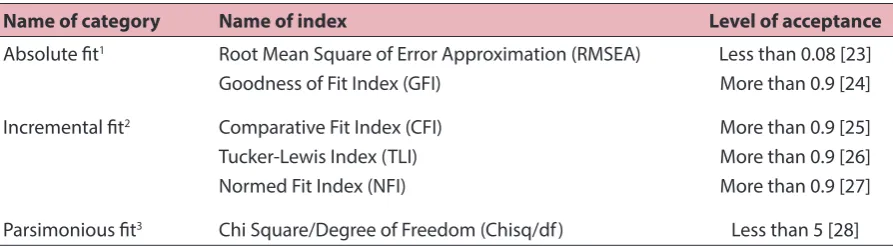
The construct validity of OLBI-M was assessed through goodness of fit indices, convergent validity and discriminant validity. The latent constructs of OLBI-M were considered fit if all the goodness of fit indices achieve minimal requirement as stated in Table 1. Convergent validity was checked with size of factor loading, average variance extracted (AVE), and composite reliability (CR). For each construct, item factor loading values should be reasonably high (which are 0.5 or more) to signify convergent validity. AVE and CR would be calculated manually using formulas as recommended by Fornell & Larcker (13) and Hair et al. (14). Values of 0.5 or more for AVE, and 0.6 or more for CR were considered as indicators to signify convergent validity. Discriminant validity was tested by comparing its AVE and shared variance (SV) values. SV is usually calculated as the square of correlation between two constructs (14, 15). Constructs were considered to have achieved acceptable level of discriminant validity when their AVE values were higher than their SV values. A correlation of more than 0.85 between constructs was considered as an indicator to signify poor discriminant validity (16).
Internal consistency
Data and Statistical Analysis
Data analysis was performed by Microsoft Excel, SPSS Version 22 (SPSS Inc., Chicago, US), and AMOS software (AMOS Development Corporation, Crawfordville, Florida, USA). Confirmatory factor analysis (CFA) is a multivariate statistical procedure that is oftenly used to test the ability of the measured variable in representing the number of construct. In CFA, the users can specify the number of factor required in the data and they can identify the relationship between measured variable to the latent variable. It is an accepted tool to confirm or reject the confirm measurement theory.
RESULTS
Out of 452 respondents, 167 (36.9%) were males and 285 (63.1%) were females. Pertaining to ethnic groups, 195 (43.1%) were Malays, followed by 174 Chineses (38.5%), 66 Indians (14.6%), and 17 others (3.8%).
Face Validity of OLBI-M
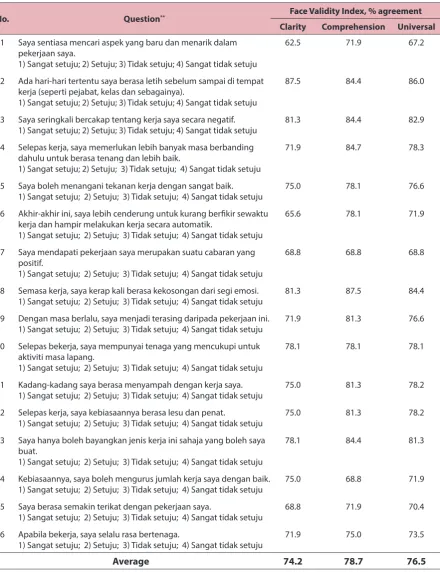
The face validity index of clarity and comprehension were 74.2% and 78.7% respectively. The universal face validity index was 76.5%, indicating a satisfactory level of face validity. The details of item-level indices
were summarised in Table 2. These results support a satisfactory level of face validity at item level.
Construct Validity of OLBI-M
Out of 452 students, 115 were 1st year medical students, 85 were 2nd year medical students, 76 were 3rd year medical students, 88 were 4th year medical students, and 88 were 5th year medical students, ranging from 19 to 26 years old with 285 of them are female and the rest are male.
The latent constructs were considered fit if all the goodness of fit indices achieve minimal requirement as stated in Table 1. Results of confirmatory analysis (CFA) are shown in Table 3. CFA showed that the one-factor model with 16 items was not a model fit, indicating OLBI has multiple constructs. Similarly, the original two-factor model with 16 items failed to achieve acceptable values of goodness of fit indices, suggesting a poor model fit. Stepwise removal of items was performed based on modification indices, and standardised residual covariance and standardised regression weighted were performed to improve the model fitness. The model fit was achieved after removal of seven items that resulted in the final two-factor model with nine items as is shown in Table 3.
Table 1: Goodness of fit indices that were used to signify model fit
Name of category Name of index Level of acceptance
Absolute fit1 Root Mean Square of Error Approximation (RMSEA) Less than 0.08 [23]
Goodness of Fit Index (GFI) More than 0.9 [24]
Incremental fit2 Comparative Fit Index (CFI) More than 0.9 [25]
Tucker-Lewis Index (TLI) More than 0.9 [26]
Normed Fit Index (NFI) More than 0.9 [27]
Parsimonious fit3 Chi Square/Degree of Freedom (Chisq/df) Less than 5 [28]
Notes: 1Absolute fit: Measures overall goodness-of-fit for both the structural and measurement models collectively.
This type of measure does not make any comparison to a specified null model (incremental fit measure) or adjust for the number of parameters in the estimated model (parsimonious fit measure). 2Incremental fit: Measures
goodness-of-fit that compares the current model to a specified “null” (independence) model to determine the degree of improvement over the null model. 3Parsimonious ft: Measures goodness-of-fit representing the degree of model fit per
Table 2: The face validity index of clarity and comprehension of all OLBI-M items
No. Question** Face Validity Index, % agreement
Clarity Comprehension Universal
1 Saya sentiasa mencari aspek yang baru dan menarik dalam pekerjaan saya.
1) Sangat setuju; 2) Setuju; 3) Tidak setuju; 4) Sangat tidak setuju
62.5 71.9 67.2
2 Ada hari-hari tertentu saya berasa letih sebelum sampai di tempat kerja (seperti pejabat, kelas dan sebagainya).
1) Sangat setuju; 2) Setuju; 3) Tidak setuju; 4) Sangat tidak setuju
87.5 84.4 86.0
3 Saya seringkali bercakap tentang kerja saya secara negatif.
1) Sangat setuju; 2) Setuju; 3) Tidak setuju; 4) Sangat tidak setuju 81.3 84.4 82.9 4 Selepas kerja, saya memerlukan lebih banyak masa berbanding
dahulu untuk berasa tenang dan lebih baik.
1) Sangat setuju; 2) Setuju; 3) Tidak setuju; 4) Sangat tidak setuju
71.9 84.7 78.3
5 Saya boleh menangani tekanan kerja dengan sangat baik.
1) Sangat setuju; 2) Setuju; 3) Tidak setuju; 4) Sangat tidak setuju 75.0 78.1 76.6 6 Akhir-akhir ini, saya lebih cenderung untuk kurang berfikir sewaktu
kerja dan hampir melakukan kerja secara automatik.
1) Sangat setuju; 2) Setuju; 3) Tidak setuju; 4) Sangat tidak setuju
65.6 78.1 71.9
7 Saya mendapati pekerjaan saya merupakan suatu cabaran yang positif.
1) Sangat setuju; 2) Setuju; 3) Tidak setuju; 4) Sangat tidak setuju
68.8 68.8 68.8
8 Semasa kerja, saya kerap kali berasa kekosongan dari segi emosi. 1) Sangat setuju; 2) Setuju; 3) Tidak setuju; 4) Sangat tidak setuju
81.3 87.5 84.4
9 Dengan masa berlalu, saya menjadi terasing daripada pekerjaan ini.
1) Sangat setuju; 2) Setuju; 3) Tidak setuju; 4) Sangat tidak setuju 71.9 81.3 76.6 10 Selepas bekerja, saya mempunyai tenaga yang mencukupi untuk
aktiviti masa lapang.
1) Sangat setuju; 2) Setuju; 3) Tidak setuju; 4) Sangat tidak setuju
78.1 78.1 78.1
11 Kadang-kadang saya berasa menyampah dengan kerja saya.
1) Sangat setuju; 2) Setuju; 3) Tidak setuju; 4) Sangat tidak setuju 75.0 81.3 78.2 12 Selepas kerja, saya kebiasaannya berasa lesu dan penat.
1) Sangat setuju; 2) Setuju; 3) Tidak setuju; 4) Sangat tidak setuju
75.0 81.3 78.2
13 Saya hanya boleh bayangkan jenis kerja ini sahaja yang boleh saya buat.
1) Sangat setuju; 2) Setuju; 3) Tidak setuju; 4) Sangat tidak setuju
78.1 84.4 81.3
14 Kebiasaannya, saya boleh mengurus jumlah kerja saya dengan baik.
1) Sangat setuju; 2) Setuju; 3) Tidak setuju; 4) Sangat tidak setuju 75.0 68.8 71.9 15 Saya berasa semakin terikat dengan pekerjaan saya.
1) Sangat setuju; 2) Setuju; 3) Tidak setuju; 4) Sangat tidak setuju 68.8 71.9 70.4 16 Apabila bekerja, saya selalu rasa bertenaga.
1) Sangat setuju; 2) Setuju; 3) Tidak setuju; 4) Sangat tidak setuju 71.9 75.0 73.5
Average 74.2 78.7 76.5
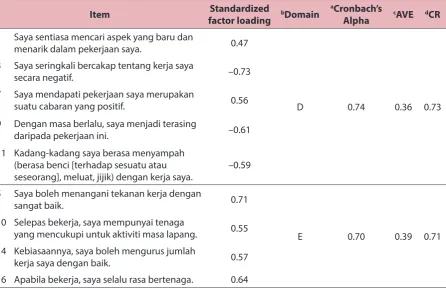
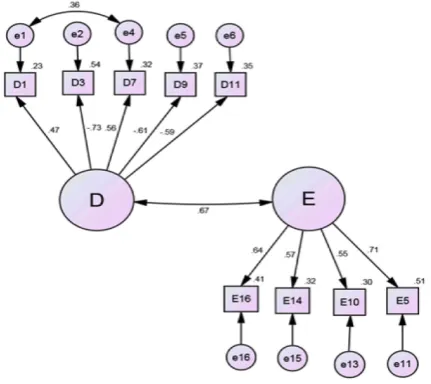
All goodness of fit indices were achieved to signify model fitness of the two-factor model. The final model of OLBI-M is illustrated in Figure 2 and details of standardised factor loading values are summarised in Table 4. The reliability analysis confirmed that the final 9-item model showed a high level of internal consistency with overall Cronbach’s alpha being more than 0.7 (range 0.70 and 0.74).
The composite reliability values of OLBI-M constructs ranged between 0.71 and 0.73, indicating a high level of convergent validity (Table 4). In addition, most of the standardised factor loading was more than 0.5 suggesting a good level of convergent validity (8). Table 5 shows that most of the AVE values of each factor is more than its SV values, indicating a good level of discriminant validity.
Table 3: The results of confirmatory factor analysis of OLBI-M
Variable X2– statistic (df) p-value Goodness of Fit Indices
Cmin/df RMSEA GFI CFI NFI TLI
One-Factor Model* 791.06 (104) < 0.001 7.606 0.121 0.768 0.633 0.603 0.577
2-Factor Model* 777.79 (103) < 0.001 7.551 0.121 0.768 0.640 0.610 0.580
2-Factor Model** 89.61 (25) < 0.001 3.585 0.076 0.958 0.934 0.912 0.905
Notes: *Based on the proposed construct by previous study (7); 16 items: Disengagement [Items 1, 3, 6, 7, 9, 11, 13, and
15] and Exhaustion [Items 2, 4, 5, 8, 10, 12, 14 and 16].
** Based on the final model; 9 items - Items 2, 4, 6, 8, 12, 13 and 15 were removed from the original construct.
Table 4: The reliability analysis of the 9 items OLBI–M based on the final model
Item factor loadingStandardized bDomain aCronbach’s
Alpha cAVE dCR
1 Saya sentiasa mencari aspek yang baru dan
menarik dalam pekerjaan saya. 0.47
D 0.74 0.36 0.73
3 Saya seringkali bercakap tentang kerja saya
secara negatif. –0.73
7 Saya mendapati pekerjaan saya merupakan
suatu cabaran yang positif. 0.56
9 Dengan masa berlalu, saya menjadi terasing
daripada pekerjaan ini. –0.61
11 Kadang-kadang saya berasa menyampah (berasa benci [terhadap sesuatu atau
seseorang], meluat, jijik) dengan kerja saya. –0.59 5 Saya boleh menangani tekanan kerja dengan
sangat baik. 0.71
E 0.70 0.39 0.71
10 Selepas bekerja, saya mempunyai tenaga
yang mencukupi untuk aktiviti masa lapang. 0.55 14 Kebiasaannya, saya boleh mengurus jumlah
kerja saya dengan baik. 0.57
16 Apabila bekerja, saya selalu rasa bertenaga. 0.64
Notes: D = Disengagement, E = Exhaustion
aReliability analysis; Cronbach’s alpha coefficient, overall Cronbach’s alpha = 0.80. bDomains were predetermined based on previous studies.
Figure 2: Standardised Factor Loadings of OLBI-M Constructs based on the final model.
Table 5: AVE and SV of OLBI-M based on the final model
Factors AVE SV by factor
D E
D 0.36 1 0.26
E 0.39 0.26 1
AVE = average variance extracted, SV = shared variance, D = Disengagement, E = Exhaustion
DISCUSSION
This study indicates that OLBI-M achieves an acceptable level of response process (i.e. an acceptable level of face validity), and good internal structure (i.e. a high level of internal consistency and an acceptable level of construct validity). This was achieved partly because of our thorough translation process that is based on standard recommendation or guideline (18) and also involvement of both content and language experts during the translation process. In addition, board meetings were held between researchers, content and language experts to reconcile and to finalise the translation product and this further adding to the rigour of translation process.
All items of OLBI-M were fairly understood by participants as evidenced by the face validity index values that were more than 70% (Table 2) except for Item 1 (I always find new and interesting aspects in my work/
Saya sentiasa mencari aspek yang baru dan
menarik dalam pekerjaan saya) and Item 7
(I find my work to be a positive challenge/
Saya mendapati pekerjaan saya merupakan suatu cabaran yang positif). Despite the lower validity values, through CFA, these two items have remained in the final model of OLBI-M. On the other hand, other items (Items 6, 13, and 15 of disengagement construct, and Items 2, 4, 8, and 12 of exhaustion construct), despite a higher face validity index, were removed due to low factorial weight. Similar to a previously reported study, Items 5 and 13 were removed due to low factorial weights and also cross-correlation with other items of other construct (9).
Also, in a recent study of more than 1,000 employees, it was concluded that the psychometric evaluation of the Slovenian translation of OLBI reveals a different structure compared to the original one. On this basis, the authors recommend against the use of Slovenian OLBI as a measure of burnout. Negative result of the Slovenian study may be due to poor level of response process – there was a mismatch between intended construct represented by items and the thought processes of subjects while responding to the items (19). Despite the challenges faced during the process of translation, OLBI-M seems to have a satisfactory level of face validity, and it is considered to have an appropriate response process that is the evidence of validity (19). An important lesson from here is that the face validation process is an important step to address contextualised issues such as cultures and norms of the local population.
All goodness of fit indices also supported its construct validity – convergent and discriminant validity – after removal of several items (Table 3). Likewise, a previous study among a group of Brazilian and Portuguese students, also removed several items to improve OLBI model fitness due to low factorial weights (9). Campos et al. (9) found the same items that we found which posed similar validity issues whereby the items were interpreted and understood differently by students. In addition, the item was poorly loaded on the proposed constructs but highly loaded on the other constructs, which is poorly understood and needs further investigation. It is worth noting thus far that the psychometric properties of OLBI had been tested on workers of various fields but not students and especially medical students (6, 7, 9, 20, 21). In the final OLBI-M, we opted to remove a few unfavourable items and further research is required to establish appropriate scoring system of OLBI-M.
Apart from that, the acceptable correlation between the two constructs of OLBI-M (i.e., less than 0.85 as illustrated in Figure 2) suggests that OLBI-M items are measuring different attributes of burnout. Campos et al. (9) found similar acceptable correlation between the two constructs in the OLBI Portugues version (i.e., more than 0.85 as illustrated in Figure 2). Furthermore, the two factors in the original OLBI showed similar correlation between each other (6, 7, 20), hence indicating a stable internal structure of OLBI across different languages. Therefore, the two-factor model displays a model fit, supporting the differentiation of the two constructs of burnout.
The high internal consistency of OLBI-M is consistent with other reported studies too (6, 7, 9, 20, 21), except for the Slovenian OLBI (22). The uniformed findings on
internal consistency of OLBI at different countries, settings and languages suggest a stable internal structure (17). These findings further support the use and applicability of this public domain measure in broader contexts than is originally proposed by Demerouti (7, 20). Nevertheless, as a lesson learnt from Sedlar et al. (22) study, OLBI should be validated in the local setting first before it is used for research purpose. Based on our validation results, the proposed final 9-item OLBI-M is adequate for future burnout research in the Malaysian population.
There are several study limitations should be considered. This study was confined to a group of medical students in a Malaysian medical school and therefore future studies should involve other professions to verify OLBI-M psychometric credential. Additional research is needed to support validity of OLBI-M by comparing with other more well-established measures of burnout. Lastly, this study provides validity evidence that are related to response process and internal structure only hence future research is needed to investigate other sources of evidence such as relations to other variables and its consequences on important variables to further support its validity. Notwithstanding the above limitations, our study findings support the use of OLBI-M – a free of charge burnout inventory – to assess burnout among Malaysian population.
CONCLUSION
Supplement I: The Full Oldenburg Burnout Inventory - Malay Version (OLBI-M)
Malay (translated version) English (original version)
1. Saya sentiasa mencari aspek yang baru dan menarik dalam pekerjaan saya.
1) Sangat setuju 2) Setuju 3) Tidak setuju 4) Sangat tidak setuju
1. I always find new and interesting aspects in my work.
1) Strongly agree 2) Agree 3) Disagree 4) Strongly disagree
2. Ada hari-hari tertentu saya berasa letih sebelum sampai di tempat kerja (seperti pejabat, kelas dan sebagainya). 1) Sangat setuju
2) Setuju 3) Tidak setuju 4) Sangat tidak setuju
2. There are days when I feel tired before I arrive at work.
1) Strongly agree 2) Agree 3) Disagree 4) Strongly disagree
3. Saya seringkali bercakap tentang kerja saya secara negatif.
1) Sangat setuju 2) Setuju 3) Tidak setuju 4) Sangat tidak setuju
3. It happens more and more often that I talk about my work in a negative way.
1) Strongly agree 2) Agree 3) Disagree 4) Strongly disagree
4. Selepas kerja saya memerlukan lebih banyak masa berbanding dahulu untuk berasa tenang dan lebih baik.
1) Sangat setuju 2) Setuju 3) Tidak setuju 4) Sangat tidak setuju
4. After work, I tend to need more time than in the past in order to relax and feel better.
1) Strongly agree 2) Agree 3) Disagree 4) Strongly disagree
5. Saya boleh menangani tekanan kerja dengan sangat baik.
1) Sangat setuju 2) Setuju 3) Tidak setuju 4) Sangat tidak setuju
5. I can tolerate the pressure of my work very well. 1) Strongly agree
2) Agree 3) Disagree 4) Strongly disagree
6. Akhir-akhir ini, saya kurang berfikir sewaktu kerja dan hampir melakukan kerja secara automatik.
1) Sangat setuju 2) Setuju 3) Tidak setuju 4) Sangat tidak setuju
6. Lately, I tend to think less at work and do my job almost mechanically.
1) Strongly agree 2) Agree 3) Disagree 4) Strongly disagree
7. Saya mendapati pekerjaan saya merupakan suatu cabaran yang positif.
1) Sangat setuju 2) Setuju 3) Tidak setuju 4) Sangat tidak setuju
7. I find my work to be a positive challenge. 1) Strongly agree
2) Agree 3) Disagree 4) Strongly disagree
8. Semasa kerja, saya kerap kali berasa kekosongan dari segi emosi.
1) Sangat setuju 2) Setuju 3) Tidak setuju 4) Sangat tidak setuju
8. During my work, I often feel emotionally drained. 1) Strongly agree
Malay (translated version) English (original version)
9. Dengan masa berlalu, saya menjadi terasing daripada pekerjaan ini.
1) Sangat setuju 2) Setuju 3) Tidak setuju 4) Sangat tidak setuju
9. Over time, one can become disconnected from this type of work.
1) Strongly agree 2) Agree 3) Disagree 4) Strongly disagree
10. Selepas bekerja, saya mempunyai tenaga yang mencukupi untuk aktiviti masa lapang. 1) Sangat setuju
2) Setuju 3) Tidak setuju 4) Sangat tidak setuju
10. After working, I have enough energy for my leisure activities.
1) Strongly agree 2) Agree 3) Disagree 4) Strongly disagree
11. Kadang-kadang saya berasa menyampah dengan kerja saya.
1) Sangat setuju 2) Setuju 3) Tidak setuju 4) Sangat tidak setuju
11. Sometimes I feel sickened by my work tasks. 1) Strongly agree
2) Agree 3) Disagree 4) Strongly disagree
12. Selepas kerja, saya kebiasaannya berasa lesu dan penat.
1) Sangat setuju 2) Setuju 3) Tidak setuju 4) Sangat tidak setuju
12. After my work, I usually feel worn out and weary. 1) Strongly agree
2) Agree 3) Disagree 4) Strongly disagree
13. Saya hanya boleh bayangkan jenis kerja ini sahaja yang boleh saya buat.
1) Sangat setuju 2) Setuju 3) Tidak setuju 4) Sangat tidak setuju
13. This is the only type of work that I can imagine myself doing.
1) Strongly agree 2) Agree 3) Disagree 4) Strongly disagree
14. Kebiasaannya, saya boleh mengurus jumlah kerja saya dengan baik.
1) Sangat setuju 2) Setuju 3) Tidak setuju 4) Sangat tidak setuju
14. Usually, I can manage the amount of my work well. 1) Strongly agree
2) Agree 3) Disagree 4) Strongly disagree
15. Saya berasa semakin sibuk dengan pekerjaan saya. 1) Sangat setuju
2) Setuju 3) Tidak setuju 4) Sangat tidak setuju
15. I feel more and more engaged in my work. 1) Strongly agree
2) Agree 3) Disagree 4) Strongly disagree
16. Apabila bekerja, saya selalu rasa bertenaga. 1) Sangat setuju
2) Setuju 3) Tidak setuju 4) Sangat tidak setuju
16. When I work, I usually feel energised. 1) Strongly agree
2) Agree 3) Disagree 4) Strongly disagree
Supplement II: The Final Oldenburg Burnout Inventory - Malay Version (OLBI-M)
Malay (translated version) English (original version)
1. Saya sentiasa mencari aspek yang baru dan menarik dalam pekerjaan saya.
1) Sangat setuju 2) Setuju 3) Tidak setuju 4) Sangat tidak setuju
1. I always find new and interesting aspects in my work.
1) Strongly agree 2) Agree 3) Disagree 4) Strongly disagree
2. Saya seringkali bercakap tentang kerja saya secara negatif.
1) Sangat setuju 2) Setuju 3) Tidak setuju 4) Sangat tidak setuju
2. It happens more and more often that I talk about my work in a negative way.
1) Strongly agree 2) Agree 3) Disagree 4) Strongly disagree
3. Saya boleh menangani tekanan kerja dengan sangat baik.
1) Sangat setuju 2) Setuju 3) Tidak setuju 4) Sangat tidak setuju
3. I can tolerate the pressure of my work very well. 1) Strongly agree
2) Agree 3) Disagree 4) Strongly disagree
4. Saya mendapati pekerjaan saya merupakan suatu cabaran yang positif.
1) Sangat setuju 2) Setuju 3) Tidak setuju 4) Sangat tidak setuju
4. I find my work to be a positive challenge. 1) Strongly agree
2) Agree 3) Disagree 4) Strongly disagree
5. Dengan masa berlalu, saya menjadi terasing daripada pekerjaan ini.
1) Sangat setuju 2) Setuju 3) Tidak setuju 4) Sangat tidak setuju
5. Over time, one can become disconnected from this type of work.
1) Strongly agree 2) Agree 3) Disagree 4) Strongly disagree
6. Selepas bekerja, saya mempunyai tenaga yang mencukupi untuk aktiviti masa lapang. 1) Sangat setuju
2) Setuju 3) Tidak setuju 4) Sangat tidak setuju
6. After working, I have enough energy for my leisure activities.
1) Strongly agree 2) Agree 3) Disagree 4) Strongly disagree
7. Kadang-kadang saya berasa menyampah (berasa benci [terhadap sesuatu atau seseorang], meluat, jijik) dengan kerja saya.
1) Sangat setuju 2) Setuju 3) Tidak setuju 4) Sangat tidak setuju
7. Sometimes I feel sickened by my work tasks. 1) Strongly agree
2) Agree 3) Disagree 4) Strongly disagree
8. Kebiasaannya, saya boleh mengurus jumlah kerja saya dengan baik.
1) Sangat setuju 2) Setuju 3) Tidak setuju 4) Sangat tidak setuju
8. Usually, I can manage the amount of my work well. 1) Strongly agree
2) Agree 3) Disagree 4) Strongly disagree
REFERENCES
1. Reis D, Xanthopoulou D, Tsaousis I. Measuring job and academic burnout with the Oldenburg burnout inventory (OLBI): factorial invariance across samples and countries. Burnout Research. 2015;2(1):8–18. https://doi.org/10.1016/j. burn.2014.11.001
2. Schaufeli WB, Taris TW. The conceptualization and measurement of burnout: common ground and worlds apart. Work & Stress. 2005;19(3):256–62. https:// doi.org/10.1080/02678370500385913
3. Karasek RA. Job demands, job decision latitude, and mental strain: implications for job redesign. Administrative Science Quarterly. 1979;24(2):285–308. https://doi. org/10.2307/2392498
4. Schaufeli WB, Salanova M, Gonzalez-Roma V, Bakker AB. The measurement of engagement and burnout: a two sample confirmatory factor analytic approach. Journal of Happiness Studies. 2002;3(1):71–92. https://doi. org/10.1023/A:1015630930326
5. Yusoff M. Promoting resilience and minimizing burnout. In: Henning MA, Krägeloh CU, Dryer R, Moir F, Billington R, Hill AG, editors. Wellbeing in higher education: cultivating a healthy lifestyle among faculty and students. Routledge: New York; 2018. p. 82–105.
6. Halbesleben JRB, Demerouti E. The construct validity of an alternative measure of burnout: investigating the English translation of the Oldenburg burnout inventory. Work & Stress. 2005;19(3):208–20. https://doi.org/10.1080/ 02678370500340728
7. Demerouti E, Bakker AB. The Oldenburg burnout inventory: a good alternative to measure burnout and engagement. Handbook of stress and burnout in health care. Hauppauge, NY: Nova Science; 2008.
8. Bria M, Spanu F, Baban A, Dumitrascu DL. Maslach burnout inventory – general survey: factorial validity and invariance among Romanian healthcare professionals. Burnout Research. 2014;1(3):103–11. https://doi. org/10.1016/j.burn.2014.09.001
9. Campos JADB, Carlotto MS, Maroco J. Oldenburg burnout inventory – student version: cultural adaptation and validation into Portuguese. Psicologia: Reflexao e Critica. 2012;25(4):709–18. https://doi. org/10.1590/S0102-79722012000400010
10. de la Puente M, Pan Y, Rose D. An overview of a proposed census bureau guideline for the translation of data collection instruments and supporting materials. Washington, DC: US Census Bureau. 2003;20–3.
11. Costello AB, Osborne JW. Best practices in exploratory factor analysis: four recommendations for getting the most from your analysis. Practical Assessment, Research & Evaluation. 2005;10(7):1–9.
Malay (translated version) English (original version)
9. Apabila bekerja, saya selalu rasa bertenaga. 1) Sangat setuju
2) Setuju 3) Tidak setuju 4) Sangat tidak setuju
9. When I work, I usually feel energized. 1) Strongly agree
2) Agree 3) Disagree 4) Strongly disagree
12. Zamanzadeh V, Ghahramanian A, Rassouli M, Abbaszadeh A, Alavi-Majd H, Nikanfar A-R. Design and implementation content validity study: development of an instrument for measuring patient-centered communication. Journal of Caring Sciences. 2015;4(2):165. https://doi.org/10.15171/ jcs.2015.017
13. Fornell C, Larcker D. Evaluating structural equation models with unobservable variables and measurement error. J Mark Res 1981; 18(1): 39–50.
14. Hair Jr JF, Black WC, Babin BJ, Anderson RE. Multivariate data analysis. Vol. 5. Upper Saddle River, NJ: Prentice Hall; 2009.
15. Awang Z. Structural equation modeling using AMOS graphic. Selangor: Penerbit Universiti Teknologi MARA; 2012.
16. Brown T. Confirmatory factor analysis for applied sciences. New York: The Guilford Press; 2006.
17. Streiner LD, Norman GR. Health measurement scales: a practical guide to their development and use. 4th ed. New York: Oxford University Press; 2008. https://doi.org/10.1093/acprof:oso/ 9780199231881.001.0001
18. Yuling P, de la Puente M. Census bureau guideline: language translation of data collection instruments and supporting materials, in Methodology and Standards Directorate. Washington DC: US Census Bureau; 2004.
19. Cook DA, Beckman TJ. Current concepts in validity and reliability for psychometric instruments: theory and application. The American Journal of Medicine. 2006;119(2):7–16. https://doi.org/10.1016/j. amjmed.2005.10.036
20. Demerouti E, Bakker AB, Nachreiner F, Schaufeli WB. The job demands-resources model of burnout. Journal of Applied Psychology. 2001;86(3):499. https://doi. org/10.1037/0021-9010.86.3.499
21. Peterson U, Demerouti E, Bergström G, Åsberg M, Nygren Å. Work characteristics and sickness absence in burnout and nonburnout groups: a study of Swedish health care workers. International Journal of Stress Management. 2008;15(2):153–72. https://doi.org/10.1037/1072-5245.15.2.153