HOW PERCEIVED WORKLOAD AFFECTS THE WORK OUTCOMES OF COMPUTER PROFESSIONALS
Chang Boon Patrick Lee
Faculty of Business Administration, University of Macau
ABSTRACT
This research, conducted in the context of computer professionals, examines the effects of perceived workload on three work outcomes – namely, work exhaustion, job satisfaction, and turnover intention. Data collected from a questionnaire survey was used to test the relationships proposed in this research. The results showed that (a) perceived workload was positively related to work exhaustion, job satisfaction and turnover intention, (b) work exhaustion was negatively related to job satisfaction, and (c) job satisfaction was negatively related to turnover intention. The contribution of this research is that it shows how workload affects turnover intention, depending partly on the mediating effects of job satisfaction. The paper discusses the implications of the results for research and practice.
INTRODUCTION
A literature search on studies related to the workload of computer professionals has provided limited results1. Nevertheless, workload is an important variable that deserves greater attention as prior studies have consistently shown that it is an antecedent of job burnout (Leiter, 1991; Jackson et al., 1986). Burnout is the emotional aspect of exhaustion and it relates to being intensely involved with people. It is especially common among those working in the human service professions such as health care, social services, criminal justice, and education (Malash and Jackson, 1984). In the case of computer professionals, Moore (2000) has found that perceived workload is the strongest contributor to work exhaustion, and that work exhaustion – defined simply as the depletion of mental resources to cope with one’s work – is an antecedent to turnover intention. Given that the turnover of computer personnel has been a persistent concern in the industry (Cappelli, 2001), and that there has been an increasing demand for computer professionals after the dot-com bubble (Zwieg et al., 2006), it would be beneficial to develop further knowledge about how perceived workload affects computer professionals’ work outcomes. As there is little research that investigates the effects of perceived workload on job satisfaction, the objective of this study, therefore, is to fill this gap in the literature. Specifically, the purpose of this study is to test a model on the effects of perceived workload on three work outcomes – namely, work exhaustion, job satisfaction, and turnover intention. The results derived from this research might provide a richer understanding of computer professionals and enable employers to better manage their human resources.
Following the introduction of this paper, the next section presents a review of related literature on workload and work outcomes. This is followed by a discussion of the research model and the method used to test the model. Next, the results are presented and the paper discusses the findings. The paper then concludes by presenting the limitations of the study and the implications for research and practice.
PRIOR RESEARCH ON WORKLOAD AND WORK OUTCOMES
Workload can be categorised as actual or perceived workload. Past research has focused more on perceived workload as researchers believe that it is the subjective feeling of the experienced workload that is more crucial in determining its consequences (Hubson and Beach, 2000; Jacobs and Dodd, 2003). As mentioned in the introduction, prior research in the context of non-computer professionals has shown that actual or perceived workload has a negative impact on job satisfaction. On the other hand, however, there are also researchers who feel that the relationship between workload and job satisfaction is not necessarily negative. Payne and Morrison (1999), for example, have indicated that not all job demands, including heavy workload, are bad or stressful. They suggested that having a higher job demand may arouse or stimulate workers’ interest. Based on this premise, it is possible that a higher workload or the perception of a higher workload may lead to higher job satisfaction.
1
Indeed, a study by Yperen and Janssen (2002) has found that even though employees felt fatigue due to increasing workloads, those with high performance orientation also experienced higher job satisfaction. To a certain extent, computer professionals resemble people with high performance orientation. Prior research has found that computer professionals have, on average, higher growth needs compared with people in other professions (Couger et al., 1979; 1992; Wynekoop and Walz, 1998; Lee, 2000) and, therefore, following the results obtained by Yperen and Janssen (2002), the relationship between workload and job satisfaction may be positive for computer professionals. There is no prior research, however, that addressed the relationship between perceived workload and job satisfaction among computer professionals.
Job satisfaction is a key variable that has been shown to have a negative impact on the employees’ turnover intention (Igbaria and Greenhaus, 1992; Lee et al., 2008; Rutner et al., 2008). As the high turnover rate of computer professionals has been described as a chronic problem that incurs high costs in the industry, many researchers and practitioners are interested to learn more about how they can increase the job satisfaction level for the computer professionals and how to better manage them (Agarwal and Ferratt, 1999; Burns, 2006; Lacity et al., 2008). In this connection, it is noteworthy that after the burst of the dot-com bubble in the early 2000s, a number of surveys have recorded lower levels of job satisfaction among computer professionals (Hoffman, 2003), possibly due to issues such budget cuts, redistribution of workload, low morale, limited career advancement, and lack of training opportunities. Even though job satisfaction was low, many computer professionals did not leave their organizations because there were few job alternatives available. Nevertheless, computer professionals were poised to move while the economy improved (McGee, 2003).
With regard to the effects of workloads, prior research has also proposed an inverted-U relationship between job demands and job satisfaction (Janssen, 2001). The U-shaped relationship is based on activation theory (Scott, 1966). According to this theory, an individual is assumed to have a characteristic level of activation that allows the central nervous system to function most efficiently. As the experienced activation level deviates from the characteristic activation level, the efficiency of the central nervous system is diminished. Based on this theory, an increase in workload is assumed to be beneficial up to a certain level. Beyond that level, however, work outcomes experience less positive affects (Gardner and Cummings, 1988). Even though this explanation for the inverted U-shaped relationship between workload and job satisfaction is compelling, there is limited empirical validation of the theory. According to Cook and Salvendy (1999), it is possible that the relationship exists only when there are extreme conditions of work ‘underload’ and ‘overload’.
RESEARCH MODEL
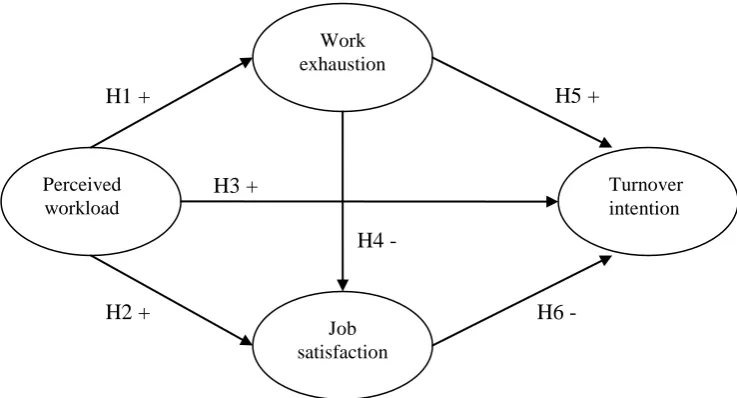
Figure 1 presents the research model. The model is comprised of four constructs – namely, perceived workload, work exhaustion, job satisfaction, and turnover intention. Turnover intention refers to voluntary turnover intention and job satisfaction refers to the affective reaction to one’s job. Consistent with prior research (Moore, 2000; Ahuja et al., 2007; Rutner et al., 2008), work exhaustion is defined as the depletion of mental resources to cope with one’s work. Perceived workload refers to perceptions that the amount of work exceeds the amount of time available for accomplishing the work.
Figure 1. Proposed model Effects of perceived workload
When computer professionals have a higher level of workload, they will need to expend more energy to meet the higher work pressure. Hockey (1997) offers a cognitive-energetical framework to understand human performance under a higher level of workload. According to this framework, a person can accommodate a higher level of workload while maintaining the target performance only at the expense of an increase in compensatory costs that are manifested psychologically (eg., fatigue and irritability) and physiologically (eg., increased excretion of cortisol). Thus, when computer professionals perceive or experience a higher level of workload and need to maintain a target level of performance, it will drain their energy and cause them to have a higher level of work exhaustion2. Hence, the following hypothesis:
Hypothesis 1: Perceived workload is positively related to work exhaustion
The computer industry is progressing rapidly. Computer professionals who do not keep pace with the developments may become obsolete (Lee, 2000). Computer professionals, therefore, are likely to prefer to be occupied so that they can learn about the technologies, rather than to be left with little or no work. It is possible that when computer professionals perceive they have a higher level of workload, they feel they are learning more and hence they are more satisfied. As allured to earlier, computer professionals have high growth needs. They seek challenges and they create opportunities for themselves to learn (Lee, 2002, p 8). A number of studies have suggested that computer professionals are internally motivated to accept a heavier workload. For example, a survey in Finland
2
The reverse is also plausible, i.e., people who experience a higher level of exhaustion tend to perceive a higher level of workload due to their ‘gloomy perception’ (Dikkers et al., 2007). The reverse effect, however, appears to be weaker (De Lange et al, 2004). As the current research is a cross-sectional study, only the effect of perceived workload on work exhaustion is examined.
Work exhaustion
Job satisfaction
Turnover intention Perceived
workload
H1 +
H5 +
H2 +
H6 -
H3 +
has reported that 82% of the computer professionals worked overtime, and only 16% received monetary compensation for it (Kivistö et al., 2008). Melymuka (2000) also presented a number of anecdotes to show that computer personnel love the opportunities to learn new skills and they are not afraid of hard work. This study, therefore, proposed the following hypothesis:
Hypothesis 2: Perceived workload is positively related to job satisfaction
While a heavier perceived workload may increase job satisfaction among computer professionals, it may also cause them to develop turnover intention. The reason is because when computer professionals feel that they have been assigned more work, their psychological contract (Rousseau, 1989) with their employer gets violated. With a heavier workload, computer professionals feel exploited and they believe they are better off working elsewhere. Thus, even though computer professionals feel satisfied with a higher level of perceived workload because they enjoy the challenge, they are likely also to develop turnover intention because they feel that other prospective employers may offer them better employment terms, as there is a competitive market for computer professionals (McGee, 1998). They seek a new employer to get them away from the demands of a heavy workload. Hence, the following hypothesis:
Hypothesis 3: Perceived workload is positively related to turnover intention Effects of work exhaustion and job satisfaction
Computer professionals who are overwhelmed and exhausted in their work have little time to engage in non-work activities. They are preoccupied with their work and this creates a work-life imbalance. They are unlikely, therefore, to be satisfied with their jobs (Scholarios and Marks, 2004). People also understand that experiencing stress such as work exhaustion can seriously impact their health and general well-being (Sparks et al., 1997; Pawlowski et al., 2007). Thus, when work exhaustion is high, computer professionals may not only have low job satisfaction but they may also develop turnover intention. They seek a new job that is less exhausting so that their health will not be affected. Hence, there are two hypotheses related to the effects of work exhaustion:
Hypothesis 4: Work exhaustion is negatively related to job satisfaction
Hypothesis 5: Work exhaustion is positively related to turnover intention
When employees are not satisfied with their jobs, they are also likely to develop turnover intention. The relationship between job satisfaction and turnover intention has extensive support in the literature, regardless whether the sample examined were computer or non-computer personnel (Cotton and Tuttle, 1986; Igbaria et al., 1992; Rutner et al., 2008). Computer professionals with low job satisfaction are likely to look elsewhere to help them fulfil their job satisfaction. Hence, the following hypothesis:
Hypothesis 6: Job satisfaction is negatively related to turnover intention
RESEARCH METHOD
IT job. They comprised systems executives, computer programmers, systems analysts, systems engineers, and computer managers.
The survey provided a postage-paid return envelope. To increase the response rate, the survey did not require respondents to identify themselves. The questionnaire was also formatted in such a way to enable respondents to fill in their answers easily. Appendix A shows the items that were used to measure the constructs used in this research. All items in the questionnaire used a seven-point Likert-scale in which the responses ranged from strongly disagree to strongly agree. Prior studies that used the items to measure the constructs have shown that they have high reliability. As in Moore (2000), perceived workload was measured using four items from Kirmeyer and Dougherty (1988). Work exhaustion was measured using four items from the General Burnout Questionnaire (Schaufeli et al., 1995). Turnover intention was measured using three items from Peters and Jackofsky (1979) and one item from Mobley et al. (1978). Job satisfaction was measured using three items from Hoppock (1935).
Table 1 shows the respondents’ characteristics. Three hundred and forty-four complete responses were received for the survey, representing a response rate of about 18 percent. Seventy percent of the respondents were males and the rest females. More than one-third of the respondents were in the age range from 25 to 30, reflecting the demographics of computer professionals in Singapore, which has a relatively young computer workforce. Given that the survey was anonymous, the researcher could not identify those who failed to respond. Thus, it was not possible to determine whether non-respondents differed systematically from those who responded. As an alternative test of non-response bias, those who responded late were used as proxies for those who did not respond. Using this method to measure non-response bias, the data from the first thirty respondents – categorized based on their postmarked dates in the returned envelopes – were compared to those for the last thirty respondents (Wallace and Mellor, 1988). The results indicate there were no significant differences in responses between the early and late respondents.
Sex Males Females
239 (70%) 105 (30%) Age
Under 25 25 to under 31 31 to under 36 36 to under 41 Over 41
58 (17%) 123 (36%)
86 (25%) 44 (13%) 33 ( 9%) Organizational Tenure
Under 2 years 2 to 5 years 6 to 10 years Over 10 years
RESULTS Scale validation
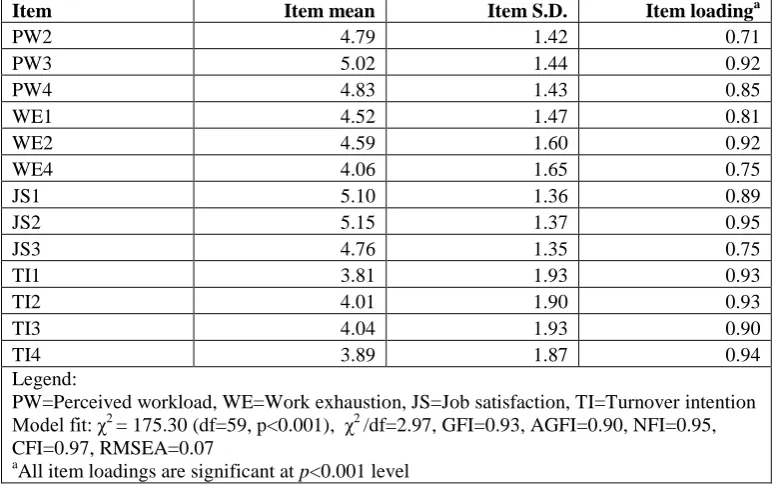
A confirmatory factor analysis (CFA) was first performed on the data using the AMOS (version 18) software. In the CFA, each scale item was modelled as a reflective indicator of its latent construct and all constructs were allowed to co-vary. The results of the CFA found that two items, PW1 and WE3, did not load well on their constructs. An examination of these two items suggests that the items could have been interpreted in ways that were not originally intended. As a result, they might have given rise to inaccurate measurements. In the case of PW1 – “I feel that the amount of work I do interferes with how well it is done” – it is possible that the amount of work is not related to how well the work is done. A respondent may have a low workload, and yet it interferes with how well the work is done because few resources are available for the respondent to complete the work3. In the case of WE3 – “I feel fatigued when I get up in the morning and have to face another day on the job” – it is possible that the fatigue that the respondents experience might not be due to being stretched at work. A respondent who is a recent mother may be tired because of non-work factors, such as having to look after her new born. Based on these reasons, items PW1 and WE3 were excluded from the analysis. Table 2 presents the results of the CFA. To assess the model fit, Straub et al. (2004) suggested that the chi-square normalized by the degrees of freedom (χ2 /df) should not exceed 3, goodness of fit index (GFI), adjusted goodness of fit index (AGFI), norm fit index (NFI), and comparative fit index (CFI) should all exceed 0.90, and the root mean square error of approximation (RMSEA) should be less than 0.08. The CFA results presented in Table 2 indicate that all the indices met the requirements, with the exception that the AGFI was marginally out of range. Overall, therefore, the data provide an adequate model fit.
Table 3 displays the scale properties and factor correlations. The table shows that all the Cronbach’s α were greater than 0.8, thereby meeting the test for uni-dimensionality. The composite reliability measures were at least 0.7, which exceeded the cut-off value of 0.5. The results suggest that the constructs have adequate reliability.
Convergent validity in this study was tested by checking that (1) all the factor loading for the items were significant and exceeded 0.6, and (2) average variance extracted (AVE) by each construct exceeded the variance due to measurement error for the construct (i.e., AVE should exceed 0.50). All factor loadings were significant at p<0.001 and exceeded the threshold of 0.6. The AVE ranged from 0.69 to 0.86. Thus, the conditions for convergent validity were met.
Discriminant validity testing showed that the AVE for each construct exceeded the squared correlation between it and any other constructs considered in the study. The factor correlations showed that the largest squared correlation between any pair of constructs was 0.34 and the smallest obtained AVE value was 0.69.
Hypothesis testing
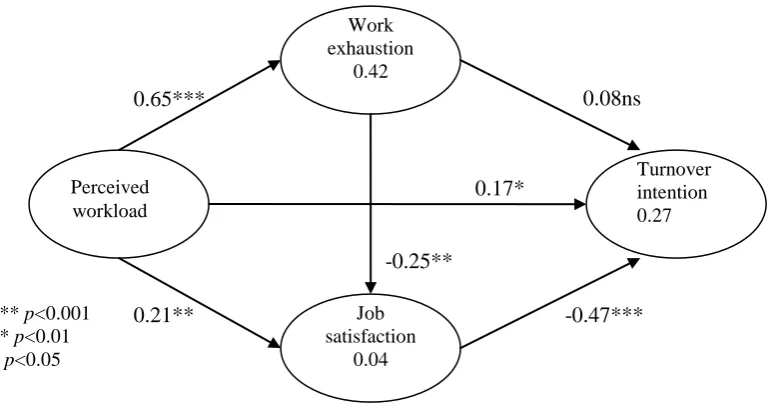
Figure 2 shows the results of the structural equation modelling (SEM). The results show that the data provide an adequate fit of the model. Furthermore, all the path coefficients, except for the path
between work exhaustion and turnover intention, are significant and in the expected direction. These results will be elaborated in the discussion section.
Post-hoc analyses
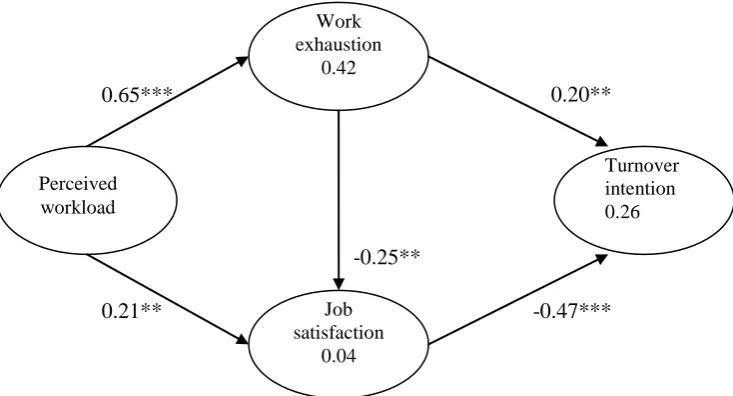
The purpose of the post-hoc analyses is to compare the explanatory power for the various models of perceived workload. The results for the research model (which is a partly-mediated model with both direct and indirect effects from perceived workload to turnover intention) were compared with the direct model and the fully-mediated model. In the direct model, there are no mediating variables between perceived workload and turnover intention. In the fully-mediated model, the effects of perceived workload on turnover intention are mediated through work exhaustion and job satisfaction, i.e., all the effects of perceived workload on turnover intention are indirect.
Item Item mean Item S.D. Item loadinga
PW2 4.79 1.42 0.71
PW3 5.02 1.44 0.92
PW4 4.83 1.43 0.85
WE1 4.52 1.47 0.81
WE2 4.59 1.60 0.92
WE4 4.06 1.65 0.75
JS1 5.10 1.36 0.89
JS2 5.15 1.37 0.95
JS3 4.76 1.35 0.75
TI1 3.81 1.93 0.93
TI2 4.01 1.90 0.93
TI3 4.04 1.93 0.90
TI4 3.89 1.87 0.94
Legend:
PW=Perceived workload, WE=Work exhaustion, JS=Job satisfaction, TI=Turnover intention Model fit: χ2 = 175.30 (df=59, p<0.001), χ2 /df=2.97, GFI=0.93, AGFI=0.90, NFI=0.95, CFI=0.97, RMSEA=0.07
aAll item loadings are significant at p<0.001 level
Table 2. Results of confirmatory factor analysis
Construct Cronbach's Alpha (α)
Composite
Reliability AVE PW WE JS TI
PW 0.86 0.77 0.69 1.00
WE 0.87 0.74 0.70 0.58*** 1.00
JS 0.90 0.84 0.76 0.04ns -0.12* 1.00
TI 0.96 0.87 0.86 0.20*** 0.25*** -0.44** 1.00
* p<0.05, ***p<0.001
Table 3. Scale properties and factor correlations
wise F-tests comparing the R2 values of the direct model with those for the partly and fully mediated models were conducted to determine whether there were significant differences between the models4. For both the partly and fully mediated models, the improvement over the direct model is significant at p<0.001, implying that the partly and the fully mediated models are better in explaining turnover intention than the direct model. There is no difference in R2, however, between the partly and fully mediated models.
Figure 2. Results of Analysis
Model fit: χ2 = 37.50 (df=13, p<0.001), χ2 /df=2.89, GFI = 0.97, AGFI = 0.94, NFI = 0.98, CFI = 0.99, RMSEA=0.07 (** p<0.05)
4 The F-test was computed as follows: F = (R2
B - R2A) ) / [ (1- R2A) /dfdifference ] Work
exhaustion 0.42
Job satisfaction
0.04
Turnover intention 0.27 Perceived
workload
0.65***
0.08ns
0.21**
-0.47***
0.17*
-0.25**
Model fit: χ2 = 156.34 (df=59, p<0.001), χ2 /df=2.65, GFI = 0.93, AGFI = 0.90, NFI = 0.96, CFI = 0.97, RMSEA=0.07
*** p<0.001 ** p<0.01 * p<0.05
Turnover intention 0.03 Perceived
workload
Figure 3. Results for direct (non-mediated) model
Model fit: χ2 = 161.35 (df=60, p<0.001), χ2 /df=2.69, GFI = 0.93, AGFI = 0.90, NFI = 0.96, CFI = 0.97, RMSEA=0.07 (** p<0.01, *** p<0.001)
Figure 4. Results for fully-mediated model
Fit Index Suggested value
Partially mediated
model
Direct model
Fully-mediated
model χ2/df <3.00 156/59=2.65 38/13=2.89 161/60=2.69
GFI >0.90 0.93 0.97 0.93
AGFI >0.90 0.90 0.94 0.90
NFI >0.90 0.96 0.98 0.96
CFI >0.90 0.97 0.99 0.97
RMSEA <0.08 0.07 0.07 0.07
Table 4. Goodness of fit statistics DISCUSSION
Some of the results derived from this study confirm the findings of prior research, while the others offer interesting insights on how perceived workload affects the work outcomes of computer professionals.
Work exhaustion
0.42
Job satisfaction
0.04
Turnover intention 0.26 Perceived
workload
0.65***
0.20**
*
0.21**
-0.47***
Perceived workload and work exhaustion (H1)
The result of hypothesis 1 shows that there is a positive relationship between perceived workload and work exhaustion. This result is consistent with those of prior research (Moore, 2000; Ahuja et al., 2002).
Positive effect between perceived workload on job satisfaction (H2)
While results from prior studies involving non-computer professionals have shown that the relationship between perceived workload and job satisfaction is negative, this research shows that the relationship for computer professionals is positive. As suggested in the section on the research model, the positive relationship might have been affected by the high growth needs of the computer professionals. It is possible that computer professionals prefer additional work so that they can learn and keep themselves up-to-date with technology. This is a suggested explanation, however. More exact tests of the explanation for the relationship are needed. Another plausible reason for the positive relationship between perceived workload and job satisfaction could be that when organizations assign additional work to computer professionals, they are actually signalling that they have trust in the computer professionals. Computer professionals, therefore, develop a sense of self-importance and they feel more satisfied. Again, this is a suggested explanation. Future research can examine the exact cause of the relationship between perceived workload and job satisfaction to determine why the two constructs are positively related. Overall, the results for this hypothesis challenge the traditional thinking that workload is negatively related to job satisfaction. The results extend Yperen and Janssen’s (2002) findings that for certain group of people, increasing workload can lead to higher job satisfaction.
Direct positive effect between perceived workload and turnover intention (H3)
The results of this research show that perceived workload has a direct positive effect on turnover intention. It should be noted that Moore (2000) and Rutner et al. (2008) reported a negative effect from perceived workload to turnover intention. Both of them, however, did not discuss their results. One tentative explanation that can be offered for the discrepant findings might be that the negative effect obtained in their studies could have resulted because they did not include a relationship between perceived workload and job satisfaction in their research models. Hence, their results could have embedded the indirect effect of workload on turnover intention via job satisfaction. With the addition of the mediating effect, it may be easier to explain the direct positive effect between workload and turnover intention.
Work exhaustion and job satisfaction (H4)
This study found that there is a negative relationship between work exhaustion and job satisfaction. This result is consistent with those of prior research (Rutner et al., 2008; Lee and Ashforth, 1996). Work exhaustion and turnover intention (H5)
third explanation for the unexpected result is that the effects of work exhaustion on turnover intention could be indirect, i.e., the effects are mediated by job satisfaction. Indeed, Rutner et al. (2008) also found that job satisfaction fully mediates the relationship between work exhaustion and turnover intention.
Job satisfaction and turnover intention (H6)
The results of this research reaffirm that job satisfaction is negatively related to turnover intention. They also show that among the various constructs examined in this research, job satisfaction has the greatest impact on turnover intention.
Total effects of perceived workload on turnover intention
The results of this research show that while a heavier perceived workload can directly increase job satisfaction, it can also lower job satisfaction indirectly by increasing work exhaustion. Based on the results shown in Figure 2, the total effects (i.e., direct and indirect) of perceived workload on job satisfaction is 0.05 { = 0.21 + (0.65 x -0.25) }. Since job satisfaction is negatively related to turnover intention, an increase in job satisfaction will decrease turnover intention. The total mediated effects of perceived workload on turnover intention, therefore, is (0.05 x -0.47) = -0.02. On the other hand, perceived workload also has a direct positive effect on turnover intention, and this direct effect is greater in magnitude than the total mediated effects. The total effects of perceived workload on turnover intention, therefore, is positive, and is 0.15 ( = 0.17 - 0.02 ). That is, the net result for an increase in perceived workload is that it will result in an increase in turnover intention.
CONCLUSION
The results of this study are subject to a number of limitations. First, the data used for this study was collected many years ago. The world has gone through a number of global events since then. For example, there was the great financial crisis. Also, to date, there has been substantial growth in the Internet and this growth brought about significant changes in the way computers are used. The data used for this study, therefore, may not reflect the experiences of computer professionals in the current environment. In future, a more updated set of data could be used to test the currency of the research model.
other. Perceived workload is measured using subjective scores provided by the survey respondents while actual workload is an objective measurement. In the event that a manager needs to assign additional work, the manager should consider the computer professionals’ perceived workload rather than the actual workload in order to make use of the results of this research to optimize work outcomes.
A final limitation of this research is related to the use of the SEM. It is generally agreed that using the SEM in research requires a strong theoretical foundation. Hypothesis 2, which states that perceived workload is positively related to job satisfaction, is developed mostly on empirical results derived from prior studies. Although the results of this study support hypothesis 2, future research should establish and test the theoretical reason(s) for the relationship. This would help to improve the legitimacy and significance of the research results.
To conclude, the results of this study have shown that perceived workload has a direct positive relationship with job satisfaction. This is an interesting finding and it provides an impetus for future studies to determine the specific explanation for the positive relationship. The results of this study also have practical implications for the management of computer personnel. Managers need to understand that perceived workload has positive as well as negative effects on job satisfaction. That is, while a heavy workload can lead to higher work exhaustion and consequently lower job satisfaction, it can also directly increase job satisfaction. Besides this, managers also need to understand that perceived workload can directly affect computer professionals’ turnover intentions. The findings of this research, therefore, provide researchers and practitioners with a richer understanding on how perceived workload affects the work outcomes of computer professionals.
REFERENCES
Agarwal R. and Ferratt, T. (1999). Coping With Labor Scarcity in Information Technology, Pinnaflex Educational Resources, Inc., Cincinnati, Ohio.
Ahuja, M.K., Chudoba, K.N., George, J.F., Kacmar, C.J. and McKnight, H. (2002). Overworked and Isolated? Predicting the Effect of Work-family Conflict, Autonomy, and Workload on
Organizational Commitment and Turnover of Virtual Workers, Proceedings of the 35th Hawaii International Conference on Systems Sciences.
Ahuja, M.K., Chudoba, K.N., Kacmar, C.J., McKnight, D.H., and George, J.F. (2007). IT Road Warriors: Balancing Work-Family Conflict, Job Autonomy, and Work Overload to Mitigate Turnover Intentions, MIS Quarterly (31:1) pp 1-17.
Blodgett, M. (2004). The Few and the Stressed, CIO, (18:3), p 1.
Burns, P.T. (2006). Voluntary Employee Turnover: Why IT Professionals Leave, IT Pro (8:3), pp.46-48.
Burke, R.J. (2003). Hospital Restructuring, Workload, and Nursing Staff Satisfaction and Work Experiences, Health Care Manager, (23:2), pp 99-107.
Cappelli, P. (2001). Why Is It So Hard to Find Information Technology Workers? Organizational Dynamics, (30:2), pp 87-99.
Cook, J.R. and Salvendy, G. (1999). Job Enrichment and Mental Workload in Computer-Based Work: Implications for Adaptive Job Design, International Journal of Industrial Ergonomics, (24:1), pp 13-23.
Couger, D.J., Halttunen, V., and Lyytinen, K. (1991). Evaluating the Motivating Environment in Finland Compared to the United States – A Survey, European Journal of Information Systems, (1:2), pp 107-122.
Couger, J.D. and O’Callaghan, R. (1994). Comparing the Motivations of Spanish and Finnish Computer Personnel with those of the United States, European Journal of Information Systems, (3:4), pp 285-291.
Couger, J.D., Zawacki, R.A. and Opperman, E.B. (1979).Motivation Level of MIS Managers Versus Those of Their Employees, MIS Quarterly, (3:1), pp 47-49
Couger, J.D., Zawacki, R.A. and Amoroso, D.L. (1992). Motivating IS Managers in the 1990s, Inside DPMA, pp 6-9.
De Lange, A.H., Taris, T.W., Kompier, M.A.J., Houtman, I. L.D, and Bongers, P.M. (2004). The Relationships Between Work Characteristics and Mental Health: Examining Normal, Reversed and Reciprocal Relationships in a 4-Wave Study, Work and Stress, (18:2), pp. 149-166. Dikkers, J.S.E., Geurts, S.A.E., Kompier, M.A.J., Taris, T.W., Houtman, I.L.D. and Heuvel, F. (2007). Does Workload cause Work-Home Interference Or Is It The Other Way Around? Stress and Health, (23:5), pp 303-314.
Gardner, D.G and Cummings, L.L. (1988). Activation Theory and Job Design: Review and Reconceptualisation, In B.M. Staw & L.L. Cummings Eds Research in Organizational Behavior, 10, 81-122. Greenwich, CT: JAI Press.
Ginzberg, M.J. and Baroudi, J.J. (1988). MIS Careers – A Theoretical Perspective, Communications of the ACM, (31:5), pp 586-594.
Gomez-Mejia, L.R. (1984). Effect of Occupation on Task-Related, Contextual and Job Involvement Orientation: A Cross-Cultural Perspective, Academy of Management Journal, (27:4), pp 706-72.
Groenewegen, P and Hutten, J. (1991). Workload and Job Satisfaction Among General Practitioners: A Review of the Literature, Social Science and Medicine, (32:5), pp 1111-1119.
Hobson, J. and Beach, J.R. (2000). An Investigation of the Relationship Between Psychological Health and Workload Among Managers, Occupational Medicine, (50:7), pp 518-522. Hockey, G.J. (1997). Compensatory control in the regulation of human performance under stress and
high workload: a cognitive-energetical framework, Biological Psychology, (45:1), pp 73-93. Hoffman, T. (2003) What’s Wrong Here? Job Satisfaction Survey 2003, Computerworld, (37:47), pp
35-40.
Hoppock, R. 1935. Job Satisfaction. New York: Harper.
Igbaria, M, and Greenhaus, J.H. (1992). Determinants of MIS Employees’ Turnover Intention: A Structural Equation Model, Communications of the ACM, (35:1), pp 35-49.
Ivancevich, J.M., Napier, H.A. and Wetherbe, J.C. (1983). Occupational Stress, Attitudes, and Health Problems in the Information Systems Professionals, Communications of the ACM, (26:10), pp 800-806.
International Labor Organization (2009). Global Wage Report, ILO, p. 6.
Jacobs, S.R. and Dodd, D. (2003). Student Burnout as a Function of Personality, Social Support, and Workload, Journal of College Student Development, (44:3), pp 291-303.
Janssen, O. (2001). Fairness Perceptions As A Moderator in the Curvilinear Relationships Between Job Demands, And Job Performance And Job Satisfaction, Academy of Management Journal, (44:5), pp 1039-1050.
Kirmeyer, S.L. and Dougherty, T.W. (1988). Workload, Tension, and Coping: Moderating Effects of Supervisor Support, Personnel Psychology, (41:2), pp 125-139.
Kivistö, M., Härmä, M. Sallienen, M., and Kalimo, R. (2008). Work-related factors, sleep debt and insomnia in IT professionals, Occupational Medicine, (58:2), pp 138-140.
Konrad, R. (2005). “For Some Techies, An Interminable Workday,” Associated Press, 8 May. Lacity, M., Iyer, V., and Rudramuniyaiah, P. (2008). Turnover Intentions of Indian IS Professionals,
Information Systems Frontier, (10:2) pp 225-235.
Lee, C.B.P. (2000). Turnover of Information Technology Professionals: A Contextual Model, Accounting, Management, and Information Technologies, (10:2), pp 101-124.
Lee, C.B.P. (2002). Career Goals and Career Management Strategy Among Information Technology Professionals, Career Development International, (7:1), pp 6-13.
Lee, T.H., Gerhart, B., Weller, I., and Trevor, C.O. (2008). Understanding Voluntary Turnover: Path Specific Job Satisfaction Effects and the Importance of Unsolicited Job Offers, Academy of Management, (51:4), pp 651-671.
Lee, R.T. and Ashforth, B.E. (1996). A Meta-Analytic Examination of the Correlates of the Three Dimensions of Job Burnout, Journal of Applied Psychology, (81:1), pp. 123-133.
Leiter, M.P. (1991). Coping Patterns As Predictors of Burnout: The Function of Control and Escapist Coping, Journal of Occupational Behavior, (12:2), pp 123-144.
Li, E.Y., and Shani, A.B. (1991). Stress Dynamics of Information Systems Managers: A Contingency Model, Journal of Management Information Systems, (7:4), pp 107-130.
Malash, C. and Jackson, S.E. (1984). Patterns of Burnout among a National Sample of Public Contact Workers, Journal of Health and Human Resource Administration, (7:2), pp 189-212.
McGee, M.K. (1998). High Demand, Soaring Pay, Information Week, 18 May. McGee, M.K. (2003). Good as gone, Information Week, 8 September.
Melymuka, K. (2000). It’s the Opportunities, Stupid, Computerworld, (34:17), pp 54-56. Ministry of Manpower, Singapore (2009). Hours Worked, Statistics accessed at the following
website:
http://www.mom.gov.sg/publish/momportal/en/communities/others/mrsd/statistics/Hours_Worked.ht ml
Mobley, W.H., Horner, S.O., and Hollingsworth, A.T. (1978). An Evaluation of Precursors of Hospital Employee Turnover, Journal of Applied Psychology, (63:3), pp 408-414. Moore, J.E. (2000). One Road to Turnover: An Examination of Work Exhaustion in Technology
Professionals, MIS Quarterly, (24:1), pp 141-168.
Peters, L.H. and Jackofsky, E.F. (1979). Predicting Turnover: A Field Test of Mobley Model. In Twenty-first Annual Meeting of the Southwest Academy of Management, Houston, Texas. Pawlowski, S.D., Kaganer, E.A. and Cater III, J.I. (2007). Focusing the Research Agenda on Burnout
in IT: Social Representations of Burnout in the Profession, European Journal of Information Systems, (16:4) pp 612-627.
Potosky, D. and Ramakrishna, H. (1998). A Conceptual Framework for Predicting Career Success of IS Professionals, Proceedings of the 1998 SIGCPR Conference, pp. 174-179.
Rousseau, D.M. (1989). Psychological and Implied Contracts in Organizations, Employee Responsibilities and Rights Journal, (2:2), pp 121-139.
Rutner, P.S., Hardgrave, B.C. and McKnight, D.H. (2008). Emotional Dissonance and the Information Technology Professionals, MIS Quarterly, (32:3), pp 635-652.
Schaufeli, W.B., Leiter, M.P , and Kalimo, R. (1995). The General Burnout Inventory: A Self-Report Questionnaire to Assess Burnout at the Workplace, Paper presented at Work, Stress and Health, Creating Healthier Workplaces, Washington, D.C. September, 1995.
Scott, W.E. (1966). Activation Theory and Task Design, Organizational Behavior and Human Performance, (1:1), pp 3-30.
Seglin, J.L. (2001). Stressed for Success, CIO, (14:18), p 132.
Seo, Y., Ko, J. and Price, J.L. (2004). The Determinants of Job Satisfaction Among Hospital Nurses: A Model Estimation in Korea, International Journal of Nursing Studies, (41:4), pp 437-446. Shi, N. and Bennett, D. (1998). Critical Success Factors for IS Executive Careers – Evidence from
Case Studies, Computer Personnel, (19:1), pp 34-54.
Smith, M. and Burke, S. (1992). Teacher Stress: Examining a Model Based on Context, Workload and Satisfaction, Teaching and Teacher Education, (8:1), pp 31-46.
Scholarios, D. and Marks, A. (2004). Work-life Balance and the Software Worker, Human Resource Management Journal, (14:2), pp 54-73.
Sparks, K., Cooper, C., Fried, Y. and Shirom, A. (1997). The Effects of Hours of Work on Health: A Meta-Analytic Review, Journal of Occupational and Organizational Psychology, (70:3), pp 391-408.
Straub, D.W., Boudreau, M.C., and Gefen, D. (2004). Validation Guidelines for IS Positivist Research, Communications of the Association for Information Systems (13:24), pp 380-427. Tapia, A.H. (2004). The Power of Myth in the IT Workplace, Information Technology & People,
(17:3), pp 303-326.
Wallace, R.S.O. and Mellor, C.J. (1988). Nonresponse Bias in Mail Accounting Surveys: A Pedagogical Note, The British Accounting Review, (20:2), pp 131-139.
Wynekoop, J.L. and Walz, D.B. (1998). Revisiting the Perennial Question: Are IS People Different? The DATABASE for Advances in Information Systems, (29:2), pp 62-72.
Yperen, N.W.V. and Janssen, O. (2002). Fatigued and Dissatisfied or Fatigued but Satisfied? Academy of Management Journal, (45:6), pp 1161-1186.
APPENDIX A Items for constructs Perceived workload
PW1.a I feel that the amount of work I do interferes with how well it is done
PW2. I feel that the number of requests, problems or complaints I deal with is more than expected PW3. I often feel busy and rushed
PW4. I often feel pressured Work exhaustion
WE1. I feel emotionally drained from my work WE2. I often feel used up at the end of the work day
WE3.a I feel fatigued when I get up in the morning and have to face another day on the job WE4. I feel burned out from my work
Job satisfaction
JS1. I like my job very much
JS2. I enjoy working in my job most of the time JS3. I like my job better than most people like theirs Turnover intention
TI1. I intend to leave my job in the next 6 months
TI2. I will actively look for a new job in the next 6 months TI3. I have thoughts of leaving my job in the next 6 months
TI4. I am likely to be working for another organization in the next 6 months a