R E S E A R C H
Open Access
Institutional capacity for health systems research
in East and Central Africa schools of public
health: enhancing capacity to design and
implement teaching programs
Mabel N Nangami
1*, Lawrence Rugema
2, Bosena Tebeje
3and Aggrey Mukose
4Abstract
Background:The role of health systems research (HSR) in informing and guiding national programs and policies has been increasingly recognized. Yet, many universities in sub-Saharan African countries have relatively limited capacity to teach HSR. Seven schools of public health (SPHs) in East and Central Africa undertook an HSR institutional capacity assessment, which included a review of current HSR teaching programs. This study determines the extent to which SPHs are engaged in teaching HSR-relevant courses and assessing their capacities to effectively design and implement HSR curricula whose graduates are equipped to address HSR needs while helping to strengthen public health policy.
Methods:This study used a cross-sectional study design employing both quantitative and qualitative approaches. An organizational profile tool was administered to senior staff across the seven SPHs to assess existing teaching programs. A self-assessment tool included nine questions relevant to teaching capacity for HSR curricula. The analysis triangulates the data, with reflections on the responses from within and across the seven SPHs. Proportions and average of values from the Likert scale are compared to determine strengths and weaknesses, while themes relevant to the objectives are identified and clustered to elicit in-depth interpretation.
Results:None of the SPHs offer an HSR-specific degree program; however, all seven offer courses in the Master of Public Health (MPH) degree that are relevant to HSR. The general MPH curricula partially embrace principles of competency-based education. Different strengths in curricula design and staff interest in HSR at each SPH were exhibited but a number of common constraints were identified, including out-of-date curricula, face-to-face delivery approaches, inadequate staff competencies, and limited access to materials. Opportunities to align health system priorities to teaching programs include existing networks.
Conclusions:Each SPH has key strengths that can be leveraged to design and implement HSR teaching curricula. We propose networking for standardizing HSR curricula competencies, institutionalizing sharing of teaching resources, creating an HSR eLearning platform to expand access, regularly reviewing HSR teaching content to infuse competency-based approaches, and strengthening staff capacity to deliver such curricula.
Keywords:Curriculum design, Health systems research, Teaching health systems research, Training in health systems research
* Correspondence:[email protected] 1
Department of Health Policy and Management, College of Health Sciences, School of Public Health, Moi University, P.O. Box 4606, Eldoret 30100, Kenya Full list of author information is available at the end of the article
Introduction
A number of studies recognize the central role that a com-petent health workforce plays in achieving the Millennium Development Goals and Universal Health Coverage in sub-Saharan Africa [1-4]. Health systems research (HSR) is recognized as a core component of a functioning and responsive health system. However, health workforce stud-ies rarely assess the capacity of training institutions to pro-duce competent research practitioners who are able to function effectively in inter-professional teams [5]. The Lancet’s seminal publication on transforming health pro-fessional education for the 21st century [5] and the recent study by the Consortium for Health Policy and Systems and Analysis in Africa (CHEPSAA) on the capacity of seven African universities to teach HSR [6] reveal three key issues: (i) a piecemeal shift from traditional education models; (ii) a lack of clarity on competencies for HSR graduates and content of curriculum; and (iii) less focus on the training (teaching) process as opposed to training output.
On the first challenge of slow adoption to change, Frenk et al. describe a three-generational paradigm shift in models for educational reforms as follows: from a science-based model at the beginning of the 20th century (scien-tific-based curriculum and traditional teaching methods), to the problem-based model in the mid-20th centuary (problem-based learning and instructional innovations), and propose a systems-based model for the 21st century (competency-driven curriculum and adult learning princi-ples) [5]. The main attraction of the systems-based model is its focus on two outcomes; namely, designing and teach-ing a competency-driven curriculum that leads to trans-formative learning and championing institutional reforms that promote interdependence in education. Furthermore, most of the principles of a competency-based education are aligned to principles of health systems. For example, sys-tems approach, people-centered, performance-based, inter-dependence, integration, team approach, and innovation to training by using technology and adult learning approaches [1,5]. Despite the strong rationale and push for educational reforms, for most African institutions there has been little strategic effort yielding a slow and disjointed process [4].
The next challenge is a lack of clarity as to the nature of the training and competencies of professionals who en-gage in HSR. The seminal review of over 2,460 medical schools indicated that the curricula are fragmented, re-dundant, and rarely revised, leading to graduates who are ill-prepared to understand and address the dynamics in the health system [5]. Yet, a competent workforce must exemplify the knowledge, skills, and attitudes that enable the professional to perform their tasks successfully [6,7]. Additionally, there is a lack of agreement between govern-ment and external stakeholders and universities on the framework for strengthening the contribution of univer-sities to development in Africa [8,9]. This lack of clarity
and appreciation for building capacity for training that is transformative has promoted a culture of project-based training and consulting which encouraged faculty to work in silos rather than teams, and to develop strategic part-nerships and networks that promote institutional capacity building in both research and teaching [9].
Finally, although there is an increasing awareness, espe-cially at government level, on the importance of staff de-velopment, the emphasis is still on capacity building to conduct research as opposed to capacity building to teach [8,10]. Rarely is the focus on the educators: the teachers or the facilitators. Global efforts to design curricula and train trainers of trainers in HSR started in the early 1980s and, according to Varkevisser et al. [11], key reasons for success of the Joint HSR Project for the Southern African Region were enthusiasm among trainers and trainees and flexibility of the training. The challenges include limited consultation of stakeholders in curricula development, inadequate frame-work for monitoring the curricula, inadequacy of funding for the projects, high turnover of in-service trainees [11], and the paradigm shift in medical education [12]. Worsen-ing quality of university education is, in part, driven by the exponential expansion in access to university education be-tween 2000 and 2010, unmatched by either a freeze in hir-ing or a geometric expansion of academic staff [8,10].
At the regional level, the Inter University Council of East Africa (IUCEA) has the mandate to attain and maintain high academic standards through quality assurance in de-sign of competency-based curricula, exchange of students, faculty and external examiners, and collaborative research [13]. Working with the National University Commissions (Kenya and Tanzania) and Councils (Uganda, Rwanda, and Burundi), IUCEA has taken the curriculum as an instru-ment of quality improveinstru-ment and developed guidelines for quality assurance framework for academic programs, al-though these are not yet fully implemented. The IUCEA also has a mandate to promote university involvement in the community by promoting research networks and cen-ters of excellence in research. Quality research is largely dependent on the design and implementation strategies of the relevant academic curricula [4-7,11-22]. The Medical Education Partnership Initiative and CHEPSAA are among the few regional initiatives that attempt to forge a link be-tween design and implementation of a curriculum and competencies of the graduate and health professional.
Perceptions from internal (within institution) and external (external to institution) stakeholders can be sought to in-form the nature of the training process as well as relevance and alignment of curricula design to national priorities. This paper reports on an organizational capacity assessment con-ducted by seven schools of public health (SPHs) from uni-versities in East and Central Africa that sought to explore these very aspects. Jimma University College of Public Health and Medical Science (CPHMS, Ethiopia), Kinshasa
Nangamiet al. Health Research Policy and Systems2014,12:22 Page 2 of 15
School of Public Health (KSPH, Democratic Republic of the Congo (DRC)), Makerere University School of Public Health (MakSPH, Uganda), Moi University School of Public Health (MUSOPH, Kenya), Muhimbili School of Public Health and Social Sciences (MUSPHSS, Tanzania), National University of Rwanda School of Public Health (NURSPH, Rwanda), and University of Nairobi School of Public Health (SPHUoN, Kenya), are collaborating under the Higher Education for Leadership Through Health (HEALTH) Alliance since 2008 [15]. The countries hosting these in-stitutions share similar health system characteristics, which may vary slightly in level and magnitude, include high disease burden, dilapidated health infrastructure, weak leadership, poor management, and inadequate hu-man resources in both numbers and competencies [4-6]. With funding from the Future Health Systems consor-tium, these seven SPHs established the Africa Hub in 2011 to build capacity for HSR as a means to strengthen the health systems in their respective countries and the re-gion. This is in recognition of the challenges that exist to strengthening local, regional, and national health systems, including a lack of in-country capacity to commission, conduct, and use HSR [1,2,16]. This, in turn, is partly driven by a limited capacity to teach HSR. Most support for research funding tends to focus on providing capacity training for individual faculty rather than an inter-professional team approach. Most funding for HSR is pegged to large research grants with a small component, if any, being earmarked for capacity development for teach-ing and for research.
It is against this background that the SPHs conducted a multi-site collaborative study to explore the institutional capacity of the SPHs to conduct HSR, conduct knowledge management, teach HSR, and network with national and regional stakeholders in HSR. This paper, one in a series of four [16-18], explores the capacity of SPHs to design and teach HSR curricula. Specifically, it reports on four issues: context for designing and teaching HSR relevant curricula; alignment of the existing curricula design to competency-based principles; perceived interest and capacity of staff to teach HSR curricula; and opportunities for aligning health system priorities to HSR teaching programs.
Methods Study design
The study employed a cross-sectional design, combined both quantitative and qualitative approaches, and used rapid appraisal techniques for an assessment of participant views and perceptions on HSR strengths, weaknesses, and priorities.
Study population
The study population can be grouped into three main categories: teaching and non-teaching staff at each SPH
(internal) who were currently or potentially interested in HSR; external (to SPH) stakeholders within the university who are part of senior management at the university and hold positions relevant to teaching and research; and ex-ternal (to University) stakeholders within the country who represent industry and academic and research institutions partnering with the host SPH.
Sampling approach
In each of the seven SPHs, focal persons (FPs) and their teams put together a sampling frame for eligible respon-dents under each of the three categories. All eligible re-spondents were purposively sampled and FPs made several attempts to secure completed interviews. The sampled re-spondents are described under the various tools.
Data collection
A co-created self-assessment tool was disseminated to all teaching staff across the seven SPHs for their perceptions of HSR capacity at the organizational, not individual, level. Furthermore, a core team from each SPH conducted key informant interviews (KIIs) of internal and external stake-holders that were led by staff from the SPHs; further details are reported elsewhere [18]. This approach was proposed because the intention of the assessment exercise was pri-marily to provide a systematic method for each of the SPHs to reflect on its strengths and weaknesses with respect to HSR and to stimulate discussion on what kind of strategies would be most effective to help develop HSR capacity, rec-ognizing the country- and school-specific contexts.
This study extracted data relevant to curriculum de-sign and teaching from primary tools for data collection.
Individual self-administered tool.Teaching and non-teaching staff at each SPH were requested to reflect on strengths and weaknesses of their own school with respect to HSR. This tool consisted largely of statements about the school’s capacity, and respondents used a 5-point Likert scale (1 = strongly disagree, 5 = strongly agree) to indicate strength of agreement. Nine questions under the organizational capacity were relevant to course design, teaching, and learning resources.
A“quick and dirty”exerciseto consult with key in-country stakeholders and researchers at each SPH using a series of semi-structured interviews. The key stakeholders included representatives of Ministries of Health, public health associations, members of parliament, and funders such as WHO, Center for Disease Control and Prevention, Belgian Technical Cooperation, and Jhpiego. Notes were taken during the interviews, but the interviews were not transcribed or formally coded and analyzed.
Consultative meetings with facultyoccurred to discuss the findings from the three prior steps.
Upon completion of document analysis of the assessment results, supplementary data on history of the SPHs and structure of curricula. This was in recognition that although capacity assessment tools explored the number and type of HSR relevant courses being offered, it did not explore the history, philosophy, and the actual content and structure of the said HSR courses. The supplementary data collection was intended to assess the alignment, if any, to competency-based models for curricula and teaching. Each Dean designated a staff member as FP to coordin-ate all HSR activities. Each SPH was requested to complete a template covering the
aforementioned data.
Overall approach to data management
To ensure reliability of data, the seven participating SPHs adopted various strategies. First, the SPHs imple-mented a common approach to the protocol based on modifications of IDRC tools developed for organizational capacity assessment [23] and tools for self-assessment and KIIs. In particular, the FPs participated in joint question-naire design in Kampala in June 2011 and were primarily responsible for piloting the tools, incorporating any changes, collecting and analyzing data, organizing internal result-sharing workshops, documenting capacity develop-ment plans, and disseminating findings at a regional work-shop held in December 2011 in Nairobi.
Second, as part of the approach, a common definition of HSR was adopted and the information along with exam-ples of what HSR is and is not was inserted at the start of each questionnaire. A common understanding of HSR not only facilitated comparison of findings across the partici-pating SPHs, but also improved consistency in approach to the assessment of capacity for HSR, HSR priorities, and the policy environment that exists at each school.
Finally, during the collection of supplementary data, following the capacity self-assessment, a common refer-ence point of October 2011 was emphasized so as to re-strict data to this period.
Data analysis
The analysis involved triangulation of various data sources, including document reviews, self-assessments, in-depth interviews with key informants, and supplementary information.
Quantitative data
Of the 26 questions on the self-assessment tools, nine questions were relevant to HSR teaching and curricula de-sign. For these nine questions, average scores calculated for each question, as described elsewhere [18], were ex-tracted for the seven SPHs. For this paper, the proportion of respondents who agreed (score 4) or strongly agreed (score 5) as well as mean scores of values from the 5-point Likert scale (1 = strongly disagree, 5 = strongly agree), were categorized and interpreted to determine the strength of agreement with the relevant statements: very strong (≥3.8), average (3.0–3.79), and very weak (<3.0). The focus of the analysis was to explore the strengths, weaknesses, and challenges of each SPH with respect to these nine ele-ments. Further analysis involved assessment of institu-tional capacity based on comparison of these strengths and weakness across all SPHs.
On design of HSR-relevant curricula and teaching, the analysis and interpretation are made based on key elements of the framework for competency-based curricula proposed by Frenk et al. [4], which promotes inter- and trans-professional (multidisciplinary admission criteria), is tai-lored to suit identified competencies, favors continuous rather than summative assessment, is student centered, promotes experiential learning through field visits and prac-ticums, emphasizes an interprofessional/team approach to training, supports adult learning strategies, is community-based, and harnesses the power of innovation using tech-nology. These were interpreted as coalesced information from secondary data review of relevant policy documents, curricula, and the self-assessment tool to determine the ex-tent to which the Masters in Public Health (MPH) curricula are anchored in competency-based principles.
Qualitative data
In this study, we use two sets of qualitative data to de-scribe views of internal (institutional profile tool) and ex-ternal stakeholders (unstructured guide) relevant to curriculum design and teaching and health system prior-ities. The first set includes qualitative statements by key informants in the SPHs and senior management at college and university levels who responded to the institutional profile tool. Relevant themes were identified from these statements and clustered around the framework for competency-based education. Relevant quotes are used to provide explanations on identified strengths or weaknesses with regard to context of courses, design, and capacity to teach HSR.
Nangamiet al. Health Research Policy and Systems2014,12:22 Page 4 of 15
For qualitative data from the interview guide for exter-nal stakeholders, recurring themes on health systems pri-orities were first collated by each FP. In this study, these themes were clustered and then aligned to the six building blocks taken from the WHO ‘Framework for Action’[1]. The lists of priority themes from each SPH were used to draw comparisons to determine if there were areas of con-vergence on health system priorities and curricula offered at the seven SPHs.
FPs organized two stakeholder meetings with these aims. The first was used to build consensus around key issues and themes from the capacity assessment. The second workshop was used to validate the findings and final report.
Ethical considerations
Ethical approval to conduct this study was granted by the various Institutional Research Boards in member institutions (one exception to this was at MUSPHSS, Tanzania, where the assessment was regarded as part of an ongoing routine capacity strengthening effort). Additionally, each Dean pro-vided a letter of introduction to the research team members. Written informed consent was voluntarily obtained from all respondents. To assure confidentiality, names of study re-spondents were omitted from the study tools as well as in the analysis and dissemination of the findings.
Limitations
Limited data was available through the capacity assess-ment to investigate the relationships between what the curricula intended, what was actually delivered, and the impact. An extended in-depth review would be required to permit a more detailed analysis. The tools and small sample size guide us to focus on determining varying perspectives of internal and external stakeholders to the SPHs without the benefit of interrogating associations and relationships among variables of interest. The qualitative tool for self-assessment was adopted from other studies on institutional capacity assessment [18]. The tool, which covered processes, context, perceptions, and limited out-puts, did not, however, collect views from graduates on the impact of curricula.
Results
A total of 123 faculty and staff completed the self-ssessments and 73 stakeholders were interviewed. Table 1 summarizes the distribution of respondents by institutions.
Quantitative and qualitative findings from the self-assessment, institutional profiles, and semi-structured interviews with internal and external stakeholders are pre-sented under the following themes: context of teaching programs in the SPHs; design of existing curricula; per-ceived interest and competencies to teach, implement, and review HSR curricula; and opportunities for alignment of HSR priorities and teaching programs.
Context for designing and teaching HSR-relevant programs in the SPHs
Despite the fact that the schools or faculties of medicine were established as early as 1924 (Makerere University), the first institute of public health in the region was not estab-lished until the early 1970s. This started with Makerere University in 1974, followed by the University of Kinshasa in 1985. In the 1990s, institutes of public health were estab-lished at Muhimbili University (1991) and Moi University (1998), which later became SPHs. More recently, the National University of Rwanda (2000), Jimma University (2009), and the University of Nairobi (2010) established their SPHs. Jimma University and Moi University were founded on the innovative problem-based and community-oriented educational philosophy; the other five schools, through development of new curricula, have evolved and adopted (to varying degrees) the problem-based model of education but none to date have fully em-braced competency-based education philosophy.
As shown in Table 2, there are variations in the number and type of departments housed by the respective SPHs. All except CPHMS, Ethiopia, and MUSOPH, Kenya, have the traditional epidemiology and biostatistics department. Similarly, all except MUSPHSS, Tanzania, have a Depart-ment of Health Policy and ManageDepart-ment, where HSR-relevant training, research, and services are located. All SPHs offer various undergraduate courses relevant to HSR in their respective colleges of health sciences, but only MUSOPH, Kenya, offers an undergraduate degree pro-gram in public health. A MPH propro-gram is offered by every SPH and each hosts at least one stand-alone short course relevant to HSR. Table 2 shows the variety of Masters pro-grams offered at the SPHs. These include MPH and Mas-ters of Science programs offered in various specializations. The HSR-relevant courses taught within the MPH pro-grams include health economics, health policy, research methods, epidemiology, and biostatistics. Only two schools offer full-fledged graduate programs that are specific to Table 1 Number of respondents by school
Institution Number of faculty and staff involved in self-assessment1
Number of external stakeholder
interviews
CPHMS, Ethiopia 26 6
KSPH, DRC 35 26
MakSPH, Uganda 15 6
MUSOPH, Kenya 22 15
MUSPHSS, Tanzania 16 4
SPHUoN, Kenya 5 12
NURSPH, Rwanda 4 4
Total 123 73
1
Table 2 Profile of the seven schools of public health in East and Central Africa
University domain
CPHMS, Ethiopia KSPH, DRC MakSPH, Uganda MUSPHSS, Tanzania MUSOPH, Kenya SPHUoN, Kenya NURSPH, Rwanda
Year of establishment of SPH
1983–as Jimma Institute of Health Sciences and later as Jimma University in 1999 and CPHMS in 2009
1985–Kinshasa School of Public Health (KSPH)
2008–as Institute of Public Health and later as School of Public Health
Initially 1991 as Institute of Public Health and in 2003 as School of Public Health and Social Sciences (SPHSS)
1998–as Institute of Public Health and 2004 as School of Public Health
2010–School of Public Health, University of Nairobi was established in September 2010 through the transformation of the Department of Community Health
2000–The National University of Rwanda, School of Public Health (NURSPH) in Butare and moved to Kigali in 2005
Departments in SPH
Health services management; Epidemiology; Population and family health; Health education and behavioral sciences
Public health policy and management; Epidemiology and biostatics; Nutrition; Community health; and Environmental sciences
Health policy, planning, and management; Community health and behavioral sciences; Disease control and environmental health; Epidemiology and biostatistics; Regional Centre for Quality Health Care
Behavioral sciences; Community health; Development studies;
Epidemiology and biostatistics; Parasitology and medical entomology; Environmental and occupational health
Health policy and management; Environmental health; Epidemiology and human nutrition
Health care systems and policy development; Epidemiology and biostatistics; Disease prevention, control, and health promotion; Community health sciences
Health policy, economics and management; Epidemiology and biostatistics; Community health. COE in HSS
Undergraduate programs
No programs but offer courses
No programs but offer courses
No programs but offer courses
No programs but offer courses
Environmental health No programs but offer courses
No programs but offer courses
Postgraduate programs
5 MPH and 1 MSc 1 MPH 3 MPH full time,
distance, MPH nutrition and 1 MSc in Health services research
5 MPH and MSc 5 MPH specializations 1 MPH 3 MPH and MSc
Short courses 1 2 9 1 2 2 4
Nangami
et
al.
Health
Research
Policy
and
Systems
2014,
12
:22
Page
6
o
f
1
5
http://ww
w.health-po
licy-systems
.com/content
HSR: Master of Health Services Research (MakSPH, Uganda) and Master of Health Systems Management (KSPH, DRC). As of October 2011, only NURSPH, Rwanda, and MakSPH, Uganda, have received technical support from agencies such as Rockefeller to develop health systems management modules/courses.
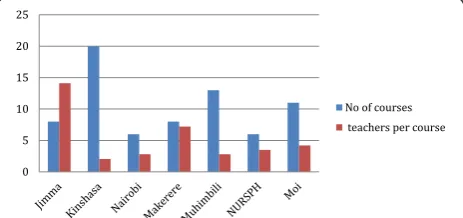
Figure 1 shows the general course load across the different SPHs. It compares the number of courses and the number of full-time staff at each SPH. This is not a demonstration of the correlation but rather a qualitative assessment of sheer numbers in relation to teaching programs. It does not take into account the research load or engagement for each member of staff. For example, CPHMS, Ethiopia, and MakSPH, Uganda, have the same number of courses (seven) but differ in staffing levels, 14 and 6, respectively.
Design of existing curricula
Table 3 outlines the structure of the MPH degree program highlighting the similarities and differences among the seven SPHs. The variables, duration, mode of delivery, credit transfer, duration of practicum, admission require-ments, assessment format, admission and graduation rates, full time staff, and last curricular review will serve as a ref-erence point for discussions on the structure of teaching programs relevant to HSR. The structure of the HSR-relevant MPH programs varies across the seven SPHs.
With respect to duration of the MPH program, MUSPHSS, Tanzania, and KSPH, DRC, host a 1-year pro-gram boasting graduation rates of 100% with an intake of 20 and 60 students per year, respectively. SPHs with 2-year programs have intakes ranging from 25 to 120 and graduation rates ranging from as low as 15% (MUSOPH, Kenya) and 19% (MaKSPH, Uganda), to 32% (SPHUoN, Kenya), to 66% (NURSPH, Rwanda) and 81% (CPHMS, Ethiopia). While it is clear that program duration influ-ences graduation rates, this does not appear to be the case between intake and graduation rates. Only MakSPH, Uganda, and CPHMS, Ethiopia, offer an MPH program by distance learning. There is no standard definition of credit hours required to complete an MPH across the seven schools with required credit hours ranging from 38.4 (MUSPHSS, Tanzania) to 85 (KSPH, DRC) for the 1-year
MPH and from 46 (CPHMS, Ethiopia) to 240 (NURSPH, Rwanda) for the 2-year MPH program.
Three other features that we reviewed on curriculum design were experiential learning (especially duration of field placements), admission criteria (focusing on multi-disciplinary background of trainees and years of relevant work experience), and the nature of program assessment (emphasis on continuous vis-à-vis summative assessment). Table 3 shows that four schools (CPHMS, Ethiopia; KSPH, DRC; MakSPH, Uganda; and MUSOPH, Kenya) offer non-thesis field placements, ranging from 3 to 12 weeks, designed to provide experiential learning. As of October 2011, MUSPHSS, Tanzania, and SPHUoN, Kenya, did not offer structured field-based learning experiences in their MPH training program. One key informant pointed out that research results are not making their way into policy and practice and suggested that SPHs need to perhaps in-clude diverse and relevant methods for engagement with external stakeholders during curricula design and dissem-ination of research results in addition to building capacity of staff.
“Some attempt is being made to train staff on research-related courses but again no emphasis on how to trans-late their finding to care, just gathering dust in the form of publications and theses. Publications are just used for career development by university lecturers.”
[KII, Ministry of Health, Kenya].
The admission criteria into the MPH programs are simi-lar across the seven SPHs: a multi-disciplinary background with at least 2 years of relevant work experience. Interest-ingly, CPHMS, Ethiopia, and MUSPHSS, Tanzania, were the only SPHs that conduct entrance examinations to as-sess applicants.
On program assessment, the distribution of formative to summative course assessments was evenly split for CPHMS, Ethiopia, at 50%. This was followed by MUSOPH, Kenya, and MUSPHSS, Tanzania, with 40% formative to 60% summative. It is noteworthy to point out that these three SPHs were established or have adopted the problem-based learning and community-problem-based education philoso-phy. Finally, for KSPH, DRC, MakSPH, Uganda, and SPHUoN, Kenya, were at 30% for formative to 70% sum-mative, indicating a more traditional mode of assessment.
Table 3 Structure of Masters in Public Health (MPH) curricula in schools of public health (SPHs) in East and Central Africa
MPH program Duration (years)
Average no. admitted per year
Average no. graduates per year
Mode of delivery-fulltime or distance
Credit hours
Duration of practicum (weeks)
Admission requirements
Assessment formative (F) and summative (S)
Full time staff in the school
Last curricula review prior to October 2011
CPHMS, Ethiopia 2 80 65 Both 46 12
(Community-based education)
Multidisciplinary/at least 2 years’relevant work experience andentrance exam
F = 50% S = 50% 80 2005–2006
KSPH, DRC 1 60 60 Fulltime/face
to face
85 8 weeks Postgraduate 3
years’experience
F = 20% S = 70% PR = 10 38 2008–on-going
MakSPH, Uganda 2–fulltime 3–distance
80 15 Both 63 10 weeks field
attachment
Multidisciplinary/at least 2 years’work experience
F = 30% S = 70% 58 2009–2010
MUSOPH, Kenya 2 120 18 Fulltime/face
to face
51 3 weeks practicum/ course based
Multidisciplinary/at least 2 years’relevant work experience
F = 40% S = 60% 22 2009–on-going
MUSPHSS, Tanzania 1 20 20 Fulltime/face
to face
38.4 None Public health/2 years’
work experience and entrance exam
F = 40% S = 60% 27 None
SPHUoN, Kenya 2 25 8 Fulltime/face
to face
120 None Multidisciplinary/2 years’
work experience
F = 30% S = 70% 18 2006–on-going
NURSPH, Rwanda 2 60 40 Fulltime/face
to face
240 3 weeks field work Multidisciplinary/2 years’ work experience in the health sector
F = 40% S = 60% 45 2008–2010
Nangami
et
al.
Health
Research
Policy
and
Systems
2014,
12
:22
Page
8
o
f
1
5
http://ww
w.health-po
licy-systems
.com/content
quality teaching and graduation rates, the variations in staffing suggest an important problem facing most of the SPHs–attraction and retention of competent staff. The two quotes below illustrate some of the factors relevant for attracting and retaining quality teaching staff.
“The factors that have been found to be successful in attracting qualified staff include the fact that the teaching philosophy of the university is community-based education, limited bureaucracy in the university as compared to other universities, openness, and, to some extent, provision of housing.”
[KII, University Management, CPHMS, Ethiopia]
“While a third of the staff are junior (37%; 16/43), with less than 10 years working experience, about 10 of the staff are about to retire or are employed on contract terms after their retirement. Although the school has a large number of well trained and experienced staff, the school is facing a challenge of keeping abreast with the new technologies for teaching competence curriculum in a large and expanding number of programs and student intake.” [KII, Focal Person, MUSPHSS, Tanzania].
This information on staffing brings to the fore the issue of mentorship as an aspect of capacity building for teaching and innovation to training by using technol-ogy. These two are key aspects of a competency-based curriculum. All the staff who are about to retire at MUSPHSS, Tanzania, are doctoral degree holders and may worsen the staffing problem unless more staff are recruited.
Finally, it appears that most SPHs, except MUSPHSS, Tanzania, do review curricula (a key requirement for quality assurance), but these reviews are not regular for some and incomplete for others. For instance, three SPHs initiated and completed reviews in the years pre-ceding the assessment in 2011. These include CPHMS, Ethiopia (2005 to 2006), NURSPH, Rwanda (2008 to 2010), and MakSPH, Uganda (2009 to 2010). Three other SPHs had initiated but not completed curricular reviews by December 2011, namely, SPHUoN, Kenya (2006), KSPH, DRC (2008), and MUSOPH, Kenya (2009). The quote below exemplifies the perspective of the slow-paced process of curriculum review.
“Curriculum review is an exercise that usually involves different departments in the SPH, bringing all members of the department together takes a lot of effort and can drag on and on for a long time delaying the review process.”
[KII, University Staff, NURSPH, Rwanda].
Perceived interest and competencies to teach HSR and implement HSR curricula
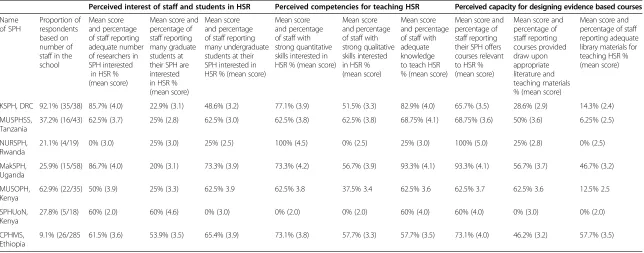
Table 4 shows three main results from staff at each school who responded to questions under the organizational cap-acity component of the self-assessment tool. The results are presented as proportions of respondents who agreed (score 4) or strongly agreed (score 5) as well as the mean scores of values from the Likert scale classified as strong, moderate, and weak under the methods section of this paper. The first set of results reveals staff perceptions on proportions of staff and students interested in HSR. In this study, this number of staff not only reflects the interest in HSR but also the capacity to teach and mentor students in HSR-relevant areas. The second set indicates staff percep-tions of existing competencies (knowledge, quantitative, and qualitative skills) to teach HSR. Finally, Table 4 re-veals perceived capacity of staff to design appropriate curriculum and access to learning and teaching re-sources (library). These results show the strengths, weaknesses, and challenges relevant to perceived cap-acity of faculty to teach HSR and implement HSR-relevant curricula in the seven SPHs.
SPHs differ in strength as well as share weaknesses across all the nine dimensions assessed. First, on perceived interest in HSR, all SPHs, except SPHUoN, Kenya (2.0), depicted a pattern of moderate (CPHMS, Ethiopia, NURSPH, Rwanda, and MUSPHSS, Tanzania) or strong (MakSPH, Uganda, KSPH, DRC, and MUSOPH, Kenya) interest among teach-ing staff. On the contrary, students were perceived by staff to have relatively less interest in HSR compared to teaching staff. Specifically, staff at MUSPHSS, Tanzania, perceived graduate students to have the least interest in HSR (mean score 2.8), while SPHUoN, Kenya, which regis-tered the lowest mean score on interest among teaching staff, had the highest mean score on perceived interest among graduate students. The other four of the SPHs reflected a moderate average score ranging between 3.0 and 3.79. Interestingly, the three SPHs with strong per-ceived undergraduate student interest in HSR – MakSPH, Uganda (adopted after 2003), MUSOPH, Kenya, and CPHMS, Ethiopia– also had strong field placement programs founded on problem- and community-based learning principles. This suggests, in part, that such cur-riculum design spurs student interest through effective supervision/mentorship at undergraduate and graduate level.
Table 4 Perceived interests, capacities for designing, and competencies to teaching and mentoring health systems research (HSR) courses at the seven schools of public health (SPHs)
Perceived interest of staff and students in HSR Perceived competencies for teaching HSR Perceived capacity for designing evidence based courses
Name of SPH
Proportion of respondents based on number of staff in the school
Mean score and percentage of staff reporting adequate number of researchers in SPH interested
in HSR % (mean score)
Mean score and percentage of staff reporting many graduate students at their SPH are interested in HSR % (mean score)
Mean score and percentage of staff reporting many undergraduate students at their SPH interested in HSR % (mean score)
Mean score and percentage of staff with strong quantitative skills interested in HSR % (mean score)
Mean score and percentage of staff with strong qualitative skills interested in HSR % (mean score)
Mean score and percentage of staff with adequate knowledge to teach HSR % (mean score)
Mean score and percentage of staff reporting their SPH offers courses relevant to HSR % (mean score)
Mean score and percentage of staff reporting courses provided draw upon appropriate literature and teaching materials % (mean score)
Mean score and percentage of staff reporting adequate library materials for teaching HSR % (mean score)
KSPH, DRC 92.1% (35/38) 85.7% (4.0) 22.9% (3.1) 48.6% (3.2) 77.1% (3.9) 51.5% (3.3) 82.9% (4.0) 65.7% (3.5) 28.6% (2.9) 14.3% (2.4)
MUSPHSS, Tanzania
37.2% (16/43) 62.5% (3.7) 25% (2.8) 62.5% (3.0) 62.5% (3.8) 62.5% (3.8) 68.75% (4.1) 68.75% (3.6) 50% (3.6) 6.25% (2.5)
NURSPH, Rwanda
21.1% (4/19) 0% (3.0) 25% (3.0) 25% (2.5) 100% (4.5) 0% (2.5) 25% (3.0) 100% (5.0) 25% (2.8) 0% (2.5)
MakSPH, Uganda
25.9% (15/58) 86.7% (4.0) 20% (3.1) 73.3% (3.9) 73.3% (4.2) 56.7% (3.9) 93.3% (4.1) 93.3% (4.1) 56.7% (3.7) 46.7% (3.2)
MUSOPH, Kenya
62.9% (22/35) 50% (3.9) 25% (3.3) 62.5% 3.9 62.5% 3.8 37.5% 3.4 62.5% 3.6 62.5% 3.7 62.5% 3.6 12.5% 2.5
SPHUoN, Kenya
27.8% (5/18) 60% (2.0) 60% (4.6) 0% (3.0) 0% (2.0) 0% (2.0) 60% (4.0) 60% (4.0) 0% (3.0) 0% (2.0)
CPHMS, Ethiopia
9.1% (26/285 61.5% (3.6) 53.9% (3.5) 65.4% (3.9) 73.1% (3.8) 57.7% (3.3) 57.7% (3.5) 73.1% (4.0) 46.2% (3.2) 57.7% (3.5)
Nangami
et
al.
Health
Research
Policy
and
Systems
2014,
12
:22
Page
10
of
15
http://ww
w.health-po
licy-systems
.com/content
Responses on capacity to design and teach HSR-relevant curricula were based on two questions in the self-assessment tool. Staff perceptions on whether staff have the knowledge to teach HSR-relevant courses and if the exist-ing curricula have HSR-relevant content (staff able to de-sign). Respondents across all the SPHs reported strengths in knowledge of HSR among staff with average scores in four SPHs (MakSPH, Uganda (4.1); KSPH, DRC (4.0); MUSPHSS, Tanzania (4.1); and SPHUoN, Kenya (4.0)) be-ing perceived as strong and in three SPHs (NURSPH, Rwanda (3.0); MUSOPH, Kenya (3.6); and CPHMS, Ethiopia (3.5)) being perceived as moderate. Interestingly, on the perception as to whether the staff in the same SPHs had knowledge to design HSR-relevant courses (existing curricula have HSR-relevant content), there was a decrease in the proportion for KSPH, DRC (4.0 to 3.5) and MUSPHSS, Tanzania (4.1 to 3.6) but an increase in those holding the view that the same staff had capacity to design (NURSPH, Rwanda (3.0 to 5.0) and CPHMS, Ethiopia (3.5 to 4.0)). The other three MakSPH, Uganda, SPHUoN and MUSOPH (both in Kenya) had similar proportions holding the view on staff with knowledge to teach as well as design HSR-relevant courses. The variations between perceived capacity to teach and design the explanation is reflected in the poor interest in HSR among postgraduate students in these SPHs suggesting a need for mentorship programs.
Finally, Table 4 also reveals that staff in all SPHs were of the opinion that courses offered were relevant to HSR; four SPHs (NURSPH, Rwanda, MakSPH, Uganda, SPHUoN, Kenya, and CPHMS, Ethiopia) strongly held that opinion and three SPHs (KSPH, DRC, MUSPHSS, Tanzania, and MUSOPH, Kenya) held a moderate opinion. None of the staff in the seven schools held a strong opinion that re-sources for designing curricula, teaching, and learning HSR (library) were adequate. The mean scores ranged from 2.0 to 3.5 for library resources with KSPH, DRC, and NURSPH, Rwanda, being the least equipped with these resources.
Opportunities for aligning HSR priorities to teaching programs
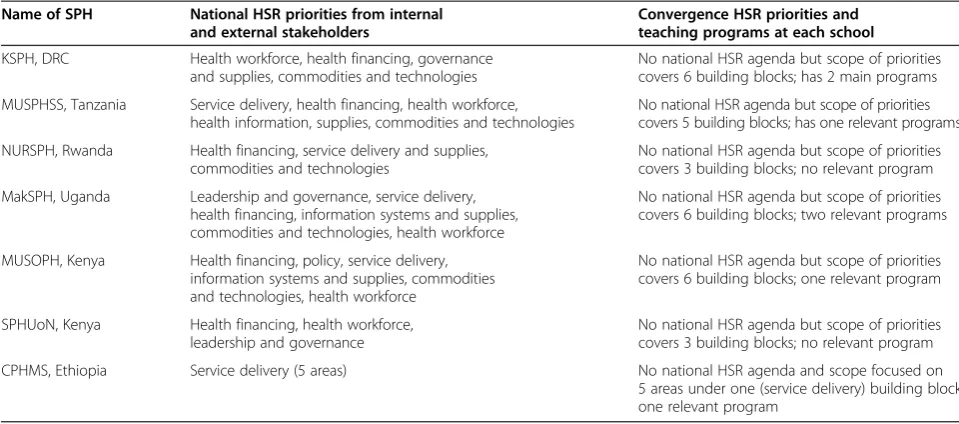
The final part of this paper explores the extent of oppor-tunities for aligning HSR priorities to design or review teaching programs. In reviewing the information from the“quick and dirty”exercise that targeted external SPH partners, we found that none of the participating coun-tries had a national agenda on HSR priorities, yet there appears to be general consensus among external stake-holders on priorities in HSR. When these identified pri-orities are juxtaposed against existing teaching programs offered at the seven universities as of October 2011, the analysis reflected in Table 5 reveals little convergence.
Several opportunities exist to leverage the strengths of the SPHs in order to address the weaknesses in existing programs. Various stakeholders identified many national
and regional opportunities relevant to curricula design and teaching of HSR, including developing eLearning plat-forms, sharing teaching and learning resources including case studies, developing a regional HSR curriculum, and establishing procedures for credit transfer across regional institutions. Perhaps these opportunities provide a plat-form for SPHs to consider when deliberating their capacity development plans.
Discussion
To address inequalities in African health systems that may be linked to policymakers having limited access to and use of evidence from relevant bodies and professionals, in part requires competent health system researchers to generate this evidence. To impart the relevant knowledge, skills, and positive attitudes on HSR practitioners requires that appro-priately trained and competent faculty deliver a well-resourced competency-based curriculum. This requirement is often overlooked as most previous capacity building ini-tiatives have oftentimes focused on building competencies of HSR practitioners without establishing sustainable sup-port for the training process [1-4,7,14].
The aim of this paper is to share and reflect on the na-ture of existing curricula for training public health stu-dents in HSR, the design of curricula, and the capacity to teach HSR at the seven universities in six countries across East and Central Africa. It also seeks to establish oppor-tunities that SPHs could leverage to align national HSR priorities to the HSR curricula at national and regional level. Establishing the status of HSR-relevant curricula and institutional capacity of SPHs to design and deliver the curricula is a key phase of the journey towards developing appropriate curricula for transformative learning of the HSR professional and promoting national as well as re-gional interdependence in teaching of HSR as argued by various scholars [5,6].
relationship between education and health [5]. We suggest a competency-based HSR curriculum and relevant cap-acity to teach that curriculum in order to integrate the two sub-systems. This was earlier defined as a curriculum that is student-centered, performance-oriented, and equips the learner with the knowledge, skills, and positive attitude to efficiently and effectively perform their current and an-ticipated tasks. A competency-based curriculum for HSR is essential in order to make training responsive to health systems needs [5]. Some known reasons for the slow and fragmented approach to adoption of educational reform include resistance to change educational philosophy during the formative years of an institution [4]. This observation is supported by two facts from these results. First, the oldest SPHs (MaKSPH, Uganda, and SPHUoN, Kenya) success-fully transitioned to SPH later than those at recently estab-lished universities. Second, the two SPHs, which did not have traditional naming of departments, e.g., epidemiology and biostatistics, were purposively established on the edu-cational philosophy of problem-based learning.
An additional finding from a key informant pointed out that research results are not making their way into policy and practice indicating that curricula need to perhaps include diverse and relevant methods for effect-ive dissemination of research results to stakeholders. Evidence-based decision making is also essential, given that about 12% of the world’s population resides in sub-Saharan Africa, yet it is home to over 25% of the global disease burden and supported by only 3% of the world’s health workforce [4]. To ensure that HSR curricula are evidence-based, the consortium of seven SPHs in East and Central Africa collaborating under the Africa Hub on HSR will have to tap into portal resources such as those identi-fied by the sub-Saharan African Medical Schools Study
initiative funded by the Bill and Melinda Gates Founda-tion, which provides updates on the state of medical edu-cation in the region covering innovations and trends. However, at the moment, this initiative does not highlight HSR [4]. Since the completion of this study, CHEPSAA has developed relevant courses on complex health sys-tems, health systems and policy research, and how to de-sign curricula that SPHs should take into account in order to enhance HSR capacity [6]. The IUCEA is working on a regional qualification framework that would set minimum standards for select programs and allow credits to be transferred between universities. This would be very rele-vant for this group of SPHs that may seek to introduce a credit transfer system and may provide an opportunity to contribute to IUCEA and Association of Schools of Public Health in Africa discussions on minimum standards for HSR course content and structure, as well as enhance-ment of teaching capacities in the region. As other studies have recommended the strengthening of regional net-works [4,6], the seven SPHs can leverage this supportive policy environment and existing networks and experiences in engaging these and other regional bodies to develop standards for HSR curricula across the region.
The results of this capacity assessment offer evidence of the differences among the seven SPHs in terms of the range and scope of their degree programs with regards to the concept of health systems, program durations, modes of delivery and assessment, graduation rates, and resources. These differences persist despite the fact that the SPHs have similar admission criteria, student back-grounds, and quality assurance policies to guide process of curricula development and teaching practices. These findings indicate that the existing curricula do not meet the requirements of a competency-based curriculum Table 5 Convergence of health system research (HSR) priorities and teaching programs
Name of SPH National HSR priorities from internal and external stakeholders
Convergence HSR priorities and teaching programs at each school KSPH, DRC Health workforce, health financing, governance
and supplies, commodities and technologies
No national HSR agenda but scope of priorities covers 6 building blocks; has 2 main programs
MUSPHSS, Tanzania Service delivery, health financing, health workforce, health information, supplies, commodities and technologies
No national HSR agenda but scope of priorities covers 5 building blocks; has one relevant programs
NURSPH, Rwanda Health financing, service delivery and supplies, commodities and technologies
No national HSR agenda but scope of priorities covers 3 building blocks; no relevant program
MakSPH, Uganda Leadership and governance, service delivery, health financing, information systems and supplies, commodities and technologies, health workforce
No national HSR agenda but scope of priorities covers 6 building blocks; two relevant programs
MUSOPH, Kenya Health financing, policy, service delivery, information systems and supplies, commodities and technologies, health workforce
No national HSR agenda but scope of priorities covers 6 building blocks; one relevant program
SPHUoN, Kenya Health financing, health workforce, leadership and governance
No national HSR agenda but scope of priorities covers 3 building blocks; no relevant program
CPHMS, Ethiopia Service delivery (5 areas) No national HSR agenda and scope focused on 5 areas under one (service delivery) building block; one relevant program
Nangamiet al. Health Research Policy and Systems2014,12:22 Page 12 of 15
that emphasizes experiential learning using adult learning principles. Limited opportunities for appropriate place-ments into experiential learning settings further weaken the alignment of the curricula to both workplace environ-ments and employee expectations. According to the WHO, the scope of a curriculum for a HSR degree pro-gram should cover all of the building blocks of the health system [1,2]. Equally important, failure to regularly review curricula suggests that the schools are overly bureaucratic and lethargic about engaging stakeholders in the process of continually improving the quality of their programs. Only three out of the seven SPHs had initiated and com-pleted curricula review, and even in these cases the process was not very inclusive, because only a few key stakeholders were engaged as shown by the qualitative in-formation on review at the departmental level.
There are major variations in the staffing levels across the seven SPHs. However, without additional data to es-tablish teaching load among other factors, it would be misleading to infer any relative advantage or disadvantage based on absolute numbers. Moreover, most of the teach-ing staff do not have the prerequisite trainteach-ing in HSR. It would be important for each school to strive to meet the staff to student ratios prescribed by UNESCO [10] for university-level training, which is divided into strong (ratio of less than 20), medium (20 to 30), and weak (less than 30). The above shortcomings notwithstanding, only two of the SPHs implement distance learning/eLearning as an al-ternative delivery strategy and two had 100% graduation rates. Unfortunately, neither the alternative mode of deliv-ery nor the high graduation rates can be associated with availability of full-time staff because of insufficient data. A formidable challenge all the universities face is declining trends in government funding used to maintain competitive salaries and provide staff development. In addition, govern-ments are reducing investment in the development of learning facilities despite rapidly rising student enrollments [20,21]. This greatly reduces the number of staff with doc-toral degrees, weakens research initiatives, and interferes with implementation of university and national policies, thus further weakening the link between university-level training by SPHs and global public health objectives.
The capacity of staff to teach and mentor HSR-relevant courses was generally weak across the seven SPHs since most faculty had training in the traditional research methods and lack a health systems-specific background and/or training. There are opportunities for sharing re-sources across the seven SPHs as well as to develop dual career pathways to mentor junior faculty to take up HSR training. This conclusion has been reached by other stud-ies examining data across different universitstud-ies throughout Africa [4,6].
As results showed, most of the SPHs were perceived to have strong policies and procedures to design curricula
drawing on a wide range of resources. It is also true that there exists basic infrastructure to design online courses, but only one SPH offered HSR-relevant curricula online. There is a strong demand for health system professionals but the supply is limited and to address the imbalance in the system new curricula should respond to both the needs of the community and priorities of the health sector. Frenk et al. point out that evaluating appropriateness of current curricula to the HSR priorities and needs of the community requires the education system to diversify training strategies so as to produce health professionals with the appropriate skill mix and competencies [5]. One way of doing this is to engage key stakeholders to deter-mine the priority health system needs and then develop an inclusive agenda. This was partially done in this study and revealed convergence between health system priorities and existing curricula relevant to HSR. Another approach is to design appropriate field placements during training which ensure experiential learning and can also help to align the curricula to workplace competencies in health systems management. Five of the SPHs had some form of field practicum; however, the data do not permit an in-depth analysis of the structure and content of these practicums to judge their effectiveness.
In the final section, we present a set of recommendations that can be used to improve the institutional capacity to design and teach HSR teaching curricula within and across the SPHs as well as at regional levels in order to improve health system responsiveness to the needs of communities. Overall, the study adds value to the existing body of know-ledge in three ways. First, having infrastructure and a sup-portive environment to design and teach HSR-relevant curricula alone is not sufficient. Instructional factors, such as conceptual clarity, interest, knowledge, and skills, are important. Second, competency-based approaches have not taken root in most SPHs and in the few where limited educational changes in philosophy have occurred, the im-plementation is largely partial and/or piecemeal. Finally, al-though opportunities exist for designing quality curricula and offering learner-centered training in HSR in SPHs across East and Central Africa, most SPHs have not lever-aged their strengths to build institutional capacity using national and regional networks.
Conclusions and recommendations
survey and the lukewarm interest in HSR research and training amongst graduate students compared to enthu-siastic external stakeholders giving clear but varied health system priorities. These findings are akin to what other scholars surveying various schools of medicine in Africa have observed – a slow-paced transition to systems-based learning, piecemeal adoption of existing technology to transform teaching and learning, and working in silos rather than building strategic networks to develop and sustain institutional capacities for inter-dependence in teaching HSR [4-6].
Program-level recommendations
These are based on the evidence of a diverse context, lack of HSR curricula, varied capacities to design and teach, and untapped opportunities at national and re-gional level; the SPHs proposed these interventions.
(i) Develop school-specific, national and regional capacity building plans to strengthen instructional capacity of staff and institutional capacity of SPHs to design and teach HSR.
(ii)To jointly develop and implement a standardized regional HSR curriculum that is competency-based and emphasizes a systems approach as a pilot. (iii)Participating countries should consider developing
an HSR eLearning platform for the regional course. (iv) Based on the diverse strengths, the SPHs should
promote sharing of experiences and practices with respect to teaching HSR, and, where gaps exist, develop an inventory of shared HSR teaching materials and through teacher and student exchange. (v)Depending on institutional practices at each SPH,
existing curricula should be reviewed with the aim of integrating the HSR syllabus, especially at
undergraduate level. This is likely to promote interest and mentorship as part of teaching across all SPHs.
Policy-level recommendations
At the policy level, schools should review relevant proce-dures and encourage their respective University Senates to support capacity-building initiatives for designing competency-based philosophy into the HSR degree pro-grams. These changes would not only improve the effi-ciency and effectiveness of these training programs but also promote the culture of evidence-based policy-making. As part of curricula design, there is a need to explore the potential for credit transfer among the seven SPHs. This may require support from regional bodies such as the IUCEA among other regional networks engaged in standardization and harmonization and quality assurance. An effective credit transfer system would increase demand and improve mobility between universities for the HSR programs across the six countries and the region.
To further stimulate interest in teaching HSR, the schools should explore the potential for a regional men-toring program for junior faculty as well as an eLearning in-service course to expand access but also stimulate more interest in HSR among health professionals. These two strategies will also strengthen the linkages among acade-micians/teachers, researchers, and policymakers, a point stressed by some of the KII respondents from the Minis-tries of Health.
Finally, at the institutional level, all SPHs need to re-view their policies on collaborations and alliances with industry to support experiential learning. Notwithstand-ing, policymakers should have clear implementation plans for operationalization of these policies. This will assure that students receive early exposure to real work-place environments and transformative learning that leads to improved outcomes and performance among health professionals. In addition, institutions should work with key stakeholders to consolidate and stream-line funding streams. This could lead to various options for regional scholarships for HSR. An institutionalized tracking system for the graduates in HSR and related degree programs is also urgent.
Further research
To better inform the process of curricula design and re-view, we recommend establishing and institutionalizing a monitoring and evaluation system for HSR graduates of the MPH programs to determine gaps in HSR training at both the undergraduate and graduate levels. Finally, a follow-up study around the systems-based competency-driven frame-work to unearth specific instructional gaps across the seven institutions in capacity building for HSR is recommended.
Abbreviations
CHEPSAA:Consortium for Health Policy and Systems Analysis in Africa; CPHMS: College of Public Health and Medical Sciences; DRC: Democratic Republic of the Congo; FP: Focal Person; HEALTH: Higher Education Alliance for Leadership Through Health; HSR: Health Systems Research;
IDRC: International Development Research Centre; IUCEA: Inter-University Council of East Africa; KII: Key informant interview; KSPH: Kinshasa School of Public Health; MakSPH: Makerere University College of Health Sciences; MPH: Master of Public Health; MUSPHSS: Muhimbili School of Public Health and Social Sciences; MUSoPH: Moi University, School of Public Health; NURSPH: National University of Rwanda School of Public Health; SPH: School of Public Health; SPHUoN: University of Nairobi School of Public Health.
Competing interests
The authors do not have any competing interests to declare.
Authors’contributions
All four authors were involved in the design and implementation of the assessment tool. MN wrote drafts of the manuscript and coordinated all inputs. BT, LR, and AM provided substantial input, as well as reviewing the draft manuscript. All four authors read and approved the final manuscript.
Acknowledgements
We acknowledge all of the original Focal Persons from the seven HEALTH Alliance SPHs for their contributions to this paper including collecting data, analyzing and sharing country-level information, and reviewing drafts of this paper. In addition to the four authors, this includes Suzanne Kiwanuka, Daudi
Nangamiet al. Health Research Policy and Systems2014,12:22 Page 14 of 15
Simba, Eric Mafuta, and Richard Ayah. We also thank Nasreen Jessani, Sara Bennett, Elizabeth Ekirapa-Kiracho, and Daniela Lewy for their unwavering advice and support. We thank Chrispus Mayora, Moses Tetui, Angela Nanyanzi, and all members Africa Hub secretariat in Kampala for ushering us through the process. Furthermore, we extend our gratitude to the Deans of the Africa Hub member SPHs, led by Professor William Bazeyo (Dean MakSPH, Uganda) for their direct support and commitment to the authors. We express our gratitude to Michael Zierler for his thoughtful review and editorial contributions. The authors express their appreciation for the financial support (Grant #H050474) provided by the UK Department for International Development (DFID) for the Future Health Systems research programme consortium (FHS-RPC). This document is an output from a project funded by DFID for the benefit of developing countries. The views expressed in this document, however, are solely a responsibility of the authors, and not necessarily those of DFID.
Author details
1Department of Health Policy and Management, College of Health Sciences,
School of Public Health, Moi University, P.O. Box 4606, Eldoret 30100, Kenya.
2Department of Community Health, School of Public Health, National
University of Rwanda, P.O. Box 5229, Kigali, Rwanda.3Maternal and Reproductive Health, College of Public Health and Medical Sciences, Jimma University, P.O Box 378, Jimma, Ethiopia.4Department Epidemiology and Biostatistics, College of Health Sciences, School of Public Health, Makerere University, P.O Box 7072, Kampala, Uganda.
Received: 2 December 2013 Accepted: 11 April 2014 Published: 2 June 2014
References
1. World Health Organization:Everybody’s Business: Strengthening Health Systems to Improve Health Outcomes.Geneva: WHO’s Framework for Action; 2007. 2. World Health Organization:Systems Thinking for Health System Strengthening.
Geneva: WHO; 2009.
3. Beinecke RH:Leadership Training Programs and Competencies for Mental Health, Health, Public Administration, and Business in Seven Countries, International Initiative for Mental Health Leadership; 2009. http://www.iimhl. com/files/docs/20090213.pdf.
4. Mullan F, Frehywot S, Omaswa F, Buch E, Chen C, Greysen SR, Wassermann T, Abubakr DE, Awases M, Boelen C, Diomande MJ, Dovlo D, Ferro J, Haileamlak A, Iputo J, Jacobs M, Koumaré AK, Mipando M, Monekosso GL, Olapade-Olaopa EO, Rugarabamu P, Sewankambo NK, Ross H, Ayas H, Chale SB, Cyprien S, Cohen J, Haile-Mariam T, Hamburger E, Jolley L,et al:Medical Schools in sub-Saharan Africa.Lancet2011,377(9771):1113–1121.
5. Frenk J, Chen L, Bhutta ZA, Cohen J, Crisp N, Evans T, Fineberg H, García PJ, Ke Y, Kelley P, Kistnasamy B, Meleis A, Naylor D, Pablos-Mendez A, Reddy S, Scrimshaw S, Sepulveda J, Serwadda D, Zurayk H:Health professionals for a new century: transforming education to strengthen health systems in an interdependent world.Lancet2010,376(9756):1923–1958.
6. Mirzoev T, Le G, Green A, Orgill M, Komba A, Esena K, Nyapada L, Uzochukwu B, Amde W, Nxumalo N, Gilson L:Assessment of capacity for Health Policy and Systems Research and Analysis in seven African universities: results from the CHEPSAA project.Health Policy Plan2013, In press. 7. Brownie S, Bahnisch M, Thomas J:Competency-based Education and
Competency-based Career Frameworks: Informing Australian Health Workforce Development.Adelaide: National Health Workforce Planning and Research Collaboration; 2011.
8. Tettey JW:Challenges of Developing and Retaining the Next Generation of Academics: Deficits in Academic Staff Capacity of African Universities, Partnership for Higher Education in Africa; 2010. http://www.foundation-partnership.org/pubs/pdf/tettey_deficits.pdf.
9. Cloete N, Bailey T, Pillay P, Bunting I, Maassen P:Universities and Economics Development in Africa.Wynberg, SA: Centre for Higher Education Transformation (CHET); 2011.
10. Martin M:Staff Management in African Universities, (IHEP) Contributions No. 7. Paris: International Institute of Educational Planning; 1991.
11. Varkevisser CM, Mwaluko GM, Le Grand A:Research in action: the training approach of the Joint Health Systems Research Project for the Southern African Region.Health Policy Plan2001,16:281–291.
12. Gukas ID:Global paradigm shift in medical education: issues of concern for Africa.Med Teach2007,29(9):887–892.
13. Inter University Council of East Africa:The IUCEA Rolling Strategic Plan for 2011/2012–2015/2016; 2011. http://www.iucea.org/.
14. Hoge MA, Paris M Jr, Adger H Jr, Collins FL Jr, Finn CV, Fricks L, Gill KJ, Haber J, Hansen M, Ida DJ, Kaplan L, Northey WF Jr, O’Connell MJ, Rosen AL, Taintor Z, Tondora J, Young AS:Workforce competencies in behavioral health: an overview.Adm Policy Ment Health2005,32:593–631. 15. Future Health Systems: Innovations for Equity; http://www.futurehealthsystems.org. 16. Simba D, Mukose A, Bazeyo W:Institutional capacity for Health systems
research in East and Central African Schools of Public Health: enhancing capacity to design and implement teaching programs.Health Res Policy Syst2014,12:23.
17. Ayah R, Jessani N, Mafuta E:Institutional capacity for health systems research in East and Central African schools of public health: knowledge translation and effective communication.Health Res Policy Syst2014,12:20.
18. Jessani N, Lewy D, Ekirapa-Kiracho E, Bennett S:Institutional strengthening in health systems research: experiences with a capacity assessment tool in seven East and Central African schools of public health.Health Res Policy Syst2014,12:21.
19. Bennett S, Adam T, Zarowsky C, Tangcharoensathien V, Ranson K, Evans T, Mills A, Agyepong I, Hu S, Lavis J, Makubalo L, Rannan-Eliya R, Sanchez D, Tomson G:From Mexico to Mali: progress in health policy and systems research.Lancet2008,372:1571–1578.
20. Alliance for Health Policy and Systems Research:Strengthening Health Systems: The Role and Promise of Policy and Systems Research.Geneva; 2004. http://www.who.int/alliance-hpsr/resources/Strengthening_complet.pdf. 21. Bruce JD:Higher education finance and accessibility: tuition fees and student loans in sub-Saharan Africa.J High Educ Afr2004,2(2):11–36. 22. Teferra D:Funding Higher Education in Sub-Saharan Africa.Basingstoke:
Palgrave Macmillan; 2013:14.
23. Lusthaus C, Anderson G, Murphy E:Institutional Assessment: A Framework for Strengthening Organizational Capacity for IDRC’s Research Partners.Ottawa: International Development Research Centre; 1995.
doi:10.1186/1478-4505-12-22
Cite this article as:Nangamiet al.:Institutional capacity for health systems research in East and Central Africa schools of public health: enhancing capacity to design and implement teaching programs.Health Research Policy and Systems201412:22.
Submit your next manuscript to BioMed Central and take full advantage of:
• Convenient online submission
• Thorough peer review
• No space constraints or color figure charges
• Immediate publication on acceptance
• Inclusion in PubMed, CAS, Scopus and Google Scholar
• Research which is freely available for redistribution