S T U D Y P R O T O C O L
Open Access
Improving the implementation of perioperative
safety guidelines using a multifaceted intervention
approach: protocol of the IMPROVE study, a
stepped wedge cluster randomized trial
Yvette EJJM Emond
1,2*, Hiske Calsbeek
1, Steven Teerenstra
1,3, Gerrit JA Bloo
1,2, Gert P Westert
1, Johan Damen
2,
André P Wolff
2and Hub C Wollersheim
1Abstract
Background:This study is initiated to evaluate the effects, costs, and feasibility at the hospital and patient level of an evidence-based strategy to improve the use of Dutch perioperative safety guidelines. Based on current knowledge, expert opinions and expertise of the project team, a multifaceted implementation strategy has been developed.
Methods/design:This is a stepped wedge cluster randomized trial including nine representative hospitals across The Netherlands. Hospitals are stratified into three groups according to hospital type and geographical location and randomized in terms of the period for receipt of the intervention. All adult surgical patients meeting the inclusion criteria are assessed for patient outcomes. The implementation strategy includes education, audit and feedback, organizational interventions (e.g., local embedding of the guidelines), team-directed interventions (e.g., multi-professional team training), reminders, as well as patient-mediated interventions (e.g., patient safety cards). To tailor the implementation activities, we developed a questionnaire to identify barriers for effective guideline adherence, based on (a) a theoretical framework for classifying barriers and facilitators, (b) an instrument for measuring determinants of innovations, and (c) 19 semi-structured interviews with perioperative key professionals. Primary outcome is guideline adherence measured at the hospital (i.e., cluster) and patient levels by a set of perioperative Patient Safety Indicators (PSIs), which was developed parallel to the perioperative guidelines. Secondary outcomes at the patient level are in-hospital complications, postoperative wound infections and mortality, length of hospital stay, and unscheduled transfer to the intensive care unit, non-elective readmission to the hospital and unplanned reoperation, all within 30 days after the initial surgery. Also, patient safety culture and team climate will be studied as potential determinants. Finally, a process evaluation is conducted to identify the compliance with the implementation strategy, as well as an economic evaluation to assess the costs. Data sources are registered clinical data and surveys. There is no form of blinding.
Discussion:The perioperative setting is an unexplored area with respect to implementation issues. This study is expected to yield important new evidence about the effects of a multifaceted approach on guideline adherence in the perioperative care setting.
(Continued on next page)
* Correspondence:[email protected] 1
Radboud university medical center, Radboud Institute for Health Sciences, IQ healthcare, PO Box 9101, 114 IQ healthcare, 6500 HB, Nijmegen, The Netherlands
2Radboud university medical center, Radboud Institute for Health Sciences, Department of Anesthesiology, Pain and Palliative Care, Nijmegen, The Netherlands
Full list of author information is available at the end of the article
(Continued from previous page)
Trial registration:Dutch trial registry: NTR3568
Keywords:Guideline adherence, Health-care quality indicators, Implementation, Multifaceted approach, Patient safety, Perioperative care, Stepped wedge design
Background
The focus of this project is to implement perioperative safety guidelines in Dutch hospitals. Perioperative ad-verse events (AEs) are associated with deaths, injured and disabled patients, and high costs [1-5]. In the Netherlands, about 1.2 million surgeries are performed annually [6]. AEs occur in 7.1% of all hospital patients [7]. Two thirds (65%) of all hospital AEs are associated with perioperative care [8]. Research shows that peri-operative mortality ranges between 1.5% and 3.13% [9-12], while 47%–62% is considered avoidable [2,8]. Analyses by the Dutch Health Care Inspectorate (IGZ) showed that perioperative care in the Netherlands was lack-ing standards in information transfer, clinical documenta-tion, teamwork, and coordination [13-15]. In response to the recommendations of the IGZ, national evidence-based perioperative safety guidelines including Patient Safety Indi-cators (PSIs) were developed (2010–2013) [16-18].
Implementation of these guidelines is expected to re-duce adverse patient outcomes. In addition, several stud-ies showed that using stop moments and the timely administration of antibiotic prophylaxis improve peri-operative outcome [3,9,12]. Adoption of guidelines in clinical practice has, however, proven to be difficult. About 30%–40% of all patients do not receive care ac-cording to actual scientific knowledge [19]. Many ap-proaches claim to offer solutions to this problem, but many aspects of the implementation process are also still unknown. From the extensive review of Grimshaw et al. [20], we know that some implementation activities are in potential very successful. However, the extent of success varies between settings and topics, and knowledge about implementation activities for guidelines or proto-cols regarding perioperative care is lacking. It is there-fore important to derive a potentially successful strategy and study its effect, costs, and feasibility in current prac-tice. It is, however, impossible to deliver such a strategy simultaneously to all hospitals because of logistical, prac-tical, and financial reasons. For that reason, a stepped wedge cluster randomized trial design is chosen. This de-sign is also considered advantageous when there is a belief that the implementation strategy will do more good than harm (making a parallel design, in which certain hospitals do not receive the intervention or to withdraw the inter-vention as would occur in a cross-over design, is uneth-ical) and it furthermore minimizes contamination [21].
Objective
The aim of this study is to investigate the (cost) effect-iveness of a multifaceted approach to implement the perioperative safety guidelines. Our main research question is
1. Can we improve the use of the national
perioperative safety guidelines at the hospital and patient levels? In other words, does a multifaceted approach to implement the perioperative guidelines lead to a higher compliance than unsupported implementation?
Other research questions are the following: 2. Does the perioperative patient safety (i.e., patient
outcomes) improve with better adherence to the guidelines?
3. What are the costs of this implementation strategy and what is the cost-effectiveness at the hospital level?
4. What is the feasibility of this implementation strategy at the hospital level?
In this study protocol, we describe a stepped wedge cluster randomized trial design to evaluate the effect of a multifaceted implementation strategy on guideline adherence and patient safety in Dutch hospitals (research questions 1 and 2). We also describe the economic evalu-ation (research question 3) and process evaluevalu-ation (re-search question 4).
Methods/design
Study design
Implementation of Perioperative Safety Guidelines (in Dutch: Implementatie Richtlijnen Operatieve Veiligheid (IMPROVE)) is a multicenter study in nine hospitals using an one-way (unidirectional) cross-over cluster trial design (i.e., the clusters cross over in one direction only, from control to intervention) where each participating cluster receives both intervention and control treatments con-secutively, in separate periods.
beginning of the study. At each time point, a new group of three hospitals crosses over from the control situation to the implementation situation. Good balance of hospital characteristics (e.g., hospital type and geographical loca-tion) over the groups (of three hospitals) was achieved by matching. Each group will start the implementation phase of 4 months at a different time point, directly after one of the measurements (T0, T1, T2). The time point a group crosses over is randomized (over the groups). Randomization was computer generated by an independent statistician when recruitment of clus-ters was complete (Additional file 1). By the end of the study, all groups (hence all hospitals) will have re-ceived the IMPROVE implementation strategy. The intervention is never removed once it has been imple-mented, at least over the course of the trial.
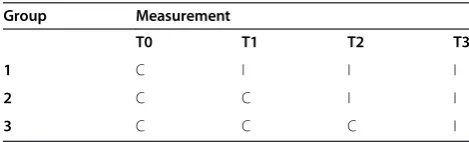
In our protocol, hospitals cross over from control to implementation period at three time points (Table 1). A stepped wedge design incorporates data collection in all hospitals at each time point [21,22]. The first time point corresponds to a baseline measurement where none of the hospitals have received the intervention of interest (i.e., multifaceted implementation approach). After the baseline measurement, the first group of hospitals re-ceives the implementation strategy. After the second measurement, the next group of hospitals receives the implementation strategy, and at the third time point, the final group switches from usual care to the imple-mentation phase, so that finally, all included hospitals have received the implementation activities. In this way, comparisons within hospitals and between hospi-tals will be available, making the design powerful.
In this study, nine hospitals are assigned into three groups of three hospitals. Data collection runs parallel for each hospital. At baseline measurement (T0), all pri-mary and secondary outcomes will be measured per pa-tient (N= 50) per hospital. In the interval between T0 and T1, implementation activities will take place in the first group of three hospitals. After the second measure-ment (T1), the second group of three hospitals crosses over to the intervention phase, while implementation ac-tivities continue in the first group and so on. At the final measurement (T3), all hospitals will be in the interven-tion phase (see Table 1).
Study population
This study comprises nine hospitals in the Netherlands: two academic, four tertiary teaching, and three regional hospitals, with 200 to up to more than 1,300 beds each. Eight hospitals have a NIAZ accreditation. This accreditation of the Dutch Institute for Health Care Accreditation (NIAZ, part of the International Society for Quality in Healthcare) is provided to hospitals that meet international standards developed and tested for external evaluation of health-care organizations [23]. Two hospitals are part of the Dutch Federation of University Medical Centers (NFU) and provide the most specialized care [24]. Four hospitals are part of the Association of Tertiary Medical Teaching Hospi-tals (STZ) and provide highly specialized medical care (the next level of specialization below that of NFU hospitals) [25]. Although the hospitals are not ran-domly chosen, the stratification in three classes is a strong point, and we believe these hospitals represent the practice of Dutch hospital care. Within these clus-ters, we assess 1,800 surgical patients distributed over four measurement points, i.e., 450 patients per meas-urement point with 50 patients per hospital (see the “Power calculation” section below). The study focuses on patients undergoing elective abdominal or vascular surgery with a mortality risk≥1% [10]. These surgeries are selected because of the estimated higher risk of complications and hospital mortality, as the number of included surgical patients is otherwise too small to be able to find significant effects of guideline adher-ence on perioperative patient safety (second research question). Exclusion criteria are the following: 1) pa-tients younger than 18 years, 2) papa-tients in day care (1-day hospital stays are defined as hospital admis-sions of 24 h or less), 3) patients undergoing cardiac surgery, 4) patients undergoing organ transplantations (except kidney transplants), and 5) patients undergo-ing emergency surgery, i.e., surgery needed within 24 h and/or without an pre-anesthesia evaluation rec-ord available and/or surgery with a start time after 4.59 PM or before 7.30 AM or during the weekend. Key disciplines are also involved as study objects: sur-geons, anesthesiologists, OR, anesthesia, recovery, and ward nurses, and ICU employees.
The intervention
The intervention consists of a multifaceted implementa-tion strategy directed at the cluster. Each group of hos-pitals will be exposed to the intervention for 4 months. The content of the multifaceted approach is based on 1) scientific literature (systematic review of interventions by Grimshaw et al. [20,26]); 2) expert opinion: prioritiz-ing implementation activities by 24 clinical and imple-mentation experts (RAND modified Delphi method); 3) Table 1 Stepped wedge design with four steps in which
‘C’represents the control situation and‘I’represents the intervention phase
Group Measurement
T0 T1 T2 T3
1 C I I I
2 C C I I
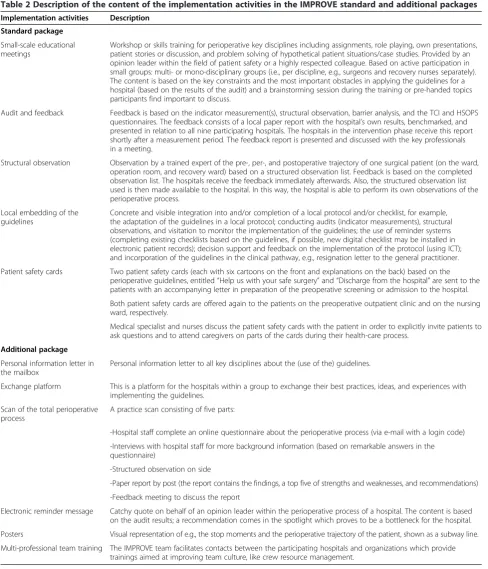
knowledge and experience of the IMPROVE team re-garding the feasibility of the interventions (estimated costs, effort, and time for the hospitals as well as the im-plementation team). This resulted in a standard package including five activities (Table 2): 1. small educational meetings, 2. audit and feedback (based on local indicator
scores and benchmarking, results of surveys on team cli-mate and safety culture, and barriers), 3. structured ob-servation rounds with feedback, 4. integration of the guidelines in local activities and processes, and 5. the use of patient safety cards. A set of six additional activ-ities are offered optional: 1. personal information letter
Table 2 Description of the content of the implementation activities in the IMPROVE standard and additional packages
Implementation activities Description
Standard package
Small-scale educational meetings
Workshop or skills training for perioperative key disciplines including assignments, role playing, own presentations, patient stories or discussion, and problem solving of hypothetical patient situations/case studies. Provided by an opinion leader within the field of patient safety or a highly respected colleague. Based on active participation in small groups: multi- or mono-disciplinary groups (i.e., per discipline, e.g., surgeons and recovery nurses separately). The content is based on the key constraints and the most important obstacles in applying the guidelines for a hospital (based on the results of the audit) and a brainstorming session during the training or pre-handed topics participants find important to discuss.
Audit and feedback Feedback is based on the indicator measurement(s), structural observation, barrier analysis, and the TCI and HSOPS questionnaires. The feedback consists of a local paper report with the hospital’s own results, benchmarked, and presented in relation to all nine participating hospitals. The hospitals in the intervention phase receive this report shortly after a measurement period. The feedback report is presented and discussed with the key professionals in a meeting.
Structural observation Observation by a trained expert of the pre-, per-, and postoperative trajectory of one surgical patient (on the ward, operation room, and recovery ward) based on a structured observation list. Feedback is based on the completed observation list. The hospitals receive the feedback immediately afterwards. Also, the structured observation list used is then made available to the hospital. In this way, the hospital is able to perform its own observations of the perioperative process.
Local embedding of the guidelines
Concrete and visible integration into and/or completion of a local protocol and/or checklist, for example, the adaptation of the guidelines in a local protocol; conducting audits (indicator measurements), structural observations, and visitation to monitor the implementation of the guidelines; the use of reminder systems (completing existing checklists based on the guidelines, if possible, new digital checklist may be installed in electronic patient records); decision support and feedback on the implementation of the protocol (using ICT); and incorporation of the guidelines in the clinical pathway, e.g., resignation letter to the general practitioner.
Patient safety cards Two patient safety cards (each with six cartoons on the front and explanations on the back) based on the perioperative guidelines, entitled“Help us with your safe surgery”and“Discharge from the hospital”are sent to the patients with an accompanying letter in preparation of the preoperative screening or admission to the hospital.
Both patient safety cards are offered again to the patients on the preoperative outpatient clinic and on the nursing ward, respectively.
Medical specialist and nurses discuss the patient safety cards with the patient in order to explicitly invite patients to ask questions and to attend caregivers on parts of the cards during their health-care process.
Additional package
Personal information letter in the mailbox
Personal information letter to all key disciplines about the (use of the) guidelines.
Exchange platform This is a platform for the hospitals within a group to exchange their best practices, ideas, and experiences with implementing the guidelines.
Scan of the total perioperative process
A practice scan consisting of five parts:
-Hospital staff complete an online questionnaire about the perioperative process (via e-mail with a login code)
-Interviews with hospital staff for more background information (based on remarkable answers in the questionnaire)
-Structured observation on side
-Paper report by post (the report contains the findings, a top five of strengths and weaknesses, and recommendations)
-Feedback meeting to discuss the report
Electronic reminder message Catchy quote on behalf of an opinion leader within the perioperative process of a hospital. The content is based on the audit results; a recommendation comes in the spotlight which proves to be a bottleneck for the hospital.
Posters Visual representation of e.g., the stop moments and the perioperative trajectory of the patient, shown as a subway line.
in the mailbox, 2. exchange platform for sharing informa-tion between hospitals within a group, 3. scan of the total perioperative process, 4. posters showing details of the perioperative care process, 5. reminder flashes via e-mail, and 6. team training.
The activities are tailor-made, i.e., the content depends on the analysis of the current performance and guideline adherence (indicator measurement, structured observa-tion of the perioperative care process, and the surveys on team climate and patient safety culture), local bar-riers in the perioperative setting (barrier analysis), local wishes, and initiatives already realized in the hospital.
Barrier analysis
We developed a questionnaire to identify barriers for effective guideline adherence experienced by the men-tioned professions, as insight into the barriers and facili-tators of guideline adherence is essential in deciding what kinds of implementation activities should be devel-oped. This questionnaire is based on (a) the theoretical framework for classifying barriers and facilitators as de-scribed by Van Sluisveld et al. [27], (b) the instrument for measuring determinants of innovations by the Dutch Organization for Applied Scientific Research [28], (c) 19 individual semi-structured interviews by the developers of the perioperative safety guidelines. The questionnaire contains questions about demographic characteristics and statements concerning barriers and facilitators re-garding perioperative guideline adherence. Professionals are also asked to prioritize their barriers into a personal top three list. Barriers and facilitators are then analyzed and grouped into the context of the intervention char-acteristics, the societal context, the implementation characteristics, the institutional characteristics, the social context, the professional characteristics, and the patient characteristics.
Outcome measures
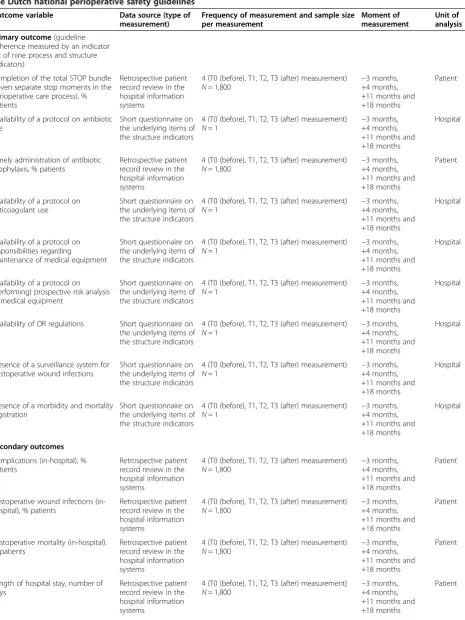
Several outcomes are measured at the hospital (i.e., the cluster) and the patient levels (Table 3). The primary outcome measure is guideline adherence according to the PSIs as defined in the national indicator set. This set comprises nine indicators on the processes and struc-tures of care [18]. Secondary (patient) outcomes are in-hospital complications (with particular attention to postoperative wound infections) and hospital mortality, as well as length of hospital stay (LoHS), unscheduled transfer to the intensive care unit (ICU), non-elective hospital readmission, and unplanned reoperation, which are derived from a maximum period of 30 days after the initial surgery.
The rationale for these secondary outcomes is based on a prioritization procedure by 16 perioperative health-care professionals in the nine participating hospitals:
they were invited to list ten outcomes with the highest clinical relevance to perioperative care.
Definitions of outcomes at patient level
We define a complication as an unintended and un-wanted event or state during or following medical treat-ment that has an unfavorable effect on the health of the patient to such an extent that adjustment of the medical treatment is necessary or irreparable harm has occurred [29]. Postoperative wound infections are divided into superficial and deep wound infections, with one of the following three symptoms present: pain and or sensitiv-ity, local swelling, redness and or warmth [30]. Postoper-ative mortality is the death of a patient as the result of any perioperative complication. Length of hospital stay is defined as the time period in days between admission and discharge. An unplanned reoperation is any second-ary surgical procedure required as a result of a complica-tion directly or indirectly related to the index operacomplica-tion [31]. A non-elective readmission is an unintended, acute readmission from the index admission [32]. A readmis-sion includes at least one overnight stay. An unsched-uled transfer to the ICU is identified when an admission to the ICU department has not been ordered preopera-tively. All these data are obtained from the hospital in-formation systems.
Data sources
Information about the processes and outcomes of peri-operative care are retrospectively derived from patient medical records in the participating hospitals by two re-searchers (YE and GB). The first 50 patients undergoing an initial elective surgery within the measurement period and who meet the inclusion criteria are selected from the hospital databases.
To measure the structure indicators of the national indicator set, the contact person in each hospital is invited to fill out a short questionnaire on the under-lying items of the structure indicators on a dichotomous scale (yes/no).
Table 3 Methods and instruments for measuring the effects of a multifaceted implementation strategy to implement the Dutch national perioperative safety guidelines
Outcome variable Data source (type of measurement)
Frequency of measurement and sample size per measurement
Moment of measurement
Unit of analysis
Primary outcome(guideline adherence measured by an indicator set of nine process and structure indicators)
Completion of the total STOP bundle (seven separate stop moments in the perioperative care process), % patients
Retrospective patient record review in the hospital information systems
4 (T0 (before), T1, T2, T3 (after) measurement)
N= 1,800
−3 months, +4 months, +11 months and +18 months
Patient
Availability of a protocol on antibiotic use
Short questionnaire on the underlying items of the structure indicators
4 (T0 (before), T1, T2, T3 (after) measurement)
N= 1 −
3 months, +4 months, +11 months and +18 months
Hospital
Timely administration of antibiotic prophylaxis, % patients
Retrospective patient record review in the hospital information systems
4 (T0 (before), T1, T2, T3 (after) measurement)
N= 1,800
−3 months, +4 months, +11 months and +18 months
Patient
Availability of a protocol on anticoagulant use
Short questionnaire on the underlying items of the structure indicators
4 (T0 (before), T1, T2, T3 (after) measurement)
N= 1 −
3 months, +4 months, +11 months and +18 months
Hospital
Availability of a protocol on responsibilities regarding
maintenance of medical equipment
Short questionnaire on the underlying items of the structure indicators
4 (T0 (before), T1, T2, T3 (after) measurement)
N= 1
−3 months, +4 months, +11 months and +18 months
Hospital
Availability of a protocol on (performing) prospective risk analysis of medical equipment
Short questionnaire on the underlying items of the structure indicators
4 (T0 (before), T1, T2, T3 (after) measurement)
N= 1 −
3 months, +4 months, +11 months and +18 months
Hospital
Availability of OR regulations Short questionnaire on the underlying items of the structure indicators
4 (T0 (before), T1, T2, T3 (after) measurement)
N= 1
−3 months, +4 months, +11 months and +18 months
Hospital
Presence of a surveillance system for postoperative wound infections
Short questionnaire on the underlying items of the structure indicators
4 (T0 (before), T1, T2, T3 (after) measurement)
N= 1 −
3 months, +4 months, +11 months and +18 months
Hospital
Presence of a morbidity and mortality registration
Short questionnaire on the underlying items of the structure indicators
4 (T0 (before), T1, T2, T3 (after) measurement)
N= 1
−3 months, +4 months, +11 months and +18 months
Hospital
Secondary outcomes
Complications (in-hospital), % patients
Retrospective patient record review in the hospital information systems
4 (T0 (before), T1, T2, T3 (after) measurement)
N= 1,800 −
3 months, +4 months, +11 months and +18 months
Patient
Postoperative wound infections (in-hospital), % patients
Retrospective patient record review in the hospital information systems
4 (T0 (before), T1, T2, T3 (after) measurement)
N= 1,800
−3 months, +4 months, +11 months and +18 months
Patient
Postoperative mortality (in-hospital), % patients
Retrospective patient record review in the hospital information systems
4 (T0 (before), T1, T2, T3 (after) measurement)
N= 1,800 −
3 months, +4 months, +11 months and +18 months
Patient
Length of hospital stay, number of days
Retrospective patient record review in the hospital information systems
4 (T0 (before), T1, T2, T3 (after) measurement)
N= 1,800
−3 months, +4 months, +11 months and +18 months
innovation and assesses the factors, vision, participative safety, task orientation, and support for innovation in 13 subscales [33]. To measure the patient safety culture, we use the HSOPS [34,38]. The HSOPS is a valid and reli-able survey for assessing the patient safety culture in hospitals. It measures 12 dimensions of patient safety culture on the basis of ideas of unsafely designed care processes or systems that increase the likelihood of the occurrence of adverse events.
Power calculation
The key characteristic of cluster randomized trials (CRTs) is that the individual units (here: patients) within a cluster (here: hospital) are correlated, and this feature must be incorporated into power calculations and trial analysis [22]. Besides the intracluster correlation (ICC), the power calculation should also take into account the number of steps and treatment delay as the power de-pends on the number of steps (or measurements) and decreases by a delay in intervention effect.
We made the following assumptions: 1) nine hospitals in the Netherlands (10% of the total number of hospi-tals) [39] will cooperate in this study; 2) an average effect of 10%–15% increase in the process indicators (primary outcome measure) might be expected from the literature [20]; 3) baseline adherence to the guidelines is unknown, but a 15% increase from a baseline level of 50% requires the largest sample size and therefore the sample size calculated will also suffice if the baseline adherence is different from 50%; and 4) ICC is unknown but can be estimated between 0.1 and 0.3 as ICCs have shown to vary between 0 and 0.4 with a median ICC of 0.06 in
other cluster randomized trials in secondary care [40]. Also, using process variables results in a comparable range and median of ICCs [40]. Based on the availability of nine hospitals, a baseline adherence of 50%, an in-crease of 15% by the intervention, a significance level alpha of 0.05, an ICC between 0.1 and 0.3, and four time points (three steps in the stepped design), 50 patients per cluster (equal sized) and time point are needed to reach a power of at least 0.85, using the formula of Hussey and Hughes [22]. As a result, 1,800 (50 patients × 9 hospitals × 4 measurements) patients will be included over all hospitals in the course of the trial.
Analysis
After each measurement period, data are manually checked to identify out-of-range answers, inconsistent or missing data. Because of the hierarchical design (patients nested within hospitals), multilevel linear and logistic re-gression analysis will be used to compare the outcomes between treatment groups, with age, sex, the American Society of Anesthesiologists (ASA) physical status classi-fication, and socioeconomic status (SES) as covariates. The ASA physical status classification is a five-point scale ranging from ASA 1 (healthy patient) to ASA 5 (moribund patient not expected to survive without sur-gery, e.g., a patient with a ruptured aortic aneurysm) [41]. Time will be included as fixed effect [22]. The asso-ciation between guideline adherence and patient out-comes will also be analyzed to determine whether better adherence leads to better patient outcomes. We will use SPSS version 20.0 for data analysis. Significance for all analyses will be set atP< 0.05.
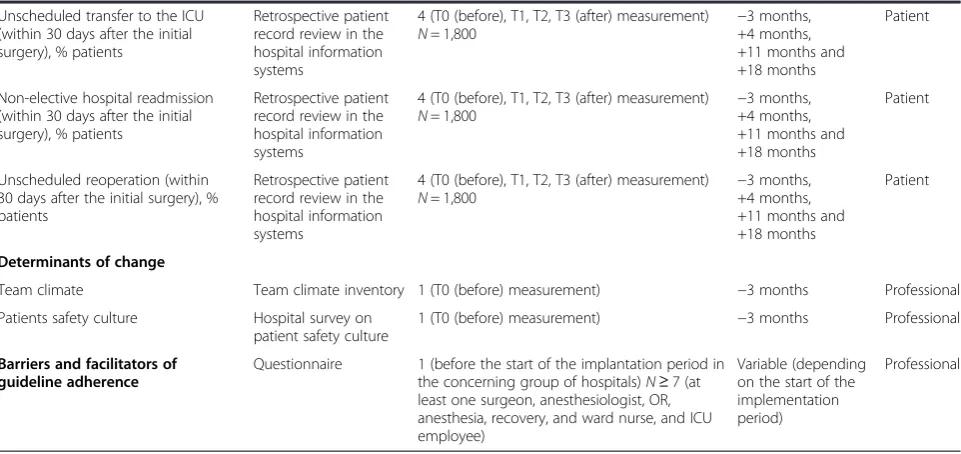
Table 3 Methods and instruments for measuring the effects of a multifaceted implementation strategy to implement the Dutch national perioperative safety guidelines(Continued)
Unscheduled transfer to the ICU (within 30 days after the initial surgery), % patients
Retrospective patient record review in the hospital information systems
4 (T0 (before), T1, T2, T3 (after) measurement)
N= 1,800 −
3 months, +4 months, +11 months and +18 months
Patient
Non-elective hospital readmission (within 30 days after the initial surgery), % patients
Retrospective patient record review in the hospital information systems
4 (T0 (before), T1, T2, T3 (after) measurement)
N= 1,800
−3 months, +4 months, +11 months and +18 months
Patient
Unscheduled reoperation (within 30 days after the initial surgery), % patients
Retrospective patient record review in the hospital information systems
4 (T0 (before), T1, T2, T3 (after) measurement)
N= 1,800 −
3 months, +4 months, +11 months and +18 months
Patient
Determinants of change
Team climate Team climate inventory 1 (T0 (before) measurement) −3 months Professional
Patients safety culture Hospital survey on
patient safety culture
1 (T0 (before) measurement) −3 months Professional
Barriers and facilitators of guideline adherence
Questionnaire 1 (before the start of the implantation period in the concerning group of hospitals)N≥7 (at least one surgeon, anesthesiologist, OR, anesthesia, recovery, and ward nurse, and ICU employee)
Variable (depending on the start of the implementation period)
Process evaluation
A process evaluation, according to Hulscher et al. [42], will be performed during and after the intervention to investigate the feasibility of the implementation strategy and to gain insight into the impact of individual imple-mentation activities on guideline adherence. For this purpose, we will document the different implementation activities and the participation level of the health-care providers in order to determine the correlation between the implementation effect (i.e., results of our implemen-tation strategy on guideline adherence) and compliance to the implementation strategy (i.e., degree of implemen-tation). For this, we use the framework of Hulscher et al. for describing the key features of an implementation of change intervention [43]. In this framework, attention is paid to features of the target group, features of the implementers, and the frequency and intensity of inter-vention activities [43]. Based on this framework, we de-scribe the features of the intervention as performed in detail. The process evaluation will furthermore be based on a questionnaire for the contact persons and a ques-tionnaire for the health-care providers to measure their experience with the implementation strategy. The survey will be emailed to those who have participated in an ac-tivity. We will also determine other factors that could have influenced adherence to the perioperative safety guidelines, such as local interventions in the hospitals, audits by the IGZ, other scientific studies in this field conducted in the participating hospitals, and possible confounding factors and barriers for guideline adherence like changing registration systems in the hospitals or merging hospitals.
Economic evaluation
Better adherence to the perioperative guidelines may reduce unnecessary perioperative harm such as com-plications and subsequently welfare losses. To assess the cost implications, an economic evaluation will be conducted that is based on the general principles of a cost-effectiveness analysis. The perspective of this eco-nomic evaluation will be a health-care perspective. The input of resources in the implementation strategy will be assessed by collecting volumes of consumed re-sources and multiplying these by the price of each resource unit (market prices, guideline prices or self-determined prices based on costing methods, i.e., full costing) [44]. The implementation process and conse-quent costs will be estimated by an activity-based costing (ABC) approach focusing on activities per-formed with costs accumulated at the activity level(s) of the health-care implementation process [44]. ABC attempts to identify all subprocesses related to the im-plementation process. Next, the underlying activities (personnel, material, and overhead costs) associated
with these subprocesses are identified. Use of ABC con-cepts facilitates the identification of no value-added activ-ities. The output or consequences of the implementation strategy will be determined by the level of adherence to the perioperative guidelines, measured before and after implementation support.
Ethical approval
This study protocol was approved by the Medical Ethical Committee of the Radboud university medical center on 9 August 2011 (registration number: 2011/318). The study conforms to Dutch law and privacy regulations and was judged not to involve human-subject research. This study is registered in the Dutch Trial Registry for clinical trials [45] (record number NTR3568). The participation of hospitals in the study is voluntary. The research team gave oral presentations and written information about the study to each hospital. Written consent has been obtained from all participating hospitals before randomization. Be-cause outcome data are routinely collected by the hospi-tals and no personal identifiers are transmitted, individual consent of patients is not required. All data will be handled strictly confidential and published anonymously. Each participant is identified in the database with a study number.
Trial status
Between May 2012 and June 2015, nine hospitals have been found willing to participate in this study. At the time of submission of the manuscript, no data cleaning or analysis has begun.
Discussion
to implement the perioperative safety guidelines can be used to improve perioperative patient safety.
This study has several strengths and limitations. The major strength of this study is the randomized compari-son made possible by the multicenter stepped wedge cluster randomized trial design. In fact, a parallel group cluster randomized trial was not feasible because of the large number of hospitals needed. A (individually) randomized, controlled trial was not possible as all Dutch hospitals have a legal obligation to implement the perioperative safety guidelines; temporarily postponing the implementation of the guidelines would have been unethical. Finally, non-randomized designs such as pre-and post-intervention evaluations are methodologically weaker as they tend to overestimate intervention effects. Another strength of our study is the use of a multifa-ceted approach consisting of in total 11 different activ-ities, covering six interventions: education, audit and feedback, organizational interventions, team-directed in-terventions, reminders, as well as patient-mediated inter-ventions, of which most have been shown to be effective in other studies [20,41,47-52]. Combinations of interven-tions may be more effective than single interveninterven-tions in changing professional behavior, because a larger variety of barriers for change can be addressed [53]. The effect-iveness of a combined strategy is determined by the ef-fectiveness of the separate interventions that make up the strategy and the interaction of the different interven-tions, which can increase or reduce the total effect. The effect of a combined intervention does not necessarily equal the sum of the effects of the single interventions that comprise it. Different interventions can support each other, so the total effect may be larger than the ef-fects of the interventions separately [53]. However, no specific combination provides a guarantee for success [53]. It seems plausible that combined interventions are only more effective than a single intervention if they ad-dress barriers and facilitators that are actually related to professional performance. This emphasizes the import-ance of a careful documentation of the most important barriers to improvement and the systematic develop-ment of impledevelop-mentation strategies as in our study, which is preferred over intuitively selected strategies [53,54]. A multifaceted implementation strategy with activities that are not carefully related to the relevant factors and needs of the target group is an unfocused intervention and likely not effective [53].
The generalizability of the findings will be high be-cause the study is carried out in a large, heterogeneous sample of nine hospitals across the country. A further strength of this study is the wide scope; we perform measurements at the cluster level and the level of their individual members, i.e., care providers and patients. A questionnaire is sent to the key disciplines to explore all
relevant barriers and facilitators to guideline adherence and opportunities for improvement. A better under-standing of the barriers and facilitators and a strategy tailored to local circumstances will enhance the imple-mentation of the perioperative guidelines like already mentioned [55,53]. We also carry out a process evaluation to analyze the mechanisms and processes responsible for the outcomes of the effect evaluation; a causal relationship between implementation activities and change in outcomes is difficult to identify because of the presence of confound-ing factors, like local hospital initiatives to improve patient safety. In case of a multifaceted implementation strategy, the process evaluation is especially important to specify which intervention was most effective [53]. Insight into the implementation process is also relevant for other hospitals that can benefit from the lessons learned. To improve the internal validity, the following actions will be undertaken. To reduce selection bias, the first 50 patients that meet the inclusion criteria are selected from the hospital databases in all hospitals at each measurement point. A possible limita-tion of the survey investigalimita-tions is response bias, which will be minimized by sending reminders. Information bias is re-duced by having the same researchers (YE and GB) check-ing the data from the hospital registries and medical records. An independent researcher checks the data entries. An independent statistician will check the analyses. To pre-vent confounding bias, we study potentially confounding determinants, such as team climate and patient safety cul-ture. To prevent publication bias, the study has been regis-tered in the Dutch register for clinical trials. Additionally, we have installed an external advisory board with the spe-cial tasks of checking the design and the integrity of the study and giving feedback.
on perioperative patient safety. Blinding of the interven-tion is not possible as the trial is designed to evaluate an implementation intervention to change professional be-havior in the real hospital setting. Outcomes assessment was not blind either, but as indicators are rather objective (e.g., is a protocol for anticoagulant use available or not), it is unlikely that they are influenced by the assessment.
Overall, knowledge of the results of this study will im-prove the implementation success of the perioperative guidelines. It is expected that better adherence to the perioperative safety guidelines will improve the safety of perioperative care.
Additional file
Additional file 1:Supplementary Tables.This file contains CONSORT 2010 checklist of information to include when reporting a cluster randomized trial and extension of CONSORT for abstracts to reports of cluster randomized trials.
Competing interests
The authors declare that they have no competing interests.
Authors’contributions
HC, ST, JD, AW, and HW conceived the design of the study and drafted the initial research proposal. YE drafted the manuscript. HC, ST, GB, GW, JD, AW, and HW helped draft the final manuscript. All authors read and approved the final manuscript.
Acknowledgements
This study has been funded by ZonMw (project number: 71103008).
Author details
1Radboud university medical center, Radboud Institute for Health Sciences, IQ healthcare, PO Box 9101, 114 IQ healthcare, 6500 HB, Nijmegen, The Netherlands.2Radboud university medical center, Radboud Institute for Health Sciences, Department of Anesthesiology, Pain and Palliative Care, Nijmegen, The Netherlands.3Radboud university medical center, Radboud Institute for Health Sciences, Dapartment for Health Evidence, section Biostatics, Nijmegen, The Netherlands.
Received: 21 November 2014 Accepted: 18 December 2014
References
1. Anderson O, Davis R, Vincent CA, Hanna GB:Surgical adverse events: a systematic review.Am J Surg2013,206:253–262.
2. Weiser TG, Haynes AB, Dziekan G, Berry WR, Lipsitz SR, Gawande AA, Safe Surgery Saves Lives Investigators and Study Group:Effect of a 19-item surgical safety checklist during urgent operations in a global patient population.Ann Surg2010,251:976–980.
3. Haynes AB, Weiser TG, Berry WR, Lipsitz SR, Breizat A-HS, Dellinger EP, Herbosa T, Joseph S, Kibatala PL, Lapitan MCM, Merry AF, Moorthy K, Reznick RK, Taylor B, Gawande AA, for the Safe Surgery Saves Lives Study Group:
A surgical safety checklist to reduce morbidity and mortality in a global population.N Engl J Med2009,360:491–499.
4. Arbous MS, Grobbee DE, Van Kleef JW, De Lange JJ, Spoormans HH, Touw P, Werner FM, Meursing AE:Mortality associated with anaesthesia: a qualitative analysis to identify risk factors.Anaesthesia2001,
56(12):1141–1153.
5. Andrews LB, Stocking C, Krizek T, Gottlieb L, Krizek C, Vargish T, Siegler M:
An alternative strategy for studying adverse events in medical care.
Lancet1997,349(9048):309–313.
6. Damen J, Hagemeijer JW, Van den Broek L, Poldermans D:[Prevention of perioperative cardiac complications in non-cardiac surgery: an evidence-based guideline].Neth J Med2008,152:2612–2616.
7. Langelaan M, De Bruijne MC, Baines RJ, Broekens MA, Hammink K, Schilp J, Verweij L, Asscheman H, Wagner C:Monitor Zorggerelatreerde Schade 2011-2012, Dossieronderzoek in Nederlandse Ziekenhuizen.Amsterdam/Utrecht: EMGO Instituut/VUmc & NIVEL; 2013:2013.
8. Wagner C, Zegers M, de Bruijne MC:Patiëntveiligheid: onbedoelde en potentieel vermijdbare schade bij snijdende specialismen.Neth J Med
2009,153:327–333.
9. De Vries EN, Prins HA, Crolla RMPH, Den Outer AJ, Van Andel G, Van Helden SH, Schlack WS, Van Putten MA, Gouma DJ, Dijkgraaf MGW, Smorenburg SM, Boermeester MA, for the SURPASS Collaborative Group:Effect of a comprehensive surgical safety system on patient outcomes.N Engl J Med
2010,363:1928–1937.
10. Noordzij PG, Poldermans D, Schouten O, Bax JJ, Schreiner FAG, Boersma E:
Postoperative mortality in The Netherlands: a population-based analysis of surgery-specific risk in adults.Anesthesiology2010,5:1105–1115. 11. Pearse RM, Moreno RP, Bauer P, Pelosi P, Metnitz P, Spies C, Vallet B, Vincent
JL, Hoeft A, Rhodes A, for the European Surgical Outcomes Study (EuSOS) group for the Trials groups of the European Society of Intensive Care Medicine and the European Society of Anaesthesiology:Mortality after surgery in Europe: a 7 day cohort study.Lancet2012,380:1059–1065. 12. Van Klei WA, Hoff RG, Van Aarnhem EE, Simmermacher RKJ, Regli LPE,
Kappen TH, Van Wolfswinkel LM, Kalkman CJ, Buhre WF, Peelen LM:Effects of the introduction of the WHO“surgical checklist”on in-hospital mortality.Ann Surg2012,255:44–49.
13. Inspectie voor de Gezondheidszorg (IGZ):Preoperatief Traject Ontbeert Multidisciplinaire en Gestandaardiseerde Aanpak en Teamvorming.Den Haag: IGZ; 2007.
14. Inspectie voor de Gezondheidszorg (IGZ):Standaardisatie Onmisbaar voor Risicovermindering in Operatief Proces.Den Haag: IGZ; 2008.
15. Inspectie voor de Gezondheidszorg (IGZ):Postoperatieve Zorg in Ziekenhuizen op Onderdelen Voldoende, Maar Kent nog Teveel Risico’s.
Den Haag: IGZ; 2009.
16. Nederlandse Vereniging voor Anesthesiologie (NVA)/Nederlandse Vereniging voor Heelkunde (NVvH):Richtlijn Het Peroperatieve Traject.
Utrecht: NVA/NVvH; 2010.
17. Nederlandse Vereniging voor Anesthesiologie (NVA)/Nederlandse Vereniging voor Heelkunde (NVvH):Richtlijn Het Peroperatieve Traject.
Utrecht: NVA/NVvH; 2011.
18. Nederlandse Vereniging voor Anesthesiologie (NVA)/Nederlandse Vereniging voor Heelkunde (NVvH):Richtlijn Het Postoperatieve Traject.
Utrecht: NVA/NVvH; 2012.
19. Grol R, Grimshaw J:From best evidence to best practice: effective implementation of change in patients’care.Lancet2003,362:1225–1230. 20. Grimshaw JM, Thomas RE, MacLennan G, Fraser C, Ramsay CR, Vale L, Vale L,
Whitty P, Eccles MP, Matowe L, Shirran L, Wensing M, Dijkstra R, Donaldson C:Effectiveness and efficiency of guideline dissemination and implementation strategies.Health Technol Assess2004,8(6):iii–iv, 1–72. 21. Brown CA, Lilford RJ:The stepped wedge trial design: a systematic
review.BMC Med Res Methodol2006,6:54–63.
22. Hussey MA, Hughes JP:Design and analysis of stepped wedge cluster randomized trials.Contemp Clin Trials2007,28:182–191.
23. Dutch Institute for Health Care Accreditation[http://www.niaz.nl/ ziekenhuizen/accreditatie-overzicht/accreditatieoverzicht-ziekenhuizen] 24. Dutch Federation for University Medical Centres[http://www.nfu.nl/umc/
feiten/]
25. Association of Tertiary Medical Teaching Hospitals[http://www.stz.nl/ interactieve-kaart.html]
26. Grimshaw J, Eccles M, Thomas R, MacLennan G, Ramsay C, Fraser C, Vale L:
Evidence (and its limitations) of the effectiveness of guideline dissemination and implementation strategies 1966–1998.J Gen Intern Med2006,21:S14–S20.
27. Van Sluisveld N, Zegers M, Westert G, Van der Hoeven JG, Wollersheim H:
A strategy to enhance the safety and efficiency of handovers of ICU patients: study protocol of the pICUp study.Implement Sci2013,8:67. 28. Fleuren MAH, Paulussen TGWM, Van Dommelen P, Van Buuren S:
Ontwikkeling MeetInstrument voor Determinanten van Innovaties (MIDI).
Leiden: Dutch Organisation for Applied Scientific Research (TNO); 2012. 29. Veilige zorg, ieders zorg; Patiëntveiligheidsprogramma GGZ[http://www.
veiligezorgiederszorg.nl/over-patientveiligheid/begrippenkader.html] 30. Wille JC, Van Den Hof S:Het PREZIES-netwerk; surveillance als
Patiëntveiligheid.Edited by Van Everdingen JJE. Houten: Bohn Stafleu van Loghum; 2006:175–186.
31. Kroon HM, Breslau PJ, Lardenoye JWHP:Can the incidence of unplanned reoperations be used as an indicator of quality of care in surgery?Am J Med Qual2007,22:198.
32. Rumball-Smith J, Hider P:The validity of readmission rate as a marker of the quality of hospital care, and a recommendation for its definition.
N Z Med J2009,122:63–70.
33. Ouwens M, Hulsher M, Akkermans R, Hermens R, Grol R, Wollersheim H:
The team climate inventory: application in hospital teams and methodological considerations.Qual Saf Health Care2008,17:275–280. 34. Jones KJ, Skinner A, Xu L, Sun J, Mueller K:The AHRQ Hospital survey on
patient safety culture: a tool to plan and evaluate patient safety programs. InAdvances in Patient Safety: New Directions and Alternative Approaches. Volume 2: Culture and Redesign.Rockville: Agency for Healthcare Research and Quality (US); 2008.
35. Mazzocco K, Petitti DB, Fong KT, Bonacum D, Brookey J, Graham S, Lasky RE, Sexton JB, Thomas EJ:Surgical team behaviors and patient outcomes.
Am J Surg2009,197:678–685.
36. Neily J, Mills PD, Young-Xu Y, Carney BT, West P, Berger DH, Mazzia LM, Paull DE, Bagian JP:Association between implementation of a medical team training program and surgical mortality.JAMA2010,304(15):1693–1700.
37. Young-Xu Y, Neily J, Mills PD, Carney BT, West P, Berger DH, Mazzia LM, Paull DE, Bagian JP:Association between implementation of a medical team training program and surgical morbidity.Arch Surg2011,
146:1368–1373.
38. Smits M, Wagner C, Spreeuwenberg P, van der Wal G, Groenewegen PP:
Measuring patient safety culture: an assessment of the clustering of responses at unit level and hospital level.Qual Saf Health Care2009,
18(4):292–296.
39. Zorgatlas [http://www.zorgatlas.nl/zorg/ziekenhuiszorg/algemene-en- academische-ziekenhuizen/aanbod/locaties-algemene-en-academische-ziekenhuizen/]
40. Campbell MK, Fayers PM, Grimshaw JM:Determinants of the intracluster correlation coefficient in cluster randomized trials: the case of implementation research.Clin Trials2005,2:99–107.
41. American Society of Anesthesiologists:New classification of physical status.Anesthesiology1963,24:111.
42. Hulscher MEJL, Laurant MGH, Grol RPTM:Process evaluation on quality improvement interventions.Qual Saf Health Care2003,12:40–46. 43. Hulscher MJ, Laurant M, Grol R:Process evaluation of change
interventions. InImproving Patient Care, The Implementation of Change in Clinical Practice.London: Elsevier; 2005: 256–272.
44. Oostenbrink JB, Koopmanschap MA, Rutten FFH:Handleiding Voor Kosten Onderzoek; Methoden en Richtlijnprijzen Voor Economische Evaluaties in de Gezondheidszorg.Amstelveen: CVZ; 2000.
45. Nederlands Trial Register[http://www.trialregister.nl/trialreg/index.asp] 46. Grol R:Successes and failures in the implementation of evidence-based
guidelines for clinical practice.Med Care2001,39(8 Suppl 2):II46–II54. 47. Grimshaw J, Eccles M:Is based implementation of
evidence-based care possible?Med J Aust2004,180:S50–S51.
48. Grimshaw J, Eccles M, Tetroe J:Implementing clinical guidelines: current evidence and future implementations.J Contin Educ Health Prof2004,
24(Suppl 1):S31–S37.
49. Boaz A, Baeza J, Fraser A, European Implementation Score Collaborative Group:Effective implementation of research into practice: an overview of systematic reviews of the health literature.BMC Res Notes2011,4:212. 50. Forsetlund L, Bjorndal A, Rashidian A, Jamtvedt G, O’Brien MA, Wolf F, Davis
D, Odgaard-Jensen J, Oxman AD:Continuing education meetings and workshops: effects on professional practice and health care outcomes.
Cochrane Database Syst Rev2009,2, CD003030.
51. Farmer AP, Legare F, Turcot L, Grimshaw J, Harvey E, McGowan JL, Wolf F:
Printed educational materials: effects on professional practice and health care outcomes.Cochrane Database Syst Rev2008,3, CD004398.
52. Jamtvedt G, Young JM, Kristoffersen DT, O’Brien MA, Oxman AD:Audit and feedback: effects on professional practice and health care outcomes.
Cochrane Database Syst Rev2006,2, CD000259.
53. Wensing M, Grol R:Multifaceted interventions. InImproving Patient Care, The Implementation of Change in Clinical Practice.London: Elsevier; 2005: 256–272.
54. Van Bokhoven MA, Kok G, Van der Weijden T:Designing a quality improvement intervention: a systematic approach.Qual Saf Health Care2004,12:215–220.
55. Wensing M, Grol R:Determinants of effective change.InImproving Patient Care, The Implementation of Change in Clinical Practice.London: Elsevier; 2005: 256–272.
Submit your next manuscript to BioMed Central and take full advantage of:
• Convenient online submission
• Thorough peer review
• No space constraints or color figure charges
• Immediate publication on acceptance
• Inclusion in PubMed, CAS, Scopus and Google Scholar
• Research which is freely available for redistribution