
R E S E A R C H
Open Access
Designing high-quality implementation
research: development, application,
feasibility and preliminary evaluation of the
implementation science research
development (ImpRes) tool and guide
Louise Hull
1*, Lucy Goulding
1, Zarnie Khadjesari
1,2, Rachel Davis
1, Andy Healey
1,3, Ioannis Bakolis
1,4and
Nick Sevdalis
1Abstract
Background:Designing implementation research can be a complex and daunting task, especially for applied health researchers who have not received specialist training in implementation science. We developed the Implementation Science Research Development (ImpRes) tool and supplementary guide to address this challenge and provide researchers with a systematic approach to designing implementation research.
Methods:A multi-method and multi-stage approach was employed. An international, multidisciplinary expert panel engaged in an iterative brainstorming and consensus-building process to generate core domains of the ImpRes tool, representing core implementation science principles and concepts that researchers should consider when designing implementation research. Simultaneously, an iterative process of reviewing the literature and expert input informed the development and content of the tool. Once consensus had been reached, specialist expert input was sought on involving and engaging patients/service users; and economic evaluation. ImpRes was then applied to 15 implementation and improvement science projects across the National Institute of Health Research (NIHR) Collaboration for Leadership in Applied Health Research and Care (CLAHRC) South London, a research organisation in London, UK. Researchers who applied the ImpRes tool completed an 11-item questionnaire evaluating its structure, content and usefulness.
Results:Consensus was reached on ten implementation science domains to be considered when designing implementation research. These include implementation theories, frameworks and models, determinants of implementation, implementation strategies, implementation outcomes and unintended consequences. Researchers who used the ImpRes tool found it useful
for identifying project areas where implementation science is lacking (median 5/5, IQR 4–5) and for improving the quality of
implementation research (median 4/5, IQR 4–5) and agreed that it contained the key components that should be considered
when designing implementation research (median 4/5, IQR 4–4). Qualitative feedback from researchers who applied the
ImpRes tool indicated that a supplementary guide was needed to facilitate use of the tool.
Conclusions:We have developed a feasible and acceptable tool, and supplementary guide, to facilitate consideration and incorporation of core principles and concepts of implementation science in applied health implementation research. Future research is needed to establish whether application of the tool and guide has an effect on the quality of implementation research.
Keywords:Implementation science, Implementation research, Design guidelines, Methods
© The Author(s). 2019Open AccessThis article is distributed under the terms of the Creative Commons Attribution 4.0
International License (http://creativecommons.org/licenses/by/4.0/), which permits unrestricted use, distribution, and
reproduction in any medium, provided you give appropriate credit to the original author(s) and the source, provide a link to the Creative Commons license, and indicate if changes were made. The Creative Commons Public Domain Dedication waiver (http://creativecommons.org/publicdomain/zero/1.0/) applies to the data made available in this article, unless otherwise stated. * Correspondence:[email protected]
1Centre for Implementation Science, Health Service and Population Research
Department, King’s College London, London, UK
Background
Evidence-based and cost-effective interventions consist-ently fail to be implemented into routine practice and policy [1], and even when such interventions are imple-mented, this is an effortful, unpredictable and typically slow process [2]. As a result, despite increasing pressure to improve the safety and quality of financially over-stretched healthcare services, patients fail to receive op-timal care and healthcare organizations fail to benefit from cost saving opportunities [1]. Over the past few
years, increased and focused efforts to close the
eviden-ce-to-practice gaphave resulted in further recognition of the importance of implementation science as a concep-tual and methodological approach to translate evidence
into routine practice [1,3,4].
However, despite the rapid growth of implementation science, designing implementation research remains a complex and daunting task for health researchers who have not completed specialist training in implementation
science. Crable et al. [5] operationalized Proctor et al.’s
recommendedten key ingredients for writing
implementa-tion research grant proposals [6] to quantitatively evaluate the quality of proposals on ten criteria. Thirty pilot grant applications submitted to a call for implementation and im-provement science projects at an academic medical center were assessed. Crable et al. reported that most proposals assessed performed poorly on most of the ten criteria [5]. For example, 67% of proposals failed to identify and de-scribe the implementation strategies to be used and/or in-correctly described the intervention as an implementation strategy. Furthermore, 70% of proposals failed to describe implementation or improvement science related outcomes and/or failed to link outcomes to the proposed study aims and/or the unit of analysis was inappropriate for the pro-posed study.
The challenge of designing implementation research is exacerbated by the fact that implementation research cuts across diverse scientific fields, resulting in the inev-itable difficulty of identifying, appraising and synthesis-ing relevant literature to inform design decisions. A
recently published editorial in Implementation Science
highlighted the need for capacity building initiatives in the research and practice of implementation to fulfil the demand for expertise in implementation science [7].
Concerns regarding the lack of guidance for designing implementation research have been raised and, to a cer-tain extent, are being addressed. For example, Waltz et al. highlighted that guidance regarding how best to select implementation strategies is lacking [8]. Similarly, lack of guidance on how to select appropriate implementation theories and frameworks has been highlighted and efforts to develop such guidance is currently underway [9].
Whilst these efforts are worthwhile and necessary to ad-vance the science of implementation, a tool consolidating
design guidance, to the best of our knowledge, does not currently exist. As a result, healthcare researchers without access to specialist implementation science expertise are tasked with identifying and assimilating design guidance and recommendations reported across a wide range of journals when designing implementation research, or re-search with substantial implementation components. This is a challenging task, not always successfully
accom-plished—as evidenced by the aforementioned literature.
To address this challenge, we report the development, application, feasibility and preliminary evaluation of the Im-plementation Science Research Development (ImpRes) tool and supplementary guide to provide health researchers with a step-by-step approach to designing high-quality imple-mentation research. Specifically, we aimed to (1) identify the core principles and concepts that research teams should consider when designing high-quality implementation re-search and (2) identify and synthesize key methodological/ conceptual literature containing guidance and recommen-dations for designing and evaluating implementation re-search. Based on the above aims, we aimed to develop, apply and evaluate a tool that guides researchers through the key principles and research design considerations of im-plementation science when designing studies. The ImpRes tool and guide aim to enable research teams to design high-quality implementation research and as a result more effectively implement evidence-based interventions into routine practice, thereby reducing research waste, and im-proving health outcomes.
Methods
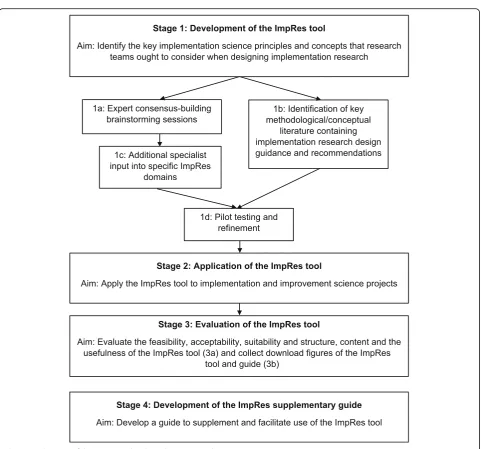
A multi-stage, multi-method approach was used to de-velop and evaluate the ImpRes tool and the subsequent
development of its supplementary guide (see Fig.1).
Stage 1: development of the ImpRes tool (July 2015–May 2016)
Development of the ImpRes tool began in July 2015. The starting point and primary factor motivating the development of the tool was firstly to evaluate the de-gree to which the core principles and concepts of imple-mentation science were embedded into research projects
conducted within a research organisation—the National
Institute for Health Research (NIHR) Collaboration for Leadership in Applied Health Research and Care (CLAHRC) South London; and secondly to provide imple-mentation research support to research teams as required. After an initial review of the literature and consultation with experts in the field, it was evident that a tool (or framework) did not exist to allow for this form of evalu-ation. The NIHR CLAHRC South London is a
collabora-tive partnership between two universities (King’s College
London and St George’s, University of London), four
(Guy’s and St Thomas’ NHS Foundation Trust, King’s
College Hospital NHS Foundation Trust, St George’s
University Hospitals NHS Foundation Trust and South London and Maudsley NHS Foundation Trust) and two other collaborating organisations (NHS England-funded
Health Innovation Network (HIN), south London’s
academic health science network; and King’s Health
Part-ners, the academic health sciences centre in south-east London). NIHR CLAHRC South London was established in 2014 as one of 13 such research organisations support-ing the conduct and application of applied health research across England; it has a catchment area of approximately 3.5 million people living and/or using the health services within south London, England. NIHR CLAHRC South London conducts research spanning a diversity of
healthcare areas including clinical (e.g. maternity and
women’s health and psychosis) and public health. In
addition to our collaborators within the London geog-raphy, a significant body of the research conducted by NIHR CLAHRC South London researchers is conducted with national and international collaborators. For
ex-ample, researchers in our ‘diabetes theme’ are leading a
(CIS), which consists of a multidisciplinary group of im-plementation and improvement scientists, statisticians, health economists and behavioural and social science ex-perts [13].
Development of the ImpRes tool involved an iterative process of:
1a. Expert brainstorming and consensus-building sessions
(July 2015–December 2015)
The CIS research team as well as international experts in the fields of implementation science and other health-care disciplines, who were members of the CIS Scientific Advisory Panel (SAP), participated in three brainstorm-ing sessions which informed the initial development and content of the ImpRes tool. Brainstorming sessions took place, and were the focus of, the CIS SAP face-to-face
meetings over a 6-month period (July 2015–December
2015); additional input and feedback was sought from the CIS SAP virtually (via email). Content suggestions were collated by LH. Subsequently, the CIS research team participated in a consensus-building session which involved reviewing and considering the content sugges-tions for inclusion in the ImpRes tool.
The CIS SAP is an international multidisciplinary panel including clinicians and academics with expertise in implementation science, improvement science, social science, health policy, biostatistics, health economics, health service research and patient and public involve-ment. A full list of members of the CIS SAP is available in the ImpRes guide [14]. The CIS SAP convenes on a quarterly basis and offers critical appraisal and advice to the CIS research and strategy.
1b. Identification of key methodological/conceptual literature containing guidance and recommendations for designing and evaluating implementation research (July
2015–March 2018)
Concurrently with the consensus-building brainstorming sessions, and informed by emerging ImpRes domains, a review of the literature was undertaken to identify key methodological/conceptual articles and reports contain-ing guidance and recommendations relatcontain-ing to the design and evaluation of implementation research. Searching via PubMed and Google, articles and reports containing design guidance relating to the domains of ImpRes were identified and screened for relevance. Google was searched to identify gray literature and relevant content that would not have otherwise been identified through PubMed. For example, in addition to peer-reviewed publi-cations, searching via Google allowed for the identification of websites, reports, webinars and blogs providing imple-mentation research design guidance. The search was con-ducted between July 2015 and March 2018, with no date restrictions. Basic search terms reflected the emerging core
ImpRes domains (e.g. ‘implementation outcomes’ and
‘implementation strategies’) and were used to identify
relevant papers in PubMed and Google. Further, key articles by prominent authors/research groups leading work on specific domains of implementation science were also searched, including guidelines and recommenda-tions relating to implementation outcomes (Enola Proctor) and implementation strategies (Byron Powell). Further-more, identification of key literature was informed by the
CIS SAP and the CIS implementation research teams’
ex-pert knowledge. In this way, the ImpRes tool represents a consolidation and unification of key implementation sci-ence constructs informed by experts and key implementa-tion science literature.
1c. Additional specialist input into specific ImpRes domains
(January 2016–March 2016)
Once the core domains of the ImpRes tool were estab-lished (i.e. through consensus amongst the CIS research team and SAP), additional specialist expert input into the content of specific domains of the ImpRes tool was sought. Specifically, the lead researcher (LH) met with NIHR CLAHRC South London specialists in patient and public involvement, and specialists in health economics (AH, a member of the research team), to review and
co--design the content of the‘patient and public involvement
and engagement’ and ‘economic evaluation’ ImpRes
do-mains, respectively. Specialist input was sought as PPI and economic evaluation are specialist fields, both of which are considered important facets of implementation
re-search [15,16].
1d. Pilot testing and refinement (December 2015–May 2016)
The ImpRes tool was piloted by an experienced health services researcher without implementation science expertise (i.e. the intended target audience of the ImpRes tool). The ImpRes tool was completed independently by the researcher, using a research project that the re-searcher was leading on. Following completion, the lead researcher (LH) sought feedback on the ImpRes tool.
Stage 2: application of the ImpRes tool (June 2016– August 2018)
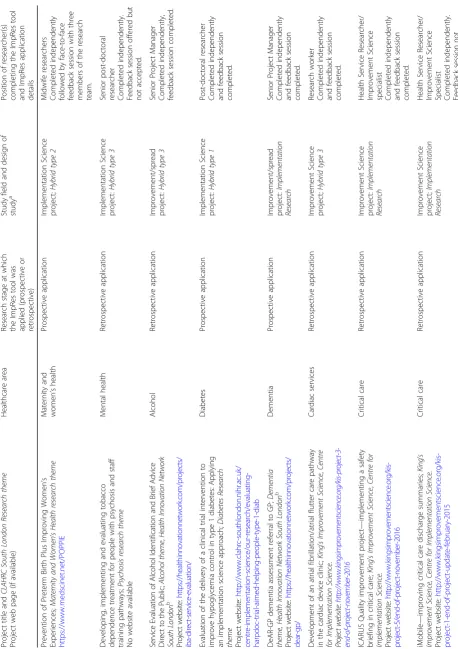
The ImpRes tool was applied to 15 implementation and improvement science research projects prospectively (i.e. at project design stage) or retrospectively (i.e. after all pro-ject design decisions had been made and/or the propro-ject had been completed), across the NIHR CLAHRC South London and partner healthcare organizations. At the time of application, the ImpRes tool was completed by re-searchers at varying stages of developing implementation science expertise following the NIHR CLAHRC South
London’s launch in 2014. The research projects focused
hybrid type 1 effectiveness-implementation studies topure
implementation research (see‘Results’section, Table3).
To suit the needs and desires of researchers, a pragmatic and flexible approach was used to apply the ImpRes tool. For example, some researchers felt confident applying the ImpRes tool without the guidance of an implementation scientist (LH), whereas others lacked confidence in applying the tool independently and welcomed expert guidance. To suit the needs of all, researchers were given the option to either (1) complete the tool independently and then partici-pate in a one-to-one feedback session after the implementa-tion scientist had reviewed the completed ImpRes tool, or (2) complete the tool with direct facilitation provided by the implementation scientist. Facilitation consisted of explaining the rationale for developing the ImpRes tool, its aims and an overview of the ten domains (via one-to-one or group presentation sessions). Researchers applying the ImpRes tool were asked to complete ten sections corre-sponding to the ten domains of ImpRes. A number of domains require researchers to provide written responses
in the form of a paragraph (e.g. in the ‘Implementation
Strategies’domain, researchers were asked to describe the
implementation strategies that they intended to use/had used). Other sections involve completion of a checklist (e.g.
‘Implementation Outcomes’ and ‘Patient and Public
In-volvement and Engagement’domains are formatted in the
form of a checklist). Researchers were asked to complete ImpRes as best as they were able to. Although researchers were not asked to document the amount of time taken to complete the ImpRes tool, we are aware that many re-searchers invested a considerable amount of time complet-ing ImpRes, especially when applied prospectively (i.e. at project design stage).
Stage 3: Evaluation of the ImpRes tool (June 2016–August 2018)
3a: Questionnaire (June 2016-August 2018)
After completing the ImpRes tool, participating researchers completed a short questionnaire indicating their level of agreement with 11 statements relating to the structure, content and the usefulness of the ImpRes tool. Responses were provided on 5-point Likert scales, ranging from 1 (strongly disagree) to 5 (strongly agree). For example, partic-ipants responded to the following statements relating to the
structure and usefulness of ImpRes tool respectively:‘The
ImpRes tool is easy to understand’and‘The ImpRes tool is
useful for identifying project areas where implementation
science is lacking.’ Participants were also encouraged to
provide free-text comments and critique. One question-naire per ImpRes tool application was completed.
3b: Download figures (April 2018-September 2018)
The ImpRes tool and supplementary guide were made
freely available on theKing’s Improvement Science (KIS)
website [14] in April 2018 and the Implementation
Science Exchange website [17] in May 2018. Since then, monthly download figures have been collected for both the ImpRes tool and guide on the KIS website
(down-load figures from the Implementation Science Exchange
website are not available to report as they are not cur-rently collected by the website owners).
Stage 4: development of the ImpRes supplementary guide (January 2017–April 2018)
During application of the ImpRes tool and informal feedback provided by researchers who had applied the tool, it became apparent that in order to maximize the potential benefits, usability and scalability of the ImpRes tool, a detailed guide to supplement its use was required. The guide provides the rationale for the inclusion of the ImpRes tool domains, guidance regarding the applica-tion of the ImpRes tool and directs researchers to fur-ther literature and specialist resources.
Results
The process to develop and evaluate the ImpRes tool
and supplementary guide is illustrated in Fig.1. In what
follows, we present the results corresponding to each stage of development and evaluation as described in the
methods section and as depicted in Fig.1. Results
report-ing the development of the ImpRes tool (stage 1) and guide (stage 4) correspond to the study aims of (1) identi-fying the core principles and concepts that research teams should consider when designing high-quality implementa-tion research and (2) identifying and synthesizing key methodological/conceptual literature containing guidance and recommendations for designing and evaluating imple-mentation research. Results reporting the application (stage 2) and evaluation of the ImpRes tool (stage 3) cor-respond to the aim of applying and evaluating a tool that guides researchers through the key principles and research design considerations of implementation science when designing studies.
Overview of the ImpRes tool
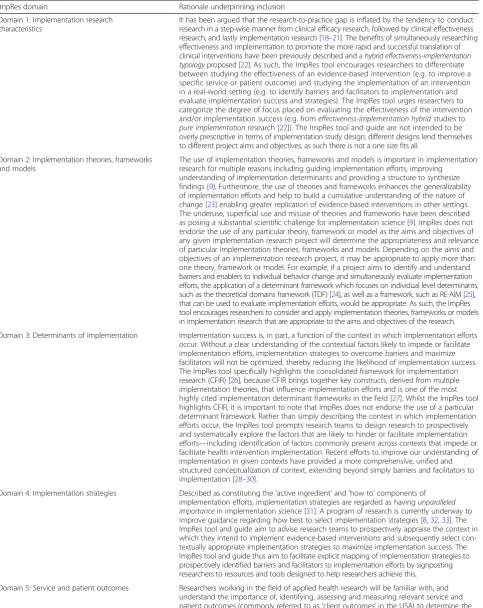
The ImpRes tool contains ten domains that experts agreed, based on current evidence, cover the core principles and methods of implementation science that researchers should consider when designing implementation research
(see Fig.2).
Stage 1: development of the ImpRes tool
1a: Expert consensus-building brainstorming sessions
The ImpRes tool is organized into ten domains; each do-main and the rationale underpinning its inclusion is
1b: Identification of key methodological/conceptual literature containing implementation research design guidance and recommendations
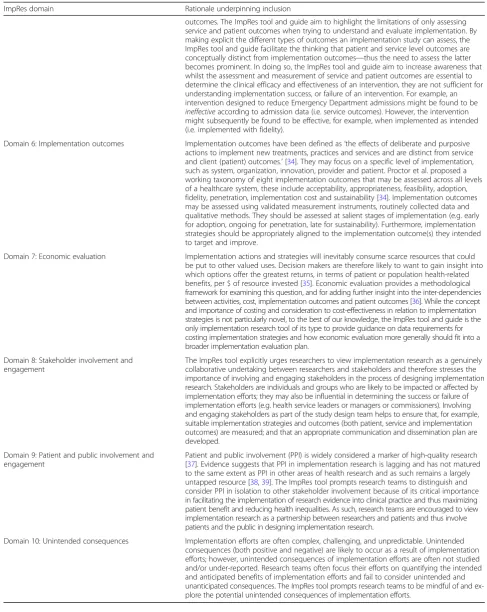
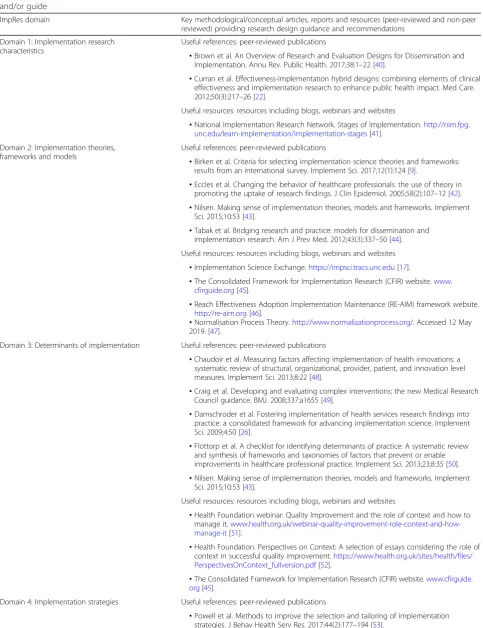
Concurrently with the consensus-building brainstorming sessions and informed by emerging ImpRes domains (presented above), key methodological and conceptual articles and reports (both peer-reviewed and non-peer-reviewed) were identified in relation to each of the 10
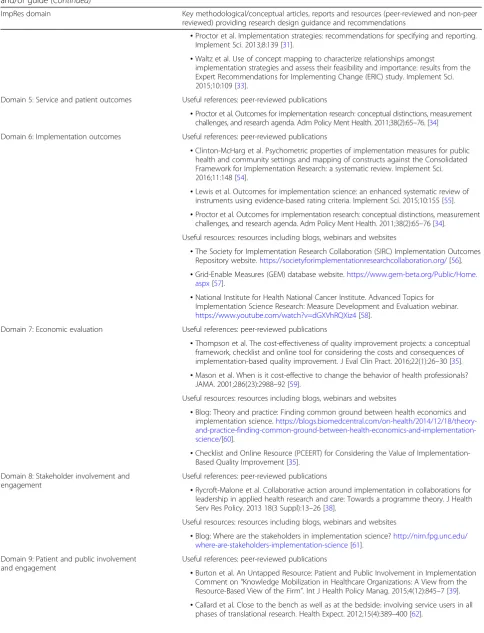
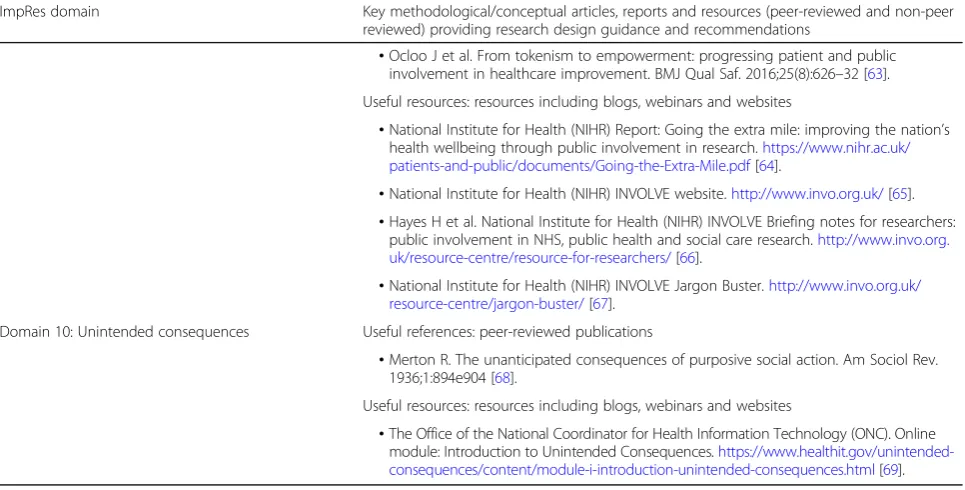
ImpRes domains. These are presented in Table2.
1c: Additional specialist input into specific ImpRes domains
After consulting with experts in the field of PPI and health economics, several refinements to the ImpRes tool were made. For example, after consulting with an expert in PPI in health services research, to ensure that researchers considered and described involvement and engagement opportunities at different stages of the
re-search cycle (i.e. from identifying and prioritizing
re-search topics to evaluating impact), and to distinguish between the different levels of involvement (i.e.
consultationtocollaboration), responses were tabulated rather than requesting researchers to describe planned involvement and engagement activities. Furthermore,
four additional questions were included in the ‘Patient
and Public Involvement’section of the ImpRes tool,
in-cluding, but not limited to, whether the patients/service users that researchers intended to involve in their re-search have formal rere-search training.
1d: Pilot testing and refinement
The tool did not undergo any significant refinements after piloting. In addition to the refinements based on specialist expert input (described above), additional feed-back received by the CIS SAP at subsequent meetings (March 2016 onwards) and discussions amongst the CIS Research team, a number of refinements were made to the ImpRes tool. For example, to improve the usability of the tool, a number of sections were tabulated (e.g. im-plementation outcomes, service and patient outcomes, and economic evaluation domains).
Table 1ImpRes domains and rationale underpinning inclusion
ImpRes domain Rationale underpinning inclusion
Domain 1: Implementation research characteristics
It has been argued that the research-to-practice gap is inflated by the tendency to conduct research in a step-wise manner from clinical efficacy research, followed by clinical effectiveness research, and lastly implementation research [18–21]. The benefits of simultaneously researching effectiveness and implementation to promote the more rapid and successful translation of clinical interventions have been previously described and ahybrid effectiveness-implementation typologyproposed [22]. As such, the ImpRes tool encourages researchers to differentiate between studying the effectiveness of an evidence-based intervention (e.g. to improve a specific service or patient outcome) and studying the implementation of an intervention in a real-world setting (e.g. to identify barriers and facilitators to implementation and evaluate implementation success and strategies). The ImpRes tool urges researchers to categorize the degree of focus placed on evaluating the effectiveness of the intervention and/or implementation success (e.g. fromeffectiveness-implementation hybridstudies to
pure implementationresearch [22]). The ImpRes tool and guide are not intended to be overly prescriptive in terms of implementation study design; different designs lend themselves to different project aims and objectives, as such there is not a one size fits all.
Domain 2: Implementation theories, frameworks and models
The use of implementation theories, frameworks and models is important in implementation research for multiple reasons including guiding implementation efforts, improving
understanding of implementation determinants and providing a structure to synthesize findings [9]. Furthermore, the use of theories and frameworks enhances the generalizability of implementation efforts and help to build a cumulative understanding of the nature of change [23] enabling greater replication of evidence-based interventions in other settings. The underuse, superficial use and misuse of theories and frameworks have been described as posing a substantial scientific challenge for implementation science [9]. ImpRes does not endorse the use of any particular theory, framework or model as the aims and objectives of any given implementation research project will determine the appropriateness and relevance of particular implementation theories, frameworks and models. Depending on the aims and objectives of an implementation research project, it may be appropriate to apply more than one theory, framework or model. For example, if a project aims to identify and understand barriers and enablers to individual behavior change and simultaneously evaluate implementation efforts, the application of a determinant framework which focuses on individual level determinants, such as the theoretical domains framework (TDF) [24], as well as a framework, such as RE-AIM [25], that can be used to evaluate implementation efforts, would be appropriate. As such, the ImpRes tool encourages researchers to consider and apply implementation theories, frameworks or models in implementation research that are appropriate to the aims and objectives of the research.
Domain 3: Determinants of implementation Implementation success is, in part, a function of the context in which implementation efforts occur. Without a clear understanding of the contextual factors likely to impede or facilitate implementation efforts, implementation strategies to overcome barriers and maximize facilitators will not be optimized, thereby reducing the likelihood of implementation success. The ImpRes tool specifically highlights the consolidated framework for implementation research (CFIR) [26], because CFIR brings together key constructs, derived from multiple implementation theories, that influence implementation efforts and is one of the most highly cited implementation determinant frameworks in the field [27]. Whilst the ImpRes tool highlights CFIR, it is important to note that ImpRes does not endorse the use of a particular determinant framework. Rather than simply describing the context in which implementation efforts occur, the ImpRes tool prompts research teams to design research to prospectively and systematically explore the factors that are likely to hinder or facilitate implementation efforts—including identification of factors commonly present across contexts that impede or facilitate health intervention implementation. Recent efforts to improve our understanding of implementation in given contexts have provided a more comprehensive, unified and structured conceptualization of context, extending beyond simply barriers and facilitators to implementation [28–30].
Domain 4: Implementation strategies Described as constituting the‘active ingredient’and‘how to’components of implementation efforts, implementation strategies are regarded as havingunparalleled importancein implementation science [31]. A program of research is currently underway to improve guidance regarding how best to select implementation strategies [8,32,33]. The ImpRes tool and guide aim to advise research teams to prospectively appraise the context in which they intend to implement evidence-based interventions and subsequently select con-textually appropriate implementation strategies to maximize implementation success. The ImpRes tool and guide thus aim to facilitate explicit mapping of implementation strategies to prospectively identified barriers and facilitators to implementation efforts by signposting researchers to resources and tools designed to help researchers achieve this.
Table 1ImpRes domains and rationale underpinning inclusion(Continued)
ImpRes domain Rationale underpinning inclusion
outcomes. The ImpRes tool and guide aim to highlight the limitations of only assessing service and patient outcomes when trying to understand and evaluate implementation. By making explicit the different types of outcomes an implementation study can assess, the ImpRes tool and guide facilitate the thinking that patient and service level outcomes are conceptually distinct from implementation outcomes—thus the need to assess the latter becomes prominent. In doing so, the ImpRes tool and guide aim to increase awareness that whilst the assessment and measurement of service and patient outcomes are essential to determine the clinical efficacy and effectiveness of an intervention, they are not sufficient for understanding implementation success, or failure of an intervention. For example, an intervention designed to reduce Emergency Department admissions might be found to be
ineffectiveaccording to admission data (i.e. service outcomes). However, the intervention might subsequently be found to be effective, for example, when implemented as intended (i.e. implemented with fidelity).
Domain 6: Implementation outcomes Implementation outcomes have been defined as‘the effects of deliberate and purposive actions to implement new treatments, practices and services and are distinct from service and client (patient) outcomes.’[34]. They may focus on a specific level of implementation, such as system, organization, innovation, provider and patient. Proctor et al. proposed a working taxonomy of eight implementation outcomes that may be assessed across all levels of a healthcare system, these include acceptability, appropriateness, feasibility, adoption, fidelity, penetration, implementation cost and sustainability [34]. Implementation outcomes may be assessed using validated measurement instruments, routinely collected data and qualitative methods. They should be assessed at salient stages of implementation (e.g. early for adoption, ongoing for penetration, late for sustainability). Furthermore, implementation strategies should be appropriately aligned to the implementation outcome(s) they intended to target and improve.
Domain 7: Economic evaluation Implementation actions and strategies will inevitably consume scarce resources that could be put to other valued uses. Decision makers are therefore likely to want to gain insight into which options offer the greatest returns, in terms of patient or population health-related benefits, per $ of resource invested [35]. Economic evaluation provides a methodological framework for examining this question, and for adding further insight into the inter-dependencies between activities, cost, implementation outcomes and patient outcomes [36]. While the concept and importance of costing and consideration to cost-effectiveness in relation to implementation strategies is not particularly novel, to the best of our knowledge, the ImpRes tool and guide is the only implementation research tool of its type to provide guidance on data requirements for costing implementation strategies and how economic evaluation more generally should fit into a broader implementation evaluation plan.
Domain 8: Stakeholder involvement and engagement
The ImpRes tool explicitly urges researchers to view implementation research as a genuinely collaborative undertaking between researchers and stakeholders and therefore stresses the importance of involving and engaging stakeholders in the process of designing implementation research. Stakeholders are individuals and groups who are likely to be impacted or affected by implementation efforts; they may also be influential in determining the success or failure of implementation efforts (e.g. health service leaders or managers or commissioners). Involving and engaging stakeholders as part of the study design team helps to ensure that, for example, suitable implementation strategies and outcomes (both patient, service and implementation outcomes) are measured; and that an appropriate communication and dissemination plan are developed.
Domain 9: Patient and public involvement and engagement
Patient and public involvement (PPI) is widely considered a marker of high-quality research [37]. Evidence suggests that PPI in implementation research is lagging and has not matured to the same extent as PPI in other areas of health research and as such remains a largely untapped resource [38,39]. The ImpRes tool prompts research teams to distinguish and consider PPI in isolation to other stakeholder involvement because of its critical importance in facilitating the implementation of research evidence into clinical practice and thus maximizing patient benefit and reducing health inequalities. As such, research teams are encouraged to view implementation research as a partnership between researchers and patients and thus involve patients and the public in designing implementation research.
Table 2Key methodological/conceptual articles, reports and resources identified that influenced the content of the ImpRes tool and/or guide
ImpRes domain Key methodological/conceptual articles, reports and resources (peer-reviewed and non-peer reviewed) providing research design guidance and recommendations
Domain 1: Implementation research characteristics
Useful references: peer-reviewed publications
•Brown et al. An Overview of Research and Evaluation Designs for Dissemination and Implementation. Annu Rev. Public Health. 2017;38:1–22 [40].
•Curran et al. Effectiveness-implementation hybrid designs: combining elements of clinical effectiveness and implementation research to enhance public health impact. Med Care. 2012;50(3):217–26 [22].
Useful resources: resources including blogs, webinars and websites
•National Implementation Research Network. Stages of Implementation.http://nirn.fpg. unc.edu/learn-implementation/implementation-stages[41].
Domain 2: Implementation theories, frameworks and models
Useful references: peer-reviewed publications
•Birken et al. Criteria for selecting implementation science theories and frameworks: results from an international survey. Implement Sci. 2017;12(1):124 [9].
•Eccles et al. Changing the behavior of healthcare professionals: the use of theory in promoting the uptake of research findings. J Clin Epidemiol. 2005;58(2):107–12 [42]. •Nilsen. Making sense of implementation theories, models and frameworks. Implement
Sci. 2015;10:53 [43].
•Tabak et al. Bridging research and practice: models for dissemination and implementation research. Am J Prev Med. 2012;43(3):337–50 [44].
Useful resources: resources including blogs, webinars and websites
•Implementation Science Exchange.https://impsci.tracs.unc.edu[17].
•The Consolidated Framework for Implementation Research (CFIR) website.www. cfirguide.org[45].
•Reach Effectiveness Adoption Implementation Maintenance (RE-AIM) framework website. http://re-aim.org[46].
•Normalisation Process Theory.http://www.normalizationprocess.org/. Accessed 12 May 2019. [47].
Domain 3: Determinants of implementation Useful references: peer-reviewed publications
•Chaudoir et al. Measuring factors affecting implementation of health innovations: a systematic review of structural, organizational, provider, patient, and innovation level measures. Implement Sci. 2013;8:22 [48].
•Craig et al. Developing and evaluating complex interventions: the new Medical Research Council guidance. BMJ. 2008;337:a1655 [49].
•Damschroder et al. Fostering implementation of health services research findings into practice: a consolidated framework for advancing implementation science. Implement Sci. 2009;4:50 [26].
•Flottorp et al. A checklist for identifying determinants of practice: A systematic review and synthesis of frameworks and taxonomies of factors that prevent or enable improvements in healthcare professional practice. Implement Sci. 2013;23;8:35 [50]. •Nilsen. Making sense of implementation theories, models and frameworks. Implement
Sci. 2015;10:53 [43].
Useful resources: resources including blogs, webinars and websites
•Health Foundation webinar: Quality Improvement and the role of context and how to manage it. www.health.org.uk/webinar-quality-improvement-role-context-and-how-manage-it[51].
•Health Foundation. Perspectives on Context: A selection of essays considering the role of context in successful quality improvement.https://www.health.org.uk/sites/health/files/ PerspectivesOnContext_fullversion.pdf[52].
•The Consolidated Framework for Implementation Research (CFIR) website.www.cfirguide. org[45].
Domain 4: Implementation strategies Useful references: peer-reviewed publications
Table 2Key methodological/conceptual articles, reports and resources identified that influenced the content of the ImpRes tool
and/or guide(Continued)
ImpRes domain Key methodological/conceptual articles, reports and resources (peer-reviewed and non-peer reviewed) providing research design guidance and recommendations
•Proctor et al. Implementation strategies: recommendations for specifying and reporting. Implement Sci. 2013;8:139 [31].
•Waltz et al. Use of concept mapping to characterize relationships amongst
implementation strategies and assess their feasibility and importance: results from the Expert Recommendations for Implementing Change (ERIC) study. Implement Sci. 2015;10:109 [33].
Domain 5: Service and patient outcomes Useful references: peer-reviewed publications
•Proctor et al. Outcomes for implementation research: conceptual distinctions, measurement challenges, and research agenda. Adm Policy Ment Health. 2011;38(2):65–76. [34]
Domain 6: Implementation outcomes Useful references: peer-reviewed publications
•Clinton-McHarg et al. Psychometric properties of implementation measures for public health and community settings and mapping of constructs against the Consolidated Framework for Implementation Research: a systematic review. Implement Sci. 2016;11:148 [54].
•Lewis et al. Outcomes for implementation science: an enhanced systematic review of instruments using evidence-based rating criteria. Implement Sci. 2015;10:155 [55]. •Proctor et al. Outcomes for implementation research: conceptual distinctions, measurement
challenges, and research agenda. Adm Policy Ment Health. 2011;38(2):65–76 [34].
Useful resources: resources including blogs, webinars and websites
•The Society for Implementation Research Collaboration (SIRC) Implementation Outcomes Repository website.https://societyforimplementationresearchcollaboration.org/[56]. •Grid-Enable Measures (GEM) database website.https://www.gem-beta.org/Public/Home.
aspx[57].
•National Institute for Health National Cancer Institute. Advanced Topics for Implementation Science Research: Measure Development and Evaluation webinar. https://www.youtube.com/watch?v=dGXVhRQXiz4[58].
Domain 7: Economic evaluation Useful references: peer-reviewed publications
•Thompson et al. The cost-effectiveness of quality improvement projects: a conceptual framework, checklist and online tool for considering the costs and consequences of implementation-based quality improvement. J Eval Clin Pract. 2016;22(1):26–30 [35]. •Mason et al. When is it cost-effective to change the behavior of health professionals?
JAMA. 2001;286(23):2988–92 [59].
Useful resources: resources including blogs, webinars and websites
•Blog: Theory and practice: Finding common ground between health economics and implementation science. https://blogs.biomedcentral.com/on-health/2014/12/18/theory- and-practice-finding-common-ground-between-health-economics-and-implementation-science/[60].
•Checklist and Online Resource (PCEERT) for Considering the Value of Implementation-Based Quality Improvement [35].
Domain 8: Stakeholder involvement and engagement
Useful references: peer-reviewed publications
•Rycroft-Malone et al. Collaborative action around implementation in collaborations for leadership in applied health research and care: Towards a programme theory. J Health Serv Res Policy. 2013 18(3 Suppl):13–26 [38].
Useful resources: resources including blogs, webinars and websites
•Blog: Where are the stakeholders in implementation science?http://nirn.fpg.unc.edu/ where-are-stakeholders-implementation-science[61].
Domain 9: Patient and public involvement and engagement
Useful references: peer-reviewed publications
•Burton et al. An Untapped Resource: Patient and Public Involvement in Implementation Comment on“Knowledge Mobilization in Healthcare Organizations: A View from the Resource-Based View of the Firm”. Int J Health Policy Manag. 2015;4(12):845–7 [39]. •Callard et al. Close to the bench as well as at the bedside: involving service users in all
Stage 2: application of the ImpRes tool
The ImpRes tool was applied to 15 implementation and improvement science projects, either prospectively or retrospectively. The ImpRes tool was fully completed for 14 projects and partially completed for one project. The ImpRes tool was applied independently by researchers (i.e. without expert guidance) to 14 projects. ImpRes was applied with the guidance of an implementation scientist (LH) to the remaining project. The tool developers are part of the research organization in which the tool was applied and evaluated. As a large research organization, the relationship between the tool developers and the researchers that applied and evaluated the ImpRes tool was variable. In the majority of cases, the application of the ImpRes tool was the first meeting between the tool developers and the lead researcher. The research projects covered a diverse range of clinical areas, including diabetes,
mental health, dementia and maternity and women’s health.
Two hybrid type 1, five hybrid type 2, three hybrid type 3 and five implementation research projects, as defined by Curran et al., [22], were included. Additional details of each
project can be found in Table3.
Stage 3: evaluation of the ImpRes tool
3a. Questionnaire
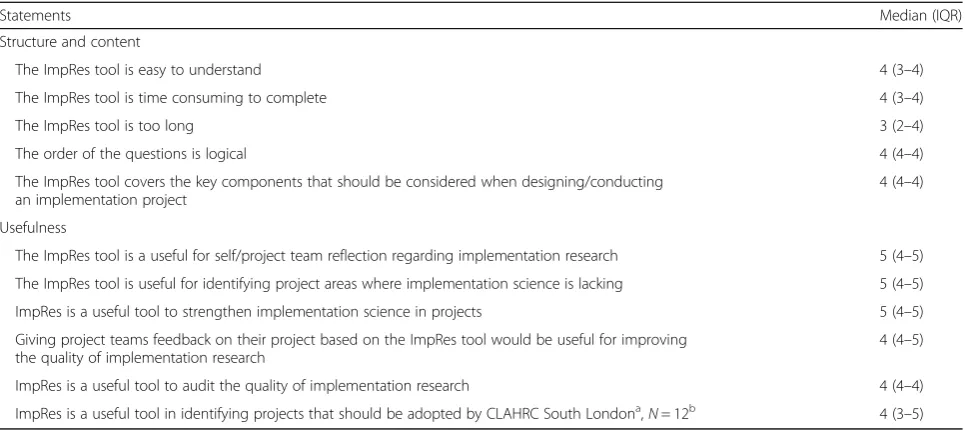
Thirteen out of 15 questionnaires were completed. Evaluative feedback from researchers on the structure, content and usefulness of the ImpRes tool is reported in
Table4. In all but one case (where the researcher stated
that‘The ImpRes tool is too long’), the median rating for
statements relating to the structure and content and the usefulness of the ImpRes tool were above the scale mid-point (3) thereby indicating that researchers who applied the ImpRes tool viewed the structure, content and usefulness of the tool favorably.
Free text comments provided by researchers after completing the ImpRes tool
Five out of 13 researchers who applied the ImpRes tool, to 15 individual projects, provided free-text comments. Suggestions for improvement included expanding the
glossary at the end of the ImpRes tool: ‘Helpful to
pro-vide definitions of “implementation/project team” and
“stakeholders”distinction not clear. Also, helpful to
pro-vide definitions of ‘research project’ and ‘improvement
project’ (Researcher 3)’. One researcher suggested that
the layout of the ImpRes tool needed modification; ‘I
think the layout will need some tweaking to be a bit more user friendly. I felt that I needed help to clarify
where which responses should go where’(Researcher 8).
Whilst some researchers thought that the ImpRes tool was too long, one researcher commented that ImpRes was
necessarily long:‘The length [of the ImpRes tool] and level
of detail are necessary to capture the complexity of the
is-sues explored’(Researcher 15). Furthermore,
acknowledg-ing that the ability to successfully conduct and complete an implementation project depends on the skills, expertise and experiences of the research team, one researcher
sug-gested including an additional question:‘There is maybe a
Table 2Key methodological/conceptual articles, reports and resources identified that influenced the content of the ImpRes tool
and/or guide(Continued)
ImpRes domain Key methodological/conceptual articles, reports and resources (peer-reviewed and non-peer reviewed) providing research design guidance and recommendations
•Ocloo J et al. From tokenism to empowerment: progressing patient and public involvement in healthcare improvement. BMJ Qual Saf. 2016;25(8):626–32 [63].
Useful resources: resources including blogs, webinars and websites
•National Institute for Health (NIHR) Report: Going the extra mile: improving the nation’s health wellbeing through public involvement in research.https://www.nihr.ac.uk/ patients-and-public/documents/Going-the-Extra-Mile.pdf[64].
•National Institute for Health (NIHR) INVOLVE website.http://www.invo.org.uk/[65]. •Hayes H et al. National Institute for Health (NIHR) INVOLVE Briefing notes for researchers:
public involvement in NHS, public health and social care research.http://www.invo.org. uk/resource-centre/resource-for-researchers/[66].
•National Institute for Health (NIHR) INVOLVE Jargon Buster.http://www.invo.org.uk/ resource-centre/jargon-buster/[67].
Domain 10: Unintended consequences Useful references: peer-reviewed publications
•Merton R. The unanticipated consequences of purposive social action. Am Sociol Rev. 1936;1:894e904 [68].
Useful resources: resources including blogs, webinars and websites
question missing about the skill set of the project teams’ (Researcher 8).
3b: Download figures
Figure 3 displays the download figures for the ImpRes
tool and guide over a 6-month period (April–September
2018). In total, the ImpRes tool and guide were down-loaded 2687 times. The ImpRes guide was downdown-loaded 1215 times in June 2018, representing a substantial increase in comparison to other months. We are aware
that the ImpRes tool and guide were presented as part of a workshop at a large international conference and re-ceived social media attention (twitter).
Stage 4: Development of the ImpRes supplementary guide
The evaluation data collected on the ImpRes tool (de-scribed in stage 3: evaluation of the ImpRes tool) led to the development, and informed the content, of the ImpRes supplementary guide. The guide is intended to be
Table 4Evaluation of the ImpRes tool
Statements Median (IQR)
Structure and content
The ImpRes tool is easy to understand 4 (3–4)
The ImpRes tool is time consuming to complete 4 (3–4)
The ImpRes tool is too long 3 (2–4)
The order of the questions is logical 4 (4–4)
The ImpRes tool covers the key components that should be considered when designing/conducting an implementation project
4 (4–4)
Usefulness
The ImpRes tool is a useful for self/project team reflection regarding implementation research 5 (4–5)
The ImpRes tool is useful for identifying project areas where implementation science is lacking 5 (4–5)
ImpRes is a useful tool to strengthen implementation science in projects 5 (4–5)
Giving project teams feedback on their project based on the ImpRes tool would be useful for improving the quality of implementation research
4 (4–5)
ImpRes is a useful tool to audit the quality of implementation research 4 (4–4)
ImpRes is a useful tool in identifying projects that should be adopted by CLAHRC South Londona
,N= 12b 4 (3–5)
1 = strongly disagree, 2 = disagree, 3 = neither agree nor disagree, 4 = agree, 5 = strongly agree
a
Research organization in which ImpRes was developed, applied and evaluated
bN
= 13 unless otherwise stated
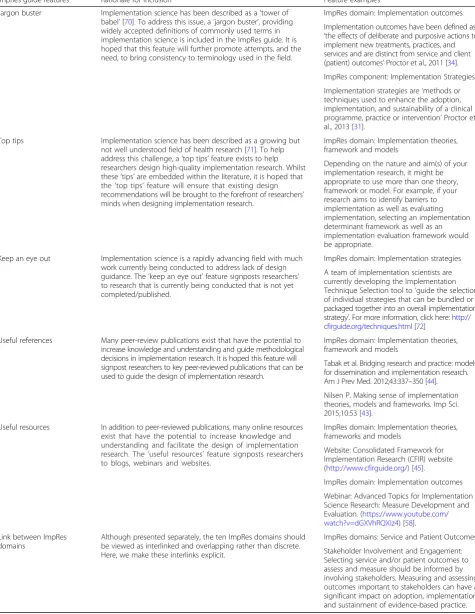
used in conjunction with the ImpRes tool. The guide aims to facilitate the use of the ImpRes tool, highlight the im-portance of implementation science in optimizing the suc-cessful implementation of evidence-based interventions into clinical practice, define terminology commonly used in the implementation science literature and direct re-searchers to relevant literature and online resources that can be used to design implementation research. Through-out the guide, several features designed to support
re-searchers are presented. These include a ‘jargon buster’
and ‘useful resources’feature. Each feature, rationale for
inclusion and feature examples are presented in Table5.
Together with the ImpRes tool, the ImpRes
supplemen-tary guide is free to download via the King’s Improvement
Science website [14] and the Implementation Science Exchange website [17].
Discussion
We developed the ImpRes tool and supplementary guide to help researchers design high-quality implementation research. Development of the tool and guide was in-formed by a consensus-building brainstorming process, involving an international multidisciplinary expert panel, and identification of key methodological and conceptual literature containing design guidance and recommenda-tions. The ImpRes tool contains ten core domains, repre-senting core implementation science principles and concepts that should be reviewed and considered when de-signing implementation research. Whilst we recommend that all components of ImpRes are worthy of consideration by research teams when designing implementation re-search, we recognize that not all sections will be applicable to, or feasible to explore, in every implementation study. Rather, each ImpRes domain should be considered stra-tegically, in the context of the research aims and objectives, to determine applicability, importance and feasibility. For
example,implementation research, as defined by Curran et
al., 2012, which is focused on the adoption or uptake of a clinical intervention and as intervention effectiveness is typ-ically assumed, gathering information on the clinical
inter-vention’s impact on relevant outcomes is typically not
assessed, as such ImpRes’ ‘Service and Patient Outcomes’
domain would not be applicable to include in such re-search. To the best of our knowledge, the ImpRes tool and supplementary guide is the only currently available compre-hensive research design instrument which synthesizes guid-ance and recommendations for designing high-quality implementation research.
We envisage that the ImpRes tool and supplementary
guide will increase users’confidence and ability to design
high-quality implementation research. The results of the present study support this vision; researchers applying the ImpRes tool found the tool to be useful in identify-ing areas where implementation science was lackidentify-ing in
research projects and in identifying how the method-ology of projects could be improved. We anticipate that research teams who use the ImpRes tool will be more likely to consider and integrate core principles and con-cepts of implementation science when designing and evaluating the implementation of evidence-based health interventions. We aspire that, in turn, this will contrib-ute to more successful implementation and evaluation of evidence-based interventions.
Strengths and limitations
Strengths of our research include the application of the ImpRes tool to a number of implementation and im-provement science research projects, by researchers with varying levels of implementation and improvement sci-ence expertise and across a diverse range of health care areas, including physical and mental health. Our initial evaluation of the ImpRes tool found that the tool is ac-ceptable and feasible to apply. Evaluation of the ImpRes tool by researchers who applied the tool viewed the structure, content and usefulness of the tool very
favor-ably; all but one structure evaluation item (‘the ImpRes
tool is too long’) had a median score≥4/5 and all
useful-nessevaluation items had a median score≥4/5. Our
ini-tial dissemination efforts (via the King’s Improvement
Science and Implementation Science Exchange websites) [14, 17] suggest that the ImpRes tool and guide fill an important capacity building gap; over a 6-month period, the ImpRes tool and guide have been downloaded over 2600 times.
Table 5ImpRes guide features, rationale for inclusion and feature examples
ImpRes guide features Rationale for inclusion Feature examples
Jargon buster Implementation science has been described as a‘tower of babel’[70]. To address this issue, a‘jargon buster’, providing widely accepted definitions of commonly used terms in implementation science is included in the ImpRes guide. It is hoped that this feature will further promote attempts, and the need, to bring consistency to terminology used in the field.
ImpRes domain: Implementation outcomes
Implementation outcomes have been defined as ‘the effects of deliberate and purposive actions to implement new treatments, practices, and services and are distinct from service and client (patient) outcomes’Proctor et al., 2011 [34].
ImpRes component: Implementation Strategies
Implementation strategies are‘methods or techniques used to enhance the adoption, implementation, and sustainability of a clinical programme, practice or intervention’Proctor et al., 2013 [31].
Top tips Implementation science has been described as a growing but not well understood field of health research [71]. To help address this challenge, a‘top tips’feature exists to help researchers design high-quality implementation research. Whilst these‘tips’are embedded within the literature, it is hoped that the‘top tips’feature will ensure that existing design recommendations will be brought to the forefront of researchers’ minds when designing implementation research.
ImpRes domain: Implementation theories, framework and models
Depending on the nature and aim(s) of your implementation research, it might be appropriate to use more than one theory, framework or model. For example, if your research aims to identify barriers to implementation as well as evaluating implementation, selecting an implementation determinant framework as well as an implementation evaluation framework would be appropriate.
Keep an eye out Implementation science is a rapidly advancing field with much work currently being conducted to address lack of design guidance. The‘keep an eye out’feature signposts researchers’ to research that is currently being conducted that is not yet completed/published.
ImpRes domain: Implementation strategies
A team of implementation scientists are currently developing the Implementation Technique Selection tool to‘guide the selection of individual strategies that can be bundled or packaged together into an overall implementation strategy’. For more information, click here:http:// cfirguide.org/techniques.html[72]
Useful references Many peer-review publications exist that have the potential to increase knowledge and understanding and guide methodological decisions in implementation research. It is hoped this feature will signpost researchers to key peer-reviewed publications that can be used to guide the design of implementation research.
ImpRes domain: Implementation theories, framework and models
Tabak et al. Bridging research and practice: models for dissemination and implementation research. Am J Prev Med. 2012;43:337–350 [44].
Nilsen P. Making sense of implementation theories, models and frameworks. Imp Sci. 2015;10:53 [43].
Useful resources In addition to peer-reviewed publications, many online resources exist that have the potential to increase knowledge and understanding and facilitate the design of implementation research. The‘useful resources’feature signposts researchers to blogs, webinars and websites.
ImpRes domain: Implementation theories, frameworks and models
Website: Consolidated Framework for Implementation Research (CFIR) website (http://www.cfirguide.org/) [45].
ImpRes domain: Implementation outcomes
Webinar: Advanced Topics for Implementation Science Research: Measure Development and Evaluation. (https://www.youtube.com/ watch?v=dGXVhRQXiz4) [58].
Link between ImpRes domains
Although presented separately, the ten ImpRes domains should be viewed as interlinked and overlapping rather than discrete. Here, we make these interlinks explicit.
ImpRes domains: Service and Patient Outcomes
Furthermore, we identified a number of barriers that are likely to affect adoption, implementation and sustainment of the ImpRes tool, including a lack of awareness amongst applied health researchers of implementation science to im-prove the implementation of evidence-based interventions. Moreover, ImpRes was applied and evaluated within a re-search organization: NIHR CLAHRC South London. Fu-ture evaluation studies should explore the generalizability and scalability, as well as the barriers and enablers, of the ImpRes tool and guide in other research settings (e.g. out-side of large, multi-million-pound funded research organi-zations such as NIHR CLAHRCs and research cutting across health and social care settings). The researchers who developed the ImpRes tool developed and distributed the questionnaire that was used for the preliminary evaluation and analyzed the questionnaire data returned. Although a
point was made of welcoming participants’comments and
critiques to help us to modify/refine the content of ImpRes tool, we are aware a social desirability bias may be present in the evaluation data.
Reflections on implementing the ImpRes tool
Barriers to implementing the ImpRes tool Applying the ImpRes tool retrospectively (i.e. to research projects that had already been completed or were underway) proved to be an unmotivating task to researchers and is likely to explain the reluctance and lack of engagement of a number of researchers/research themes that were approached, but declined, to apply the ImpRes tool to their projects. This is not unexpected considering that research projects already completed would not directly benefit from applying the ImpRes tool, i.e. it was not possible to amend and improve the design of implemen-tation or improvement science research as the research was already underway or had been completed. Like many applied health researchers, several researchers lacked awareness/familiarity with implementation sci-ence. This is likely to have resulted in some reluctance to commit the time needed to complete the ImpRes tool. Whilst we believe that the content of the ImpRes tool and guide is appropriate across all types of implementa-tion research, the presentaimplementa-tion of informaimplementa-tion may need to be revised, perhaps shortened, to better suit practitioner-researchers based outside of an academic research organization. Without education to establish awareness of the importance of implementation science in implementing evidence-based interventions, this bar-rier is likely to prevent the adoption, implementation and sustainability of the ImpRes tool. Furthermore, the ImpRes tool was perceived by some as a research-heavy tool targeted more at large-scale academic research ra-ther than more applied, small-scale, pragmatic projects (e.g. improvement/spread projects). Such perceptions
were expressed predominately by those who applied the ImpRes tool to projects being conducted outside of a university setting (i.e. Health Innovation Network) rather than those who applied the tool to projects being
con-ducted within a university setting (i.e. King’s College
London). Again, this is likely to have resulted in some reluctance to commit the time needed to complete the ImpRes tool.
Facilitators to implementing the ImpRes tool Pro-spective application to projects that were in the design phase, and amenable to design change, and to grant applications that were being drafted for submission, per-haps unsurprisingly proved to be a factor motivating the application of ImpRes. The benefits of applying ImpRes were clear and immediate. Researchers who were ac-tively encouraged by principal investigators (PIs) to apply the ImpRes tool were far more likely and moti-vated to do so than researchers who were approached on an individual basis and who had not received direct encouragement from PIs. Furthermore, researchers who were aware and interested in implementation science and implementation research yet felt they lacked the knowledge and skills to design implementation research welcomed the ImpRes tool, together with the support and facilitation of the lead researcher (LH), to structure the process of designing implementation research.
Planned ImpRes research and development
proposal by identifying project areas that require im-provement. Furthermore, researchers who have imple-mentation science expertise may also benefit from using the ImpRes tool and guide. The initial intention of the ImpRes tool and guide at the inception stage was to sup-port those researchers who have no or limited expertise in implementation science research; however, we ac-knowledge and plan to evaluate the benefits of applying the ImpRes tool and guide for applied health researchers who have implementation science expertise.
Conclusion
We have developed a new and promising educational tool and supplementary guide to help overcome the many chal-lenges that applied health researchers face when attempting to design implementation research. We believe that adopt-ing the ImpRes tool and guide will improve the quality of implementation research, in turn advancing the field and leading to optimized implementation of evidence-based interventions and ultimately improved service and patient outcomes.
Abbreviations
CIS SAP:Centre for Implementation Science Scientific Advisory Panel; CIS: Centre for Implementation Science; CLAHRC: Collaboration for Leadership in Applied Health Research and Care; ImpRes tool: Implementation Science Research Development tool; IQR: Interquartile range; NIHR: National Institute for Health Research; PPI: Patient and public involvement
Acknowledgements
The authors would like to thank the researchers across the NIHR CLAHRC South London and partner organizations who applied and evaluated the ImpRes tool.
Funding
IB, AH, LH and NS’research is part funded by the National Institute for Health Research (NIHR) via the‘Collaboration for Leadership in Applied Health Research and Care South London’(CLAHRC South London) at King’s College Hospital National Health Service (NHS) Foundation Trust, London, UK. LG, LH and ZK are funded by King’s Improvement Science, which is part of the NIHR CLAHRC South London and comprises a specialist team of improvement scientists and senior researchers based at King’s College London. King’s Improvement Science is funded by King’s Health Partners (Guy’s and St Thomas’NHS Foundation Trust, King’s College Hospital NHS Foundation Trust, King’s College London and South London and Maudsley NHS Foundation Trust), Guy’s and St Thomas’Charity, the Maudsley Charity and the Health Foundation. NS is also funded by the South London and Maudsley NHS Foundation Trust. The views expressed are those of the authors and not necessarily those of NHS, NIHR or the Department of Health. IB is also supported by the NIHR Biomedical Research Centre at South London and Maudsley NHS Foundation Trust.
The above funding bodies were not involved in the design of the study and collection, analysis and interpretation of data or in writing the manuscript.
Availability of data and materials
The datasets used and/or analyzed, relating to the evaluation questionnaire only, during the current study are available from the corresponding author on reasonable request.Completed ImpRes tools are not available.
Authors’contributions
All authors made substantial contributions to conception and design of the study. LH and ZK made substantial contribution to the acquisition of data. LH analysed and interpreted the data. LH drafted the manuscript and all authors have been involved in revising it critically for important intellectual content. All authors have given final approval of the version to be published.
Each author has participated sufficiently in the work to take public responsibility for appropriate portions of the content; and have agreed to be accountable for all aspects of the work.
Ethics approval and consent to participate
This study was performed as an education evaluation and was therefore not applicable for ethical committee review. Individual level or organizational level written consent (by email) was provided for projects to be described and evaluation data to be incorporated within this manuscript.
Consent for publication
Not applicable; no identifying information on any individual’s data is presented in this manuscript.
Competing interests
NS is the Director of London Safety and Training Solutions Ltd., which provides quality and safety training and advisory services on a consultancy basis to healthcare organizations globally. NS is an Associate Editor of
Implementation Science.All other authors declare that they have no competing interests.
Publisher’s Note
Springer Nature remains neutral with regard to jurisdictional claims in published maps and institutional affiliations.
Author details
1Centre for Implementation Science, Health Service and Population Research
Department, King’s College London, London, UK.2School of Health Sciences, University of East Anglia, Norwich Research Park, Norwich, UK.3King’s Health Economics, Institute of Psychiatry, Psychology and Neuroscience, King’s College London, London, UK.4Department of Biostatistics and Health Informatics, Institute of Psychiatry, Psychology and Neuroscience, King’s College London, London, UK.
Received: 8 November 2018 Accepted: 15 April 2019
References
1. Grimshaw JM, Eccles MP, Lavis JN, Hill SJ, Squires JE. Knowledge translation of research findings. Implement Sci. 2012;7:50.
2. Morris ZS, Wooding S, Grant J. The answer is 17 years, what is the question: understanding time lags in translational research. J R Soc Med. 2011;104(12): 510–20.
3. Eccles MP, Armstrong D, Baker R, Cleary K, Davies H, Davies S, et al. An implementation research agenda. Implement Sci. 2009;4:18.
4. Bero LA, Grilli R, Grimshaw JM, Harvey E, Oxman AD, Thomson MA. Closing the gap between research and practice: an overview of systematic reviews of interventions to promote the implementation of research findings. BMJ. 1998;317(7156):465–8.
5. Crable EL, Biancarelli D, Walkey AJ, Allen CG, Proctor EK, Drainoni ML. Standardizing an approach to the evaluation of implementation science proposals. Implement Sci. 2018;13(1):71.
6. Proctor EK, Powell BJ, Baumann AA, Hamilton AM, Santens RL. Writing implementation research grant proposals: ten key ingredients. Implement Sci. 2012;7:96.
7. Straus SE, Sales A, Wensing M, Michie S, Kent B, Foy R. Education and training for implementation science: our interest in manuscripts describing education and training materials. Implement Sci. 2015;10:136.
8. Waltz TJ, Powell BJ, Chinman MJ, Smith JL, Matthieu MM, Proctor EK, et al. Expert recommendations for implementing change (ERIC): protocol for a mixed methods study. Implement Sci. 2014;9:39.
9. Birken SA, Powell BJ, Shea CM, Haines ER, Alexis Kirk M, Leeman J, et al. Criteria for selecting implementation science theories and frameworks: results from an international survey. Implement Sci. 2017;12(1):124. 10. The National Institute for Health Research (NIHR) Collaboration for
Leadership in Applied Health Research and Care (CLAHRC) South London.
http://www.clahrc-southlondon.nihr.ac.uk/diabetes/research-projects/ helping-people-type-1-diabetes-avoid-severe-hypoglycaemia#section2. Accessed 20 Mar 2019.

![Proceedings of the 13th ESARDA Annual Symposium on Safeguards and Nuclear Material Management, EUR 13686 [EN]](data:image/gif;base64,R0lGODlhAQABAIAAAP///wAAACH5BAEAAAAALAAAAAABAAEAAAICRAEAOw==)