
Assessment of interventions to attract and retain health workers in rural Zambia: a discrete choice experiment
Full text
Figure


Related documents
The odds of developing anemia were almost four times more likely among late adolescents as compared to early adolescents (AOR = 3.8 95%CI = 2.3 to 8.5).Adolescents from rural areas
C.2 Research Project Title Rural internship job attribute preferences of final year medical students in South Africa: A Discrete Choice Experiment. C.3 Research Proposal Attached:
In this study, we investigate preferences for job attri- butes among students training to join four health worker cadres in Uganda, identified by the Ministry as being es- sential to
Keywords: Discrete choice experiment, Attribute and attribute-levels development, Qualitative study, Micro health insurance, Rural communities, Malawi1. *
This study uses data from the 1993 Robert Wood Johnson Foundation Employer Health Insurance Survey to measure differences in the proportion of rural and urban workers who are
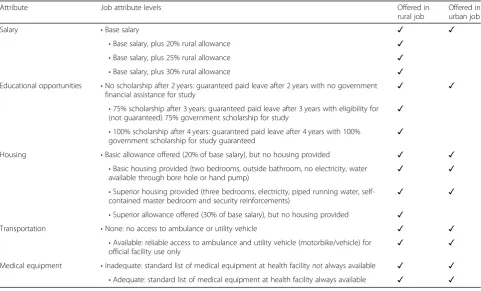
Gaining insight into incentives (attributes) or package of incentives that elicit choices of low level trained health workers to work in particular location
In this study, we investigate preferences for job attri- butes among students training to join four health worker cadres in Uganda, identified by the Ministry as being es- sential to
Gallego et al.. Six factors were identified as potentially of greatest im- portance to the retention of AHPs working in the dis- ability sector in rural areas. These six factors
