R E S E A R C H
Open Access
Brachial plexopathy: a case
–
control study of the
relation to physical exposures at work
Jørgen Riis Jepsen
1,2Abstract
Background:Work-related upper limb disorders constitute a diagnostic challenge. However, patterns of neurological abnormalities that reflect brachial plexus dysfunction are frequent in limbs with pain, weakness and/or numbness/ tingling. There is limited evidence about the association between occupational physical exposures and brachial plexopathy.
Methods:80 patients with brachial plexopathy according to defined criteria and 65 controls of similar age and sex without upper limb complaints were recruited by general practitioners. Patients and controls completed a questionnaire on physical and psychosocial work-exposures and provided psychophysical ratings of their perceived exposures. The exposures of cases and controls were compared by a Wilcoxon rank sum test. Odds ratios and dose–response relationships were studied by logistic regression.
Results:Whether assessed as the extent during the workday or days/week, most physical exposures, in particular upper limb posture and repetition, were significant risk indicators with clear dose–response relationships. These findings were supported by psychophysical responses that also identified perceived work pace and the use of force as risk indicators. The identified psychosocial relations were limited to measures reflecting physical exposures.
Conclusions:While the identified risk indicators have previously been associated to upper limbsymptomsas well as to diagnoseddisordersother than brachial plexopathy, this study indicates an association between physical and work-exposures and brachial plexopathy. Longitudinal studies should be conducted in order to exclude bias from information and selection, both of which may occur with the applied case–control design.
Background
In addition to pain, which is often of a neuropathic char-acter, people with upper limb complaints frequently report weakness and/or numbness/tingling. The character of pain may be nagging, stabbing, burning, “like tooth ache”and/or shooting [1]. This combination of symptoms suggests neural involvement and may represent a disorder of the brachial plexus.
Few studies, however, have established a relation between physical exposures and brachial plexopathy [2], although many have suggested hypothetical relations [3-7]. The limited evidence for the existence and
frequency of relation to work of brachial plexopathy argues for further research in this field.
Studies of occupational risk indicators for upper limb disorders should rely on both signs and symptoms [8]. Still, epidemiological studies have mainly been restricted to studies of the relation to regional symptoms [9] or to the so-called“specific”disorders such as, e.g. carpal tun-nel syndrome [10,11], wrist tendinitis [11,12], epicondyl-itis [11] and shoulder tendinepicondyl-itis [13,14]. The challenge is that a major group of so-called“non-specific” disorders (that do not meet the criteria for “specific” conditions) are only characterised by symptoms [1]. In a study of upper extremity musculoskeletal complaints, a specific diagnosis was made in only 25% and 16% of patients were not given any diagnosis. The remaining 59% patients (n = 389) were labelled as “non-specific”, i.e. “repetitive strain syndrome”, by the clinician. The pain in this group of patients was equally distributed among
Correspondence:[email protected]
1Department of Occupational Medicine, Hospital of South-western Jutland, Østergade 81-83, DK-6700 Esbjerg, Denmark
2Center of Maritime Health and Society, Institute of Public Health, University of Southern Denmark, DK-6700 Esbjerg, Denmark
neck, shoulder, upper arm, elbow, forearm, and wrist/ hand and shared the characteristics of neuropathic pain described above. “Repetitive strain syndrome” was sig-nificantly associated with activities with elevated arms, repetitive and extreme movements [1]. In a French population, more than 50% of workers participating in an epidemiologic surveillance system presented non-specific symptoms during the preceding 12 months, and only 13% had a defined upper limb musculoskeletal con-dition, in particular rotator cuff syndrome, carpal tunnel syndrome and epicondylitis [15].
The application in people with upper limb pain in the primary health sector [16] and in clinical occupa-tional medicine [17-19] of a physical examination consisting of semi-quantitative ratings of selective muscle weakness, sensory deviations from normal in homonymous innervation territories and disturbed mechano-sensitivity of nerve trunks has revealed high frequencies of neurological patterns in accordance with neuropathies with various locations. The clinical applicability and feasibility of this approach, which is based on the classical neurological examination, is indicated by good inter-examiner reliability [17,20-22], construct validity in terms of correlation of physical findings to symptoms [19], and significant interrela-tions of locainterrela-tions of defined focal neuropathy [23]. The majority of the patients that were subjected to this examination displayed neurological physical patterns in accordance with brachial plexopathy with a prevailing infraclavicular location [16,20]. This observation suggests the importance of identifying, managing and preventing this condition.
Brachial plexopathy remains a controversial diagnosis. Some researchers and clinicians argue that the clinical assessment has a limited validity [24] and that the diagno-sis mostly cannot be confirmed by electrophysiological studies [25,26]. They therefore reject the frequency of bra-chial plexopathy [27] Other researchers and clinicians recognize brachial plexopathy as a common condition [28,29] –also in the context of occupational health [30]. Sheth and Belzberg regard brachial plexopathy as the most underrated, overlooked, misdiagnosed, and diffi-cult to manage peripheral nerve compression in the upper extremity [31].
Clinicians tend to emphasize brachial plexopathy as a condition related to an affliction of the brachial plexus on its passage through the scalene triangle and pay less attention to a compromise more distally, e.g. at the passage of the brachial plexus behind the pectoralis minor muscle (pectoralis minor syndrome) [32,33]. In the clinical setting as well as in epidemiological research distorted diagnostics due to this focus would be unfortu-nate, in particular in case of the latter location being more common.
Brachial plexopathy can be defined as a combination of symptoms (pain or subjective weakness or sensory ab-normalities) and physical findings (weakness in defined muscles, mechanical allodynia at the brachial plexus, and sensory deviations from normal with specific loca-tions). This physical approach permits the examiner to diagnose brachial plexopathy and to define its location precisely [17,20] and accurately [19,23] in a significant number of symptomatic patients, including patients that are diagnostically unclassifiable according to standard diagnostic criteria [17,20,34]. With the application of this diagnostic approach, brachial plexopathy with an infracla-vicular location was found to be the most frequent diag-nosis in a sample of people with upper limb pain in the primary health sector [16] as well as among patients re-ferred to a department of occupational medicine [19,20].
Such physical diagnostic approach based on symptoms and neurological findings permits the identification of proximally located upper limb neuropathic conditions and makes better sense than alternative diagnostic classifi-cation systems in common use [16], e.g. those suggested by Sluiter et al. [35]. It would therefore be essential to include physical neurologic signs that can identify brachial plexopathies in diagnostic classification systems for upper limb disorders.
This study aims to assess the association of brachial plexopathy to physical and psychophysical exposures at work.
Material and methods Study design
This case–control study was based on a case group of people with non-traumatic upper limb pain fulfilling defined criteria for brachial plexopathy and a control group without upper limb complaints. The cases and the controls answered the same questionnaire on work ex-posures. The distribution of exposures was compared for cases and controls.
Study subjects
Cases: Out of 277 patients with upper limb pain, of 16–65 years of age and in active occupation that were identified by 21 general practitioners, 169 agreed to participate in the study. Eight patients were excluded due to a history of previous acute trauma, or information on medical conditions that may predispose to upper limb disorders (pregnancy, alcoholism, rheumatoid arthritis, cardiac disease, hypothyroidism, diabetes, amyloidosis, polyneuropathy, vitamin B12 deficiency). The remaining 161 patients were physically examined by a single exam-iner and classified diagnostically according to previously defined criteria [16].
examination consisted of manual testing of 17 upper limb muscles, assessment of sensation (light touch, pinprick, vibration 256 Hz) in five homonymously innervated territories of the skin corresponding to the peripheral nerves, and assessment of mechanical allo-dynia at ten defined nerve-locations [16]. Abnormal sensation was recorded with hypo- as well as hyper-exitability and/or abnormal perception of vibration. Brachial plexopathy was defined in the presence of the following characteristics [16]:
Symptoms
Pain, subjective weakness or sensory disturbances in either/or the neck, shoulder, arm, or hand.
Brachial plexopathy at the infraclavicular level (pectoralis minor syndrome)
The definition of this condition required all three of the following findings:
Weakness of the posterior deltoid, biceps brachii, and radial flexor of wrist muscles and one or more of the following muscles: Triceps, short radial extensor of wrist, long extensor of thumb, long flexor of thumb, short abductor of thumb, pectorals, deep flexor to the 5thdigit, small adductor of the 5th digit.
Mechanical allodynia with mild pressure at the infraclavicular brachial plexus on the passage behind the pectoralis minor muscle.
Sensory abnormalities in the deltoid region.
Brachial plexopathy at the supraclavicular level (scalene triangle syndrome)
The definition of this condition required all three of the following findings:
Weakness of the infraspinatus, posterior deltoid, and biceps brachii muscles. Normal strength in the radial flexor of wrist (unless concomitant more distal neuropathy).
Mechanical allodynia with mild pressure at the brachial plexus at the passage through the scalene triangle
Sensory abnormalities in the deltoid region.
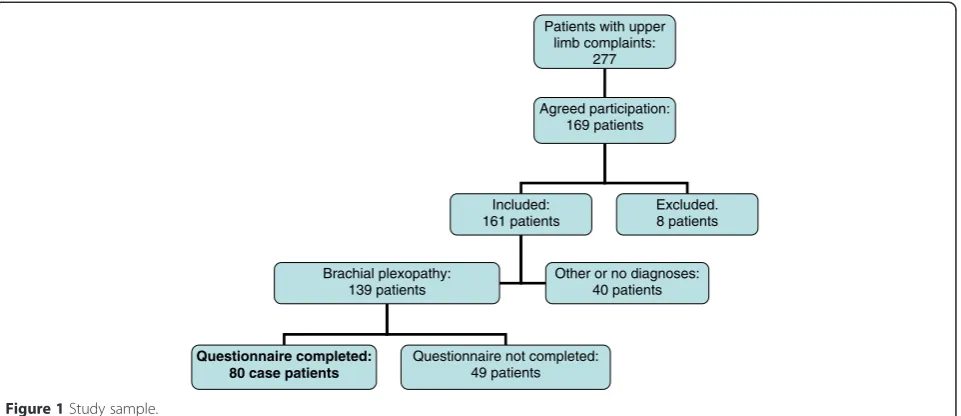
139 patients were diagnosed with brachial plexopathy, and the affliction within the plexus was localized. Based on the same protocol [16] additional upper limb disorders were diagnosed (Figure 1).
Out of patients defined with brachial plexopathy, 80 patients who answered the exposure questionnaire [36] constituted the case group (Figure 1) giving a response rate for cases of 58%. The mean age (SD) of the cases
was 43.9 (10.1) years for 61 females and 46.3 (9.1) years for 19 males, respectively.
Controls: 86 control subjects were recruited from the same general practitioners. For each case, the selected control subject was the first subsequent patient after each enrolled case who belonged to the same sex and age-group and who agreed to participate. The controls fulfilled identical inclusion and exclusion criteria as the cases. They could have any occupation and call for any complaint, work-related or not except for the requirement of the absence of any neck or upper limb complaints.
Out of these, 65 control subjects who answered the exposure questionnaire [36] constituted the final group of controls (Figure 2) giving a response rate for controls of 81%. The mean age (SD) of the 65 controls was 41.9 (10.4) years for 49 females and 47.3 (9.9) years for 16 males, respectively.
Assessment of work exposures
A questionnaire was developed for the assessment of physical and psychosocial work exposures and rating of psychophysical perceptions [36]. This questionnaire combined previously published questionnaires, out of which two addressed physical exposures [37,38], one psychophysical items [39] and one psychosocial issues [40]. The final questionnaire included questions to which answers were to be ranked in terms of duration or intensity. Some psychophysical ratings assessed the respondents’perceptions for each side while others did not (e.g. work pace and back position). All scores were ordinal as reflected by the legends for Tables 1, 2, 3, 4 and 5.
Various ways to validate these questionnaires have been previously applied. The ability to predict symptoms and the usefulness of psychophysical perceptions for prevent-ive purposes was demonstrated for the questionnaire based on psychophysical items. One of the questionnaires on mechanical exposure was shown to be reliable in use [38]. The advantages of combining questions relating to the exposure and psychophysical perceptions has been documented [41].
Questions regarding psychosocial issues were included in order to assess their potential role as confounders ra-ther than individual risk indicators for brachial plexopathy.
Statistics
The presence of brachial plexopathy on any or both sides was compared to the reported exposures. The rela-tion between case status and individual ordinal scores for exposures according to Wiktorin et al. [37] was
ana-lysed by a Wilcoxon Mann–Whitney rank sum test
In addition, the magnitude of risk expressed by the odds ratios for selected mechanical exposures according to Torgén et al. [38] was calculated with logistic regres-sion and the dose–response relationships estimated. For this calculation, the influence of the proportion of the workday with exposure to each risk factor was assessed with three exposure levels, except for work with vibrat-ing hand tools, which was assessed dichotomously (Table 2). The effect of the number of exposure days per week was assessed with five exposure categories (Table 3). All exposure categories were compared to “Almost never/not at all”.
A Wilcoxon Mann–Whitney rank sum test was also applied for the comparison of the psychophysical ratings [39] in between cases and controls. When applicable, separate analyses were made for the right and left side.
Data were processed by Stata ver. 12.1.
Ethics
The study complied with the Helsinki declaration. The clinical examination protocol was approved by the local ethics committee (De Videnskabsetiske Komittéer for
Region Syddanmark) and signed informed consent was obtained from all participants.
Results
According to the defined criteria, 9 and12 limbs were di-agnosed as right and left supraclavicular brachial plexo-pathy, respectively, with bilateral affliction in five. 52 and 37 limbs were diagnosed as right and left infraclavicular brachial plexopathy, respectively, with bilateral involve-ment in 12. Nine and eight patients had a combination of supraclavicular and infraclavicular plexopathy on the right and left side, respectively.
According to the applied diagnostic criteria [16], a high proportion of cases had additional non-neuropathic diagnoses with the major concomitant diagnoses on the right/left side being rotator cuff disorder (12/8), and epicondylitis (19/12), respectively [16]. Simultaneous presence of epicondylitis and rotator cuff disorder was identified in one right limb. All except one limb with brachial plexopathy had additional peripheral neuropathy, which was mainly involving the median and the radial/ interosseous nerves at elbow level.
Patients with upper limb complaints:
277
Agreed participation: 169 patients
Included: 161 patients
Excluded. 8 patients
Brachial plexopathy: 139 patients
Other or no diagnoses: 40 patients
Questionnaire completed: 80 case patients
Questionnaire not completed: 49 patients
Figure 1Study sample.
Recruited: 86 controls
Eligible: 80 controls
Not eligible: Not in work: 3 subjects Upper limb complaints: 3 subjects
Questionnaire completed: 65 control patients
Questionnaire not completed: 15 subjects
Relation between cases and controls in terms of ordinally grouped individual exposures, exposures grouped into indices and psychophysical ratings
Assessment of the daily amount of exposure by the application of the mechanical exposure questions by Wiktorin [37] showed that sitting and computer work appeared to be protective in terms of brachial plexopa-thy. Working with arms at or over shoulder height, stretched arms 45° or more forward or laterally, neck flexion and repetitive arm and hand/finger work all con-stituted highly significant physical risk exposures while vibrating hand tools had a relatively minor influence on the prevalence of brachial plexopathy (Table 1).
The extension of work tasks with the limb extended more than 45° forward or laterally more than a half hour/day and of repetitive arm, hand or finger work more than 2 hours/day was also strongly associated to case status. Cold exposure was also a risk factor. Preci-sion work exceeding 2 hours/day was not significantly related to brachial plexopathy (Table 1).
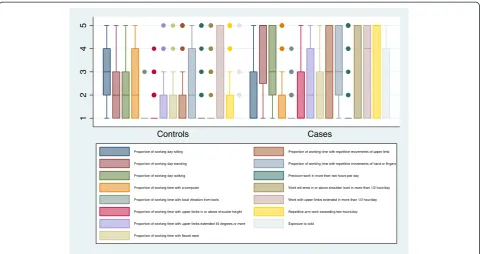
The distribution in controls and cases of the extent of the various job tasks is illustrated in the box plot in Figure 3.
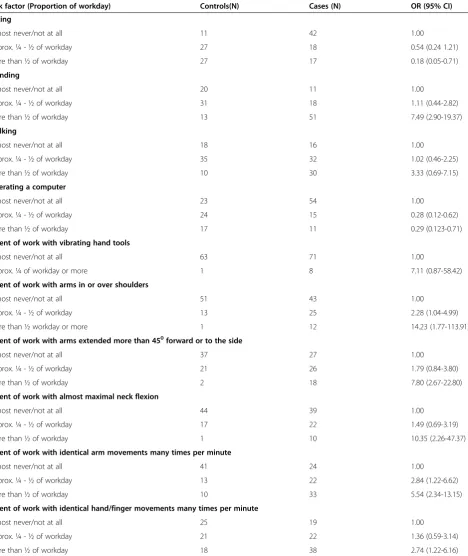
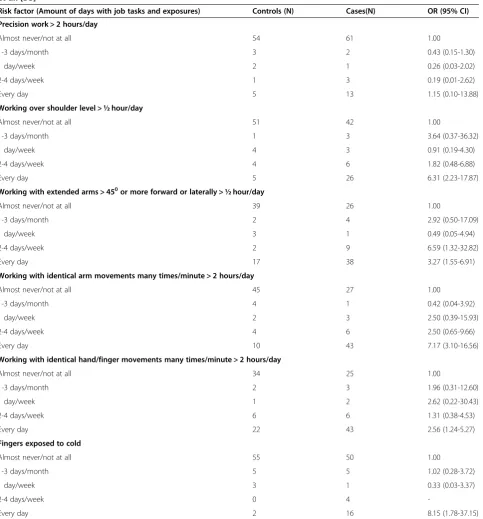
The risk estimates for the various job tasks and expo-sures according to Torgén et al. [38] as illustrated in Table 2 (Proportion of workday exposed) and Table 3 (Number of days/week exposed) showed similar results. There was a dose–response relationship with increasing
exposure during the workday for standing, arms in or over shoulder height, arms extended more than 45° for-ward or laterally, almost maximal neck flexion, identical arm movements many times/minute, and identical finger movements many times/minute. At the maximal expos-ure levels, the risk estimates for all these variables were significant. There was an increasing risk with increasing amount of walking and work with vibrating hand tools, but the risk estimates did not reach significance. Again, sitting and computer work appeared to be protective in this sample (Table 2).
Except for precision work exceeding 2 hours/day, the analyses of the influence of the amount of days/week ex-posed showed a similar picture with significantly ele-vated risk estimates for work over shoulder level more than a half hour/day, arms extended more than 450 for-ward or laterally more than a half hour/day, identical arm movements many times/minute exceeding 2 hours/ day, and identical finger movements many times/minute during more than 2 hours/day. Exposure to cold was also a significant risk factor. There was a dose–response relationship to the number of days exposed per week for all exposures except precision work (Table 3).
All psychophysical measures [39] that relate to work pace, postures, the use of force, the usual weight of manually handled items, and local pressure were significantly related to case status. Local vibration was
Table 1 Extent of time for various job tasks and exposures according to Wiktorin [37]
Exposure U Controls Cases p
N Median N Median
A. Sitting (a) −4.2 65 3 77 1 0.0000
B. Standing (a) 5.3 64 2 80 5 0.0000
C. Walking (a) 3.1 63 2 78 3 0.0023
D. Operating a computer (a) −3.7 64 2 80 1 0.0003
E. Work with vibrating hand tools (a) 2.1 64 1 79 1 0.0385
F. Work with arms in or over shoulder level (a) 3.4 65 1 80 1 0.0006
G. Work with stretched arms≥45 degrees forward or laterally (a) 3.6 63 1 80 2 0.0004
H. Work with almost maximally flexed neck (a) 3.0 63 1 79 2 0.0025
I. Work with identical arm movements many times per minute (a) 4.4 64 1 79 3 0.0000
J. Work with identical hand/finger movements many times/minute (a) 2.7 64 2 79 3 0.0074
K. Precision work > 2 hours/day (b) 1.2 65 1 80 1 0.2441
L. Work with arms in or over shoulder height > ½ hour/day (b) 3.5 65 1 80 1 0.0004
M. Work with arm extension≥45 degrees forward or laterally > ½ hour/day (b) 3.3 63 1 78 4 0.0010
N. Work with identical arm movements many times/minute > 2 hours/day (b) 4.8 63 1 80 5 0.0000
O. Work with identical hand or finger movements many times/minute > 2 hours/day (b) 2.6 65 1 79 5 0.0088
P. Fingers exposed to cold (b) 2.9 65 1 76 1 0.0041
The questions read: (a) How big a proportion of a normal work-day did you…..? Answers on a five step scale: Almost never/not at all (1), approx. 1/4 of the time (2), approx. 1/2 of the time (3), approx. 3/4 of the time (4), almost all the time (5). (b) Did you have………? Answers on a five step scale: Almost never/not at all (1), 1–3 days/months (2), 1 day/week (3), 2–4 days/week (4), every day (5).
borderline not significantly related to brachial plexopa-thy. Whole body vibrations, the weight and balance of the usual tool and the weight of the heaviest handled items were unrelated to case status (Table 4).
Psychosocial exposures [40], for which the distribution differed significantly between cases and controls are il-lustrated in Table 5. The distribution was the same in the two samples for all other variables (emotional
Table 2 Odds ratios depending of the temporal extent of exposure during the workday according to Torgén et al. [38]
Risk factor (Proportion of workday) Controls(N) Cases (N) OR (95% CI)
Sitting
Almost never/not at all 11 42 1.00
Approx. ¼ - ½ of workday 27 18 0.54 (0.24 1.21)
More than ½ of workday 27 17 0.18 (0.05-0.71)
Standing
Almost never/not at all 20 11 1.00
Approx. ¼ - ½ of workday 31 18 1.11 (0.44-2.82)
More than ½ of workday 13 51 7.49 (2.90-19.37)
Walking
Almost never/not at all 18 16 1.00
Approx. ¼ - ½ of workday 35 32 1.02 (0.46-2.25)
More than ½ of workday 10 30 3.33 (0.69-7.15)
Operating a computer
Almost never/not at all 23 54 1.00
Approx. ¼ - ½ of workday 24 15 0.28 (0.12-0.62)
More than ½ of workday 17 11 0.29 (0.123-0.71)
Extent of work with vibrating hand tools
Almost never/not at all 63 71 1.00
Approx. ¼ of workday or more 1 8 7.11 (0.87-58.42)
Extent of work with arms in or over shoulders
Almost never/not at all 51 43 1.00
Approx. ¼ - ½ of workday 13 25 2.28 (1.04-4.99)
More than ½ workday or more 1 12 14.23 (1.77-113.91)
Extent of work with arms extended more than 450forward or to the side
Almost never/not at all 37 27 1.00
Approx. ¼ - ½ of workday 21 26 1.79 (0.84-3.80)
More than ½ of workday 2 18 7.80 (2.67-22.80)
Extent of work with almost maximal neck flexion
Almost never/not at all 44 39 1.00
Approx. ¼ - ½ of workday 17 22 1.49 (0.69-3.19)
More than ½ of workday 1 10 10.35 (2.26-47.37)
Extent of work with identical arm movements many times per minute
Almost never/not at all 41 24 1.00
Approx. ¼ - ½ of workday 13 22 2.84 (1.22-6.62)
More than ½ of workday 10 33 5.54 (2.34-13.15)
Extent of work with identical hand/finger movements many times per minute
Almost never/not at all 25 19 1.00
Approx. ¼ - ½ of workday 21 22 1.36 (0.59-3.14)
More than ½ of workday 18 38 2.74 (1.22-6.16)
demands, meaning and commitment, collaboration and leadership, interaction between the individual and work, stress and depression).
Discussion
The high frequency of brachial plexopathies in the original sample of patients from which the cases for
this study was drawn [16] is in accordance with pre-vious studies [16,19,20]. With the applied diagnostic definition [16], this study has clearly indicated a number of risk indicators for brachial plexopathy. Whether based on assessments of physical exposures or of psychophysical perceptions, highly significant relations were demonstrated for adverse upper limb
Table 3 Odds ratios relating to the amounts of workdays for various job tasks and exposures according to Torgén et al. [38]
Risk factor (Amount of days with job tasks and exposures) Controls (N) Cases(N) OR (95% CI)
Precision work > 2 hours/day
Almost never/not at all 54 61 1.00
1-3 days/month 3 2 0.43 (0.15-1.30)
1 day/week 2 1 0.26 (0.03-2.02)
2-4 days/week 1 3 0.19 (0.01-2.62)
Every day 5 13 1.15 (0.10-13.88)
Working over shoulder level > ½ hour/day
Almost never/not at all 51 42 1.00
1-3 days/month 1 3 3.64 (0.37-36.32)
1 day/week 4 3 0.91 (0.19-4.30)
2-4 days/week 4 6 1.82 (0.48-6.88)
Every day 5 26 6.31 (2.23-17.87)
Working with extended arms > 450or more forward or laterally > ½ hour/day
Almost never/not at all 39 26 1.00
1-3 days/month 2 4 2.92 (0.50-17.09)
1 day/week 3 1 0.49 (0.05-4.94)
2-4 days/week 2 9 6.59 (1.32-32.82)
Every day 17 38 3.27 (1.55-6.91)
Working with identical arm movements many times/minute > 2 hours/day
Almost never/not at all 45 27 1.00
1-3 days/month 4 1 0.42 (0.04-3.92)
1 day/week 2 3 2.50 (0.39-15.93)
2-4 days/week 4 6 2.50 (0.65-9.66)
Every day 10 43 7.17 (3.10-16.56)
Working with identical hand/finger movements many times/minute > 2 hours/day
Almost never/not at all 34 25 1.00
1-3 days/month 2 3 1.96 (0.31-12.60)
1 day/week 1 2 2.62 (0.22-30.43)
2-4 days/week 6 6 1.31 (0.38-4.53)
Every day 22 43 2.56 (1.24-5.27)
Fingers exposed to cold
Almost never/not at all 55 50 1.00
1-3 days/month 5 5 1.02 (0.28-3.72)
1 day/week 3 1 0.33 (0.03-3.37)
2-4 days/week 0 4
-Every day 2 16 8.15 (1.78-37.15)
Table 5 Psychosocial exposure measures according to Søndergaard [40]
Psychosocial exposure U Controls Cases p
N Median N Median
A. Required to work at high pace (a) 2.9 61 3 77 2 0.003
B. Influence on decisions about the work (b) −2.8 63 2 77 3 0.005
C. Possibilities for learning (b) −2.8 63 2 79 3 0.005
D. Influence on the content of work (b) −2.1 63 3 78 3 0.038
E. Support from immediate superior (a) −2.6 63 2 75 3 0.009
F. Frequency of consultation with superior of quality of job performance (a) −2.4 63 3 75 4 0.015
G. Conflict solving skills with superior (b) −2.0 63 3 75 3 0.047
H. Satisfied with physical work environment (c) −4.5 53 2 77 2 0.000
I. Satisfied with the way your skills are used (c) −3.4 63 2 76 2 0.001
J. Self-rating of health (d) −4.6 65 2 79 3 0.000
K. Happy and satisfied during the last four weeks −2.3 64 2 79 3 0.024
L. Enthusiastic and full of life during the last four weeks −3.6 64 3 78 4 0.000
M. Full of energy during the last four weeks −3.8 64 3 77 4 0.000
N. Warn during the last four weeks 3.5 64 5 78 4 0.000
O. Tired during the last four weeks 2.4 64 5 79 4 0.01
Wilcoxon Mann–Whitney rank sum test.
(a) Always, frequently, at times, rarely, never/almost never, (b) to very high degree, to high degree, partly, to small degree, to very small degree, (c) very satisfied, satisfied, unsatisfied, very unsatisfied, (d) excellent, very good, good, not so good, bad, (e) All the time, most of the time, a lot of the time, some times, little of the time, never.
U = test magnitude. p = significance level.
Table 4 Psychophysical measures according to Punnett et al. [39]
Exposure U Controls Cases p
N Median N Median
Right Left Right Left Right Left Right Left Right Left Right Left
Work pace (a) 2.925 65 6 80 8 0.0034
Back positions (b) 4.319 65 3 80 5 0.0000
Neck positions (b) 4.505 64 3 79 5 0.0000
Shoulder positions (b) 5.235 4.958 65 65 3 2 80 80 6 5 0.0000 0.0000
Arm positions (b) 4.651 5.304 65 65 3 2 80 80 6 5 0.0000 0.0000
Hand positions (b) 3.625 4.211 65 65 4 2 80 80 5.5 5 0.0000 0.0003
Whole body vibration (c) 1.093 64 0 80 0 0.2743
Local vibration (c) 1.942 1.848 65 65 0 0 80 79 0 0 0.0521 0.0646
Applied hand force (d) 4.746 4.993 65 65 2 2 80 80 6 5 0.0000 0.0000
Applied hand force in uncomfortable positions 4,211 4.281 65 65 1 1 76 76 2 1 0.0000 0.0000
Pressure on hand or arm (d) 3.976 65 0 78 0 0.0001
Usual weight with manual handling (e) 2.094 33 4 63 5 0.0362
Heaviest weight with manual handling (e) 1.228 32 6.5 62 7.5 0.2194
Weight of usual tool (e) 1.503 24 2 36 3 0.1329
Balance of usual tool (f) 1.824 24 1 36 2.5 0.0681
Force required for holding and using tool (g) 2.901 24 1.5 35 5 0.0037
Wilcoxon Mann–Whitney rank sum test. All ordinal measures on a VAS-scale 0–10.
(a) Very slow - too fast, (b) (Very comfortable - very uncomfortable, (c) None - a lot, (d) None/very small - very large, (e) Very light–very heavy, (f) Perfect–major imbalance, (g) Very small–very large. NB Calculations for perceptions related to the limbs made for each side.
postures, repetitive work, work pace and the use of strength.
Two of the identified risk factors, walking and expos-ure of the fingers to cold (Table 1), can hardly be ex-plained in terms of pathophysiological mechanisms, but may rather be related to the character of work, which may combine walking and cold exposure with other identified risk indicators.
Surprisingly, two exposures were more prevalent among controls than cases: sitting and computer work. The effect of sitting may be explained by the fact that most sitting work does not involve adverse positions and repetitive work, although undertaking sitting tasks that do involve these exposures may in fact contribute to further adverse upper limb postures, e.g. by requiring further arm elevation than working in the standing position. Brachial plexopathy has been demonstrated in a series of patients with intensive computer work [42], and neurological patterns in accordance with brachial plexopathy were common in symptomatic computer op-erators in active occupation [43]. A meta-analysis found moderate evidence for the relation between computer use and upper limb pain but limited relation to specific musculoskeletal disorders out of which brachial plexopa-thy was not addressed [44]. The current findings might be explained by an exposure to computer work of a low intensity, which does not constitute a risk for brachial plexopathy.
The relation between local vibration and upper limb nerve afflictions is well documented [45], but the effect on brachial plexopathy in the current study was limited. The minor impact of vibration may relate to the distance between the hand and the brachial plexus. A more likely explanation, however, is the limited number of subjects in the sample that were exposed to local vibration (Table 2).
The analyses assessed the association between the exposures and brachial plexopathy with a supraclavicu-lar as well as an infraclavicusupraclavicu-lar location. Due to the dominance of infraclavicular locations in this sample, the conclusions concern infraclavicular rather than supraclavicular brachial plexopathy. This observation demonstrates the importance of studying the brachial plexus at several locations – not only at the scalene triangle.
The assessment of exposure by a questionnaire based on questions developed and validated by others included physical, psychophysical, and psychosocial issues. Al-though a questionnaire approach to exposure assessment is generally regarded as inferior to direct observations, the former has major advantages in terms of costs and practical execution. A French study found that the ques-tionnaire was superior to direct observations in identify-ing workers at high risk of upper limb work-related musculoskeletal disorders [46]. The inclusion of the psy-chophysical questions was regarded advantageous due to
Figure 3Boxplot illustrating the distribution of the extent of job tasks and exposures in Table 1. The boxes illustrate the interquartile range. The horizontal line represents the median. The vertical lines illustrate the maximal and minimal values excluding outliers, and the dots
the ability of these to qualify questions addressing physical exposures [41]. The ability of the physical and psycho-physical ratings to identify comparable risk indicators sup-ports the consistency of the presented findings.
Validity
Non-experimental research has a number of innate methodological constraints. One point of importance is the potential confounding that may occur when the fre-quency of risk indicators other than those studied differs in between cases and controls. This potential for bias is an acknowledged weakness of the case–control design.
Bias of information
The collection on a cross-sectional basis of question-naire information on exposure may result in information bias. Such bias would be differential and lead to spuri-ously increased risk estimates if, compared to controls, cases would overrate their exposures. The absence of differential misclassification has been demonstrated for some of the posed questions [37] while the risk for dif-ferential misclassification cannot be excluded in the remaining questions on mechanical exposure [37,47]. It has, however, been shown that questions addressing physical risk exposures for upper limb disorders seem to cause less misclassification than is the case for low back disorders [48]. In this context, the absence of a relation between symptoms and exposures, which the responders would be likely to regard as related to upper limb symptoms (e.g. precision work or computer work) is noteworthy. Information bias cannot therefore be excluded but is regarded as less likely to seriously distort the results.
Bias of selection
The selection of the studied samples of patients and controls is another potential source of bias. In spite of instructions, the general practitioners may not have selected all eligible patients. For example, although the practitioners were asked to enrol as cases all patients with non-traumatic upper limb symptoms, there could be a reluctance to enrol those with milder or easily inter-preted symptoms rather than patients for which they may have been more inclined to request a second opin-ion from the research team [16]. Bias from the selectopin-ion of controls can also not be excluded. While the general practitioner was asked to select as control subject the first eligible patient who was willing to complete the questionnaire, one cannot be sure if this really happened. Whether the occupations differed in between cases and controls is not known. A higher share of manual workers in the case group could induce a bias of selec-tion. Consequently, although the response rate and the distribution on age and sex were comparable in cases
and controls, a potential differential selection may have influenced the composition of the final sample of controls.
Psychosocial issues
It is noticeable that answers to questions about psycho-social issues [40] that differed between cases and con-trols (Table 5) reflect either the physical exposure or conditions that can either be linked to circumstances that characterize the physical work-environment such as repetitive work (Tables 1, 2 and 3), or the psychophysical perceptions, e.g. the requirement of working at high pace (Table 4-A). Most responses to psychosocial issues, however, were not linked to these factors. This applies for, e.g. the perceived emotional demands from work, the meaning and commitment of work, the collaboration and leadership, the interaction between the individual and the work, as well as for perceptions that reflect stress and depression.
This study supports previous longitudinal studies that have shown evidence for a link between upper limb symptoms and the influence of high work demands [49], little control at work [49], and low job satisfaction [50]. The adverse influence of little job control and addition-ally of supervisor support has also been demonstrated in a cross-sectional study that, however, estimated the magnitude of the population attributable fraction of upper limb disorders for exposure to psychological fac-tors to 12% [51]. While several physical risk indicafac-tors for arm pain were identified, no psychosocial stressors were identified in a case–control study of patients pre-senting to primary care, in which, however, a number of mental health variables were linked to case status [52].
High work demands, little control, low job satisfaction, and supervisor support are common terms in trades with repetitive and paced work with adverse upper limb positions. Consequently, the demonstration in the present study of the role of these psychosocial exposures is not surprising. On the other hand, the absence of an influence of psychosocial exposures that are not linked to physical risk indicators suggests psychosocial factors in themselves to be less likely risk indicators for brachial plexopathy. This observation supports the validity of the identified relations to mechanical exposures.
Physical examination and case-definition
study were comparable to those included in the current definitions of brachial plexopathy. This definition permit-ted the diagnosis of brachial plexopathy in a high number of people with upper limb pain in clinical occupational medicine [19] and general practice [16].
Still, the endpoints in terms of defined disease outcome may be challenged. Brachial plexopathy is a controversial diagnostic construct, and there is neither consensus about its diagnosis, frequency nor potential work-relatedness. The main challenge is the absence in most brachial plexo-pathies of electrophysiological abnormalities [25], which tends to be interpreted as its nonexistence. This is unfor-tunate because brachial plexopathy should be diagnosed based on clinical findings rather than electrophysiological studies [53]. Although the latter are regarded by many as the “gold standard” for peripheral neuropathy, a mixed and partial nerve affliction with few myelinated fibers intact and reinnervation taking place may result in entirely normal findings [54].
Characteristic symptoms in these patients include pain, which is often of a neuropathic character, weakness and/or numbness/tingling. The content of the applied neurological examination was derived from anatomical facts and pathophysiology that has led to an established paradigm on which the traditional neurologic bedside examination is based: Focal neuropathy with a certain location is likely to result in rather specific neurological deviations from normal. These abnormalities may well be minor and include weakness and sensory deviations from normal distal to the nerve affliction, and a maximal mechanical allodynia of nerve trunks where, according to the neurological patterns, the affliction is located.
The case definition for infraclavicular brachial plexo-pathy (pectoralis minor syndrome) that was applied in this study is based on anatomical facts. A compromise at this location is likely to involve the lateral-most portion of the brachial plexus because the available space for passage behind the pectoralis minor muscle is more lim-ited laterally than medially. This portion of the brachial plexus contains neurons from the axillary, musculocuta-neous and radial nerves that supply motor innervation to the deltoid, biceps, and radial flexor of wrist muscles as well as the cutaneous axillary nerve innervation of the deltoid region. With a supraclavicular location of brachial plexopathy (scalene triangle syndrome), the neurons sup-plying the suprascapular nerve that innervates the infra-spinatus muscle are at risk because of the location in the top of the scalene triangle.
The applied diagnostic criteria for brachial plexopathy cannot be satisfied with any other upper limb condition. On the other hand, when these criteria are met, concomi-tant disorders of a neuropathic or a non-neuropathic character may also be present. Concomitant disorders, in particular rotator cuff disorders, epicondylitis, and
peripheral upper limb neuropathies were frequent in the studied sample [16]. Their relative influence as depend-ant variables cannot be determined in this study. It can, however, be argued that rotator cuff disorders and epi-condylitis may share similar risk indicators and that these conditions may complicate or predispose to brachial plexopathy. This study cannot determine the potential relation and succession of such events.
It is noticeable that the criteria for diagnosing a con-comitant peripheral neuropathic condition were fulfilled for all except one limb with brachial plexopathy. This observation is in accordance with clinical experiences as well as with the “double crush” theory [55], which can explain neurological patterns and symptoms that may appear confusing to the clinician. According to the diag-nostic criteria applied in this study [16], the identifica-tion of a peripheral neuropathic condiidentifica-tion required a defined combination of motor and sensory outcomes as well as allodynia with gentle palpation of the nerve trunk at the location of entrapment. The latter suggests a per-ipheral nerve involvement at this specific location.
The correlation of regional pain to physical findings in the same region characterises much analytical research targeting upper limb disorders. However, epidemiological studies that aim to correlate the location of symptoms with physical findings at the same location may be dis-torted because upper limb pathology may be situated at a distance to the dominant location(s) of symptoms such as pain. This is particularly true with involvement of the per-ipheral nerves (referred pain [56]). Upper limb symptoms are often of a fluctuant character and intensity, and their locations are likely to change and spread. Consequently, the physical examination should include the whole limb as well as the neck and include a careful examination of the peripheral nervous system [57]. Such comprehensive physical approach can identify proximally located neuropathic conditions such as at the brachial plexus, and explain the fluctuating symptoms by a dynamic compression. In the absence of such examination, the correlation between exposures and symptoms with certain locations is likely to be diluted.
Causality
effects resulting from low level nerve pressure, consist-ing of inhibition of intraneurial microvascular blood flow, axonal transport and nerve function as well as endoneurial oedema and displacement of myelin. Higher pressure have more profound effects including demye-lination, inflammation, fibrosis, growth of new axons and remyelination [59]. Schmid et al. have reviewed the pathophysiological mechanisms [60] and shown that even mild nerve compression in animals is sufficient to induce intraneural inflammation, which is associated with neuropathic pain behaviour [61].
Still, some weak points should be mentioned. Consistency in terms of similar results from other studies is lacking as no other studies have yet demon-strated the relation of brachial plexopathy to mechanical exposures at work. The specificity in terms of causation may also be questioned. A variety of exposures were attributed to brachial plexopathy. In addition, other upper limb conditions may share the risk indicators as here reported for brachial plexopathy. Consequently, this study has demonstrated associations to work exposures but can-not conclude about causality, which needs to be examined in prospective studies of patients with brachial plexopathy without other concomitant disease. In addition, the aggre-gated effects of the various mechanical exposures, and the interaction in between them should be studied. Most im-portantly, the demonstration of a reduced occurrence of disease following elimination or reduction of the identified risk exposures would represent an important step for improved prevention of brachial plexopathy.
Conclusions
This study has demonstrated several adverse physical exposures at work, in particular upper limb posture and repetitive movements of the arm, hand and fingers to be risk indicators for brachial plexopathy with significant dose–response relationships. These findings were sup-ported by psychophysical responses that additionally in-dicated work pace and the use of force as risk indicators. The identified relations to psychosocial measures were limited to those reflecting physical exposures.
This study has two major clinical implications. With acceptance of the applied diagnostic criteria, brachial plexopathy is a frequent condition, which should not be overlooked. A simple screening of the upper limb nerves can exclude this condition [62]. The diagnosis of brachial plexopathy can provide directions for management and, taking into account the demonstrated risk indicators, for preventive interventions at workplaces.
It can therefore be concluded that this study provides evidence of a relation of mechanical work-exposures to brachial plexopathy. The identified risk indicators for upper limb disorders have previously been associated to symptoms as well as to diagnosed “specific” upper limb
disorders other than brachial plexopathy. Longitudinal studies should be conducted in order to provide evi-dence of causality and for excluding bias from informa-tion and selecinforma-tion, both of which may occur with the applied case–control design.
Competing interests
The author declares that he has no competing interests.
Received: 5 September 2014 Accepted: 17 March 2015
References
1. Sluiter JK, Rest KM, Frings-Dresen MHW. Criteria document for evaluation of the work-relatedness of upper extremity musculoskeletal disorders. Amsterdam: Coronel Institute for occupational and environmental health, academic medical center, University of Amsterdam. 2000. p. 1–194. 2. Ohlsson K, Attewell RG, Pålsson B, Karlsson B, Balogh I, Johnsson B, et al.
Repetitive industrial work and neck and upper limb disorders in females. Am J Ind Med. 1995;27:731–47.
3. Feldman RG, Goldman R, Keyserling WM. Classical syndromes in occupational medicine. Peripheral nerve entrapment syndromes and ergonomic factors. Am J Ind Med. 1983;4:661–81.
4. Hagberg M, Wegman DH. Prevalence rates and odds ratios of shoulder-neck diseases in different occupational groups. Br J Ind Med. 1987;44:602–10. 5. Mackinnon SE, Patterson GA, Novak CB. Thoracic outlet syndrome: a current
overview. Semin Thor Cardiovasv Surg. 1996;8:176–82.
6. Mandel S. Neurologic syndromes from repetitive trauma at work. Postgrad Med. 1987;82:87–92.
7. Wright IS. The neurovascular syndrome produced by hyperabduction of the arms. Am Heart J. 1945;29:1–19.
8. Gold JE, Piligian G, Glutting JJ, Hanlon A, Frings-Dresen MH, Sluiter JK. Cluster analysis of symptoms among patients with upper extremity musculoskeletal disorders. J Occup Rehabil. 2010;20:526–36. 9. Musculoskeletal disorders and workplace factors - A critical review of
epidemiological evidence for work-related musculoskeletal disorders of the neck, upper extremity and low back. Cincinnati (OH): National Institue for Occupational Safety and Health. 1997.
10. Thomsen JF, Hansson GA, Mikkelsen S, Lauritzen M. Carpal tunnel syndrome in repetitive work: a follow-up study. Am J Ind Med. 2002;42:344–53. 11. Leclerc A, Landre MF, Chastang JF, Niedhammer I, Roquelaure Y. Upper-limb
disorders in repetitive work. Scand J Work Environ Health. 2001;27:268–78. 12. Thomsen JF, Mikkelsen S, Andersen JH, Fallentin N, Loft IP, Frost P, et al. Risk
factors for hand-wrist disorders in repetitive work. Occup Environ Med. 2007;64:527–33.
13. Frost P, Bonde JP, Mikkelsen S, Andersen JH, Fallentin N, Kaergaard A, et al. Risk of shoulder tendinitis in relation to shoulder loads in monotonous repetitive work. Am J Ind Med. 2002;41:11–8.
14. Miranda H, Punnett L, Viikari-Juntura E, Heliovaara M, Knekt P. Physical work and chronic shoulder disorder. Results of a prospective population-based study. Ann Rheum Dis. 2008;67:218–23.
15. Cruccu G, Truini A. Assessment of neuropathic pain. Neurol Sci. 2006;27 Suppl 4:s288–90.
16. Laursen LH, Sjogaard G, Hagert CG, Jepsen JR. Diagnostic distribution of non-traumatic upper limb disorders: vibrotactile sense in the evaluation of structured examination for optimal diagnostic criteria. Med Lav. 2007;98:127–44.
17. Jepsen J, Laursen L, Larsen A, Hagert CG. Manual strength testing in 14 upper limb muscles. A study of the inter-rater reliability. Acta Orthop Scand. 2004;75:442–8.
18. Greening J, Smart S, Leary R, Hall-Craggs M, O’Higgins P, Lynn B. Reduced movement of median nerve in carpal tunnel during wrist flexion in patients with non-specific arm pain: a magnetic resonance imaging study. Lancet. 1999;354:217–8.
19. Jepsen JR, Laursen LH, Hagert C-G, Kreiner S, Larsen AI. Diagnostic accuracy of the neurological upper limb examination II. The relation to symptoms of patterns of findings. BMC Neurol. 2006;6:10.
21. Schmid AB, Brunner F, Luomajoki H, Held U, Bachmann LM, Künzer S, et al. Reliability of clinical tests to evaluate nerve function and mechanosensitivity of the upper limb peripheral nervous system. BMC Musculoskelet Disord. 2009;10:11.
22. Thaller M, Hughes T. Inter-rater agreement of observable and elicitable neurological signs. Clin Med. 2014;14:264–7.
23. Jepsen JR, Laursen LH, Kreiner S, Larsen AI. Neurological examination of the upper limb: A study of construct validity. Open Neurol J. 2009;3:54–63. 24. Warrens AN, Heaton JM. Thoracic outlet syndrome: the lack of reliability of
its clinical assessment. Ann R Coll Surg Engl. 1987;69:203–4. 25. Aminoff MJ, Olney RK, Parry GF, Raskin NH. Relative utility of different
electrophysiologic techniques in the evaluation of brachial plexopathies. Neurology. 1988;38:546–50.
26. Daube JR. Nerve conduction studies in thoracic outlet syndrome. Neurology. 1975;25:347.
27. Wilbourn AJ. The thoracic outlet syndrome is overdiagnosed. Arch Neurol. 1990;47:328–30.
28. Poole GV, Thomae KR. Thoracic outlet syndrome reconsidered. Am Surg. 1996;62:287–91.
29. Roos DB. The thoracic outlet syndrome is underrated. Arch Neurol. 1990;47:327–8.
30. Pascarelli EF, Hsu YP. Understanding work-related upper extremity disorders: clinical findings in 485 computer users, musicians, and others. J Occup Rehabil. 2001;11:1–21.
31. Sheth RN, Belzberg AJ. Diagnosis and treatment of thoracic outlet syndrome. Neurosurg Clin North Am. 2001;12:295–310.
32. Sanders RJ. Recurrent neurogenic thoracic outlet syndrome stressing the importance of pectoralis minor syndrome. Vasc Endovascular Surg. 2011;45:33–8.
33. Sanders RJ, Rao NM. The forgotten pectoralis minor syndrome: 100 operations for pectoralis minor syndrome alone or accompanied by neurogenic thoracic outlet syndrome. Ann Vasc Surg. 2010;24:701–8. 34. Palmer K, Cooper C. Repeated movement and repeated trauma affecting
the musculoskeletal disorders of the upper limbs. In: Baxter P, Adams P, Aw T, Cockcroft A, Harrington J, editors. Hunter’s diseases of occupations. London: Arnold; 2000. p. 453–75.
35. Sluiter JK, Rest KM, Frings-Dresen MH. Criteria document for evaluating the work-relatedness of upper-extremity musculoskeletal disorders. Scand J Work Environ Health. 2001;27:1–102.
36. Jepsen JR. Udvikling af et spørgeskema til belysning af arbejdsmæssige risikofaktorer for belastningslidelser i overekstremiteten. Esbjerg: Arbejdsmedicinsk afdeling; 2002. p. 1–139.
37. Wiktorin C, Vingård E, Mortimer M, Pernold G, Wigaeus-Hjelm E, Kilbom A, et al. Interview versus questionnaire for assessing physical loads in the population-based MUSIC-Norrtälje Study. Am J Ind Med. 1999;35:441–55. 38. Torgén M, Alfredsson L, Köster M, Wiktorin C, Smith KF, Kilbom Å.
Reproduceability of a questionnaire for assessment of present and past physical activities. Int Arch Occup Environ Health. 1997;70:107–18. 39. Punnett L. Ergonomic stressors and upper extremity disorders in vehicle
manufacturing: cross sectional exposure-response trends. Occup Environ Med. 1998;55:414–20.
40. Søndergaard T. AMI’s spørgeskema om psykisk arbejdsmiljø. København: Arbejdsmiljøinstituttet; 2002.
41. Moore JS, Garg A. The strain index: A proposed method to analyze jobs for risk of distal upper extremity disorders. Am Ind Hyg Assoc J. 1995;56:443–58. 42. Jepsen JR. Upper limb neuropathy in computer operators? A clinical case
study of 21 patients. BMC Musculoskelet Disord. 2004;5:26.
43. Jepsen JR, Thomsen G. A cross-sectional study of the relation between symptoms and physical findings in computer operators. BMC Neurol. 2006;6:40.
44. Andersen JH, Fallentin N, Thomsen JF, Mikkelsen S. Risk factors for neck and upper extremity disorders among computers users and the effect of interventions: an overview of systematic reviews. PLoS One. 2011;6:e19691. 45. Bovenzi M, Giannini F, Rossi S. Vibration-induced multifocal neuropathy in
forestry workers: electrophysiological findings in relation to vibration exposure and finger circulation. Int Arch Occup Environ Health. 2000;73:519–27. 46. Descatha A, Roquelaure Y, Caroly S, Evanoff B, Cyr D, Mariel J, et al.
Self-administered questionnaire and direct observation by checklist: Comparing two methods for physical exposure surveillance in a highly repetitive tasks plant. Appl Ergon. 2009;40:194–8.
47. Wiktorin C, Selin K, Ekenvall L, Alfredsson L, The MUSIC - Norrtälje Study Group. An interview technique for recording work postures in epidemiological studies. Int J Epidemiol. 1996;25:171–80.
48. Viikari-Juntura E, Rauas S, Martikainen R, Kuosma E, Riihimäki H, Takala EP, et al. Validity of self-reported physical work load in epidemiologic studies on musculoskeletal disorders. Scand J Work Environ Health. 1996;22:251–9. 49. Bongers PM, Ijmker S, Vanden HS, Blatter BM. Epidemiology of work related
neck and upper limb problems: Psychosocial and personal risk factors (Part I) and effective interventions from a bio behavioural perspective (Part II). J Occup Rehabil. 2006;16:279–302.
50. Andersen JH, Haahr JP, Frost P. Risk factors for more severe regional musculoskeletal symptoms: a two-year prospective study of a general work-ing population. Arthritis Rheum. 2007;56:1355–64.
51. Sim J, Lacey RJ, Lewis M. The impact of workplace risk factors on the occurrence of neck and upper limb pain: a general population study. BMC Public Health. 2006;6:234.
52. Ryall C, Coggon D, Peveler R, Reading I, Palmer KT. A case–control study of risk factors for arm pain presenting to primary care services. Occup Med (Lond). 2006;56:137–43.
53. Parziale JR, Akelman E, Weiss AP, Green A. Thoracic outlet syndrome. Am J Orthop. 2000;29:353–60.
54. Krarup C. Pitfalls in electrodiagnosis. J Neurol. 1999;246:1115–26. 55. Novak CB, Mackinnon SE. Multilevel nerve compression and muscle
imbalance in work-related neuromuscular disorders. Am J Ind Med. 2002;41:343–52.
56. Quintner JL, Cohen ML. Referred pain of peripheral nerve origin: an alternative to the“myofascial pain”construct. Clin J Pain. 1994;10:243–51. 57. Jepsen JR. Work-related upper limb pain and its diagnosis: Contribution
from the neurological examination. In: Pain in perspective. Gosh Sth ed. Rijeka: InTech; 2012. p. 11–34.
58. Hill AB. The environment and disease: association or causation? Proc R Soc Med. 1965;58:295–300.
59. Rempel D, Dahlin L, Lundborg G. Pathophysiology of nerve compression syndromes: response of peripheral nerves to loading. J Bone Joint Surg (Am ). 1999;81:1600–10.
60. Schmid AB, Nee RJ, Coppieters MW. Reappraising entrapment neuropathies -Mechanisms, diagnosis and management. Man Ther. 2013;18:449–57. 61. Schmid AB, Coppieters MW, Ruitenberg MJ, McLachlan EM. Local and
remote immune-mediated inflammation after mild peripheral nerve compression in rats. J Neuropathol Exp Neurol. 2013;72:662–80. 62. Jepsen JR. Can testing of six individual muscles represent a screening
approach to upper limb neuropathic conditions? BMC Neurol. 2014;14:90.
Submit your next manuscript to BioMed Central and take full advantage of:
• Convenient online submission
• Thorough peer review
• No space constraints or color figure charges
• Immediate publication on acceptance
• Inclusion in PubMed, CAS, Scopus and Google Scholar
• Research which is freely available for redistribution
![Table 1 Extent of time for various job tasks and exposures according to Wiktorin [37]](https://thumb-us.123doks.com/thumbv2/123dok_us/729462.1569451/5.595.58.539.98.350/table-extent-time-various-tasks-exposures-according-wiktorin.webp)
![Table 4 Psychophysical measures according to Punnett et al. [39]](https://thumb-us.123doks.com/thumbv2/123dok_us/729462.1569451/8.595.57.541.455.691/table-psychophysical-measures-according-punnett-et-al.webp)