Open Access
Systematic Review
Effectiveness of electronic guideline-based implementation systems
in ambulatory care settings - a systematic review
Annemie Heselmans*
1, Stijn Van de Velde
†1,2, Peter Donceel
†1,
Bert Aertgeerts
†1,2and Dirk Ramaekers
†1,2,3Address: 1School of Public Health, Katholieke Universiteit Leuven, Kapucijnenvoer 35 blok d, 3000 Leuven, Belgium, 2Belgian Branch of the Cochrane Collaboration, Belgian Centre for Evidence-Based Medicine, Kapucijnenvoer 33 Blok j, 3000 Leuven, Belgium and 3ZNA Hospital Network Antwerp, Leopoldstraat 26, 2000 Antwerp, Belgium
Email: Annemie Heselmans* - [email protected]; Stijn Van de Velde - [email protected]; Peter Donceel - [email protected]; Bert Aertgeerts - [email protected];
Dirk Ramaekers - [email protected] * Corresponding author †Equal contributors
Abstract
Background: Electronic guideline-based decision support systems have been suggested to successfully deliver the knowledge embedded in clinical practice guidelines. A number of studies have already shown positive findings for decision support systems such as drug-dosing systems and computer-generated reminder systems for preventive care services.
Methods: A systematic literature search (1990 to December 2008) of the English literature indexed in the Medline database, Embase, the Cochrane Central Register of Controlled Trials, and CRD (DARE, HTA and NHS EED databases) was conducted to identify evaluation studies of electronic multi-step guideline implementation systems in ambulatory care settings. Important inclusion criterions were the multidimensionality of the guideline (the guideline needed to consist of several aspects or steps) and real-time interaction with the system during consultation. Clinical decision support systems such as one-time reminders for preventive care for which positive findings were shown in earlier reviews were excluded. Two comparisons were considered: electronic multidimensional guidelines versus usual care (comparison one) and electronic multidimensional guidelines versus other guideline implementation methods (comparison two).
Results: Twenty-seven publications were selected for analysis in this systematic review. Most designs were cluster randomized controlled trials investigating process outcomes more than patient outcomes. With success defined as at least 50% of the outcome variables being significant, none of the studies were successful in improving patient outcomes. Only seven of seventeen studies that investigated process outcomes showed improvements in process of care variables compared with the usual care group (comparison one). No incremental effect of the electronic implementation over the distribution of paper versions of the guideline was found, neither for the patient outcomes nor for the process outcomes (comparison two).
Conclusions: There is little evidence at the moment for the effectiveness of an increasingly used and commercialised instrument such as electronic multidimensional guidelines. After more than a decade of development of numerous electronic systems, research on the most effective implementation strategy for this kind of guideline-based decision support systems is still lacking. This conclusion implies a considerable risk towards inappropriate investments in ineffective implementation interventions and in suboptimal care.
Published: 30 December 2009
Implementation Science 2009, 4:82 doi:10.1186/1748-5908-4-82
Received: 22 July 2009 Accepted: 30 December 2009 This article is available from: http://www.implementationscience.com/content/4/1/82
© 2009 Heselmans et al; licensee BioMed Central Ltd.
Background
Physicians are encouraged to integrate the best available sci-entific evidence with clinical expertise and patient values in their routine medical practice. Because clinicians often do not have the time or the skills to retrieve and appraise the ever-increasing health evidence base, the evidence can be provided by instruments such as clinical practice guidelines (CPGs). However, the implementation of CPGs is often cumbersome, and a large number of randomized controlled trials (RCTs) and systematic reviews have already examined the cost-effectiveness of different guideline implementation strategies including electronic approaches [1,2].
Electronic guideline-based decision support systems have been suggested to successfully deliver the knowledge embedded in evidence-based guidelines to patients [3]. A number of studies have already shown positive findings for decision support systems, in areas such as drug-dosing systems and computer-based reminder systems for pre-ventive care services [4,5]. An earlier review of Shiffman et al. [6] investigated the functionality and effectiveness of computer-based guideline implementation systems but this is now dated given the technological evolution and the burgeoning amount of computerized guidelines of the last decade. More recent systematic reviews of clinical decision support systems exist, but they assess a heteroge-neous group of systems [7,8].
The objective of this systematic review was to systemati-cally and comprehensively search the literature for studies evaluating the effectiveness of computer-based guideline implementation systems in ambulatory care settings with the multidimensionality of the guideline (the guideline needed to consist of several aspects or steps) and real-time interaction with the system during consultation as impor-tant inclusion criteria.
Methods
Selection criteria
An electronic guideline implementation method was defined as an electronic system directly supporting evi-dence-based clinical decision making in which point-of-care advice is provided based on one or more CPGs. The basic requirement to include an intervention in the sys-tematic review was the electronic implementation of one or more multidimensional CPGs as a single intervention for physicians' use.
General expert systems and systems for education of healthcare professionals were not included in the review. Provider order entry systems were only included if they were accompanied by one or more electronic guidelines.
For the purpose of this study we defined a set of criteria to which the guideline system and the guideline had to cor-respond. Minimum criteria were:
1. The implemented guideline needed to consist of several aspects or steps. Brief prompts based on, e.g., simple age-related algorithms that could be electronic alerts for vacci-nation or screening were excluded. Dose calculation sys-tems and alerts for drug-drug interactions were not included.
2. The development process of the implemented guideline needed to be transparent and well-documented. The development group was known and/or literature review was available.
3. Guidelines for prevention, as well as diagnosis, therapy, or management of a particular disease were included.
4. The mode of evidence delivery needed to be on-screen with system interaction during consultation. This crite-rion served to distinguish between recommendations pre-sented to physicians on a computer screen from computer-generated output on paper, which was a reason for exclusion. The electronic recommendations had to be accessible during consultation, either automatically within the routinely used electronic medical records (EMRs) (e.g., via a pop-up screen) or on the initiative of the physician himself. Personal digital assistant systems were excluded.
System implementations supported by one or more tional interventions were included as long as the addi-tional interventions concerned components of an implementation strategy, were of secondary importance, and were targeted at physicians.
Any study in which the main group of end users (>50%) consisted of physicians were included. Systems designed only for patients, nurses, dentists, pharmacists, physio-therapists, or other healthcare workers were not selected, nor were systems designed specifically for the treatment of hospitalised patients. The main focus was guideline implementation in outpatient medical care. Systems designed for a combined group of outpatients as well as inpatients also were excluded.
Two types of outcome measures were considered: patient outcomes with direct and surrogate endpoints, (e.g., blood pressure, blood glucose levels) and process out-comes such as physician adherence or compliance to CPGs, organisational, logistic, and financial issues. Quan-titative outcome measures for which no comparison value existed in the control group, (e.g., use of the system or time using the system) were not selected.
(CBA), and interrupted time-series (ITS). RCTs with rand-omization at the level of the patient were excluded because of the major methodological flaw that the physi-cians were required to manage patients in the control and experimental groups concurrently.
Search strategy
A literature search of the English literature (1990 to December 2008) indexed in the Medline database, Embase, the Cochrane Central Register of Controlled Tri-als and CRD (DARE, HTA and NHS EED databases) was conducted. The search strategy was sensitive. The search in OVID Medline was performed using either one of the following MeSH terms: decision support systems, clinical -decision making, assisted - therapy, computer-assisted - drug therapy, computer-computer-assisted - decision support techniques computerized medical records systems -reminder systems - expert systems. Synonyms for 'guide-line' were used as free text words in combination with the MeSH terms. The search string was adapted corresponding to the characteristics of the other electronic databases (detailed search strategy in appendix, see Additional File 1). The reference lists of all relevant studies and related systematic reviews were explored, Google scholar was searched to ensure that no studies were missed.
Review process
Two reviewers independently selected studies from the titles and abstracts of all the retrieved references. Full texts of the remaining articles were then evaluated and irrele-vant studies were excluded. The methodological quality was independently evaluated by two reviewers using the EPOC data collection checklists [9]. A study was judged as having a low risk of bias if all criteria were rated as done or not applicable; a moderate risk of bias was assigned if one or two criteria were not done, partially done, or not clear; and a high risk of bias was assigned if three or more criteria were not done, partially done, or not clear. Studies were excluded from final analysis summary in the case of major methodological flaws. Authors of selected studies were contacted if certain data were not reported in the arti-cle. If essential information could not be obtained, the study was excluded from further analysis. Relevant data of the remaining included studies were extracted by one reviewer and checked by another. Disagreements between assessors were discussed and resolved by consensus. In case of no consensus agreement, a third reviewer was con-sulted.
Results
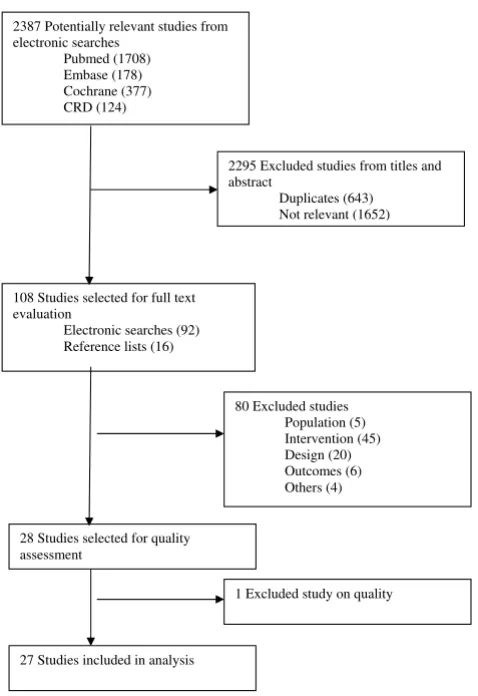
An initial electronic search yielded a total of 2,387 titles and abstracts of which 92 were judged to be potentially relevant based on title and abstract reading. Full texts of these 92 retrieved articles were reviewed. We finally selected 26 studies that met the inclusion criteria and rejected 66 studies. Another 16 articles were identified
from reference searching of which one was included in final analysis. A flow chart through the different steps of study selection is provided in Figure 1. A Cohen's kappa of 0.82 was reached for inter-reviewer agreement.
From the 27 selected studies, there were twenty cluster RCTs, one CCT study, two CBA designs, and four ITS. The included studies are characterised by heterogeneity of clinical areas, format of interventions, and outcome parameters.
Excluded studies
A total of 81 studies were rejected, five studies were excluded on population, 45 on intervention, 20 on design, six on outcome, one on methodological quality and four for other reasons. A table with references and rea-sons for exclusion can be found in Additional file 2.
Included studies Setting and participants
The majority of studies (52%) were conducted in the USA [10-23], four in the UK [24-28], five in the Netherlands [29-33], two in Norway [34,35], one in France [36], and one in Finland [37]. All studies evaluated the implemen-tation of electronic guidelines in ambulatory care of which four were performed in the emergency department [18-20,36].
The studies of Hetlevik [34,35], Tierney[15,16], Mur-ray[17], Schriger [19,20], and Day [18] each relate to eval-uations of the same system across different modules. Because the modules were separately assessed as being independent systems, we considered them as different sys-tems.
The number of professionals participating in the studies was difficult to determine because some of the studies reported in terms of the number of participating practices, others published the number of healthcare providers. The number of patients in the studies varied from a few hun-dred to a few thousand, ranging from paediatric to geriat-ric patients.
Intervention
assist in the diagnosis as well as management of the dis-ease.
Targeted diseases were angina [24], coronary artery dis-ease (CAD) [14], heart failure and ischemic heart disdis-ease [15], hypertension [17,22,26,34], dyslipidemia [32], hypercholesterolemia [33], diabetes [12,14,35], asthma/ chronic obstructive pulmonary disease (COPD) [16,24,25,30,33], depression [13], HIV [23], occupational exposure to body fluids [19], acute low back pain [18], otitis media [21], and fever in children [20]. The study by Davis was related to various common pediatric diseases [10] and the study by Jousimaa [37] to various primary care problems. The system for prevention and screening was related to tobacco use cessation[11]. The intervention periods fluctuated around 12 months, ranging from four weeks [37] to 50 months (at one site in the study of Davis [10]).
The types of comparison were grouped as: electronic guidelines versus usual care [10-14,18-23,25,26,29,32-36] and electronic guidelines versus another
guideline-based implementation method [13,15-17,24,26,27,30-32,37].
Outcome
A variety of outcome parameters were reported in each study, of which a vast majority investigated multiple comes of different data types. In the main process out-comes, such as guideline compliance, were addressed. The reporting of patient outcomes (e.g., blood pressure, cho-lesterol levels) was often complicated by methodological problems, and was limited.
Risk of bias in included studies
The methodological quality of included studies was diverse. Several criteria could not be rated because of insufficient information.
We identified 20 cluster-RCTs [10,12-17,21,22,24-27,30-35,37], one CCT [23], and two CBA studies [11,29]. Reporting of specific procedures for concealment was con-sidered less important because it concerned cluster-RCTs. The unit of randomization was the healthcare provider in five studies [10,12,13,21,37], physicians' practices in nine trials [22,24-27,30-33], health center or clinic in three studies [14,34,35], and practice session in another three trials [15-17]. The majority of studies accounted for clus-tering in their sample size calculations and their statistical techniques. Caution is needed with the interpretation of the results when clustering is not taken in account [11,23,29,34,35].
Most studies had similar baseline measurements for the primary outcomes or controlled for baseline imbalance in their statistical analyses [11-17,22,24,27,29,31,32,35,37]. A lack of information on this topic especially for the (pri-mary) outcomes could potentially influence the results of the studies by McCowan, Kuilboer, Martens, and Safran [23,25,30,33].
The study of McCowan [25] possibly suffered from attri-tion bias because of insufficient follow-up. It was not pos-sible to draw conclusions on this topic for the studies of Szpunar [11] and Sequist [14] because of insufficient data. An intention-to-treat analysis was performed and explic-itly reported in eight trials [10,12,13,22,24,26,27,29].
Seven studies [11,22,25,26,30,34,35] scored negatively for the criterion 'blinded assessment of primary outcomes' Another source of bias may be the non-blinding of the healthcare providers. Because of the nature of the inter-vention, healthcare professionals could not be blinded to the intervention. Only the balanced incomplete block design of Eccles [24] and Martens [33] controlled for a possible Hawthorne effect. The reliability of the primary outcomes was scored positively in 11 studies [10,13-15,21,23,24,29,31-33].
Flowchart of identification and selection of studies
Figure 1
Flowchart of identification and selection of studies.
2387 Potentially relevant studies from electronic searches
Pubmed (1708) Embase (178) Cochrane (377) CRD (124)
2295 Excluded studies from titles and abstract
Duplicates (643) Not relevant (1652)
108 Studies selected for full text evaluation
Electronic searches (92) Reference lists (16)
80 Excluded studies
Population (5)
Intervention (45)
Design (20)
Outcomes (6)
Others (4)
28 Studies selected for quality assessment
1 Excluded study on quality
As a result of the cluster design of most trials, the risk of intervention contamination could be minimised in all of included studies. Although minimal, completely eradicat-ing this type of bias with this kind of intervention is nearly impossible for most of the studies.
Four ITS designs [18-20,36] were included. Three of these ITS designs consisted of the analysis of different modules of one and the same system [18-20]. The study of Carton [36] was the only study with sufficient data points before and after the intervention and where data collection methods were identical before and after the intervention. It was not possible to draw definite conclusions on the completeness of data sets for the study of Carton [36], for the three other studies [18-20] the data sets were incom-plete. The reasons for the number of points pre and post intervention were not given in any of the studies and none of the studies provided information on the shape of the intervention effect. Data were analysed appropriately in the studies by Schriger [19,20] and Day [18]. 'Protection against secular changes' was only explicitly reported in the study by Schriger [19]. Outcomes were assessed blindly and measured reliable in all of the studies. Because of insufficient essential methodological information, all ITS designs were judged to be at a high risk of bias.
Effects of intervention
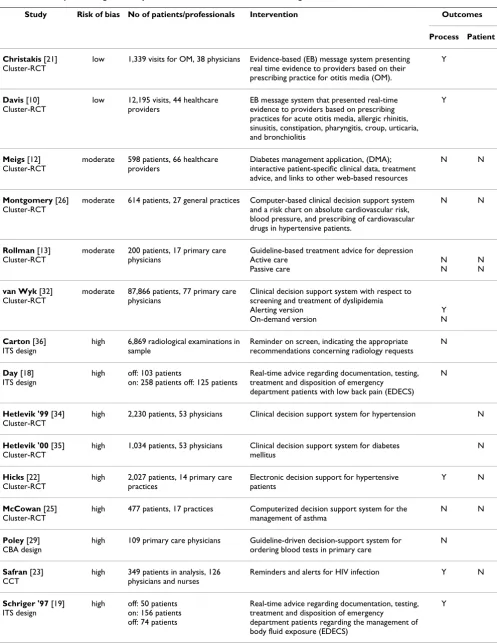
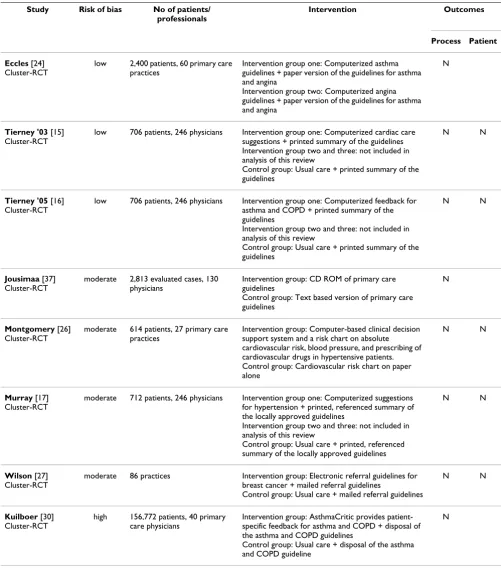
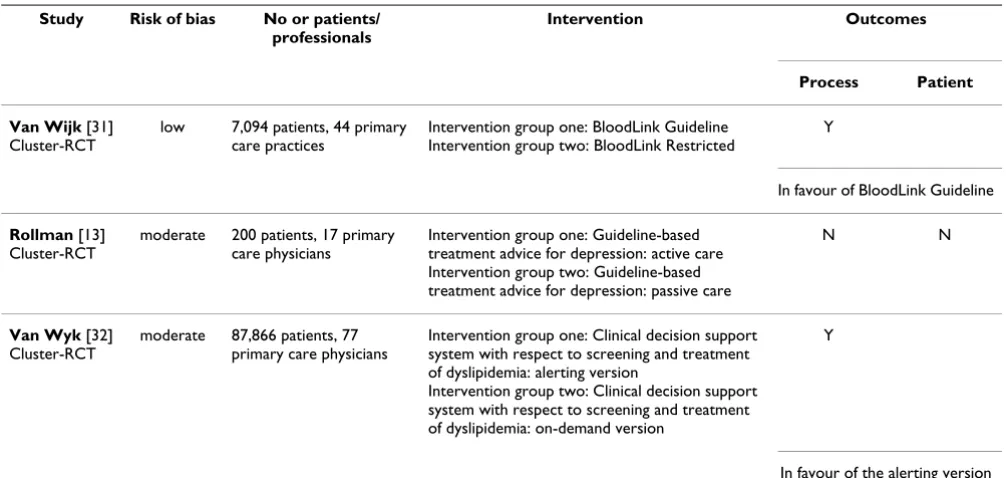
A meta-analysis was not performed due to the risk of bias in some of included studies and the heterogeneity in out-come measures. We were unable to calculate the corrected odds ratios for the individual studies because we could not correct for clustering. Because of this, we had to rely on the effect sizes reported in the articles, which could be biased in studies which had methodological flaws. Sum-maries of findings are reported in Tables 1, 2 and 3. An intervention was defined as successful when at least 50% of the outcomes were statistically significant (alpha = 0.05 (without correction for multiple comparisons in a lot of studies)).
Comparison one: Electronic multidimensional guidelines versus usual care
Nineteen studies-- twelve cluster-RCTs, one CCT, two CBA trials and four ITS designs--assessed the effectiveness of elec-tronic guideline implementation systems compared with a usual care control group [10-14,18-23,25,26,29,32-36]. The majority investigated only process outcomes and reported at least one statistically significant process outcome in favour of the intervention group. However, in most trials this finding was not consistent throughout the study, and the authors were not unanimous in endorsing the effectiveness of elec-tronic guidelines.
None of the studies in comparison one showed better patient outcomes, and seven of seventeen studies that
investigated process showed improvements in process of care variables.
A subgroup analysis was performed to identify potential guideline or system characteristics that could predict suc-cess. Odds ratios for the following subgroups were deter-mined: local guidelines versus national guidelines, advice alone versus advice plus a link to the evidence or the full text of the guideline, automated advice versus having to actively seek it, type of targeted decision (test ordering, therapy, diagnosis or diagnosis plus therapy), integrated into EMR versus not integrated. None of the odds ratios was statistically significant at a significance level of p < 0.05.
Reported reasons for failure to show an effect were work overload and time pressure [12-15,25,35], low levels of use of the system [12,24,25,35], lack of integration within the normal workflow [12,14], lack of patient participation [13,24,35], technical problems [25], controversy about the implemented guideline [15,18,20], or highly complex suggestions [17].
A summary of the results of the studies in comparison group one is given in Table 1. An expanded table of the results can be found in Additional file 3.
Comparison two: Electronic multidimensional guidelines versus another guideline implementation method
Eleven studies were available for this comparison. Systems were classified into two groups. One group investigated the differences in effect between the electronic implemen-tation of the guideline and the distribution of a paper ver-sion of the guideline, and the other group assessed the differences in effect between two different types of elec-tronic implementation. Eight studies were included in the analysis of the first group [15-17,24,26,27,30,37] and three in the second group [13,31,32]. We could not find an incremental effect of the electronic implementation over the distribution of paper versions of the guideline. None of the studies showed better patient or process out-comes in favour of the electronic implementation. The only significant difference was found in the study by Montgomery [26] where the computer support group fared worse, having a poorer cardiovascular risk reduction than the chart-only group.
Discussion
Summary of main results
Our search yielded a limited number of studies investigat-ing the effects of electronically implemented multidimen-sional guidelines.
The methodological quality of the included studies was variable. The majority of studies were cluster-RCT. Despite the clustering, most (75%) of the studies appropriately accounted for the clustered nature of the study data, if needed.
Most of included studies were designed to study a large variety of process outcomes and were inconsistent in their published results. Patient outcomes were not widely stud-ied. It is important to consider whether the proper goal of decision-support systems is to improve process outcomes (such as provider performance) or patient outcomes [38-40]. Patient outcomes are not easily measured [41]; they often rely on patient compliance and severity of the dis-ease and generally require longer periods of assessment. Many researchers would agree that showing an improve-ment in a process measure based on good evidence is suf-ficient. We acknowledge that process of care endpoints can be very appropriate. But because the purpose of many guidelines is to improve patient care, we believe that patient outcomes should be measured more often, or that at least the link between process indicator and final patient outcome should have been validated.
We found no evidence of an effect on patient outcomes, but the evidence is more mixed in terms of process of care. With success defined as at least 50% of the outcome vari-ables being significant, none of the studies were successful in improving patient outcomes. Only seven of seventeen studies that investigated process outcomes showed improvements in process of care variables compared with the usual care group (comparison one). No incremental effect of the electronic implementation over the distribu-tion of paper versions of the guideline was found, for either patient outcomes or the process outcomes (com-parison two). Although there is a risk of studies selectively reporting only positive results [42], we do not think that this is a major issue in this review because the results do not suggest a positive effect from electronic guideline-based implementation systems.
The review by Kawamoto et al. [7] report four predictors of improved clinical practice using clinical decision sup-port systems. Two of them were used as inclusion criteria for this review, namely 'provision of decision support at the time and place of consultation' and 'computer-based decision support'. Despite this promising starting point, we could not find sufficient scientific evidence to support the widespread implementation of complex electronic
guideline systems at the moment. It should be stressed that the exclusion of computer-generated paper output and the electronic implementations of single-step guide-lines and alert systems probably had an important effect on our main finding. In contrast to the results of our review, computer-based simple reminders have been demonstrated to be effective in increasing physicians' compliance, for a single procedure [4]. A meta-analysis by Shea et al. [5] supported the effectiveness of computer-based reminder systems to improve prevention services.
No uniform approach could be recognised in the func-tional or technical designs of the systems. The results of this review confirm the statement of James [43] that com-puterized CPGs must present the right information, in the right format, at the right time without requiring special effort. Tedious additional data entry, an overwhelming amount of feedback [15,35], software or hardware prob-lems [25] were more than once reported as a key element for failure of the system. It is important that the data sys-tems require are drawn from existing sources such as EMRs and that the system is as integrated into the entire workflow and possibly within the existing provider order entry system [12,14]. Ease, speed, and some control in the use of the system [44] seemed to be critical success factors according the Discussion section of several included stud-ies [10,45], though further literature review to explore these topics was not done.
Collaboration with end-users [46] during the develop-ment process is essential in the design of the system, as is managerial support. Allowing end-users to identify their information needs for electronic implementation and the manner in which they would like to receive the recom-mendations seems to be one step in the right direction [15,47]. The possibility for updating the evidence and adding local practice-based evidence should be consid-ered [48]. It is likely that an electronic guideline will lose its value with obsolete evidence not adapted to local prac-tice.
Overall completeness and applicability of the evidence The evidence found is probably of limited generalisabil-ity. No guarantee exists that an electronic guideline which works in one setting will do the same in another [49], e.g., results of academic practice with its specific setting and characteristics may be different from everyday practice. The characteristics of the healthcare system in each coun-try (e.g., financing systems) may also be important when generalising the results.
Table 1: Summary of Findings for comparison one: Electronic multidimensional guidelines versus usual care
Study Risk of bias No of patients/professionals Intervention Outcomes
Process Patient
Christakis [21] Cluster-RCT
low 1,339 visits for OM, 38 physicians Evidence-based (EB) message system presenting real time evidence to providers based on their prescribing practice for otitis media (OM).
Y
Davis [10] Cluster-RCT
low 12,195 visits, 44 healthcare providers
EB message system that presented real-time evidence to providers based on prescribing practices for acute otitis media, allergic rhinitis, sinusitis, constipation, pharyngitis, croup, urticaria, and bronchiolitis
Y
Meigs [12] Cluster-RCT
moderate 598 patients, 66 healthcare providers
Diabetes management application, (DMA); interactive patient-specific clinical data, treatment advice, and links to other web-based resources
N N
Montgomery [26] Cluster-RCT
moderate 614 patients, 27 general practices Computer-based clinical decision support system and a risk chart on absolute cardiovascular risk, blood pressure, and prescribing of cardiovascular drugs in hypertensive patients.
N N
Rollman [13] Cluster-RCT
moderate 200 patients, 17 primary care physicians
Guideline-based treatment advice for depression Active care
Passive care
N N
N N
van Wyk [32] Cluster-RCT
moderate 87,866 patients, 77 primary care physicians
Clinical decision support system with respect to screening and treatment of dyslipidemia Alerting version
On-demand version
Y N
Carton [36] ITS design
high 6,869 radiological examinations in sample
Reminder on screen, indicating the appropriate recommendations concerning radiology requests
N
Day [18] ITS design
high off: 103 patients
on: 258 patients off: 125 patients
Real-time advice regarding documentation, testing, treatment and disposition of emergency
department patients with low back pain (EDECS) N
Hetlevik '99 [34] Cluster-RCT
high 2,230 patients, 53 physicians Clinical decision support system for hypertension N
Hetlevik '00 [35] Cluster-RCT
high 1,034 patients, 53 physicians Clinical decision support system for diabetes mellitus
N
Hicks [22] Cluster-RCT
high 2,027 patients, 14 primary care practices
Electronic decision support for hypertensive patients
Y N
McCowan [25] Cluster-RCT
high 477 patients, 17 practices Computerized decision support system for the management of asthma
N N
Poley [29] CBA design
high 109 primary care physicians Guideline-driven decision-support system for ordering blood tests in primary care
N
Safran [23] CCT
high 349 patients in analysis, 126 physicians and nurses
Reminders and alerts for HIV infection Y N
Schriger '97 [19] ITS design
high off: 50 patients on: 156 patients off: 74 patients
Real-time advice regarding documentation, testing, treatment and disposition of emergency
department patients regarding the management of body fluid exposure (EDECS)
some trials and the discussion section of the studies some-times made it possible to deduce some negative implica-tions of the systems. As important as the potential harms is the duration of effect of a system after an extended period of time, which remains understudied at this time.
Potential biases in the review process
The review process could possibly be influenced by two forms of bias. One form of potential bias is situated in the identification of potentially relevant studies, the other in the final selection of studies. Electronic guideline systems generating patient-specific reports on paper could have been excluded when the existence of simultaneous online recommendations was not sufficiently stressed. Our search strategy was chosen to be deliberately broad, but even more search terms that focused on the technical aspects could have been added. A manual search was not performed because it was not possible to determine a set of objective criteria for inclusion of one journal and exclu-sion of the other.
The lack of studies in this field could potentially be explained by the methodological difficulties that arise for this type of implementation research. A large number of narrative articles--often opinions or technical descrip-tions--and studies without control group can be found. In general, these publications advocate the use of electronic systems, and some of them have a commercial conflict of interest.
Agreements with other studies or reviews
Although still heterogeneous concerning content and sys-tem design, the main difference between this syssys-tematic review and earlier reviews is the basic requirement of implementation of a guideline, on screen, at time and place of consultation, and the restriction in scope to mul-tidimensional multi-step guidelines and to electronic sys-tems in ambulatory care settings. This review seems to be an update of the review by Shiffman et al. [6], but
included different studies and technologies. Most of included studies in the review by Shiffman were related to generating paper-based output by a computer, while this was used as an explicit exclusion criterion in our review. Shiffman et al [6] reported a guideline adherence and doc-umentation improvement in fourteen of eighteen and four of four studies, respectively.
Other reviews relevant for this topic studied the effective-ness and/or efficiency of guideline dissemination and implementation strategies in general or discussed a heter-ogeneous group of (computerized) clinical decision sup-port systems [4,7,8,46,50]. Garg et al. [8] updated earlier reviews by Johnston et al. [4] and Hunt et al. [46] investi-gating the effect of clinical decision support systems. All three reviews reported that computer-based decision sup-port can improve clinical performance, the effects on patient health outcomes remained understudied and, when studied, inconsistent. These results were in line with the conclusions of Kawamoto et al. [7], who found a sig-nificant improvement in clinical practice in 68% of the tri-als. Cramer et al. [50] found the use of evidence delivery systems to enhance the process of care, but could not detect any effect on patient outcomes when pooling the data of the studies. A recent systematic review by Bryan et al. [51] studied the effectiveness of clinical decision sup-port tools in ambulatory/primary care and concluded that clinical decision support tools (CDSS) have the potential to produce statistically significant improvements in out-comes: 76% of studies found either positive or variable outcomes related to CDSS intervention with 24% show-ing no significant effect.
Outcomes were not consistent throughout all trials in ear-lier reviews, and patient outcomes were seldom studied, which is in line with the results of our review. However, conclusions were, in general, more positive than the main findings of our review, probably due to the exclusion of the more effective simple reminder systems and compu-Schriger '00 [20]
ITS design
high off: 352 patients on: 374 patients off: 104 patients
Real-time advice regarding documentation, testing and treatment of children with fever presenting in the emergency department (EDECS)
N
Sequist [14] Cluster-RCT
high Diabetes: 4,549 patients - CAD: 2,199 patients, 194 physicians
EB electronic reminders for diabetes and coronary artery disease (CAD)
N
Szpunar [11] CBA design
high Pre: 5,334 patients - Post: 3,970 patients, 6 clinics
Tobacco Use Cessation (TUC) Automated Clinical Practice Guideline
Y
Martens [33] Cluster-RCT
high 53 primary care physicians Intervention group one: Reminders on antibiotics, asthma/chronic obstructive pulmonary disease (COPD)
Intervention group two: Reminders on cholesterol-lowering drugs
N
Y = if at least 50% of outcomes significant, N = if less than 50% of outcomes significant
Table 2: Summary of Findings for comparison two: Electronic guideline implementations versus paper version of the guideline
Study Risk of bias No of patients/ professionals
Intervention Outcomes
Process Patient
Eccles [24] Cluster-RCT
low 2,400 patients, 60 primary care practices
Intervention group one: Computerized asthma guidelines + paper version of the guidelines for asthma and angina
Intervention group two: Computerized angina guidelines + paper version of the guidelines for asthma and angina
N
Tierney '03 [15] Cluster-RCT
low 706 patients, 246 physicians Intervention group one: Computerized cardiac care suggestions + printed summary of the guidelines Intervention group two and three: not included in analysis of this review
Control group: Usual care + printed summary of the guidelines
N N
Tierney '05 [16] Cluster-RCT
low 706 patients, 246 physicians Intervention group one: Computerized feedback for asthma and COPD + printed summary of the guidelines
Intervention group two and three: not included in analysis of this review
Control group: Usual care + printed summary of the guidelines
N N
Jousimaa [37] Cluster-RCT
moderate 2,813 evaluated cases, 130 physicians
Intervention group: CD ROM of primary care guidelines
Control group: Text based version of primary care guidelines
N
Montgomery [26] Cluster-RCT
moderate 614 patients, 27 primary care practices
Intervention group: Computer-based clinical decision support system and a risk chart on absolute cardiovascular risk, blood pressure, and prescribing of cardiovascular drugs in hypertensive patients. Control group: Cardiovascular risk chart on paper alone
N N
Murray [17] Cluster-RCT
moderate 712 patients, 246 physicians Intervention group one: Computerized suggestions for hypertension + printed, referenced summary of the locally approved guidelines
Intervention group two and three: not included in analysis of this review
Control group: Usual care + printed, referenced summary of the locally approved guidelines
N N
Wilson [27] Cluster-RCT
moderate 86 practices Intervention group: Electronic referral guidelines for breast cancer + mailed referral guidelines
Control group: Usual care + mailed referral guidelines
N N
Kuilboer [30] Cluster-RCT
high 156,772 patients, 40 primary care physicians
Intervention group: AsthmaCritic provides patient-specific feedback for asthma and COPD + disposal of the asthma and COPD guidelines
Control group: Usual care + disposal of the asthma and COPD guideline
N
terized paper-generated output and the differences in the definition of a successful intervention. For example, the review by Bryan [51] classified studies with variable out-comes separately while the same studies could be classi-fied as unsuccessful in our review when less than 50% of outcomes were statistically significant.
Summary
There is little evidence at the moment for the effectiveness of an increasingly used and commercialised instrument such as electronic multidimensional guidelines. After more than a decade of development of numerous elec-tronic systems, evidence on the most effective implemen-tation strategy for this kind of guideline-based decision support systems is still lacking. This conclusion suggests the risk of inappropriate investments in ineffective imple-mentation interventions and in suboptimal care. It is remarkable that healthcare payers require evidence on effectiveness and safety for other healthcare interventions, such as drugs and devices, and seem not to be concerned about the cost-effectiveness of organisational interven-tions such as electronic implementation of multidimen-sional CPGs that can also seriously impact patient care.
Future developments of this kind of information systems should incorporate a high-quality research design, and patient outcomes in concordance with other studies need to be studied. Not only studies investigating the benefits but also studies exploring potential harms, lasting effects, and both direct and indirect costs are important.
Competing interests
The authors declare that they have no competing interests.
Authors' contributions
All authors were involved in various stages of the study design. AH implemented and wrote the review. SVDV was the second reviewer and screened retrieved papers against inclusion criteria, appraised the methodological quality of studies, and checked if data extraction was accurate. DR supervised the study. DR, BA, and PD gave methodologi-cal advice and commented on subsequent drafts of the paper. All authors read and approved the final manu-script.
Additional material
Additional file 1
Search strategy (OVID Medline). Search strategy performed in Medline.
Click here for file
[http://www.biomedcentral.com/content/supplementary/1748-5908-4-82-S1.DOC]
Additional file 2
List of excluded studies. List of excluded studies based on full text evalu-ation.
Click here for file
[http://www.biomedcentral.com/content/supplementary/1748-5908-4-82-S2.DOC]
Table 3: Summary of Findings for comparison two: Comparison of different types of electronic guideline implementation
Study Risk of bias No or patients/ professionals
Intervention Outcomes
Process Patient
Van Wijk [31] Cluster-RCT
low 7,094 patients, 44 primary care practices
Intervention group one: BloodLink Guideline Intervention group two: BloodLink Restricted
Y
In favour of BloodLink Guideline
Rollman [13] Cluster-RCT
moderate 200 patients, 17 primary care physicians
Intervention group one: Guideline-based treatment advice for depression: active care Intervention group two: Guideline-based treatment advice for depression: passive care
N N
Van Wyk [32] Cluster-RCT
moderate 87,866 patients, 77 primary care physicians
Intervention group one: Clinical decision support system with respect to screening and treatment of dyslipidemia: alerting version
Intervention group two: Clinical decision support system with respect to screening and treatment of dyslipidemia: on-demand version
Y
In favour of the alerting version
Acknowledgements
We are grateful to Joan Vlayen for his support in composing the search strategy and Geert Molenberghs for giving statistical advice. We are thank-ful for the additional information provided by the following authors: Robert Davis, James Meigs, Ian Nick Steen and William Michael Tierney.
References
1. Eccles M, Grimshaw J: Selecting, Presenting and Delivering Clinical Guidelines: Are There Any 'Magic Bullets? Med J Aust
2004, 180(Suppl 6):S52-54.
2. Grimshaw J, Thomas R, MacLennan G, Fraser C, Ramsay C, Vale L, Whitty P, Eccles MP, Matowe L, Shirran L, Wensing M, Dijkstra R, Donaldson C: Effectiveness and efficiency of guideline dissem-ination and implementation strategies. Health Technol Assess
2004, 8:iii-iv. 1-72
3. Grimshaw J, Russell I: Effect of clinical guidelines on medical practice: a systematic review of rigorous evaluations. Lancet
1993, 342:1317-1322.
4. Johnston ME, Langton KB, Haynes RB, Mathieu A: Effects of com-puter-based clinical decision support systems on clinician performance and patient outcome. A critical appraisal of research. Ann Intern Med. 1994, 120(2):135-142.
5. Shea S, DuMouchel W, Bahamonde L: A meta-analysis of 16 ran-domized controlled trials to evaluate computer-based clini-cal reminder systems for preventive care in the ambulatory setting. J Am Med Inform Assoc 1996, 3:399-409.
6. Shiffman RN, Liaw Y, Brandt CA, Corb GJ: Computer-based guideline implementation systems: a systematic review of functionality and effectiveness. J Am Med Inform Assoc 1999,
6:104-114.
7. Kawamoto K, Houlihan CA, Balas EA, Lobach DF: Improving clini-cal practice using cliniclini-cal decision support systems: a sys-tematic review of trials to identify features critical to success. BMJ 2005, 330:765.
8. Garg AX, Adhikari NK, McDonald H, Rosas-Arellano MP, Devereaux PJ, Beyene J, Sam J, Haynes RB: Effects of computerized clinical decision support systems on practitioner performance and patient outcomes: a systematic review. JAMA 2005,
293:1223-1238.
9. Cochrane Effective Practice and Organisation of Care Group: The data collection checklist. [http://www.epoc.cochrane.org/Files/ Website%20files/Documents/Reviewer%20Resources/datacollec-tionchecklist.pdf].
10. Davis RL, Wright J, Chalmers F, Levenson L, Brown JC, Lozano P, Christakis DA: A cluster randomized clinical trial to improve prescribing patterns in ambulatory pediatrics. PLoS Clin Trials
2007, 2:e25.
11. Szpunar SM, Williams PD, Dagroso D, Enberg RN, Chesney JD:
Effects of the tobacco use cessation automated clinical prac-tice guideline. Am J Manag Care. 2006, 12(11):665-673.
12. Meigs J, Cagliero E, Dubey A, Murphy-Sheehy P, Gildesgame C, Chueh H, Barry M, Singer D, Singer D, Nathan D: A Controlled Trial of Web-Based Diabetes Disease Management: The MGH Dia-betes Primary Care Improvement Project. Diabetes Care 2003,
26:750-757.
13. Rollman BL, Hanusa BH, Lowe HJ, Gilbert T, Kapoor WN, Schulberg HC: A randomized trial using computerized decision support
to improve treatment of major depression in primary care.
J Gen Intern Med 2002, 17:493-503.
14. Sequist TD, Gandhi TK, Karson AS, Fiskio JM, Bugbee D, Sperling M, Cook EF, Orav EJ, Fairchild DG, Bates DW: A randomized trial of electronic clinical reminders to improve quality of care for diabetes and coronary artery disease. J Am Med Inform Assoc
2005, 12:431-437.
15. Tierney WM, Overhage JM, Murray MD, Harris LE, Zhou XH, Eckert GJ, Smith FE, Nienaber N, McDonald CJ, Wolinsky FD: Effects of computerized guidelines for managing heart disease in pri-mary care. J Gen Intern Med 2003, 18:967-976.
16. Tierney WM, Overhage JM, Murray MD, Harris LE, Zhou XH, Eckert GJ, Smith FE, Nienaber N, McDonald CJ, Wolinsky FD: Can compu-ter-generated evidence-based care suggestions enhance evi-dence-based management of asthma and chronic obstructive pulmonary disease? A randomized, controlled trial. Health Serv Res 2005, 40:477-497.
17. Murray MD, Harris LE, Overhage JM, Zhou XH, Eckert GJ, Smith FE, Buchanan NN, Wolinsky FD, McDonald CJ, Tierney WM: Failure of computerized treatment suggestions to improve health out-comes of outpatients with uncomplicated hypertension: results of a randomized controlled trial. Pharmacotherapy 2004,
24:324-337.
18. Day F, Hoang LP, Ouk S, Nagda S, Schriger DL: The impact of a guideline-driven computer charting system on the emer-gency care of patients with acute low back pain. Proc Annu Symp Comput Appl Med Care 1995:576-580.
19. Schriger DL, Baraff LJ, Rogers WH, Cretin S: Implementation of clinical guidelines using a computer charting system. Effect on the initial care of health care workers exposed to body fluids. JAMA 1997, 278:1585-1590.
20. Schriger DL, Baraff LJ, Buller K, Shendrikar MA, Nagda S, Lin EJ, Miku-lich VJ, Cretin S: Implementation of clinical guidelines via a computer charting system: effect on the care of febrile chil-dren less than three years of age. J Am Med Inform Assoc 2000,
7:186-195.
21. Christakis DA, Zimmerman FJ, Wright JA, Garrison MM, Rivara FP, Davis RL: A randomized controlled trial of point-of-care evi-dence to improve the antibiotic prescribing practices for oti-tis media in children. Pediatrics 2001, 107:E15.
22. Hicks LS, Sequist TD, Ayanian JZ, Shaykevich S, Fairchild DG, Orav EJ, Bates DW: Impact of computerized decision support on blood pressure management and control: a randomized controlled trial. J Gen Intern Med 2008, 23:429-441.
23. Safran C, Rind DM, Davis RB, Ives D, Sands DZ, Currier J, Slack WV, Makadon HJ, Cotton DJ: Guidelines for management of HIV infection with computer-based patient's record. Lancet 1995,
346:341-346.
24. Eccles M, McColl E, Steen N, Rousseau N, Grimshaw J, Parkin D, Purves I: Effect of computerised evidence based guidelines on management of asthma and angina in adults in primary care: cluster randomised controlled trial. BMJ 2002, 325:941. 25. McCowan C, Neville RG, Ricketts IW, Warner FC, Hoskins G,
Tho-mas GE: Lessons from a randomized controlled trial designed to evaluate computer decision support software to improve the management of asthma. Med Inform Internet Med 2001,
26:191-201.
26. Montgomery AA, Fahey T, Peters TJ, MacIntosh C, Sharp DJ: Evalu-ation of computer based clinical decision support system and risk chart for management of hypertension in primary care: randomised controlled trial. BMJ 2000, 320:686-690.
27. Wilson B, Torrance N, Mollison J, Wordsworth S, Gray J, Haites N, Grant A, Campbell M, Miedyzbrodzka Z, Clarke A, Watson M, Doug-las A: Improving the referral process for familial breast can-cer genetic counselling: findings of three randomised controlled trials of two interventions. Health Technol Assess Health Technol Assess. 2005 Feb;9(3):iii-iv, 1-126 2005, 9(3):1-126. 28. Wilson BJ, Torrance N, Mollison J, Watson MS, Douglas A,
Miedzy-brodzka Z, Gordon R, Wordsworth S, Campbell M, Haites N, Grant A: Cluster randomized trial of a multifaceted primary care decision-support intervention for inherited breast cancer risk. Fam Pract 2006, 23:537-544.
29. Poley MJ, Edelenbos KI, Mosseveld M, van Wijk MA, de Bakker DH, Lei J van der, Rutten-van Mölken MP: Cost consequences of implementing an electronic decision support system for ordering laboratory tests in primary care: evidence from a
Additional file 3
Summary of Findings--expanded tables. Expanded versions of the tables with the summary of findings. Table 1 for comparison one, electronic mul-tidimensional guidelines versus usual care and Table 2 and 3 for compar-ison two, electronic multidimensional guidelines versus another guideline implementation method.
Click here for file
Publish with BioMed Central and every scientist can read your work free of charge "BioMed Central will be the most significant development for disseminating the results of biomedical researc h in our lifetime."
Sir Paul Nurse, Cancer Research UK
Your research papers will be:
available free of charge to the entire biomedical community
peer reviewed and published immediately upon acceptance
cited in PubMed and archived on PubMed Central
yours — you keep the copyright
Submit your manuscript here:
http://www.biomedcentral.com/info/publishing_adv.asp
BioMedcentral
controlled prospective study in the Netherlands. Clin Chem
2007, 53:213-219.
30. Kuilboer M, van Wijk M, Mosseveld M, Does E van der, de Jongste J, Overbeek S, Ponsioen B, Lei J van der: Computed critiquing inte-grated into daily clinical practice affects physicians' behavior--a randomized clinical trial with AsthmaCritic. Methods Inf Med 2006, 45:447-454.
31. van Wijk MA, Lei J van der, Mosseveld M, Bohnen AM, van Bemmel JH: Assessment of decision support for blood test ordering in primary care. a randomized trial. Ann Intern Med 2001,
134:274-281.
32. van Wyk JT, van Wijk MA, Sturkenboom MC, Mosseveld M, Moor-man PW, Lei J van der: Electronic alerts versus on-demand deci-sion support to improve dyslipidemia treatment: a cluster randomized controlled trial. Circulation 2008, 117:371-378. 33. Martens JD, Weijden T van der, Severens JL, de Clercq PA, de Bruijn
DP, Kester AD, Winkens RA: The effect of computer reminders on GPs' prescribing behaviour: a cluster-randomised trial.
Int J Med Inform 2007, 76:S403-S416.
34. Hetlevik I, Holmen J, Krüger O: Implementing clinical guidelines in the treatment of hypertension in general practice. Evalu-ation of patient outcome related to implementEvalu-ation of a computer-based clinical decision support system. Scand J Prim Health Care 1999, 17:35-40.
35. Hetlevik I, Holmen J, Krüger O, Kristensen P, Iversen H, Furuseth K:
Implementing clinical guidelines in the treatment of diabe-tes mellitus in general practice. Evaluation of effort, process, and patient outcome related to implementation of a compu-ter-based decision support system. Int J Technol Assess Health Care 2000, 16:210-227.
36. Carton M, Auvert B, Guerini H, Boulard JC, Heautot JF, Landre MF, Beauchet A, Sznajderi M, Brun-Ney D, Chagnon S: Assessment of radiological referral practice and effect of computer-based guidelines on radiological requests in two emergency departments. Clin Radiol 2002, 57:123-128.
37. Jousimaa J, Mäkelä M, Kunnamo I, MacLennan G, Grimshaw JM: Pri-mary care guidelines on consultation practices: the effective-ness of computerized versus paper-based versions. A cluster randomized controlled trial among newly qualified primary care physicians. Int J Technol Assess Health Care 2002, 18:586-596. 38. Mant J: Process versus outcome indicators in the assessment of quality of health care. Int J Qual Health Care 2001, 13:475-480. 39. Sintchenko V, Magrabi F, Tipper S: Are we measuring the right end-points? Variables that affect the impact of computerised decision support on patient outcomes: a systematic review.
Med Inform Internet Med 2007, 32:225-240.
40. Donabedian A: The evaluation of medical care programs. Bull N Y Acad Med 1968, 44:117-124.
41. Feinstein A: Clinimetrics. New Haven, CT: Yale University Press; 1987.
42. Mathieu S, Boutron I, Moher D, Altman DG, Ravaud P: Comparison of registered and published primary outcomes in rand-omized controlled trials. JAMA 2009, 302:977-984.
43. James B: Making it easy to do it right. N Engl J Med 2001,
345:991-993.
44. Rousseau N, McColl E, Newton J, Grimshaw J, Eccles M: Practice based, longitudinal, qualitative interview study of computer-ised evidence based guidelines in primary care. BMJ 2003,
326:314.
45. Martens JD, Weijden T van der, Winkens RA, Kester AD, Geerts PJ, Evers SM, Severens JL: Feasibility and acceptability of a compu-terised system with automated reminders for prescribing behaviour in primary care. Int J Med Inform 2008, 77:199-207. 46. Hunt DL, Haynes RB, Hanna SE, Smith K: Effects of
computer-based clinical decision support systems on physician per-formance and patient outcomes: a systematic review. JAMA
1998, 280:1339-1346.
47. Lobach DF: A model for adapting clinical guidelines for elec-tronic implementation in primary care. Proc Annu Symp Comput Appl Med Care 1995:581-585.
48. Sim I, Gorman P, Greenes RA, Haynes RB, Kaplan B, Lehmann H, Tang PC: Clinical decision support systems for the practice of evidence-based medicine. J Am Med Inform Assoc 2001, 8:527-534. 49. Foy R, Eccles M, Grimshaw J: Why does primary care need more
implementation research? Fam Pract 2001, 18:353-355.
50. Cramer K, Hartling L, Wiebe N, Russell K, Crumley E, Pusic M, Klas-sen T: Computer-Based Delivery of Health Evidence: A Sys-tematic Review of Randomized Controlled Trials and Systematic Reviews of the Effectiveness on the Process of Care and Patient Outcomes. Edmonton: Alberta Heritage Founda-tion for Medical Research 2003.
51. Bryan C, Boren S: The use and effectiveness of electronic clin-ical decision support tools in the ambulatory/primary care setting: a systematic review of the literature. Inform Prim Care