International Journal of Applied Science and Research
79
www.ijasr.org Copyright © 2019 IJASR All rights reservedGEOTECHNICAL PROPERTIES OF EXPANSIVE SOILS IN AWKA AND ENVIRONS,
SOUTHEASTERN NIGERIA, IN RELATION TO ENGINEERING PROBLEMS
P. O. Ogbuchukwu1, O.C. Okeke1, C.A. Ahiarakwem1 and O.O. Ozotta2
1. Department of Geology, Federal University of Technology Owerri, Imo State, Nigeria.
2. Harold Hamn School of Geology and Geological Engineering, Grand Forks, North Dakota, United States.
IJASR 2019 VOLUME 2
ISSUE 4 JULY – AUGUST ISSN:2581-7876 Abstract – Failures of engineering structures such as buildings and roads erected on expansive soils that occur extensively in the study area have been observed. Expansive soils are a clayey soil that swells or increases in volume when in contact with water but also shrinks or decreases in volume when the water is removed. This study was undertaken to evaluate the geotechnical properties of expansive soils in the study area Awka and environs, in relation to the failure of engineering structures (roads and buildings) in the areas. A total of eight (8) expansive soil samples were collected in different locations of the study area to represent soils derived from the different geologic Formations (Ameki Formation and Imo Shale); and their geotechnical properties determined in the laboratory. The geotechnical properties used in the study includes; grain size, Atterberg limit test, linear shrinkage, natural moisture content, free swell, specific gravity, dry and bulk density, compaction test and California Bearing Ratio test (soaked and unsoaked). The results of the tests indicate that the parent rock/geologic Formations from which the soils were derived influence the geotechnical properties of the soils. Soils derived from Imo Shale generally have higher values of liquid limit (LL), plasticity index(PI) and activity 68.40 to 77.40%, 37.45 to 46.45% and 1.31 to 1.55 respectively (at Ugwuoba, Akpugoeze, Ufuma, Umunze and Amansea) than similar values from Ameki Formation 63.10 to 66.80%, 33.55 to 34.05% and 0.98 to 1.16 (at Nibo, Nise and Enugwu –Agidi). On the basis of swelling potential classification, the expansive soils derived from Ameki Formation are classified as high while soils derived from Imo Shale are classified as very high but on the basis of degree of expansion classification, soils derived from both Ameki Formation and Imo Shale are classified as high using free swell values 53.00 to 71.00%, and critical using linear shrinkage (LS) 10.70 to 20.00%. On the Casagrande plasticity chart, all the studied soils plots as CH soils (fat clays). All the studied soils also have low CBR values (soaked CBR 1.00 to 3.00% and Unsoaked CBR 10.00 to 18.00%) and low compaction values using maximum dry density (1.49 to 1.75Mg/m3) , thus making them poor subgrade soils for high way construction and poor foundation soils
(due to unacceptable Atterberg limit/activity) for building construction.
Keywords: Expansive soils, Swelling potential, Atterberg limit, Degree of expansion, Failure, Strength characteristics.
1.0 Introduction
International Journal of Applied Science and Research
80
www.ijasr.org Copyright © 2019 IJASR All rights reservedExpansive soils are worldwide problem, causing severe damages to engineering structures like underground utilities, highways, hydraulic conduits, buildings, slopes and embankments. Kerrane (2013), states that United States Housing and Urban Development (HUD) in 1981, estimated nine billion US dollars ($9billion) damages resulting from expansive soil. Also, Jones & Holtz (1973) attributed that effects of expansive soil on engineering structures in the United States exceed the combined average annual damages from flood, hurricane, earthquake and tornadoes while Steinberg (1992), reported the annual cost of damages from expansive soils in United States to be over $10billion. According to Zumrawi & Hamza (2014), these problematic soils upon swelling and shrinking causes severe impairment to the engineering structure founded on them while Braja (1996), states that the major problems associated with expansive clay soils, especially the montmorillonite-rich soils are the volume change and this often result to severe damages of the engineering structures. Expansive soils tend to absorbs large volume of water due to the presence of montmorillonite clay mineral it poses (Ola, 1981). Craig (1992), states that if poor soil cannot be removed, then its engineering properties can be enhanced by suitable method of ground treatment while Bell (1993 and 2007), suggest that the treatment of such soil can be done by preventing the ingress of groundwater flow or removing the soil from the site in question or by improving the soil strength through chemical or mechanical medium.
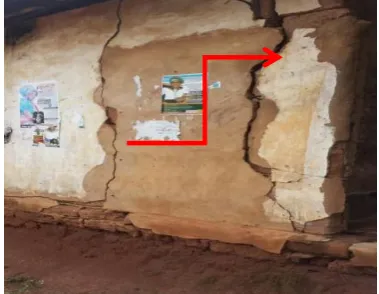
The occurrence of expansive soils have lead to cracking, failures and eventually collapse of engineering structures such as roads, buildings and drainage facilities in the study area (Figure 1 to 4). The durability of these engineering structures are threatened or reduced due to cracks caused by expansive soils on the walls of buildings and roads. These problematic soils are difficult to be used for most engineering constructions due to their swelling and shrinkage nature and they also experience settlement with a reduction of strength (Owolabi & Aderrinola, 2014). Whitlow (1995), characterized soil samples with liquid limit less than 35% as low plasticity soil, between 50 to 70% as high plasticity soil, between 70 to 90% as very high plasticity soil, while greater that 90% as an extremely high plasticity soil. Expansive soils can be characterized in terms of its swelling potential using geotechnical parameters like plasticity index (PI), liquid limit (LL) and activity of clay values and degree of expansion using geotechnical parameters like linear shrinkage and free swell values. The effects of expansive soils on the engineering properties in the study area are shown below (Figure 1 to 4).
Figure 1: Abandoned building due to cracks at Ugwuoba
Figure 2: Patched cracks on the wall due to expansive soil at Ugwuoba
Figure 4: Failed portion of the road at Ufuma Figure 3: Failed Portion of the road at Enugwu-
International Journal of Applied Science and Research
81
www.ijasr.org Copyright © 2019 IJASR All rights reserved 2.0. Study Area Description2.1. Location of the Study Area
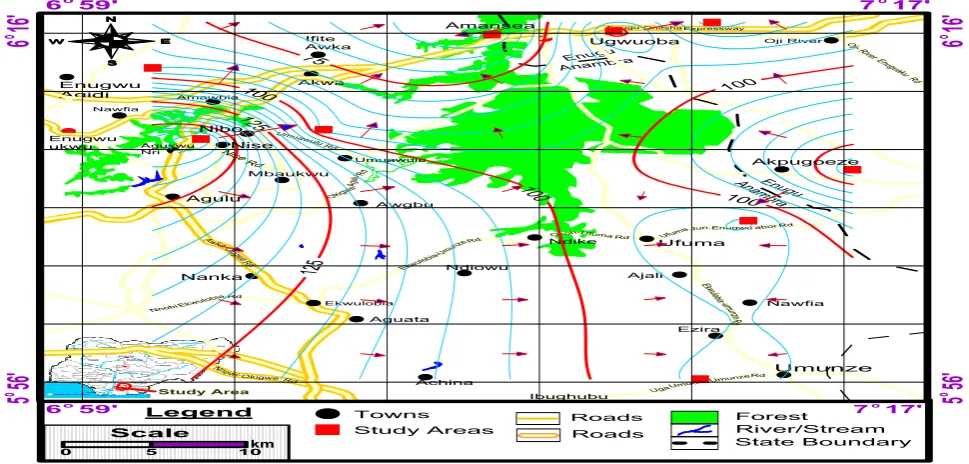
The study area, Awka and environ is predominantly a low lying region on the western plain of the Mamu River with all parts at 333meters above sea-level. It lies between latitude 5⁰ 56'N to 6⁰ 16'N and longitude 6⁰ 59'E to 7⁰
17'E and elevation of 53 to 170m above sea level (Figure 5). The major topographic feature in the region is the cuestas and the study area includes Nise, Nibo, Enugwu Agidi, Akpugoeze, Amansea, Ufuma, Ugwuoba and Umunze. It is accessible through; Awka-Onitsha road, Awka-Enugu express road, Ekwulobia-Umunze road. The study area is part of the rainforest vegetation with two seasonal climatic conditions (Rainy and Harmattan seasons). The hot season (Harmattan) is between February to May, while the wet season (rainy) is between June and September. It is also characterized by the annual double maxima of rainfall with a slight drop in either July or August known as dry spell or August break. The annual total rainfall in the area is about 1,450mm concentrated mainly in eight months of the year with few months of relative drought (Nigeria Metrological Agency, 2007).
Themeantemperature of the study area is 27⁰C with daily minimum and maximum temperature ranges of about 22⁰C and 34⁰C respectively. It has a relative humidity of 80% at dawn (Source: Hydrometeorological department, Awka). The vegetation in the study area comprises different species of tall forest trees, shrubs, with thick undergrowth as well as numerous climbers and grasses. The typical trees are deciduous in nature, such trees are palm trees, raffia palm, iroko trees, oil bear trees and gravelina trees. Oil palm trees and raffia palm are the most common and they are not deciduous in nature.
Figure 5: Topographic/location Map of the Study Area (Digitized Google-earth Imagery, 2017)
2.2. Geology of the Study Area
International Journal of Applied Science and Research
82
www.ijasr.org Copyright © 2019 IJASR All rights reservedtowns in the study area. The regional stratigraphic sequence and Geologic map of the study area is shown below (Table 1 and Figure 6).
Table 1: General regional Stratigraphy of Southeastern Nigeria (Modified from Reyment, 1965, Offodile, 1975 and Mode 2004)
Age Formation Lithology
Recent Recent sediments Alluvium/Deltaic Plains
Miocene Recent
(5-23 m.y.) Benin Formation Unconsolidated sandstone with lenses of clay
Oligocene Miocene
(23-34 m.y.) Ogwashi-Asaba Formation Unconsolidated sandstone, mudstone, clays and lignite seams
Eocene
(34-38 m.y.) Ameki Formation Grey to green argillaceous sandstone, shale and limestone unit
Paleocene
(56-66 m.y.) Imo Shale Blue to dark grey shales and subordinate sandstone members (Umunna and Ebenebe)
Maastrichtian
(65-72 m.y.) Nsukka Formation Alternating sequence of shale, sandstone and coal seams
Ajali Formation Friable sandstones with iron stains
Mamu Formation Sandstones, shale, siltstone with coal seams
Upp
er
c
re
taceo
u
s
Tert
International Journal of Applied Science and Research
83
www.ijasr.org Copyright © 2019 IJASR All rights reservedFigure 6: Geologic Map of Awka and Environs (modified from Okeke and Igboanua, 2003)
3.0. Materials and Methods
3.1. Materials Used for the Study
The materials used for the purpose of the study are Portland cement, hydrated lime and expansive soils derived from Awka and environs, Southeastern Nigeria. The equipment used for sample collection in the field includes: Global Positioning systems (GPS), Geologic maps, Calibrated hand auger, Zip-lock nylon bags, Camera, Masking tape and ink marker and other items used in the field include shovels, geologic hammer, tapes and cutlass.
3.2. Field Study
The field studies were carried out to identify the presence of suspected expansive soils and their destructive effects on engineering structures like buildings, roads and drainage facilities in the study area. A total of eight (8) soil samples were collected from different locations of the expansive soils derived from Ameki Formation and Imo Shale in the study area. The soil sampling strictly followed standard procedure specified in British Standard Institution (BSI) 1377 (1990), US Bureau of Reclamation (USBR) (1963), Spangler & Handy (1973). The expansive soil were collected with the aid of a calibrated hand auger from the exposed outcrop in the study area and geo-referenced using the GPS and carefully sealed in a clean polythene bag in order to prevent loss of moisture and carefully labelled using the masking tape and ink maker. Later, the samples were sent to the laboratory within 24 hours of collection for further analysis. All sampling was done between July, 2017 and January, 2018.
3.3 Laboratory Test (Geotechnical Tests)
The laboratory tests of the studied soils were performed in accordance with the General Specification of Roads and Bridges, volume ll, Revised 1997, British standard institution (BSI) 1377 (1990) and ASTM D-854-10 (2010) and BS 1377 part 2 (1990) for specific gravity, compaction and particle size distribution, ASTM D1883 and Bailey (1976) for CBR test, ASTM D4381 (2012) for Atterberg limit, ASTM international D4943 (1992) for linear shrinkage, IS: 2720 (part 40) (1997) for free swell, The dry density of the expansive soil sample was derived from the known natural moisture content (in fraction) and bulk density values. It is represented mathematically as Dry density, (%) =
Where,
= bulk density
Wn= natural moisture content
International Journal of Applied Science and Research
84
www.ijasr.org Copyright © 2019 IJASR All rights reservedAlso, the activity of claywhich is the measure of contribution of clay minerals to plasticity were derived using a known values of plasticity index and clay fraction which is represented mathematically as
Where,
Ac = activity of clay
P.I = plasticity index
% clay = clay fraction
4.0. Results and Discussions
4.1. Results of the analysis
The results of the index property parameters of the analysis revealed generally that the natural moisture content ranges between 24.40 to 30.60%, specific gravity from 2.62 to 2.71, dry density from 0.82 to 1.03Mg/m3 and bulk
density 1.04 to 1.29Mg/m3, liquid limit from 63.10 to 77.40%, plastic limit from 29.30 to 37.65%, plasticity index
from 33.55 to 46.45%, linear shrinkage from 10.70 to 20.00%, clay content from 24.29 to 30.79%, activity from 0.98 to 1.55 and free swell from 53.00 to 71.00% while the strength characteristics analysis like optimum moisture content ranges from 17.70 to 27.00%, maximum dry density from 1.40 to 1.75Mg/m3, unsoaked CBR from 10.00
to 18.00% and soaked CBR from 2.00 to 3.00% (Table 2 and 3).
Table 2: Result of the Geotechnical index properties of Expansive Soils from Awka and environs, Southeastern Nigeria
Para meter
Geologic Formations Feder
al Minis try of Work
s Stand
ard (1997
), AST
M D792 (2008 )
Ameki Formation Imo Shale
Nise Nibo Enugwu
-Agidi Average Ugwuoba Akpugoeze Ufuma Umunze Amansea Average
Liqui d limit
(%)
63.10 65.00 66.80 64.97 75.50 76.40 74.40 68.40 77.40 74.42 < 35%
Plasti c limit
(%)
29.30 30.95 33.25 31.17 32.50 29.95 34.30 30.95 37.65 33.07 -
Plasti city index
(%)
33.80 34.05 33.55 33.80 43.00 46.45 40.10 37.45 39.75 41.35 < 12%
Linea r Shrin
kage (%)
17.90 20.00 10.70 16.20 10.70 17.90 14.80 13.60 15.70 14.54 < 8
Natur
International Journal of Applied Science and Research
85
www.ijasr.org Copyright © 2019 IJASR All rights reserved moisture conte
nt (%) Speci fic Gravi
ty
2.64 2.62 2.65 2.64 2.64 2.71 2.68 2.63 2.70 2.67 0.94
Clay fracti on (%)
28.00 32.42 30.79 30.40 29.29 24.29 26.66 26.90 30.37 27.50
Activ ity of
clay
1.21 0.98 1.16 1.12 1.47 1.55 1.50 1.39 1.31 1.44 -
Bulk Densi ty (Mg/
m3)
1.13 1.14 1.04 1.10 1.21 1.05 1.29 1.22 1.16 1.19 -
Dry Densi ty (Mg/
m3)
0.89 0.84 0.83 0.85 0.95 0.82 1.03 1.00 0.93 0.95 -
Free Swell (%)
56.00 58.00 53.00 55.67 70.00 63.00 71.00 68.00 62.00 66.80 <50 %
% passi
ng sieve
200
80.70 84.90 63.00 76.20 86.70 94.80 72.60 62.10 75.10 78.26 <35 %
Table 3: Result showing the strength characteristics of expansive soils derived from Awka and environs, Southeastern Nigeria.
Param
eter Geologic formations Federal
Minis try of Work
s Stand
ard (1997
)
Ameki formation Imo shale
Nise Nibo Enugwu
-Agidi Average Ugwuoba Akpugoeze Ufuma Umunze Amansea Average MDD
(Mg/ m3 ) Comp action
1.67 1.49 1.63 1.59 1.56 1.40 1.67 1.59 1.75 1.58 >1.76
OMC (%) Comp action
24.00 27.00 17.70 22.90 21.30 23.20 24.30 22.20 18.10 21.80 -
CBR % (UnSo
aked)
12.00 17.00 18.00 16.00 11.00 10.00 15.00 15.00 12.00 13.00 >40
CBR %
2.00 2.00 1.00 2.00 3.00 3.00 2.00 3.00 3.00 3.00 >15
Ac
tivit
y (%
International Journal of Applied Science and Research
86
www.ijasr.org Copyright © 2019 IJASR All rights reserved (Soaked)
Table 4: General guideline for subgrade, sub-base and base course for highway designs by Federal Ministry of Works (Roads and Bridges) (1997)
Parameter Sub grade (%) Sub base (%) Base course (%)
LL <35 <35 <30
PI <12 <16 <13
% passing sieve 200 <35 <35 <35
CBR value (unsoaked) >40 ≥30 ≥80
CBR value (soaked) >15 >25 -
Relative compaction >100 >100 >100
Table 5: Summary of Swelling Potential and Degree of Expansion classification of Expansive Soils from Awka and Environs, Southeastern Nigeria
S / N o. Sample location Geologic Formation
1 Nise Ameki 63.10 33.80 17.90 1.21 56.00 High Critical Medium High High
2 Nibo Ameki 65.00 34.05 20.00 0.98 51.00 High Critical Medium High High
3
Enugwu-Agidi Ameki 66.80 31.38 10.70 1.16 53.00 High Critical Medium High High
4 Ugwuoba Imo Shale 75.50 43.00 10.70 1.47 71.00 High Critical High Very high Very high
5 Akpugoeze Imo Shale 76.40 46.45 17.90 1.55 63.00 High Critical High Very high Very high
6 Ufuma Imo Shale 74.40 40.10 14.80 1.50 61.00 High Critical High Very high Very high
International Journal of Applied Science and Research
87
www.ijasr.org Copyright © 2019 IJASR All rights reserved7 Umunze Imo Shale 68.40 37.45 13.60 1.39 65.00 High Critical High Very high Very high
8 Amansea Imo Shale 77.40 39.75 15.70 1.31 62.00 High Critical High Very high Very high
4.2. Discussion
4.2.1. Consistency/ Atterberg Limit
The Atterberg limit test using liquid limit indicates that the results of the expansive soils derived from Imo Shale ranges from 68.40 to 77.40% with an average of 74.42% while those derived from Ameki Formation ranges from 63.10 to 66.80% with an average of 64.97%. Using liquid limit classification by Holtz & Gibbs (1965), the soil samples from Imo Shale have very high swelling potentials while samples derived from Ameki Formation have high swelling potential. Also, the swelling potential of the studied soils using plasticity index values of expansive soils derived from Imo Shale indicates a very high swelling potential with PI values ranges from 37.45 to 46.45% with average of 41.35% while those derived from Ameki Formation have high swelling potential with the PI values ranges from 33.55 to 34.05% with average of 33.80% (Ola, 1981).
In general, the entire studied soils sample using liquid limit indicates high compressibility (Venkatramaiah, 2006), high degree of expansiveness (Chen 1975) and high to very high swelling potentials using liquid limit and plasticity index (Hortz & Gibbs, 1956; Ola, 1981). Using Federal Ministry of Works and Housing (1997) specification for liquid limit and plasticity index value, all the studied soils are poor subgrade and poor foundation materials for engineering purposes because they exceeded the permissible limit.
4.2.2. Activity of Clay
Activity of clay is another geotechnical parameter used to estimate for the swelling potential of a soil, it is the measure of the contribution of clay minerals to plasticity of the soil. It was obtained by dividing plasticity index (PI) with the percent of clay sized particles (less than 2µm) present. It helps to infers for a particular clay mineral responsible for swelling behaviour of expansive soils.
The activity of clay of the studied soil samples for Imo Shale ranges from 1.31 to 1.55 with an average of 1.44 while that of Ameki Formation ranges from 0.98 to 1.16 with an average of 1.12. All the soil samples from Imo Shale have high activity while sample from Ameki Formation have medium activity (Skempton, 1953). Therefore, the swelling potential of the studied soil using Skempton (1953) classification has medium-high activity.
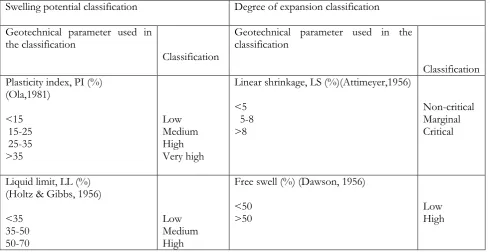
Table 6: General guideline for swelling potential and degree of expansion classification of expansive soils based on various geotechnical parameters.
Swelling potential classification Degree of expansion classification
Geotechnical parameter used in the classification
Classification
Geotechnical parameter used in the classification
Classification Plasticity index, PI (%)
(Ola,1981)
<15 15-25 25-35 >35
Low Medium High Very high
Linear shrinkage, LS (%)(Attimeyer,1956)
<5 5-8 >8
Non-critical Marginal Critical
Liquid limit, LL (%) (Holtz & Gibbs, 1956)
<35 35-50 50-70
Low Medium High
Free swell (%) (Dawson, 1956)
<50
International Journal of Applied Science and Research
88
www.ijasr.org Copyright © 2019 IJASR All rights reserved>70 Very high
Activity of clay (Skempton, 1953)
>0.75 0.75-1.25 >1.25
Low Medium High
4.2.3. Linear Shrinkage Limit
Linear shrinkage is one of the important geotechnical parameter used to determine the degree of expansion of soils. The possibility of recognizing expansive soil with linear shrinkage was proposed by Kantey & Brink (1952). The linear shrinkage of the studied soils form Imo Shale ranges from 10.70 to 17.90% with an average of 14.54% while samples from Ameki Formation range from 10.70 to 20.00% with an average of 16.20%. This high value of linear shrinkage maybe due to the high plasticity of the soils and it implies that the studied soils have the affinity/tendency to swell when in contact with water and shrinks when dried.
Thus, the result indicates that the degree of expansion of the studied soil samples from both Imo Shale and Ameki Formation have critical value using linear shrinkage (Attimeyer, 1956) and thus, do not conform to Federal Ministry of Works and Housing (1997) specification for linear shrinkage.
4.2.4. Free swell
The free swell value of the studied soil samples is another important geotechnical parameter used to estimate for the degree of expansion of the expansive soils. The free swell values of the studied soils derived from Imo Shale ranges from 62.00 to 71.00% with an average of 66.80% while those samples derived from Ameki Formation ranges from 53.00 to 58.00% with an average of 55.67%.
Expansive soil samples derived from both Imo Shale and Ameki Formation have high degree of expansive because they have free swell values >50% (Dawson, 1956; FMWH, 1997).
4.2.5. Natural moisture content
The natural moisture content of soils has much to say about soil type. Clay soils absorb and retain more water than saturated sandy soil because sandy soils are more permeable and porous than clay soils and as such, clay soil retains/traps more water than sandy soil. The result of the natural moisture content on the studied soils derived from Ameki Formation ranges from 25.60 to 30.60% with an average of 27.67% while samples derived from Imo Shale ranges from 23.40 to 28.80% with an average of 25.92% which indicates that they are fine grained soils with great affinity to absorb moisture. It also shows low transmisivity and high compressivity from the plot on the Casagrande plasticity chart (Figure 5). The high affinity for moisture in the studied soils indicates the presence of minerals like montmorillonite, kaolin, illite etc. which attracts water molecules to get attached on the surface of clay soils.
Generally, the studied soils derived from both Ameki Formation and Imo Shale confirms that the soils are highly expansive and as such are not suitable for subgrade and foundation materials in engineering construction because they exceed the permissible limit of between 5 to 15% according to Weltman and Head (1983).
4.2.6. Bulk Density
Bulk density of a soil depends primarily on soil organic matter, soil texture, density of soil mineral (sand, silt, and clay) and their packing arrangement (degree of compaction) and the bulk density of a mineral soil are between 1.00 and 1.60Mg/m3. Loose, well-aggregated, porous soils and those rich in organic matter have lower bulk
density while sandy soils have relatively high bulk density because total pore space in sands is more than silt or clay soils. Bulk density typically increases with soil depth since subsurface layers are more compacted and have less organic matter, less aggregation, and less root penetration compared to surface layers, therefore contain less pore space. Paige-Green (2007) states that low bulk density value of <2.6 Mg/m3 for a construction material is highly
International Journal of Applied Science and Research
89
www.ijasr.org Copyright © 2019 IJASR All rights reservedThe Bulk Density of the studied derived soils form Imo Shale ranges from 1.05 to 1.29 Mg/m3 with an average of
1.19 Mg/m3 while the samples derived from Ameki Formation ranges from 1.04 to 1.14 Mg/m3 with an average
of 1.10 Mg/m3. Base on Paige- Green (2007) Facts, the studied soils have low permeability and porosity due its
high compaction because it have more of finer materials than coarse material. Generally, the studied soils from both geologic Formations are not suitable for construction purposes.
4.2.7. Specific gravity
Thestrength of a soil mass is directly proportional to its specific gravity. The higher the specific gravity of a soil, the more the strength is increased and the lower the specific gravity of a soil, the more the strength decreases. In essence, the specific gravity of soils largely depends on the density of the minerals and chemical making up of the individual soil particles (Oyediran & Durojaiye, 2011). The specific gravity of soils reflects the history of weathering (Tuncer & Lohnes, 1977) and it is also used in mineral classification of soils (Bowles, 2012). The specific gravity of a soil also gives an idea of the suitability of the soil for construction purposes in the sense that the higher the specific gravity value of a soil, the more the shear strength parameters (cohesion, angle of shearing resistance and California bearing ratio) and the more considerable/recommendable the soil is for construction purposes because it gives more strength for roads construction and foundations (Roy & Dass, 2014; Roy, 2016). Wright (1986) classified that the standard range for specific gravity of soils should be between 2.60 and 2.80 while FMWH (1997) specified a specific gravity value of 2.2 as suitable for construction purposes.
Based on the studies, the specific gravity of the studied soils derived from Ameki Formation ranges from 2.62 to 2.65 with an average of 2.64 while those derived from Imo Shale ranges from 2.63 to 2.71 with an average of 2.67 which indicates that the studied soils are inorganic soil.
Table 7: Range of specific gravity by ASTM D854-92 and Bowles (2012)
Soil type Range of specific gravity specified by
ASTM D854-92 and Bowles (2012) Iron-rich or mica laterite (eg lateritic soils) 2.67-3.00
Sand 2.65-2.67
Silt 2.67-2.70
Clay and silty clay(inorganic) 2.67-2.80
Organic soil 1.00-2.60
4.2.8. Dry Density
Dry density of a soil depends on the structure of the soil matter (compacted or loosen) and the soil matrix swelling and shrinkage characteristics. The dry density of the samples derived from Imo Shale range from 0.82 to 1.03Mg/m3 with an average 0.95Mg/m3 while that of Ameki Formation ranges from 0.83 to 0.89Mg/m3 with an
average of 0.85 Mg/m3. Using Hillel (1980), the dry density of the studied soils falls within aggregated loam and
clayey soils because he reported that dry density of soils can be as high as 1.6g/m3 in sandy soils while in
aggregated loam and clayey soils, it can be as low as 1.1g/m3.Comparing the studied soils with Poffijn (1988)
specifications for dry density, the values of dry density of the studied soils falls within range of clay. The highest value of dry density of 1.03g/m3 was observed at Imo Shale (Ufuma) while the lowest value of 0.82g/m3 was
observed at Ameki Formation (Enugwu-Agidi).
4.2.9 Particle Size Distribution and Soil Classification
International Journal of Applied Science and Research
90
www.ijasr.org Copyright © 2019 IJASR All rights reserveddegree of expansiveness with respect to particle size distribution curve, Chen (1975) established that a soil with more than 95% passing through No.200 BS sieve and more than 60% liquid limits have degree of expansion. All the soil samples analyzed have liquid limit >60% and >60% passing through No.200 BS sieve which supports that they are expansive in nature. These observations tend to support the fact that all the studied soil samples are problematic soils because they have more fine-grained than coarse-grained materials. Also evaluating the results of the studied soils using Federal Ministry of Works and Housing (1997) specification, all the studied soil samples are not suitable for subgrade and sub-base materials as the percentage by weight finer than No.200 BS test sieve is >35%.
Figure 7: Particle Size Distribution Curve of expansive soils derived from Ameki and Imo Shale in Awka and environs
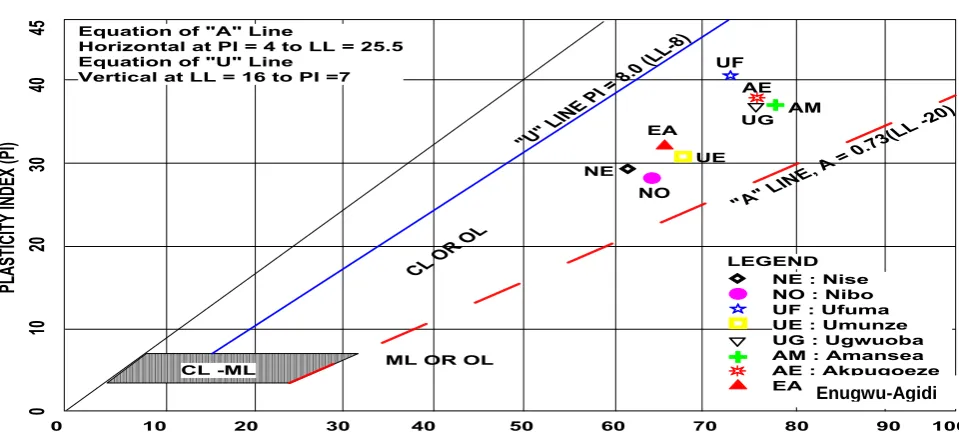
Casagrande (1948) classified soils with 50% passing sieve No. 200, liquid limit of more than 50% and PI plots above the “A” and “U” line as CH soils (inorganic fat clays). A plot of the entire soil sample on the Casagrande plasticity chart indicates that all the soil plots between the “A’’ and “U” line which is the boundary for clays. They plot as CH soils (clay with high plasticity) which indicate that they are problematic soils for engineering constructions. Using AASHTO soil classification for highway (1967), the studied soils from both geologic Formations are poor soils (fall within A-7 group) for both sub-grade and sub-base material because they have percentage passing sieve No. 200 >35%.
Enugwu-Agidi
International Journal of Applied Science and Research
91
www.ijasr.org Copyright © 2019 IJASR All rights reservedFigure 8: Identification and classification of expansive soils derived from Imo Shale and Ameki Formation in Awka and environs using Casagrande Plasticity Chart.
4.2.10. Compaction characteristics
The compaction test of the studied soils indicates that maximum dry density (MDD) of the expansive soils derived from Ameki Formation ranges from 1.49 to 1.67Mg/m3 with an average of 1.59 Mg/m3 while the samples
derived from Imo shale ranges from 1.40 to 1.75Mg/m3 with an average of 1.58Mg/m3 and the optimum
moisture content (OMC) of the expansive soils derived from Ameki Formation ranges from 17.70 to 27.00% with an average of 22.90% while the samples derived from Imo shale ranges from 18.10 to 24.30% with an average of 21.82%. Bello et al., (2007) and Madedor (1983) characterized soil samples with high maximum dry density (MDD) and low optimum moisture content (OMC) as suitable for sub-grade and sub-base materials while Federal Ministry of Works and Housing (1997), characterized soils with OMC value of <18% and MDD value of >0.047 Mg/m3 as suitable for both sub-grade and sub-base materials. Thus, the soil samples derived from both Imo Shale
and Ameki Formation are not suitable to be used as sub-grade or sub-base Materials because they have low MDD value and high OMC value.
4.2.11. California Bearing Ratio Test
The CBR test quantitatively evaluates the inherent strength of a subgrade for a road pavement to be designed for a particular strength of subgrade. The higher the CBR value of soils, the more recommendable the soils to be used as subgrade and sub-base materials.
The California Bearing Ratio (CBR) test of the studied soils indicates that the unsoaked CBR value of expansive soil samples derived from Ameki Formation 12 to 18.00% with an average of 16% while the samples derived from Imo Shale ranges from 10.00 to 15.00% with an average of 13% and the soaked CBR value of expansive soil samples derived from Ameki Formation 1.00 to 2.00% with an average of 2.00% while the samples derived from Imo Shale ranges from 2.00 to 3.00% with an average of 3.00%. FMWH (1997) recommend soaked CBR value of minimum of 15% and unsoaked CBR value of minimum 40% for highway subgrade.
In general, the studied soils yield poor CBR values which are not likely to provide a stable compacted sub-grade and sub-base materials. This reduction in CBR value in the study area could be as a result of high amount of clayey soil, poor laterization and ingress of groundwater flow due to poor maintenance of drainage facilities in some of the studied area. Thus, the studied soils in terms of strength are not suitable to be used as subgrade and foundation materials in engineering construction.
5.0. Conclusions and Recommendations
Expansive soils derived from different geologic formations in Awka area were investigated in terms of their geotechnical characterization. The result of the geotechnical characterization of the expansive soils derived from Ameki Formation and Imo Shale generally have high to very high swelling potential respectively using liquid limit and plasticity index values (Holtz & Gibbs,1956; Ola, 1981) and medium to high activity using activity of clay
International Journal of Applied Science and Research
92
www.ijasr.org Copyright © 2019 IJASR All rights reservedvalues (Skempton, 1953) but Federal Ministry of Works and Housing (1997) recommend liquid limit of 40% maximum and plasticity index value of 20% maximum as suitable for subgrade material but none of the studied expansive soils meets the required specification.
Generally, on the basis of degree of expansion using linear shrinkage and free swell values (Attimeyer, 1956; Dawson, 1956) both geologic Formations have critical (linear shrinkage) and high (free swell) degree of expansion. Based on their plots on the Casagrande plasticity chart (PI and LL), they are classified as CH soils with more than 50% liquid limit, and plots between the “A” and “U” line (Casagrande, 1948) and they are poorly graded soil materials (USCS).
Generally, the study proved actually that geotechnical properties such as liquid limit, plasticity index, activity of clay are responsible for the high to very high swelling potential of the soils while linear shrinkage and free swell are responsible for the critical and high degree of expansion of the soil thereby affecting the strength characteristics of the studied soils using CBR and MDD values.
Acknowledgement
The authors hereby express their profound gratitude to laboratory staff of Arab Contractor Owerri, Imo state branch and Institute of Erosion Studies Federal University of Technology Owerri (FUTO) for their assistance in laboratory analysis of the soil samples.
References
1. Adegoke, O. S. (1969). Eocene stratigraphy of southeastern Nigeria. Colloquesur 1‘ Eocene; 111.Bureaue de Recherchedde groloiques et minieres 69 22-48.
2. Al-Rawas, A.A., Taha, R., Nelson, J.D., Beit Al-Shab, T. & Al-Siyabi, H. (2002). A comprehensive evaluation of various additives used in the stabilization of expansive soils. Geotechnical testing journal, GTJODJ, ASTM; 25(2): 199-209.
3. American Association of State Highway and Transportation Official, (1967). The AASHTO road test, highway research board of the NAS-NRC division of engineering and industrial research, Report5, special report 61E, Washington D.C., USA.pp:90-100.
4. Arua, I. (1986). Paleoenvironmental of Eocene deposit in the Afikpo syncline, Southeastern Nigeria. Journal of African Earth science 5, 279-284.
5. ASTM D4381 (2012). Standard test methods for sand content by volume of Bentonitic slurries.
6. ASTM D854-10 (2010). Standard test method for specific gravity of soils by water pycnometer. ASTM international West Conshohocken, PA USA.
7. ASTM D854-92 (1992). Test method of specific gravity of soils.
8. ASTM D4943-89 (1992). Standard method for shrinkage factors of soils by the wax method. Annual Book of ASTM standards, Volume 04.08
9. Attimeyer, W.T. (1956). Discussion of engineering properties of expansive soils by Holtz, W.G. and Gibbs, H.G. (1956). Trans. ASCE, 21, 666-669.
10. Bailey, M.J. (1976). Degradation and other parameters related to the use of shale compacted embankments. Joint Highway Research Project No. 23, Purdue University and Indiana State Highway Commission pp: 209.
11. Bell, F.G. (1993). Engineering treatment of expansive soils. Chapman and Hall, London.
12. Bell, F. G. (2007). Engineering geology, 2nd edition, Elsevier science publishers, Oxford, United Kingdom.
13. Bello, A.A., Ige, J.A. & Tajudeen, S. (2007). Geotechnical characterization of lateritic soils in parts of Ejigbo local government area, Southwestern Nigeria. LAUTECH J. Engr. Technol. 4(2): 34-38.
14. Berggen, W. A. (1960). Paleocene Biostratigrahy and planktonic foraminifera of Nigeria (West Africa). International Geological Congress, Copenhagen, Report 21 (6), 41-55.
15. Bowles, J.E. (2012). Engineering Properties of Soils and their Measurements, 4th edition, McGraw Hill Education (India) Private Limited, New Delhi.
16. Braga, M. D. (1996). Principles of foundation engineering. 4th Edn, PWs Pacific Groove USA, pp 203-210.
17. British Standard (BS) 1377-part 2, (1990). Methods of testing soils for Civil Engineering purposes. British Standards Institution, London.
International Journal of Applied Science and Research
93
www.ijasr.org Copyright © 2019 IJASR All rights reserved19. Chen, F.H. (1975). Foundations on expansive soils. Developments in geotechnical engineering 12. Elsevier scientific publishing company, Amsterdam. Compaction Handbook (2008). Soil compaction-soil types, method, and compaction techniques.
20. Craig, R.F. (1992). Soil mechanics 4th Edn, champion and Hall London, pp: 146-148.
21. Dawson, R.F. (1956). Discussion of engineering properties of expansive soils by Holtz, W.G. and Gibbs, H.J. ASCE trans., vol.121, pp.644-666.
22. Ezeigwe, P. C. (2015) Investigation of the Characteristics of the Soils behind the Proposed Governors Lodge, Ekwueme Square Awka and the Environmental Hazards Prevalent in the Area. Journal of Natural Sciences Research www.iiste.org. ISSN 2224-3186 (Paper) ISSN 2225-0921 (Online) Vol.5, No.20, 43. Federal Ministry of Works, (1970). Specification for roads and bridges in Nigeria. 2, 137-275.
23. Federal Ministry of Works and Housing (1997). Nigerian General Specifications for Roads and Bridges (Revised Edition), 2, 137-275.
24. Gromko (1974) Review on expansive soil. Journ. ASCE, Geotechnical Div., Vol. 100, GT6, pp. 667-687. 25. Harry, A.T. (1974) Geologic origin and distribution of swelling soils. Bull. Asso. Of Eng. Geologists, 4,
259 – 275.
26. Hillel, D. (1980). Application of soil Physics. Academic press INC: New York.
27. Holtz, W.G and Gibbs, H.G. (1956). Engineering properties of expansive soils. ASCE Trans., No.121, pp, 641-677.
28. Jones, D.E. and Holtz, W.G. (1973). Expansive soil-the Hidden Disaster. Civil Engineering, vol.43, No.8, pp.49-51.
29. IS: 2720, Part 40 (1997). Determination of Free Swelling Index of Soils. Bureau of Indian Standards, Manak Bhavan, New Delhi
30. Kantey, B.A. and Brink, A.B.A (1952). Laboratory criteria for the recognition of expansive soil, Bull. No. 9, National building research South African Council for scientific and industrial research.
31. Kerrane, J.P. (2013). What are Expansive Soils. pdf http://www. bensonpc.Com/ downloads/public 32. Kogbe, C.A. (1989). Geology of Nigeria: Rock View Ltd, pp.366-368.
33. Madedor, A. O. (1983). Pavement design guidelines and practice for different geological areas In Nigeria: Ola, S. A. (Editor). Tropical soils of Nigeria in engineering practices Balkema Publishers, Rotterdam, Netherlands, Pp: 291-298.
34. Mode, A.W. (2004). Shallow marine transgressive sedimentation in the Nsukka Formation, Southeastern Anambra Basin, Nigeria. NAPE Bull. 17(1), 28-41.
35. Nigerian Metrological Agency (NMA) (2007). Rainfall data of towns in Nigeria. Federal Ministry of Aviation, Abuja, Nigeria.
36. Nwajide, C. S. and Reijer, T. J. A. (1996). Geology of southern Anambra basin. In Reijer T. J. A. (Ed.). Selected chapters of Geology SPDC, Warri, pp. 133-148.
37. Nwajide, C. S. (1990). Cretaceous sedimentary and paleogeography of the central Benue trough. In: Ofoegbu, C. O. (Ed.), The Benue Tough structure and Evolution international monograph series, Braunschweig, pp.19-38.
38. Offodile, M.E. (1975). A review of the creteacous of the Benue valley. In: geology of Nigeria (C.A. Kogbe ed.). Elizabethau publishing company Nigeria, 319-330.
39. Okeke, O.C. and Igboanua, A.H. (2003). Characteristics and quality assessment of surface water and groundwater resources of Awka town, SE Nigeria. W. Res. J. 14:71-77.
40. Okeke, O.C. (2008). Distribution, characterization and improvement of expansive soils in parts of southeasternNigeria for engineering construction. Unpublished Ph.D. Thesis, University of Nigeria, Nsukka, Nigeria.
41. Okeke O.C. and Okogbue, C.O., (2010). Distribution and geotechnical properties of expansive soils in parts of Southeastern Nigeria. J. Min. and Geol., 46(1), 13-31.
42. Ola, S.A. (1981). Mineralogical properties of some Nigerian residual soils in relation with building problems. Eng. Geol., 19, 133 – 148.
43. Owolabi, T.A. and Aderrinola, O.S. (2014). An assessment of Renolith on cement-stabilized poor lateritic soils. Sci-Afric journal of scientific issue, research and essays. 1st Academia publishing London. Vol. 2(5).
44. Oyediran, A. and Durojaiye, H.F. (2011). Variability in the geotechnical properties of some residual clay soils from south western Nigeria, IJSER, 2 (9), 1-6.
International Journal of Applied Science and Research
94
www.ijasr.org Copyright © 2019 IJASR All rights reserved46. Poffijn A.; Berkvens, P. Vanmarcke, H. & Bourgoignie, R. (1988). On the exhalation and diffusion characteristics of concrete, radiation protection dosimerty 24, 203-206.
47. Reyment, R. A. (1965). Aspects of the Geology of Nigeria. Ibadan univ. Press, 133pp.
48. Roy, S. and Dass, G., (2014). Statistical models for the prediction of shear strength parameters at Sirsa, India, I. Journal of Civil and Structural Engineering., 4(4), 483-498.
49. Skempton, A.W. (1954). A found failure due to clay shrinkage caused by popular trees. Proc. Inst. C.E., v. 3, p.66-85.
50. Spangler, M.G. and Handy, R.L. (1973). Soil engineering (3rd edition). Harper and row publishers, New
York.
51. Steinberg, M.L. (1992). Geogrids as a Rehabilitation Remedy for Asphaltic Concrete Pavements. TRR-1409, 54-62.
52. Tuncer, E.R. and Lohnes, R.A. (1977). An engineering classification for basalt-derived lateritic soils. Eng. Geol., 4,319– 339.
53. U.S Army, (1983). Foundations in expansive soils, Publication of Headquarter, United State Army Corps of Engineers TMS-818-7 Washington D.C.
54. US Bureau of reclamation (USBR), (1963). Earth manual U.S. government printing office, Washington D.C.
55. Venkatramaiah, C. (2006). Geotechnical engineering. New Age International Publishers, New Delhi, India.
56. Weltman, J. and Head, J.M. (1983). Site investigation manual construction industry research and information association London.
57. Whitlow, R. (1995). Basic soil mechanics. 3rd Edn, addison Wesley Longman Edinburgh gate, pp: 44-48. 58. Wilson, R. C. (1925). The Geology of Eastern Railway. Bull. Geol. Survey Nig., 19:95-102.
59. Wright, P. H. (1986). Highway Engineering, Sixth Edition. John Willey and Sons: New York, NY.