http://www.ijcmph.com pISSN 2394-6032 | eISSN 2394-6040
Original Research Article
Morbidity profile of the patients attending the health camp in
Ramanagar district, Karnataka
Savita S. Patil, Jayashree S. Seeri*, Narayana Swamy D. M.
INTRODUCTION
The WHO defines Health as “A state of complete physical, mental and social well-being and not merely an absence of disease or infirmity.”1
Medical camps in various specialities on a regular basis are very popular in the developing countries. In the developing and under developed countries, majority of the population live in the rural areas. Until the development of nationwide health service in the remote and rural areas, the medical camps or outreached clinics will have great importance. The medical camp conducted once in a while is useful in
providing curative and preventive and screening services.2 The health of an individual does have a direct relationship with human resources development and economic development of a nation. Throughout the country the spread and accessibility of medical care has improved substantially. Still a high level of morbidity has been seen in India, despite huge efforts to improve the health.3 Considering the diverse nature of the state, there are some limitations in arriving at the exact nature of the illness pattern in a specified geographical area.4 Health services should not be restricted to curative services and should include preventive, rehabilitative, palliative and should be sufficient to meet the health needs both in
ABSTRACT
Background: Free health camp is an important means to cater health services to the needy people in an underdeveloped county like India with difficult geographical terrain. The objective of this study was to assess the morbidities of patients attending the free health camp in Ramanagara District, Karnataka.
Methods: A cross sectional descriptive study was conducted at free health camp in Jogaradoddi, Ramanagara District, Karnataka, by the staff and interns of department of community medicine of a medical college. All the individuals who attended the camp were included in the study. Patients who attended the health checkup camp were assessed for morbidity. Data collected by semi structured questionnaire was entered into Microsoft Excel and analyzed using SPSS version-17.0.
Results: A total of 123 patients visited the health camp, among them 68(55.28%) of them were males and 55 (44.71%) were females. 41 (33.8%) were in the age group of 21-30 years. Majority were skilled workers with 30(26.1%), 18 (15.7%) were unemployed and only 1 (0.9%) were professionals .About 47 (46.1%) had normal body mass index, 26 (25.5%) were overweight, 10 (9.8%) were obese and 19 (18.6%) were underweight. It was observed that diseases with musculoskeletal system and gastrointestinal system were reported among 35 (28.5%) and 20 (16.3%) of the attendees respectively, 9 (7.7%) individuals presented with hypertension, 6 (5.5%) with diabetes mellitus.
Conclusions: The study helped identify the common diseases in the selected area, improve the health, provide counselling and create awareness at the community level.
Keywords: Health profile, Morbidity, Health camp
Department ofCommunity Medicine, BGS Global Institute of Medical Sciences, Bangalore, Karnataka, India
Received: 08 March 2019
Accepted: 04 April 2019
*Correspondence:
Dr. Jayashree S. Seeri,
E-mail: [email protected]
Copyright: © the author(s), publisher and licensee Medip Academy. This is an open-access article distributed under the terms of the Creative Commons Attribution Non-Commercial License, which permits unrestricted non-commercial use, distribution, and reproduction in any medium, provided the original work is properly cited.
quality and quantity (WHO, 2015). Free health camps provides adequate health personnel to provide integrated health services at community level and provides information on heath profile of the community.5 Free health camps are the sole source of health care in some rural communities and its importance has been demonstrated in various areas. With this background, the study was planned with the main objective of identifying the reported morbidity and the socio demographic profile of people attending the camp.
METHODS
Ethical clearance was obtained from the institution ethical committee. A cross sectional descriptive study was conducted in field practice area of rural health training centre of a medical college by the staff and interns of Department of Community Medicine with a view of obtaining an overview of population’s health by conducting a general health check-up camp at Jogaradoddi village, Ramanagara Taluk in the year 2018. Wide publicity was given in the camp area 2-3 days prior to the camp date to mobilize maximum people suffering from illnesses. All the individuals who attended the camps were included in the study. An oral informed consent was obtained from the patients. Patients who attended the health check-up camp were assessed for morbidity. A semi structured, predesigned questionnaire was used for data collection comprising of socio-demographic information, general physical examination, vital parameters and anthropometric measurements required to perform the study were used. Patients who attended the health check-up camp were assessed for
morbidity. Anthropometric measurements included
height, weight and waist circumference, hip
circumference for adults. Height was measured using a portable stadiometer, weight was measured using electronic weighing machine and a non-stretchable tape was used to measure the various circumferences. From the above data, body mass index (BMI) and waist: hip ratio (WHR) were calculated and classified according to
WHO protocol (>0.9 for males and >0.85 for females). These were used as an estimate of obesity which was further classified using who guidelines. However for statistical analysis, obesity classes I, II and III were clubbed as obesity, blood pressure was recorded using a digital sphygmomanometer, screening for diabetes mellitus was carried out by random blood sugar levels estimation using a digital glucometer.(For statistical analysis purpose children under the age of 0-15 were excluded for BMI and W/H ratio calculation).
Statistical analysis
Data collected was entered into Microsoft Excel spread sheet and analysed using SPSS version-17.0 software. Descriptive data tables were generated, for quantitative data, means with standard deviation and for qualitative data, proportions were computed. Appropriate tests of significance like Chi-square/Fisher exact test to find the association between variables were applied. A p value ≤0.05 was considered statistically significant.
RESULTS
The general population who attended the camp were 123 subjects. Mean age of female patients was found to be 33.05±20.57 years and of males 28.11±15.45 years. All the study subjects belonged to Hindu religion. About 30 (25.2%) had their education till PUC or intermediate degree and 26 (21.8%) were illiterate, only 6 (5%) were graduates. About 71 (57.7%) belonged to nuclear families and 18 (14.6%) were residing in joint families. Majority of the population belonged to the upper class, 42 (51.2%) and 7 (8.5%) of them belonged to upper lower class and 10 (12.2%) were from lower class.
Majority of the patients belonged to the age group of 16-30 years with 41 (33.4%), followed by 32 (26%) between 0-15 year children, the geriatric patients were 9 (7.4%). Majority who attended the camp were males 68 (55.2%) whereas females were 55 (44.7%) (Table 1).
Table 1: Age-sex distribution of study population (n=123).
Age Female % Male % Total %
0–15 12 21.8 20 29.4 32 26.0
16– 30 14 25.4 27 39.7 41 33.4
31–45 10 18.1 9 13.2 19 15.4
46–60 12 21.8 10 14.7 22 17.8
>60 7 12.7 2 6.9 9 7.4
Total 55 44.71 68 55.28 123 100.0
Total of the 115 subjects (children below the age 10 years were excluded), majority were skilled workers 30 (26.1%), professionals were 1 (0.9%) and 18 (15.7%) were unemployed (Figure 1).
Nearly 47 (46.1%) had normal body mass index, 26 (25.5%) were overweight, 10 (9.8%) were obese and 19 (18.6%) were underweight (Table 2).
Table 2: BMI status of study population (n=102*).
*n=102 (paediatric age group were excluded).
Table 3: Obesity among study population (n=102).
Obesity Female
N (%)
Male N (%)
Total N (%) High BMI
(≥25) 19 (51.4) 18 (48.6) 37 (30.1) High W/H
ratio 34 (63.0) 20 (37.0) 54 (43.9)
Figure 1: Occupational status of study population (n=115*).
*(Children below the age 10 years were excluded).
Table 4: Morbidity pattern of the study population (n=123).
Systems involved Morbidity/conditions No. of patients Percentage (%)
Musculoskeletal Polymyalgia, osteoarthritis 35 28.45
Gastrointestinal Gastritis, diarrhoea, worm infestation 20 16.26
Respiratory
Upper and lower respiratory tract infection, bronchial asthma, allergic bronchitis,
chronic obstructive pulmonary disease 18 14.63
Skin
Eczema, candidiasis, phrynoderma,
ringworm infection, seborrhoea, urticaria 12 9.75
Others Anxiety disorder, dental caries, fever for
evaluation 9 7.3
Eye Cataract, allergic conjunctivitis, myopia 8 6.5
Nutritional Anaemia, vitamin deficiency, 8 6.5
Obstetrics and gynaecology
Dysmenorrhoea, chronic cervical spasm,
vaginitis, warts 5 4.06
Ear, nose and throat Sinusitis, tonsillitis, acute and chronic
suppurative otitis media 6 4.89
Existing co-morbidity Hypertension 9 7.2
Diabetes mellitus type II 6 4.8
Diabetes mellitus type II and hypertension 2 1.6
Cardiovascular Cardiac failure, angina 4 3.25
26.1% 13%
25.2% 1.7%
0.9%
17.4% 15.7%
0 5 10 15 20 25 30 35
Skilled Semiskilled Unskilled Semi-professional Professional House wife Unemployed
No. of Patients
BMI No. of patients %
Underweight 19 18.6
Normal 47 46.1
Over weight 26 25.5
Obese 10 9.8
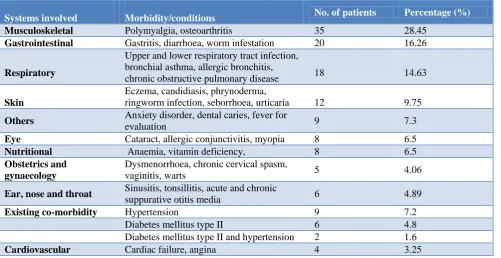
Majority of the patients had musculoskeletal system involvement with 35 (28.45%) such as myalgia and osteoarthritis, followed by gastrointestinal system disorders with 20 (16.26%), respiratory system diseases with 18 (14.63%). Nutritional deficiencies and eye involvement in the elderly contributed to 8 (6.5%) of the total disease burden of the population. The major non communicable diseases diabetes mellitus type II and hypertension were 9 (7.2%) and 6 (4.8%) respectively (Table 4).
DISCUSSION
The present study was conducted with the objective of identifying the reported morbidity and the socio demographic profile of people attending the camp. We found majority of the patients in the productive age group between 16-30 years and is consistent with studies in Tamilnadu, Ghaziabad and in Nepal respectively.6-8 Where as in Sanjay Kini study, above 60 years comprised the highest and Niranjan study in Karnataka found majority (50.6%) were in the age group of 15–45 years, followed by 45–60 years (16%) and 13% were above 60 years of age.9 In the present study geriatric patients constituted around 9 (7.4%) which is comparably lesser to study by Gopalakrishnan et al and Mane et al.4,6 In the current study, it was found that more than half of the patients were males 68 (55.28%) and females were 55 (44.71%). Similar age pattern was observed by Sanjay et al and Santosh et al in Srinagar.5,10 Among the study subjects, majority had studied intermediate and higher degrees with male literacy rate more than the women and is similar to the study by Mane et al and Raj Kumar et al study in Nepal.6,11
With regard to morbidity pattern of the patients who presented, majority had musculoskeletal disorder with 35 (28.5%), followed by gastrointestinal disorders 20 (16.2%) respiratory diseases around 18 (15%), skin 12 (10%), least reported cases were cardiovascular with 4 (3%). Similar pattern was observed by Rayamajhi in Nepal, Venkatashivareddy study in Uttarakhand, and Rouf et al in north India where they noticed hypertension was 7%.8,12,13 In another study by Santosh et al in Srinagar where they found the leading cause of non-communicable diseases was found to be musculoskeletal system and connective tissue.10 Gopakrishna et al study result showed that majority of the people had illness affecting the respiratory system, symptoms and signs, musculo-skeletal system and digestive system in the order of the proportion affected.4 Where as in Mane et al study respiratory followed by gastrointestinal, non communicable diseases around 4 to 8% were reported.6 Sehgal study in Ghaziabad reported maximum of eye diseases, followed by respiratory diseases (10.06%), gastrointestinal diseases (6.20%), bone and joint diseases (5.86%) and CVS diseases (5.20%).7 Gupta et al in Puducherry found musculoskeletal pain as most common
NCD followed by hypertension.13 A study in Ahmedabad
city showed mainly musculoskeletal disorders,
respiratory disorders and digestive disorders. Their contribution was more than 50 % of the reported morbidity.15 Highest reported cases were hypertension, digestive system in a study by Sanjaya et al Mangalore district.5 Niranjan et al study in Karnataka found hypertension and diabetes 8%.9 Deepak et al study found acute respiratory tract infections as most common communicable disease followed by skin infections and GIT infections. Among non-communicable diseases, hypertension followed by diabetes mellitus were the most common ones.16 In the present study around 37 (30.1%) of the total population were found to have obesity, of which 19(51.4%) were females and 18(48.6%) were males which is consistent with study in Nepal.8
The variation in findings of different studies with regard to variables like sociodemographic, morbidity pattern may be due to a wide variation in the morbidity profile of the people in different states as well as within the states and inequitable distribution of the population between urban and rural areas and peculiar pattern of morbidity incidental to the geographic location and season.
CONCLUSION
Free health camp not only conducts curative services and awareness programs but also provides screening programs for various diseases and referral to higher centre for further management. Health camps helps to improve health by counselling and raising awareness programs at community level to encourage health utilization at health institutions; referral for complicated cases addressing and integrating health issues of minorities and indigenous people in the general health programme. Health camps conducted with good planning and in a very systematic manner can be more useful for the rural population of our country.
ACKNOWLEDGEMENTS
Principal, interns and Dr Veena V Asst professor community medicine, Mr Mohan MSW, BGS Global Institute of Medical Sciences Bangalore.
Funding: No funding sources Conflict of interest: None declared
Ethical approval: The study was approved by the Institutional Ethics Committee
REFERENCES
1. Park K. Textbook of Preventive and Social
Medicine. 24th ed. Jabalpur; 2017:14-15.
2. Karki DB, Dixit H, Neopane A. Medical camps and
their usefulness. Kathmandu University Med J. 2005;3(12):449-50.
3. Deshpande RV. Morbidity Differentials in Rural
4. Gopalakrishnan S, Ganeshkumar P, Ajitha K. Study of Morbidity Profile of a Rural Population in Tamil Nadu. J ClinDiagn Res. 2015;9(2):5-9.
5. Sanjay K, Shankar S, Nishanth K, Navya, Sudharani
N, Priyadarisini M. Morbidity Profile Of Patients Attending Health Camp At Mahamasthakabhisheka Festival At Karkala, Karnataka. International J Curr Res Life Sci. 2015;4(9):380-2.
6. Mane V, Markam J, William RF, Vidya DC.
Socio-demographic profile and pattern of illness among patients attending outpatient department of a tertiary care hospital in Tamil Nadu. IJCMPH. 2016;3:476-81.
7. Ravi Kant S, Garg R, Sharmila A, Dhot PS. The Analysis of the Rural Outreach Programme of a Tertiary Care Hospital in Ghaziabad and the Morbidity Profile of Out-Patients attending the
Programme. J Evol Med Dental Sci.
2015;4(55):9561-7.
8. Rayamajhi RB, Yadav DK, Ghimire A, Khanal VK,
Tamrakar D, Shrestha A. A Descriptive Study On Morbidities Of Patients Attending Free Health Camp In Sankhejung Vdc Of Ilam District, Nepal. J Chitwan Med Coll. 2013;3(6):48-51.
9. Niranjan GV, Deepa LN, Meundi AD, Menzil M,
Kurre B. Morbidity profile of a rural and an urban population in South India. Int J Med Sci Public Health. 2018;7(11):869-73.
10. Santosh K, Haroon AS, Kumar A, Abhisek R.
Morbidity Pattern among Out-Patients Attending Urban Health Training Centre in Srinagar. International J Public Health Sci. 2018;7(1):1-7.
11. Raj Kumar T, Parbati T, Kalpana PB, Muhammad GK. Disease proportions and drug prescribing pattern observed in a free health camp organized at Dhorphirdi Village Development Committee of Western Nepal. BMC Res Notes. 2015;8(494):1-6.
12. Venkatashivareddy B, Arti G, Amit Kumar S.
Health camp profile and its cost in Hilly terrains, North India. Clinical Epidemiol Global Health. 2015;3(101):102-6.
13. Abdul R, Mahbooba R, Salim SM, Mariya A,
Sheikh MS. Morbidity Pattern among Patients Attending Urban Health Centre in North India. JMSCR. 2017;5(8):265-74.
14. Gupta A, Chellaiyan V, Lohiya A. Morbidity profile
of out-patients at-tending a primary health centre in rural Puducherry, South India. Natl J Community Med. 2014;5(4):424-7.
15. Rajesh M, Niraj P, Reena P. Morbidity profile of Brick Kiln workers around Ahmedabad city, Gujarat. Healthline. 2010;1(1):41-4.
16. Deepak U, Arun S, Hari Shanker J, Medhavi A, Rashmi K. Study of patterns of diseases among patients attending the out-patient department at urban health and training centre of a Medical College in India. International J Biomedical Res. 2017;8(8):455-60.