https://dx.doi.org/10.24001/ijaems.3.6.14 ISSN: 2454-1311
Experimental study and calculation of the
electron transfer coefficients on the dissolution
behavior of chitosan in organic acids
Prudencio Fidel Pacheco-García
1, Andrea Perez-Gonzalez
2, Alejandra Ramos-Flores
2,
Lillhian Arely Flores-Gonzalez
2, Juan Manuel Lopez-Oglesby
2, Manuel Gonzalez-Perez
2 1Departamet of Graduate Manufacturing and Quality, Universidad Popular Autónoma del Estado de Puebla (UPAEP), PueblaMéxico
2Department of Graduate Biomedical Engineering, Universidad Popular Autónoma del Estado de Puebla (UPAEP), Puebla
México
Abstract—Chitosan (CH) consists of water-insoluble N-acetylglucosamine and D-glucosamine molecules and has a higher solubility at a pH below six. This studyevaluated the solubility of chitosan in solutions of organic acids for the formation of films. HyperChemTMsoftware was used to perform the quantum analysis. In the experimental trials, the total soluble mass (TSM) and the viscosity of the solutions were measured by capillary viscometer. The chitosan filmswere made by the plate melting method, and the filmcharacteristics were evaluated. A quantum simulation suggested that lactic acid (LA) has a greater stability to react with chitosan. It was then verified experimentally that LA is a better solvent for chitosan due to the increase in its viscosity. The chemical interaction between CH and LA in solution favors the polymerization
of films with better physical properties. We
thereforeconclude that the uniformity in the formation of films of this polymer depends on the chemical interaction between the CH and the acid and not on the degree of solubility of the polymer.
Keywords—Chitosan, Electron Transfer Coefficient (ETC), HyperChem, Organic Acid, Quantum Chemistry
I. INTRODUCTION
CH is a natural cationic polymer formed of molecules of N-acetyl glucosamine and D-glucosamine, derived from chitin [1]. It has insoluble D-glucosamine units at neutral and alkaline pH.
CH is soluble in aqueous solutions of pH less than 6.5 [2-3]. At a low pH, the amino groups in the polymer chain of
CH are protonated, resulting in a water-soluble cationic polyelectrolyte [4]. It can dissolve in organic and inorganic acids [5-6]. The solution of CHin aqueous solutions of acids depends on the concentration of protons and must be proportional to the concentration of the amino groups in solution [7].
In prior studies, the researchers used CHas a semipermeable matrix in biological dressings and films for the treatment of wounds and burns. The properties of CHare antimicrobial, hemostatic, anti-inflammatory, non-toxic, biodegradable and biocompatible [8-9]. Finding easily manufactured, stable, resistant, compliant CH-based films can have important additional applications.
The effect of viscosity on the solubility of Chitosan. In solution, hydrogen bonds between CH molecules and water determine the viscosity of the solution. The acids have a hydrophilic structure that form strong hydrogen bonds. Strong hydrogen bonds and CH decrease molecular mobility and increase the viscosity of the solution [10].
The solubility of Chitosan in Organic Acids.
Viscosity measures the ability of a polymer to enhance the viscosity of a solvent at a given temperature. Capillary viscometers are useful for evaluating the viscosity of a polymer. The technique of viscometry consists of recording the time required by two fluids to flow between two reference marks in a capillary tube at a constant temperature [11].
The objective of this work was to evaluate the solubility of CH in solutions of organic acids by quantum simulation and experimental validation for the formation of chitosan films with optimal physical characteristics.
II. MATERIALSANDMETHOD
Quantum analysis
https://dx.doi.org/10.24001/ijaems.3.6.14 ISSN: 2454-1311 a quantum modeling program. The function of
Hyperchem is to analyze the compounds chemically and their possible interactions [12-13].
Hyper ChemTM.The selected method of analysis was the Semiempirical Method Parametric 3 (SE-PM3). The calculation was optimized with thePolakRibiere method, calculating the following variables: HOMO-LUMO, Bandgap (BG), Electrostatic Potential (EP) and other properties[12-13].
Selected specific parameters for each of the simulations shows in Table 1 and 2.
Table.1: Parameters used for quantum computing molecular orbitals HOMO and LUMO and BG
Parameter Val
ue Parameter Value Total Charge 0 Polarizability Not
Spin Multiplicity 1
GeometryOpti mization: Algoritm
Polak-Ribiere (Conjugated gradient)
Spin Pairing RH F
Termination condition RMS gradient of
0.1 kcal/Amol
StateLowestConv ergetLimit
0.0 1
Terminationco nditionor
195 maximumcy cles
InterationLimit 50 Terminationco
nditionor In vacuo AccelerateConve
rgence
Ye s
Screenrefreshp
eriod 1 cyclest
Table.2: Parameters used for quantum computing E-, E+ and EP
Paramete r
Value Parameter Val
ue Molecula
r Property
PropertyElectrostat icPotential
ContourGridInc rement 0.05
Represent ation
3D
MappedIsosurface
MappedFunctio nOptions
Def ault Isosurfac
e Grid: Grid Mesh Size
Coarse Transparencyle vel
A crite ria
Isosurfac eGrid: GridLaya out
Default
Isosurface Rendering: Total charge density contour value
0.01 5
ContourG rid: StartingV alue
Default Rendering Wire Mesh
Def ault
[12]
Experimental analysis
The solubility of CH in aqueous solutions of organic acids for the formation of filmswas evaluated as follows: 1% low molecular weight CH (Sigma-Aldrich) was added in 20mL of 0.1 M solution of organic acids in duplicate (Table 3). The solution was dissolve at 25°C, with magnetic stirring at 660 rpm for 15 minutes, and the final solution was filtered [14-15].
The CH films were made by the plate casting method [16]. The filtrate was poured into a polypropylene vessel and placed in a drying oven at 80 °C for three hours.
To determine the solubility of CH in the organic acids, the total soluble mass (TSM) of the solutions was measured[17] The castings were dried at 80°C until steady-stateweight was recorded of the filter paper with the undissolved residue of CH. The percentage of TSM was calculated using the following formula (Equation 1):
%𝑇𝑆𝑀 =𝑄𝑖(𝑔)− 𝑄𝑛𝑑(𝑔)
𝑄𝑖(𝑔)
Equation 1
Where:
Qi = initial weight of CH
Qnd = weight of the undissolved portion of the CH
Table.3: Organic Acids used in the solubility tests of CH
Key Acids (0.1 M)
AcA Acetic Acid AsA Ascorbic Acid CA Citric Acid MA Malic Acid
LA Lactic Acid
The solutions of CH with the acids that presented the best solubility were AcA and LA. The identified solutionswere used to to make CH films. The drying was carried out on a plate covered with low-density polyethylene. Film thickness was measured (Micrometer MITUTOYO), as well as planar dimensions, weight (OHAUS Sensitivity: 0.01 g) and density of the films [18].
https://dx.doi.org/10.24001/ijaems.3.6.14 ISSN: 2454-1311 cm. Finally, the height of the liquid in each capillary was
recorded in triplicate under these conditions.
III. RESULTSANDDISCUSSION
Quantum chemical results.
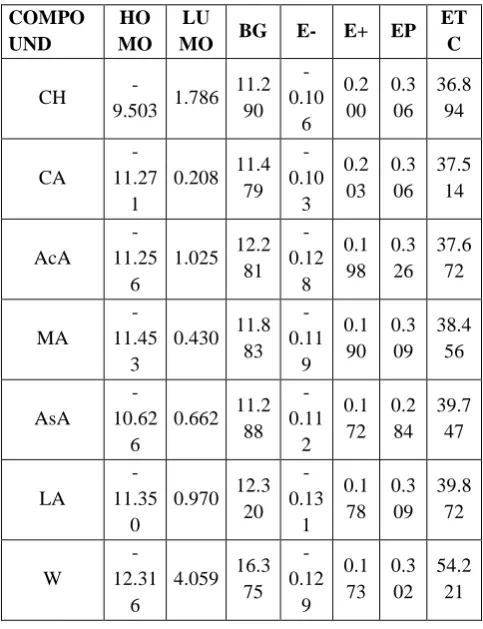
Table 4 shows a study of reactivity and chemical stability between two compounds from the perspective of quantum analysis.
We calculated the ETC[12]of each substance by dividing the BG between the EP. The calculated ETC represents the number of multiples an electron’s EP is needed to jump the BG between molecules of the same compound. The compound that has a higher ETC has greater impediment for the intermolecular movement of its electrons. Therefore, CH is the most stable and least reactive compound due to its lower ETC, while water is the most reactive and least stable of these molecules.
Table.4: Chemical Stability of Compounds
COMPO UND
HO MO
LU
MO BG E- E+ EP
ET C
CH
-9.503 1.786 11.2 90 -0.10 6 0.2 00 0.3 06 36.8 94 CA -11.27 1
0.208 11.4 79 -0.10 3 0.2 03 0.3 06 37.5 14 AcA -11.25 6
1.025 12.2 81 -0.12 8 0.1 98 0.3 26 37.6 72 MA -11.45 3
0.430 11.8 83 -0.11 9 0.1 90 0.3 09 38.4 56 AsA -10.62 6
0.662 11.2 88 -0.11 2 0.1 72 0.2 84 39.7 47 LA -11.35 0
0.970 12.3 20 -0.13 1 0.1 78 0.3 09 39.8 72 W -12.31 6
4.059 16.3 75 -0.12 9 0.1 73 0.3 02 54.2 21
Table 5 shows the results of all possible cross-bands of all compounds studied. This crossing of bands is done by taking the HOMO of a substance with the LUMO of the other substance and calculating its BG. In the same way, the EP of each substance is calculated.
Compounds with their lowest ETC have the highest probability of interacting by dissolving or reacting. In this case, we foundthat the organic acids most reactive with
CH are CA and MA. LA has a more stable reactivity (Figure 1).
As shown in the same Table 5, all the acids have a high probability of electron exchange with CH.
In Figure 1, the dots represent the bottom of the quantum well of each interaction; while the dotted lines represent the bottoms of the quantum wells upper limit (W) and lower limit (CH). It can be deduced that acids in aqueous solution easily attack CH by removing electrons, i.e. as oxidizing agents. From Table 5 and Figure 1 we can suggest that CA attacks CH more easily. This type of attack can range from Van der Waals forces, H-bridges, to chemical reactions in the electron orbitals.
Table.5: Chemical Reactivity of Compounds. Organic acids against CH
Red ucin g Agen t Oxid izing Agen t HO MO LU
MO BG E- E+ EP ET C CH CA -9.5 03 0.2 08 9.7 11 -0.1 06 0.2 03 0.3 09 31. 429 CH MA -9.5 03 0.4 30 9.9 33 -0.1 06 0.1 90 0.2 96 33. 557 CH AcA -9.5 03 1.0 25 10. 528 -0.1 06 0.1 98 0.3 04 34. 631 CH AsA -9.5 03 0.6 62 10. 165 -0.1 06 0.1 72 0.2 78 36. 566 CH LA -9.5 03 0.9 70 10. 473 -0.1 06 0.1 70 0.2 80 36. 878
CH CH
-9.5 03 1.7 87 11. 290 -0.1 06 0.2 00 0.3 06 36. 895 CA CA -11. 271 0.2 08 11. 479 -0.1 03 0.2 03 0.3 06 37. 514 AcA AcA -11. 256 1.0 25 12. 281 -0.1 28 0.1 98 0.3 26 37. 672 W CA -12. 316 0.2 08 12. 524 -0.1 29 0.2 03 0.3 32 37. 724 MA MA -11. 453 0.4 30 11. 883 -0.1 19 0.1 90 0.3 09 38. 456
https://dx.doi.org/10.24001/ijaems.3.6.14 ISSN: 2454-1311 11.
350
87 137 0.1 31
00 31 689
AsA AsA -10. 626 0.6 62 11. 288 -0.1 12 0.1 72 0.2 84 39. 748 AcA CH -11. 256 1.7 87 13. 043 -0.1 28 0.2 00 0.3 28 39. 765 AsA CH -10. 626 1.7 87 12. 413 -0.1 12 0.2 00 0.3 12 39. 784 LA LA -11. 350 0.9 70 12. 321 -0.1 31 0.1 78 0.3 09 39. 872 W MA -12. 316 0.4 30 12. 746 -0.1 29 0.1 90 0.3 19 39. 956 W AcA -12. 316 1.0 25 13. 341 -0.1 29 0.1 98 0.3 27 40. 798 MA CH -11. 453 1.7 87 13. 240 -0.1 19 0.2 00 0.3 19 41. 505 W CH -12. 316 1.7 87 14. 103 -0.1 29 0.2 00 0.3 29 42. 866 CA CH -11. 271 1.7 87 13. 058 -0.1 03 0.2 00 0.3 03 43. 095 W AsA -12. 316 0.6 62 12. 978 -0.1 29 0.1 72 0.3 01 43. 118 W LA -12. 316 0.9 70 13. 286 -0.1 29 0.1 78 0.3 07 43. 278 CH W -9.5 03 4.0 59 13. 562 -0.1 06 0.1 73 0.2 79 48. 609 LA W -11. 350 4.0 59 15. 409 -0.1 31 0.1 73 0.3 04 50. 687 AcA W -11. 256 4.0 59 15. 315 -0.1 28 0.1 73 0.3 01 50. 880 AsA W -10. 626 4.0 59 14. 685 -0.1 12 0.1 73 0.2 85 51. 525 MA W -11. 453 4.0 59 15. 512 -0.1 19 0.1 73 0.2 92 53. 123
W W
-12. 4.0 59 16. 375 -0.1 0.1 73 0.3 02 54. 221
316 29
CA W -11. 271 4.0 59 15. 330 -0.1 03 0.1 73 0.2 76 55. 542
Fig.1: Background of quantum wells represented by points. It can be noted that the five acids that have a high
probability of electron exchange.
LA was identifiedas one of the organic acids with the greatest potential for interaction within quantum stability analysis (Figure 2)[20-21]. The simulations and subsequent experiments show chemical interaction of CH with LA.
Experimental results.
To validate the computational simulations, physical experiments were performed with the following results: The solutions with the highest percentage of TSM of CH were AcA (ETC = 34.631), LA (ETC = 36.878) and MA (ETC = 33.557) with 89, 79 and 72% respectively. The solutions with a lower proportion ofTSM were CA (ETC = 31.429) and AsA (ETC = 36.566), with 55 and 65% respectively (Table 6).
Fig.2: Interaction of CH vs. LA. In this figure it can be seen that the HOMO (CH) vs. LUMO (AL) competes
https://dx.doi.org/10.24001/ijaems.3.6.14 ISSN: 2454-1311 CH was soluble in the MA solution (TSM: 72%).
However, it is possible that this acid changes the chemical properties of CH, and therefore does not polymerize (Table 7).
In the quantum analysis, a high reactivity of MA and AsAwith CH (Table 4/5)was observed. However, the solutions of these acids formed films with non-favorable physical characteristics. Therefore, they have an adverse effect on the polymerization of CH (Table 7).There is a possiblechemical reaction CH--MA and CH—AsA (Figure 1)
CH in the CA solution hadlow solubility (TSM: 55%) but formed a uniform film (Table 7). The characteristic may derive fromthe high chemical interaction between CAadCH as observed in the quantum analysis (Table 4/5). The AsA solution hadhigh solubility (TSM: 65%). However, the film was hard, nonresistant and presented oxidation. AsA is a thermolabile vitamin, so it is possible that it reacted with the drying temperature (Table 7). The CH films of better flexibility, appearance, thickness and resistance were those that we formed from the LA, AcA and CA. These acids had 79, 89 and 55% of TSM, respectively. As a result, the uniformity in the formation of CH films didnot depend on the amount of CH dissolved but the chemical interaction between CH and acid in solution (Table 6/7).
The solutions of AcA and LAhada soft amber color. The AcAsolution had a characteristic vinegar odor, and that of LAwas odorless. CHdissolvedin AcA and LA solutions allowed the formation of smooth and resistant films at different temperatures (Table 8).
Solutions of both acids dried at 100 °C formed the densest films. The highest density CH film was with AcA solution (1.67 g / cm3) at 100 °C, and the lowest density was with LA solution (0.66 g / cm3). Therefore, the thickness and density of the films werenot proportional (Table 8).
Table.6: TSMof Chitosan CH in solutions of organic acids
Solution (A 0.1M +CH1%) Solubility TSM (%)
* 89.0
* 65.0
* 55.0
* 79.0
* 72%
*Soluble
The drying temperature at 100 °C allowed the formation of thinner films in both samples. It was observed that the thickness of the film was dependent on the volume and drying temperature of the solution. This information was versatile in the applications of CH films (Table 8). The capillary viscometryresults for the solutions of AcA and LAwere statistically analyzed. The displacement reachedby the solution of AcA in the capillary viscometer suggests that it was less viscous than LA. Overall, theviscometrytests suggest that LA was a better solvent for CH by increasing solution viscosity (Table 9) [22-23].
Table.7: Physical Characteristics of CH Films Dissolved in Solutions of Organic Acids
CH Films Physical characteristics
Transparent Odor (vinegar) Flexible, Lisa, R,
Hard, Thick, Uniform
Amber (oxidation), Lisa, NR, Hard Thick, Uniform
Smooth amber yellow, Lisa, R,
https://dx.doi.org/10.24001/ijaems.3.6.14 ISSN: 2454-1311
Smooth amber yellow, Lisa, R,
Hard, Flexible Thick, Uniform
* Precipitate solid coffee
* No film formed; R: Resistant; NR: Not resistant
CH wasmore soluble in AcA (TSM: 89%) than LA (TSM: 79%). However, the chemical interaction between CH and LA in solution favors the polymerization of films with better physical properties. In simulation, the AcA had a higher reactive interaction than LA, but in the experimental validation, the LA had better final physical properties.
Table.8: CH films soluble in solutions of AcA and LA after drying at 100 °C (A) and 90 °C (B) Sample A:LA B:LA A:AcA B:AcA
Dimensions (cm)
5.4x1 3.0
6.0x1 3.1
4.2x9.8 4.1x7.3
Weight (g) 0.594 3
0.452 6
0.1647 0.1890
Physicalcharact eristics
Ambe r yello
w faint, odorle ss, Soft thin, elastic
, unifor
m
Soft amber , odorl
ess Soft thick, elasti
c
Transpar ent, with
odor (vinegar
), hard, uniform
Transpar ent, with
odor (vinegar
), hard, uniform
Table.9: Capillary viscometrytest in AcA and LAsolutions (0.1 M)
Sample Height reached in capillary (t=1 h) Viscosity
AcA 2.8 ± 0.17 *
LA 1.8 ± 0 **
W 3.0 ± 0.29 -
- Not viscous * Less viscous ** More viscous; W:Water
IV. CONCLUSION
CH dissolved in a solution of MAand AsAdidnot allow the formation of uniform films. The MA solution was soluble but was likely to degrade the CH.
The acids with the best characteristics for the formation of optimal films werelactic, acetic and citric acid.
The quality of the films of CHdidnot correspond to the percentage of solubility of CH in the acid but corresponded to the chemical interaction between the chemical structure of both.
Quantum simulations suggested that LA has a greater abilityto react with CH. LA was a viable option for interaction with CH.
The chemical interaction during the polymerization process between the solution of 1% CH and 0.1 M LAwas better because of its high viscosity.
LA and AcA solutions dissolve CH for the formation of films with optimal physical characteristics.
CH is more soluble in AcA. However, the physical properties of the film formed from LA are better.
REFERENCES
[1] Tungtong, S., Okonogi, S., Chowwanapoonpohn, S., Phutdhawong, W., Yotsawimonwat,S. (2012). Solubility, viscosity and rheologial properties of water-soluble chitosan derivates, Maejo International Journal of Science and Technology, 6(02), 315-322
[2] S. S. Voznesenskiy, A. A. Sergeev, A. Yu. Mironenko, S. Yu. Bratskaya, and V. A. Kolchinskiy. Effect of Relative Humidity on the Optical and Waveguide Properties of Thin Chitosan Films. TechnicalPhysicsLetters, 2012, Vol. 38, No. 3, pp. 228–230.
[3] NurulHidayatiFithriyah, and Erdawati. Mechanical Properties of Paper Sheets Coated with Chitosan Nanoparticle. American Institute of Physics. International Conference on Mathematics and Natural Sciences (2014).
https://dx.doi.org/10.24001/ijaems.3.6.14 ISSN: 2454-1311 Following Tooth Extraction. PLOS ONE, March
2014 | Volume 9 | Issue 3, e92362, 1-11
[5] Kamala, K., Sivaperumal, P., &Rajaram, R. (2013). Extraction and characterization of water soluble chitosan from Parapeneopsisstylifera shrimp shell waste and its antibacterial activity. Int. J. Sci. Res. Pub, 3, 1-8.
[6] Tungtong, S., Okonogi, S., Chowwanapoonpohn, S. Phutdhawong, W., Yotsawimonwat, S. (2012) Solubility, viscosity and rheological properties of water-soluble chitosan derivatives. Maejo International Journal of Science and Technology, 6(02), 315-322
[7] Voznesenskiy*, S. S., Sergeev, A. A. Mironenko, A, Y. Bratskaya, S.Y. Kolchinskiy, V. A. (2012). Effect of Relative Humidity on the Optical and Waveguide Properties of Thin Chitosan Films. TechnicalPhysicsLetters, 38 (3), pp. 228–230. [8] Mascheroni, E., Figoli, A., Musatti, A., Limbo, S.,
Drioli, E, Suevo, R., Talarico, S., Rollini. M. (2014) An alternative encapsulation approach for production of active chitosan– propolisbeads.International Journal of Food Science and Technology , 49, 1401–1407
[9] Sun, X., Tian, Q., Xue, Z., Zhang, Y., Mu, T. (2014). The dissolution behaviour of chitosan in acetate-based ionic liquids and their interactions: from experimental evidence to density functional theory analysis. Royal Society of Chemistry Advances, 4, 30282-30291.
[10] Chow, l., Frukhtbeyn, S.A., Takagi, S. (2015). pH Dependence of Chitosan Solubility Determined Using a Titration Method. International Association for Dental Research, 39.
[11] Singh, T.P., Chatli, M.K., Sahoo, J. (2015) Development of chitosan based edible films: process optimization using response surface methodology. Journal of FoodScience and Technology, 52(5):2530–2543
[12] Manuel Gonzalez Perez 2014. Theoretical Calculation Of Electron Transfer Coefficient For Predicting The Flow Of Electrons By Pm3, Using 20 Amino Acids And Nicotine European Scientific Journal September 2014 edition vol.10, No.27 ISSN: 1857 – 7881 (Print) e - ISSN 1857- 7431 42
[13] Tian, Q., Liu, S., Sun, X., Sun, H., Xue, Z., & Mu, T. (2015). Theoretical studies on the dissolution of chitosan in 1-butyl-3-methylimidazolium acetate ionic liquid. Carbohydrate research, 408, 107-113. [14] Zhu, G.Q., Wang, F.G., Liu, Y.Y., Gao, Q. C.
(2013). Properties of water-soluble carboxymethyl chitosan film modified by hydrophobic
poly(propylene glycol). Chemical paper, 67 (4), pp 423–428.
[15] Rimondino, G.N., Strumia, M.C., Martinelli, M. (2014). Synthesis and Characterization of Water-Soluble Dendronized Chitosan Using Newkome-Type Dendrons. ACS SustainableChem. Eng., 2014, 2 (11), pp 2582–2587
[16] Arafat, A., Samad, S. A., Masum, S. M., &Moniruzzaman, M. (2015). Preparation and Characterization of Chitosan from Shrimp shell waste. International Journal of Scientific & Engineering Research, 6(5).
[17] Rwegasila, E., Mubofu, E. B., Nyandoro, S. S., Erasto, P., &Munissi, J. J. (2016). Preparation, Characterization and in Vivo Antimycobacterial Studies of Panchovillin-Chitosan Nanocomposites. International Journal of Molecular Sciences, 17(10), 1559.
[18] Asan-Ozusaglam, M., Cakmak, Y. S., Kaya, M., Erdogan, S., Baran, T., Mentes, A., &Saman, I. (2016). Antimicrobial and Antioxidant Properties of CeriodaphniaquadrangulaEphippia
Chitosan. Romanian Biotechnological Letters, 21(5), 11881.
[19] Blanco, A. García-Abuín , D. Gómez-Díaz & J.M. Navaza (2013). Physicochemical characterization of chitosan Derivatives. Journal of Food, Vol. 11, No. 2, 190–197
[20] Long Chen, Chang-yu Tang, Nan-ying Ning, Chao-yu Wang, Qiang Fu, Qin Zhang. PREPARATION AND PROPERTIES OF CHITOSAN/LIGNIN COMPOSITE FILMS. Chinese Journal of Polymer
Science Vol. 27, No. 5, (2009), 739−746
[21] Improvement in the properties of chitosan membranes using natural organic acid solutions as solvents of chitosan dissolution. Po Hui Chen, Ya-Hsi Hwang, Ting-Yun Kuo, Fang-Hsuan Liu, Juin-Yih Lai, Hsyeu-Jen Hsieh. Journal of Medical And Biological Engineering, 27 (1), 23-28.
[22] Gianfranco Romanazzi, FrankaMlikotaGabler, Dennis Margosan, Bruce E. Mackey, and Joseph L. Smilanick. Effect of Chitosan Dissolved in Different Acids on Its Ability to Control Postharvest Gray Mold of Table Grape. Postharvest Pathology and Mycotoxins, Vol. 99, No. 9, 2009, 1020-1036 [23] Kim, Ki Myong; Son, Jeong Hwa; Kim, Sung-Koo;