Semantic Ontology Based IoT-Resource
Description
Vandana C.P
Department of Information Science Engineering, New Horizon College of Engineering, Bangalore, India [email protected]
Dr. Ajeet A. Chikkamannur
Department of Computer Science and Engineering, R. L. Jalappa Institute of Technology, Doddaballapur, Bangalore, India
---ABSTRACT--- Internet of Things (IoT) ecosystem is progressing at an enormous speed with interconnection of various heterogeneous smart devices. Web Semantics has standardized with its numerous technologies. IoT resources discovery, interoperatibility, QOS services, availability can be modeled by integrating semantics, to these IoT resources and their data. Integrating semantics with IoT has numerous challenges and lacks standardization in various domains. In this paper, we present the current web semantic technologies and their adaption in IoT. A review of SSN ontology, its extension is performed. An ontology based resource description is presented enabling semantic integration in IoT.
Keywords - Web semantics, RDF, OWL, Linked Data, SSN, IoT
--- --- Date of Submission: June 04, 2019 Date of Acceptance: July 10, 2019 --- ---
I.
INTRODUCTIONT
he Internet of things (IoT) [1] is growing at an enormous rate connecting physical devices to the Internet. To enable IoT ecosystem based customer centric products featuring value added services, efficient resource discovery and exchange of data is need to time. Various business vendors in different domains have emerged with varying data description interaction techniques in IoT. This heterogeneity and lack of standardization in IoT resource, data and service description is creating challenging situations in IoT success. The things in IoT should be described in a uniform manner.One paradigm shift is industry is adding semantics to IoT. As suggested by Berners-Lee et al. in their landmark article about the Semantic Web[2], “developments will usher in significant new functionality as machines become much better able to process and understand the data”. Since all devices needs to be uniquely identified so that they can be access through Internet. Adding semantic to these devices will solve many of the challenges. Devices should directly send and receive data in formats that contain semantics along with the actual raw message. Since semantic is the meaning of the actual raw message, IoT nodes need not have node-specific knowledge and the processing can happen in a uniform fashion.
Since IoT devices have the following limitations: memory, energy consumption, Communication and computation power, semantic Web technologies needs to be adapted to these resource constrained resource sin IoT. Progress in semantic technologies in IoT will enable and solve the issues related to describing IoT resources and services contributing to information models, data access and exchange by producers and consumers and its seamless integration, resource discovery, interoperatibility. Once
semantic technologies would also facilitate semantic reasoning, knowledge extraction for decision making. Quality of service (QOS) parameters like availability, response time can be modeled and achieve in a standardized way making IoT products a success.
In this paper, we present an overview of the recent advances in semantic technologies with respect to IoT, considering the limitation of IoT devices. Section II details with highlighting semantics importance in IoT resource discovery. Section III discusses the main semantic technologies RDF, OWL, SenML, and Linked Data Platform [2]. Section IV highlights the W3C adopted SSN ontology. Section V proposes an ontology based resource description template, followed by Section VI describing the future work in this regard.
II.
A
DDINGS
EMANTICS FOR IOT RESOURCED
ISCOVERYAn IoT resource [5] is an entity or thing that can sense the data (sensor) or performs actuation (actuator). A service is referred as a software entity that represents the functionality of its corresponding IoT resource. A service is an integral and indispensible part of the resource. Resource discovery involves retrieving/locating and ranking these resources [5].
network connection loss lead to unavailability should be considered.
Key constraints in semantic based resource discovery 1. Standardized ontology and semantic annotation
for IoT devices at global scale. W3C SSN[3] ontology are effective steps in achieving same, but standardised acceptance of ontology definition, semantic annotation frameworks in IoT needs to pace up.
2. Semantic descriptions/annotations need to be processed and analyzed. Although semantics would make the representation machine readable and interpretable with metadata to describe IoT resources. But machine-understand ability is still an issue.
3. Well defines semantic description frameworks like RDF[3], OWL[3], SPARQL[4] have developed to create, manage ,access/query web semantic. Same needs to be adopted for describing IoT resources and its data for analyze. These frameworks should be lightweight and simple to meet the needs of resource constrained IoT devices. Compression mechanism to make semantic description small.
Semantically annotating IoT resources and data is a fundamental requirement to achieve interoperable IoT applications.
III.
S
EMANTICW
EBT
ECHNOLOGIESSemantic senor (Actuator) Web is an extension of current internet where information have well defined meaning to better enable things (IoT resources) and end users to work in cooperation, also enabling autonomous interaction between these things. Research in Semantic web has resulted in some standard representations.
A. Resource Description Framework (RDF)
RDF is the most widely accepted data modelling technology for representing semantic data. It is a general proposition language for web, unifying data from different sources. Data is represented as triples in the form of subject, property, object, <subject, property,object>. Examples as < “Sensor1“, hasType, “Brightness”>, < “Node1”,hasLocation,“RoomA”>
<rdf:RDF xml:base=“http://iot.fi/o” xmlns:i=“http://iot.fi/o#”
xmlns:rdf=“ http://www.w3.org/2017/02/22-rdf-syntax-ns#”>
<rdf:Description rdf:about= LocationSensor”> <ID>locSensor111</ID>
<ownerID>" Tom”<ownerID> <longitude>75.468<longitude> <latitude>35.058<latitude> </LocationSensor> </rdf:RDF>
Fig.1. RDF representation of sensor
An IoT device can be represented as a subject, the measured quantity will be the property(Predicate) and measured value of that quantity as Object. RDF triples form graph. RDF are heavy and have huge length format and light version of same needs to be studied.
B. OWL (Web Ontology Language)
OWL is a formal syntax for defining ontology and is an extension to RDF schema (RDFS). OWL provides more concepts to express meaning and semantics than just RDF.OWL allows to define the logical expression, contextual relationships in the defined vocabulary like equality, property restrictions, class intersection, cardinality, versioning, property characteristics, etc. Class, Property type, subclassOf, domain, range are some of the examples of vocabulary.
<rdf:RDF xml:base=“http://iot.fi/o” xmlns:i=“http://iot.fi/o#”
xmlns:rdf=“ http://www.w3.org/2017/02/22-rdf-syntax-ns#”>
<owl:Class
rdf:about="http://www.linkeddatatools.com/plants#plantty pe">
<rdfs:label>The plant type</rdfs:label> <rdfs:comment>The class of all plant types. </rdfs:comment>
</owl:Class> </rdf:RDF>
Fig. 2. Owl Representation
C. SPARQL
SPARQL (Simple Protocol and RDF Query Language) is a query language for RDF to integrate data from different databases, inference engines. Since it is a semantic query language, it allows the query of triple patterns, conjunctions, disjunctions and User can write queries in “key-value” data formats.
The general format being
[prefix declarations] SELECT <variable list> WHERE { <graph pattern>}
Example:
PREFIX foaf: <http://xmlns.com/foaf/0.1/> SELECT ?friend ?college
WHERE { ?name foaf:college ?college . ?name foaf:friend ?friend . }
Fig. 3. SPARQL Representation
D. Vocabulary and Ontology
specification of a domain, concepts and their relationships in the domain. It is used to define the knowledge domain. Any Ontology can be represented as
Ontology ={ C, R, P, A , I}
C represent the classes, R is the relation between the classes. Various types of relations can modeled between the classes like be is-a, instance-of, has-a, attribute-of, subclass relationship. P represents the set of properties describing the classes, A is the set of axioms which can be the constraints on the data values and I represent the instances of the Classes C.
Many ontology are proposed to handle IoT sensors, their data collection and inferences for making decision making.
Considering a scenario of home automation and fire monitoring system, both needs to be monitored from a remote location to develop a complete solution for a smart building system. Integration of these system is challenging due to heterogeneous sensors and different nomenclature used for same. Temperature or temp sensed in a home automation system to switch on AC and temperature sensed to detect fire, both are different.
The core concepts in IoT ontology is based on
1. Sensor: An IoT application refers to the data collected from various heterogeneous sensors. Sensor data is the data captured by sensors and the metadata that describe the sensors.
Platform provides the power supply, battery, communication modules to which the sensor is attached. TestBed enables the large-scale deployment of IoT, consisting of heterogeneous sensors, sending the sensor data to applications gateway. Sensor is part of Platform which is in turn a part of Platform.
4. Service: It refers to providing required information to enable the task completion.
5. Contextual information: Location & time about IoT things (people, devices, software agents, objects) help in modeling the service in IOT framework.
6. Application Gateway: It a resource with higher resources and performs the aggregation and filtering of senor data and makes it available to application servers for decision making. This gateway plays a major role while integrating IOTs in same domain. Security and authentication would be an important parameter to model with respect to them.
Ontology development is an iterative process. Rules for defining an ontology.
A. Find the domain and scope of the model for which the ontology has to be designed.
B. Reuse existing ontologies for better interoperability.
C. Determine and enumerate the key concepts to be defined in the ontology. Concepts must represent physical or logical things.
D. Define class its relationships like parent/child hierarchy using meaningful nouns and verbs.
E. Define properties of the class and the features of the properties, restrictions using OWL or other. F. Define/add instances.
E. LINKED DATA
Linked Data[6] is a way to relate different resources available on web. In IoT, the various resources and the data generated by them needs to related to each other for effective reasoning. Semantic descriptions of the resources and the data generated by them also need to be related. Linked Data approach is a solution to it.
According to Berners-Lee, 2006, the four main principles involved in publishing data as a linked data is as follows:
1. Everything is addressed as URI’s, URIs are used as names of things.
2. All the URI;s must be accessible via HTTP interface.
3. Useful RDFs must be provided for respective URI’s which can be accessed by machines or humans. It means standard-conforming representation of data like RDF must be used. 4. Linking the URI’s to other URI’s. It enables the
discovery of new information, by including links in the representation to other relevant data or resources.
The linked data approach allows the IoT resources described via heterogeneous models and ontologies to be interconnected and accessible. This is a mechanism to achieve IoT ontologies interoperability. The main components involved are:
1. Linked Data Platform (LDP): It is the Linked Data specification that enables to build RESTful Http services which can read/write RDF data. It includes the 4 principles specified earlier. 2. LDP Resources: Linked data can be written or
read using HTTP and RDF techniques. HTTP methods like POST, GET, DELETE, PUT, PATCH are used to create, delete, modify, access/read RDF resources or binary resources. 3. LDP Containers (LDPC): These are containers to
which POST method is used to create new things, GET method to locate existing resources. BasicContainer, DirectContainer, IndirectContainer are the three different types of containers available.
.
F. SENSOR MARKUP LANGUAGE (SensorML)
SenML cannot be mapped to a conceptual graph like RDF. Hence, SenML data cannot be utilized by knowledge-based systems very easily. But SenML will be easy encode by IoT nodes. It supports only four basic data types, i.e., floating points, numbers, boolean values, and strings, on the other hand RDF ahs rich schema support.
f“e”: [ f “n”: “longitude”, “v”: 75.468 g, f “n”: “latitude”, “v”: 35.058g],
“bn”: “locaSensor111”, “pr”: “http://iot.fi/o#”, “bt”: “3296123968”, “rt”: “LocationSensor” g
Fig.4: SensorML Representation
IV.
S
EMANTICS
ENSORN
ETWORK ONTOLOGY(SSN)
The W3C Semantic Sensor Network (SSN)[8] Incubator Group, developed the SSN ontology based on SensorML. SSN is meant for sensors, sensor data, platform and systems. It enables cross-domain concepts for sensors and annotates sensor features like observations, capabilities and deployment. SSN enables sensor discovery, deployment and maintenance. SSN model is based on the following
1. A sensor perspective: what it senses, how it senses, and what is sensed;
2. An observation perspective: observation data and related metadata;
3. A system perspective: systems of sensors and deployments
4. A feature and property perspective: what senses a particular property or what observations made about a property.
The SSN ontology does not model the time and space related parameters of the senor data, representation of data ,units of measurement, control and actuation, network communication and topology. These missing entities need to be associated with the sensor and sensor data to support autonomous data communications, efficient reasoning and decision making. Also modeling the senor capabilities is also challenging in SSN ontology. SSN is organized into 10 modules. It consist of 41 concepts, 39 object properties, inheriting from 11 DUL (DOLCE-UltraLite) concepts and 14 DUL object properties.
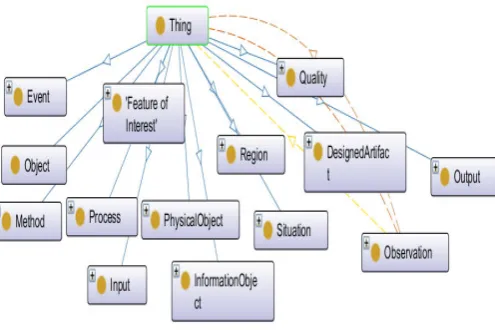
The SSN ontology integrates sensor topic and observation topics into a single ontology and is based on the Stimulus-Sensor-Observation (SSO) ontology design pattern.SSN is developed in a modular fashion and its main classes being : device, observation, feature of interest, sensing process , deployment ,platform and measurement capability. The SSN ontology includes the general features of sensing and does not focus on the communication process.
Fig. 5. Class representation in SSN
M3 [10] ontology provides an extension to SSN ontology including sensors, observations, phenomena, units and domain. Sensed data can be made to infer useful information by applying rule definitions. IoT-Lite [15], is a lightweight implementation of SSN ontology. It covers sensor information, time and location and is meant for constrained devices. It includes dynamic semantic to extrapolate the missing sensor data inside of handing this task to gateway.
OpenIoT ontology [9] extends SSN to include utility metrics for Service level. IoT-O[10] is an approach for unification of IoT ontology. It reuses the concepts from SAN, SSN, DUL, QUDT. It includes the core concepts and functional requirements. FIESTA-IoT ontology [5] is again meant to unify the existing IoT ontologies.It lacks contextual information like place of interest, virtual entities. This ontology is supported by standardization bodies in IoT. IoT-A is an IoT ontology for IoT Architecture that includes sensors, context and observation. It also takes SSN ontology as base.
V.
P
ROPOSEDO
NTOLOGY BASEDI
OT
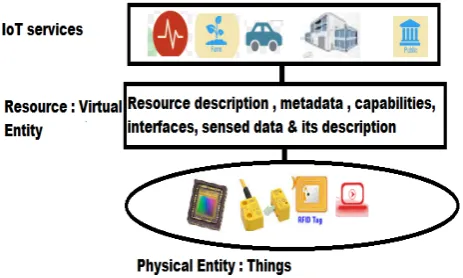
RESOURCE DESCRIPTIONFig.6. IOT resource abstraction
The description contents for resources in IoT can be divided into several aspects:
1) Physical Entity: It represents the devices like sensors, actuators and RFID tag hosts. Device level properties like identity, type, attributes, model & make, interfaces of the device, location, time communication, battery, power levels are included.
2) Observation: Data sensed by the physical entitiy, any events(name of the event and its value), time and location, unit of measurement. Feedback data is a type of observation
3) Virtual Entity: Entity representing the Physical Entity which allows simultaneous access to provide additional data.
4) Heath Information & history: Working status of the physical entity based power, network and other parameters. Threshold value can be used to test this condition periodically based on time period attributes. 5) Capabilities: It includes the capabilities of physical entities and virtual entities. Sensor sensing range, coverage, accuracy of the observation are the capabilities of the physical entities. History data related to these service capabilities help in ranking.
6) Application Entity: Gateway address, location, time, interface, protocol description, authentication are some of its key features.
7) Services: It includes the interfaces exposed by Virtual Entity for providing the required functionalities to the Application Entity.
8) Entity authentication information: The access control and security policies for different user roles at Virtual Entity, Services hosted at and used by Application Entity. Figure7 represents the snippet of RDF/XML representation of the ontology described for the resource description in the proposed approach.
/---/ <rdf:Description
rdf:about="http://purl.oclc.org/NET/ssnx/ssn#isProducedB y">
<rdfs:domain
rdf:resource="http://www.semanticweb.org/vandana/ontol ogies/2017/10/resource-description#ApplicationEntity"/> <rdfs:range
rdf:resource="http://www.semanticweb.org/vandana/ontol ogies/2017/10/resource-description#HealthInformation"/> <rdfs:domain
rdf:resource="http://www.semanticweb.org/vandana/ontol ogies/2017/10/resource-description#VirtualEntity"/> </rdf:Description>
<rdf:Description rdf:about="http://www.loa-cnr.it/ontologies/DUL.owl#hasPart">
<rdfs:domain
rdf:resource="http://www.semanticweb.org/vandana/ontol ogies/2017/10/resource-description#PhysicalEntity"/> <rdfs:range
rdf:resource="http://www.semanticweb.org/vandana/ontol ogies/2017/10/resource-description#Platform"/>
</rdf:Description>
//---//
Fig.7. RDF/XML representation of resource description
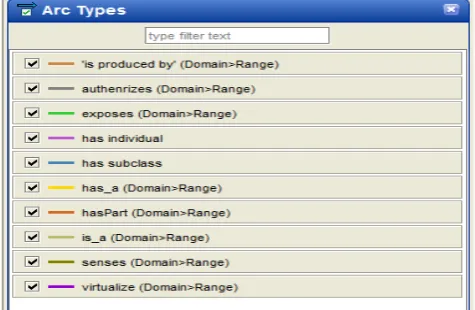
Fig.8. Class Representation of Resource Description As shown in figure 7, the various classes are modelled for IOT resource description and the core classes are depicted. The relationships are displayed in Figure 9. The graph is generated using Protege4.3 tool. Data properties are displayed in figure 8 which describe the core classes defined in figure7.
Fig. 10. Some of the Object relationships
VI.
C
ONCLUSION ANDF
UTURE WORKIn this paper, we presented the comprehensive review of all existing Web Semantic technologies and their adoptions in IoT. Semantics integration in IoT is the future. An ontology based IoT resource description is presented. In future, a prototype for the IoT resources description and its modelling for a specific application would be implemented. Efficient query [18][19] would be executed to verify its effectiveness.
REFERENCES
[1] A. Whitmore, A. Agarwal and L. Da Xu, “The Internet of Things—A survey of topics and trends,” Information Systems Frontiers, Vol. 17, pp. 261-274, 2015.
[2] “Describing Things in the Internet of Things”: From CoRE Link Format to Semantic Based Descriptions [Online]. Available https://tools.ietf.org/html/draft-ietf-core-resource-directory-08
[3] Thabet Slimani, “Ontology Development: A Comparing Study on Tools, Languages and Formalisms”, Indian Journal of Science and
Technology, Vol 8(24), DOI:
10.17485/ijst/2015/v8i34/54249,September 2015 [4] Resource Description Framework (RDF): Concepts
and Abstract Syntax. https://www.w3.org/TR/rdf-concepts
[5] Vandana C.P, Ajeet A. Chikkamannur, “Study of Resource Discovery trends in Internet of Things”, Int.
J. Advanced Networking and
Applications,Vol.08,Issue 03,ISSN: 0975-0290 pp. 3084-3089 (2016)
[6] G. Zhang, C. Li, Y. Zhang, C. Xing and J. Yang, “SeanMedical: A kind of semantic medical monitoring system model based on the IoT sensors”, In e-Health Networking, Applications and Services (Healthcom), 2012 IEEE 14th International Conference on, (2012).
[7] C. Bizer, T. Heath, and T. Berners-Lee, “Linked Data - The Story So Far”. International Journal on Semantic Web and Information Systems (IJSWIS), 2009.
[8] Xiang Sua, Hao Zhangb, Jukka Riekkia , Ari Keranen, Jukka K. Nurminend, Libin Dub, “Connecting IoT Sensors to Knowledge-Based Systems by Transforming SenML to RDF”, 5th International Conference on Ambient Systems, Networks and Technologies (ANT-2014), Procedia Computer Science 32 ( 2014 ) pp. 215 – 222
[9] R. Agarwal, D. G. Fernandez, T. Elsaleh, A. Gyrard, J. Lanza, L. Sanchez, N. Georgantas, V. Issarny, “Unified IoT Ontology to Enable Interoperability and Federation of Testbeds”, 3rd IEEE World Forum on Internet of Things, 2016, pp. 70-75.
[10]H. Van der Schaaf, R. Herzog, “Mapping the OGC Sensor Things API onto the OpenIoT Middleware”, Interoperability and Open-Source Solutions for the Internet of Things: International Workshop, FP7 OpenIoT Project, SoftCOM 2014, Springer International Publishing, Croatia, 2014, pp. 62-70. [11]A. Gyrard, S. K. Datta, C. Bonnet, K. Boudaoud,
“Standardizing generic cross-domain applications in internet of things”, Globecom Workshops (GC Wkshps), 2014, IEEE, 2014, pp. 589-594.
[12]W3C. 2011, W3C SSN Incubator Group Report. Available:http://www.w3.org/2005/Incubator/ssn/wiki /Incubator_Report
[13]Xiaoming Zhang, Yunping Zhao and Wanming Liu, “A Method for Mapping Sensor Data to SSN Ontology”, International Journal of uand e- Service, Science and Technology Vol.8, Issue. 6 (2015). [14]M. Bermudez-Edo, T. Elsaleh, P. Barnaghi, K. Taylor,
“IoT-Lite: A Lightweight Semantic Model for the Internet of Things”, Ubiquitous Intelligence & Computing, Advanced and Trusted Computing, Intl IEEE Conferences, IEEE, 2016, pp. 90-97.
[15]N. Seydoux, K. Drira, N. Hernandez, T. Monteil, “IoT-O, a Core-Domain IoT Ontology to Represent Connected Devices Networks”, Knowledge Engineering and Knowledge Management. EKAW 2016 Computer Science, Vol. 24, pp. 561-576,2016 [16]H. Zhang and C. Meng, “A Multi-dimensional
Ontology-based IoT Resource Model”, 2014 5th IEEE International Conference on Software Engineering and Service Science (ICSESS), pp. 124-127,2014. [17].Chang Ho Yun, Yong Woo Lee, Hae Sun Jung, “An
evaluation of semantic service discovery of a U-city middleware”, Advanced Communication Technology (ICACT), 2010 The 12th International Conference on, vol.1, pp.600-603, Feb. 2010.