Original Research Article
Intensity of physical activity among school going adolescents in
Chennai, South India
Balaji S. M.
1, Karthik R. C.
2*, Durga R.
3, Harinie S.
3, Ezhilvanan M.
4INTRODUCTION
Insufficient physical activity is the fourth leading risk factor for global mortality.1 Insufficient physical activity is a key risk factor for non-communicable diseases (NCDs) such as cardiovascular diseases, cancer and diabetes. Physical activity has significant health benefits and contributes to preventing NCDs. It’s estimated that more than 80% of the world's adolescent population is not sufficiently physically active.2 Several studies have
shown that increased physical activity decreases the incidence of cardiovascular diseases, stroke, and improves psychological well-being.3-5
World Health Organization (WHO) defines physical activity as any bodily movement produced by skeletal muscles that requires energy expenditure – including activities undertaken while working, playing, carrying out household chores, travelling, and engaging in recreational pursuits. Globally, 81% of adolescents aged 11-17 years
ABSTRACT
Background: Insufficient physical activity is one of the leading risk factors for global mortality and is on the rise in many countries, adding to the burden of NCDs and affecting general health worldwide. People who are insufficiently active have a 20% to 30% increased risk of death compared to people who are sufficiently active. Objective of the study was to assess the intensity of physical activity among school going adolescents aged 13–17 years.
Methods: A cross sectional study was done among school going adolescents aged 13 – 17 years in 2 semi urban schools. About 235 subjects were selected and administered with a modified GPAQ questionnaire which measured the physical activity of the students in METs (metabolic equivalent).
Results: The median intensity of physical activity among the study population was 500 METs (IQR 360 – 800). Among the study population, 148 (63%) adolescents were insufficiently physically active (< 600 METs) out of which females were 84 (57%). Among the adolescents, insufficient physical activity was significantly higher among females and among 16-17 years than 13-15 years age group.Academic stress and no space near their home for playing were found to be associated with insufficient physical activity.
Conclusions: The prevalence of insufficient physical activity is very high among adolescents especially more among females. Reducing the academic burden and inclusion of physical activity classes in regular academic schedule and proper motivation from parents are required to improve physical activity among adolescents.
Keywords: Physical activity, MET, Adolescent
1
Assistant Professor, Institute of Community Medicine, Madras Medical College, Chennai, Tamil Nadu, India
2
Assistant Professor, 3III MBBS Undergraduate, 4Statistician, Department of Community Medicine, Tagore Medical College and Hospital, Chennai, Tamil Nadu, India
Received: 05 March 2018
Revised: 30 March 2018
Accepted: 02 April 2018
*Correspondence:
Dr. Karthik R. C.,
E-mail: [email protected]
Copyright: © the author(s), publisher and licensee Medip Academy. This is an open-access article distributed under the terms of the Creative Commons Attribution Non-Commercial License, which permits unrestricted non-commercial use, distribution, and reproduction in any medium, provided the original work is properly cited.
were insufficiently physically active in 2010. Adolescent girls were less active than adolescent boys, with 84% vs. 78% not meeting WHO recommendations.2
WHO recommends that children and adolescents aged 5-17 years should do at least 60 minutes of moderate to vigorous-intensity physical activity daily. Physical activity of amounts greater than 60 minutes daily will provide them additional health benefits. Most of the daily physical activity should be aerobic. Vigorous-intensity activities should be incorporated, including those that strengthen muscle and bone, at least 3 times per week.2
Physical activity can lead to improvements in both long- and short-term physical and mental health and there is increasing evidence that it is also associated with academic and cognitive performance.6-8
Several studies have shown that regular physical activity in children and adolescents improves body composition, cardiorespiratory and muscular fitness, bone health, and levels of metabolic health biomarkers.9
Objectives
To assess the intensity of physical activity among school going adolescents aged 13-17 years.
To elucidate the factors associated with the insufficient physical activity among school going adolescents aged 13-17 years.
METHODS
Study design and setting
Two schools in Chennai, one at Thiruvottiyur (urban) and one at Chrompet (semi-urban) were chosen for conducting a cross sectional survey among school going adolescents during the period of Nov–Dec 2016. The adolescents aged between 13–17 years of both sex were included in the study. Physically challenged subjects having deformities in hands or legs were excluded from the study.
Sampling and sample size
With a prevalence of 81% of insufficient physical activity among adolescents, with 5% precision at 95% confidence limits accounting for a non-response of 5%, the sample size was calculated to be 250.2 125 subjects were selected from each school by systematic random sampling with 25 subjects from each age group.
Study tool
A questionnaire was designed based on the global physical activity questionnaire (GPAQ) modified to suit the school students. GPAQ was developed by WHO for physical activity surveillance.10 The questionnaire
collected information regarding physical activities which include vigorous activity, moderate activity, travel (walking/cycling) and sedentary activities. The intensity of physical activity is calculated according to GPAQ guidelines.
Data collection and analysis
Informed consent was obtained and the questionnaire was administered to the selected subjects and each question was explained in detail. The data collected were entered in MS Excel Office and analysed using SPSS v21 software. After checking for errors and non-response, 13 subjects’ data were removed and the total data accounted to 235 subjects.
Operational definitions
METs (metabolic equivalents): One MET is defined as the energy cost of sitting quietly, and is equivalent to a caloric consumption of 1 kcal/kg/hour.10
Measurement of intensity of physical activity: 4 METs get assigned to the time spent in moderate activities and 8 METs for vigorous activities and 1 MET for sedentary activities. Total physical activity MET minutes per week <600 is classified as insufficient physical activity.10
RESULTS
The study population had almost an equal sex distribution with 118 males and 117 females with almost equal distribution of subjects in each age group.
Table 2 shows that among the study population, 148 (63%) adolescents were insufficiently physically active (<600 METs) out of which females were 84 (56.75%). The insufficient physical activity was more among 16–17 years age group (70.8%) compared to 13–15 years age group (57.5%) and the difference was statistically significant (p=0.038). The level of insufficient physical activity was significantly higher in females (70%) compared to males (56%) and the difference was statistically significant (p=0.041).
Table 1: Distribution of physical activity (METs per week) among various age and sex of the study population.
Age (years)
Physical activity (mets per week)
Male Female Overall
N Median (IQR) N Median (IQR) N Median (IQR)
13 25 640 (350-900) 25 440 (350-760) 50 490 (355-880)
14 24 680 (520-955) 21 400 (300-590) 45 520 (380-800)
15 21 500 (360-720) 23 560 (440-860) 44 550 (375-750)
16 23 540 (400-960) 23 460 (280-800) 46 510 (350-855)
17 25 480 (400-610) 25 440 (310-520) 50 480 (360-560)
Total 118 560 (400-855) 117 460 (320-700) 235 500 (360-800)
Table 2: Distribution of prevalence of insufficient physical activity among various demographic characteristics.
Variable Category
Physical activity Total
N=235 (100%)
Chi square p value Insufficient
N=148 (63%)
Sufficient N=87 (37%)
Age categories 13-15 years 80 (57.5) 59 (42.5) 139 0.038
16-17 years 68 (70.8) 28 (29.2) 96
Sex Male 64 (54.2) 54 (45.8) 118 0.005
Female 84 (71.8) 33 (28.2) 117
Academic stress limiting activity
Yes 89 (71.7) 35 (28.2) 124
0.003
No 59 (53.2) 52 (46.8) 111
Encouragement by Parents for playing
Yes 41 (48.8) 43 (51.2) 84
0.001
No 107 (70.9) 44 (29.2) 151
Space near home for play
Yes 46 (46.9) 52 (53.1) 98
<0.001
No 102 (74.4) 35 (25.5) 137
Sedentary Activity >6 hours / day 85 (60.7) 55 (39.3) 140 0.383
<6 hours / day 63 (66.3) 32 (33.7) 95
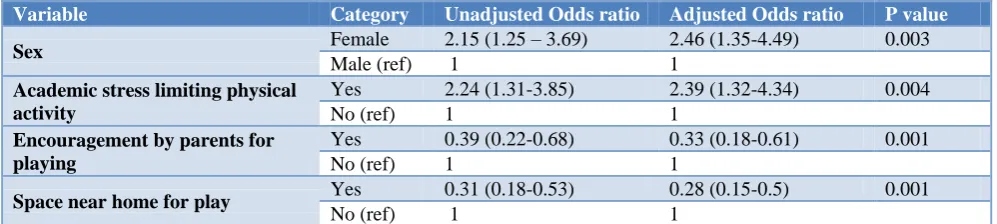
Table 3: Multivariate analysis (Binomial logistic regression) to predict the insufficient physical activity among the study population.
Variable Category Unadjusted Odds ratio Adjusted Odds ratio P value
Sex Female 2.15 (1.25 – 3.69) 2.46 (1.35-4.49) 0.003
Male (ref) 1 1
Academic stress limiting physical activity
Yes 2.24 (1.31-3.85) 2.39 (1.32-4.34) 0.004
No (ref) 1 1
Encouragement by parents for playing
Yes 0.39 (0.22-0.68) 0.33 (0.18-0.61) 0.001
No (ref) 1 1
Space near home for play Yes 0.31 (0.18-0.53) 0.28 (0.15-0.5) 0.001
No (ref) 1 1
McFadden R2=0.139; Goodness of fit: Pearson’s chi square p=0.736. Model fitting: Likelihood ratio chi square p<0.001
A binomial logistic regression was carried out to predict the insufficient physical activity among the adolescents aged 13-17 years. The gender of the participant, their academic stress, encouragement by parents for playing, playing space near home were significantly associated predictor variables.
Female adolescents have 2.46 odds of becoming insufficiently physically active compared to male adolescents. Those adolescents who have academic stress are 2.39 times at risk of becoming insufficiently physically active compared to others. Those adolescents who have encouragement from their parents for playing
are 67% protected and those who had space near their homes are 72% protected from becoming insufficiently physically inactive.
DISCUSSION
study done in Tamil Nadu, the prevalence of insufficient physical activity among adolescents was found to be 59%.13
Among the study population, the physical activity measured in METs was more in the 13–15 years age group compared to 16–17 years and showed a decline with increasing age. In a study by Anmol et al, the pattern of the physical activity among the school going adolescents were studied which showed a significant decrease in the duration of physical activity between 10-12 years adolescents and 16-18 years adolescents.14
In our study, insufficient physical activity was significantly higher in females (70%) compared to males (56%). Similar results were seen in a study done in Chennai.13 In a similar study done in Malaysia it was reported that female adolescents were less active when compared to their male counterparts.15
The present study showed a significant association between adolescents being physically active and encouragement by their parents for playing. In a systemic review of studies published between 1998 and 2013 it was suggested that parental encouragement and support may influence child’s physical activity.16
Similar association was also seen in a study done in Alberta, Canada where it was found that increased parental encouragement was positively associated with boys’ and girls’ physical activity on schooldays and girls’ physical activity on weekends.17
Academic stress was found to be a significant predictor for insufficient physical activity in our study. Several studies have shown similar association between insufficient physical activity and academic stress.18-20
A statistically significant association was found between insufficient physical activity and unavailability of playing space near home or residence in the present study. Similar findings were reported in a study in Kalaburagi city, India.21 A study done in Coimbatore among 11-15 year school children also revealed that access to playground was an important factor for physical activity.22
Studies have proven that physical activities in school environment have short term as well as long term benefits over health. Encouraging physical activity from school days should be promoted in India, which will prevent the children from many risk factors including childhood obesity.7,23
Limitations
The intensity of physical activity measurement was based on subjective responses and there is a slight lack in credibility.
Recommendations
Parents of the school going children should be counselled for motivating their wards to engage in sufficient physical activity atleast 5 days a week.
Those adolescent children who do not have adequate space or playground near their homes for physical activity should be encouraged to spend more time in school playground after academic hours.
The physical activity of the school children and adolescents must be monitored in the school health activities.
CONCLUSION
The prevalence of insufficient physical activity is very high among school going adolescents especially more among females. Reducing the academic burden and inclusion of physical activity classes in regular academic schedule and proper motivation from teachers and parents are required to improve physical activity among adolescents.
ACKNOWLEDGEMENTS
We would like to thank the headmasters and headmistresses of the selected schools in Chennai for giving permission to do this study and the students for their cooperation.
Funding: No funding sources Conflict of interest: None declared
Ethical approval: The study was approved by the Institutional Ethics Committee
REFERENCES
1. World Health Organization. Global
recommendations on physical activity for health. :
Geneva: WHO; 2010. Available
at:http://apps.who.int/iris/bitstream/10665/44399/ 1/9789241599979_eng.pdf. Accessed on 01 January 2018.
2. World Health Organization. Physical activity. Geneva: WHO; 2017. Available at: http://www. who.int/mediacentre/factsheets/fs385/en/. Accessed on 10 December 2017.
3. Carlos CM, Carlos S, Cristian A, Nicolas AF, Rodrigo RC, Jaime L, et al. Higher physical activity levels are associated with lower prevalence of cardiovascular risk factors in Chile. Rev med Chile. 2015;143(11):1435-43.
4. Do Lee C, Folsom AR, Blair SN. Physical activity and stroke risk a meta-analysis. Stroke. 2003;34(10):2475-81.
6. Janssen I, Katzmarzyk PT, Boyce WF, Pickett W. The independent influence of physical inactivity and obesity on health complaints in 6th and 10th grade Canadian youth. J Physical Activity Health, 2004;1(4):331–43.
7. Strong WB, Malina RM, Blimkie CJ, Daniels SR, Dishman RK, Gutin B, et al. Evidence based physical activity for school-age youth. J Paediatrics. 2005;146(6):732-7.
8. Nelson MD, Gordon-Larsen P. Physical activity and sedentary behavior patternsare associated with selected adolescent health risk behaviours. Pediatrics, 2006;117:1281–90.
9. United States Department of Health and Human Services. Physical Activity Guidelines Advisory Committee Report 2008. Washington; 2008. 10. World Health Organization. Global Physical
Activity Questionnaire. Available at:
http://www.who.int/ncds/surveillance/steps/resource s/GPAQ_Analysis_Guide.pdf. Accessed on 10 December 2017.
11. Jurakic D, Pedisic Z. Prevalence of Insufficient Physical Activity in Children and Adolescents: Review. Paediatr Croat. 2012;56:321–6.
12. World Health Organisation. Inequalities in young people’s health: Health behaviour in school aged children international report from the 2005/2006 survey. Copenhagen, Denmark: WHO regional office for Europe; 2008.
13. Rani MA, Sathiyasekaran BWC. Behavioural
Determinants for Obesity: A Cross-sectional Study among Urban Adolescents in India. J Prev Med Pub Health. 2013;46(4):192–200.
14. Anmol G, Randhir K, Vishal S, Goel RKD, Chetal A, Singh J. Pattern of physical activity among school going adolescents (10-18 years) in district Ambala, Haryana. Int J Health Sci Res. 2016;6(2):59-64.
15. Aniza I, Fairuz M. Factors Influencing Physical
Activity Level Among Secondary School
Adolescents in Petaling District, Selangor. Med J Mal. 2009;64:228-32.
16. Xu H, Wen LM. Associations of parental influences with physical activity and screen time among young
children: A systematic review. J Obes.
2015;2015:546925.
17. Vander Ploeg KA, Kuhle S, Maximova K,
McGavock J, Wu B, Veugelers PJ. The importance of parental beliefs and support for pedometer-measured physical activity on school days and weekend days among Canadian children. BMC Public Health. 2013;13:1132.
18. Fox CK, Barr-Anderson D, Neumark-Sztainer D, Wall M: Physical activity and sports team participation: associations with academic outcomes in middle school and high school students. J Sch Health. 2010;80(1):31-7.
19. Taras H. Physical activity and student performance at school. J Sch Health. 2005;75:214-18.
20. Lindner KJ. Sport participation and perceived academic performance of school children and youth. Pediatr Exerc Sci. 1999;11:129-43.
21. Hussain M, Tenglikar PV. Nigudgi SR. Physical activity and its association with body mass index among 10-15 years school children in Kalaburagi city, Karnataka, India. Int J Community Med Public Health. 2016;3:2264-9.
22. Shylesh R, Suvetha K. A study on obesity and factors influencing physical activity among adolescents aged 11-15 years in urban school of Coimbatore. Asian Student Medical J. 2011;7:4. 23. Myers L, Strikmiller PK, Webber LS, Berenson GS.
Physical and sedentary activity in school children grades 5-8: The Bogalusa Heart Study. Medicine and Science in Sports and Exercise. 1996;28(7):852-9.