Original Research Article
Students’ perceptions regarding problem-based learning
in community medicine
Liaquat R. Johnson, Narayanan S. Nair*, Catherine Simon, Jeffy Binu
INTRODUCTION
Problem-based learning (PBL) is a novel Teaching-learning (TL) method that employs „triggers‟ to stimulate self-directed learning among students.1 A hands-on approach, it promotes team-work, communication skills, problem-solving skills, and boosts confidence while providing an environment to apply theoretical knowledge to practice.1-6 We introduced PBL as a TL method in 2016, and used the approach to teach semester 7 students how to approach a problem, and devise a reasoned solution to the same. The primary aim was to promote
generic skills and attitudes that, although listed as desirable competences by the Medical Council of India (MCI), do not receive due focus in routine training. These skills included teamwork; self-directed learning; literature review; communication skills; planning; budget preparation; interaction with various intramural and extramural functionaries; etc.1
The PBL program was conducted as follows: Prior to the commencement of the semester 7 posting, faculty identified suitable topics, and developed problem statements. The problems selected were important public
ABSTRACT
Background: Although a problem based learning (PBL) program in community medicine was introduced over a year ago, student perceptions about the same had not been elicited. This study was conducted to ascertain the perceptions regarding the PBL program from a representative sample of students completing the same.
Methods: This cross-sectional study was conducted among 32 semester 7 medical students in a private medical college in south India. Data were collected anonymously after obtaining written informed consent. Students rated their own involvement in the PBL program; confidence across broad PBL areas before and after the program; usefulness of the broad PBL areas; and how likely they were to use the broad PBL areas, using a 10-point rating scale. Statistical analyses were performed using EZR (version 1.36). Descriptive statistics, Mann-Whitney U test, Wilcoxon signed-rank test, Cronbach‟s alpha were employed.
Results: Of the participants, 20(62.5%) were female. There was a statistically significant difference in perceived confidence across all broad PBL areas following the program, compared to ratings before the program. The median overall rating for the program was 8/10. Greater student involvement was significantly associated with higher ratings for confidence following the program; usefulness in most broad PBL areas. Male gender was significantly associated with high ratings in some broad PBL areas.
Conclusions: A PBL approach can improve student perceptions of confidence in generic skills. High student involvement is key to good student perceptions regarding a PBL program.
Keywords: Problem based learning, Medical students, Community medicine, Perceptions
Department ofCommunity Medicine, Azeezia Institute of Medical Sciences and Research, Kollam, Kerala, India
Received: 16 June 2018
Revised: 25 July 2018
Accepted: 26 July 2018
*Correspondence:
Dr. Narayanan S. Nair, E-mail: [email protected]
Copyright: © the author(s), publisher and licensee Medip Academy. This is an open-access article distributed under the terms of the Creative Commons Attribution Non-Commercial License, which permits unrestricted non-commercial use, distribution, and reproduction in any medium, provided the original work is properly cited.
health problems that had no easy solutions. The problem statements were refined and finalized through mutual discussions. Then, students were randomly divided into groups, and assigned to faculty guides. On the first day of the posting, students would receive a common briefing about the PBL process, and objectives. Subsequently, they would have to meet with faculty guides to work on their respective problems. It was felt that individual faculty should provide instruction to their groups, instead of conducting common sessions on core areas. This would allow greater flexibility in the conduct of PBL related activities, and faculty would be free to follow any instructional approach they deemed fit. However, the activity for each date was predetermined, and incorporated in the schedule. Thus, all groups knew the ideal timeline for completion of each activity, and could pace themselves accordingly. The PBL program culminated with each group presenting their solution(s) to the entire batch, and defending the same in a question-answer session with their peers and faculty. Every student was required to present at least one aspect of the presentation, and other students could pose questions either to individuals, or the group as a whole. Faculty provided constructive feedback on the presentations. Following the PBL program in the previous year, we received informal feedback from students regarding various aspects of the same. However, the feedback thus received was neither structured, nor comprehensive. Moreover, only a select few volunteered to provide feedback. This study was conducted to ascertain the perceptions regarding PBL from a representative sample of students completing the program.
METHODS
This cross-sectional study was conducted between June and September 2017 in a private medical college in south India. It was restricted to semester 7 students who had just completed the PBL program in the Department of Community Medicine. These students belonged to the supplementary (additional) batch, and numbered 34 in all. After obtaining scientific and ethical committee clearances, participation was solicited from all eligible students. Thirty two students gave voluntary written informed consent, and anonymously participated in the study.
The use of a criterion-referenced tool developed by Elizondo-Montomayer to assess PBL perceptions has been described.7 However, we decided against its use because it has not been formally assessed for validity, and hence, its psychometric properties are unknown.8
Following extensive discussions, we identified the following broad headings: literature review; planning; budget; oral and written communication; interaction with various functionaries; teamwork; resource management; and problem-solving. students were required to first indicate how involved they were in the PBL process; then
rate how confident they were in the aforementioned broad areas before and after the PBL program, on a scale of one to ten (ten being the maximum). Similarly, they were asked to use the same rating scale to indicate how useful they found each of the aforementioned broad areas; as well as how likely they felt they were to use them in future. The tool was assessed for face validity. Students also had to provide an overall rating (using the same rating scale); and unstructured written feedback on what was done well; what was not done well; and how the program could be improved.
Data entry was performed using Microsoft Office Excel 2013; and data analyses were performed using EZR (version 1.36 [RCMDR version 2.4-0]).9 In addition to descriptive statistics, Wilcoxon Signed-Rank Test and Chi-square test were used to determine statistical significance.10,11 Cronbach‟s alpha was used to determine internal reliability. Statistical significance was set at the 5% level.
RESULTS
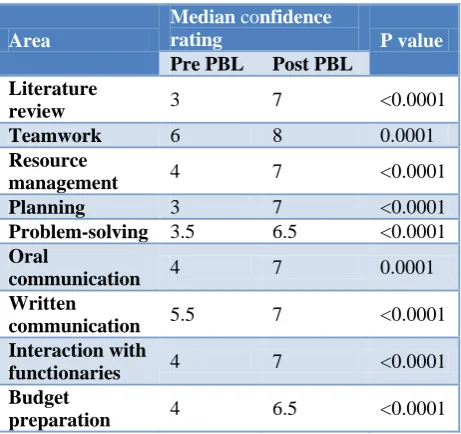
Of the participants, 20 (62.5%) were female. Self-reported involvement in the PBL process ranged from 3 to 10 (median 7). We considered self-reported involvement of ≥8 (out of 10) as good. The median Confidence ratings across the broad areas before and after the PBL process are shown in Table 1. In general, students reported higher confidence after the PBL process, than before it. This was true across all broad areas under consideration, and was statistically significant. The greatest improvements in confidence were reported for literature review and planning.
Table 1: Results of Wilcoxon’s signed rank test for confidence rating before and after PBL.
Area
Median confidence
rating P value
Pre PBL Post PBL Literature
review 3 7 <0.0001
Teamwork 6 8 0.0001
Resource
management 4 7 <0.0001
Planning 3 7 <0.0001
Problem-solving 3.5 6.5 <0.0001
Oral
communication 4 7 0.0001
Written
communication 5.5 7 <0.0001
Interaction with
functionaries 4 7 <0.0001
Budget
preparation 4 6.5 <0.0001
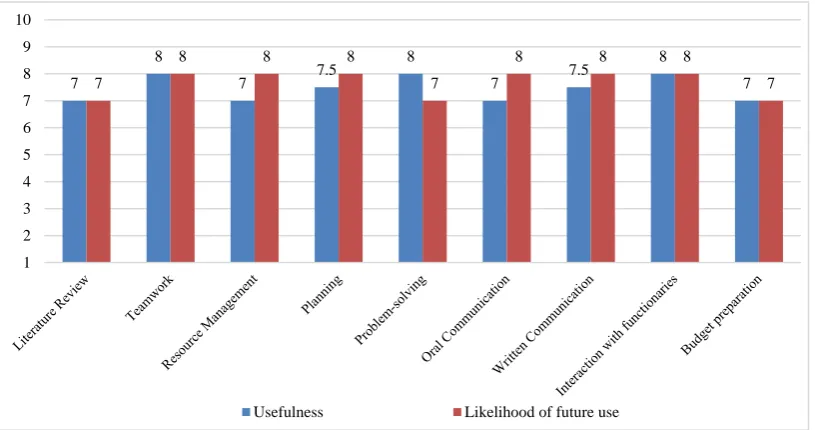
rating was between 7 and 8 for both usefulness and future utility, across all broad areas (Figure 1).
The median overall rating for the PBL program was 8 (on a scale from 1 to 10, with 10 being the highest).
We performed Mann-Whitney U tests to determine if the ratings were influenced by student involvement (Table 2), or gender (Table 3). Perceived confidence across broad PBL areas was more often significantly affected by students‟ self-reported involvement rating, than gender.
Figure 1: Median rating scores indicating perceived usefulness and likelihood of future use for broad areas of the PBL.
Table 2: Results of Mann-Whitney U tests on confidence ratings (1-10) by Involvement score across broad PBL areas.
Area
Involvement score
≥8 (n=15) Involvement score <8 (n=17) Test
statistic P value
Median [IQR]* Median [IQR]
Literature review 7 [5, 8] 6 [4, 7] 171 0.09
Teamwork 8 [8, 9] 8 [6, 8] 164.5 0.15
Resource management 7 [6.5, 9] 6 [4, 7] 185 0.02
Planning 7 [6.5, 8] 6 [5, 7] 188.5 0.01
Problem-solving 8 [6.5, 8] 6 [5, 7] 194 0.01
Oral communication 8 [7, 8] 6 [5, 7] 197.5 0.007
Written communication 7 [7, 8] 7 [5, 7] 177.5 0.051
Interaction with functionaries 8 [7, 8.5] 7 [5, 7] 198.5 0.006
Budget preparation 7 [6, 8.5] 6 [3, 7] 182.5 0.03
*
IQR: Interquartile range.
High student involvement (≥8) was significantly associated with usefulness rating across all broad PBL areas, except budget preparation (details in supplementary material). There was no significant difference in usefulness rating by gender, except for oral (p=0.01) and written (p=0.03) communication, where male respondents gave significantly higher ratings than their female counterparts.
Internal reliability of the tool was estimated using unstandardized Cronbach‟s alpha, and was 0.93. This indicates the construct of the tool was robust, and suitable for the task.
The qualitative feedback regarding PBL was encouraging, with students stating that it was a good learning experience. They indicated that they initially had some difficulty comprehending the PBL process, but understood it over time. Many stated that they were better able to relate to several theoretical topics (like planning) after the experience. Some stated that the experience had transformed their way of thinking and approach to problems. Almost universally, students requested that the duration of the PBL program be extended. Some wanted the PBL process to be introduced much earlier in the course, and suggested it be adopted by other departments as well. Many students indicated that the exercise had
7
8
7 7.5
8
7 7.5
8
7 7
8 8 8
7
8 8 8
7
1 2 3 4 5 6 7 8 9 10
boosted their confidence in public speaking, particularly in communicating with various officials. However, they lamented about non-uniform participation within groups, but were unable to suggest how to ensure participation by all group members. Students reported a feeling of competition between groups, and stated that this was to be avoided. There was a feeling that some faculty were better at providing instruction in core areas (how to perform brainstorming/ literature review/ budget preparation/ critical appraisal, etc.), and most students
requested that common sessions be taken on these areas, instead of faculty instructing each group separately. Students requested that they be involved in the process of topic selection, instead of faculty deciding the same. They felt that doing so would boost student participation. Another suggestion was to permit students approach any faculty to seek guidance, instead of limiting themselves to the assigned faculty guide. They felt this would help improve learning.
Table 3: Results of Mann-Whitney U tests on confidence ratings (1-10) by gender across broad PBL areas.
Area Male (n=12) Female (n=20) Test statistic P value
Median [IQR]* Median [IQR]
Literature review 7 [6.5, 7.25] 5.5 [4, 8] 148.5 0.26
Teamwork 8 [7.75, 9] 8 [6.75, 9] 136.5 0.5
Resource management 7 [6.75, 8] 6 [4, 7.5] 161.5 0.12
Planning 7 [6.75, 8] 6 [5, 7.25] 163.5 0.08
Problem-solving 7.5 [6, 8.25] 6 [5, 7.25] 176.5 0.02
Oral communication 8 [7, 8] 6 [5, 8] 170.5 0.04
Written communication 7.5 [7, 8.25] 7 [5, 7.25] 174 0.03
Interaction with
functionaries 8 [7, 8.25] 7 [5, 8] 169.5 0.05
Budget preparation 7 [6, 8] 6 [3, 8] 157.5 0.14
*
IQR: Interquartile range.
DISCUSSION
Conventional teaching in community medicine is didactic, and unsuitable for development of generic skills like self-directed learning; communication; collaborative problem-solving; teamwork; critical thinking; and lifelong learning.7,12,13 This has prompted the shift to PBL in several institutions the world over, as it is better suited to the development and transfer of the aforementioned generic skills.5,8,14-16
True to the focus on the process rather than the product in PBL, we chose to investigate the perceived benefits in generic skills like communication; interaction with various functionaries- public health and otherwise; self-directed learning; etc.14
As mentioned in literature, the development of good problems is not an easy task. We identified problems that were socially relevant; realistic; and complex.5 As with any change, students were initially uncomfortable with the idea of self-directed learning.15 However, with faculty support, they were able to tackle the complex problems and develop detailed plans suitable for immediate implementation.
The results indicate that following the exercise, there was a significant improvement in student confidence across all broad areas of the PBL process. These findings are consistent with literature on PBL that report an improvement in generic skills by following a PBL approach.5,14-16 To our knowledge, this is the first study to
provide empirical evidence for the importance of student involvement/ participation on perceived improvements in generic skills. Students who reported greater involvement in the PBL process typically gave significantly high ratings for confidence in skills; and usefulness across the various broad areas. The only exception was budget preparation (for usefulness), and may be on account of the students‟ inability to foresee using that skill in the near future. Even so, the p value is near-significant (0.06).
Except for oral and written communication, where male respondents‟ ratings for usefulness were significantly higher than their female counterparts, there was no gender difference in ratings. This is similar to the findings reported by Singaram et al, who did not find any influence of gender on perceptions of PBL effectiveness.17 Similar to the findings reported by others, students in this study had good perceptions of the PBL program, and rated it highly.7,12
The high unstandardized Cronbach‟s alpha value indicates that there is a good degree of variability within the sample.18,19
practical- those regarding extension of the posting; and somehow ensuring participation by all group members. We feel that despite the suggestion to advance introduction of the PBL program, the current timing is preferable since students are better equipped to address complex problems, and are more knowledgeable when they are in semester 7. Moreover, they are more liable to take the process seriously, since it is included in the final posting in community medicine.
There are several limitations of this study, chief among which is the absence of formal assessment of generic skills/ knowledge. In addition, the small sample makes generalization of the results difficult. Another potential problem with small samples is the lack of power. However, despite the use of non-parametric tests of statistical significance (that are less sensitive than parametric tests of significance at detecting a difference where it exists), many results of this study have high statistical significance. This should assuage concerns regarding lack of power. The absence of a validated tool to assess generic skills required us to devise our own tool. Although it has a high Cronbach‟s alpha value, the same could have been influenced by one or other factor described by Streiner.19 These limitations not-withstanding, this study demonstrates that it is possible to employ PBL to better engage with students, while promoting the perceived development of generic skills.
CONCLUSION
A PBL approach can successfully improve student perceptions of confidence in generic skills. High student involvement is more important than gender in influencing student perceptions regarding a Problem-Based Learning program.
ACKNOWLEDGEMENTS
The authors wish to thank the students who participated in this study.
Funding: No funding sources Conflict of interest: None declared
Ethical approval: The study was approved by the Institutional Ethics Committee
REFERENCES
1. Wood DF. ABC of learning and teaching in medicine Problem based learning. BMJ Br Med J. 2003;326:328–30.
2. Wood DF. Problem based learning: time to stop arguing about the process and examine the outcomes. BMJ. 2008;336(7651):971.
3. Dolmans DHJM, Wilkerson L. Reflection on studies on the learning process in problem-based learning. Adv Heal Sci Educ. 2011;16(4):437–41.
4. Kilroy DA. Problem based learning. Emerg Med J. 2004;21:411–3.
5. Telang A. Problem-based learning in health professions education: An overview. Arch Med Heal Sci. 2014;2(2):243–6.
6. Hung W, Jonassen DH, Liu R. Problem-Based Learning. Handb Res Educ Commun Technol. 2008;(3):485–506.
7. Joseph N, Rai S, Madi D, Bhat K, Kotian S, Kantharaju S. Problem-based learning as an effective learning tool in community medicine: Initiative in a private medical college of a developing country. Indian J Community Med. 2016;41(2):133.
8. Elizondo-montemayor LL. Formative and Summative Assessment of the Problem- Based Learning Tutorial Session Using a Criterion- Referenced System. J Int Assoc Med Sci. 2004;14:8–14.
9. Kanda Y. Investigation of the freely available easy-to-use software „EZR‟ for medical statistics. Bone Marrow Transplant. 2013;48(3):452–8.
10. Johnson LR, Karunakaran UD. How to Choose the Appropriate Statistical Test Using the Free Program “ Statistics Open For All ” ( SOFA ). Ann Community Heal. 2014;2(2):54–62.
11. Johnson LR, Karunakaran UD. How to Perform Data Analysis Using the Free Software EZR . Part 1 : Single Continuous Dependent Variable. Ann Community Heal. 2014;3(2):22–5.
12. Navinan M, Rajapakse S, Wijayaratne D. Final-year medical students′ perceptions regarding the curriculum in public health. Indian J Community Med. 2011;36(4):268.
13. Kadri AM. Reforming Community Medicine in Line with the Country‟s Health Priorities - Let‟s Make it Relevant and Rational. Indian J Community Med. 2017;42(4):189–92.
14. Miles CA, Lee CA, Foggett KA, Nair KBR. Reinventing Medical Teaching and Learning for the 21st Century: Blended and Flipped Strategies. Arch Med Heal Sci. 2017;5(1):97–102.
15. Nerali J, Telang L, Telang A, Chakravarthy PK. The role of self-directed learning in problem-based learning: Health professions education. Arch Med Heal Sci. 2016;4(1):125–6.
16. Abraham R, Ramnarayan K, George B, Adiga I, Kumari G, Suvarna N, et al. Effects of problem-based learning along with other active learning strategies on short-term learning outcomes of students in an Indian medical school. Int J Heal Allied Sci. 2012;1(2):98.
17. Singaram VS, Dolmans DH, Lachman N, van der Vleuten CP. Perceptions of problem-based learning (PBL) group effectiveness in a socially-culturally diverse medical student population. Educ Health (Abingdon). 2008;21(2):116.
19. Streiner DL. Starting at the Beginning: An Introduction to Coefficient Alpha and Internal Consistency. J Pers Assess. 2003;80(1):99–103.