Journal of Engineering Sciences, Volume 6, Issue 1 (2019), pp. D 7–D 15 D 7 JOURNAL OF ENGINEERING SCIENCES
ЖУРНАЛ ІНЖЕНЕРНИХ НАУК
ЖУРНАЛ ИНЖЕНЕРНЫХ НАУК
Web site: http://jes.sumdu.edu.ua DOI: 10.21272/jes.2019.6(1).d2 Volume 6, Issue 1 (2019)
UDC 519.63:539.3
Ritz Variational Method for the Flexural Analysis of Rectangular
Kirchhoff Plate on Winkler Foundation
Ike C. C.*
Enugu State University of Science and Technology, P.M.B. 01660, Enugu, Nigeria
Article info:
Paper received:
The final version of the paper received: Paper accepted online:
May 19, 2018 December 14, 2018 December 18, 2018
*
Corresponding Author’s Address:
[email protected]
Abstract. In this study, the Ritz variational method has been applied to solve the bending problem of rectangular Kirchhoff plate resting on Winkler foundation for the case of simply supported edges and transverse distributed load. The problem was presented in variational form using energy principles to obtain the total potential energy functional. Ritz technique was then used to find the generalised displacement parameters which minimized the total potential en-ergy functional; where basis functions were choose to apriori satisfy the boundary conditions. Analytical solutions were obtained which were found to be identical with Navier’s series solutions for the general case of arbitrary dis-tributed transverse load, as well as the specific cases of point loads, sinusoidal load, uniform and linearly disdis-tributed loads.
Keywords: Ritz variational method, Kirchhoff plate, Winkler foundation, total potential energy functional, general-ised displacement parameters, displacement basis functions.
1
Introduction
Problems of the flexure of plates resting on elastic foundations are fundamental in geotechnical and structur-al engineering and anstructur-alysis. They are encountered in the analysis and design of foundations such as column foot-ings, combined footings and raft foundations. They are also encountered in problems of structural analysis that are mathematical analogues of the plate on Winkler foun-dation problem. Many theories exist for the analysis of the flexural behaviour of plates. They include: Lagrange plate theory, Germain theory, Kirchhoff theory, Von Karman theory, Reissner [1, 2] theory, Mindlin [3], Shimpi [4] theory, Reddy [5] theory, and other variants of Refined plate theory and shear deformation plate theories. Kirchhoff plate theory also called the classical thin plate theory is adopted in this paper. The fundamental hypothe-sis of the Kirchhoff plate theory includes:
1) straight lines normal to the plate’s middle surface remain straight after bending deformation;
2) straight lines normal to the plate middle surface be-fore deformation remain normal to the middle surface after bending deformation;
3) the thickness of the plate does not change during flexural deformation.
The Kirchhoff plate theory is a two dimensional proximation of the mathematical theory of elasticity ap-plied to plates to determine the stress and deformation fields in thin plates subject to forces and moments under different restraint conditions. It is an extension of the Euler-Bernoulli beam theory, and assumes that a middle plane surface, neutral during deformation can be used to represent a three dimensional plate in two dimensional form (Mama et al, [6]). The obvious merits of Kirchhoff plate theory include:
1) the problem is reduced to two dimensional one; 2) the uncoupling of bending and stretching behav-iours;
3) the linear nature of the governing partial differential equation;
4) stresses can be calculated from the stress-displacement relations;
5) it is commonly applied.
D 8 MECHANICAL ENGINEERING: Dynamics and Strength of Machines Many models exist for describing the soil interaction
on the foundation structure. The elastic foundation mod-els are classified as discrete parameter modmod-els, simplified elastic continuum models and elastic continuum models (Rajpurohit et al, [8]; Ghaitani et al, [9]). In discrete pa-rameter models, the elastic foundation is modeled as a set of closely spaced discrete individual springs that may or may not be coupled to one another. In continuum models, the mathematical theory of elasticity is used to find com-plex analytical expressions that describe the soil reaction. Simple elastic continuum foundation models are models that may be described as simplifications of the theory of elasticity formulation for the soil reaction. Discrete pa-rameter foundation models include: Winkler [10], Paster-nak [11], Filonenko-Borodich [12], and Hetenyi [13] foundation models, as well as generalised two- and multi-parameter foundation models.
The simplest representation of soil reactive pressure distribution is provided by the classical Winkler founda-tion model which replaces the subgrade by a mechanical analogy made up of single bed of closely spaced inde-pendent vertical springs, without interaction with one another. In the Winkler foundation idealization, the soil reaction at any point on the foundation (plate) is directly proportional to the deformation of the foundation (plate) at that point. Thus, analytically,
( , ) s ( , )
p x y k w x y , (1)
where p(x, y) is the soil reactive pressure distribution at an arbitrary point (x, y) in the plate-soil interface area,
w(x, y) is the corresponding vertical deformation and ks is
the constant of proportionality, representing contact pres-sure per unit deformation – commonly referred to as the Winkler coefficient or coefficient of subgrade reaction or simply the subgrade modulus.
Hence in the Winkler model, ks is the only foundation
parameter characterizing the elastic response of the soil, Winkler’s foundation has the basic demerit of resulting in a vertical deformation of only those springs alone that are located under the loaded region. Thus the Winkler model leads to discontinuity of vertical deformation at the edges of the loaded plate. In addition, the Winkler model im-plies that a point undergoes vertical deformation that is independent of the vertical deformation of other adjoining points; which is not in line with elasticity findings. These shortcomings have led to the development of other dis-crete parameter foundation models that account for the effect of shear interaction (Pasternak, [11]). However, the simplificity of the Winkler model and its long term famil-iarity has ensured its usage till today. The Filonenko-Borodich, and Pasternak foundation models are two pa-rameter discrete papa-rameter foundation models where the soil reaction pressure is given generally by (Pasternak, [11]):
2
1 2
( , ) ( , ) ( , )
p x y k w x y k w x y , (2)
where k1 and k2 are two discrete parameters of the model, and 2 is the Laplacian operator with respect to coordinates x, y. In the Kerr [14] model, a shear layer is introduced in the numerator Winkler foundation and the shear layer separates the elastic bed into two beds with two different spring constants, k1 for the first layer inter-facing the plate and k2 for the second layer making con-tact with a rigid base.
The governing differential equation of the Kerr [14] foundation is given by
2 2
2
2
1 1
1 k p G p k w G w
k k
, (3)
where k1 is the spring constant of the first layer, k2, the spring constant of the second layer and w(x, y) is the de-flection of the first layer, G is the shear modulus of the shear layer which separates the first and second layers in a Kerr foundation.
The research [15] expanded the previous work done by Mama et al [6] by considering new particular types of distributed transverse load namely, bisinusoidal distribu-tion and linear distribudistribu-tion over the entire plate domain and using the Fourier sine transform method. In addition, paper [15] considered and solved numerical problems for simply supported Kirchhoff plates resting on Winkler foundations for different values of the dimensionless Winkler parameter; for cases of uniformly distributed transverse load on the plate domain.
Other researchers who have studied the plate on elastic foundation problem are: Althobaiti and Prikazchikov [16]; Zhong, Zhao and Hu [17]; Li, Zhong and Li [18]; Li, Zhong and Tian [19]; Li et al [20]; Zhang, Shi and Wang [21]; Agarana, Gbadeyan and Ajayi [22]; Are, Idowu and Gbadeyin [23]; Agarana and Gbadeyin [24]; Tahuoneh and Yas [25]; and Ye et al [26].
The research aim is to apply the Ritz variational meth-od to obtain solutions for the flexural problem of simply supported Kirchhoff plate resting on Winkler foundation for cases of transversely distributed loads. The specific objectives include:
1) to obtain the Ritz variational statement of the prob-lem of Kirchhoff plate on Winkler foundation for the case of arbitrary distribution of transverse loads;
2) to solve the variational problem using the energy minimization principle to obtain the general solution for the deflection for any distributed load as well as the cor-responding internal force resultants;
3) to obtain solutions for deflections and internal forc-es for particular typforc-es of transverse loads namely:
– point load P0 applied at a known point (x0, y0) on the plate domain;
– bisinusoidal distributed load over the entire plate domain;
– uniformly distributed load over the entire plate do-main;
Journal of Engineering Sciences, Volume 6, Issue 1 (2019), pp. D 7–D 15 D 9
2
Research Methodology
Kirchhoff plate theory was adopted for the plate while Winkler foundation model was used to describe the soil reaction pressure on the plate. Kirchhoff plate theory is based on the following kinematic assumptions:
1) straight lines normal to the middle surface remain straight after deformation;
2) straight lines normal to the middle surface remain normal to the middle surface after deformation;
3) the thickness of the plate does not change during flexural deformation.
Using the strain energy density for a generalised three dimensional state of stress, the generalized Hooke’s stress-strain law for isotropic elastic plates and the fun-damental assumption of thin plate theory, the bending strain energy functional Ub for the Kirchhoff plate is
ob-tained by the following formula:
2 2 2
2 1
2 ( ) ( )( )
b xy xx yy
R D
U
w w w w dxdy, (4)where R is the two dimensional domain of the plate on the xy coordinate plane, D is the plate flexural rigidity given by
3 2
12 1( )
Eh
D
; (5)
h is the plate thickness, wxx denotes the second partial
derivative of w(x, y) with respect to x, while wxy is the
mixed partial derivative of w(x, y) with respect to x and y
variables.
The potential energy of the distributed transverse load
p(x, y) is given by
( , ) ( , )
R
V
p x y w x y dxdy. (6)The potential energy functional due to the Winkler foundation is given by:
21
2 ( , )
s R
W
k w x y dxdy, (7)where ps(x, y) is the soil reactive pressure on the plate.
The total potential energy functional then becomes
b s
U W V
; (8)
The problem of flexure under static transverse loads for Kirchhoff plate on Winkler foundation then reduces to one of finding the value of the deflection w(x, y) that minimizes the total potential energy functional expressed as the abovementioned equation; a problem situated in calculus of variations. Thus, for equilibrium of the Kirch-hoff plate on Winkler foundation problem
0
, (9)
where denotes the first variation in the total po-tential energy functional.
Ritz variational method is based on the principle of minimum total potential energy functional for equilibri-um. The principle states that the displacement field (func-tion) that corresponds to the minimum total potential energy functional represents a state of equilibrium, pro-vided the displacement function satisfies the given boundary conditions. Thus, the Ritz variational method seeks to obtain the displacement field defined over the plate domain such that the total potential energy func-tional of the Kirchhoff plate on Winkler foundation carry-ing known transverse distributed load is minimized. In the Ritz method, the unknown displacement field (func-tion) w(x, y) is sought or defined in terms of a finite or infinite number of basis (shape or coordinate) functions as follows:
( , ) mn m( ) n( )
m n
w x y w X x Y y
, (10)where Xm(x) and Yn(y) are the basis (coordinate or
shape) functions in the x and y coordinate directions re-spectively, chosen such that they identically satisfy the end condition along the x and y directions respectively; and wmn are the generalised displacement parameters
which are sought.
For Kirchhoff plate on Winkler foundation, extremiza-tion of the total potential energy funcextremiza-tional (8) in terms of the unknown generalised displacement parameters wmn
0 mn w
(11)
allows obtaining the system of algebraic equations:
1 1 1 1
mn mn mn
m n m n
k w F
. (12)3
Results
3.1
Arbitrary distributed load
p
(
x
,
y
) over
the simply supported Kirchhoff plate
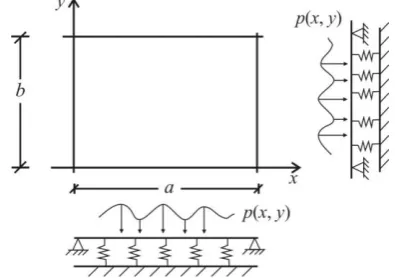
A rectangular Kirchhoff plate of length a and width b
resting on Winkler foundation as shown in Figure 1 was considered.
D 10 MECHANICAL ENGINEERING: Dynamics and Strength of Machines The geometric and force boundary conditions at the
simply supported edges are: w(0, y) = w(a, y) = 0;
2 2
2( 0, ) 2 ( , ) 0
w w
x y x a y
x x
; w(x, 0) = w(x, b) = 0;
2 2
2( , 0) 2 ( , ) 0
w w
x y x y b
y y
.
The displacement basis functions that satisfy the boundary conditions are:
X xm( ) sinm x sin mx a
; Y xn( ) sinn y sin ny b
, (13)
where m m
a
; n n
b
.
For simply supported plates, the Gaussian curvature given by (w2xyw wxx yy) contributes nothing to the total
potential energy since its integral vanishes and simpli-fies to:
2 2 1 2
2 ( ) 2
R R R
D
w dxdy kw pw dxdy
. (14)Let the arbitrary distributed transverse load be repre-sented using Fourier sine series as
1 1
( , ) mnsin sin m n
m x n y
p x y p
a b
. (15)where pmn are the Fourier coefficients of the
distribut-ed load, then
2
2 2
2 1
2 m n mn
D m n
w I a b
+ 2 1 1 12km n wmnI pmnwmnI
, (16)where 2 2 1 0 0 sin sin a b
m x n y
I dxdy
a b
. (17)Extremizing with respect to the generalised coordi-nates after simplifying allows obtaining
2 2 2 mn mn p D wm n k
a b D
. (18)
Using the dependence
0 0
4
( , )sin sin a b
mn
m x n y
p p x y dxdy
ab a b
, (19)it can be obtained:
2 2 2 sin sin ( , ) mn m n
m x n y p
a b w x y
m n k
D
a b D
. (20)In this case, the bending and twisting moments are
2 2 2 2 2 sin sin mn xx m n
m n m x n y p
a b a b
M
m n k
a b D
; 2 2 2 2 2 sin sin mn yy m nn m m x n y
p
b a a b
M
m n k
a b D
; (21)2 2 2 1 cos cos ( ) mn xy m n
m n m x n y
p
a b a b
M
m n k
a b D
.3.2
Ritz variational solutions for
point load
P
0at (
x
0,
y
0)
For the case of point load P0 applied at the arbitrary point x0, y0, within the plate domain, the Fourier series coefficient pmn is
0 0 0
4
sin sin mn
P m x n y
p
ab a b
. (22)
Then, the solutions for transverse deflections and bending moments become:
0 0
0
2
2 2
4 sin sin sin sin
( , )
m n
m x n y m x n y
P a b a b
w x y
abD m n k
a b D
2 2 0 0 0 2 2 24 sin sin sin sin
xx
m n
m x n y
m n m x n y
P a b a a b b
M
ab m n k
a b D
(23)
2 2 0 0 0 2 2 2
4 sin sin sin sin
yy m n
m x n y
n m m x n y
P b a a a b b
M
ab m n k
a b D
where m, n = {1, 3, 5, …}.
When the point load is applied at the center of the plate (x0 = a/2, y0 = b/2), the maximum deflection and bending moments would occur at the plate center and are found as:
2 2 0 2 2 24 2 2
2 2 sin sin , m n m n P a b w
abD m n k
a b D
2 2 2 2 0 2 2 24 2 2
2 2
sin sin ,
xx
m n
m n m n
P a b
a b
M
ab m n k
a b D
(24)
2 2 2 2 0 2 2 24 2 2
2 2
sin sin ,
yy
m n
n m m n
P b a
a b
M
ab m n k
a b D
Journal of Engineering Sciences, Volume 6, Issue 1 (2019), pp. D 7–D 15 D 11 For square plates on Winkler foundation where the
point load P0 acts at the center (a = b), and the maximum deflection and bending moments occur at the center, and are given by:
2 2
2 0
4 4 2 2 2
4 2 2
2 2 sin sin , ( ) m n m n P a a b w D ka m n D
;
2 2 2 2 2
0 4
4 2 22
2 2 4
2 2
( )sin sin
, ( ) xx m n m n m n a b M P ka m n D
. (25)Additionally, Myy(a/2, b/2) = Mxx(a/2, b/2).
3.3
Ritz variational solutions for transverse
sinusoidal load
In the case of transverse sinusoidal load
0
( , ) sin xsin y
p x y p
a b
, the Fourier sine series coeffi-cient for the sinusoidal load pmn p0 m1, n1
and 0 1, 1
mn
p m n . Then by substitution into the Ritz variational solutions for arbitrary distribution of transverse load, the solutions for sinusoidal loads be-come: 0 2 2 2 sin sin ( , ) x ny p a b
w x y
k D
a b D
; 2 2 0 2 2 2 sin sin xx x ny p
a b a b
M
k
a b D
; (26)
2 2 0 2 2 2 sin sin yy x ny p
b a a b
M
k
a b D
.
The maximum values of deflection and bending mo-ments occur at the plate center, and are given by:
0 2
2 2 2 2 2 sin , p a b w k D
a b D
;
2 2 2 0 2 2 2 2 2 2 sin , xx p a b a b M ka b D
; (27)
2 2 2 0 2 2 2 2 2 2 sin , yy p b a a b M ka b D
.
For square plates (a = b) it can be obtained:
4 0 0 4 4 4 sin sin ( , ) x y p
p a a a
w x y
D ka D ;
4 2
0 4 4 2 2 2 4 sin , yy p a a a w D ka D
; (28)
4 0 4 4 1 4 max p a w D ka D .
Similarly, the maximum bending and twisting mo-ments for square plates on Winkler foundation for the case of sinusoidal load are:
2 2 0 4 4 1 4 max max ( ) xx yy
M p a M
ka D ; 2 2 0 4 4 1 0 0 4 max ( ) ( , ) xy xy p a
M M x y
ka D
. (29)
3.4
Ritz variational solution for uniformly
distributed load
p
(
x
,
y
) =
p
0= const
The Fourier sine series coefficients for the uniformly distributed load are:
0 2 16 mn p p mn
. (30)
Then, the Ritz variational solutions become:
0
2 2 2 2
4
16 sin sin
( , )
m n
m x n y
p a b
w x y
D m n k
mn
a b D
02 2 2 2
4
16
2 2 max
sin sin ,
m n
m x n y
p a b
a b
w w
D m n k
mn
a b D
(31)The bending moment distributions are:
2 2
0
2 2 2 2
16 sin sin
( , )
xx
m n
m n m x n y
p a b a b
M x y
m n k
mn
a b D
2 2 02 2 2 2
16 sin sin
( , )
yy
m n
n m m x n y
p b a a b
M x y
m n k
mn
a b D
D 12 MECHANICAL ENGINEERING: Dynamics and Strength of Machines The maximum moments occur at the center
xa2,yb2
and are given by:
2 2 2 0 4 22 2 4
2 2 16
max
( ) sin sin
( )
xx
m n
m n
m nr
M p a
ka
mn m nr
D
;
2 2 2 0 4 22 2 4
2 2 16
max
( ) sin sin
( )
yy
m n
m n
nr m
M p a
ka
mn m nr
D
. (33)where r = a/b.
For square plates (r = 1):
4 0
4 2 2 2 4
16 2 2
max sin sin ( ) m n m n p a w D ka
mn m n
D
; 2 2 2 0 42 2 2 4
2 2 16
max max
( )sin sin
( )
xx yy
m n
m n
m n
M M p a
ka mn m n
D
. (34)The twisting moments are:
0
2
2 2
4
2 2
1 16 cos cos
( )
xy
m n
m x n y
p a b
M
ab m n k
D a b
; 3 0 4 4 2 2 2 216 1 1
max ( ) ( ) xy m n p a M b ka
m n r D
. (35)For square plates:
2
0 4
4 2 2 2
1 16 1
max ( )
( )
xy
m n
M p a
ka m n D
. (36)3.5
Ritz variational solutions for linearly
distributed load
p
(
x
,
y
) =
p
0x
/
a
The Fourier sine series coefficient for linearly distrib-uted load p(x, y) = p0x/a is:
0 2 8 cos mn p m p mn
. (37)
Then the deflection field (function) becomes:
4 0
2 4
4 2 2 2 2
8 cos sin sin
( , )
( )
m n
m x n y m
p a a b
w x y
D ka
mn m n r D
. (38)At the plate center:
40
2 4
4 2 2 2 2
8 2 2
2 2
max
cos sin sin , ( ) m n m n m p a a b w w D ka
mn m n r D
. (39)The bending moments are obtained from the moment-displacement (moment-curvature) relations as:
2 2 2 2
2 0
2 4
2
4 2 2
8 cos sin sin
( ) xx
m n
m x n y m n r m
p a a b
M
ka m nr mn
D
;2 2 2
2
0 4
4 2 2 2 2
8
( ) cos sin sin
( )
yy
m n
m x n y n r m m
a b M p a
ka mn m n r
D
. (40)Bending moments at the plate center, is given by:
2 2 2 0 4 2 4 2 22 2
8
2 2
( ( ) ) cos sin sin ,
( )
xx
m n
m n
m nr m
a b
M p a
ka
m nr mn
D
;2 2 2
2
0 4
4 2 2 2 2
2 2
8
max
( ) cos sin sin
( )
yy
m n
m n n r m m
M p a
ka mn m n r
D
. (41)For square plates (r = 1):
4 0
2 4
4 2 2 2
8 2 2
max
cos sin sin
( ) m n m n m p a w D ka
mn m n
D
; 2 2 2 0 44 2 2 2
2 2
8
( ) cos sin sin
( )
c xx
m n
m n
m n m
M p a
ka
mn m n
D
; (42)
2 2 2 2
0 4
4 2 2 2
2 2 8
( ) cos sin sin
( )
c yy
m n
m n
n r m m
M p a
ka
mn m n
D
.The Ritz variational solutions for the maximum deflec-tion and maximum bending moments which occur at the plate center
xa2,yb2
for square simply supportedKirchhoff plate resting on Winkler foundation for values
1 4 4 / ka K D
(43)
Journal of Engineering Sciences, Volume 6, Issue 1 (2019), pp. D 7–D 15 D 13 Table 1 – Ritz variational solution for deflection and bending
moment coefficients for simply supported square Kirchhoff plate on Winkler foundation under transverse uniform load (for Poisson’s ratio 0.3)
ka4/D K wxx, ×10–3pa4/D
Mxx,
×10–2pa2
Myy,·
×10–2pa2
Mxy,
×10–2pa2
0 0 4.062 4.790 4.790 –
1 1 4.053 4.809 4.809 2.943
81 3 3.348 3.910 3.910 2.456
625 5 1.507 1.575 1.575 1.181
Table 2 – Ritz variational solutions for maximum deflection and bending moment coefficients for simply supported square Kirchhoff plate on Winkler foundation under transverse sinus-oidal load (for Poisson’s ratio 0.3)
ka4/D K wxx,
×10–3pa4/D
Mxx,
×10–2pa2
Myy,·
×10–2pa2
Mxy,
×10–2pa2
0 0 2.566 3.293 3.293 1.797
1 1 2.560 3.285 3.285 1.792
81 3 2.125 2.726 2.726 1.487
625 5 0.986 1.265 1.265 0.069 2401 7 0.358 0.460 0.460 0.025
4
Discussion
The Ritz variational method has been effectively used in this study to solve the flexural problem of simply sup-ported rectangular Kirchhoff plate resting on a Winkler foundation, when the plate domain is subjected to trans-versely distributed loads. The problem was presented in variational form using the principle of minimization of the total potential energy functional. The total potential energy functional was obtained using the stress-strain laws, the geometric relations in the strain energy density expression together with the considerations of work done by the externally applied distributed loads, and soil reac-tive forces. The total energy functional for the problem was obtained as Equation (28). The variational statement of the problem was then expressed as Equation (29). The displacement shape functions that satisfy the simply sup-ported conditions at the plate edges were given as Equa-tions (38) and (39). The Ritz variational solution obtained for any arbitrary distribution of transverse load was given as Equaton (52) where the arbitrary load distribution could be described using Fourier sine series. The bending and twisting moments were found using the moment curvature relations as Equations (57), (58) and (59). From the general solutions obtained for arbitrary load distribu-tions, solutions were obtained for the following specific cases:
1) point load P0 acting at a point (x0, y0) in the plate domain where 0x0 a, 0y0 b;
2) sinusoidal load distribution over the entire plate sur-face;
3) uniform load distribution over the entire plate area; 4) hydrostatic (linear) distribution of load over the en-tire plate.
Ritz variational solutions obtained for the deflections and bending moments for the case of point load P0 acting at point (x0, y0) on the plate are given as equations (23). Their maximum values for square thin plates on Winkler foundations were obtained as equations (24) and (25).
For the case of transverse sinusoidal load, the deflec-tions and bending moments were obtained as equadeflec-tions (26). Their maximum values for square Kirchhoff plates on Winkler foundations were found at the plate center as equations (27), (28) and (29).
The Ritz variational solution for the case of uniformly distributed transverse load were found for deflection and bending moments as equations (31) and (32). The maxi-mum values for deflection and bending moments for square Kirchhoff plate on Winkler foundation were found as equations (31), (33) and (34).
The Ritz variational solutions for linearly distributed transverse load on the Kirchhoff plate on Winkler foun-dation were obtained as equations (38) and (40). The deflections and bending moments were obtained at the plate center as equations (39) and (41). For square Kirch-hoff plate on Winkler foundation, the solutions for linear loads are Equations (42). Here the maximum values may not occur at the plate center due to the non-symmetrical load distribution with respect to the plate center.
The Ritz variational solutions obtained for square Kirchhoff plate on Winkler foundation for the case of uniform transverse load and simply supported edges shown tabulated in Table 1 for various values of the di-mensionless parameter K show that the maximum deflec-tions and bending and twisting moments at the plate cen-ter decrease as the elastic stiffness of the Winkler founda-tion, measured by parameter K increases. It is further observed that the Ritz variational solutions obtained in this study for Kirchhoff plate on Winkler foundation with simply supported edges (x = 0, x = a, y = 0, y = b) yielded mathematical closed form solutions which were identical with the solutions obtained using a Navier double Fourier sine series method for the problem.
5
Conclusions
As a result of the presented research, the following conclusions are made.
The Ritz variational method yielded mathematically closed form solutions for the deflection, and bending moments for the rectangular Kirchhoff plate on Winkler foundation with simply supported edges, and under trans-verse distributed load.
The analytical closed form solutions obtained were ex-act within the limitations and foundational assumptions of the classical Kirchhoff thin plate theory and the Win-kler foundation model used in the problem formulation.
The Ritz variational solutions were exactly identical with the solutions obtained using Navier trigonometric series method for the same problem.
D 14 MECHANICAL ENGINEERING: Dynamics and Strength of Machines The Winkler foundation has the effect of diminishing
the maximum deflections and bending moments at the center of the plate for symmetrical loads about the plate center.
The use of displacement functions with orthogonality properties simplified the resulting definite integrations and simplified the process of minimization of the total potential energy functional.
Convergence of the expressions obtained for the dis-placements were faster than those obtained for the bend-ing moments.
Convergence of the expressions obtained for the case of concentrated load on the plate was very slow due to the singularity property of the point load, and its representa-tion by many terms of the Fourier sine series.
References
1. Reissner, E. (1944). On the theory of bending of elastic plates. Journal of Mathematics and Physics, Vol. 23, pp 184–191. 2. Reissner, E. (1945). The effect of shear deformation on the bending of elastic plates. Journal of Applied Mechanics, Vol. 12,
pp 69–75.
3. Mindlin, R. D. (1951). Influence of rotary inertia on flexural motion of isotropic, elastic plates. Journal of Applied Mechanics, Vol 18(1), pp. 31–38.
4. Shimpi, R. P. (2002). Refined plate theory and its variants. AIAA Journal, Vol. 40, pp 137–146.
5. Reddy, J. N. (1984). A refined non linear theory of plates with transverse shear deformation. International Journal of Solids and Structures, Vol. 20, pp. 881–896.
6. Mama, B. O., Ike, C. C., Onah, H. N., & Nwoji, C. U. (2017) Analysis of rectangular Kirchhoff plate on Winkler foundation us-ing finite Fourier sine transform method. IOSR Journal of Mathematics, Vol. 13(1), pp 58–66, doi: 10.9790/5728-1301065866. 7. Caselunghe, A., & Eriksson, J. (2012). Structural Element Approaches for Soil Structure Interaction. MSc thesis, Chalmer
Uni-versity of Technology, Goteborg, Sweden.
8. Rajpurohit, V. K., Gore, N. G., & Sayagavi, V. G. (2014). Analysis of structures supported on elastic foundations. International Journal of Engineering and Technology, Vol. 4(1), pp. 1–6.
9. Ghaitani, M. M., Esmaieili, H. A., & Kolahchi, R. (2014). Elastic foundation effect on bending behavior of oil pipelines. Inter-national Conference on Civil, Biological and Environmental Engineering, Istanbul, Turkey, pp. 36–39.
10. Winkler, E. (1867). Lehre vouder elastizitat und festigkeit. Dominicus, Prague.
11. Pasternak, P. L. (1954). On a new method of analysis of an elastic foundation by means of two foundation constants. State Pub-lishing House, Moscow [in Russian].
12. Filonenko-Borodich, M. M. (1945). A very simple model of an elastic foundation capable of spreading the load. Proceeding of the Moscow Electronic Institure, Moscow, Russia.
13. Hetenyi, M. (1946). Beams on Elastic Foundation: Theory with Applications in the fields of Civil and Mechanical Engineering. The University of Michigan Press, Ann Arbor, Michigan.
14. Kerr, A. D (1964). Elastic and visco-elastic foundation models. Journal of Applied Mechanics, Vol. 31, pp. 491–498.
15. Ike, C. C. (2017). Flexural analysis of Kirchhoff plates on Winkler foundations using finite Fourier sine integral transform method. Mathematical Modelling of Engineering Problems, Vol. 4(4), pp. 145–154, doi: 10.18280/mmep.040402.
16. Althobaiti S, Prikazchikov D.A. (2016). Edge bending waves on an orthotropic elastic plate resting on the Winkler–Fuss founda-tion. Vol. 69(1), pp. 16–24.
17. Zhong, Y., Zhao, X.–F., & Hu, H. (2014). Vibration of plate on foundation with four edges free by finite cosine integral trans-form method. Latin American Journal of Solids and Structures, Vol. 11(5), pp. 854–863.
18. Li, R., Zhong, Y., & Li, M. L. (2013). Analytic bending solutions of free rectangular thin plates resting on elastic foundations by a new symplectic superposition method. Proceedings of the Royal Society, Vol. 46, pp. 468–474.
19. Li, R., Zhong, Y., & Tian, B. (2011). On new symplectic superposition method for exact bending solutions of rectangular canti-lever thin plates. Mechanics Research Communications, Vol. 38, pp 111–116.
20. Li, R., Zhong, Y., Tian, B., & Lin, Y. M. (2009). On the finite integral transform method for exact bending solutions of fully clamped orthotropic rectangular thin plates. Applied Mathematics Letters, Vol. 22(12), pp. 1821–1827.
21. Zhang, H., Shi, O. H., & Wang, Q. S. (2016). Free vibration analysis of the moderately thick laminated composite rectangular plate on two-parameter elastic foundation with elastic boundary conditions. ASRTU Symposium on Advanced Materials and Processing Technology, Vol. 2016, pp. 189–192, doi: 10.18502/kms.vi/1.584.
22. Agarana, M. C., Gbadeyan, J. A., & Ajayi, O. O. (2016). Dynamic response of inclined isotropic elastic clamped rectangular Mindlin plate resting on Pasternak foundation under a moving load. Proceedings of the International Multiconference of Engi-neers and Computer Scientists, IMECS 2016, Vol II, pp. 1–6.
23. Are E.B., Idowu A.S, Gbadeyin J.A (2013). Vibrations of damped simply supported orthotropic plate resting on elastic Win-kler’s foundation subjected to moving loads. Advances in Applied Science Research Vol 4, No 5, pp. 387 – 393.
Journal of Engineering Sciences, Volume 6, Issue 1 (2019), pp. D 7–D 15 D 15 25. Tahouneh, V., & Yas, M. H. (2012). 3D free vibration analysis of thick functionally graded annular sector plates on Pasternak
foundation via 2-D differential quadrature method. Acta Mechanica, Vol. 223(9), pp. 1879–1897.
26. Ye, T., Jin, G., Su, Z., & Chen, Y. (2014). A modified Fourier solution for vibration analysis of moderately thick laminated plate with general boundary restraints. International Journal of Mechanical Sciences, Vol. 80, pp 29–46.
Застосування варіаційного методу Рітца для дослідження
вигину прямокутної пластини на вінклеровій основі
Іке Ч. Ч.
Державний університет науки і технології м. Енуґу , П.M.Б. 01660, м. Енуґу, Нігерія
Анотація. У роботі застосовано варіаційний метод Рітца до роз’язання задачі вигину прямокутної пластини на вінклеровій основі під дією поперечного навантаження за умов відповідності гіпотезам Кірхгофа для випадку шарнірно закріплених країв. Поставлена задача представлена у варіаційній формі із застосуванням принципу мінімуму функціонала повної потенціальної енергії пластини. Для отримання узагальнених переміщення застосовано метод Рітца для функцій переміщення, що задовольняють кінематичні граничні умови задачі. Шляхом застосування тригонометричного ряду Фур’є отримані аналітичні розв’язки для загального випадку довільно розподіленого навантаження. Додатково розглянуто окремі випадки, зокрема, для прикладення сили у точці, навантаження за синусоїдальним закономрозподілу, а такождлярівномірного та рівнозмінного навантажень.