IJSRSET1731135 | Received : 20 Feb -2017 | Accepted : 28 Feb-2017 | January-February-2017 [(3)1: 543-548]
© 2017 IJSRSET | Volume 3 | Issue 1 | Print ISSN: 2395-1990 | Online ISSN : 2394-4099 Themed Section: Engineering and Technology
543
Embedded Based Deaf Mute Communication System
C. Umarani
1, J. Naskath
2, M. Banu
3, J. Uhaya Shanthi
41,2,3,4Department of Computer Science and Engineering, National Engineering College, Kovilpatti, Tamilnadu, India
ABSTRACT
Today communication between deaf- mute and a normal person always have been a challenging task. Many researchers are focusing on communication between normal and deaf-mute person. To the best of our knowledge, little work has been done in this area. The main objective of this project is to present a system that can efficiently convert text to voice. In the deaf -mute communication interpreter is a device that translate the TEXT to auditory speech. For each text a signal is produced by the computer and send corresponding controller unit and it generate vibration signal. The deaf people are using this device by their mouth; hence they easily understand data given by the computer. The device can also be made to translate larger text. In addition, the system also includes a text to speech conversion (TTS) block which converts the matched gestures i.e. text to voice output, and also voice to voice output and also call making as output.
Keywords: Text to Speech (TTS), Voice to Voice (VTC), Voice User Interface (VUI), Voice Command Device (VCD).
I.
INTRODUCTION
Nowadays, the event of mobile devices, particularly automaton showed exaggerated terribly quickly. This development is seen within the year 2014, wherever the automatons have one billion users. As mobile devices are very often used, automaton would like an alternate thanks to facilitate the operation of the user once doing activities like driving and different activities that use the hand. By applying various input strategies like with a voice command can resolve that drawback of dump peoples. Just by exploitation the voice user will offer commands on the mobile. The applying helps users to run applications that are put in on your automaton device employing a voice that has been outlined.
The automaton application feature was voice Action that permits one to grant speech commands to AN automaton phone. Once solely on the market for the U.S. English scene – commands were later recognizable and replied to in yank, British, and Indian English, French, Italian, German, and Spanish. An itinerant may be a phone which will build and receive calls over a rate carrier whereas the user is moving within a utility area. During this post, we’ll build a good sounding amplifier with the Low Voltage Audio Power electronic equipment IC. I engineered virtually a dozen totally different amplifier circuits with the IC810 however
most of them made method an excessive amount of noise, popping, and different interference. Finally I found one that sounds nice. Granted, this can be not a “minimal components” amplifier. The audio power electronic equipment is employed to amplify low power audio signals to grade that may be appropriate for driving the loudspeakers. Thus the audio power electronic equipment becomes a form of essential half within the physical science that might build sounds.
II.
METHODS AND MATERIAL
A. Related Works
android platform is used for dumb people. The normal person uses the glove the glove is store the normal person speech and that speech will convert the sign language, Monali arun sonawane, 2015.
[7] The deaf people are using Glove gesture and that gesture movements are passed to the LCD display here the movement are converted to the text that are produce speech using speaker. Mr. A. A. Bhosale,2015et al. [8] The gesture glove is used to capture the gesture that glove gesture are converted into English language are converted into Tamil language the voice to text as output. Archana S, 2014. [9] The Tamil letters are programmed into binary number to decimal number that Tamil language will displayed into system. G.Balakrishnanb, 2011. [10] A brain computer interface is used to a direct communication path between external device and human brain. Example controlling of wheel chair. Kevin Leo Jacob, 2015.
[11] The flex sensor is used to translate different signs to text as well as voice format. Ashik, 2015. [12] The hand gesture glove is used to capture are the hand movement and that hand movements are converted to text with the help of LCD display is used for dumb people. That message will convert to voice with the help of speaker. S. Darwin, 2014. [13] The input signals will send through nerves. The user experience as input and immersive environment as output. Kevin Leo Jacob, 2015. [14] The text to speech conversion some of the language using android platform.Devika Sharma, 2015[15] It will convert the tooth simulation to brain activation Mats Trulsson, 2010.
B. Proposed System
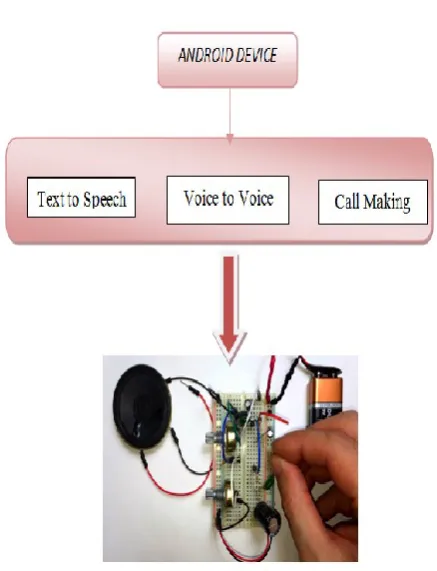
The concept of this proposed system focuses on the deaf mute communication. Figure.3.1 illustrates that the text and also voice as input to the system. It involves two different processes, they are Android, Hardware. These methods are to be carried out with the input TEXT, VOICE to obtain the correct vibration.
1. Android
In figure 1 Android is generally outlined because retrieving a TEXT, VOICE from mobile devices, typically a hardware-based source. Without a text, voice no process is feasible. To create android application
java coding is used. The natural language processing contains three blocks Text to speech, Voice to voice, Call making. The letter-to-sound module aims to convert input letters into phonetic code which will be additional with prosody info by build use of the prosody generator module. Natural language processing is a locality of human-computer interaction that modifies computers to know and manipulate natural (human) language text or speech. An android could be a open source operating system (OS) supported UNIX kernel and developed by Google is one in all the foremost common OS used to develop mobile application.
Block Diagram:
Figure 1. Deaf mute communications
2. Text To Speech
language translation is implemented for the mobile on android environment Text to speech conversion with language translator converts traditional language text into artificial production of human speech. This work converts the written text type to a phone illustration and at the moment converts the phone illustration to waveforms which will be output as intonation sound.
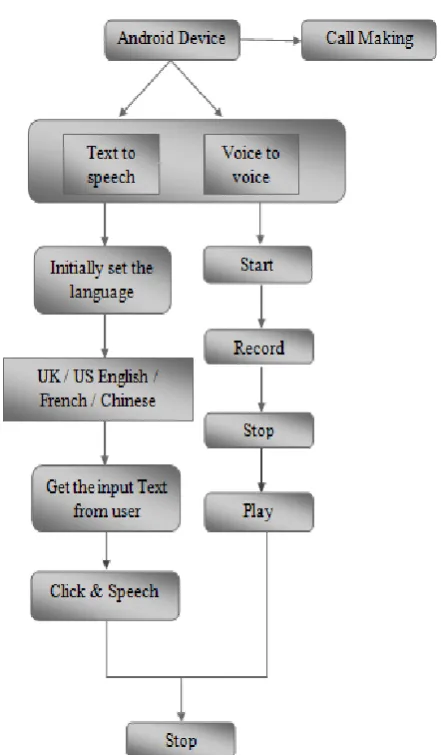
Figure 2. Flow chart of text to speech system
The flow chart figure 2 shows the essential flow of labor for English text to English speech conversion. By obtaining begin; get the input text within the English language. Once obtaining the text in English, the operation to be performed is that the separation of English words from the text. Then perform the library lookup to induce the phonetic equivalent of the text and prepare these entire phonetic equivalents during a series several to text. This can be the flow of the work for English text to U.S. English, UK English, and French, Chinese speech conversion for mobile devices.
3. Voice to Voice
Most android devices embody microSD card slots and may browse microSD cards formatted with the file systems. To permit use of external storage media like USB flash drives and USB HDDs, some android devices are pre packaged with USB-OTG cables. Storage formatted with FAT32.A VCD may be a device controlled by means that of the human voice. By removing the necessity to use buttons, dials and switches, customers will simply operate appliances with their hands voice command. A VUI makes human interaction with computers possible through a voice/speech platform so as to initiate an automatic service or method.
Figure 3. Flow chart of deaf mute communication system
4. Call Making
Contacts are often provided in a very sizable amount of classes with information. Usage of mobile apps has become progressively prevalent across itinerant users Mobile user interface (UI) style is additionally essential. Mobile UI considers constraints and contexts, screen, input and quality as outlines for style. The user is commonly the main target of interaction with their device, and therefore the interface entails elements of each hardware and software package. User input permits for the users to control a system, and device's output permits the system to point the consequences of the users' manipulation. Overall, mobile UI design's goal is primarily for an understandable, easy interface.
C. Hardware Components
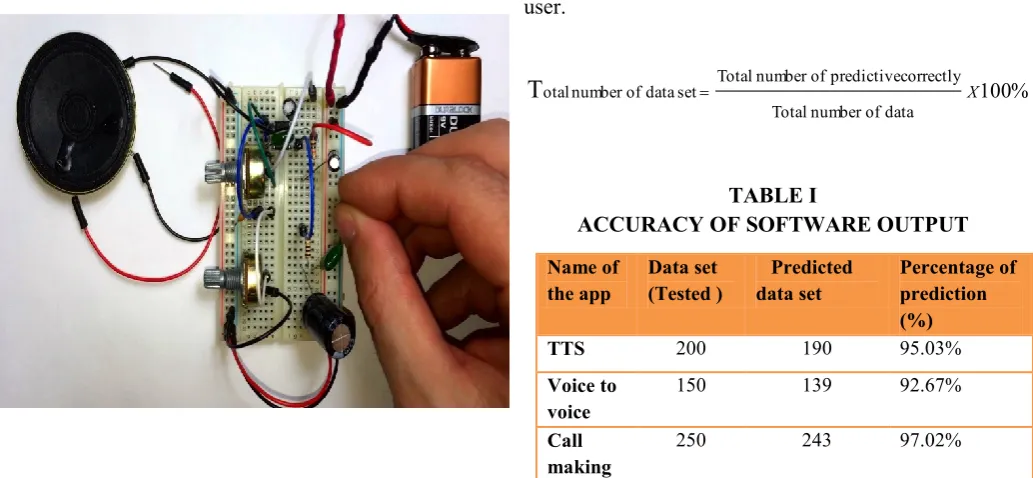
output to match the input signal shape but with a larger amplitude. In this case, an amplifier modulates the output of the power supply to make the output signal stronger than the input signal. An amplifier is effectively the opposite of an attenuator: while an amplifier provides gain, an attenuator provides loss. An amplifier can either be a separate piece of equipment or an electrical circuit within another device. The ability to amplify is fundamental to modern electronics, and amplifiers are widely used in almost all electronic equipment. The types of amplifiers can be categorized in different ways. One is by the frequency of the electronic signal being amplified; audio amplify signals in the audio (sound) range of less than 20 kHz, RF amplifiers amplify frequencies in the radio frequency range between 20 kHz and 300 GHz. Another is which quantity, voltage or current is being amplified; amplifiers can be divided into voltage amplifiers, current amplifiers, trans conductance amplifiers, and trans resistance amplifiers. A further distinction is whether the output is a linear or nonlinear representation of the input. Amplifiers can also be categorized by their physical placement in the signal chain. This amplifier produces a lot of noise, static and popping. To fix this, we need to add some decoupling capacitors. Decoupling capacitors isolate the amplifier circuit from signal interference caused by fluctuations in power and filter noise from the audio signal. Larger value capacitors will filter lower frequency noise while smaller value capacitors will filter out higher frequency noise.
III.
RESULTS AND DISCUSSION
Expected Outcome
The output of our project will increase the communication of normal to deaf-mute people. It is very easy for deaf people to understand. The text to voice, voice to voice and call making is our main goal using android environment. It can be used for partially deaf mute people so that they can tell our thoughts by their own and not depend on others. Voice can be changed based on user’s choice. There is one teeth stick which is fixed in the teeth of deaf people. For each text a signal is produced by the computer and send corresponding controller unit and it generate vibration signal. The control unit acts as the converter to convert the text to voice, voice to voice and call making. The teeth stick produced the vibrate signal which is used to understand the text typed in the Mobile by the deaf person. This type of interpreter can also able to convert the larger text. Using this device we can easily able to communicate with the deaf people.
Experimental Results
All experiments reported in this paper are conducted on text and voice from variety of users. In the voice to voice, we have tested with 20 people. But only 18 people are able to understand the output clearly and exactly. The accuracy of the output is 90% for the users. There is a small inaccuracy of 10% of the output to the user.
% 100
data of number Total
correctly predictive of
number Total set data of number otal
T
X
TABLE I
ACCURACY OF SOFTWARE OUTPUT
Name of the app
Data set (Tested )
Predicted data set
Percentage of prediction (%)
TTS 200 190 95.03%
Voice to voice
150 139 92.67%
Call making
Figure 4. Software Predicted Data Set
Figure 5. Percentage of prediction for Software
From Table I and Fig: 4 represents the predicted data set for software, Here the total number of software prediction was calculated. The text to speech was tested among 200 people. 190 people clearly understands the text to speech output.
Fig: 5 represents the percentage of prediction for software, Here the total data set tested was 200. Finally the percentage of prediction rate is 94.90%
TABLE II
ACCURACY OF HARDWARE OUTPUT
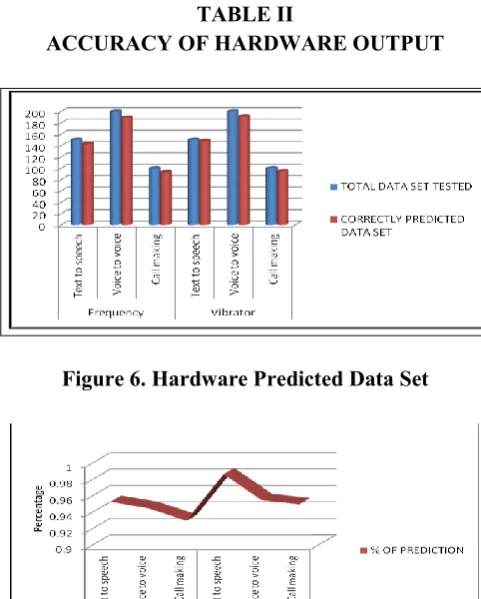
Figure 6.Hardware Predicted Data Set
Figure 7. Percentage of prediction for Hardware
From Table II and Fig: 7 represents hardware predicted dataset, Here the total number of hardware prediction was calculated with the frequency and vibrator as output. 200 peoples was tested 189 people correctly understand the output without noise. Fig: 6.4 represents the percentage of prediction for hardware, Here the total data set was calculated. Prediction rate is 95.328% decibel.
IV.
CONCLUSION
This research paper describes the design and working of a system which is useful for, deaf people to communicate with one another and with the normal people. The deaf people use their standard sign language which is not easily understandable by common people and deaf people cannot hear their speech. This system converts the word language into voice and also voice to voice, call making which is easily TOTAL DATA
SET TESTED
CORRECTLY PREDICTED DATA SET
p
e
rc
e
n
tage
Application % OF PREDICTION
Text to speech
Voice to voice
Call making Level of
output
Name of the app
Data set (Tested )
Predicted data set
Percentag e of prediction (%)
F
re
qu
ency
TTS 150 143 95.3%
VTV 200 189 94.5%
Call making
100 93 93%
Vibra
to
r TTS 150 148 98.67%
VTV 200 191 95.5%
Call making
understandable by deaf and normal people. The speech language is translated into some text form and also voice form, to facilitate the deaf people as well. This text is display on mobile. The voice is stored on external device. The call making is used to send and receive a call.
V.
REFERENCES
[1] Peter Matetelki, Mate Pataki, Sandor Turbucz, Laszlo Kovacs,” An assistive interpreter tool using glove-based hand” , IEEE Canada International Humanitarian Technology Conference - (IHTC) 978-1-4799-3996-1/14/$31.00 ©IEEE 2014.
[2] Fernando Ramirez-Garibay,et al”MyVox-Device for the communication between people blind ,deaf, deaf-blind and unimpaired”,IEEE 2014 Global Humanitarian Technology Conference,2014. [3] Syed Faiz Ahmed, Syed Muhammad Baber Ali,
Sh. Saqib Munawwar Qureshi,” Electronic Speaking Glove for Speechless Patients A Tongue to a Dumb”, Proceedings of the 2010 IEEE Conference on Sustainable Utilization and Development in Engineering and Technology, 20 & 21 November 2010.
[4] Anbarasi Rajamohan, Hemavathy R., Dhanalakshmi M.,” Deaf-Mute Communication Interpreter”, International Journal of Scientific Engineering and Technology volume2 Issue 5,pp:336-341, 1 May 2013.
[5] Vinod J , Diljo Thomas” A Motion based Sign Language Recognition Method”, International Journal of Engineering Technology, Management and Applied Sciences, Volume 3 Issue 4, ISSN 2349-4476 , April 2015.
[6] Monali arun sonawane, Sanjay l. nalbalwar, Swarali sheth” voice to the voiceless on android platform” Proceedings of 25th IRF International Conference, Pune, India, ISBN: 978-93-85465-00-0, 26th April 2015.
[7] Mr.M.V.N.R.P.kumar, Mr.Ashutosh Kumar, Ms. S.B.Arawandekar, Mr. A. A. Bhosale, Mr. R. L.Bhosale” AVR based gesture vocalizer using speech synthesizer IC” International Journal of Research in Advent Technology, Vol.3, No.5, E-ISSN: 2321-9637, May 2015.
[8] Archana S. Ghotkar and Dr. Gajanan K. Kharate” Study of vision based hand gesture recognition using Indian sign language” International Journal
on smart sensing and intelligent systems vol. 7, no. 1, march 2014.
[9] P. Subha Rajama, G. Balakrishnanb, “Recognition of Tamil Sign Language Alphabet using Image Processing to aid Deaf-Dumb People” International Conference on Communication Technology and System Design 2011.
[10] Deepak R, K R Rachith, Kevin Leo Jacob, Prashanth Kambli,” A Survey: Usage of Brain- Machine Interface in Various Applications” International Research Journal of Engineering and Technology (IRJET) e-ISSN: 2395 -0056 Volume: 02 Issue: 01 | Apr-2015.
[11] Sachin Bhat, Amruthesh M, Chidanand Das, Ashik, Sujith,” Translating Indian Sign Language to text and voice messages using flex sensors” International Journal of Advanced Research in Computer and Communication EngineeringVol. 4, Issue 5, May 2015.
[12] J. Thilagavathy, A. Jeyapaul Murugan, S. Darwin,” Embedded Based Hand Talk Assisting System for Deaf and Dumb” International Journal of Engineering Research & Technology (IJERT) ISSN: 2278-0181 Vol. 3 Issue 3, March – 2014. [13] Alessandro L. Stamatto Ferreira, Leonardo Cunha
de Miranda, Erica E. Cunha de Miranda, Sarah Gomes Sakamoto,” A Survey of Interactive Systems based on Brain-Computer Interfaces”SBC Journal on 3D Interactive Systems, volume 4, number 1, 2013.
[14] Devika Sharma, Ranju Kanwar,” Text to Speech Conversion with Language Translator under Android Environment” International Journal of Emerging Research in Management &Technology ISSN: 2278-9359 (Volume-4, Issue-6),June 2015. [15] Mats Trulsson, Susan T. Francis, Richard Bowtell,