Original Research Article
Sputum smear conversion rate of adult pulmonary tuberculosis patients
under directly observed treatment shortcourse in Rajarajeswari
Medical College and Hospital, Bangalore
Vidya Basavaraju
1, Chetan Lakshmikantha Bukanakere
2*
,
Damayanthi M. Nagaraj
3, Shashikala Manjunatha
4INTRODUCTION
Tuberculosis is among the oldest infection (more than 5000 years old) known to affect humans. It is among the most important causes of death from a single infectious agent and a major public health problem causing an
enormous burden of disease and economic impact especially in the developing countries.1,2
Globally there were 8.6 million new tuberculosis cases in 2012 and 1.3 million tuberculosis deaths (just under 1.0 million among negative people and 0.3 million
HIV-ABSTRACT
Background: Tuberculosis is among the most important causes of death from a single infectious agent and a major public health problem causing an enormous burden of disease and economic impact especially in the developing countries. Pulmonary tuberculosis is the most common form of tuberculosis causing >85% of all tuberculosis cases. The smear conversion rate is an operational indicator for the directly observed treatment short course (DOTS) strategy of Revised National Tuberculosis Control Programme (RNTCP) in India.
Methods: A longitudinal study was conducted in DMC, RRMCH, in the first two quarters of the year 2013 i.e., from January 1st to June 31st of the year 2013. All 130 adult category I (new) sputum smear positive cases that attended DMC, and registered under RNTCP constituted the sample for the study. Data was collected by interview method by using pre-tested, semi-structured questionnaire. Data was analyzed using SPSS version 20.0.
Results: Majority of the study subjects was >50 years, Hindus, illiterates, belonged to nuclear family from rural area belonged to upper lower socio-economic class. The overall sputum smear conversion rate is 92.4%. Lower sputum smear conversion rate was observed in the following risk factors like the male gender, smoking, diabetes, initial high pre-treatment smear grading and poor drug compliance.
Conclusions: The overall sputum conversion rate at the end of two months of intensive phase under (DOTS) chemotherapy in 118 sputum smear positive (cat I) new pulmonary tuberculosis patients in Designated Microscopy and Treatment Centre (DMC) Rajarajeswari Medical College and Hospital was 92.4%.
Keywords: RNTCP, Sputum smear conversion rate, Designated microscopy and treatment centre, Directly observed treatment short course, Intensive phase, Category I pulmonary tuberculosis
1Department of Community Medicine, S.S. Institute of Medical Sciences, Davangere, Karnataka, India
2
Department of Dermatology, JJM Medical College and Hospital, Davangere, Karnataka, India
3Department of Community Medicine, Chamarajanagar Institute of Medical Sciences, Karnataka, India
4Department of Community Medicine, RajaRajeswari Medical College and Hospital, Karnataka, India
Received: 20 August 2019
Revised: 09 October 2019
Accepted: 10 October 2019
*Correspondence:
Dr. Chetan Lakshmikantha Bukanakere, E-mail: [email protected]
Copyright: © the author(s), publisher and licensee Medip Academy. This is an open-access article distributed under the terms of the Creative Commons Attribution Non-Commercial License, which permits unrestricted non-commercial use, distribution, and reproduction in any medium, provided the original work is properly cited.
associated tuberculosis deaths). The 1990 World Health Organization (WHO) report on the Global Burden of Disease ranked tuberculosis as the seventh most morbidity-causing disease in the world, and expected it to continue in the same position up to 20203.
India accounts for nearly 20% of the global burden of tuberculosis (TB), with global TB ranking of ‘one’. It is the leading cause of death in patient with infectious diseases in India. Around 1.8 million people are detected to have tuberculosis every year in India, of which about 0.8 million are new smear positive highly infectious cases.3,4
Sputum smear positive (SSP) pulmonary tuberculosis patients are the most significant source of infection for tuberculosis. One untreated infectious tuberculosis patient is likely to infect 10 to 15 person annually.5,6 For patients receiving Category-I regimen in the Revised National Tuberculosis Control Programme (RNTCP), smear conversion at the end of the intensive phase (IP) of treatment is emphasized as an important early predictor of treatment success. The sputum conversion results are used both for management of patients and for monitoring programme performance. If the smear is positive, the IP is extended by one more month for that patient.6 Target cure rate is 85% under the Millennium Development Goal 7. In spite of various serological markers, qualitative sputum microscopy acid-fast bacilli (AFB) remain the important measure for the treatment response and diagnosis8. Change in the bacteriological status of sputum of patients from initial AFB positive to AFB negative after treatment is referred to as sputum smear conversion. Smear conversion rate (SCR) at two months of IP and at three months of IP (extended IP) is a significant operational indicator as it shows the capacity of the programme to maintain the patients on treatment. It also provides an objective evidence for the patient’s response to therapy and hence the treatment outcome.7,8
The non-governmental agencies, private sector and the medical colleges play an important role in making RNTCP a success.10 Medical college faculty, who are academicians are seldom directly involved in the implementation of national public health programmes. More than a decade ago for the first time in the global history of TB control, medical colleges of India were involved in the RNTCP of Government of India (GOI). For more than a decade, medical colleges have been providing diagnostic services (Designated Microscopy Centres), treatment [Directly Observed Treatment (DOT) Centres] referral for treatment, recording and reporting data, carrying out advocacy for RNTCP and conducting operational research relevant to RNTCP. As the programme widens the scope of services that it provides, medical colleges will have an increasingly important role to play in areas such as TB/HIV co-infection, external quality assurance of the sputum microscopy network,
drug-resistance surveillance and management of
multidrug-resistant TB patients. The RNTCP needs active
support of medical colleges in carrying out operational research or in these areas to guide the development of the programme’s future policies.9-11
Objectives
The objectives of the present study were to determine sputum smear conversion rate at the end of two months of intensive phase among category I (new) adult pulmonary tuberculosis patients attending Designated Microscopy and Treatment Centre in Rajarajeswari Medical College and Hospital and to describe socio demographic characteristics of study subjects.
METHODS
Source of data
All the category I knew sputum smear positive adult pulmonary tuberculosis patients who attended Designated Microscopy and Treatment Centre (DMC), Rajarajeswari Medical College and Hospital, Bangalore in first two quarters of the year 2013 i.e., from January to June 2013 were considered for the study.
Inclusion criteria
Newly diagnosed smear positive adult pulmonary tuberculosis cases, category I under DOTs were included.
Exclusion criteria
Extra pulmonary category I cases were excluded.
Study design
A longitudinal study.
Study setting
The study was conducted at Designated Microscopy and Treatment Centre (DMC), Rajarajeswari Medical College and Hospital, Bangalore, covering two lakh populations which comes under Konanakunte TB unit (TU).
Study duration
First two quarters of the year i.e., from January 1 to June 30th of the year 2013.
Study population
All adult category I (new) sputum smear positive cases who attended DMC, Rajarajeswari Medical College and Hospital, Bangalore registered under RNTCP.
One hundred and thirty adult category I (new) sputum smear positive cases who attended DMC, Rajarajeswari Medical College and Hospital, Bangalore and registered under RNTCP in the first two quarters of the year 2013 i.e., from January 1st to June 30th constituted the sample for the study.
Study tools
A pre-tested, semi-structured questionnaire. Weight of the subjects was recorded by using standardized adult weighing machine. Subjects were made to empty the bladder and with their light weight cloth with pockets empty were made to stand on the weighing machine with their feet adequately spaced and head looking straight and both the arms by the side is then weighed on a bathroom scale (Zhongshan Camry Electronic Co. Ltd, Guangdong, China). The measurement was considered to the nearest decimal point of 0.5 kg. It was ensured that weighing machine was regularly standardized and calibrated during the study. Height was measured with a stadiometer to the nearest decimal and then converted to meters. Subjects are made to stand with bare foot and looking forward. BMI was calculated by dividing weight (kg) by height squared (m2) and obesity defined as BMI greater or equal to 30 kg/m2.
Method of data collection
A pilot study was conducted before the actual study, following which necessary changes were incorporated in the questionnaire before the actual study. These patients have been excluded for the main study.
Data collection was started after obtaining clearance from the institutional ethical committee, respective authorities from Lady Willingdon State TB Center and concerned DTO. Pretreatment smear grading was obtained from RNTCP lab sputum register. The 130 new sputum smear positive patients on their first contact were explained about the purpose of the study and a written informed consent was taken. Data was collected from the patients by interview method by using pre-tested, semi-structured
questionnaire. The study variables including
sociodemographic characteristics, treatment taken, clinical history, history of contact, history of habits and any co-morbidity were collected at their first visit. Patient’s complete address, TB number and phone number were noted down for their follow up. The patients were followed up for compliance of the drugs. Patients compliance was identified by treatment cards, if they failed to return for drug collection less than three times a week was considered poor compliance and if they returned for drug collection three days a week was considered good compliance.
After the completion of two months of intensive phase of treatment the patients were followed up for the sputum smear examination to know about sputum smear conversion by quality sputum microscopic examination.
The reports were collected from RNTCP lab sputum register and patient’s treatment cards.
Statistical analysis
The data was compiled in Microsoft Excel work sheet and analyzed using Statistical Package for Social Sciences (SPSS) software version 20.0.
Descriptive statistics
All qualitative variables are presented as frequency and percentages. Chi-square test of significance was used and Fisher’s exact test was used when the expected value of a cell was less than 5. P values of less than 0.05 were considered statistically significant. Microsoft word and Excel have been used to generate graphs, tables.
RESULTS
In the present study which was conducted at Designated Microscopy and Treatment Centre (DMC), Rajarajeswari Medical College and Hospital, Bangalore, the following observations were made.
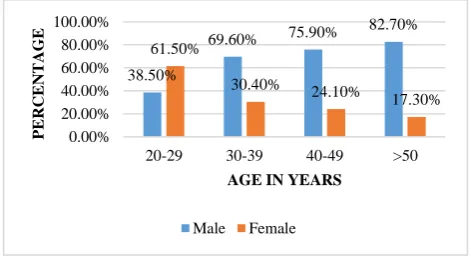
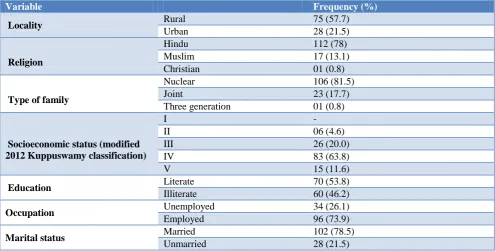
The socio-demographic characteristics were, maximum number of patients were in the age group of >50 years, majority were males 91 (70.0%), Hindus 112 (86.1%), 102 (78.5%) were married, 106 (81.5%) stayed in a nuclear family, 75 (57.7%) were from rural area, 60 (46.2%) were illiterate, 55 (42.3%) were unskilled workers and 83 (63.8%) belonged to (class IV) upper lower class (Figure 1) (Table 1).
Figure 1: Distribution of patients according to age and gender.
Majority of the patients 71 (54.6%) were in underweight category, 51 (39.2%) were in normal weight category, 7 (5.4%) were in overweight, 1 (0.8%) was in pre-obese category (Figure 2).
Habits of the patients were, 71 (54.6%) were smokers, 20 (15.4%) patients had a history of tobacco consumption and 69 (53.1%) patients were alcoholics.
38.50%
69.60% 75.90%
82.70%
61.50%
30.40% 24.10%
17.30%
0.00% 20.00% 40.00% 60.00% 80.00% 100.00%
20-29 30-39 40-49 >50
PE
R
C
E
N
T
A
GE
AGE IN YEARS
Co-morbidity pattern among patients was 31 (23.8%) were diabetics, 6 (4.6%) patients were HIV positive and
majority of the patients 71 (54.6%) were in underweight category (Table 2).
Table 1: Sociodemographic profile of the study participants (n=130).
Variable Frequency (%)
Locality Rural 75 (57.7)
Urban 28 (21.5)
Religion
Hindu 112 (78)
Muslim 17 (13.1)
Christian 01 (0.8)
Type of family
Nuclear 106 (81.5)
Joint 23 (17.7)
Three generation 01 (0.8)
Socioeconomic status (modified 2012 Kuppuswamy classification)
I -
II 06 (4.6)
III 26 (20.0)
IV 83 (63.8)
V 15 (11.6)
Education Literate 70 (53.8)
Illiterate 60 (46.2)
Occupation Unemployed 34 (26.1)
Employed 96 (73.9)
Marital status Married 102 (78.5)
Unmarried 28 (21.5)
Table 2: Habits and comorbidity of the study subjects (n=130).
Variable Frequency (%)
Habits
Smoking 71 (54.6)
Tobacco 20 (15.4)
Alcohol 69 (53.1)
Comorbidity Diabetes 31 (4.6)
HIV 6 (13.1)
BMI
Underweight 71 (54.6)
Normal 51 (39.2)
Overweight 07 (5.4)
Pre obese 01 (0.8)
Pretreatment smear grading showed that, most of the patients 60 (46.2%) had 1+ smear grading, 27 (20.8%) patients had 2+ smear grading, 24 (18.5%) patients had 3+ smear grading, and 19 (14.5%) patients had scanty smear grading (Figure 3).
Figure 2: Distribution of patients according to body mass index.
Major factor for delay in seeking health care facilities was lack of knowledge about the disease, majority of patients 109 (83.8%) had good drug compliance (Table 3).
Figure 3: Pre-treatment smear grading of the patients.
54.60% 39.20%
5.40% 0.80%
Underweight Normal Overweight Pre Obese
14.50%
46.20%
20.80% 18.50%
0% 10% 20% 30% 40% 50%
Scanty 1+ 2+ 3+
PE
R
C
E
N
T
A
GE
Out of 130 patients 11 (8.5%) of the patients died, 1 (0.8%) patient defaulted. So the total number of patients were 118. Out of 118 patients 9 (7.6%) remained smear positive, 109 (92.4) converted to smear negative (Table 4).
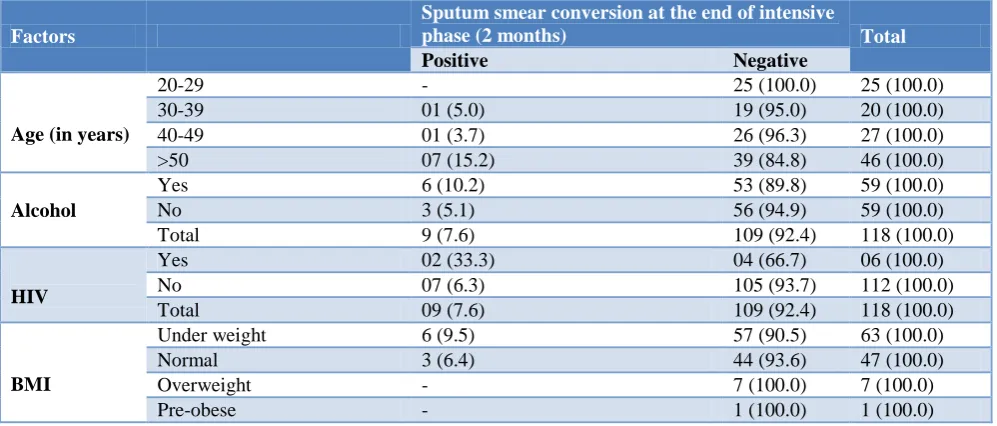
Lower sputum smear conversion rate was observed in the following factors like age, alcohol consumption, HIV status and BMI (Table 5).
The overall sputum smear conversion rate is 92.4%. Lower sputum smear conversion rate was observed in the following factors like the male gender, smoking, diabetes, initial high pre-treatment smear grading and poor drug compliance which were statistically significant (Table 6).
Table 3: Factors for delay in seeking health care facilities and drug compliance (n=130).
Factors for delay in seeking health care facilities Frequency %
No knowledge about the disease 71 54.6
No care taker 15 11.6
Not aware of facility 44 33.8
Total 130 100.0
Drug compliance
Good 109 83.8
Poor 21 16.2
Total 130 100.0
Table 4: Sputum smear conversion rate (excluding defaulters and dead) (n=118).
Sputum smear conversion Frequency %
Positive 09 7.6
Negative 109 92.4
Total 118 100.0
Table 5: Factors associated with sputum conversion rate.
Factors
Sputum smear conversion at the end of intensive
phase (2 months) Total
Positive Negative
Age (in years)
20-29 - 25 (100.0) 25 (100.0)
30-39 01 (5.0) 19 (95.0) 20 (100.0)
40-49 01 (3.7) 26 (96.3) 27 (100.0)
>50 07 (15.2) 39 (84.8) 46 (100.0)
Alcohol
Yes 6 (10.2) 53 (89.8) 59 (100.0)
No 3 (5.1) 56 (94.9) 59 (100.0)
Total 9 (7.6) 109 (92.4) 118 (100.0)
HIV
Yes 02 (33.3) 04 (66.7) 06 (100.0)
No 07 (6.3) 105 (93.7) 112 (100.0)
Total 09 (7.6) 109 (92.4) 118 (100.0)
BMI
Under weight 6 (9.5) 57 (90.5) 63 (100.0)
Normal 3 (6.4) 44 (93.6) 47 (100.0)
Overweight - 7 (100.0) 7 (100.0)
Pre-obese - 1 (100.0) 1 (100.0)
Table 6: Factors associated with sputum conversion rate.
Factors Sputum smear conversion at the
end of intensive phase (2 months) Chi square/
Fisher exact test P value
Gender
Positive Negative
Male 9 (11.3) 71 (88.7)
Fisher exact test p<0.05
Female - 38 (100.0)
Smoking Yes 8(13.1) 53 (86.9) Fisher exact test p<0.05
Factors Sputum smear conversion at the end of intensive phase (2 months)
Chi square/
Fisher exact test P value
Positive Negative
Diabetes Yes 5 (18.5) 22 (81.5) Fisher exact test p<0.05
No 4 (4.4) 87 (95.6)
Pretreatment smear grading
Scanty - 17 (100.0)
X2=8.145
Df-3 p<0.05
1+ 02 (3.4) 56 (96.6)
2+ 03 (13.0) 20 (87.0)
3+ 04 (20.0) 16 (80.0)
Compliance Good 01 (0.9) 108 (99.1) Fisher exact test p<0.05
Poor 08 (88.9) 01 (11.1)
DISCUSSION
In our study socio-demographic characteristics were, maximum number of patients were in the age group of >50 years, majority were males 91 (70.0%), Hindus 112 (86.1%), 102 (78.5%) were married, 106 (81.5%) stayed in a nuclear family, 75 (57.7%) were from rural area, 60 (46.2%) were illiterate, 55 (42.3%) were unskilled workers and 83 (63.8%) belonged to (class IV) upper lower class.
Study done by Gopikrishna et al observed that sputum positivity was maximum in age group 20-39 years i.e., (39.0%) more among males i.e., 39.8% specially Hindus i.e., (40.1%).12 Majority of the study subjects i.e., 52.5% belong to joint family, (42%) were from rural area (30%) were illiterates.
Habits of the patients were 71 (54.6%) were smokers, 20 (15.4%) patients had a history of tobacco consumption and 69 (53.1%) patients were alcoholics.
Study done by D’Souza et al showed that 38.3% had the habit of drinking alcohol and taking tobacco, 63.3% had consumed tobacco or alcohol for more than five years.13
In our study co-morbidity pattern among patients was 31 (23.8%) were diabetics, 6 (4.6%) patients were HIV positive.
Mota et al showed that out 136 TB patients 15 (11.05%) were HIV positive 121 (89.0%) were HIV negative.14
Viswanathan et al showed that age, BMI, positive family history of DM and sedentary occupation were the common risk factors associated with diabetes among TB patients.15
In our study majority of the patients 71 (54.6%) were in underweight category. Pretreatment smear grading showed that, most of the patients 60 (46.2%) had 1+ smear grading, 27 (20.8%) patients had 2+ smear grading, 24 (18.5%) patients had 3+ smear grading, and 19 (14.5%) patients had scanty smear grading.
Gopi et al showed that out of 1463 patients, 43 patients had scanty smear grading, 562 patients had 1+ smear
grading, 374 patients had 2+ smear grading, 484 patients had 3+ smear grading.16
Majority of patients 109 (83.8%) had good drug compliance in our study,
Pandit et al showed that, out of 100 patients, 93 patients are compliant with the treatment and they also observed that compliances not associated with any socio-demographic factors.17
In the present study, the overall sputum smear conversion rate is 92.4%. Lower sputum smear conversion rate was observed in the following factors like the male gender, smoking, diabetes, initial high pre-treatment smear grading and poor drug compliance.
Similarly, Bawri et al showed that the overall sputum conversion rate under DOTS chemotherapy in 100 sputum smear positive pulmonary tuberculosis patients in DOTS Centre, Gauhati Medical College and Hospital was 92%.18 Lower sputum smear conversion rate was observed in the following factors like the male gender, smoking, diabetes, initial high pre-treatment smear grading and poor drug compliance.
CONCLUSION
The overall sputum conversion rate at the end of two months of intensive phase under DOTS chemotherapy in 118 sputum smear positive (cat I) new pulmonary tuberculosis patients in Designated Microscopy and Treatment Centre (DMC) Rajarajeswari Medical College and Hospital is 92.4%. Lower sputum smear conversion rate was observed in the following risk factors like the male gender, smoking, diabetes, initial high pre-treatment smear grading and poor drug compliance.
Recommendations
ACKNOWLEDGEMENTS
I thank all the tuberculosis patients who participated in the study and helped me in providing the information; it would not have been possible to complete my study without their support and co-operation.
Funding: No funding sources Conflict of interest: None declared
Ethical approval: The study was approved by the Institutional Ethics Committee
REFERENCES
1. Ministry of Health and Family Welfare. TB India 2009 RNTCP status report. Central TB Division New Delhi: Directorate General of Health Services, Nirman Bhawan, New Delhi, 2009. Available at: http://www.tbcindia.org. Accessed on
2. Ministry of Health and Family Welfare. Revised National Tuberculosis Control Programme. Training module for medical practitioners Central TB Division, Directorate General of Health Services, Nirman Bhawan New Delhi: 2010.
3. 3. World Health Organization. Global Tuberculosis
Report 2013, 2013. Available at: URL:
http://www.who.int/tb/publications/global_report/20 13/update/en/index.html. Accessed on
4. Srinivas K, Sreedevi A. A study on treatment
outcome of new sputum smears positive
tuberculosis patients among tribal population in Kurnool district. Int J Res Develop Health. 2013;1(1):5-10.
5. Conjeevaram J, Kuntumalla S, Jayarama P. A study
on the treatment out-comes in patients on DOTS under RNTCP in Nellore District, A.P. Nat J Res Com Med. 2012;1(1):1-6.
6. Rekha BVV, Balasubramanian R, Swaminathan S,
Ramachandran R, Rahman F, Sundaram V, et al. Sputum conversion at the end of intensive phase of Category-1 regimen in the treatment of pulmonary tuberculosis patients with diabetes mellitus or HIV infection: An analysis of risk factors. Indian J Med Res. 2007;126:452-8.
7. Parikh R, Nataraj G, Kanade S, Khatri V, Mehta P.
Time to Sputum Conversion in Smear Positive Pulmonary TB Patients on Category I DOTS and Factors Delaying it. J Assoc Physician India. 2012;60:22-6.
8. Pajankar S, Khandekar R, Amri MAA, Lawati
MRA. Factors influencing sputum smear conversion at one and two months of tuberculosis treatment. Oman Med J. 2008;23(4):263-8.
9. Tiwari S, Kumar A, Kapoors SK. Relationship
between sputum smear grading and smear conversion rate and treatment outcome in the patients of pulmonary tuberculosis undergoing DOTS- a prospective cohort study. Indian J Tuberc. 2012;59:135-40.
10. Arora V, Jaiswal AK, Gupta S, Gupta MB, Jain V, Ghanchi F. Implementation of RNTCP in a private medical college: five years’ experience. Indian J Tuberc. 2012;59:145-50.
11. Sharma SK, Mohan A, Chauhan LS, Narain JP, Kumar P, Behera D, et al. Contribution of medical colleges to tuberculosis control in India under the Revised National Tuberculosis Control Programme (RNTCP): Lessons learnt and challenges ahead. Indian J Med Res. 2013;35:283-94.
12. Gopikrishna B, Prabhu GR. Sputum conversion and
defaulter rate in the directly observed therapy short course among new sputum positive cases in Tirupati, Andhra Pradesh. J Dr. NTR Univ Health Sci. 2014;3(3):160-3.
13. D ‘Souza J. Effect of intensive health education on adherence to treatment in sputum positive pulmonary tuberculosis patients. Ind J Tub. 2003;50(33):33-8.
14. Mota CP, Carvalho A, Valented I, Bragad R, Duarteb R. Predictors of delayed sputum smear and culture conversion among a Portuguese population with pulmonary tuberculosis. Rev Port Pneumol. 2012;18(2):72-9.
15. Viswanathan V, Kumpatla S, Aravindalochanan V, Rajan R, Chinnasamy C, Srinivasan R, et al. Prevalence of diabetes and pre-diabetes and associated risk factors among tuberculosis patients in India. Plos One. 2012; 7(7):e41367.
16. Gopi PG, Chandrasekaran V, Subramani R, Santha T, Thomas A, Selvakumar N, et al. Association of conversion and cure with initial smear grading among new smear positive pulmonary tuberculosis patients treated with Category I regimen. Indian J Med Res. 2006;123:807-14.
17. Pandit N, Choudhary SK. A study of treatment compliance in directly observed therapy for
tuberculosis. Indian J Community Med.
2006;31(4):241-3.
18. Bawri S, Ali S, Phukan C, Tayal B, Baruwa P. A study of sputum conversion in new smear positive pulmonary tuberculosis cases at the monthly intervals of 1, 2 and 3 month under directly observed treatment, short course (DOTS) regimen. Lung India. 2008;25(3):118-23.
19. Rajeswari R, Chandrasekaran V, Suhadev M,
Sivasubramaniam S, Sudha G, Renu G. Factors associated with patient and health system delays in the diagnosis of tuberculosis in South India. Int J Tuberc Lung Dis. 2002; 6(9):789-95.
20. Mukhopadhyay S, Sarkar AP, Sarkar S. A Study on
factors influencing treatment outcome of failure patie nts receiving DOTS in a District of West Bengal. Indian J Public Health. 2010;54(1):21-3.
Cite this article as: Basavaraju V, Bukanakere CL,
Nagaraj DM, Manjunatha S.Sputum smear conversion
rate of adult pulmonary tuberculosis patients under directly observed treatment shortcourse in Rajarajeswari Medical College and Hospital, Bangalore. Int J