Original Research Article
Effect of yoga on physical and various hematological parameters
Ashish Bijaykrishna Banerjee
1*, Anita Ashish Banerjee
2,
Lokendra Kumar Sharma
3, Susheel Kumar
4INTRODUCTION
Yoga is an Art and Science of healthy living. It is a spiritual discipline based on an extremely subtle science, which focuses on bringing harmony between mind and body. The holistic approach of yoga is well established in attaining balance in the physical, mental, emotional, and spiritual dimensions of the individual. It is known for disease prevention, promotion of health and management of many lifestyle-related disorders. The practice of yoga is believed to have started with the very dawn of civilization. Today, yoga is popular across the globe and
is being practiced as part of healthy life style.1 There is no single definition of universally accepted yoga practice, although it is generally described as an ancient tradition.
2-6
It is based on five basic principles: proper relaxation, proper exercise, proper breathing, proper diet, positive thinking and meditation. Hence, some describe it as a “lifestyle polypill”.7-9 Yoga includes the techniques of
posture (asana), breath control (pranayama), and meditation, as well as moral and ethical observances.2,10,11
The proposed benefits of regular yoga practice are many and varied, including increase in muscular strength, flexibility and balance, reduced stress, anxiety and ABSTRACT
Background: Yoga is a physical, mental and spiritual practice that has been around since ages. With time, people have discovered a number of health benefits associated with yoga.
Methods: This longitudinal interventional study intended to evaluate the effect of yoga intervention on physical health and various hematological parameters. Thirty five healthy individuals between the age group of 18 to 45 years participated in the study. After a written informed consent, the individuals underwent various types of yoga exercises for 90 days under supervision of professional yoga trainer. Impact on body mass index (BMI), pulse rate, blood pressure (BP), and various haematological parameters like hemoglobin percentage (Hb %), white blood cell (WBC) count, platelet count, were taken under consideration before and after training. Statistical analysis was performed using paired t-test.
Results: Significant reduction in BMI, BP and rise in Hb % and platelet (p<0.05) was observed. However, although WBC count showed improvement, the difference was statistically non-significant. No adverse events were observed during the study period.
Conclusions: The present study findings highlight the importance of yoga in improving physical health and hematological markers.
Keywords: Yoga, BMI, Hematological markers, Hemoglobin
1Department ofCommunity Medicine, Jaipur National University Institute of Medical Sciences and Research Centre,
Jaipur, Rajasthan, India
2Specialist Paediatrics, Central Government Health Scheme Polyclinic, Jaipur, Rajasthan, India 3Department of Pharmacology, Sawai Man Singh Medical College, Jaipur, Rajasthan, India 4Department of Pharmacology, Rajasthan University of Health Sciences, Jaipur, Rajasthan, India
Received: 23 September 2019
Accepted: 11 November 2019
*Correspondence:
Dr. Ashish Bijaykrishna Banerjee, E-mail: [email protected]
Copyright: © the author(s), publisher and licensee Medip Academy. This is an open-access article distributed under the terms of the Creative Commons Attribution Non-Commercial License, which permits unrestricted non-commercial use, distribution, and reproduction in any medium, provided the original work is properly cited.
depression, and an enhancement of overall well-being and quality of life.12,13 There is not enough data to assess the effectiveness of yoga in the management of hematological problems.14 Therefore, the aim of this study is to examine whether yoga practice alters the physical and hematological parameters among healthy volunteers.
METHODS
This was an uncontrolled longitudinal study. Thirty five healthy volunteers of both sexes in the age range 18-45 years were selected. The study was conducted betweenMarch 2019 and June 2019 for a period of 90 days. Healthy individuals with no previous experience in yoga were included. Exclusion criteria included patients with diabetes mellitus, asthma, and hypercholesteremia, recent surgery, arthritis, alcoholics, smokers, antenatal and postnatal mothers, and those with regular yoga practice or practicing similar techniques.
The study protocol was explained to the subjects and informed written consent was taken from all the participants. The participants were assessed before and after yoga practice. The same subjects were chosen as both study and control groups in order to minimize the confounding factors. An ISO certified weighing machine was used to measure weight; an inch tape and a scale (stadiometer) to determine height. Body mass index (BMI) was calculated by weight (kilograms) divided by height (meters) squared by Quetelet index. Before recording the parameters, the subject was asked to relax physically and mentally for 15 minutes. The pulse rate (PR) and blood pressure (BP) were recorded by LED BP monitor (Omron HEM-7130) in supine position in the right upper limb. Three readings were taken at an interval of 5-10 minutes each and average of the three values calculated. Haemoglobin percentage (Hb %), white blood cell (WBC) and platelets were measured by using Sysmex xp-300 automated hematology analyzer after drawing 2 ml of blood in ethylenediaminetetraacetic acid (EDTA) vial after aseptic precautions.
Yoga classes were conducted at the various locations across Jaipur between 6 am to 7am for 90 days. The subjects practiced asanas, pranayama and meditation under the guidance of a certified yoga teacher. The yoga program was designed based on the following principles: simple and safe; optimum stretch to the muscles of the extremities, trunk and neck; all postures: standing, sitting, supine and prone.
Asanas were standing position which were Tadasana, Ardhakatichakrasana, Padahasthasana, Trikonasana; sitting position which were Vakrasana, Vajrasana, Paschimottanasana, Gomukhasana; supine position which are as follows Pavanamuktasana, Padauttanasana - Eka and Dwipada; and prone position which includes Bhujangasana, Shalabhasana- Eka and Dwipada. At the end of asana session, they were advised to practice Shavasana for 5 min. After asanas, pranayama was practised Kapalabhati 3 rounds each of 30 to 50 strokes Nadishodana pranayama 3 rounds Bhramari 3 rounds, followed by Raja Yoga meditation for 15 min.
Results were expressed as mean±standard deviation (SD). Student’s paired t test (two-tailed) from baseline to 3 months was computed.
RESULTS
In the present study, out of 35 participants, 19 (54.29%) were male and 16 (47.71%) were femalein the age group between 18-45 years.
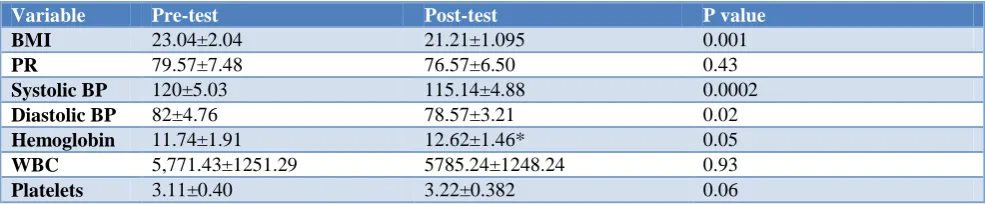
Table 1 shows evaluation of participants done on physical and hematological markers before and after yoga practice.
It was observed that BMI, systolic and diastolic BP, and Hb% changed after intervention. The results were statistically significant. Though PR, WBC and platelets showed improvement in values after yoga practice, it was statistically non-significant.
Table 1: Physical and hematological parameters before and after yoga practice (mean±SD).
Variable Pre-test Post-test P value
BMI 23.04±2.04 21.21±1.095 0.001
PR 79.57±7.48 76.57±6.50 0.43
Systolic BP 120±5.03 115.14±4.88 0.0002
Diastolic BP 82±4.76 78.57±3.21 0.02
Hemoglobin 11.74±1.91 12.62±1.46* 0.05
WBC 5,771.43±1251.29 5785.24±1248.24 0.93
Platelets 3.11±0.40 3.22±0.382 0.06
P’ value taken significant at <0.05, highly significant at <0.01 and very highly significant at <0.001; BMI=Body mass index; BP= Blood pressure; WBC= White blood cells.
DISCUSSION
This study intended to evaluate the effect of yoga training on various physical and hematological parameters based on the hypothesis that yoga has beneficial effect on health
of individuals and long term regular yoga practice can be touted as the panacea for all of life’s ills.
90 days under supervision of professional yoga trainer. Impact on body weight, PR, BP, and various haematological parameters like Hb%, WBC count and platelet count were taken under consideration before and after training. Significant reduction in body weight and BP, rise in haemoglobin was observed. However, although PR, WBC count and platelets showed improvement, difference was statistically non-significant.
A significant reduction in BMI was observed in our study which is consistent with other studies. Balaji in his study observed that training in yoga asana and pranayama one hour every day in the morning for three continuous months under a yoga expert resulted in decrease in body weight, BMI, and waist hip ratio.15,16 Another study showed significant reduction in BMI, heart rate and BP in the total cohort with yoga.17
PR in healthy humans is influenced by physical, emotional, and cognitive activities.18,19 In the present study, there was a fall in average PR in subjects after intervention though not statistically significant. This was in tandem with earlier study.20
Yoga practices are reported to reduce PR without corresponding changes in heart rate variability.21-23 Regular exercise improves the heart's ability to pump blood efficiently, so fewer heart contractions are required to supply the body's needs.24
It is well known that physical activity has a BP lowering effect. 26 Significant reduction in systolic and diastolic BP was observed after yoga in our study which was consistent with previous studies.27-30
Though it is evident that more than 70% of participants exhibited an improvement in both systolic and diastolic BP in study group, improvement in 100% was not achieved; a finding supported by earlier study.2 This could be due to participants doing some form of regular exercise apart from yoga. Some subjects with BP in the lower range of normal may not have further scope of reduction.
The mean values of heart rate, systolic BP and diastolic BP show significant reduction after at least 3 months of yoga practice. Reduction in heart rate and BP indicate a shift in the balancing components of autonomic nervous system towards the parasympathetic activity.31,32 This modulation of autonomic nervous system activity might have been brought about through the conditioning effect of yoga mediated through the limbic system and higher areas of central nervous system.33 Regular practice of yoga increases the baroreflex sensitivity and decreases the sympathetic tone, thereby restoring BP to normal level in patients of essential hypertension.34 Meditation by modifying the state of anxiety reduces stress induced sympathetic over activity thereby decreasing arterial tone and peripheral resistance, and resulting in decreased diastolic BP and heart rate. This ensures better peripheral
circulation and blood flow to the tissues.35,36 The study by Devasena et al also revealed the significant response in subjects with BMI of >25.37 This may suggest that yoga is more effective in reducing the basal heart rate and BP in morbid conditions like obesity. The study also revealed a highly significant reduction in weight after 6 months of yoga. Similar findings were reported by Udupa et al.38
Our study revealed a significant rise in Hb% post yoga. Sayyad et al studied the effect of Sudarshan Kriya yoga for 8 days on Hb%, lipid profile, and pulmonary functions in 150 participants. Hb% was found to be elevated, along with improved lipid profile and pulmonary functions.14,39
Ramanath et al observed various beneficial results like improvement in PR, BP and Hb% in anemic patients after three months of treatment with iron and folic acid along with yoga practice. The reason for increased Hb% can be explained by two different mechanisms: release of erythropoietin due tohypoxia during yoga practices; increased release of iron stores from reticulo-endothelial cells and enhanced release of reserved RBCs by splenic contraction.25,40 Our study revealed a rise in WBC count though not significant. This is consistent with earlier studies. Thus the practice of yoga improves our immune system and protects against infections.14
There was a non-significant rise in platelets in the present study. Purohit et al found a rise in platelets in 87.5% subjects. In addition, clotting time was increased while bleeding time was decreased significantly.41 A similar study by Chohan et al support our findings on platelet count. In their study on 7 previously untrained male adults, there was a rise in platelet count after 4 months of yoga training. The reason for increased platelet count can be explained by two different mechanisms: hypoxia induced during yoga practices; enhanced contraction of spleen which can release the reserved platelets.42
Limitations
Small sample size, lack of control groups and short duration of the study were the major limitations of our study. Additionally, focusing on particular aspects for consideration as outcomes neglected the other possible benefits of yoga. Longitudinal research on this simple and promising intervention over long term in larger sample size and with control arms is necessary to reinforce the conclusions.
CONCLUSION
ACKNOWLEDGEMENTS
Authors would like to thank all participants for their voluntary participation. Authors acknowledge Yog Guru Swami Soham for providing training to participants.
Funding: No funding sources Conflict of interest: None declared
Ethical approval: The study was approved by the Institutional Ethics Committee
REFERENCES
1. Basavaraddi IV. Yoga. Available at: https://www .nhp.gov.in/yoga_mty. Accessed on 12 August 2019.
2. Sujatha T, Judie A. An Effectiveness of a 12-Week Yoga Program on Physiopsychological Parameters in Patients with Hypertension. Int J Pharm Clin Res. 2014;6(4):329-35.
3. Walters JD. The art and science of raja yoga: fourteen steps to higher awareness. Delhi, India: 2002.
4. Feuerstein G. The yoga tradition: its history, literature, philosophy, and practice. New Delhi, India: Bhavana Books; 2002.
5. Brown RP, Gerbarg PL. Sudarshan Kriyayogic breathing in the treatment of stress, anxiety, anddepression: part I- neurophysiologic model. J Alternat Complementary Med. 2005;11(1):189–201. 6. Baer RA. Mindfulness training as a clinical intervention: a conceptual and empirical review. Clin Psychol. 2013;10(2):125–43.
7. Tripathy JP, Thakur JS. Integration of yoga with modern medicine for promotion of cardiovascular health. Int J Non-communicable Dis. 2017;2(3):64-8.
8. International Sivananda Yoga Vedanta Centres: The Five Points of Yoga. Available at: http://www. sivananda.org/teachings/fivepoints.html. Accessed on 12 August 2019.
9. Manchanda S. Yoga as a lifestyle polypill. J Prev Cardiol. 2016;5:881-7.
10. Baldwin MC. Psychological and physiological influences of hatha yoga training on healthy, exercising adults (yoga, stress, wellness). Boston University, USA; 1999.
11. Cowen VS, Adams TB. Physical and perceptual benefits of yoga asana practice: results of a pilot study. J Bodywork Movement Therap. 2005;9(3):211–9.
12. Tew GA, Howsam J, Hardy M, Bissell L. Adapted yoga to improve physical function and health-related quality of life in physically-inactive older adults: a randomised controlled pilot trial. BMC Geriatrics. 2017;17:131.
13. Woodyard C. Exploring the therapeutic effects of yoga and its ability to increase quality of life. Int J Yoga. 2011;4(2):49–54.
14. Sharma P, Kumar P. Scope of yoga practices in hematological and biochemical alterations. Asian J Pharm Clin Res. 2016;9(1):73-5.
15. Taneja DK. Yoga and health. Indian J Community Med. 2014;39(2):68-72.
16. Balaji PA, Smitha VR, Sadat AS. Effects of yoga- pranayama practices on metabolic parameters and anthropometry in type 2 diabetes. Int Multidiscip Res J. 2011;1:1–4.
17. Satyanarayana P, Benerji GV, Dulala RK, Meka FB, Kummari NR. Effect of yoga on heart rate, BP, body mass index. IOSR J Dent Med Sci. 2013;8(2):36-9. 18. Tyagi A, Cohen M. Yoga and heart rate variability:
A comprehensive review of the literature. Intl J Yoga. 2016;9(2):97-113.
19. Thayer JF, Hansen AL, Saus-Rose E, Johnsen BH. Heart rate variability, prefrontal neural function, and cognitive performance: the neurovisceral integration perspective on self-regulation, adaptation, and health. Ann Behav Med. 2009;37:141–53.
20. Vinay AV, Venkatesh D, Ambarish V. Impact of short-term practice of yoga on heart rate variability. Intl J Yoga. 2016;9(1):62-6.
21. Tyagi A, Cohen M. Yoga and heart rate variability: A comprehensive review of the literature. Intl J Yoga. 2016;9(2):97-113.
22. Bowman AJ, Clayton RH, Murray A, Reed JW, Subhan MM, Ford GA. Effects of aerobic exercise training and Yoga on the baroreflex in healthy elderly persons. Eur J Clin Invest. 1997;27:443–9. 23. Singh MU, Ghildiyal A, Kala S, Srivastava N.
Effect of Yoga Nidra on physiological variables in patients of menstrual disturbances of reproductive age group. Indian J Physiol Pharmacol. 2012;56:161–7.
24. Bradycardia. Available at: https://www.health.Harv ard.edu/a_to_z/bradycardia-a-to-z. Accessed on 12 August 2019.
25. Ramanath B, Shaik T, Reddy MS. A randomized control study of yoga on anemic patients. Int J Res Med Sci. 2013;1(3):240-2.
26. Priya JV, Kanniammal C, Mahendra J, Valli G. Impact of Yoga on BP and Quality of life in patients with hypertension. Int J Pharm Clin Res. 2017;9(5):413-6.
27. Gadham J, Sajja S, Rooha V. Effect of Yoga on obesity, hypertension and lipid profile. Int J Res Med Sci. 2015;3(5):1061-5.
28. Murugesan R, Govindarajulu N, Bera TK. Effect of selected Yogic practices on the management of hypertension. Indian J Physiol Pharmacol. 2000;44:207-10.
29. Sahay BK. Yoga and diabetes. Novo Nordisk Diabetes. 1994;1:159-67.
31. Joseph S, Sridhar K, Patel SKB, Kumaria ML, Selvamurthy W, Joseph NT, et al. Study of some physiological and biochemical parameters in subjects undergoing yoga training. Indian J Medicine Res. 1981;74;120-4.
32. Anand BK. Yoga and medical seicences. Indian J Physio Pharmocol. 1991;35(2):84-7.
33. Selvamurthy W, Nayar HS, Joseph NT, Joseph S. Physiological effects of yogic practice. Nimhans J. 1983.
34. Vijayalakshmi P, Mohan M, Bhavanani AB, Patil A, Kumar BP. Modulation of stress induced by isometric hand grip test in hypertensive patients following yogic relaxation training. Indian J Physiol Pharmacol. 2004;48(1):59-60.
35. Bhargava R, Gogate MG, Macarenhas JF. Autonomic responses to breath holding and its variations following pranayama. Indian J Physiol Pharmacol. 1988;32(4):257-64.
36. Gopal KS, Bhatnagar OP, Subramanian N, Nishith SD. Effect of yogasana and pranayamas on blood pressure, pulse rate and some respiratory functions. Indian J Physiol Pharmocol. 1973;17(3);273-6. 37. Devasena I, Narhare P. Effect of Yoga on heart rate
and BP and its clinical significance. Int J Biol Med Res. 2011;2(3):750-3.
38. Udupa KN, Singh RH. The scientific basis of yoga. J Am Med Assn. 1972;220(10):1365.
39. Sayyed A, Patil J, Chavan V, Patil S, Charugulla S, Sontakke A, et al. Study of lipid profile and pulmonary functions in subjects participated in SudarshanKriya Yoga. Al Ameen J Med Sci. 2010;3(1):42-9.
40. Mairbäurl H. Red blood cells in sports: effects of exercise and training on oxygen supply by red blood cells Front Physiol. 2013;4:332.
41. Purohit G, Chawla VK, Harsoda JM. Effect of Yoga on Various Heamatological Parameters in Young Healthy Individuals. Indian Journal of Applied Basic Medical Sci. 2011;13(17):425-7.
42. Chohan IS, Nayar HS, Thomas P, Geetha NS Influence of yoga on blood coagulation. Int J Vascular Biol Med. 1984;51(2):196-7.
Cite this article as: Banerjee AB, Banerjee AA, Sharma LK, Kumar S.Effect of yoga on physical and