* To whom all correspondence should be addressed. Telefax: 0-07-863-2019-133;
E-mail: [email protected]
Methods of Assessing Properties and Behavioral Characteristics
of Toxic Components of Exhaust Gases from Stationary and
Mobile Sources of Air Pollution in Major Cities
Vadim Igorevich Bespalov, Lubov Zakharovna Ganicheva, Natalia Vladimirovna Yudina, Oksana Nickolaevna Paramonova*, Tatiana Leonidovna Pirozhnikova and Irina Nickolaevna Gevorkyants
Federal State Budgetary Educational Institution of Higher Professional Education, “Rostov State University of Civil Engineering”, Russian Federation 344022, Rostov region,
Rostov-on-Don, Socialisticheskaya St., 162. doi: http://dx.doi.org/10.13005/bbra/1436
(Received: 27 September 2014; accepted: 10 October 2014)
The aim of research is to develop a methodology for assessing the properties and behavioral characteristics of toxic pollutants, that will allow to examine the nature of the change of stability, controlling it. We systematized property parameters and energy parameters of pollutants, investigated characteristics of their behavior in the conditions of urboecosystem. We proposed a method that allows to assess the behavior of the aerosol stability, controlling the behavior of toxic pollutants in order to reduce their stability and, ultimately, to reduce air pollution.
Key words: property parameters, energy parameters, stability of disperse systems, behavior of pollutants, urban pollution.
Under modern conditions of urboecosystems, the most acute problem is the problem of pollution of air which is subject to a maximum of anthropogenic loads and is the most dynamic of all the environmental components (Ilchenko, 2009; Vavilova, 2009; Choi and Jo, 2011; Mcdonald, 2012; Goudie, 2013; Qingsong et al.,
2013). It should be noted that objects that make the greatest contribution to urban air pollution are no longer industrial enterprises which in modern conditions of urban development are placed outside it, but transportation vehicles and housing and communal enterprises providing functioning
of objects of industrial and social spheres (Fazlollahi et al, 2014; Vavilova, 2009). The last-mentioned objects are placed in the cities and cannot be taken out beyond their borders which is aimed at the minimization of losses (material, energy, and others) when providing services to consumers. Furthermore, urban placement facilities include construction industry enterprises (production of building structures and materials) and construction sites, which is related to the aim of minimization, primarily of transportation costs (Magomadova, 2012; Moiseev, 2014; Suzdaleva, 2014).
the investigation of separate properties and phenomena, as well as to the determination of the corresponding parameters (Ivlev and Andreev, 1986; Ivlev and Dovgaluk, 1999; Tsytovich, 1997, etc.).
Currently, there is no pollutants’ property parameters systematization taking into account the change in their stability. In our opinion, it is stability that determines behavior of toxic pollutants in the air basin of urban areas.
In our study, methodological approaches to the assessment of the properties and behavior of toxic components should be divided into two main trends (Yudina et al, 2014). The first trend involves consideration of toxic components particles as discrete material bodies whose behavior is subject to the laws of Newton’s mechanics (Fuchs, 1955; Green and Lane, 1972). However, considering the polydispersity of aerosols containing toxic components, such approach quite accurately describes the behavior of relatively large particles (particle sizes are more than 100 microns), having considerable dimensions and mass, but with high degree of error it describes the behavior of small particles (particle sizes are less than 1 micron), having relatively small size and mass. As a result, you cannot predict the behavior of polluting aerosol with sufficient reliability.
The second trend involves consideration of pollutant aerosol comprising particles of toxic components, as a continuous medium, the behavior of which must be subject to the laws of the theory of continuous media (Rayst, 1987; Kousov and Scriabina, 1983; Petryanov-Sokolov and Sutugin, 1989; etc.). However, also considering the polydispersity of aerosols containing toxic components, such approach quite accurately describes the behavior of the relatively small particles which are small enough in size and mass, but with high degree of error it describes the behavior of large particles having a relatively large size and mass. The result is also not possible to with sufficient reliability predict the behavior of pollutant aerosol. As a result, as you cannot predict the behavior of polluting aerosols with sufficient reliability.
Thus, in both cases when describing the behavior of a toxic polluting aerosol, either large or small particles are not considered. Obviously,
the most complete characterization of the pollutants properties and behavior can be given applying a comprehensive approach to their investigation, taking into account peculiarities of the continuous medium - on one hand, and multiple discrete particles of various sizes - on the other hand, wherein the approach relies on the theory of disperse systems, based on the classical positions of the colloidal and physical chemistry.
METHOD
Methods of investigation are based on the fundamentals of the theory of disperse systems, system analysis and the theory of modeling systems, analytical generalization of known scientific and practical results.
The object of research - toxic pollutants as disperse systems and characteristics of their behavior in urban ecosystem.
RESULTS AND DISCUSSION
Having a certain margin of total free energy, pollutants, as well as any dispersed system exhibits certain features of the behavior in the air environment, which eventually determined by their stability (Ivlev and Dovgaluk, 1999). Toxic components as dispersed systems due to its large specific surface are thermodynamically non-equilibrium system, resulting in the tendency to decrease the surface energy with decreasing of the specific surface. Instability of toxic components (polluting aerosols) is manifested in the consolidation of the particles (recrystallization), often in sticking together and the formation of aggregates (coagulation). The more stable the system is, the slower its parameters change, and vice versa.
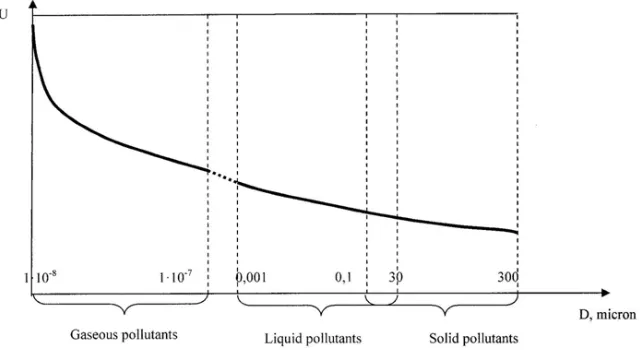
Stability is the resultant characteristic determining the behavior and existence of a pollutant as a dispersion system, i.e. the parameter of its “viability”, the characteristic of the degree (speed) of changes in the parameters determining the properties and energy of the polluting aerosols, for a certain period of time in the conditions of external influences (Figure 1) (Bespalov, 1995).
characterizing the properties of the dispersed phase (D.P.) and the dispersion medium (D.M.) (Bespalov et al., 2014; Lysova and Lisutina, 2013). For this, the parameters determining the properties of D.P. have been classified by us into groups where main classification criterion is the physical nature of the processes and phenomena observed in pollutant aerosols, including toxic components (Bespalov, 1995; Bespalov et al., 2014):
A group of geometric parameters (GPD.P.) a) Dispersity (is the main characteristic of the
D.P. composition and denotes the proportion of particles in any range of their size by weight, volume, surface or number of particles);
b) The average median diameter of the particles;
c) The equivalent particle diameter corresponding to the diameter of a sphere the volume of which is equal to the volume of the particle;
d) The volume of D.P. in the aerosol;
e) Specific surface of the particles (the ratio of the surface of all the aerosol particles to their volume or weight);
f) The average distance between D.P. particles in the aerosol;
Group of physicochemical parameters (PCPD.P.) a) Density of the pollutant or material; b) Tensile strength of the substance or
material (characterizes the adhesion and is expressed in the force necessary to break the layer (volume) divided by the area of
contact);
c) Concentration of particles;
d) The resulting particle velocity (relative to the movable or fixed coordinate system); e) Coagulation constant;
A group of optical parameters (OPD.P.)
a) Refractive index of the light flux of the particles;
b) Reflectance index of the light flux of the particles;
c) The degree of blackness of material or substance particles;
A group of aerodynamic parameters (ADPD.P.) a) Coefficient of the particles surface
roughness;
b) Dynamic coefficient of the particles shape (which equals the ratio of medium resistance to movement of irregularly shaped particles and spherical particles of the same volume); A group of hydrodynamic parameters (HDPD.P.) a) Wetting contact angle;
b) The surface tension at the interface of the interacting phases;
c) Humidity of the substance or material (absolute and relative);
A group of thermophysical parameters (TPPD.P.): a) Temperature of the particles;
b) Coefficient of the particles thermal conductivity;
A group of electromagnetic parameters (EMPD.P.): a) The average charge (potential of the
particles);
b) Internal electric field strength;
c) The dielectric constant of the substance or material;
d) The value of the elementary charge in the material;
e) Specific electric resistance of the material layer (volume) which corresponds to the resistance of an electrical current running through the material from the cube with the side of 1m, and is caused by surface and internal conductivity;
f) Mmagnetic susceptibility of the material. Analysis of the processes occurring in aerosols allowed to identify the parameters that determine the properties of D.M., dividing them into groups similar to the parameters of D.P. (Bespalov, 1995; Bespalov et al., 2014):
A group of geometric parameters (GPD.M.) a) The amount of D.M., which limits the size
of the aerosol cloud;
b) The equivalent diameter of the aerosol cloud;
c) The volume of D.P. in the aerosol;
d) The mean free path of the molecules in the aerosol;
A group of physicochemical parameters (PCPD.M.) a) Density of D.M.;
b) Mass of the molecules of the D.M. (gas) substance;
c) The oscillation period of gas molecules in a direction normal to the surface of the adsorbent;
d) The concentration of molecules of the D.M. substance in the aerosol upon reaching adsorption equilibrium;
A group of optical parameters (OPD.M.)
a) refractive index of of the light flux for the D.M. substance;
b) Dissipation index of the luminous flux of the D.M. substance;
A group of aerodynamic parameters (ADPD.M.) a) Dynamic (kinematic) viscosity of the D.M.; b) The equilibrium pressure of the substance
in the D.M.;
c) Moving speed of the D.M. relative to the environment;
d) Velocity pulsation component of the D.M. in the aerosol;
e) The root mean square velocity of the D.M. molecules;
f) The number of adsorbate molecules at full saturation of the adsorbent surface; A group of hydrodynamic parameters (HDPD.M.) a) humidity of D.M. (absolute and relative); A group of thermophysical parameters (TPPD.M.): a) Temperature of D.M. (gas);
b) Coefficient of thermal conductivity of D.M.; c) Translational component of thermal
conductivity of D.M. (gas); d) Molar heat of adsorption;
A group of electromagnetic parameters (EMPD.M.) a) The electric field strength;
b) Permittivity of the D.M. material; c) Space charge density;
d) The number of ions per D.M. unit volume. As a result of such consideration of the parameters that determine the properties of D.P. and D.M., the set of parameters that determine the properties of the aerosol (PP) generally can be represented as a functional dependence between parameter groups of the aerosol phase components (Bespalov, 1995; Bespalov et al., 2014): PPA. = f1(PPD.P., PPD.M.) = f1 (f (GPD.P., PCPD.P., OP D.P., ADP D.P., HDP D.P., TPPD.P., EMPD.P.), f (GPD.M., PCP
D.M.,OP D.M., ADP D.M., HDP D.M., TPP D.M., EMP D.M.), ...(1) where PPD.P. – a set of parameters that determine the properties of D.P. aerosol; PPD.M. – a set of parameters that determine the properties of D.M. aerosol.
Such a generalization in the development of theoretical foundations allows to complement each D.P. and D.M. parameter group with new features and make targeted and consistent assessment of all sides of the dynamics of formation, distribution, emission and destruction of the aerosol.
Obtaining, distribution and consumption of the aerosol energy is characterized quantitatively by energy parameters, which are determined by an interconnected groups of property parameters complex of D.P. and D.M. aerosol.
be approached as normalized to a unit of time and expressed by their chemical power (W).
From the specified groups the following basic energy aerosol parameters are formed by linking D.P. and D.M. parameter properties of the aerosol (Rayst, 1987):
a) The energy of motion (kinetic energy) Wkinet.; b) Quantum energy (energy of optical
interaction) Wopt.;
c) Adhesive interaction energy (the energy of coagulation) Wadh.;
d) Hydrodynamic interaction energy (the energy of wetting, spreading, absorption, evaporation, condensation) WHD;
e) Thermal energy Wtherm.; f) Electromagnetic energy WEM..
With regard to the aerosol phase components, the relationship of each listed energy parameter with the parameters of aerosol properties can be expressed in a general form as follows (Bespalov, 1995; Bespalov et al., 2014):
for D.P.:
Wkinet. (D.P.) = f2 (GPD.P., PCPD.P., ADPD.P.) ...(2)
Wopt. (D.P.) = f3 (HDD.P., PCPD.P., OPD.P.) ...(3)
Wadh. (D.P.) = f4 (GPD.P., PCPD..P.) ...(4)
WHD (D.P.) = f5 (GPD.P., PCPD.P., HDPD.P.) ...(5)
Wtherm. (D.P.) = f6 (GPD.P., PCPD.P., DPD.P., “PPD.P.) ...(6)
WEM (D.P.) = f7 (GPD.P., PCPD.P., DPD.P., HDPD.P., TPPD.P.,
E“PD.P.) ...(7)
for D.M.:
Wkinet. (D.M.) = f8 (GPD.M., PCPD.M., ADPD.M.) ...(8)
Wopt. (D.M.) = f9 (HDD.M., PCPD.M., PD.M.) ...(9)
Wadh. (D.M.) = f10 (GPD.M., PCPD.M.) ..(10)
WHD (D.M.) = f11 (GPD.M., PCPD.M., HDPD.M.) ...(11)
Wtherm. (D.M.) = f12 (GPD.M., PCPD.M., DPD.M., TPPD.M.)
....(12)
WEM (D.M.) = f13 (GPD.M., PCPD.M., ADPD.M., HDPD.M.,
TPPD.M., EMPD.M.) ...(13)
The above forms of energy together determine the total free energy (the activation energy) of the aerosol, which can be expressed as follows (Bespalov, 1995; Bespalov et al., 2014): WS A. = f14 (WS D.P., WS D.M.) = f14 ( f14.1 (Wkinet. (D.P.), Wopt. (D.P.), Wadh. (D.P.), WHD (D.P.), Wtherm.. (D.P.), WEM
(D.P.)),
f14.2 (Wkinet. (D.M.), Wopt. (D.M.), Wadh. (D.M.), WHD (D.M.), Wtherm. (D.M.), WEM (D.M.)) ...(14)
Thus, free energy of the dispersed system is functionally dependent on some D.P. and D.M. energy parameters of the aerosol, which implies
the possibility of redistribution of certain types of energy, reflecting the features of aerosol behavior. Having a certain reserve of the total free energy (activation energy), aerosols display environmental characteristics of their behavior, which ultimately affects its stability (Bespalov, 1995):
WSA . ~ UA ...(15)
Disperse systems due to their high specific surface of phase interface are thermodynamically unstable, which is manifested in their downward trend in the total free energy. Decrease in stability of disperse systems is manifested either in the strengthening of D.P. particles (recrystallization) or in the coalescence and enlargement of the particles (the formation of aggregates).
For aerosols the following notions were introduced:
a) Kinematic stability, which is caused by Brownian motion and diffusion;
b) Aggregative stability, associated with the effects and phenomena preventing the coalescence and enlargement of the particles.
According to current concepts, stability is a resulting characteristic defining features of the behavior of disperse systems, ie parameters of their viability. Stability is a characteristic of the intensity of properties parameter changes and the dispersed system energy parameters for a certain period of time under conditions of external influences (Lysova and Lisutina, 2013).
Disperse systems due to their high specific surface of phase interface are thermodynamically unstable, which is manifested in their downward trend in the total free energy. Decrease in stability of disperse systems is manifested either in strengthening of D.P. particles (recrystallization) or coalescence and enlargement of the particles (the formation of aggregates) (Lysova and Lisutina, 2013).
The more stable dispersion system is, the slower its parameters change at external influences on it and, conversely, the less stable dispersion system is, the faster its parameters change.
main options (Bespalov et al., 2014):
1) dUA/d > 0 – increase in stability of the aerosol when changing the properties parameters and increasing energy parameters.
2) dUA/d = 0 – permanence of stability, while the system tends to stabilize the property parameters at constant energy parameters. 3) dUA/d < 0 – decrease in stability when dispersed system tends to change
parameter properties, decreasing the energy parameters.
The concept of stability should be clearly specified and referred to the relevant type of disperse systems.
Analysis of parameters characterizing the state of disperse systems enables us to conclude that for describing the behavior of aerosols the following sequence of parameters is acceptable (Figure 2).
It is evident that to type I parameters are attributed parameters of polluting aerosol properties PP, representing a set of parameter properties of the dispersed phase PPD.P. and the dispersion medium PPD.M. of this aerosol. Parameters of type II are the energy parameters of aerosol WS(A), which characterize energy acquisition, distribution and consumption by the aerosol and are determined by interrelated complex of parameter properties groups of aerosol PP. Parameters of the third type – stability of the aerosol UA – the resulting characteristic
representing the aerosol ability to resist external influences (its viability), which determines the features of the aerosol behavior and is a characteristic of the change rate of PP and WS(A), dispersed systems for a certain period of time under conditions of external influences.
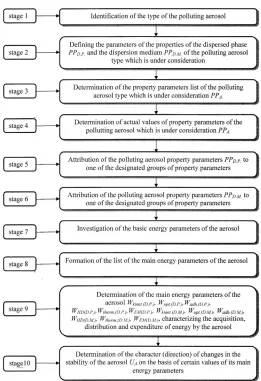
The carried out examinations of pollutants as a disperse system allow us to offer a methodology of describing toxic components properties and behavior characteristics of the waste and exhaust gases, which includes the following main steps (Figure 3).
Fig. 3. Flowchart of the implementation of the method describing the toxic pollutants properties and behavioral characteristics
CONCLUSIONS
As a result of the completed stages of the research, we have improved methods of describing toxic components properties and behavior characteristics of the waste and exhaust gases, which allows:
a) Proceed to solving the problem of controlling the behavior of exhaust gases toxic components from industrial and energy enterprises, municipal and domestic energy installations, as well as the exhaust gas from transport systems and mobile power plants in order to reduce air pollution in urban areas;
b) Develop physical models of processes of air pollution and reduction of air pollution by toxic components;
c) Perform a mathematical description of the environmental efficiency and energy efficiency as resulting criteria for the selection of emissions treatment technology;
ACKNOWLEDGMENTS
The authors express their sincere gratitude to the staff of the Department of Environmental Engineering, Federal State Budgetary Educational Institution of Higher Professional Education “Rostov State University of Civil Engineering” for advice and recommendations kindly given while writing of this article.
REFERENCES
1. Bespalov, V.I., Physical and energy concept of describing the processes and systematic approach to the selection of highly effective and economical engineering complexes for protection of air environment from emissions of pollutants. News of the North Caucasian Scientific Center of Higher School. Natural Sciences. Rostov-on-Don: 1995; 37- 47.
2. Bespalov, V.I., Lysova, E.P., Paramonova, O.N., Ganicheva, L.Z., Pirozhnikova, T.L., Mishchenko, A.N., Impact analysis and the development of a physical model of the process of air pollution for the enterprises of thermal power complex. Collection of scientific works SWorld. 2014; 1(3): Odessa: 3-10.
3. Choi, I. H., Jo, W. K., Application of Stack Emissions Data from Tele-Monitoring Systems for Characterization of Industrial Emissions of Air Pollutants. Aerosol and Air Quality Research, 2011; 11: 412-418.
4. Fazlollahi, S., Girardin, L., Marechal, F., ClusteringUrban Areas for Optimizing the Design and the Operation of District EnergySystems. Computer Aided Chemical Engineering, 2014; 33: 1291-1296. DOI: 10.1016/B978-0-444-63455-9.50050-7/ 5. Fuchs, N.A., The mechanics of aerosols. M .:
USSR Academy of Sciences Publishing House, 1955.
6. Goudie, A.S., The human impact on the natural environment: past, present, and future. John Wiley & Sons, 2013.
7. Green, H., Lane, B., Aerosols – dust, smokes and fogs. 2nd ed. A .: Chemistry, 1972. 8. Ilchenko, I.A., Research of primary and
secondary air pollution of industrial cities and the ways to reduce it. News of Higher Educational Institutions. The North Caucasus region. Series: Natural Sciences. 2009; 6: 79-83.
9. Ivlev, L. S., Dovgalyuk, Y. A., Physics of
atmospheric aerosol systems. SPb.: Research Institute Of Chemistry, St. Petersburg State University, 1999.
10. Ivlev, L.S., Andreyev, S.D., Optical properties of atmospheric aerosols. Leningrad: Publishing house of Leningrad State University, 1986. 11. Kouzov, P.A. and Skryabina L.Ya., Methods
for determination of physical and chemical properties of industrial dusts. Leningrad, 1983. 12. Lysova, E.P. and Lisutina L.A., The main provisions of physico-energy concept of ecological safety maintenance in the areas of location of fuel and energy complex enterprises. Low-waste resource-saving chemical technologies and environmental safety: Theses.
All-Russia Scientific and Practical Conference dedicated to the Year of Environmental Protection and the 65th anniversary of the Ufa State Petroleum Technological University. Sterlitamak: 2013; 98-100.
13. Magomadova, H.A., Problems of social-ecological-economic efficiency of interaction of society and the nature. Engineering Bulletin of Don. 2012; 1. http://www.ivdon.ru/magazine/ archive/n1y2012/666.
14. Maricq, M.M., Monitoring motor vehicle pm emissions: an evaluation of three portable low-cost aerosol instruments. Aerosol Science and Technology. 2013; 47(5): 564-573.DOI: 10.1080/ 02786826.2013.773394.
15. Mcdonald, K., Air pollution in the urban atmosphere: sources and consequences.
Metropolitan Sustainability. Understanding and Improving the Urban Environment. A volume in Woodhead Publishing Series in Energy: 2012; 231-259. DOI: 10.1533/9780857096463.3.231 16. Moiseev, Y.M., Urban planning system in the face of climate change challenges. Ecology of the urbanized territories. 2014; 2: 6-11.
17. Petryanov-Sokolov, I.V., Sutugin, A.G., Aerosols. M.: Science, 1989.
18. Qingsong, W., Xueliang, Y., Jian, Z., Ruimin, M., Huichun, Y., Chunyuan, M., Key evaluation framework for the impacts of urbanization on air environment – A case study. Ecological Indicators, 2013; 24: 266-272. DOI: 10.1016/ j.ecolind.2012.07.004.
19. Rayst, P., Aerosols – an introduction to the theory. M.: World, 1987.
20. Suzdaleva, A.L., Modern pattern of urbanization and need for a complex solution to the Environmental security problems. Ecology of the urbanized territories. 2014; 2: 12-16. 21. Tsytovich, B.H., Plasma and dust crystals,
UFNr.0167.199701e.0057. URL: http://ufn.ru/ ru/articles/1997/1/e/
22. Vavilova T.Y., Background of regulation of planning and development of multifunctional industrial and residential areas. Privolzhsky Scientific Journal. 2009; 4: 100-105.
23. Yudina, N.V., Lysova, E.P., Ganicheva, L.Z., The
analysis of methodical approaches to an assessment of parameters and properties of the polluting substances in environment: Theses.