21
Development of Laser Beam Diffraction
Technique for Determination of Thermal Expansion
Coefficient of Polymeric Thin Films
Nguyen Van Thuan
1,
Tran Vinh Son
2, Tran Quang Trung
2,
Tran Thi Thao
1, Nguyen Nang Dinh
1,*
1
VNU University of Engineering and Technology, 144 Xuan Thuy, Cau Giay, Hanoi, Vietnam
2
University of Natural Science, VNU Ho Chi Minh City, 227 Nguyen Van Cu, District 5, Ho Chi Minh City
Received 04 March 2015
Revised 15 April 2015; Accepted 13 May 2015
Abstract: Laser beam diffraction by a patterned surface has been investigated theoretically and experimentally for the determination of the thermal expansion coefficient (α) of polymeric materials. By tracking the deviation of the first order diffraction mode from surface-patterned polymers, expansion coefficients in a range 10-7 to 10-4 K-1 can be measured by temperature changes less than 100 oC. A set-up of laser diffraction (SLD) was made, using a He-Ne laser (λ = 632.8 nm) and thin film casting technique. The results of measurements on the SLD system for polymers like PVK polycarbonate, PDMS, organic complex (chitosan) and conducting polymer (P3HT) showed that SLD technique can be applied to determine thermal expansion coefficients of different polymeric materials with a considerably small volume. Especially, the fact that α of P3HT-composite films was found to be much lower than that of the pure P3HT suggests a potential application of polymeric composites for organic devices working at elevated temperature, for organic solar cells (OSC) in particular.
Keywords:Laser beam diffraction; thermal expansion; diffraction grating; polymer.
1. Introduction∗∗∗∗
Conducting polymers and polymer-based devices have been increasingly studied due to their potential application in optoelectronics, such as field emission transistors (FETs), organic light emitting diodes (OLED), organic solar cells (OSC), etc [1-4]. Comparing with inorganic devices, the performance efficiency and service durability of organic devices until now are considerably low. In OSC this limitation is usually attributed to the strong decay of the excitons which are generated in the donors/acceptors junctions owing to the illumination of solar radiation. The excitons decay can be
_______ ∗
diminished by the creation of either appropriate heterojunctions or nanocomposite layers. This results in the charge separation, i.e. generated electrons and holes move in opposite directions, and consequently the luminous quenching occurs [5]. Thus, by embedding inorganic nanocrystalline oxides into polymer matrices one can enhance the efficiency and service duration of the devices. The embedded oxides can substantially influence both the electrical, and optical properties of the polymer, for instance, nanocrystalline TiO2 (nc-TiO2) particles in poly(3-hexylthiophene) (P3HT), abbreviated to P3HT + nc-TiO2 composite thin films were studied as a photoactive material [6]. It is very important to improve the thermal stability of the device performance under operating conditions. For OSC, the thermal stability is strongly dependent on the thermal expansion of the polymeric active layer. However, until now as so far, from references we have not found yet the data of the thermal expansion coefficient (α) of the conjugate polymers like poly[2-methoxy-5-(2'-ethyl-hexyloxy)-1,4-phenylenevinylene] (abbreviated to MEH-PPV) and (P3HT). Thus to determine α of these conjugate polymers is necessary for characterizing the stability of the device performance.
Methods for measuring thermal expansion coefficient (α) of materials often rely on electro-mechanical techniques such as capacitance changes [7], strain gauges and push rods [8]. Measuring displacement with a mechanical device introduces difficulties with regard to calibration and thermal isolation of the sample from the push rod and sensors. To avoid these difficulties, optical techniques based on the Michelson interferometry with a resolution on the order of the wavelength are commonly used [9-12]. On the other hand, the propagation of laser beams in media with varying temperature introduces phase shifts which need to be calibrated and corrected.
In this paper, we demonstrate a non-contact optical method to achieve high-accuracy thermal expansion measurement using a single laser beam. Contrary to interferometric techniques, the optical technique is less affected by the temperature gradient of air ambience. An advantage over conventional methods is that, by using non-contact optical method one can determine α for very thin samples, consequently a small volume of the materials investigated is required.
2. Determination of thermal expansion coefficient
2.1. Principles of measurement technique
A Gaussian laser beam with a width w and wavelength radiates to a diffraction grating with a slit separation Г. Suggest that angles and represent, respectively the incident and diffracted angles relative to the normal of the grating. Both the incident and diffracted beams lie in the plane normal to the ruling of the grating. According to Bragg’s condition for diffraction, there is:
mλ = Г(sinθm - sinθi ) (m is order, Г is split separation) (1)
If slit separation of the grating Г changes as a result of thermal expansion (or stress), the diffracted angle θm is expected to change accordingly. Arcording to Eq. 1, it is possible to obtain the thermal expansion coefficient of the grating by measuring the location of diffraction beam after increased temperature. Assuming the grating is made of a material with a linear expansion, we can calculate the linear expansion coefficient (α), as follows.
where is slit separation of the grating at room temperature (RT); Г(T) - slit separation of the grating at the measuring temperature and ∆T = T - TRT.
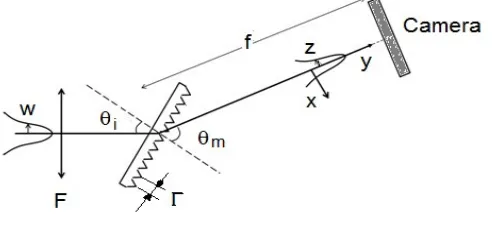
Figure 1 shows a set-up of thermal expansion measurements by laser diffraction. A red He-Ne laser beam (632.8 nm) was collimated to a width of 3 mm (FWHM) and focused to the sample. The sample was heated from room temperature up to 200 oC by a heater controlled via computer. Using a thermocouple to feedback the control unit, temperature is stabilized to within 0.2 oC. A silicon CCD camera with 720 pixel in x and 576 pixels in z, for a resolution of 6.65 µm per pixel, was positioned at the minimum waist of the focused diffracted beam. The detector can be moved to capture various diffraction orders (m = 1, 2, 3,...). The distance from sample to camera (f) can be adjusted from 10 to 500 mm, howerver in our experiments, the most suitable value of f was fixed at 150, 250 or 300 mm for polymeric materials like chitosan, PDMS, PVK and P3HT.
At the different temperature of sample, the beam location on the camera is analyzed by computer in real time by mean of a Gaussian profile fitting algorithm. From measured data, one can determine the thermal expansion coefficient of the samples.
Fig. 1. Schematic of the linear thermal expansion coefficient measurement linear thermal expansion coefficient using laser beam diffraction.
The samples studied included various types of already patterned surfaces using casting or stampling technique. Among prepared samples, polymer grating films were made by casting polymer solutions over diffraction grating preformed. The ruled grating has a slit separation Г = 1600 ± 100 nm. Polydimethylsiloxane (PDMS), conducting polymer P3HT and organic complex like chitosan with a thickness lees than 100 µm were patterned by the casting method, whereas other kind of polymers like polycarbonate (PVK), poly(vinyl chloride) (PVC), etc. with thickness over 250 µm were prepared by applying pressure on a flat substrate lying in contact with a preformed grating.
From equation (1) and (2) one can set-up a relationship of thermal expansion coefficient (α), the diffraction angle and sample temperature in case θi = 0:
(
)
1 sin
1 sin
T
θ α
θ θ
= −
∆ ± ∆ (3)
D x f
θ × ∆
∆ = (in radian) (4)
where D is a pixel size along x-axis. In our experiments D is fixed at 6614 nm; ∆x is a pixel-shift (the multiple number of D) and and f - distance between sample and camera. Thus from experimental data obtained for ∆x one, can determine ∆θ by Eq. 4, consequently thermal expansioncoefficient (α) by Eq. 3.
2.2. Determination of thermal expansion coefficient of some polymers
From thermal expansion coefficient references the thermal expansion coefficient some kinds of popular materials was charcterized and reported. For instance, for used for polycarbonate α = 65 to 70 × 10-6 K-1 [9], for PDMS α = 300 to 320 × 10-6 K-1 [10] and for chitosan α = - 2.5 × 10⁻³ K-1 [11]. In our experiments we also used these materials for the determination of α by the SLD technique, consequently to compare its accuracy with the one of the traditional methods. Further, by the same SLD technique we carried-out measurements of thermal expansion coefficient of two types of samples: pure conjugate polymers P3HT and composite of P3HT and nc-TiO2.
a. Polycarbonate.
This is a popular polymer that is used for the thermal isolation or optical compact disk. By melting polycarbonate at 160 oC then cast on diffraction grating, we can obtain the film of polycarbonate. The set-up parameters in measurement process are f = 300 mm, first order diffraction angle 24.5o and ∆T = 75o C. The difracted beam location on the camera is analyzed by computer in real time by mean of a Gaussian profile fitting algorithm (Fig. 2), and the pixel-shift was of ∆x = 99. Using Eq. 4 with data of D (6614 nm or 6.614×10⁻³ mm) and (f = 300 mm), ∆θ was found to be ca. 0.002 (rad) or 0.126o. Then the thermal expansion coefficient calculated from Eq. 3 was determined at ~ 64 × 10-6 K-1. This result is quite close to the value reported in [9]. In a repeated experiment with ∆T = 67o C, the received α was 70 × 10-6 K-1 which is similiar to the one that was reported in [13]. A neglegible difference in the values of α that were determined by either the traditional [9, 13] or SLD techniques reflects the different errors of each measuring method. Thus the thermal expansion coeeficient of polycarbonate is approximately equal to (67±3) 10-6 K-1.
b. Polydimethylsiloxane (PDMS)
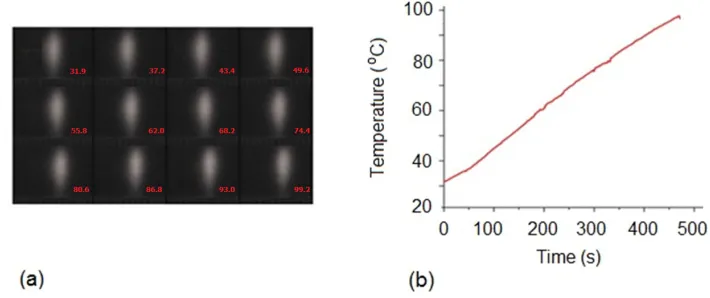
The thermal expansion of PDMS is higher than of polycarbonate. The thin PDMS grating was performed by casting method on the reference ruled glass grating with Г0 = 1600 nm. The set-up parameters in measurement process are f = 150 mm, first order diffraction angle 24.5o and ∆T = 72o C. The pixel-shift was of 234, consequently the thermal expansion coefficient was found to be ca. 320 × 10-6
K
-1 that was analyzed in real time by mean of a Gaussian profile fitting algorithm (Fig. 3). In a repeated experiment with ∆T = 70o C and f = 250 mm, the obtained result was of almost the same value as 320 × 10-6K
-1. These results are close to the value reported in [13].Fig. 3. Pixel shift of PDMS (a) and time-temperature dependence of heating (b).
c. Chitosan
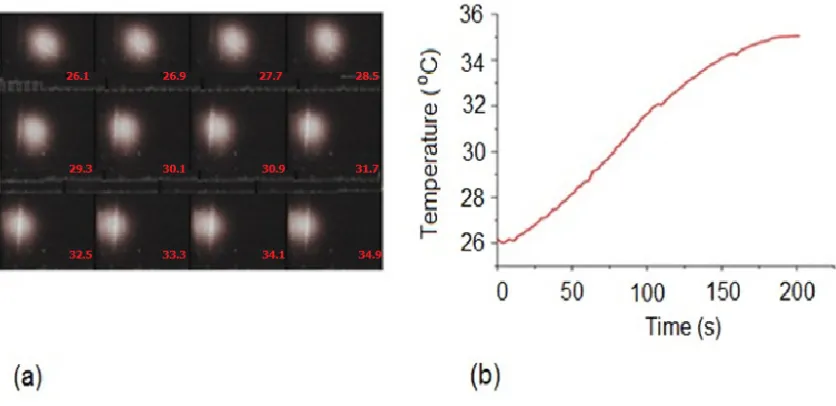
Chitosan, a derivative of chitin, a biopolymer found in insects and crustacean shells that are applied on water filter, anti-bacteria and medicine. Chitosan have the negative thermal expansion coefficient. A solution of 1% chitosan in water and acetic acid was dropped on the surface of grating with density 625 grooves/mm (Г0 = 1600 nm), and then heated at 50-60
o
C to evaporate the solvent slowly. Then, the dried film was peeled off and used as a self-supported sample. The set-up parameters in measurement process are f = 250 mm, first order diffraction angle 24.5o and ∆T= 9o C and the thermal expansion coefficient is calculated about -1.6 × 10⁻³ K-1 (Fig. 4). In the repeated experiments with ∆T= 10o C and f = 250 mm, the received result is -1.4 × 10⁻³ K-1. The absolute values are not much larger than -2.5 × 10⁻³ K-1 as reported in [11] and this difference is due to the derivative technique.
d. P3HT
For measurering the thermal expansion coefficient of the pure P3HT and PTC, a solution of 10 mg of P3HT and PTC in chloroform was dropped on the surface of glass grating with density 625 grooves/mm (Г0 = 1600 nm), and then slowly heated at 70-80oC in vacuum to evaporate the solvent.
The set-up parameters in measurement process are f = 250 mm, first order diffraction angle 24.5o and ∆T = 27o C and the thermal expansion coefficient was calculated about 71 × 10-6 K-1 for P3HT and 8.5 × 10⁻⁶ K-1 for the PTC composite. In the repeated experiments with ∆T= 10o C and f = 250mm, the obtained results for P3HT and PTC samples were of 76 × 10-6 K-1 and 9.1 × 10⁻⁶ K-1, respectively (Fig. 5). This demonstrates that both the P3HT and PTC composite have positive thermal expansion coefficients. Moreover, the polymeric composite film possesses much smaller thermal expansion coefficient than that of the pure polymer. As seen in [14], changing of the thermal expansion of polymer composites was successfully carried-out by blending with a negative thermal expansion material. Table 1 lists values of the thermal expansion coefficient of the measured polymers at room temperature.
Table.1. Thermal expansion coefficient of some polymers
Polymers α (K-1) α, K-1 (from Ref.)
Polycarbonate (64 − 70) × 10-6 (65 − 70) × 10-6 [9]
PDMS (310 − 320)× 10-6 (300 − 320) × 10-6 [10]
Chitosan - (1.4 − 1.6) × 10-3 - 2.5 × 10⁻³ [11]
P3HT (71 - 76) × 10-6 Unknown
P3HT+nc-TiO2 (8.5 to 9.1) × 10-6 Unknown
3. Conclusion
By using a He-Ne laser (λ = 632.8 nm) and casting polymer technique, a set-up of laser diffraction (SLD) was made for measurements of thermal expansion coefficient of polymers. Measurement results obtained on the SLD for polymers like PVK, PDMS, chitosan, conducting polymer P3HT and composite of P3HT+nc-TiO2 allowed to apply SLD technique for determining thermal expansion coefficients of different polymeric materials with a considerably small volume. The fact that the thermal expansion coefficient of P3HT composite films is much lower than that of the pure P3HT suggests a useful application of polymeric composites for producing organic devices, especially organic solar cells working at elevated temperatures.
Acknowledgements
This research is funded by Vietnam National Foundation for Science and Technology (NAFOSTED) under grant number 103.02-2013.39.
References
[1] B. D. Malhotra, Handbook of Polymers in Electronics, Rapra Technology Ltd., Shawbury, Shrewsbury, Shropshire, SY4 4NR, UK, 2002.
[2] J. S. Salafsky, Phys. Rev. B 59 (1999) 10885.
[3] V. M. Burlakov, K. Kawata, H. E. Assender, G. A. D. Briggs, A. Ruseckas, I. D. W. Samuel, Phys. Rev. B 72 (2005), 075206.
[4] A. Petrella, M. Tamborra, P. D. Cozzoli, M. L. Curri, M. Striccoli, P. Cosma, G. M. Farinola, F. Babudri, F. Naso, A. Agostiano, Thin Solid Films 451/452 (2004) 64.
[5] S. Bhattacharyya, A. Patra, Bull. Mater. Sci. 35 (2012) 719.
[6] Tran Thi Thao, Do Ngoc Chung, Nguyen Nang Dinh, Vo-Van Truong, Comm. in Phys. 24 (2014) No. 3S1, 22-28. [7] R. Scholl, B. W. Liby, Manhattan College, Riverdale, NY 2009 The Physics Teacher, Vol. 47.
[8] H. Watanabe, N. Yamada, M. Okaji, Inter J. of Thermophysics 25 (2004) 221. [9] http://www.engineeringtoolbox.com/linear-expansion-coefficients-d_95.html
[10] W. W. Tooley, S. Feghhi, S. J. Han, J. Wang, N. J. Sniadecki, J. Micromech Microeng (IOP publishing) 21 (2011) 054013.
[11] P. A. Do, M. Touaibia, A. Haché, App. Optics, 52 (2013) No. 24, 5979.
[12] http://www.physast.uga.edu/files/phys3330_fertig/Gaussian-Beam-Optics.pdf [13] www.plasticsintl.com/datasheets/Polycarbonate.pdf