http://www.ijcmph.com pISSN 2394-6032 | eISSN 2394-6040
Original Research Article
Posterior segment eye diseases in Ijebu, Southwestern Nigeria
Tayo Julius Bogunjoko*, Adekunle O. Hassan, Adunola Ogunro, Toyin Akanbi, Bidemi Abudu
INTRODUCTION
According to recent estimates, the major global causes of moderate to severe vision impairment are: age-related macular degeneration 4%, glaucoma 2%, and diabetic retinopathy 1% after uncorrected refractive error (53%) and un-operated cataract (25%).1 The first three diseases are posterior segment in location. They are diseases of the retina, choroid and optic nerve and primarily include: glaucoma, age-related macular degeneration (AMD) and diabetic retinopathy (DR).2 With an increasing population
of older people, more people will be at risk of vision impairment due to chronic eye diseases.
In totality, the prevalence of vision impairment worldwide has decreased since early estimates in the 1990s. This decrease is associated with: massive socioeconomic development; increased public health action; availability of eye care services more than before; awareness of the general population about solutions to the problems related to vision impairment.1
ABSTRACT
Background: To review cases of posterior segment eye diseases (PSEDs) seen at the Eye Foundation Centre Ijebu, Nigeria in a 5 year period for planning purposes.
Methods: Data was collected from patients’ case notes from January 2006 to December 2011. A systematic sampling of 468 patients from 1173 case notes of patient with (PSEDs) was done. Information retrieved was: age, sex, state of residence and diagnosis. All patients were examined by the glaucoma and the vitroretinal specialist as the case may be. They had visual acuity, refraction, slit lamp examination (including intraocular pressure (IOP) with Goldman applanation tonometer), and dilated fundoscopy with (bilateral indirect ophthalmoscopy) BIO, slit lamp using 20 D, 78 D and 90 D respectively. The glaucoma patients in addition had central visual field (CVF), Central cornea thickness (CCT), fundus photograph and in some cases optical coherence tomography (OCT) done in addition to the above.
Results: The mean age was 59.98 years (SD 17.67) and the age range is 5-95 years. Males outnumbered females by 63% to 37%. The diseases were more common in age group 61 to 80. Patients’ attendances were mostly from Ijebu division of Ogun state (57%). Glaucoma is the commonest cause of attendance 262 (56%) followed by diabetic retinopathy 29 (6.2%) and age-related macular degeneration (ARMD) 28 (6.0%).
Conclusions: Glaucoma, diabetic retinopathy and ARMD were noted as the commonest PSEDs in Ijebu division in Southwestern Nigeria.
Keywords: Glaucoma, Diabetic retinopathy, Posterior segment eye diseases, Age-related macular degeneration, Blindness, Visual impairment
Eye Foundation Centre for the Prevention of Blindness Ilese/Ijebu-Imushin, Ogun state, Nigeria
Received: 05 November 2018 Revised: 09 December 2018 Accepted: 12 December 2018 *Correspondence:
Dr. Tayo Julius Bogunjoko,
E-mail: [email protected]
Copyright: © the author(s), publisher and licensee Medip Academy. This is an open-access article distributed under the terms of the Creative Commons Attribution Non-Commercial License, which permits unrestricted non-commercial use, distribution, and reproduction in any medium, provided the original work is properly cited.
However it is estimated that the number of people with vision impairment could triple due to population growth and ageing. For example, by 2050 there could be 115 million people who are blind, up from 38.5 million in 2020.3
Posterior segment eye diseases (PSEDs) and the individual diseases they are made of are a major cause of blindness in sub-Saharan Africa (SSA).2 Grouped together, it is the second commonest cause of blindness after cataract ranging from13% to 37%.2 In the Nigeria national blindness and visual impairment survey, PSED is the second largest cause of bilateral blindness.4 Presently many centres have the facilities and personnel to treat PSEDs unlike in the past in Nigeria and other developing countries.5-8
In Ijebu-Imushin, Ogun state, Eye Foundation Community Hospital has these facilities and manpower and it is a major referral center.9
Ijebu division in Ogun state of Nigeria is made up of 6 local governments namely: Ijebu North, Ijebu Northeast, Ijebu East, Ijebu-Ode, Odogbolu and Ogun waterside. It is located in the southwest zone of Nigeria with population of 815,281 according to 2006 census (Estimated 2016: 1,134,600). Ijebu division headquarter is Ijebu-Ode. 45% of the population is urban and 55%, rural.9-12
Figure 1: Map of Ogun state showing the 4 divisions.
Source: Tayo Bogunjoko.12
The aim of this study is to review cases of posterior segment eye diseases (PSEDs) seen at the Eye Foundation Centre Ijebu, Nigeria in a 5 year period for planning purposes.
Figure 2: Map of Ogun state and Ijebu-Ode. Source:
Murtala Oke.13
METHODS
RESULTS
468 patients were included in the study. One eye of the patients was used for diagnosis even when diagnosis is bilateral. Mean age was 59.98 (17.66) standard deviation years. Age range was 5-95 years. Males were 295 (63%) and females 173 (37%). Patients that presented were mostly employed 39%, previously in paid job 28% and businessmen and women 22%, totalling 90%. Most of
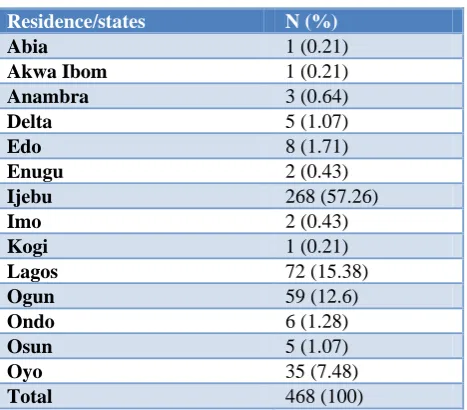
the patients reviewed are from Ijebu division in Ogun state 268 (57%), followed by patients from Lagos state 72 (15%) and patients from Ogun state excluding Ijebu and Oyo state 59 (12%) and 35 (8%) respectively. Glaucoma is the commonest cause of attendance 262 (56%) followed by diabetic retinopathy 29 (6.2%), ARMD 28 (6.0%), retinal detachment 21 (4.5%), macula hole 16 (3.45%) and retinitis pigmentosa 13 (2.80%).
Figure 3: Percentage of PSEDs in Ijebu, Southwestern Nigeria.
Figure 4: Bar chart of distribution by age category/number of patients.
Glaucoma 56%
Diabetic retinopathy
6.20% ARMD
6.00% Retinal detachment
4.50% Macula hole
3.42% Retinitis pigmentosa
2.80%
Others 21.08%
0 50 100 150 200 250
<=20 21 – 40 41 – 60 61 – 80 >80
Number of patients
Ag
e
gro
up
(y
ears)
%
Table 1: Frequency table for residence.
Residence/states N (%)
Abia 1 (0.21)
Akwa Ibom 1 (0.21)
Anambra 3 (0.64)
Delta 5 (1.07)
Edo 8 (1.71)
Enugu 2 (0.43)
Ijebu 268 (57.26)
Imo 2 (0.43)
Kogi 1 (0.21)
Lagos 72 (15.38)
Ogun 59 (12.6)
Ondo 6 (1.28)
Osun 5 (1.07)
Oyo 35 (7.48)
Total 468 (100)
DISCUSSION
Glaucoma is the commonest cause of PSEDs, followed by diabetic retinopathy and ARMD. This is comparable in the absence of cataract to the review of population based studies of PSEDs in sub-Saharan Africa (SSA) and the causes of blindness and visual impairment in the Nigerian national survey.2,4 This also shows that PSEDs led by glaucoma form a substantial cause of vision loss in developing countries like Nigeria. In the developed world like the United States of America, after cataract, ARMD leads, followed by diabetic retinopathy and glaucoma.14
Facilities like retinal laser treatment, intravitreal injections and vitreoretinal surgery are much more available now both in private and public hospitals in Nigeria to diagnose and treat PSEDs.5-8 This is including laser treatment and glaucoma drainage devices for glaucoma. Same applies to personnel. Therefore more diagnosis of PSEDs is expected to increase unlike before. The result from the Eye Foundation Center in Ijebu is not comparable with results from most centres in Nigeria because most of the hospital-based studies done are on retinal diseases.5-8 Not including glaucoma which in most cases is treated as a single entity. There is no waiting list.
This is a hospital based retrospective study with the attendant selection bias. It may not be representative enough but the Eye Foundation Centre is a major referral eye centre in the south western Nigeria with glaucoma and vitreoretinal consultants and latest equipments and facilities.
Even though this study further provides some knowledge about PSEDs in low resource country, there is need for more studies to be done especially on prevalence and incidence of PSED in population based studies to be able to compare more effectively with those studies done thus far in the developed world. Also, longitudinal studies are
needed to investigate the natural history of disease which will help in fashioning out health policies at local, state and national levels.
CONCLUSION
Glaucoma, diabetic retinopathy and ARMD were noted as the commonest PSEDs in Ijebu division in south-western Nigeria. Population based cohort study is needed to be able to get a more representative data in Ogun state and Nigeria. This will help to plan services to prevent blindness that is avoidable.
Funding: No funding sources Conflict of interest: None declared Ethical approval: Not required
REFERENCES
1. Bourne RRA, Flaxman SR, Braithwaite T, Cicinelli MV, Das A, Jonas JB, et al. Vision Loss Expert Group. Magnitude, temporal trends, and projections of the global prevalence of blindness and distance and near vision impairment: a systematic review and meta-analysis. Lancet Glob Health. 2017;5(9):888– 97.
2. Bastawrous A, Burgess PI, Mahdi AM, Kyari F, Burton MJ, Kuper H. Posterior segment eye disease in sub-Saharan Africa: review of recent population-based studies. Trop Med Int Health. 2014;19:600-9. 3. Bourne RRA, Flaxman SR, Braithwaite T, Cicinelli
MV, Das A, Jonas JB, et al. Global causes of blindness and distance vision impairment 1990-2020: a systematic review and meta-analysis. Lancet Glob Health. 2017;5(12):1221-34.
4. Rabiu MM, Kyari F, Ezelum C, Elhassan E, Sanda S, Murthy GV, et al. Review of the publications of the Nigeria national blindness survey: methodology, prevalence, causes of blindness and visual impairment and outcome of cataract surgery. Ann Afr Med. 2012;11:125-30.
5. Oluleye TS, Ajaiyeoba AI. Retinal diseases in Ibadan. Eye (Lond). 2006;20:1461-3.
6. Onakpoya OH, Olateju SO, Ajayi IA. Retinal diseases in a tertiary hospital: The need for establishment of a vitreo-retinal care unit. J Natl Med Assoc. 2008;100:1286-9.
7. Karki DB, Malla OK, Byanju RN, Shrestha S. Analysis of 400 cases of posterior segment diseases visiting retina clinic of Nepal Eye hospital. Kathmandu Univ Med J. 2003;1:161-5.
8. Akinwale A. Indication and Outcome for Laser Treatment among Adult Patients in South Western Nigeria. Available at: www.ajol.info/index.php/njo/ article/viewFile/147204/136712. Accessed on 10 October 2016.
Nigeria. J Ophthalmol Eastern Central Southern Africa. 2015
10. The Official Website of Ogun state, Nigeria. Available from: http:// www.ogunstate.gov.ng. 11. Nigeria 2006 Census Figure (population). Available
at: http://www. nigeriamasterweb.com/ Nigeria06censusng.
12. Bogunjoko TJ, Hassan AO, BGK Ajayi, Oderinlo O, Okonkwo O, et al. Impact of Cataract Surgical Services in Ogun State, Nigeria. J Eye Cataract Surg. 2017;3:16.
13. Muritala OKE, Oyebola O, Assessment of rain water harvesting potential and challenges in Ijebu-Ode. 2015. DOI: 10.15551/scigeo.v60i2.345. 14. American Academy of Ophthalmology. US Eye
disease statistics. Available at: https://www.aao.org/ eye-disease-statistics.