Asian J. Med. Biol. Res. 2017, 3 (2), 267-275; doi: 10.3329/ajmbr.v3i2.33579
Asian Journal of
Medical and Biological Research
ISSN 2411-4472 (Print) 2412-5571 (Online)www.ebupress.com/journal/ajmbr
Article
Quantification of purity of some frequently used insecticides in vegetables insect
pests
Md. Sultan Ahmed1*, Md. Mohsin Ali Sardar2, Masum Ahmad2 and Kamal Humayun Kabir1
1
Division of Entomology, Bangladesh Agricultural Research Institute, Joydebpur, Gazipur-1701, Bangladesh
2
Department of Entomology, Bangladesh Agricultural University, Mymensingh, Bangladesh
*Corresponding author: Md. Sultan Ahmed, Division of Entomology, Bangladesh Agricultural Research Institute, Joydebpur, Gazipur-1701, Bangladesh. E-mail: [email protected]
Received: 07 June 2017/Accepted: 19 June 2017/ Published: 29 June 2017
Abstract: The study was carried out to quantify the purity of different marketed brands of three insecticide
namely diazinon, acephate and cypermethrin using suitable protocols GC-FID and GC-ECD. Nineteen marketed brands of these insecticides collected from retailers of Jessore, Gazipur and Rangpur region were analyzed and estimated their purity in two seasons of 2006-2007 and 2007-2008. Among six marketed brands of diazinon, only one brand (RSN) had 96.71-100% purity in both the seasons in all locations which considered to be standard product, but four brands (DZN, SBN, HZN, DNN) in other regions, contained <95% pure which were substandard product. The remaining 2 brands (DNN, AZN) contained 33.71-51.94% purity in 2006-07 and the other two brands (SBN, DZN) had very small amount of active ingredient (0.16-0.84% purity) in 2007-08 and all these were impure in quality. All five tested brands of acephate had 57.14-88.59% purity in 2006-07 which were substandard but in 2007-08, three brands (SNT, BNS, ATF) showed >90% purity and the remaining 2 had <80% purity which were less AI than required. Of eight tested brands of cypermethrin, three brands were almost to have >95% pure in 2006-07 in all locations. The other two brands (CPR, AMT) contained >90% purity. In 2007-08, two brands of cypermethrin (RCD, SCR) contained >95% pure, another two brand (CRN, RLT) had 88.77-91.15% purity. The brands UTD was standard in purity in 2006-07 but this brand was below standard in quality in 2007-08 in all locations. Most of the tested brands of cypermethrin were found standard and sub standard level of purity in comparison to diazinon and acephate.
Keywords: quantification; purity; insecticides; diazinon; acephate; cypermethrin
1. Introduction
weeds (Handa and Walia, 1996). It was noted in the country report produced by FAO (2011) the regulatory scheme for pesticide registration is systematic. But in practice, there are gaps between policies and implementation. Lack of trained manpower and lab facilities does not allow proper monitoring. In most of the cases specification and prescription of marketed pesticides may differ from those registered (Aziz, 2006). So, concern on the purity in respect of active ingredient of the marketed brands of pesticides is therefore likely key factor for repeated use of pesticides in vegetables. It is reported that less amount of active ingredient in the formulated pesticides, they do not work against insect pests and the farmers use more pesticide for better result (Kabir et al., 2008). It was assumed that impurity or adulteration of pesticide might be one of the major causes of extensive use of pesticide in Bangladesh. In this perspective, it has become important to analyze the marketed brands of insecticide for their purity quantification and to ensure the actual amount of active ingredient that required.
2. Materials and Methods
The research works were carried out on testing purity of three commonly used insecticides in Pesticide Analytical Laboratory, Division of Entomology, Bangladesh Agricultural Research Institute (BARI), Gazipur. The samples were collected from markets of Jessore, Rangpur and Gazipur districts during 2006-07 and 2007-08 seasons.
2.1. Materialsused in insecticide analysis
Tested insecticides
There were three insecticides like diazinon, acephate and cypermethrin, the first two insecticides belonging to organophosphorus class and the last one of pyrethroid class, all being EC formulation except acephate of soluble powder (SP), showing below their baseline information.
Diazinon 60EC
Common name: Diazinon(Anonymous, 2000)
Chemical abstract name: O,O-diethyl O-[6-methyl-2-(1-methylethyl)-4-pyrimidinyl] phosphorothioate) Molecular formula: C12H21N2O3PS, Mol. wt.304.3
Available tested brands: AZN, RSN, HZN, DZN, DNN, SBN.
Mode of action:Non-systemic insecticide and acaricide with contact, stomach and respiratory action. Acephate 75SP
Common name: Acephate (Anonymous, 2000)
Chemical abstract name: N-[methoxy (methylthion) phosphinoyl]acetamide) Molecular formula: C4H10NO3PS, Mol. wt. 183.2
Available tested brands: ATF, TDT, SNT, BNS, LNR.
Mode of action:Systemic insecticide. Of moderate persistence, with residual activity lasting 10-21 days. Cypermethrin 10EC
Common name: Cypermethrin (Anonymous, 2000)
Chemical abstract name: cyano(3-phenoxyphenyl) methyl 3-(2,2-dichloroethenyl)-2,2 dimethyl=cyclopropanecarboxylate)
Molecular formula: C22H19Cl2NO3, Mol. wt. 416.3
Available tested brands: CMB, RCD, CMR, UTD, RLT, CRN, SCR, AMT, CPR.
Mode of action: Non-systemic insecticide with contact and stomach action. Also exhibits anti feeding action. Good residual activity on treated plants.
Chemicals: Methanol, Acetone, n-hexane, Acetonitrile and Insecticide standard.
Glass wares: Conical flask, Beaker, Pipette, Syringe and Vials with septum.
Others: Scissors, Spatula, Knife, Chopping board, PTFE filter, Forceps, Zipper bag, Zip Stick, Teflon stopcock,
Aluminium foil, Para film, etc.
2.2. Analytical device used in insecticide analysis
2.3. Testing purity of marketed insecticides
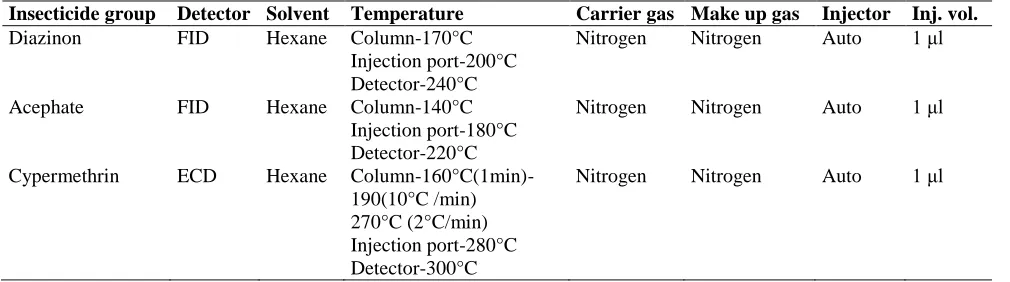
The tested brands of three different insecticides were selected on the basis of frequency of insecticide use and demand among the farmers from survey and research reports of Jessore, Rangpur and Gazipur regions of Bangladesh (Kabir et al., 1996; Anonymous, 2001; Ahmed et al., 2005). Each formulated product either of powder or liquid was being dissolved in the respective solvent. The solvents were selected on the basis of the criteria described by Lehotay and Mastovska (2004). The brands of diazinon and cypermethrin were varied in two years but the brands of acephate were same in both the years with at least five brands in each insecticide were tested. There were nineteen brands of three insecticides showing individual batch number and expiry date but not mentioning manufacture date in all brands on the label. The purity tests were done before the expiry date of each brand of the insecticides. The solutions of different brands of marketed insecticides were prepared following the procedure compatible with the respective equipment. In case of color less liquid or powder insecticide, the known concentrations of the solutions were prepared directly. Thus known and similar concentrated solutions of each of the standard and formulated insecticides were prepared. Methods for testing of different brands with GC-FID and GC-ECD were developed by setting the instrument parameters suitable for analyzing concerned insecticide selected on the basis of peak sharpness of the chromatogram and retention time for respective compound. The carrier and makeup gas used in the instrument for analysis was helium during 2006-2007 and nitrogen was used in 2007-2008 depending upon the availability of gases. The instrument parameters of Gas Chromatography set for analysis of each group of insecticide are listed in Tables 1 and 2.
Table 1. The instrument parameters of GC-2010 set for analysis of different groups of insecticide during 2006-2007.
Pesticide group Detector Solvent Temperature Carrier gas Make up gas Injector Inj. vol.
Diazinon FID Hexane Column-170°C
Injection port-200°C Detector-240°C
Helium Helium Auto 1 μl
Acephate FID Hexane Column-180°C Injection port-200°C Detector-250°C
Helium Helium Auto 1 μl
Cypermethrin ECD Hexane
Column-160°C(1min)-190°C (10°C /min)- 240°C (2°C /min)
Injection port-250°C Detector-280°C
Helium Helium Auto 1 μl
Table 2. The instrument parameters of GC-2010 set for analysis of different groups of insecticide during 2007-2008.
Insecticide group Detector Solvent Temperature Carrier gas Make up gas Injector Inj. vol.
Diazinon FID Hexane Column-170°C Injection port-200°C Detector-240°C
Nitrogen Nitrogen Auto 1 μl
Acephate FID Hexane Column-140°C Injection port-180°C Detector-220°C
Nitrogen Nitrogen Auto 1 μl
Cypermethrin ECD Hexane Column-160°C(1min)-
190(10°C /min) 270°C (2°C/min)
Injection port-280°C Detector-300°C
Nitrogen Nitrogen Auto 1 μl
FID: Flame Ionization Detector; ECD: Electron Capture Detector.
marketed brands and the purity percentage was determined by comparing it with the amount of AI actually required in the concerned insecticide using the following formula.
Actual amount of AI present in the insecticide Purity (%) = --- × 100 Amount of AI recommended/required
3. Results
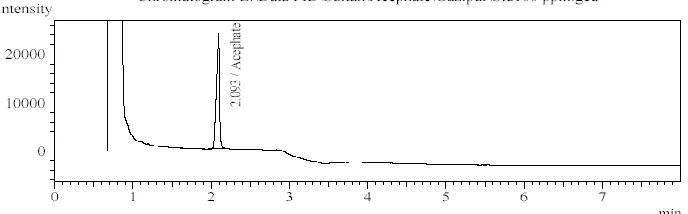
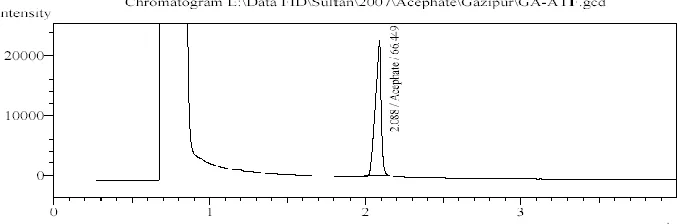
The results of this investigation were the purity test of three prevalently used insecticides from local markets of three regions viz., Jessore, Rangpur and Gazipur under different brands. The results were obtained on the chromatograms in tabular form based on the quantification of active ingredient (AI) of the insecticides. Only one chromatogram of standard solution of tested insecticides and one chromatogram of marketed brand of each insecticide are shown in Figure 1 to Figure 6. In this way the results of other marketed brands were also made by in-built GC-2010 software. The lowest detection limit of diazinon and acephate was 0.01 mgkg-1 and 0.02 mgkg-1 in GC-FID and cypermethrin, it was 0.02 mgkg-1 in GC-ECD.
3.1. Diazinon
Five different brands of diazinon from each location as Jessore, Rangpur and Gazipur region were tested with GC-FID to estimate their purity during 2006-07 and 2007-08 seasons. The standard of diazinon and the marketed brands showed similar retention time in Figure 1 and 2. The purity percentages of different marketed brands of diazinon are presented in the Tables 3 and 4.
Table 3. The percentages of active ingredient and purity of marketed brands of diazinon 60EC collected from different locations during 2006-07.
Diazinon brands (Code no.)
Amount of AI present (%) at different locations
Purity (%) at different locations
Gazipur Jessore Rangpur Gazipur Jessore Rangpur
RSN 58.141 58.052 58.062 96.862 96.714 96.731
DZN 41.577 41.754 41.507 69.267 69.562 69.150
SBN 36.072 36.189 35.858 60.095 60.290 59.739
AZN 30.757 31.011 31.179 51.056 51.664 51.944
DNN 20.235 20.458 20.404 33.711 34.083 33.993
Table 4. The percentages of active ingredient and purity of marketed brands of diazinon 60EC collected from different locations during 2007-08.
Diazinon brands (Code no.)
Amount of AI present (%) at different locations
Purity (%) at different locations
Gazipur Jessore Rangpur Gazipur Jessore Rangpur
RSN 60.00 59.301 59.779 100.00 98.795 99.591
HZN 56.921 57.601 56.360 94.830 95.963 93.895
DNN 54.247 54.522 54.571 90.375 90.833 90.915
DZN 0.502 0.475 0.468 0.836 0.791 0.779
SBN 0.095 0.100 0.098 0.158 0.166 0.163
Among 5 tasted brands of diazinon only RSN had acceptable level of purity as found >96% in all the locations in 2006-07 (Table 3). In the remaining brands the level of purity was 69.150-69.562% for DZN, 59.739-60.290% for SBN, 51.056-51.944% for AZN and 33.711-34.083% for DNN. All these four brands were considered impure and substandard. During 2007-08, the purity level of first three brands of diazinon was higher (Table 4) than in 2006-07. Purity of two brands (RSN and HZN) ranged 93.895-100%. This could be considered as acceptable level. The brand DNN showed 90.375-90.915% purity which was substandard. The brands DZN and SBN had almost no active material counting only 0.095-0.502% AI. Their purity ranged from 0.158 to 0.836%. These results are unacceptable in contest of required AI presence.
3.2. Acephate
of acephate was 2.09 min (Figure 3). The formulated brands also showed similar RT proving the presence of acephate (Figure 4). The purity percentages of the formulated brands of acephate are presented in the Tables 5 and 6.
Table 5. The percentages of active ingredient and purity of marketed brands of acephate 75SP collected from different locations during 2006-07.
Acephate brands (Code no.)
Amount of AI present (%) at different locations
Purity (%) at different locations
Gazipur Jessore Rangpur Gazipur Jessore Rangpur
ATF 66.449 66.409 66.461 88.598 88.523 88.592
BNS 46.564 42.935 45.263 62.069 57.232 60.335
LNR 43.329 45.061 42.866 57.772 60.066 57.140
SNT 51.616 49.628 49.966 68.804 66.154 66.604
TDT 46.564 45.983 46.928 62.069 61.295 62.555
Table 6. The percentages of active ingredient and purity of marketed brands of acephate 75SP collected from different locations during 2007-08.
Acephate brands (Code no.)
Amount of AI present (%) at different locations
Purity (%) at different locations
Gazipur Jessore Rangpur Gazipur Jessore Rangpur
ATF 74.996 73.272 72.221 100.00 97.671 96.270
BNS 71.276 70.041 69.602 95.010 93.364 92.779
LNR 48.419 46.849 48.094 64.542 62.449 64.109
SNT 67.913 68.545 67.913 90.428 91.370 90.528
TDT 55.142 56.196 53.495 73.504 74.909 71.308
In 2006-07, five marketed brands of acephate were tested of which only one brand (ATF) showed >80% purity (Table 5). The purity of remaining four brands (BNS, LNR, SNT and TDT) showed <70% purity in all locations. These were poor in purity and unacceptable. During 2007-08, the purity level of 5 tested brands of acephate was higher than in 2006-07. The purity of three brands (ATF, BNS and SNT) ranged from 90.428-100% (Table 6). Among the three brands, BNS of Gazipur had 95.010% purity and ATF had also ≥ 96% purity in all locations which was acceptable. The brand BNS of two other locations had 92.779-93.364% purity while the brand of SNT had the purity ranged from 90.428-91.370%. This level of purity could be considered as substandard. The brand TDT had lower purity ranging 71.308-74.909% and LNR had purity below the purity of TDT. These two brands were contained little amount of AI that required which were also below standard.
3.3. Cypermethrin
Cypermethrin brand were not available in common in the period of 2006-07 and 2007-08. Only RCD and UTD were analyzed in both the years. The three remaining brands in each year were different. The RT for the standard and formulated cypermethrin was the same as 12.58 min (Figure 5 and Figure 6). The purity percentages of the formulated brands of cypermethrin are presented in the Tables 7 and 8.
Table 7. The percentages of active ingredient and purity of marketed brands of cypermethrin 10EC collected from different locations during 2006-07.
Cypermethrin brands (Code no.)
Amount of AI present (%) at different locations
Purity (%) at different locations
Gazipur Jessore Rangpur Gazipur Jessore Rangpur
RCD 9.800 9.887 9.654 98.00 98.870 96.540
CMB 9.764 9.877 9.672 97.640 98.770 96.720
UTD 9.438 9.733 9.783 94.380 97.330 97.830
CPR 9.304 9.399 9.430 93.040 93.990 94.300
Table 8. The percentages of active ingredient and purity of marketed brands of cypermethrin 10EC collected from different locations during 2007-08.
Cypermethrin brands (Code no.)
Amount of AI present (%) at different locations
Purity (%) at different locations
Gazipur Jessore Rangpur Gazipur Jessore Rangpur
RCD 10.00 9.976 10.00 100.00 99.760 100.00
SCR 9.780 9.709 9.666 97.800 97.090 96.660
CRN 9.026 9.115 9.072 90.260 91.150 90.720
RLT 8.877 9.004 9.039 88.770 90.040 90.390
UTD 7.734 7.839 7.853 77.340 78.390 78.530
Two brands (RCD, CMB) showed is greater than 96% purity in all locations in 2006-07 and the same brand RCD and a new brand SCR also showed similar purity in 2007-08 (Tables 7 and 8). The brand RCD was reaching 100% purity in the second year in all locations. UTD also showed over ≥97% purity except one in Gazipur in the first year but this brand was having less AI and 77.34-78.53% purity in the second year which were sub-standard. Although the brand AMT of Rangpur was found to be 95.36% pure but the similar brand of two other locations had less purity. The brand CPR showed <95% purity. The brands CRN and RLT had the purity ≥ 90% excepting RLT which was collected form Gazipur having 88.77% purity in 2007-08. These two brands were also considered as substandard and impure in quality.
Figure 1. Chromatogram of diazinon standard solution.
Figure 2. Chromatogram of diazinon obtained from the marketed brand of JD-DNN.
Figure 4. Chromatogram of acephate obtained from the marketed brand of GA-ATF.
Figure 5. Chromatogram of cypermethrin standard solution.
Figure 6. Chromatogram of cypermethrin obtained from the marketed brand of GC-SCR.
4. Discussion
showing standard and substandard level of purity as compared to other brands of insecticides of wettable powder formulation such as in acephate insecticide. Cypermethrin was more pure in quality in comparison to diazinon with emulsifiable concentration (EC) in formulation. Ahmed et al., (2016) found purity ranged from 22-100% in malathion, 74.43-100% in fenitrothion and 59.32-100% in quinalphos with EC formulation which were collected from Gazipur, Rangpur and Jessore region. Kabir et al., (2008) reported that three of four tested brands of cypermethrin 10EC were 100% pure and the one brand was found to have below standard with 65% purity and among five tested brands of diazinon 60EC, 3 had more than 80% purity and the rest two were <70% pure. Begum et al., (2016) found that six of eight tested brands of diazinon 60EC were 100% pure and one contained 65% active ingredient and the remaining one had no AI. They also found only one of eleven tested brands of cypermethrin 10EC was pure, two had >90% purity and the remaining others had below 90% purity except one brand which contained no active ingredient. The results of the present works were similar with the works of the mentioned authors in Bangladesh. So, adulteration, transportation and inadequate storage facilities (presence of light, temperature, humidity, etc.) might be the probable cause of different degrees of purity of marketed insecticides.
5. Conclusions
The results of three different groups of insecticides with nineteen marketed brands found variations in purity. Five of eight tested brands of cypermethrin, two of five tested brands of acephate and one of six tested brands of diazinon were showed standard level (>90%) of purity. Most of the brands of diazinon and acephate were found at substandard level (< 90%) of purity. Some brands of diazinon had lower level of purity which contained less than 50% purity. These levels are below standard and quite unacceptable.
Conflict of interest None to declare.
References
Ahmed MS, MA Sardar, MA Haque and KH Kabir, 2005. A survey on the pattern of insecticidal usage for the protection of brinjal (Solanum melongena) from the attack of insect pests in Jessore. Bangladesh J. Zool., 33: 57-63.
Ahmed MS, MA Sardar, M Ahmad and KH Kabir, 2016. Testing purity of commonly used marketed insecticides collected from different regions of Bangladesh. Asian J. Med. Biol. Res., 2: 616-623.
Alabaster JS, 1981. Review of the state of aquatic pollution of East African inland water. CIFA Occas, pap. 9: 35p.
Ali MMMS, 2004. Pesticide uses and food safety. “The Independent” January 30 issue, p. 10.
Anonymous, 2000. The pesticide manual. In: CDS Tomlin (ed.). British Crop Protection Council (BCPC), UK, pp. 3-414.
Anonymous, 2001. Coordinated research on insecticide residue and resistance in major vegetables grown in Bangladesh. Report on Contact Research Project, BARC, BARI, Joydebpur, Gazipur, 102 p.
Anonymous, 2007. Bangladesh Crop Protection Association Sales report 2007, Dhaka, Bangladesh. Anonymous, 2013. Bangladesh Crop Protection Association Sales report 2007, Dhaka, Bangladesh.
Aziz, M A. 2006. Country reports -Bangladesh, Proceedings of the Asia regional workshop on the implementation, monitoring and observance of the International Code, FAO Corporate Document Repository, pp. 1-8.
Begum A, WM Akon, MS Ahmed and SN Alam, 2016. Purity analysis of nine pesticides collected from eight locations in Bangladesh. Bangladesh J. Agril. Res., 41: 685-694.
FAO, 2011. 5th FAO/ WHO joint meeting on pesticide management report. 2011. Rome pp. 5-38.
Hunda SK and Walia, 1996. Pesticide residue and its implication in integrated pest management, IPM system in agriculture Vol. 1 Principles and perspectives, pp. 62-94.
Hasanuzzoha, 2004. Environment friendly use of pesticides in field crop protection in Bangladesh and pre/post safety measures for farmers, Ph.D. Thesis. IPM Laboratory, Institute of Biological Sciences, University of Rajshahi, Bangladesh, pp. 366.
Kabir KH, ME Baksh, FMA Rouf, MA Karim and A Ahmed, 1996. Insecticide usage pattern on vegetable at farmer level of Jessore region in Bangladesh: A Survey Finding. Bangladesh J. Agril. Res., 20: 241-254. Kabir KH, MA. Rahman, MS Ahmed, MDH Prodhan and MW Akon, 2008. Quantitative analysis of some
Lahotay SJ and K Mastovska, 2004. Evaluation of common organic solvents for gas chromatographic analysis and stability of multi class pesticide residues. J. Chromatography A., 1040: 259-272.