Original Research Article
Adequacy of iodisation of salt at the household level and its associated
factors in a rural sub-centre area of Bangalore Urban District,
Karnataka, India: a cross-sectional study
Jacob D. Kalliath
1, Twinkle Agrawal
2*, Farah N. Fathima
2, Sonu Antony
3, Amal Antony
3,
Swarajyam Gampala
3, Dilip K. Bata
3INTRODUCTION
Iodine is an essential micronutrient for our body. Average daily requirement is 100-150 mcg/day. Iodine deficiency disorders (IDD) are a wide spectrum encompassing mental and physical retardation, deaf-mutism, cretinism, goitre/hypothyroidism, stillbirth, squint and abortions arising as a result of iodine deficiency. Iodine deficiency disorder (IDD) is one of the common preventable causes of mental retardation and an important public health
problem in India. Consumption of iodised salt is a simple, inexpensive and effective preventive measure to prevent IDD. The National Goitre Control Programme (NGCP) was established in 1962 by the government of India to identify the goitre endemic regions of the country and to supplement iodine to the entire population in these regions. The nomenclature of the NGCP changed to National Iodine Deficiency Disorder Control Programme (NIDDCP) in 1992. The objectives of the NIDDCP were to undertake surveys to assess the magnitude of the IDD
ABSTRACT
Background: Consumption of iodised salt is a simple, effective and inexpensive preventive measure to prevent iodine deficiency disorders. Lack of awareness, faulty practices in storage as well as poor production quality lead to decreased availability of iodine at consumer level. The objective of the study was to estimate the proportion of households using adequately iodised salt and to assess their awareness and practices regarding iodised salt consumption in a subcentre region of Sarjapur PHC area in Bangalore Urban District.
Methods: A cross-sectional study was done in 382 households selected by two stage method involving proportional allocation based on village size followed by systematic random sampling at village level. MBI salt testing kit was used to check for iodisation level.
Results: Of the 382 households, 22.3% used inadequately iodised salt. Out of the 382 individuals interviewed, 72% were females and only 21% were aware about iodised salt. Majority of the households purchased salt from a general store, was stored in tightly closed plastic containers and kept on shelves. Only 5% looked for the iodine logo on the packets before purchase of salt. Individuals with poor awareness, purchase of salt at public distribution system store, storage of salt on the floor, use of crystal salt were significantly associated with presence of inadequately iodised salt at the household.
Conclusions: Nearly 30% of the salt packets used by households were inadequately iodised. Awareness regarding iodised salt was poor which contributed to the presence of inadequately iodised salt at household level.
Keywords: Adequacy, Household, Iodisation, Salt
Department of Community Health, 1Post-graduate Student, 2Associate Professor, 3Under-graduate Student, St Johns Medical College, Bangalore, Karnataka, India
Received: 06 April 2019
Accepted: 16 May 2019
*Correspondence:
Dr. Twinkle Agrawal,
E-mail: [email protected]
Copyright: © the author(s), publisher and licensee Medip Academy. This is an open-access article distributed under the terms of the Creative Commons Attribution Non-Commercial License, which permits unrestricted non-commercial use, distribution, and reproduction in any medium, provided the original work is properly cited.
and to supply iodised salt in place of common salt. It conducts resurveys every 5 years to determine the extent of IDD and the impact of iodised salt and also laboratory monitoring of iodised salt and urinary iodine excretion in along with health education and advocacy.1 The Universal Salt Iodisation (USI) programme was later started in India to supplement the Government of India’s efforts to strengthen the NIDDCP through increased availability of adequately iodized salt to the vulnerable sections of the population of India to 90% by 2013.2 According to the PFA (Prevention of Food Adulteration) Act of 1988, there should be a minimum iodine concentration in salt of 30 ppm at production level and 15 ppm at the consumer level.
Inadequate iodised salt consumption leads to iodine deficiency disorders. In India, the entire population is prone to iodine deficiency and hence IDD due to deficiency of iodine in the soil of the subcontinent and consequently the food derived from it. Poor storage of iodised salt also leads to loss of iodine in the salt. Iodine compound used in India for salt fortification is Potassium Iodate which undergoes partial decomposition due to presence of moisture content in salt and hence leads to loss of iodine.2 Though universal salt iodization (USI) was made mandatory in India from 2005, only 71% of households were consuming adequately iodized salt as per a Coverage Evaluation Survey done in 2009. This gap in the utilization of adequately iodized salt is due to various reasons such as non-availability in the rural areas, poverty, poor knowledge of iodine deficiency diseases, and faulty storage practices.3 The proportion of households using iodised salt in India is 93.1 % according to NFHS 4 (2015-2016) data and Karnataka state is presently below the national average (86.8%).4 In rural Karnataka, only 82% of households are using adequately iodised salt and no proper evaluation regarding iodised salt consumption has been done so far in our field practice area which calls for a study in this region.
Hence this study was done to estimate the proportion of households using adequately iodised salt in a subcentre region of Sarjapur PHC area in Bangalore Urban District and to assess the knowledge and practices with respect to iodised salt consumption among households in the same study area.
METHODS
It was a cross-sectional study done in villages coming under Mugalur subcentre of Sarjapur PHC area of Anekal taluk in urban Bangalore district, Karnataka. Sampling unit taken was a household in Mugalur subcentre of Sarjapur PHC area. Study period was from September 2017 to October 2017. Based on a previous study done in Karnataka, the sample size calculated was 380 using the formula: n=Z2pq/d2, where Z=standard normal variate corresponds to α=5% which is equal to 1.96, p= 54%, q=1-p=46%, d=fixed precision of 5%.5 Inclusion Criteria: Households in Mugalur subcentre of Sarjapur PHC area.
Study tools used were an interview schedule and a MBI kit (rapid iodised salt testing kit) for testing iodine content in salt. The Interview schedule was translated into local language (Kannada). Study tool was validated with help of experts and finalised by doing a pilot study in a non-study area.
Method of data collection
Data of all households in Mugalur subcentre area were accessed from HMIS records at Community Health Training Centre, Mugalur including the number of households in each village of Mugalur subcentre under Sarjapur PHC area. Number of households proportional to size of each village was then computed. Households in each village were then selected using systematic random sampling. For this, sampling interval in each village was obtained by dividing the total number of households in that village by the sample size for that village. Each nth household was approached for the study. Informed written consent was taken from them. In case the house was found locked, the immediate next house was visited. MBI kit was used to test the adequacy of iodine content in the salt which was taken from salt being currently used in that household for cooking and concentration of iodine of >15 ppm were considered adequate. The person who holds the primary responsibility for cooking in the house was interviewed to collect the sociodemographic details, purchasing and storage pattern and knowledge on iodised salt and on iodine deficiency disorders. In case the person was not available, a repeat visit was done based on availability of that person.
Statistical analysis
The data was entered in Microsoft Excel and analysed by using statistical software SPSS version 20 for Windows. All study variables were described by using descriptive statistical methods like frequencies, percentages, mean, standard deviation etc. Normality of the continuous study variables was checked by using Shapirow-Wilkoxon normality test. The various factors and their association with primary study variables was studied using Chi square (Fischer’s exact test wherever applicable). Multivariate analysis was performed if more than one variable is significantly associated with outcome variable in bivariate analysis. A p-value less than 0.05 were considered statistically significant.
RESULTS
Table 1: Socio-demographic profile (n=382).
Variables Type N (%)
Gender Female 73.0
Religion Hindu 94.0
Education Illiterate 30.0
High school 33.0
Occupation House wife 45.0
Socioeconomic
status Upper class 56.6
Knowledge and practice with respect to iodised salt consumption
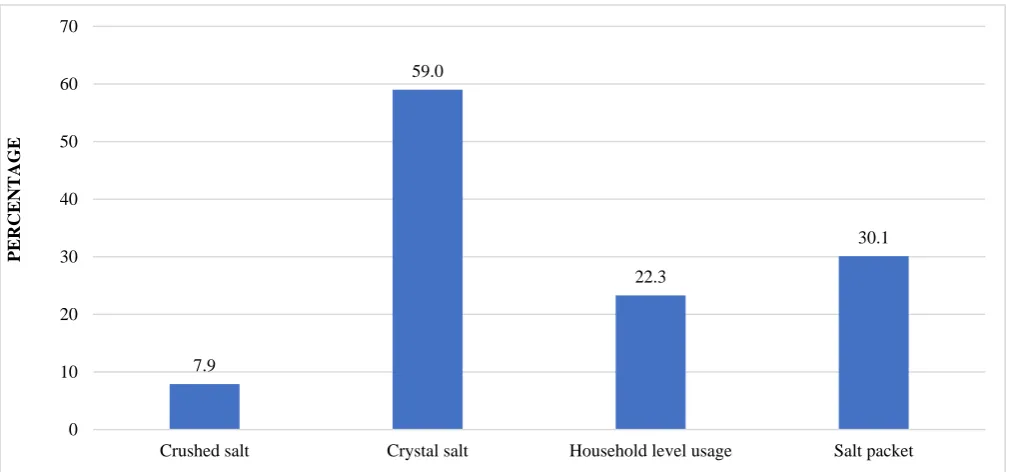
Overall 77.7% of the households were using adequately iodised salt. Of the 495 salt packets tested (290 crushed salt and 205 crystal salt packets) 70.9% of the salt packets were adequately iodised which included 92.1% of the crushed salt packets and only 41.0% of the crystal salt packets (Figure 1). Most important factor determining the choice of iodised salt was found to be availability of salt (50.8%) followed by brand of the salt (18.6%), expiry date (13.9%) and iodisation of the salt (7.35%). 30.4% of the households were using only crushed salt, 26.2% only crystal salt and 43.5% of the households were using both
crystal and crushed salts. Majority (86.6%) of salt packets were procured from a general store whereas only 5.8% and 7.6% were procured from a kirana store and public distribution system respectively. Majority (57.7% and 56.4% crushed and crystal respectively) of the salt packets were purchased within the last 2 weeks with majority of them manufactured within the last 6 months. Majority (77.2%) of the households use cooking salt during cooking, 22.3% of them add salt before and after cooking and the rest 0.5% of them add salt only after cooking. Majority (58.1%) store salt in shelves, 40.1% on a platform and 1.8% on the floor. Nearly 79.0 % of the households were unaware about iodised salt and only 5.0% were aware about the advantages of iodised salt. Only 5.1% of households actually looked for an iodine logo before purchase. Nearly 86.4% were unaware about iodine deficiency disorders. 10.5% and 7.9% respectively knew about some symptoms of hypothyroidism and goitre as a part of IDD. The most common source of information regarding Iodine deficiency disorders were television (38.4%), school/college (30.2%), health personal (21.9%) and friends/relatives (12.3%). Nearly 7% of the households believe that consumption of iodised salt can prevent iodine deficiency. Nearly 9.9% of the families of the households had a member suffering from hypothyroidism.
Figure 1: Proportion of salt-inadequately iodised.
Knowledge regarding iodised salt, purchase of salt from a kirana store compared to a general store or public distribution system, storage of salt in shelves compared to platform or floor and use of crushed salt compared to crystal salt were significantly associated with use of adequately iodised salt. No statistically significant association was found between adequacy of iodized salt consumption and brand, cost, manufacturer, location of
manufacture, days since manufacture or days since purchase (Table 2).
On multivariate logistic regression analysis, purchase of salt from a public distribution system had 26.6 times higher chance and use of crystal salt had 22.06 times higher chance of being inadequately iodised and this was found to be statistically significant (p<0.05) (Table 3).
7.9
59.0
22.3
30.1
0 10 20 30 40 50 60 70
Crushed salt Crystal salt Household level usage Salt packet
PERCEN
Table 2: Use of adequately iodised salt at the household level-associations (n=382).
Variables Response Inadequate(n=85) Adequate(n=297) p Value
Awareness about iodized salt
Aware 10 (12.5%) 70 (87.5%)
0.023a
Not aware 75 (24.8%) 227 (75.2%)
Place of purchase
Kirana store 2 (9.1%) 20 (90.9%)
0.045b
General store 72 (21.8%) 259 (78.2%)
PDS outlets 11 (37.9%) 18 (62.1%)
Place of storage
Floor 2 (28.6%) 5 (71.4%)
0.003b
Platform 47 (30.7%) 106 (69.3%)
Shelf 36 (16.2%) 186 (83.8%)
Type of salt
Crushed 15 (9%) 151 (91%)
0.000a
Crystal 67 (67%) 33 (33%)
Both 3 (2.6%) 113 (97.4%)
a
Chi square test; bFisher’s exact test.
Table 3: Factors associated with use of adequately iodised salt at the household level: multivariate logistic regression analysis (n=382).
Factor Responses Odds ratio 95% confidence interval P value
Place of purchase
Kirana stores 1.0 - - -
General stores 6.4 0.48 86.5 0.15
PDS outlets 26.6 1.50 469.3 0.025
Type of salt
Crushed 1.0 - - -
Crystal 22.06 3.6 135.0 0.001
Both 0.26 0.07 0.94 0.04
DISCUSSION
According to NFHS 4 (2015-2016) data the proportion of households using Iodised salt in rural Karnataka is 82.2%. This is similar to our study findings where 77.7% of households were using adequately iodised salt. The public health implication of this finding is that with the introduction of universal salt iodisation program all the salt used and sold at the household level should be adequately iodised in order to prevent iodine deficiency disorders but it is not the case in India at present.4
A coverage evaluation study, done to ascertain the proportions of households in rural areas of 8 states in India consuming adequately iodized salt and to understand salt buying behaviour of the consumers showed that 71.7% of packaged crushed salt were adequately iodized. Packaged crystal and loose crystal salt had very low levels of samples which were adequately iodized (24.0 and 6.8% respectively). Similar low levels of iodisation was also observed in NFHS-3 (2005-2006) data where only 51% of households of the country were using adequately iodised salt.6 This shows that with the universal salt iodisation programme, there has been significant improvement in the proportion of households using adequately iodised salt with time as indicated by higher levels of iodisation according to NFHS 4 data. The coverage evaluation study also showed that 72% of the households bought their salt from a Kirana store and that 50.7% of households were aware of
iodized salt which is higher than our study findings probably due inclusion of both rural and urban areas in their study.7
A study conducted in 2014 in rural areas of south-interior Karnataka with the objective to estimate the prevalence of goitre in children in the rural areas of Mysore and Coorg districts in India showed that in Mysore district 54.08% of the salt samples had adequate iodine content (>15 ppm), whereas in Coorg district only 26.08% of the salt samples were adequately iodised.5 In another cross-sectional study done in 2014 in districts of Gulbarga with the objectives to assess the magnitude of the IDD among the 6-12-year-old children and to determine the Iodine content of the salt used at houses of the above children revealed that 49.69% of household were using adequately iodized cooking salt.9 The findings in these studies are lower than our study probably due to more crystal salt usage in their study area.
A study done in 2007 in Sindh and Punjab Provinces, Pakistan to assess knowledge, attitude and practices with respect to use of iodised salt showed that 85.3% of the households have heard about iodised salt which is higher compared to our study findings again showing difference in methods in data collection and different study settings. In addition, study also revealed that illiteracy, no knowledge of iodised salt, unavailability of iodised salt, and unawareness about the advantages of use of iodised salt were the main associated factors with non-use of iodised salt for cooking at household levels.10 In a cross-sectional survey conducted in 2016 in the villages of Gautam Budh Nagar, catered by Rural Health Training Centre under the Department of Community Medicine, School of Medical Sciences and Research, Uttar Pradesh with the objective to assess knowledge attitude and practice with respect to the current use of iodised salt, and to estimate its uptake at the household level showed that about 62.5% of households were consuming adequately iodized salt. It also revealed that the most common source of information regarding iodized salt was television (31.1%), more than half (53.8%) of the households were unaware of the benefits of iodine. It showed significant association between the practice of storing salt in closed containers, use of packaged iodised salt, awareness about the benefits of iodine and type of salt used and iodisation of salt which are similar to our study findings.3
In a cross-sectional study conducted from January 2005 to July 2006 in school children of 6-15 years of age, attending 55 schools in Bellur Hobli in the southern India, with the objectives to assess the prevalence of goitre and to find out the relationship of goitre prevalence with the salt intake and urinary iodine excretion, the iodine content of the salt samples was found to be adequate in 90.75% of sample population.11 Also in a cross-sectional study conducted in between 2008 and 2011 with the objective to compare the iodine status of pregnant women and their children in Bangalore, India showed that the median iodine concentration of household powdered, and crystal salt was 55·9 ppm and 18·9 ppm, respectively. 62% of the pregnant women preferred powdered salt in contrast to 26% who preferred
crystal salt. This higher crushed salt preference was also observed in our study.12
Limitations which can be considered in our study include observer bias in inference of MBI kit results. Some household members predominantly involved in cooking were not involved in purchase of cooking salt and hence could lead to errors in data provided. Non-availability of salt packets in some households is another important limitation.
CONCLUSION
In this study it was found that about 30.1% of the households were using inadequately iodised salt and majority of the crystal salt packets used were inadequately iodised. Purchase of salt from the public distribution system, storage of salt on the floor compared to shelves and use of crystal salt were significantly associated with use of inadequately iodised salt. Knowledge regarding iodised salt and its advantage, knowledge regarding iodine deficiency disorders and logo of iodised salt in general was found to be low which also might have significantly contributed to low levels of iodisation of salt at the household level.
Recommendations
MBI (rapid iodised salt testing) kits should be used and recommended at retail/household level in order to check adequacy of iodine in cooking salt. Health education regarding importance of iodised salt at the household level, correct storage practices and awareness about iodine deficiency disorders by healthcare personnels like ANM/ASHA worker should be promoted. Further research should be done to ascertain customs and beliefs governing usage of crystal as opposed to crushed salt and also research on reason for low levels of iodisation for crystal salt as opposed to crushed salt should be found out.
Funding: No funding sources Conflict of interest: None declared
Ethical approval: The study was approved by the Institutional Ethics Committee
REFERENCES
1. IDD and Nutrition Cell, DGHS, Ministry of Health and Family Welfare. Revised Policy Guidelines on NIDDCP. New Delhi, India: Government of India; 2006: 32.
2. Pandav CS, Yadav K, Srivastava R, Pandav R, Karmarkar MG. Iodine deficiency disorders ( IDD ) control in India. Indian J Med Res. 2013;9:418–33.
3. Roy R, Chaturvedi M, Agrawal D, Ali H.
Household use of iodized salt in rural area. J Family Med Prim Care. 2016;5(1):77–81.
4. National Family Health Survey – 4(2015 -16). State
http://rchiips.org/nfhs/pdf/NFHS4/KA_FactSheet.pd f. Accessed on February 10th 2019.
5. Ahmed M, Zama SY, Nagarajarao V, Khan MA. Iodine deficiency in children : A comparative study in two districts. J Family Community Med. 2014;21(1):48–52.
6. National Family Health Survey 2005-06 (NFHS-3).
Ministry of Health and Family Welfare,
Government of India. Available at:
http://rchiips.org/nfhs/NFHS-3%20Data/
Karnataka_report.pdf. Accessed on 15th February 2019.
7. ICCIDD Salt Commissioners Office. Evaluation study on consumption of adequately iodized salts in rural areas of eight states of India. New Delhi, India: ORG Centre for Social Research; 2011: 77.
8. Tiwari VK, Kumar P, Raj S, Nair KS. Strategies and Approaches towards Universal Iodisation of Salt : Knowledge , Attitude and Practice in Selected States in India. Intl J BioSci, Healthcare Technol Management. 2013;5(1):1–1.
9. Raveesh PM, G AK, Boramma G, Reddy S, Kapate
R. Prevalence of iodine deficiency disorders among 6-12 years school children of Gulbarga. Indian J Comm Med. 2014;26(2):3–6.
10. Khan GN, Hussain I, Soofi SB, Rizvi A, Bhutta ZA. A Study on the Household Use of Iodised Salt in Sindh and Punjab Provinces , Pakistan : Implications for Policy Makers. Journal of Pharmacy and Nutrition Sciences. 2012;2(2):148-54.
11. Sridhar PV, Kamala CS. Iodine Status and Prevalence of Goitre in School Going Children in Rural Area. Journal of Clinical and Diagnostic Research. 2014;8(8):15-7.
12. Jaiswal N, Melse-boonstra A, Sharma SK,
Zimmermann MB. The iodized salt programme in Bangalore , India provides adequate iodine intakes in pregnant women and more-than-adequate iodine intakes in their children. Public Health Nutrition. 2014;18(3):403–13.
Cite this article as: Kalliath JD, Agrawal T, Fathima FN, Antony S, Antony A, Gampala S, et al.